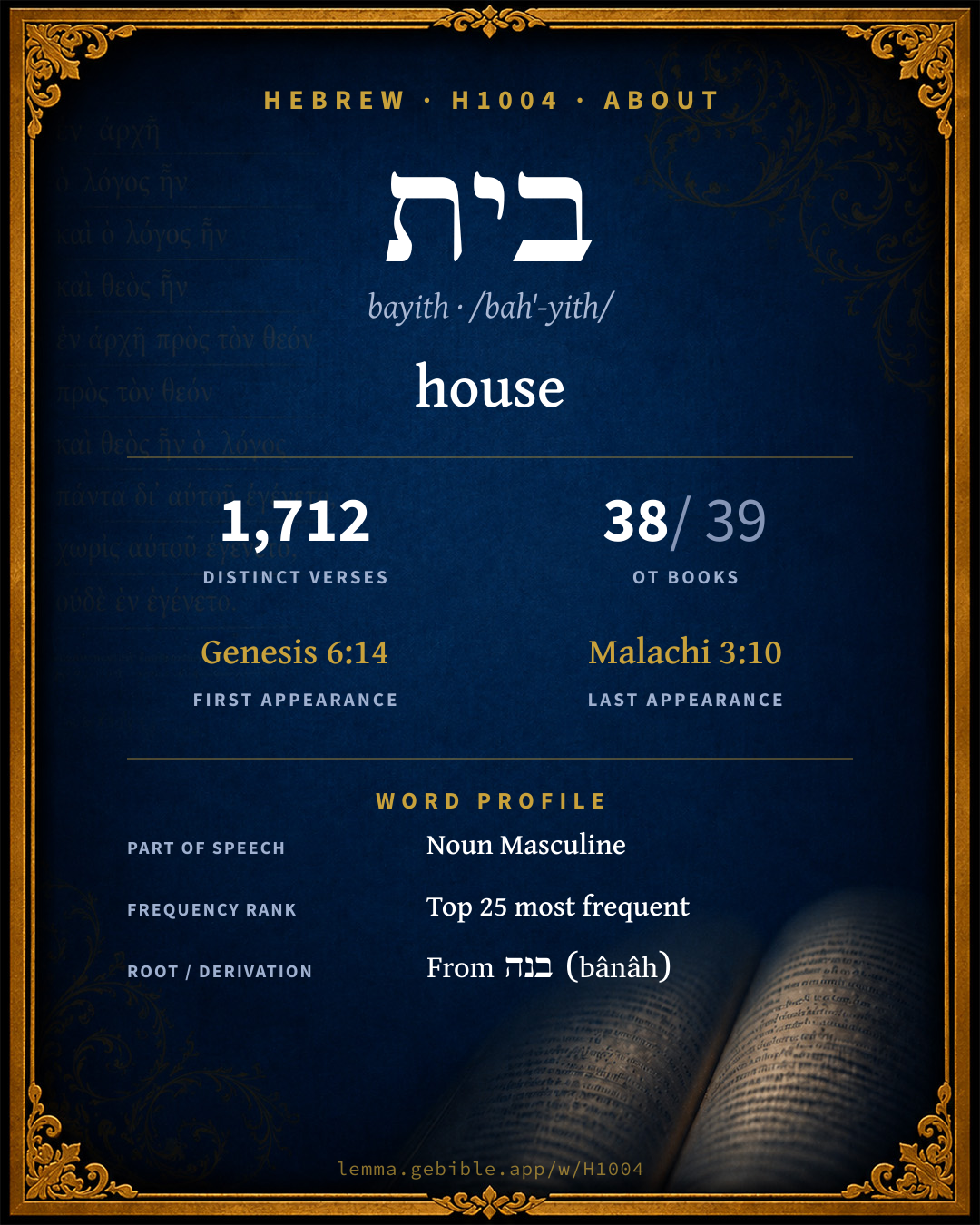
בית
house
‘house’ is one of 9 main senses fuller range ↓
Full lexicon entry — Brown-Driver-Briggs (BDB)
From Brown-Driver-Briggs (BDB)
Where this word appears
See every Construct-state word in the Hebrew Bible →
Grammar key — what these labels mean
Part of speech
- Noun
- A naming word — a person, place, thing, or idea.
Noun type
- Common
- A common noun — a general class of person, place, or thing (“king,” “city,” “water”), not a specific name.
- Proper
- A name of a specific person, place, or people (e.g. Abraham, Zion, Israel).
State
- Construct
- A noun bound to a following noun in a possessive / “of” relationship (the construct chain).
- Absolute
- The independent form of a noun, not bound to a following word.
Gender
- Masculine
- Grammatically masculine.
Number
- Singular
- One.
- Plural
- More than one (in Hebrew, generally three or more).
23 verses where H1004 appears in the Construct state in the Book of Zechariah. Filtered view — show all forms. Click any verse to open its interlinear word-by-word view. Verse text shown in the World English Bible for context — . Each verse’s Hebrew form is shown with its reference; the English is not keyword-highlighted, since the data carries no word-level English alignment. Use “Compare translations” on any verse to read it across multiple English versions. This concordance covers the Hebrew Bible; Septuagint (Greek Old Testament) occurrences are not indexed here.
Zechariah
- Zechariah 1:16 בֵּיתִ/י֙ n c ms cs + sfx pers 1cs Therefore thus says Yahweh: "I have returned to Jerusalem with mercy. My house shall be built in it," says Yahweh of Hosts, "and a line shall be stretched forth over Jerusalem."'
- Zechariah 3:7 בֵּיתִ֔/י n c ms cs + sfx pers 1cs "Thus says Yahweh of hosts: 'If you will walk in my ways, and if you will keep my charge, then you also shall judge my house, and shall also keep my courts, and I will give you a place of access among these who stand by.
- Zechariah 5:4 בֵּ֣ית בֵּ֛ית בֵּית֔/וֹ n c ms cs n c ms cs n c ms cs + sfx pers 3ms I will cause it to go out," says Yahweh of Hosts, "and it will enter into the house of the thief, and into the house of him who swears falsely by my name; and it will remain in the midst of his house, and will destroy it with its timber and its stones."
- Zechariah 6:10 בֵּ֚ית n c ms cs "Take of them of the captivity, even of Heldai, of Tobijah, and of Jedaiah; and come the same day, and go into the house of Josiah the son of Zephaniah, where they have come from Babylon.
- Zechariah 7:3 לְ/בֵית prep + n c ms cs and to speak to the priests of the house of Yahweh of Hosts, and to the prophets, saying, "Should I weep in the fifth month, separating myself, as I have done these so many years?"
- Zechariah 8:9 בֵּית n c ms cs Thus says Yahweh of Hosts: "Let your hands be strong, you who hear in these days these words from the mouth of the prophets who were in the day that the foundation of the house of Yahweh of Hosts was laid, even the temple, that it might be built.
- Zechariah 8:13 בֵּ֤ית וּ/בֵ֣ית n c ms cs conj + n c ms cs It shall come to pass that, as you were a curse among the nations, house of Judah and house of Israel, so will I save you, and you shall be a blessing. Don't be afraid. Let your hands be strong."
- Zechariah 8:15 בֵּ֣ית n c ms cs so again have I thought in these days to do good to Jerusalem and to the house of Judah. Don't be afraid.
- Zechariah 8:19 לְ/בֵית prep + n c ms cs Thus says Yahweh of Hosts: "The fasts of the fourth fifth, seventh, and tenth months shall be for the house of Judah joy and gladness, and cheerful feasts. Therefore love truth and peace."
- Zechariah 9:8 לְ/בֵיתִ֤/י prep + n c ms cs + sfx pers 1cs I will encamp around my house against the army, That none pass through or return; And no oppressor will pass through them any more: For now I have seen with my eyes.
- Zechariah 10:3 בֵּ֣ית n c ms cs My anger is kindled against the shepherds, And I will punish the male goats; For Yahweh of Hosts has visited his flock, the house of Judah, And will make them as his horse in the battle that he is proud of.
- Zechariah 10:6 בֵּ֣ית בֵּ֤ית n c ms cs n c ms cs "I will strengthen the house of Judah, And I will save the house of Joseph, And I will bring them back; For I have mercy on them; And they will be as though I had not cast them off: For I am Yahweh their God, and I will hear them.
- Zechariah 11:13 בֵּ֥ית n c ms cs Yahweh said to me, "Throw it to the potter, the handsome price that I was valued at by them!" I took the thirty pieces of silver, and threw them to the potter, in the house of Yahweh.
- Zechariah 12:4 בֵּ֤ית n c ms cs In that day," says Yahweh, "I will strike every horse with terror, and his rider with madness; and I will open my eyes on the house of Judah, and will strike every horse of the peoples with blindness.
- Zechariah 12:7 בֵּית n c ms cs Yahweh also will save the tents of Judah first, that the glory of the house of David and the glory of the inhabitants of Jerusalem not be magnified above Judah.
- Zechariah 12:8 וּ/בֵ֤ית conj + n c ms cs In that day Yahweh will defend the inhabitants of Jerusalem. He who is feeble among them at that day will be like David, and the house of David will be like God, like the angel of Yahweh before them.
- Zechariah 12:10 בֵּ֨ית n c ms cs I will pour on the house of David, and on the inhabitants of Jerusalem, the spirit of grace and of supplication; and they will look to me whom they have pierced; and they shall mourn for him, as one mourns for his only son, and will grieve bitterly for him, as one grieves for his firstborn.
- Zechariah 12:12 בֵּית בֵּית n c ms cs n c ms cs The land will mourn, every family apart; the family of the house of David apart, and their wives apart; the family of the house of Nathan apart, and their wives apart;
- Zechariah 12:13 בֵּית n c ms cs the family of the house of Levi apart, and their wives apart; the family of the Shimeites apart, and their wives apart;
- Zechariah 13:1 לְ/בֵ֥ית prep + n c ms cs "In that day there will be a spring opened to the house of David and to the inhabitants of Jerusalem, for sin and for uncleanness.
- Zechariah 13:6 בֵּ֥ית n c ms cs One will say to him, 'What are these wounds between your arms?' Then he will answer, 'Those with which I was wounded in the house of my friends.'
- Zechariah 14:20 בְּ/בֵ֣ית prep + n c ms cs In that day there will be on the bells of the horses, "HOLY TO YAHWEH;" and the pots in Yahweh's house will be like the bowls before the altar.
- Zechariah 14:21 בְּ/בֵית prep + n c ms cs Yes, every pot in Jerusalem and in Judah will be holy to Yahweh of Hosts; and all those who sacrifice will come and take of them, and cook in them. In that day there will no longer be a Canaanite in the house of Yahweh of Hosts.
About this entry
At a glance — auto-summarized from this page’s data, not written by a person. Every figure links to its source below. This summary describes the numbers; it doesn’t interpret them.
“house” is the headline sense of the Hebrew noun בית (bayith). Older and newer Bibles part ways — “house” in the King James Version, “house of” (unfoldingWord Literal Text) in modern versions. See the renderings breakdown. It turns up in 1,712 verses across 38 books, one of the most common footprint. Its earliest occurrence is Genesis 6:14. Its meaning spans more than one sense — see its full sense range. The sections below give every sense, occurrence, and version rendering.
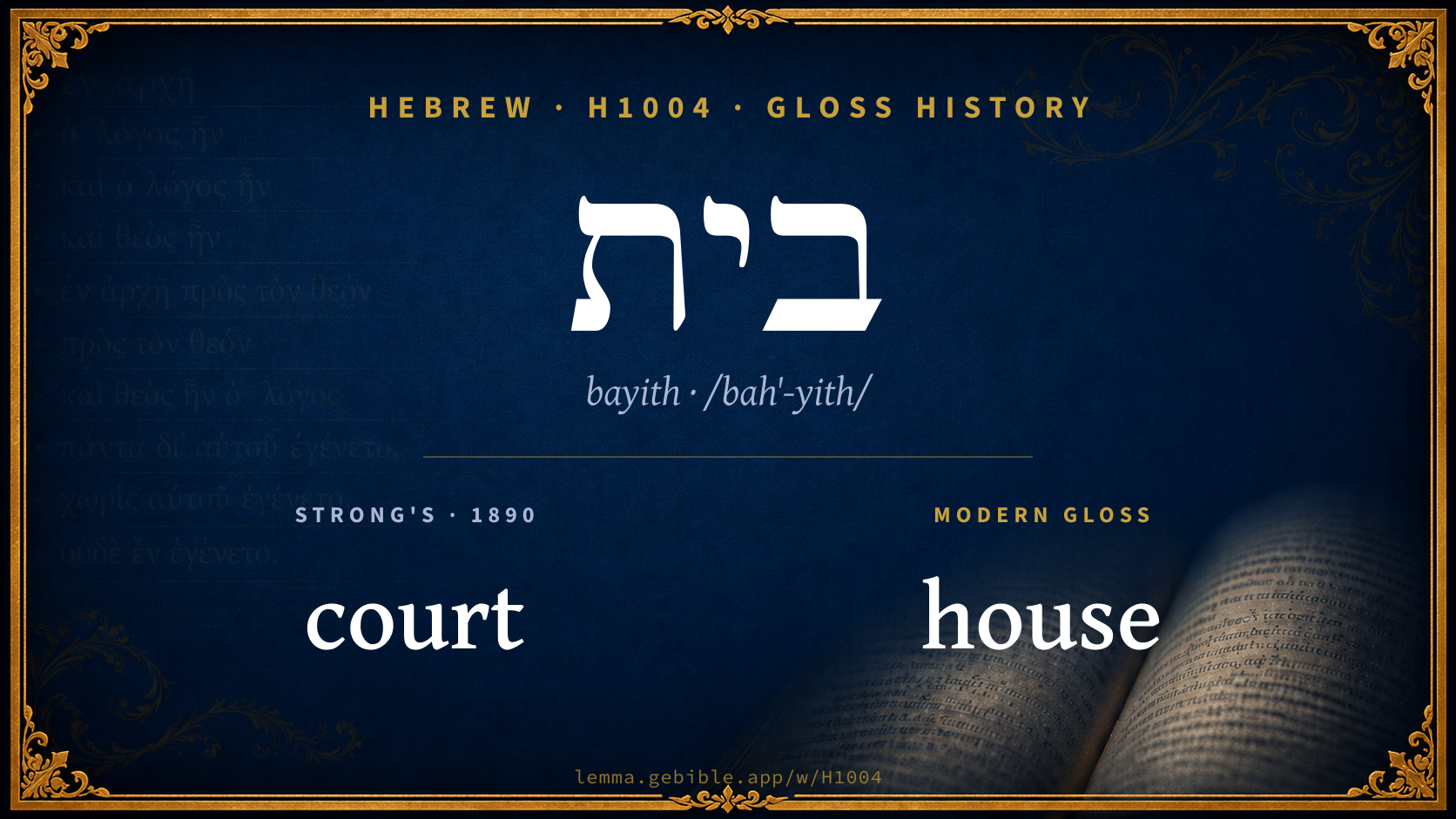
Gloss history
Strong's 1890 vs modern scholarship
About this word
Strong's H1004 catalogs a Hebrew word from the Hebrew Old Testament.
These counts are not copied from any lexicon or concordance. They are computed here, from the morphology-tagged Hebrew Old Testament. What Lemma adds →
- 1,712
- distinct verses
- The word appears in 1,712 distinct verses.
- 38 / 39
- OT books
- The word appears in 38 of 39 Old Testament books.
- #21
- by frequency
- Top 25 most frequent Hebrew words (rank 21 of 8,640 Hebrew words by occurrence).
View all 1,712 occurrences in the concordance →
Most concentrated in
- 2 Chronicles 172 verses 10%
- Ezekiel 159 verses 9%
- 1 Kings 148 verses 9%
By section of the Old Testament
By traditional corpus
Conventional, traditional groupings — biblical authorship is debated, so this is a traditional corpus grouping, not an authorship claim. Each share is this word’s portion of its verses in that division of the Hebrew canon. Each figure is a share of the word’s 1,712 distinct verses.
- Prophets (Nevi'im) 937 verses · 55%
- Writings (Ketuvim) 494 verses · 29%
- Torah (Pentateuch) 281 verses · 16%
How translations render this word
Counts come from each version’s own published word-to-Strong’s tagging or interlinear alignment — an approximate guide to how each version renders this word, not a word-level alignment the data otherwise carries. Because each total is that version’s own tagged count, the per-version totals vary from one another and need not match the appearance or distinct-verse counts above. These counts may also differ from a printed concordance because Lemma counts each distinctly tagged rendering and does not collapse phrase taggings into a single head-word total. This is a fixed set of word-tagged versions (KJV, ASV, BSB, ULT) and does not change with the reading translation you choose elsewhere. Each version’s license is shown beside its name below (and on Sources).
BDB lists this Strong’s number as 7 distinct words (homographs). Each count above pools all of them and is not split by sense — see the Senses section below. A low-frequency rendering may belong to a different one of those words, not the primary meaning.
- King James Version†: House 1,458×, Houses 94×, All the house 28×
- American Standard Version†: House 1,128×, 's house 170×, Houses 78×
- Berean Standard Bible†: House 1,097×, Temple 172×, Palace 111×
- unfoldingWord Literal Text†: House of 850×, House 815×, Houses 70×
King James Version Public Domain
Renders H1004 across 2,049† tagged occurrences — most commonly:
Plus other, less common renderings. Plus 173 renderings that appear only once — usually multi-word phrases or single function words the recovered tagging swept in, not distinct renderings. Not rendered by a distinct English word in 6 further occurrences.
American Standard Version Public Domain
Renders H1004 across 2,044† tagged occurrences — most commonly:
Plus other, less common renderings. Plus 269 renderings that appear only once — usually multi-word phrases or single function words the recovered tagging swept in, not distinct renderings.
Berean Standard Bible Public Domain
Renders H1004 across 1,913† tagged occurrences — most commonly:
Plus other, less common renderings. Plus 113 renderings that appear only once — usually multi-word phrases or single function words the recovered tagging swept in, not distinct renderings. Not rendered by a distinct English word in 127 further occurrences.
unfoldingWord Literal Text CC BY-SA 4.0
Renders H1004 across 2,061† tagged occurrences — most commonly:
Plus other, less common renderings. Plus 62 renderings that appear only once — usually multi-word phrases or single function words the recovered tagging swept in, not distinct renderings.
39 senses and sub-senses in the full BDB
What do BDB’s symbols mean?
BDB uses these scholarly abbreviations:
| Symbol | Meaning |
|---|---|
| 𝔊 | the Septuagint (the ancient Greek translation, LXX) |
| 𝔙 | the Vulgate (the Latin translation) |
| 𝔖 | the Syriac version (the Peshitta) |
| 𝔗 | the Targum (the Aramaic translation) |
| ψ | the Psalms |
| √ | root (the underlying root or stem) |
| ‖ | parallel passage (a synonymous or contrasted parallel) |
| † | the dagger: every passage where the word occurs is cited |
The 39 senses and sub-senses the full Brown-Driver-Briggs lexicon distinguishes for this word, in lexicon order (not ranked by frequency), with BDB’s own verbatim wording and sub-sense lettering. Shown in Hebrew script with BDB’s own scholarly abbreviations. The condensed entry is in the Lexicon Entry tab. See also the Forms in the corpus table below.
בית I
- 1. house,
- a. as dwelling, habitation Gn 19:2, 3, 4, 11; 27:15 33:17 (obj. of בָּנָה) Ex 12:7 + often; בּ׳ מוֹשַׁב Lv 25:29 (cf. בַּיִת לְשִׁבְתִּי 2 S 7:5); בֵּית = in the house of, when modifying word follows, cf. DrSm 29, n. 2 (after st. cstr. מוֹלֶדֶת בַּיִת אוֹ מוֹלֶדֶת הוּץ Lv 19:9); e.g. בּ׳ אָבִיךָ Gn 24:23; בּ׳ אִישָׁהּ Nu 30:11; בּ׳ יהוה 2 K 23:24; so in n.pr. ביתאל Am 7:13; (ה)בַּ֫יְתָה into the house, home Ex 9:19 (of man & beast) cf. Ju 19:18 1 S 6:7 (cf. v 10) 1 K 13:7, 15 ψ 68:7 Is 14:17 etc.; cf. sub 7 infr.; partic. (α) in J occasionally of tent Gn 27:15 cf. 33:17 c.בנה; here of nomad’s hut); usually (β) house of solid materials, with doorposts, etc. Ex 12:7 Dt 6:9; 11:20, walls Lv 14:37, 39, of stones, timber & mortar v 45 (cf. v 40, 42, 43); so also Jos 2:15; supported by pillars Ju 16:26 f.; with roof on which one could walk 2 S 11:12 etc.; v. especially temple and king’s house in Jerusalem 1 K 5–7 etc.; cf. Ct 1:17 Je 22:14; of Ezekiel’s temple Ez 40f.; בָּֽתֵּכֶם סְפוּנִים of luxurious houses Hg 1:4; בנה בָּֽתִּים טֹבִים Dt 8:12; בּנה בַּיִת־חָדָשׁ Dt 20:5 cf. 22:8; also c. בנה Dt 28:30 + often; (γ) cstr. before word of material, בּ׳ אֲרָזִים 2 S 7:2, 7 = 1 Ch 17:1 (בּ׳ הָא׳) v 6; בּ׳ הַשֵׁן 1 K 22:39 cf. Am 3:15; בּ׳ גָּזִית house of hewn stone Am 5:11; cf. בֵּית יַעַר הַלְּבָנוֹן 1 K 7:2 2 Ch 9:20, בֵּית הַיַּעַר Is 22:8; (δ) also before word of quality or characteristic, בֵּית אֵבֶל Ec 7:2 ‖ בּ׳ מִשְׁתֶּה; v 4 ‖ בּ׳ שִׂמְחָה; בּ׳ מַרְזֵחַ Je 16:5; בּ׳ מִשְׁתֶּה Je 16:8; בָּֽתֵּי חֶמְדָּתֵךְ Ez 26:12; בֵּית תַּעֲנֻנֶי֑הָ Mi 2:9; cf. בּ׳ מְרִי rebellious house sub 5. d infr.; (ε) in combinations, of structures for various purposes:—(1) בֵּית הַמֶּלֶךְ = palace 1 K 9:1, 10; 10:12 +, etc.; בֵּית מַמְלָכָה Am 7:13 cf. sub 2 infr.; בּ׳ הַמַּלְכוּת Est 5:1 cf. 2:16; בּ׳ לְמַלְכוּתוֹ 2 Ch 1:18; (2) בֵּית הַסֹּהַר = the prison Gn 39:20(×2), 21, 22(×2), 23(×2); 40:3, 5; cf. בּ׳ מִשְׁמַרְכֶם Gn 42:19; בּ׳ מִשְׁמֶרֶת 2 S 20:3; בּ׳ הָאָסוּר Je 37:15; בּ׳ הָאֲסיּרים Ju 16:21, 25; בּ׳ הָסֿוּרִים Ec 4:14; בּ׳ הַכֶּלֶא 1 K 22:27 2 K 17:4 2 Ch 18:26 Je 37:15, 18 cf. Is 42:7; בּ׳ כֶּלֶא 2 K 25:27; בּ׳ הַמַּהְפֶּכֶת 2 Ch 16:10; בּ׳ הַכְּליּ֯א Je 37:4; 52:31; בָּֽתֵּי כְלָאִים Is 42:22; בֵּית־הַבּוֹר Je 37:16; בּ׳ הַפְּקֻדּוֹת Je 52:31; (3) בֵּית הַנָּשִׁים house of the women, harem Est 2:9, 11, 13, 14; (4) בּ׳ מִשְׁתֵּה הַיַּיִן Est 7:8; בּ׳ הַיָּ֑ין Ct 2:4; cf. מָשׂוֹשׂ בָּֽתֵּי Is 32:13; (5) בֵּית הַחֹרֶף Am 3:15 Je 36:22; בּ׳ הַקָּ֑יִץ Am 3:15; (6) בֵּית נְכֹתֹה & בֵּית כֵּלָיו 2 K 20:13 = Is 39:2; (7) בֵּית הַגָּן garden-h. (or n.pr.? cf. p. 111) 2 K 9:27; (8) בֵּית־עֵקֶד binding-h. (or n.pr.?) 2 K 10:12, 14; (9) בֵּיתעֲבָדִים h. of slaves (where slaves live), only fig. of Egypt Ex 13:3, 14; 20:2 Dt 5:6; 6:12; 7:8; 8:14; 13:6, 11 Jos 24:17 Ju 6:8 Mi 6:4 Je 34:13;—on בּ׳ הַחָפְשִׁית 2 K 15:5 = 2 Ch 26:21 cf. חפשׁית; especially (10) בֵּית י׳ = temple 1 K 7:12, 40, 45, 51 & very often; also (mostly late) בֵּית הָאֱלֹהִים 1 Ch 9:11, 13, 26 + often; but also of earlier tent of worship Ju 18:31; v. also בּ׳ הָאֹהֶל 1 Ch 9:23; cf. בּ׳ אֱלֹהִים of local shrine 17:5; & also in mouth of Jacob, as explanation of name of Bethel Gn 28:17 (cf. v 19), & as name of stone, or Mac̦c̦eba v 22 (all E); also ב׳ י׳ of earlier tent of worship Ju 19:18 1 S 1:7, 24 2 S 12:20 (cf. further אֱלֹהִים, יהוה); בּ׳ הָאוֹצָר Mal 3:10; cf. הֵיכַל הַבַּיִת 1 K 6:3, & בּ׳ alone in same sense, especially 1 K 6 cf. 2 Ch 1:18; 2:3, 11 +; v. 1 Ch 28:2 בּ׳ מְנוּחָה לַאֲרוֹן בְּרִית־י׳ וְלַהֲדֹם רַגְלֵי אֱלֹהֵינוּ; also בֵּית הַקֹּדֶשׁ 29:3; בּ׳ קֹדֶשׁ הַקֳּדָשִׁים 2 Ch 3:8, 10; בּ׳ קָדְשֵׁנוּ וְתִפְאַרְתֵּנוּ Is 64:10; בֵּית־זְבֻל 2 Ch 6:2; בֵּית זָ֑בַח 2 Ch 7:12; בֵּית מִקְדָּשָׁם 2 Ch 36:17; בּ׳ תְּפִלָּה Is 56:7(×2); בּ׳ תִּפְאַרְתִּי 60:7; also of heathen temples ב׳ בַּעַל־בְּרִית Ju 9:4; ב׳־דָּגוֹן 1 S 5:5; ב׳ עַשְׁתָּרוֹת 1 S 31:10; ב׳ רִמּוֹן 2 K 5:18(×3); ב׳ הַבַּעַל 2 K 10:21(×2), 23, 25, 26, 27; 11:18; בּ׳ עֲצַבֵּיהֶם 1 S 31:9 (but read rather את־עצביהם as in ‖ 1 Ch 10:9 so 𝔊 We Dr); בֵּית בָּמוֹת 1 K 12:31 (cf. MI בת במת), v. also 13:32 2 K 17:29, 32; בֵּית אוֹצַר אֱלֹהָיו Dn 1:2, etc.; made of woven material 2 K 23:7; אֲשֶׁד הַנָּשִׁים אֹרְגוֹת שָׁם בָּֽתִּים לָאֲשֵׁרָה perhaps = tent-shrines but textdub. 𝔊 χεττιεῖν (כתנות?); 𝔊L στολάς; cf. EwH iii. 718 & Klo; (ζ) of portion of larger building (late), so pl. בָּֽתָּיו 1 Ch 28:11 i.e. of the temple (‖ גַּנְזַכָּיו, עֲלִיֹּתָיו, חֲדָרָיו); cf. בּ׳ הַכַּפֹּרֶת ib.; בּ׳ הַמְֿבַשְּׁלִים Ez 46:24. e.g. Genesis 19:2
- b. as shelter or abode of animals 1 S 6:7, 10 cf. Ex 9:19; בֵּית עַכָּבִישׁ Jb 8:14 spider’s web (cf. בָּנָה כָעָשׁ בֵּיתוֹ 27:18); of wild ass Jb 39:6 שַׂמְתִּי עֲרָבָה בֵיתוֹ; צִפּוֹר מָֽצְאָה בַּיִת ψ 84:4 (‖ קֵן); חֲסִידָה בְּרוֹשִׁים בֵּיתָהּ ψ 104:17 (cf. ‖ & Che); Pr 30:26 (of the שְׁפַנִּים ‘conies’). e.g. 1 Samuel 6:7
- c. fig. of human bodies בָּֽתֵּי־חֹמֶר Jb 4:19 houses of clay, cf. in phr. שֹׁמְרֵי הַבַּיִת Ec 12:3 keepers of the house, i.e. the arms; v. further בֵּית מְגוּרָ֑י ψ 119:54. e.g. Job 4:19
- d. of She’ôl, שְׁאוֹל בֵּיתִי Jb 17:13, cf. בֵּית מוֹעֵד לְכָל־חָ֑י 30:23 (‖ מָוֶת); בֵּית עוֹלָמוֹ Ec 12:5 (perhaps = tomb, v. De). e.g. Job 17:13
- e. of abode of light & darkness Jb 38:20. e.g. Job 38:20
- f. Ephraim as בּ׳ יהוה Ho 8:1; 9:15 (cf. אֶרֶץ י׳ 9:3); cf. Zc 9:8. e.g. Hosea 8:1
- 2. place, of Jerusalem בֵית קִבְרוֹת אֲבֹתַי Ne 2:3 (‖ עִיר v 5), cf. also n.pr. cpd. with בֵּית, infr., & בֵּית מַמְלָכָה Am 7:13 (pred. of Bethel); בֵּית נְתִיבוֹת Pr 8:2 i.e. where paths meet RV; בּ׳ אֲבָנִים Jb 8:17; on both these v. בֵּית sub [בַּיִן] בֵּין p. 108. e.g. Nehemiah 2:3
- 3. receptacle, תְּעָלָה כְּבֵית סָאתַיִם 1 K 18:32 a trench like a receptacle of two seahs; בָּֽתֵּי נֶפֶשׁ Is 3:20 i.e. vials of perfume; especially בָּֽתִּים לְבַדִּים Ex 25:27 holders for the staves, i.e. rings, טַבָּעֹת ib.; so 37:14, 27; 38:5; cf. בָּֽתִּים לַבְּרִיחִם 26:29; 36:34 holders for the bars (all P, & all expl. by טבעת); בֵּית־לָהּ סָבִיב Ez 1:27 (si vera l.) its [cstr. as ψ 58:5] house (= enclosing cage) was round about (del. BHi Co). e.g. 1 Kings 18:32
- 4. of house as containing a family, hence in phr. of slaves belonging to household יְלִידֵי בֵיתוֹ Gn 14:14 cf. 17:12 (opp. מִקְנַת־כֶּסֶף) v 13 (all ‖ id.); fig. of Israel Je 2:14 (‖ עֶבֶד); cf. בֶּן־בֵּיתִי Gn 15:3; בְּנֵי־בַיִת הָיָה לִי Ec 2:7 (as token of wealth & prosperity); also of one’s sister מוֹלֶדֶת בַּיִת Lv 18:19 (‖ מ׳ חוּץ cf. infr.); אַנְשֵׁי בֵיתוֹ Gn 17:27; נַפְשׁוֹת בּ׳ Gn 36:6; כָּל־הַנֶּפֶשׁ לְבֵית־יַעֲקֹב Gn 46:27. Hence e.g. Genesis 14:14
- 5. household, family (592 times)
- a. ordinary sense, those belonging to the same household Gn 7:1; 12:1, 17 +, Dt 6:22; 11:6 +; Hex mostly JD; E Gn 35:2; 42:33; 50:22 cf. Ex 1:21 infr.; P Gn 36:6 Ex 1:1; 12:4 Lv 16:6, 11, 17 Nu 16:32; 18:31 Jos 22:15; even where expressly said to inhabit tents Nu 16:32 Dt 11:6 אֶת־בָּֽתֵּיהֶם וְאֶת־אָהֳלֵיהֶם; specif. זְקַן־בּ׳ Gn 24:2 cf. 50:7 (of rank & dignity in household); of a family of handicraftsmen מִשְׁפְּחוֹת בֵּית־עֲבֹדַת הַבֻּץ 1 Ch 4:21 (v. בוץ); also, with fig. of house clearly in mind מִשְׁקֹלֶת בּ׳ 2 K 21:13; מַפְתֵּחַ בּ׳ Is 22:22. e.g. Genesis 7:1
- b. family of descendants, descendants as organized body Gn 18:19 (J ‖ בָּנִים) +, & so c. בָּנָה (q.v.) יִבְנֶה בּ׳ אחיו Dt 25:9 cf. Ru 4:11 &, subj. י׳, בָּנָה בּ׳ לְ 2 S 7:27 = 1 Ch 17:10, 25; also 1 S 2:35 1 K 11:38 (both בּ׳ נֶאֱמָן), so עשׂה בּ׳ לְ 2 S 7:11 1 K 2:24; also pl. וַיַּעַשׂ לָהֶם בָּֽתִּים Ex 1:21; עשׂה ב׳ נֶאֱמָן לְ 1 S 25:28; cf. especially c. n.pr., e.g. e.g. Genesis 18:19
- c. †בֵּית שָׁאוּל 2 S 3:1(×2), 6(×2), 8, 10; 9:1, 2, 3, 9; 16:5 (משׁפחת בּ׳ שׁ׳), v 8; 19:18 (cf. 21:1 where read וְאֶל־בֵּיתֹה דָמִים, so 𝔊 We Dr) 1 Ch 12:29; †בֵּית דָּוִד 2 S 3:1, 6; 7:26 = 1 Ch 17:24 (cf. context in both), 1 K 12:19 = 2 Ch 10:19, v 20, 26; 13:2; 14:8 2 K 17:21 Is 7:2, 13; 22:22 Je 21:12 Zc 12:7, 8, 10, 12 (משׁפחת בּ׳ דּ׳) 2 Ch 21:7 ψ 122:5; †בּ׳ יָרָבְעָם 1 K 13:34; 14:10(×2), 13, 14; 15:29; 16:3 21:22 2 K 9:9; 13:6; †בּ׳ אַחְאָב 2 K 8:18, 27(×3) (of Ahaziah חֲתַן בּ׳ א׳), 9:7, 8, 9; 10:10, 11; 21:13 Mi 6:16 2 Ch 21:6, 13; 22:3, 4, 7, 8; etc. e.g. 2 Samuel 3:1
- d. especially of Hebrew people & subdivisions: (α) †בֵּית יִשְׂחָ֑ק Am 7:16; (β) †בּ׳ עֵשָׂו Ob 18(×2); (γ) †בֵּית יַעֲקֹב Gn 46:27 (P) Ex 19:3 (E) Am 3:13; 9:8 Mi 2:7; 3:9 Ob 17, 18 Is 8:17; 10:20; 14:1; 29:22; 46:3; 48:1; 58:1 Je 2:4; 5:20 ψ 114:1; also זֶרַע בּ׳ יעקב Ez 20:5 (del. Co); most frequently (δ) בֵּית יִשְׂרָאֵל (Vrss & var. sometimes בני v. בֵּן) †Hex Ex 16:31; 40:38 Lv 10:6 Nu 20:29 (all P) Lv 17:3, 8, 10; 22:18 (H) Jos 21:43 (D) †; 1 S 7:2 + 8 times S K; Ho 1:4, 6; 5:1; 6:10; 12:1; Am 5:1 + 7 times Am; † Mi 1:5; 3:1, 9 Is 5:7; 14:2, also 46:3; 63:7 Zc 8:13†; but especially Je 2:4, 26 + 17 times Je; Ez 3:1, 4, 5, 7(×2), 17 + 75 times Ez; also זֶרַע בּ׳ יִשְׂרָאֵל Je 23:8 Ez 44:22 (Co del. בּ׳); +שְׁנֵי בָֽתֵּי יִשְׂרָאֵל Is 8:14; בֵּית יִשְׂרָאֵל וִיהוּדָה Ez 9:9 + 25:8 Co; further בֵּית מְרִי rebellious house (of Isr.) Ez 2:5, 6; 3:9, 26, 27; 12:2, 3, & בּ׳ הַמֶּ֑רִי Ez 2:8; 12:2, 9, 25; 17:12; 24:3 [+ 44:6 Co]; (ε) בֵּית יְהוּדָה 2 S 2:4, 7, 10, 11 1 K 12:21 = 2 Ch 11:1, 2 K 19:30 = Is 37:31, Is 22:21 Ho 1:7; 5:12, 14 Zp 2:7 Zc 8:13, 15, 19; 10:3, 6; 12:4, & especially Je 3:18 + 9 times Je; Ez 4:6 + 4 times Ez + 9:9 supr. also †בּ׳ יְהוּדָה וּבִנְיָמִן 1 K 12:23; †בּ׳ מֶלֶךְ יְהוּדָה Je 21:11; 22:6; (ζ) †בּ׳ יוֹסֵף Gn 50:8 Jos 17:17; 18:5 (all JE) Ju 1:22, 23, 35 2 S 19:21 1 K 11:28 Am 5:6 Ob 18 Zc 10:6; (η) †בּ׳ אֶפְרַיִם Ju 10:9; (θ) בּ׳ בִּנְיָמִן 2 S 3:19 cf. 1 K 12:23 supr.; (ι) †בּ׳ יִּשָּׂשכָר 1 K 15:27; (κ) †בּ׳ לֵוִי Ex 2:1 (E) Nu 17:23 (P) Zc 12:13 (משׁפחת ב׳ ל׳), ψ 135:20; & (λ) בּ׳ אַהֲרֹן ψ 115:10, 12; 118:3; 135:19. e.g. Amos 7:16
- e. technically, yet with some looseness of usage, בֵּית אָב father’s house, of family or clan, pl. בֵּית אָבוֹת father-houses, families (e.g. Nu 1:2) (79 times; only P & Chr) Ex 6:14; 12:3 Nu 1:2, 4, 18 + 41 times Nu; Jos 22:14(×2) 1 Ch 4:38; 5:13 + 25 times Ch; Ezr 2:59; 10:16 Ne 7:61; 10:35; = tribe Nu 17:17(×2), 18, 21; = main division of tribe Nu 3:20, 24 +, cf. 34:14(×2) etc.; further subdivision Ex 12:3 1 Ch 7:2, 7 +; cf. especially 1 Ch 23:11 Jeush and Beriah had not many sons, therefore they became לְבֵית אָב לִפְקֻדָּה אֶחָ֑ת (cf. ראשׁי אבות, sub אב). e.g. Numbers 1:2
- 6. house, including household affairs, persons, property, etc. וַיַּפְקִדֵהוּ עַל־בֵּיתוֹ Gn 39:4 cf. בְּבֵיתוֹ v 5; אֲשֶׁר עַל־בֵּיתוֹ Gn 44:1, 4; hence אשׁר על הבית as title of governor of the palace (EwH iii. 269) Is 22:15; 36:3 cf. 1 K 4:6 2 K 15:5; in Israel 1 K 16:9; 18:3 2 K 10:5: further 2 S 17:23 2 K 20:1 = Is 38:1; hence of personal property 1 K 13:8 אִם־תִּתֶּן־לִי אֶת־חֲצִי בֵּיהֶ֑ךָ; family and property (everything on which one depends) Jb 8:15. e.g. Genesis 39:4
- 7. בַּ֫יְתָה, בָּ֑יְתָה, lit. housewards, hence metaph. inwards, †Ex 28:26 = 39:19 (sc. of the ephod), 1 K 7:25 = 2 Ch 4:4 (sc. of the circle of oxen supporting the molten sea); 2 S 5:9 מִן־הַמִּלּוֹא וָבָ֑יְתָה from the Millo and inward, Ez 44:17. e.g. Exodus 28:26
- 8. מִבַּיִת
- a. adv. on the inside (of a building, chest, etc.: opp. מִחוּץ) †Gn 6:14 Ex 25:11 = 37:2 Lv 14:41 1 K 6:15, 16; 7:9 2 K 6:30 (of a person’s clothes), Ez 7:15; so with ה loc. מִבַּ֫יְתָה †1 K 6:15. e.g. Genesis 6:14
- b. †מִבֵּית לְ (cstr. Ges§ 130, 1 n.) prep. within (opp. מִחוּץ לְ), מִבֵּית לַפָּרֹכֶת within the veil Ex 26:33 Lv 16:2, 12 Nu 18:7 לְכָל־דְּבַר הַמִּזִבֵּחַ וּלְמִבֵּית לַפָּרֹכֶת for everything of the altar, and for (that) within the veil; 1 K 7:8, 31 (read לַכְּתֵפֹת; see VB & StaZAW 1883, 165); אֶל־מִבֵּית לְ (after a verb of motion) in within Lv 16:15 2 K 11:15 = 2 Ch 23:14. Note.—בית perhaps occurs abbrev. into בּ in n.pr. בְּעֶשְׁתְּרָה q.v. so Thes al.; cf. also Aramaic בא = בית in like usage LagArmen. Stud. § 339; Se i. 51; GGA 1884, 276. On בְּ as abbrev. בית v. Wetzst Hauran 110 KampffmeyerZPV xv (1892), 111. e.g. Exodus 26:33
בית II c. art. הַבַּיִת Is 15
בית III loc.? 𝔊 Βαιθαν (Βαιατγαν), 𝔊L Βαιθωρων, 2 K 9
בית IV daughter (= בַּנְתְּ from בן
- 1. daughter, female child, born of a woman Gn 30:21; 34:1 Ex 1:16, 22; 21:4 Lv 12:6 Ho 1:6 cf. Gn 20:12 Lv 18:9 Dt 27:22 +; begotten by a man Gn 5:4, 7, 10; 11:11, 13, 15 cf. Gn 11:29; 19:8; 20:12; 28:2 Lv 19:9 Dt 27:22 +; often ‖ בֵּן son Gn 5:4, 7 + (v. בֵּן); cf. in allegory of Jehoash 2 K 14:9 = 2 Ch 25:18; note especially בְּנוֹת הָאָדָם i.e. human women Gn 6:2, 4; בִּתְּךָ הַקְּטַנָּה thy younger daughter Gn 29:18 (cf. הַצְּעִירָה v 26 opp. הַבְּכִירָה); בִּתִּי הַגְּדוֹלָה my eldest daughter 1 S 18:17; בַּת־(הַ)מֶּלֶךְ = princess 2 Ch 22:11 2 K 9:34 Dn 11:6 cf. 2 S 13:18 Je 41:10; 43:6 ψ 45:10; cf. as term of praise בַּת־נָדִיב Ct 7:2; in partic. e.g. Genesis 30:21
- a. girl called בִּתֵּנוּ by father and brothers Gn 34:17 cf. בִּתְּכֶם v 8. e.g. Genesis 34:17
- b. of adopted daughter Est 2:7, 15. e.g. Esther 2:7
- c. used in speaking to daughter-in-law Ru 1:11, 12, 13; 2:2, 8, 22; 3:1, 16, 18. e.g. Ruth 1:11
- d. בַּת־אָבִיו = sister Ez 22:11 (appos. אחותו); also half-sister Gn 20:12 בַּת־אָבִי אַךְ לֹא בַת־אִמִּי, cf. Lv 18:9 & v 11 בַּת־אֵשֶׁת אָבִיךָ, 20:17. e.g. Ezekiel 22:11
- e. בַּת־דֹּדוֹ = cousin Est 2:7. e.g. Esther 2:7
- f. used in kindly address, בִּתִּי Ru 3:10, 11 (Boaz to Ruth), cf. ψ 45:11; בְּנוֹתַי in mouth of י׳ Is 43:6 (‖ בָּנַי). e.g. Ruth 3:10
- g. בְּנוֹת בָּנָיו = granddaughters Gn 46:7 (P) cf. Lv 18:10 & v 17 (H); note also Gn 37:35, where בנותיו must include other than actual daughters. e.g. Genesis 46:7
- h. רִבְקָה בַּת־בְּתוּאֵל (as more precise designation) Gn 25:20 cf. 24:23, 24, 47(×2) also 26:34(×2); 29:10 +; note especially †בַּת־פַּרְעֹה (without personal name) Ex 2:5, 7, 8, 9, 10 cf. 1 K 3:1; 7:8; 9:24; 11:1 2 Ch 8:11; בַּת־אִישׁ כְּנַעֲנִי וּשְׁמוֹ שׁוּעַ Gn 38:2 cf. v 12 (but cf. 1 Ch 2:3 sub בַּת־שׁוּעַ n.pr.f. infr.) e.g. Genesis 25:20
- i. often pl. as designation of women of a particular city, land, or people: בְּנוֹת צִיּוֹן Is 3:16, 17; 4:4 Ct 3:11 cf. Is 49:22; 60:4 La 3:51; בְּנוֹת יְרוּשָׁלַם Ct 1:5; 2:7; 3:5, 10; 5:8, 16; 8:4; בְּנוֹת־שִׁילוֹ Ju 21:21(×2); בְּנוֹת רַבָּה Je 49:3; observe transitional phrase בְּנוֹת אַנְשֵׁי הָעִיר Gn 24:13; further בְּנוֹת כְּנָ֑עַן Gn 28:1, 6, 8; 36:2 (all P) cf. ב׳ הַכְּנַעֲנִי Gn 24:3, 37 (J); בְּנוֹת הָאָרֶץ Gn 27:46; 34:1 (both P); בְּנוֹת מוֹאָב Nu 25:1 Is 16:2 cf. Nu 21:29; ב׳ חֵת Gn 27:46(×2) (P); ב׳ פְּלִשְׁתִּים Ju 14:1, 2 2 S 1:20 ‖ ב׳ הָֽעֲרֵלִים v 20 (poet.); ב׳ יִשְׂרָאֵל Ju 11:40 1 S 1:24 (poet.); ב׳ יְהוּדָה ψ 48:12; 97:8; ב׳ מְנַשֶּׁה Jos 17:6; ב׳ דָּן 2 Ch 2:13; cf. בַּת־לֵוִי Ex 2:1 i.e. a woman of tribe of Levi; also ב׳ אַחֶיךָ Ju 14:3; ב׳ עַמֶּ֑ךָ Ez 13:7.—בַּת־צִיּוֹן etc. v. sub 3 infr. e.g. Isaiah 3:16
- 2. young women, women Gn 30:13 (J) Pr 31:29 Ct 2:2; 6:9; בָּנוֹת בֹּטְחוֹת Is 32:9; also בַּת הַנָּשִׁים Dn 11:17. e.g. Genesis 30:13
- 3. with name of city, land, or people, poet. personif. of that city or inhabitants, etc.: בַּת־צִיּוֹן Is 1:8; 10:32; 16:1; 62:11 Mi 1:13; 4:8, 10, 13 Je 4:13; 6:2, 23 Zp 3:14 Zc 2:14; 9:9 ψ 9:15 La 1:6; 2:1, 4; 4:22; even זִקְנֵי בת־ציון La 2:10; חוֹמַת ב׳ צ׳ v 8, 18; also בְּתוּלַת ב׳־צ׳ 2 K 19:21 = Is 37:22 La 2:13; שְׁבִיָּה ב׳־צ׳ Is 52:2; ב׳ יְרוּשָׁלַם 2 K 19:21 = Is 37:22 Mi 4:8 Zp 3:14 Zc 9:9 La 2:13, 15; cf. בַּת־פּוּצַי Zp 3:10 daughter of my dispersed ones; בַּת־צֹר ψ 45:13; ב׳ בָּבֶל Je 50:42; 51:23 ψ 137:8; בְּתוּלַת ב׳ בָּבֶל Is 47:1; v. further Zc 2:11; also of Tarshish Is 23:10, Sidon v 12 (+ בְּתוּלַת), Dibon Je 48:18 (+ יוֹשֶׁבֶת), Gallim Is 10:30; בְּתוּלַת ב׳־יְהוּדָה La 1:15; cf. מִבְצְרֵי בַּת יְהוּדָה 2:2; בַּת־עַמִּי daughter of my people Is 22:4 Je 4:11; 6:14, 26; 8:11, 19, 21, 22, 23; 9:6 La 3:48; 4:3, 6, 10, בְּחוּלַת ב׳ ע׳ Je 14:17; בַּת־מִצְרָ֑יִם Je 46:24; also 46:11 (+ בְּתוּלַת), v 19 (+ יוֹשֶׁבֶת); ב׳ אֱדוֹם La 4:21, 22; ב׳ כַּשְׂדִּים Is 47:1, 5; note הַבַּת הַשּׁוֹבֵבָ֑ה Je 31:22 (‖ בְּתוּלַת יִשְׂרָאֵל v 21) 49:4 (= Ammon); on בַּת־אֲשֻׁרִים Ez 27:6 v. sub אֲשֻׁרִים p. 81; less often in pl. בְּנוֹת הַגּוֹיִם Ez 32:16; ב׳ גּ׳ אַדִּרִם v 18 (these perhaps sub 1 i); בְּנוֹת פְּלִשְׁתִּים Ez 16:27 (in allegory); cf. also of Sodom, Samaria, Syria etc. v 44, 45, 46(×2), 53, 55(×2), 57(×2); 23:2. e.g. Isaiah 1:8
- 4. pl. = villages, after name of city, וּבְחֶשְׁבּוֹן וּבְכָל־בְּנֹתֶיהָ Nu 21:25 cf. v 32; 32:42 (E) Jos 15:45, 47(×2) (JE?) + v 28 𝔊 Di, 17:11 (6 times) v 16 (J) = Ju 1:27(×4); 11:26(×2) Je 49:2 + 17 times Ch + 6 times Ne 11:25–31. On 1 Ch 18:1 & its variation from ‖ 2 S 8:1 vid. We Dr e.g. Numbers 21:25
- 5. in phrases denoting character, quality, etc., בַּת־אֵל נֵכָר daughter of a strange god, i.e. idolatrous (woman or people) Mal 2:11; בַּת־גְּדוּד daughter of a troop, i.e. war-like city Mi 4:14; בְּנוֹת הַשִּׁיר Ec 12:4 the daughters of song, i.e. songs, melodious notes; בַּת־בְּלִיַּעַל 1 S 1:16 v. בְּלִיַּעַל sub בלה. e.g. Malachi 2:11
- 6. בַּת יַעֲנָה = ostrich Lv 11:16 = Dt 14:15; pl. בְּנוֹת יַעֲנָה Jb 30:29 Mi 1:8 Is 13:21; 34:13; 43:20 Je 50:39 (v. יַעֲנָה); בַּת־עַיִן pupil of the eye La 2:18 cf. Ethiopic ብንተ ዐይን v. also אִישׁוֹן. e.g. Leviticus 11:16
- 7. fig. לַעֲלוּקָה שְׁתֵּי בָנוֹת Pr 30:15 two daughters (i.e. Sheʾôl & the barren womb, cf. Comm.) e.g. Proverbs 30:15
- 8. of vine = branch בָּנוֹת צָֽעֲדָה עֲלֵי־שׁוּר Gn 49:22 cf. Di & v. sub בֵּן. e.g. Genesis 49:22
- 9. as n. relat. (all P), of age of woman בַּת־תִּשְׁעִים שָׁנָה Gn 17:17; of ewe-lamb בַּת־שְׁנָתָהּ Lv 14:10 Nu 6:14; of she-goat id. Nu 15:27. Cf. בֵּן. 9—ii. בַּת v. בתת p. 144. e.g. Genesis 17:17
בית V daughter v. sub בן.
בית VI bath (a measure), בָּתָה, בַּתָּה v. בתת.
Senses from the full Brown-Driver-Briggs lexicon (Brown, Driver, Briggs; Oxford 1906 — public domain), digitized via Sefaria, supplemented by the OpenScriptures HebrewLexicon (CC BY 4.0). Full attribution on Sources.
Word origin
I. n.m. Dt 8:12 house (Ph. בת, MI. בת, sf. ביתה, Arabic بَيْتٌ, Aramaic בַּיְתָא, ܒܰܝܬܳܐ, Assyrian bîtu, COTGloss., Sab. בית, בת, fortress DHMZMG 1883, 387; temple Hal257 DHMZMG 1876, 697, Ethiopic ቤት: Palm. in בת עלמא, בת מקברתא sepulchre Vog32, 64 al.; etym. dub.; Thes √ בות, Aramaic בּוּת, ܒܳܬ spend the night, Arabic بَاتَ, Ethiopic ቤተ: but this perhaps denom., & בית from √ ל״י c. ת afform. cf. Sta§ 187 a)—abs. בַּיִת Ex 12:30 +; בָּ֑יִת Gn 33:17 +; בַּ֫יְתָה (ָה loc.) ψ 68:7 +; cstr. בֵּית Gn 12:15 +; sf. בֵּיתִי Gn 15:2 +; בֵּיתְךָ Gn 7:1 +, etc.; הַבַּ֫יְתָה, בַּיְתָה (in) to the house, homeward, Gn 19:10 ψ 68:7 +; also בֵּ֫יתָה (in) to the house of …; pl. בָּֽתִּים Ex 1:21 + (i.e. bâttîm, v. Nö in MeArchaeology i. 456 f., cf. Ges§ 96); cstr. בָּתֵּי Ex 8:17 +; sf. בָּתֶּיךָ Ex 10:6; בָּֽתָּיו 1 Ch 28:11; בָּתֵּינוּ Ex 12:27 +; בָּֽתֵּיכֶם Gn 42:19; בָּתֵּיהֶם Nu 16:32 +; (בָּֽתֵּ֫ימוֹ ψ 49:12), etc.;—
II. c. art. הַבַּיִת Is 15:2 according to Ew Brd Di al. n.pr.loc. but abbrev.; perhaps for בֵּית דִּבְלָתַיִם Je 48:22 (so Ew al.) or בֵּית בָּמוֹת cf. MI27 (cf. De Di); others (Ges De Che Or) take הַבּ׳ here = the house, i.e. temple or shrine.
I. n.pr.loc.? 𝔊 Βαιθαν (Βαιατγαν), 𝔊L Βαιθωρων, 2 K 9:27; mod. Jenîn? v. גַּן, sub גנן, and עֵין גַּנִּים; cf. StaGesch. i. 542.
I. n.f. daughter (= בַּנְתְּ from בן; Ph. בת, MI בנת pl. maidens, Assyrian bintu WincklerSargon, Gloss., Arabic بِنْتٌ Sab. בת, בנת DHMZMG 1883, 391 CISiv. 1, No. 6. 21; Aramaic ܒܰܪܬ )—ב׳ abs. Ex 1:16 +; cstr. Gn 11:29 +; sf. בִּתִּי Dt 22:16 +; בִּתְּךָ Gn 29:18 +; בִּתֵּנוּ Gn 34:17 etc.; pl. בָּנוֹת Gn 5:4 +; cstr. בְּנוֹת Gn 6:2 +; sf. בְּנֹתַי Gn 31:26 +; בְּנוֹתֶיךָ Gn 19:12 +; בְּנֹתָם Gn 34:21; בְּנוֹתֵיהֶם Dt 12:31 +, etc.;—
II. daughter v. sub בן.
III. bath (a measure), בָּתָה, בַּתָּה v. בתת.
IV. n.m. Ez 45:14 (f. Is 5:10) bath (Thes al. from above √ in sense of define, measure; cf. τέμνω; LagOr. ii. 10 f. makes = בדת, = בד + fem. ת; cf. Syriac ܒܕ, instrument for pressing olives; cf. Epiphan. βάδος = ἐλαιοτριβεῖον; & βάδος also Hesych. JosAnt. viii, 2, 9 but ed. Niese βάτους, βάτος)—בּ׳ abs. Is 5:10 + 6 times; (בָּ֑ת Ez 45:11) cstr. Ez 45:10; pl. בַּתִּים 2 Ch 2:9(×2) + 3 times;—a liquid measure = אֵיפָה of dry measure, each being 1/10 חֹמֶר (q.v.) Ez 45:11(×2), 14(×2); also Is 5:10 1 K 7:26, 38 2 Ch 2:9(×2), 4:5 + Ez 45:14(×2) (4 times in this v., Co del. a & d). Ez 45:10 בַּת־צֶדֶק a righteous (right, accurate, full) bath (‖ אֵיפַת־צֶדֶק). The actual size of bath (= ephah) is appar. c. 40 litres (= Attic metretes cf. JosAnt. viii, 2, 9; = 39.39 lit. cf. Boeckh Metrol. Untersuch. 259 f.; v. also J. Brandis Münz- Mass- u. Gewichtswesen 29 f. Smith Dict. Bible, art. Weights & Measures RiHWB 934 f.).—i. בַּת v. sub בֵּן.
— Brown-Driver-Briggs (Oxford 1906, public domain), digitized via Sefaria, supplemented by the OpenScriptures HebrewLexicon (CC BY 4.0). See Sources.
Derived from בנה (bânâh) (H1129) — to build.
Jastrow Dictionary
A second Hebrew/Aramaic lexicon for comparison, covering Aramaic and post-biblical (Talmudic, Targumic, Midrashic) usage that the biblical-Hebrew BDB does not. Matched by lemma rather than by Strong’s number, so a lemma may carry more than one Jastrow headword (shown separately below), and the entries cover usage well beyond the Bible.
בִּית
- , inf. בּוּת (sec. r. of בוא) to go in, lodge, pass the night. Dan. VI, 19. Targ. Gen. XXXII, 22; a. fr.—Pes. 107ᵃ בת טוות (Dan. l. c.) he went to bed without tasting food. Snh. 95ᵃ (prov.) בת דינא וכ׳ if punishment is procrastinated, punishment is gone. Taan. 24ᵇ ביתו כולי וכ׳ go ye all to bed fasting. Pes. 42ᵃ מיא דביתו (Chald. transl. of the ambiguous מים שֶׁלָּנוּ) water kept in vessels over night. Ber. 60ᵇ בת בדברא he slept in the open field. Snh. 63ᵇ.—Ib. 109ᵃ top בעי למֵיבַת he wanted to stay over night; a. e.—Part. בָּאֵית. Targ. Is. LVIII, 5. e.g. Daniel 6:19
- same. Erub. 73ᵃ (opp. to taking meals).
- to keep over night, postpone burial. Snh. 47ᵃ מֵבִית ליה למת dare one postpone the burial of the dead?
בַּיִת
- cmp. preced.; v. Ges. H. Dict. s. v. as to various etymological attempts), constr. בֵּית, pl. בָּתִּים.
- 1. house, household, home. Yoma 11ᵇ ב׳ מיוחד לדירה bayith means a building intended for a dwelling. Ib. מי שמייחד ביתו לו (Var. v. Rabb. D. S. a. l. note) he who devotes his house (its contents) to himself exclusively (unaccommodating); Arakh. 16ᵃ מי שמיוחד וכ׳.—בעל הב׳ (abbrev. בע"ה) owner, landlord; host; private man, opp. to trader, artisan &c. Ber. 46ᵃ בע"ה בוצע וכ׳ the host breaks the bread, and the guest says the blessing. Tosef. ib. IV, 14 של בע"ה home-made (bread), opp. גלוסקין; Y. ib. VI, 10ᵇ bot.—Sabb. I, 1 בע"ה the donor, opp. עני the recipient. Gen. R. s. 22; a. v. fr.—בן ב׳ inmate, attendant. Ab. I, 5; a. fr.—פסול הב׳ the degraded (slave) of the house. Gen. R. s. 70.
- 2. Esp. (הַ)בַּ׳ the Temple. בפני הב׳ in days when the Temple exists, שלא בפני הב׳ when it does not exist. Ḥull. V, 1; a. fr.—ב׳ שני or ב׳ אחרון the Second Temple. Cant. R. to VIII, 9; a. fr.—הר הב׳ Temple Mount, v. הַר.
- 3. school, college, (collect.) disciples; בֵּית הלל Hillelites &c. Bets. I, 1; a. fr. Treat. Sof’rim IV, 1 של ב׳ וכ׳ those of the house of &c. [Y. Shebi. II, 33ᵈ bot., a. e. דבית … ר׳, usu. דבי, v. בֵּי].
- 4. body. Ber. 44ᵇ אוי לו לב׳ וכ׳ that human body (Rashi: stomach) is to be pitied where vegetables are a constant guest (being the only food).
- 5. wife. Yoma I, 1 ביתו זו וכ׳ ‘his house’—that means his wife. Ib. 13ᵃ והך לאו ביתו היא but this one (designated for him in case of his wife’s death) cannot be called ‘his house’. Sabb. 118ᵇ; a. fr.
- 6. Euphem. pudenda; marital intercourse. Y. Sabb. IX, 12ᵃ top; Mikv. VIII, 4 שמשה את בֵּיתָהּ she had intercourse. Ib. כבדה את הב׳ she washed &c. Y. Sot. I, 16ᶜ bot. אסורה לביתה is forbidden to her husband. Nidd. 5ᵃ מהומת לביתה she hastens to perform her marital duty. Y. ib. I, beg. 48ᵈ. Cmp. חֶדֶר.
- 7. store-house, store-room. בֵּית העצים wood-room; ב׳ התבן straw-magazine; ב׳ הבקר stable; &c. Yoma 11ᵃ; a. fr.
- 8. (geogr.) place, town, in compounds (for which see the respective determinants), e.g. ב׳ בוקיא Beth-Bukya &c.
- 9. (anat.) limb, organ, in compounds (v. supra 8)), e.g. ב׳ הבליעה œsophagus, &c.
- 10. shed for plants, covering. Shebi. II, 4 (pl.). Y. ib. 33ᵈ.—Y. Sabb. VII, 10ᵃ.—1
- receptacle, cover &c., e.g. ב׳ הדיו inkstand. Tosef. Kel. B. Mets. IV, 11; ב׳ יד sleeve, v. אוּנְקְלַי II, &c.—Men. 34ᵇ, a. e. cases of the T’fillin
- , pl. בָּתֵּי אָבוֹת
- 1. paternal home, family. Snh. 38ᵃ שני ב׳ א׳ two families (dynasties); a. fr.—Tosef. Ter. II, 11 בתי אבות = אריסי ב׳ א׳ hereditary land-tenants; B. Bath. 46ᵇ
- 2. priest’s division. Taan. II, 6; a. fr.; v. אֱנוֹשׁ pl.
- 3. origin of a law, rule &c.; cmp. אָב II. Cant. R. to II, 4 ב׳ א׳ של הלכה the origin (principle) of a legal rule. Midr. Till. to Ps. CIV, 29 wherever the root רעש is used, it means cessation of government, ואיזהו ב׳ א׳ שלהם וכ׳ and where is the origin (determining the meaning) of all of them? (Answ. Jer. LI, 29). Lev. R. s. 1, beg. מב׳ א׳ שלהן וכ׳ from the chief passage (Hag. I, 13 ‘Haggai, the messenger’ &c.) we learn that prophets are called messengers (or angels).—בֵּית דִּין (abbr. ב"ד) court.—ב"ד של שבעים ואחד or ב"ד הגדול the Great Sanedrin of seventy one members. Snh. I, 5. Y. ib. 19ᵃ bot.; a. fr.—ב"ד נוטה court of an odd number of judges. ב"ד שקול of an even number of judges. Snh. 3ᵇ.—ב"ד שריא a permitting court, opprobrious name of a court too lax in religious affairs. Y. Gitt. VII, 48ᵈ top; Y. Nidd. III, 50ᵈ bot.—[For all other compounds not self-evident, v. respective determinants.] [בית תר, v. בִּיתֵּר.—Gen. R. s. 12 בית שלו, בית של עולם, v. בִּיָּא.] e.g. Jeremiah 51:29
A Dictionary of the Targumim, the Talmud Babli and Yerushalmi, and the Midrashic Literature (Marcus Jastrow; London, Luzac, 1903) — Public Domain. Digitized via Sefaria. Digitized via Sefaria. Full attribution on Sources.
Forms in the corpus
The 381 distinct written forms H1004 takes in the Hebrew Bible, most frequent first — each parse links to that state’s occurrences in the concordance. Hebrew forms include their vowel points and cantillation, so a single lemma takes many written forms.
The 60 most common forms are shown; 321 rarer forms follow in the full concordance.
Same root — word family
Other BDB entries built from the same root as H1004, grouped by Strong’s listed origin. These share a root / origin per the lexicon — not necessarily a shared meaning. Each links to that word’s own entry.
Derives from
Shares the same root
- אבן ʼeben H68 stone
- בן bên H1121 son
- בנא bᵉnâʼ H1124 to build
- בניה binyâh H1140 building
- בנין binyân H1146 building
- בת bath H1323 daughter
- מבנה mibneh H4011 building
- תבן teben H8401 stubble
- תבנית tabnîyth H8403 pattern
Derived from this word
Proper names from this root
People and places named from this root — a name, not an additional meaning of the word.
- בנוי Binnûwy H1131 Binnui
- בני Bânîy H1137 Bani
- בני Bunnîy H1138 Bunni
- בניה Bᵉnâyâh H1141 Benaiah
- יבנאל Yabnᵉʼêl H2995 Jabneel
- יבנה Yabneh H2996 Jabneh
- יבניה Yibnᵉyâh H2997 Ibneiah
- יבניה Yibnîyâh H2998 Ibnijah
- מבני Mᵉbunnay H4012 Mebunnai
- Βηθαβαρα Bēthabará G962 Bethabara
- בית Bayith H1006 Bajith
- בית און Bêyth ʼÂven H1007 Beth-aven
- ביתאל Bêyth-ʼÊl H1008 Bethel
- בית ארבאל Bêyth ʼArbêʼl H1009 Beth-Arbel
- בית בעל מעון Bêyth Baʻal Mᵉʻôwn H1010 Beth-baal-meon
- בית בראי Bêyth Birʼîy H1011 Beth-birei
- בית ברה Bêyth Bârâh H1012 Beth-barah
- ביתגדר Bêyth-Gâdêr H1013 Beth-gader
- בית גמול Bêyth Gâmûwl H1014 Beth-gamul
- בית דבלתים Bêyth Diblâthayim H1015 Beth-diblathaim
- ביתדגון Bêyth-Dâgôwn H1016 Beth-dagon
- בית האצל Bêyth hâʼêtsel H1018 Beth-ezel
- בית הגלגל Bêyth hag-Gilgâl H1019 Beth-gilgal
- בית הישימות Bêyth ha-Yshîy-môwth H1020 Beth-jesimoth
- בית הכרם Bêyth hak-Kerem H1021 Beth-haccerem
- בית המרחק Bêyth ham-Merchâq H1023 Beth Ham-merchaq
- בית המרכבות Bêyth ham-Markâbôwth H1024 Beth-marcaboth
- בית העמק Bêyth hâ-ʻÊmeq H1025 Beth-emek
- בית הערבה Bêyth hâ-ʻĂrâbâh H1026 Beth-arabah
- בית הרם Bêyth hâ-Râm H1027 Beth-aram
- בית השטה Bêyth hash-Shiṭṭâh H1029 Beth-shittah
- בית חגלה Bêyth Choglâh H1031 Beth-hoglah
- בית חורון Bêyth Chôwrôwn H1032 Beth-horon
+21 more proper names from this root (not shown).
Compare all same-root words → Showing 4 of 67 — not the complete family. 54 of the same-root words are proper names (people or places). They share a root, not necessarily a meaning.
Septuagint verse parallels
This word appears in 1,623 verses that also exist in the Greek Old Testament (Septuagint), out of the 1,712 Hebrew verses it occurs in. You can read those verses in Greek by switching the Old Testament edition to the Septuagint.
Read these verses in the Septuagint
- Genesis 6:14
- Exodus 1:1
- Leviticus 10:6
- Numbers 1:2
- Deuteronomy 5:6
- Joshua 2:1
- Judges 1:22
- Ruth 1:8
- 1 Samuel 1:7
- 2 Samuel 1:12
- 1 Kings 1:53
- 2 Kings 4:2
This is a verse-level parallel only — the same verses exist in both the Hebrew and Greek Old Testaments. No word-level Hebrew↔Greek correspondence is claimed: the data carries no such alignment, so no Greek word is shown as this Hebrew word’s translation. Coverage is not total — the Septuagint omits the deuterocanon and renumbers the Psalms, so some Hebrew verses have no direct Greek parallel.