Ezekiel 10:3

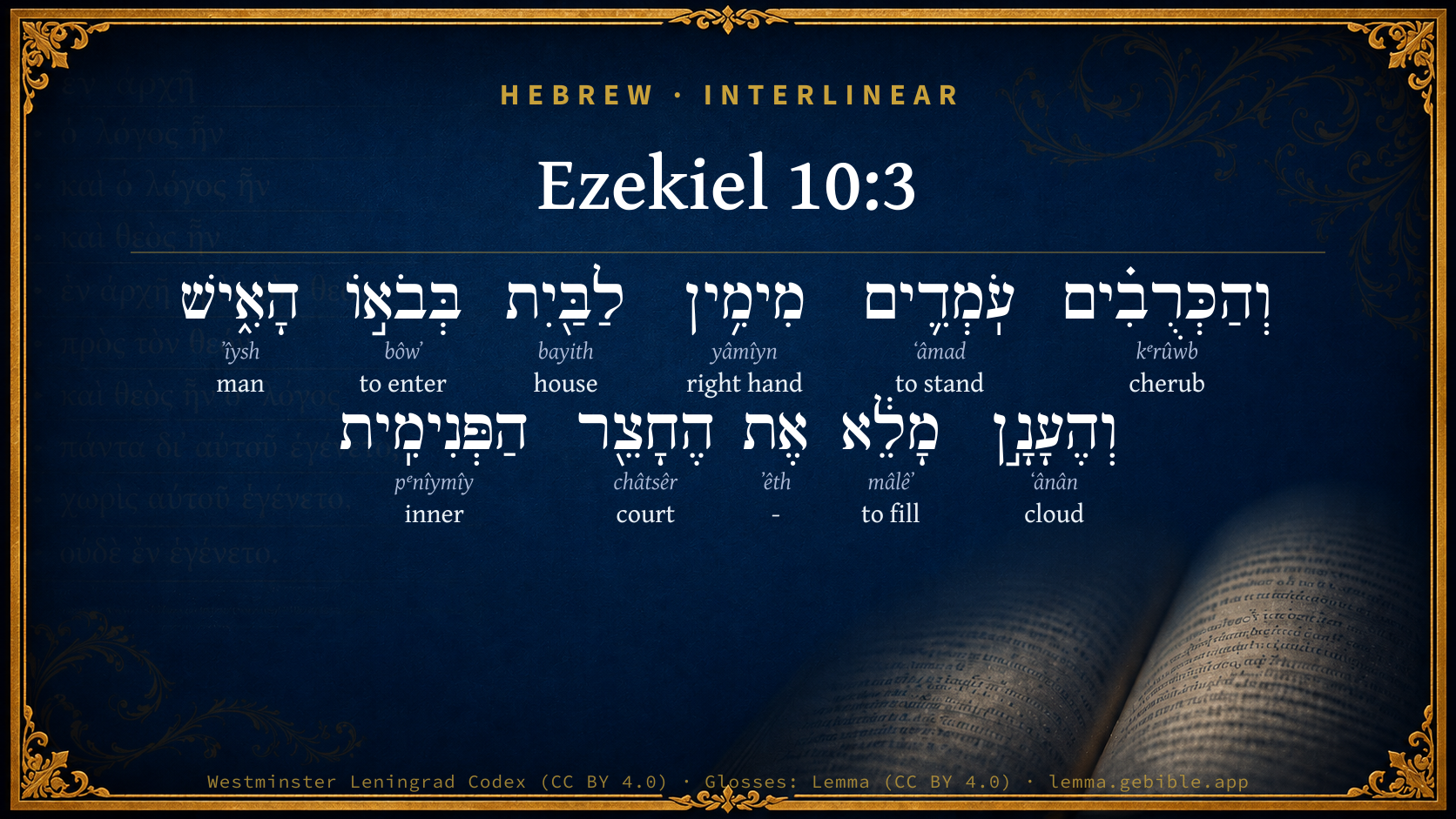
Hebrew (Westminster Leningrad Codex) Ezekiel 10:3 appears in the Hebrew Old Testament. The text above is from the Westminster Leningrad Codex. Each word links to its Strong’s number, a concise gloss, and parsing drawn from the Open Scriptures Hebrew Bible morphology. Click any word for its full Brown-Driver-Briggs (BDB) entry.
Download image
Cite this verse

Ezekiel 10:3 (World English Bible). Public Domain. Lemma interlinear Bible study tool, https://lemma.gebible.app/v/ezekiel/10/3.

Show BibTeX & RIS
BibTeX
RIS
English Translation
Now the cherubim stood on the right side of the house, when the man went in; and the cloud filled the inner court.
World English Bible · Public Domain
Download a study sheet

One document with this verse’s original text, its word-by-word gloss line, the meaning frame, cross-references with their text, attributed commentary, and full source and license credits — printable, and it pastes into notes with its structure intact.

This verse Autodidact and up

Study sheet (.html) Plain text (.txt)

A passage Seminary Student

Up to 50 verses in one chapter. A passage sheet keeps up to 6 commentary sources and 12 cross-references per verse, in the order this page ranks them, and says so on the sheet whenever that leaves anything out. Ask for a single verse and you get the Autodidact verse sheet above.

Everything on this page stays free to read, with no account — the sheet is a download of what is already on screen, not access to it.

Want to remove ads? Support Godless Engineer
Compare translations 3

The same verse in 3 English versions, stacked beneath the original-language interlinear above. Click any original word for its lexicon entry.

Each is an independent rendering of the whole verse — the interlinear is not word-aligned to these translations.

Highlighted words mark where these versions differ — a whole-verse word diff, not a word-by-word alignment.

  • World English Bible Public Domain
    Now the cherubim stood on the right side of the house, when the man went in; and the cloud filled the inner court.
  • King James Version Public Domain
    Now the cherubims stood on the right side of the house, when the man went in; and the cloud filled the inner court.
  • unfoldingWord Literal Text CC BY-SA 4.0
    The cherubim stood on the right side of the house when the man went in, and a cloud filled the inner courtyard.

unfoldingWord Literal Text — © unfoldingWord, licensed CC BY-SA 4.0. Word-aligned USFM3 via Door43 (git.door43.org/unfoldingWord/en_ult).

Versions to compare (up to 4)

3 of 4 selected

Show all 18 translations

Every available English version of this verse, each an independent rendering of the whole verse.

  • World English Bible Public Domain
    Now the cherubim stood on the right side of the house, when the man went in; and the cloud filled the inner court.
  • Berean Standard Bible Public Domain
    Now when the man went in, the cherubim were standing on the south side of the temple, and a cloud filled the inner court.
  • Majority Standard Bible Public Domain
    Now when the man went in, the cherubim were standing on the south side of the temple, and a cloud filled the inner court.
  • King James Version Public Domain
    Now the cherubims stood on the right side of the house, when the man went in; and the cloud filled the inner court.
  • American Standard Version (1901) Public Domain
    Now the cherubim stood on the right side of the house, when the man went in; and the cloud filled the inner court.
  • Revised Version (1885) Public Domain
    Now the cherubim stood on the right side of the house, when the man went in; and the cloud filled the inner court.
  • Geneva Bible (1599) Public Domain
    Now the Cherubims stood vpon the right side of the house, when the man went in, and the cloude filled the inner court.
  • Douay-Rheims (1899) Public Domain
    And the cherubims stood on the right side of the house, when the man went in, and a cloud filled the inner court.
  • Young's Literal Translation Public Domain
    And the cherubs are standing on the right side of the house, at the going in of the man, and the cloud hath filled the inner court,
  • Literal Standard Version CC BY-SA 4.0
    And the cherubim are standing on the right side of the house, at the going in of the man, and the cloud has filled the inner court,
  • Unlocked Literal Bible CC BY-SA 4.0
    The cherubim stood on the right side of the house when the man went in, and a cloud filled the inner courtyard.
  • unfoldingWord Literal Text CC BY-SA 4.0
    The cherubim stood on the right side of the house when the man went in, and a cloud filled the inner courtyard.
  • Darby Bible Public Domain
    And the cherubim stood on the right side of the house, when the man went in; and the cloud filled the inner court.
  • World Messianic Bible Public Domain
    Now the cherubim stood on the right side of the house when the man went in; and the cloud filled the inner court.
  • Webster's Bible Public Domain
    Now the cherubim stood on the right side of the house, when the man went in; and the cloud filled the inner court.
  • Free Bible Version CC BY-SA 4.0
    The cherubim were standing on the south side of the Temple when the man went in. A cloud filled the inner court.
  • Bible in Basic English Public Domain
    Now the winged ones were stationed on the right side of the house when the man went in; and the inner square was full of the cloud.
  • JPS Tanakh (1917) Public Domain
    Now the cherubim stood on the right side of the house, when the man went in; and the cloud filled the inner court.

Literal Standard Version (2020), Covenant Press — licensed CC BY-SA 4.0. Text via the HelloAO Bible API (eBible.org). Unlocked Literal Bible (unfoldingWord) — licensed CC BY-SA 4.0. Text via the HelloAO Bible API (eBible.org). unfoldingWord Literal Text — © unfoldingWord, licensed CC BY-SA 4.0. Word-aligned USFM3 via Door43 (git.door43.org/unfoldingWord/en_ult). Free Bible Version, Dr. Jonathan Gallagher — licensed CC BY-SA 4.0. Text via the HelloAO Bible API (eBible.org).

Word by word

More ways to search: Search by grammar → Find every occurrence → Compare this word →

Practice this passage: Drill this verse → Learn its vocabulary →

הַפְּנִימִֽית
pᵉnîymîy
H6442
“the · inner”
Particle, Definite Article + Adjective, Adjective, Feminine, Singular, Absolute
Part of Speech
Particle + Adjective
Type
Adjective
Gender
Feminine
Number
Singular
State
Absolute
Full BDB Definition

Origin: from H6440

TWOT: 1782d

inner
  1. וְהַכְּרֻבִ֗ים kᵉrûwb H3742 “and · the · cherubim” Conjunction + Particle, Definite Article + Noun, Common, Masculine, Plural, Absolute
  2. עֹֽמְדִ֛ים ʻâmad H5975 “standing” Verb, Qal, Participle Active, Masculine, Plural, Absolute
  3. מִימִ֥ין yâmîyn H3225 “from · right hand of” Preposition + Noun, Common, Feminine, Singular, Construct
  4. לַבַּ֖יִת bayith H1004 “to/for the · house” Preposition, Determined + Noun, Common, Masculine, Singular, Absolute
  5. בְּבֹא֣וֹ bôwʼ H935 “in/at · to enter · him” Preposition + Verb, Qal, Infinitive Construct + Suffix, Personal, 3rd Person, Masculine, Singular
  6. הָאִ֑ישׁ ʼîysh H376 “the · man” Particle, Definite Article + Noun, Common, Masculine, Singular, Absolute
  7. וְהֶעָנָ֣ן ʻânân H6051 “and · the · cloud” Conjunction + Particle, Definite Article + Noun, Common, Masculine, Singular, Absolute
  8. מָלֵ֔א mâlêʼ H4390 “to fill” Verb, Qal, Perfect, 3rd Person, Masculine, Singular
  9. אֶת ʼêth H853 “-” Particle, Direct Object
  10. הֶחָצֵ֖ר châtsêr H2691 “the · court” Particle, Definite Article + Noun, Common, Both, Singular, Absolute

About this verse

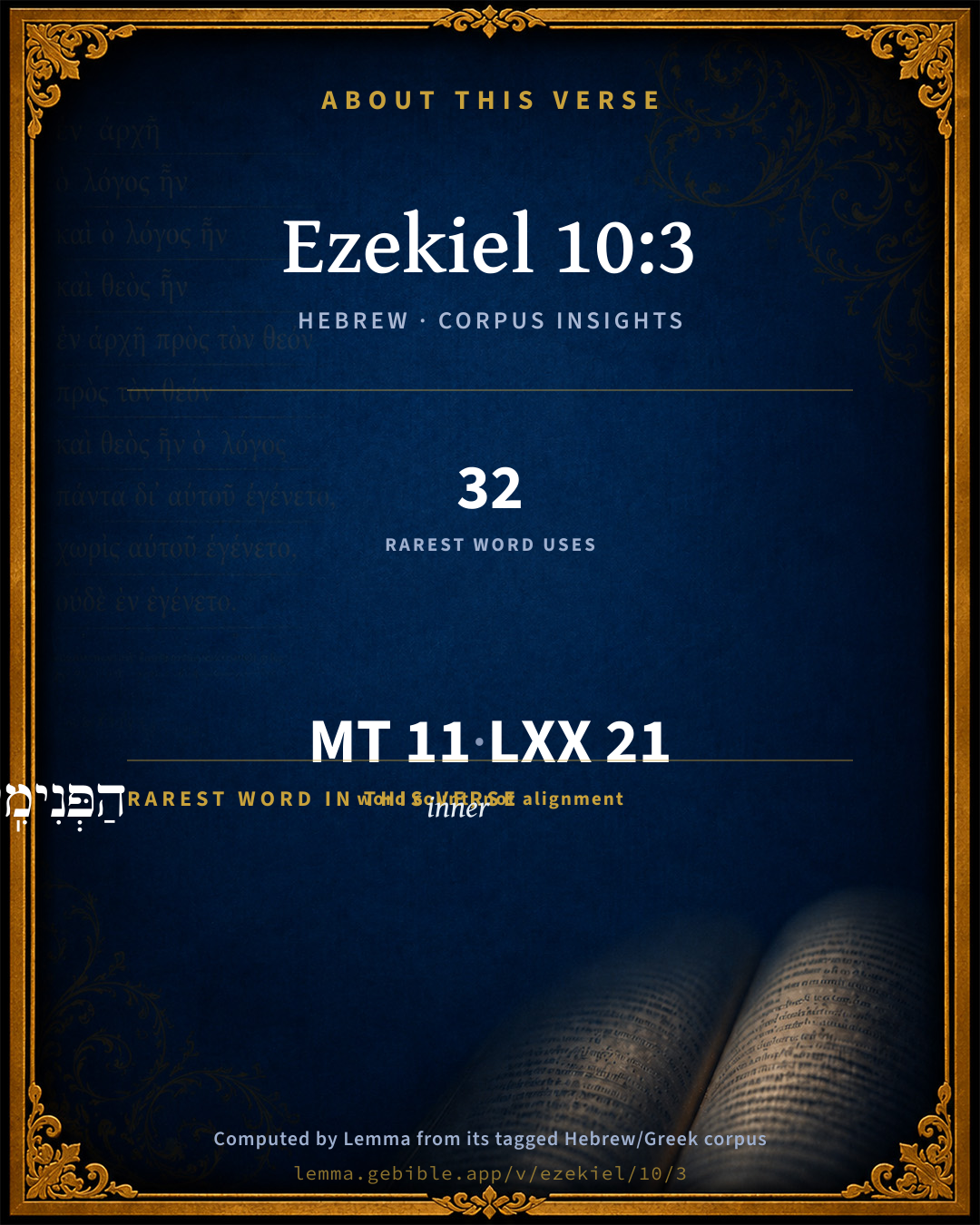
These counts appear in no published source. They are computed here, from the morphology-tagged text and Lemma’s own curated glosses. What Lemma adds →

11
words
11
distinct lemmas
Prophets
section

Shared distinctive vocabulary

הַפְּנִימִֽית inner H6442 occurs in 29 verses of the Hebrew Bible. Also found in:

Grammatical profile

  • 3 verbs
  • 6 nouns
  • 1 adjective
  • 1 particle

Verb forms

  • עֹֽמְדִ֛ים Qal · Participle Active
  • בְּבֹא֣וֹ Qal · Infinitive Construct
  • מָלֵ֔א Qal · Perfect

Hebrew & Septuagint length

In English translation the verse runs 23 words from the Hebrew and 23 from the Septuagint (LXX English) — the same length.

A rough comparison of the two English renderings, which tokenize alike — not a word-level alignment.

Word counts can differ between the Hebrew and the Greek without any difference in meaning — e.g. the Hebrew direct-object marker אֵת has no separate Greek word, and Greek often adds the article ὁ.

In the original languages it is 11 Hebrew tokens and 21 Greek tokens — but the two are counted differently (Hebrew bundles its prefixes and suffixes into one token; the Greek is in lemma form), so that isn’t a like-for-like length.

Cross-references

3

Topical passages linked to Ezekiel 10:3 in the Treasury of Scripture Knowledge — connected by theme and wording, ordered by reader-vote popularity; previews shown in the World English Bible.

  • Ezekiel 9:3 The glory of the God of Israel was gone up from the cherub, whereupon it was, to the threshold of the house: and he called to the man clothed in linen, who had the writer's inkhorn by his side.
  • Ezekiel 43:4 The glory of Yahweh came into the house by the way of the gate whose prospect is toward the east.
  • Ezekiel 8:16 He brought me into the inner court of Yahweh's house; and see, at the door of the temple of Yahweh, between the porch and the altar, were about twenty-five men, with their backs toward the temple of Yahweh, and their faces toward the east; and they were worshipping the sun toward the east.

Cross-references courtesy of OpenBible.info (CC BY 4.0).

Hebrew and Greek witnesses Masoretic Hebrew ↔ Greek Septuagint

The same verse in the two great witnesses to the Old Testament, shown verse-for-verse.

These are two independent witnesses, not word-aligned to each other, and the Septuagint is shown in lemma (dictionary) form.

Hebrew Ezekiel 10:3 Masoretic · Westminster Leningrad Codex

וְהַכְּרֻבִ֗ים עֹֽמְדִ֛ים מִימִ֥ין לַבַּ֖יִת בְּבֹא֣וֹ הָאִ֑ישׁ וְהֶעָנָ֣ן מָלֵ֔א אֶת הֶחָצֵ֖ר הַפְּנִימִֽית

Now the cherubim stood on the right side of the house, when the man went in; and the cloud filled the inner court.

World English Bible · Public Domain

Greek LXX Ezekiel 10:3 Septuagint · lemma form

καί ὁ χερουβείμ ἵστημι ἐκ δεξιός ὁ οἶκος ἐν ὁ εἰςπορεύομαι ὁ ἀνήρ καί ὁ νεφέλη πίμπλημι ὁ αὐλή ὁ ἐσώτερος

And the cherubs stood on the right hand of the house, as the man went in; and the cloud filled the inner court.

LXX2012 (modern English Septuagint) · Public Domain

Hebrew: Westminster Leningrad Codex (CC BY 4.0). Greek: Septuagint (public domain); English from LXX2012 (modern English Septuagint) (Public Domain). How the Septuagint differs from the Hebrew →

Targum (Aramaic paraphrase)

1

The Targum is the ancient Jewish Aramaic paraphrase of the Hebrew Scriptures — an interpretive translation, not the Hebrew text itself. Onkelos (literal) and Pseudo-Jonathan (expansive) render the Torah, and Jonathan the Prophets. Coverage is partial: where no permissively-licensed English translation exists for a verse, only the Aramaic is shown. This is verse-level text, not a word-by-word alignment to the Hebrew.

  1. Targum Jonathan Prophets (Joshua–Malachi)
    וּכְרוּבַיָא קַיְמִין מִדָרוֹם לְבֵיתָא בְּמֵיעַל גַבְרָא וַעֲנַן אֲמִיטְתָא אִתְמְלִיאַת יַת דַרְתָּא גַוַיְתָא:

    (no public-domain English translation for this verse)

    Targum Jonathan — Aramaic: “Mikraot Gedolot” (public domain). English: “Sefaria Community Translation” (CC0 1.0 (public-domain dedication)); “London "Chaldee Paraphrase," 1871” (public domain). Text via Sefaria.

Commentary

Notes on Ezekiel 10:3 from classic Christian and Jewish commentators (each source and its license shown beneath its notes). The classic Christian expositions comment on the surrounding passage and are grouped to its opening verse, so a note may address several verses; the Jewish commentaries on the Tanakh (Rashi and others) are per-verse, so they appear only where the commentator wrote on this verse.

Lemma curates 59 commentaries, every one of them public domain or Creative Commons licensed, each selected and text-cleaned for this edition rather than reprinted as found. About our sources →

Trapp's Complete Commentary

John Trapp

Eze 10:3 Now the cherubims stood on the right side of the house, when the man went in; and the cloud filled the inner court.

Ver. 3. Now the cherubims stood on the right side., ] i.e., On the south side; being now removed from the north door, {Eze 8:3-4; Eze 9:3} as loathing that place of so great idolatry.

And the cloud filled the inner court.] {a} To signify that now upon God’s departure, there should be darkness in the temple, yea, in the priests’ courts. See Psa 18:11 Rev 15:8.

{a} Significat sequentia tempora nubila fore. - Lav.

John Trapp, A Commentary or Exposition upon All the Books of the Old and New Testament (1647–1656) — public domain. Text from a community e-Sword module.

Tyndale Open Study Notes

Tyndale Open Resources

10:3-22 As if reluctant to leave, the glory of the Lord (10:4) moved slowly and haltingly, by stages. From above the cherubim in the Most Holy Place, it moved to the entrance of the Temple, paused, then hovered above the cherubim (10:18) and moved to the east gate of the courtyard (10:19), where it again paused. The glory of the Lord later left the city altogether (11:23).

Tyndale Open Study Notes — © Tyndale Open Resources, licensed CC BY-SA 4.0. Text via the HelloAO Bible API.

Jamieson, Fausset & Brown

Robert Jamieson, A. R. Fausset & David Brown

right . . . of . . . house--The scene of the locality whence judgment emanates is the temple, to mark God's vindication of His holiness injured there. The cherubim here are not those in the holy of holies, for the latter had not "wheels." They stood on "the right of the house," that is, the south, for the Chaldean power, guided by them, had already advanced from the north (the direction of Babylon), and had destroyed the men in the temple, and was now proceeding to destroy the city, which lay south and west.

the cherubim . . . the man--There was perfect concert of action between the cherubic representative of the angels and "the Man," to minister to whom they "stood" there (Eze 10:7).

cloud--emblem of God's displeasure; as the "glory" or "brightness" (Eze 10:4) typifies His majesty and clearness in judgment.

Jamieson, Fausset & Brown — Commentary Critical and Explanatory on the Whole Bible (1871) — public domain (CC PDM 1.0). Text via the HelloAO Bible API.

Adam Clarke's Commentary

Verse 3. On the right side of the house] The right hand always marked the south among the Hebrews.

Adam Clarke's Commentary on the Bible (1810–1826) — public domain. Text from a community e-Sword/MySword module.

John Calvin's Commentaries

Here the Prophet relates where the cherubim were when the men entered, which looks only to the certainty of the prophecy. For we are not here to seek any cunning speculations why they were on the right hand. It is only intended to show that the way was open to the angel to approach directly to God, and that the cherubim were disposed there to render their assistance; for there ought to be an agreement between the angel who took the fire which he scattered through the whole city, and the cherubim who carried all the angels. Here the Prophet shows this agreement, because the cherubim were turned to the right hand when he entered, so that God was at hand; then also the cherubim were at. hand, and thus the wheels bore along the fire.

Now we understand the intention of what we read. The interior court was filled with a cloud: doubtless this signifies, that God by all means confirmed the vision, that no suspicion should creep in that the Prophet was deluded with an empty spectra (Exodus 40:34, 35; Numbers 9:15.) This therefore is the reason why God not only appeared on his heavenly throne, but also filled the temple with a cloud; although, as I have said before, this cloud was a symbol of God’s alienation, (1 Kings 8:10, 11; Psalm 18:12,) and we know that the sanctuary was filled with a cloud, although God then wished to testify his paternal favor: but in this place and elsewhere, as in Psalm 18, and in other places, a cloud seems to signify the averted face of God, as if the temple was full of darkness. And this afterwards is better confirmed; for he says —

John Calvin's Commentaries (1540-1563) — public domain. Text from the Calvin Translation Society English edition (1840s-50s) via the Christian Classics Ethereal Library (ccel.org). Calvin's coverage is partial (roughly two-thirds of the Bible); uncommented books and verses are honest gaps, never fabricated. The 19th-century editor's footnotes and remarks are omitted so the notes are faithfully Calvin's own voice.

The Cambridge Bible for Schools and Colleges

gen. ed. J. J. S. Perowne

3. the right side of the house] i.e. on the south of the temple proper. It is difficult to see any significance in the position of the cherubim, except that the south side of the house was more in the direction of the city than either the north or east side, and the west side was closed by buildings.

The Cambridge Bible for Schools and Colleges (gen. ed. J. J. S. Perowne; Cambridge University Press, 1878–1918) — public domain. Text from a community e-Sword module.

John Gill's Exposition

Now the cherubim stood on the right side of the house,.... According to the Targum, it was the south side of the house; and so Jarchi interprets it opposite to the north, where the gross idolatries were committed, Eze 8:3; standing at the greatest distance from them, and bearing their testimony against them:

when the man went in; they stood as it were in a levee, through which the man passed, waiting upon him; paying a respect to him; assenting to what he did; and approving of it: this circumstance is mentioned, because they were not always in this position, only at this time; nor did they continue so; we afterwards hear of their motion:

and the cloud filled the inner court; the court of the priests, not as a token of God's presence, as at the dedication of the temple; but rather of judicial blindness and darkness, which the people of the Jews were left unto.

John Gill's Exposition of the Whole Bible (1746–1763) — public domain (CC PDM 1.0). Text via the HelloAO Bible API.

Albert Barnes' Notes on the Bible

On the right side - On the south Eze 47:2. The idolatries had been seen on the north side. On the south stood the “cherubim” ready to receive and bear away the glory of the Lord.

Albert Barnes' Notes on the Bible (1834–1885) — public domain. Text from a community e-Sword/MySword module.

Haydock's Catholic Bible Commentary

Right, south of the priests’ court.

George Leo Haydock (1774–1849), Haydock's Catholic Family Bible and Commentary, 1859 edition — public domain. Excludes Psalms (Douay-Rheims chapter numbering differs from Protestant) and Deuterocanonical books (Catholic canon only).

Matthew Poole's English Annotations

Stood, as servants, and ready, waiting for orders.

On the right side; the north side, i.e. say some, the side toward Babylon, from whence the desolation, that fire, came which consumed the city.

The man; Christ, the Lord of angels, who now attend his coming and commands.

The cloud; as the sign of God’s presence, so an emblem of the troubles and darkness of afflictions coming upon Jerusalem.

The inner court; the court of the priests, who were, as it appears, chief in the apostacy and idolatry, and shall now be chief in the misery and ruin which overwhelmed them about five years after.

Matthew Poole's English Annotations on the Holy Bible (1683–1685) — public domain. Text from a community e-Sword/MySword module.

Whedon's Commentary on the Bible

Daniel D. Whedon

3. Right side — Or, south side — of the temple. Ezekiel, coming through the north door into the outer court of the sanctuary, sees just in front of him the cherubim and the throne. He states the position in order to show that he had the best possible opportunity to see what happened when the man went into the fire.

Daniel D. Whedon (gen. ed.), Commentary on the Old and New Testaments (1874–1909) — public domain. Text from a community e-Sword module.

The Pulpit Commentary

Vers 3, 4. Now the cherubim stood, etc. The position of the cherubim is defined, with a vivid distinctness of detail, which once more reminds us of Dante. They had been standing on the right, i.e. the southern side of the sanctuary. What follows is probably a reproduction of the change of positions described in Eze_9:3, and the verbs should be taken, therefore, as pluperfects. The cloud of glory, as in 1Ki_8:10, 11 and Isa_6:1, Isa_6:2, the Shechinah, that was the taken of the Divine presence, filled the court, but the glory itself had moved to the threshold at the first stage of its departure.

The Pulpit Commentary (1880–1919), ed. H.D.M. Spence-Jones & Joseph S. Exell — public domain. Text from a community e-Sword module.

John Wesley's Explanatory Notes

The right side - The north-side, the side towards Babylon, from whence the fire came which consumed the city. The man - Christ, the Lord of angels, who now attend his coming and commands. The cloud - As the sign of God's presence. The inner court - The court of the priests, who were chief in the apostacy.

John Wesley, Explanatory Notes Upon the Whole Bible (1754–1765) — public domain. Text via the GEBible commentary corpus.

unfoldingWord translationNotes

Door43 World Missions Community

Connecting Statement:

Ezekiel interrupts his description of what was happening and describes what he saw.

The cherubim stood ... inner courtyard

This is background information for the events that follow. (See: Background Information)

cherubim

See how you translated this in Ezekiel 9:3.

on the right side

As one faces east, "the right side" is toward the south. AT: "on the south side" (See: Assumed Knowledge and Implicit Information)

the house

the temple

The glory of Yahweh

See how you translated this in Ezekiel 1:28.

It filled

the glory of Yahweh filled

translationWords

cherub

house

court

glory

Yahweh

threshold

voice

God

Almighty

unfoldingWord translationNotes — © Distant Shores Media and the Door43 World Missions Community, licensed CC BY-SA 4.0. Source: git.door43.org/Door43/en_tn.

Rashi

Rabbi Shlomo Yitzchaki (Rashi)

at the right of the House In the south [of the Temple].

the inner court This is the Temple court.

Rashi on the Tanakh — English translations: “The Judaica Press complete Tanach with Rashi, translated by A. J. Rosenberg” (CC BY 4.0); “Pentateuch with Rashi's commentary by M. Rosenbaum and A.M. Silbermann, 1929-1934” (public domain); “The Metsudah Tanach series, Lakewood, N.J” (CC BY 4.0); and “The Book of Joshua, Metsudah Publications, 1997” (CC BY 4.0). Text via Sefaria.

Lesson kit

Teaching starters — assembled from the data on this page, not authored interpretation. Every prompt links to the verse data it draws on. Edit before teaching.

Ezekiel, in the Prophets, opens this verse with 11 words (11 distinct Hebrew lemmas). Its most distinctive word is pᵉnîymîy (“inner”). A historical commentator’s framing appears above. Read the whole chapter for the surrounding context.

Discussion questions

  1. The word pᵉnîymîy carries the sense “inner.” How does it shape the verse?
  2. How does 1 Kings 6:27, which shares the word «inner», read alongside this verse?
  3. The translations on this page render this verse differently — a whole-verse word diff, not a word-by-word alignment. What might account for the different wordings?
  4. «עֹֽמְדִ֛ים» is a Qal Participle Active verb. How does that grammatical form shape the action described?
  5. Compare how Trapp's Complete Commentary and Tyndale Open Study Notes read this verse. Where do they agree or differ?

Things to notice

Reading settings

Reading text

Shown beneath each verse's original-language words.

Old Testament
Old Testament edition

Read the OT as the Masoretic Hebrew (MT) or the Greek Septuagint (LXX).

English shown for the Greek Septuagint (in the Hebrew ↔ Greek comparison).

Comparing translations? Open the Compare panel on any verse page to stack up to four side by side.