

Ecclesiastes 10:18

Hebrew (Westminster Leningrad Codex) Ecclesiastes 10:18 appears in the Hebrew Old Testament. The text above is from the Westminster Leningrad Codex. Each word links to its Strong’s number, a concise gloss, and parsing drawn from the Open Scriptures Hebrew Bible morphology. Click any word for its full Brown-Driver-Briggs (BDB) entry.
Download image
Cite this verse

Ecclesiastes 10:18 (World English Bible). Public Domain. Lemma interlinear Bible study tool, https://lemma.gebible.app/v/ecclesiastes/10/18.

Show BibTeX & RIS
BibTeX
RIS
English Translation
By slothfulness the roof sinks in; And through idleness of the hands the house leaks.
World English Bible · Public Domain
Highlights Full analysis ↓
Download a study sheet

One document with this verse’s original text, its word-by-word gloss line, the meaning frame, cross-references with their text, attributed commentary, and full source and license credits — printable, and it pastes into notes with its structure intact.

This verse Autodidact and up

Study sheet (.html) Plain text (.txt)

A passage Seminary Student

Up to 50 verses in one chapter. A passage sheet keeps up to 6 commentary sources and 12 cross-references per verse, in the order this page ranks them, and says so on the sheet whenever that leaves anything out. Ask for a single verse and you get the Autodidact verse sheet above.

Everything on this page stays free to read, with no account — the sheet is a download of what is already on screen, not access to it.

Want to remove ads? Support Godless Engineer
Compare translations 3

The same verse in 3 English versions, stacked beneath the original-language interlinear above. Click any original word for its lexicon entry.

Each is an independent rendering of the whole verse — the interlinear is not word-aligned to these translations.

Highlighted words mark where these versions differ — a whole-verse word diff, not a word-by-word alignment.

  • World English Bible Public Domain
    By slothfulness the roof sinks in; And through idleness of the hands the house leaks.
  • King James Version Public Domain
    By much slothfulness the building decayeth; and through idleness of the hands the house droppeth through.
  • unfoldingWord Literal Text CC BY-SA 4.0
    With laziness, the beams of the roof sink, and in idleness of hands, the house will leak.

unfoldingWord Literal Text — © unfoldingWord, licensed CC BY-SA 4.0. Word-aligned USFM3 via Door43 (git.door43.org/unfoldingWord/en_ult).

Versions to compare (up to 4)

3 of 4 selected

Show all 18 translations

Every available English version of this verse, each an independent rendering of the whole verse.

  • World English Bible Public Domain
    By slothfulness the roof sinks in; And through idleness of the hands the house leaks.
  • Berean Standard Bible Public Domain
    Through laziness the roof caves in, and in the hands of the idle, the house leaks.
  • Majority Standard Bible Public Domain
    Through laziness the roof caves in, and in the hands of the idle, the house leaks.
  • King James Version Public Domain
    By much slothfulness the building decayeth; and through idleness of the hands the house droppeth through.
  • American Standard Version (1901) Public Domain
    By slothfulness the roof sinketh in; and through idleness of the hands the house leaketh.
  • Revised Version (1885) Public Domain
    By slothfulness the roof sinketh in; and through idleness of the hands the house leaketh.
  • Geneva Bible (1599) Public Domain
    By slouthfulnes the roofe of the house goeth to decaie, and by the ydlenesse of the handes the house droppeth through.
  • Douay-Rheims (1899) Public Domain
    By slothfulness a building shall be brought down, and through the weakness of hands, the house shall drop through.
  • Young's Literal Translation Public Domain
    By slothfulness is the wall brought low, And by idleness of the hands doth the house drop.
  • Literal Standard Version CC BY-SA 4.0
    By slothfulness is the wall brought low, || And by idleness of the hands the house drops.
  • Unlocked Literal Bible CC BY-SA 4.0
    Because of laziness the roof sinks in, and because of idle hands the house leaks.
  • unfoldingWord Literal Text CC BY-SA 4.0
    With laziness, the beams of the roof sink, and in idleness of hands, the house will leak.
  • Darby Bible Public Domain
    By much sloth fulness the framework falleth in; and through idleness of the hands the house drippeth.
  • World Messianic Bible Public Domain
    By slothfulness the roof sinks in; and through idleness of the hands the house leaks.
  • Webster's Bible Public Domain
    By much slothfulness the building decayeth; and through idleness of the hands the house droppeth through.
  • Free Bible Version CC BY-SA 4.0
    Lazy people let their roofs collapse; idle people don't repair their leaky houses.
  • Bible in Basic English Public Domain
    When no work is done the roof goes in, and when the hands do nothing water comes into the house.
  • JPS Tanakh (1917) Public Domain
    By slothfulness the rafters sink in; and through idleness of the hands the house leaketh.

Literal Standard Version (2020), Covenant Press — licensed CC BY-SA 4.0. Text via the HelloAO Bible API (eBible.org). Unlocked Literal Bible (unfoldingWord) — licensed CC BY-SA 4.0. Text via the HelloAO Bible API (eBible.org). unfoldingWord Literal Text — © unfoldingWord, licensed CC BY-SA 4.0. Word-aligned USFM3 via Door43 (git.door43.org/unfoldingWord/en_ult). Free Bible Version, Dr. Jonathan Gallagher — licensed CC BY-SA 4.0. Text via the HelloAO Bible API (eBible.org).

Word by word

More ways to search: Search by grammar → Find every occurrence → Compare this word →

Practice this passage: Drill this verse → Learn its vocabulary →

About this verse

These counts appear in no published source. They are computed here, from the morphology-tagged text and Lemma’s own curated glosses. What Lemma adds →

7
words
7
distinct lemmas
Wisdom
section

Notable vocabulary

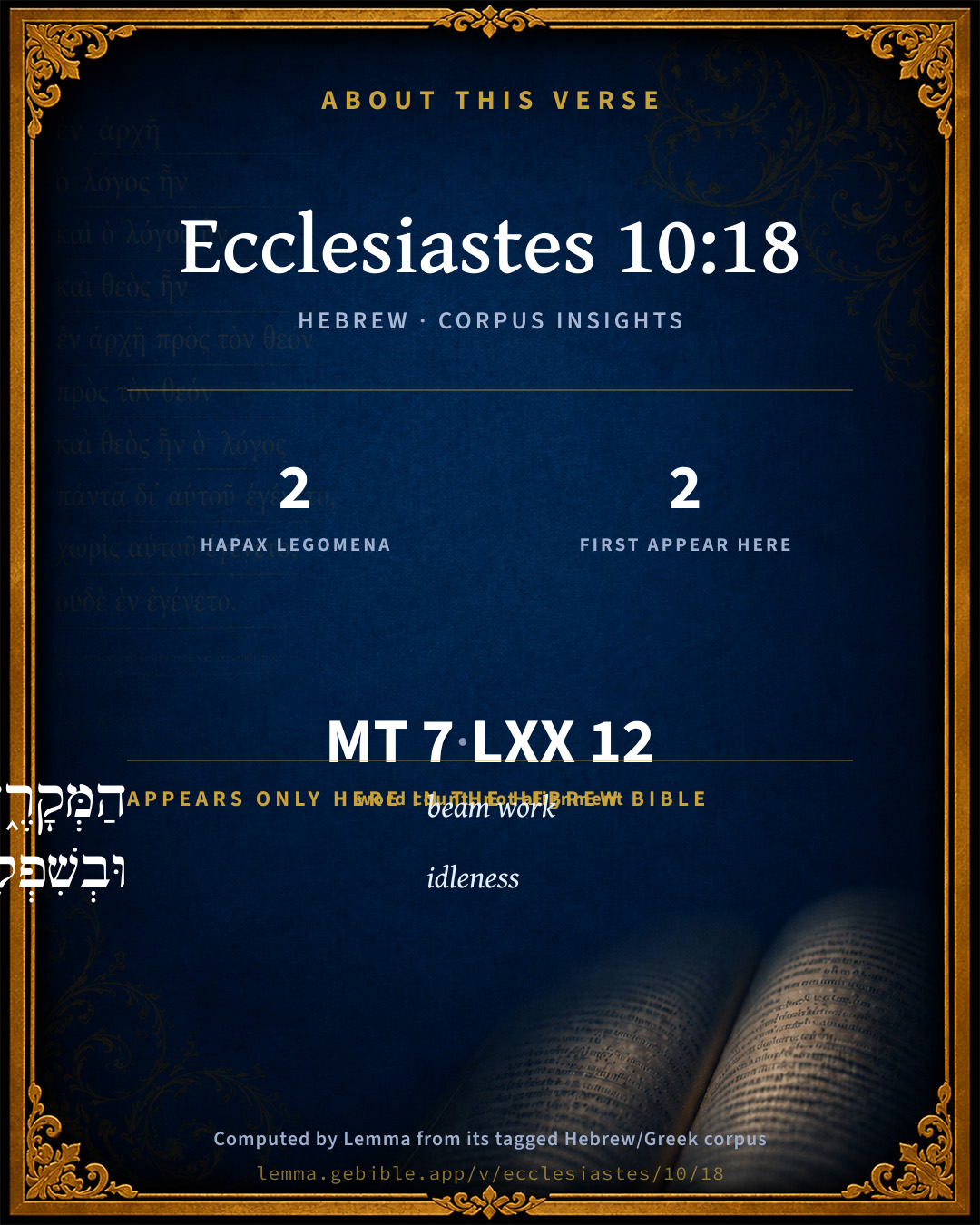
2 hapax legomena — words that appear only here in the entire Hebrew Bible:

  • הַמְּקָרֶ֑ה beam work H4746
  • וּבְשִׁפְל֥וּת idleness H8220

First appearance in Scripture

These words make their first canonical appearance in the Hebrew Bible here:

  • הַמְּקָרֶ֑ה beam work H4746
  • וּבְשִׁפְל֥וּת idleness H8220

Shared distinctive vocabulary

בַּעֲצַלְתַּ֖יִם laziness H6103 occurs in 2 verses of the Hebrew Bible. Also found in:

Grammatical profile

  • 2 verbs
  • 5 nouns

Verb forms

  • יִמַּ֣ךְ Niphal · Imperfect
  • יִדְלֹ֥ף Qal · Imperfect

Hebrew & Septuagint length

In English translation the verse runs 15 words from the Hebrew and 21 from the Septuagint (LXX English) — the Septuagint runs noticeably longer here. See the side-by-side →

A rough comparison of the two English renderings, which tokenize alike — not a word-level alignment.

Word counts can differ between the Hebrew and the Greek without any difference in meaning — e.g. the Hebrew direct-object marker אֵת has no separate Greek word, and Greek often adds the article ὁ.

In the original languages it is 7 Hebrew tokens and 12 Greek tokens — but the two are counted differently (Hebrew bundles its prefixes and suffixes into one token; the Greek is in lemma form), so that isn’t a like-for-like length.

Cross-references

8

Topical passages linked to Ecclesiastes 10:18 in the Treasury of Scripture Knowledge — connected by theme and wording, ordered by reader-vote popularity; previews shown in the World English Bible.

  • Proverbs 14:1 Every wise woman builds her house, But the foolish one tears it down with her own hands.
  • Proverbs 20:4 The sluggard will not plow by reason of the winter; Therefore he shall beg in harvest, and have nothing.
  • Proverbs 24:30–34 I went by the field of the sluggard, By the vineyard of the man void of understanding;
  • Proverbs 21:25 The desire of the sluggard kills him, For his hands refuse to labor.
  • Proverbs 23:21 For the drunkard and the glutton shall become poor; And drowsiness clothes them in rags.
  • Hebrews 6:11 We desire that each one of you may show the same diligence to the fullness of hope even to the end,
  • Proverbs 12:24 The hands of the diligent ones shall rule, But laziness ends in slave labor.
  • 2 Peter 1:5–10 Yes, and for this very cause adding on your part all diligence, in your faith supply moral excellence; and in moral excellence, knowledge;

Cross-references courtesy of OpenBible.info (CC BY 4.0).

Hebrew and Greek witnesses Masoretic Hebrew ↔ Greek Septuagint

The same verse in the two great witnesses to the Old Testament, shown verse-for-verse.

Here the Septuagint runs noticeably longer than the Hebrew — LXX2012 (modern English Septuagint) 21 words vs World English Bible 15. A rough length comparison of the two English translations, not a word-level alignment — read both below.

These are two independent witnesses, not word-aligned to each other, and the Septuagint is shown in lemma (dictionary) form.

Hebrew Ecclesiastes 10:18 Masoretic · Westminster Leningrad Codex

בַּעֲצַלְתַּ֖יִם יִמַּ֣ךְ הַמְּקָרֶ֑ה וּבְשִׁפְל֥וּת יָדַ֖יִם יִדְלֹ֥ף הַבָּֽיִת

By slothfulness the roof sinks in; And through idleness of the hands the house leaks.

World English Bible · Public Domain

Greek LXX Ecclesiastes 10:18 Septuagint · lemma form

ἐν ὀκνηρία ταπεινόω ὁ δόκωσις καί ἐν ἀργία χείρ στάζω ὁ οἰκία

By slothful neglect a building will be brought low: and by idleness of the hands the house will fall to pieces.

LXX2012 (modern English Septuagint) · Public Domain

On this verse, The Pulpit Commentary discusses the Septuagint’s reading. Read the note in Commentary ↓

Hebrew: Westminster Leningrad Codex (CC BY 4.0). Greek: Septuagint (public domain); English from LXX2012 (modern English Septuagint) (Public Domain). How the Septuagint differs from the Hebrew →

Commentary

Notes on Ecclesiastes 10:18 from classic Christian and Jewish commentators (each source and its license shown beneath its notes). The classic Christian expositions comment on the surrounding passage and are grouped to its opening verse, so a note may address several verses; the Jewish commentaries on the Tanakh (Rashi and others) are per-verse, so they appear only where the commentator wrote on this verse.

Lemma curates 59 commentaries, every one of them public domain or Creative Commons licensed, each selected and text-cleaned for this edition rather than reprinted as found. About our sources →

Trapp's Complete Commentary

John Trapp

Ecc 10:18 By much slothfulness the building decayeth; and through idleness of the hands the house droppeth through.

Ver. 18. By much slothfulness the building decayeth.] So doth the commonwealth not sheltered with good government; for, as the householder is in his house, so is the magistrate in the city, and the king in his dominions. In his palace he may see a pattern of his kingdom, a draught of his city. Especially if it be, as George Prince of Anhalt’s was, ecclesia, academia, curia, a church, a university, and a court. For the better despatch of civil businesses, there was daily praying, reading, writing, yea, and preaching too, as Melanchthon and Scultetus report. {a} Here was no place for sloth and sluggishness within this most pious prince’s territories. His house was built of cedar beams, {Son 1:17} of living stones; {1Pe 2:5} his polity a theocracy, as Josephus saith of the Jewish Government; and of his people it might be said, as Polydor Virgil saith of the English, Regnum Anglicae regnum Dei. Oh, the blessednesses of such a country!

And through idleness of the hands the house droppeth, &c.] Stillicldia praecedunt ruinam, de poenas gravissimas, leviores, saith Jerome. If course be not timely taken, the house will run to ruiu for want of people or reparation; so will that person that takes not warning by lighter punishments. Surely, as one cloud follows another, till the sun disperseth them, so do judgments - greater succeed lesser, till men, meeting God by repentance, disarm his wrath.

{a} Melch. Adam in Vit. Melanch.

John Trapp, A Commentary or Exposition upon All the Books of the Old and New Testament (1647–1656) — public domain. Text from a community e-Sword module.

Joseph Benson's Commentary

Ecc 10:18. By much slothfulness, &c., the house droppeth through — That house which is neglected by its owner, and not repaired, must needs come to ruin. Whereby he intimates that the sloth and carelessness of princes, in the management of public affairs, which is a usual attendant on that luxury of which he now spoke, is most destructive to themselves and to their people.

Joseph Benson's Commentary on the Old and New Testaments (1811–1818) — public domain. Text from a community e-Sword module.

Tyndale Open Study Notes

Tyndale Open Resources

10:18 Delay in repairing a roof leads to drooping rafters and eventually to the ruin of the home (see Prov 12:27; 20:4). Corruption in government has a similar effect (Eccl 10:15-16).

Tyndale Open Study Notes — © Tyndale Open Resources, licensed CC BY-SA 4.0. Text via the HelloAO Bible API.

Jamieson, Fausset & Brown

Robert Jamieson, A. R. Fausset & David Brown

building--literally, "the joining of the rafters," namely, the kingdom (Ecc 10:16; Isa 3:6; Amo 9:11).

hands-- (Ecc 4:5; Pro 6:10).

droppeth--By neglecting to repair the roof in time, the rain gets through.

Jamieson, Fausset & Brown — Commentary Critical and Explanatory on the Whole Bible (1871) — public domain (CC PDM 1.0). Text via the HelloAO Bible API.

Adam Clarke's Commentary

Verse 18. By much slothfulness] This is remarkably the case in some countries. Houses are not repaired till they almost fall about the ears of the inhabitants. We have an adage that applies to all such cases: "A stitch in time saves nine."

Adam Clarke's Commentary on the Bible (1810–1826) — public domain. Text from a community e-Sword/MySword module.

Ellicott's Commentary for English Readers

(18) Droppeth—i.e., lets the rain drop through.

A Bible Commentary for English Readers, edited by Charles John Ellicott (1878–1897) — public domain. Text from a community e-Sword module.

The Cambridge Bible for Schools and Colleges

gen. ed. J. J. S. Perowne

18. By much slothfulness the building decayeth] The maxim, though generalised in form, and applicable to every form of the evil which it condemns, may fairly be contemplated, in relation to its context, as having a political bearing. There, laissez-faire, the policy of indolent procrastination, may be as fatal to the good government and prosperity of a state as the most reckless profligacy. The figure is singularly apt. The fabric of a state, like that of the house (Amo_9:11), needs from time to time to be surveyed and repaired. “Time,” as Bacon has said, “alters all things” (houses of both kinds included) “for the worse.” “The timber framework of the house decays.” The decay may be hidden at first (this seems the point implied in the relation of the two parts of the proverb) but the latent cause soon shews itself in a very patent effect, “The house lets in the rain,” there is the “continual dropping,” the “drip, drip, drip,” which, to the householder seeking comfort, is the type of all extremest discomfort (Pro_19:13). Delitzsch quotes a curious Arab proverb that “there are three things that make a house intolerable, rain leaking through the roof, an ill-tempered wife, and the cimex lectularius.” So is it with the state. The timbers are the fundamental laws or principles by which its fabric is supported. Corruption or discord (the “beginning of strife” which is “as when one letteth out of water,” Pro_17:14) is the visible token that these are worm-eaten and decayed through long neglect.

The Cambridge Bible for Schools and Colleges (gen. ed. J. J. S. Perowne; Cambridge University Press, 1878–1918) — public domain. Text from a community e-Sword module.

John Gill's Exposition

By much slothfulness the building decayeth,.... Or, "by slothfulnesses" (g), The word is in the dual number, and so may signify the slothfulness of the hands, as Aben Ezra, of both hands, and of both feet; or the various kinds of slothfulness, as the Arabic version, slothfulness both of body and mind; or of all sorts of persons, superiors and inferiors, princes and subjects; and with respect to all things present and future: and, as through slothfulness a material building decays; or a "beam", as the word signifies, the raftering of a house, the roof, which consists of rafters and beams joined together when the tiling is decayed by winds and rains, or any breaches made in the rafters, and no care taken to repair, the whole falls in, and the house is in ruins: so figurative buildings, families, churches, and kingdoms, come to nothing, through the sluggishness of masters of families, ministers of the word, and civil magistrates; to the latter of which more especially this is to be applied, who give up themselves to luxury and sloth;

and, through idleness of the hands, the house droppeth through; or, "through the letting" or "hanging down of the hands" (h); the remissness of them, as is to be observed in idle persons, who will not lift them up to work; particularly to repair a breach in a house, by means of which the rain drops through it, and makes it uncomfortable and unsafe being in it; and, in process of time, that itself drops to the ground: and this expresses the same thing, how, through the neglect of the civil magistrate, a commonwealth comes to nothing; or, however, the members of it become wretched and miserable.

(g) "in pigritiis", Montanus; "per duplicem pigritiam", Tigurine version; "pigritia amborum", Junius & Tremellius. (h) "per remissionem", Tigurine version; "demissione", Junius & Tremellius, Piscator, Gejerus; so Cocceius, Rambachius.

John Gill's Exposition of the Whole Bible (1746–1763) — public domain (CC PDM 1.0). Text via the HelloAO Bible API.

Haydock's Catholic Bible Commentary

CHAPTER X.

Through. If we neglect our own, or other’s soul, (Haydock) in the administration of Church, (St. Jerome) or state, all will go to ruin.

George Leo Haydock (1774–1849), Haydock's Catholic Family Bible and Commentary, 1859 edition — public domain. Excludes Psalms (Douay-Rheims chapter numbering differs from Protestant) and Deuterocanonical books (Catholic canon only).

Matthew Poole's English Annotations

That house which is neglected by its owner, and not repaired, must needs come to ruin; whereby he intimates that the sloth and carelessness of princes in the management of public affairs, which is a usual attendant upon that luxury of which he hath now discoursed, is most destructive, both to themselves and to their people.

Matthew Poole's English Annotations on the Holy Bible (1683–1685) — public domain. Text from a community e-Sword/MySword module.

Whedon's Commentary on the Bible

Daniel D. Whedon

18. The condition of the state in the hands of such rulers as are mentioned Ecc_10:16 is compared to that of a neglected building.

By much slothfulness — Hebrew, By slothful hands; through neglect the beams decay and the roof leaks.

Daniel D. Whedon (gen. ed.), Commentary on the Old and New Testaments (1874–1909) — public domain. Text from a community e-Sword module.

The Pulpit Commentary

By much slothfulness the building decayeth. The subject is still the state. Under the image of a house which falls into ruin for lack of needful repairs, is signified the decay that surely overtakes a kingdom whose rulers are given up to indolence and debauchery, and neglect to attend to the affairs which require prompt care. (comp. Amo_9:11) Such were they whom Amos (Amo_6:6) denounced, "That drink wine in bowls, and anoint themselves with the chief ointments; but they are not grieved for the affliction of Joseph." "Much slothfulness" is expressed in the original by a dual form, which gives an intensive signification. Ewald and Ginsburg take it as referring to the "two idle hands;" but the intensifications of the dual is not unprecedented (see Delitzsch, in loc.). The rest of this clause is more accurately rendered, the rafters sink, i.e. the timber framework, whether of roof or wall, gives way. This may possibly not be noticed at once, but it makes itself known unmistakably ere long. And through idleness of the hands the house droppeth through; rather, the house leaketh, the roof lets in the rain. Septuagint, jEn ajrcia ceirwn staxei hJ oijkia, "Through laziness of hands the house will drip." The very imperfect construction of the fiat roofs of Eastern houses demanded continual attention. Such common and annoying occurrences as a leaky roof are mentioned in the Book of Proverbs. (see Pro_19:13 Pro_27:15) Plautus, "Mostell.," 1:2.28

Ventat imber, lavit parietes; perpluunt Tigna; putrefacit aer operam fabri." "The rain comes down, and washes all the walls, The roof is leaky, and the weather rough Loosens the architect"s most skilful work.

The curse of sloth.

Religious teachers are sometimes unwilling to touch upon common faults, such as are noticeable by every observer as prevailing too generally in the everyday life of their fellow-men. The Scriptures give no countenance to such negligence, but, on the contrary, deal faithfully with those errors and evil habits which are alien from the Christian character, and which are injurious to: human society. Slothfulness was peculiarly hateful to the writer of this book, who inculcated diligence as a religious duty, and exhibited in homely but effective ways the results of its prevalence.

I TEMPTATIONS TO SLOTH ARE MANY. Work must be done, some will admit; but it may be left to others, or it may be put off to a more convenient season. Work need not be done, others will declare; much may be left undone which some people think of importance, but which is not really so. Upon the plea of ill health, or mental inability, or preoccupation, multitudes, in this world where there is so much to be done, sink into slothful, indolent habits and a useless life,

II THE FOLLY OF SLOTH IS EASILY MADE EVIDENT.

1. The slothful man is his own enemy. Had he exerted himself and exercised his powers, he would have grown an abler and a better man. Who does not know persons with undeniable gifts who have "wrapped their talent in a napkin," and who have morally deteriorated, until they have become worthless members of society?

2. The slothful man wrongs society. Every man is born into this world to do a work for the general good. To live in idleness and comfort upon the produce of others" toil is to inflict a positive injury. Others have to labor in order that the idle may be fed. Work is left undone for which the indolent possess, it may be, some peculiar gift. For the life of the slothful the world is none the better.

III THE SIN OF SLOTH IS CONDEMNED BY THE WORD OF GOD. The Book of Proverbs contains some very striking reflections and statements upon this point. And for the Christian it is enough to consider the example of the Lord Jesus, who with all his consecrated energy devoted himself to his Father"s will and work. How alien from the Master"s spirit is the habit of the indolent! We cannot lose sight of the fact that, in the last judgment, the "wicked and slothful servant" must hear words of condemnation.

IV PRESERVATIVES FROM SLOTH MAY BE FOUND IN THE PROVISIONS OF GOD"S GRACE.

1. Prayer prompts to watchfulness and toil.

2. Attention to the counsels and admonitions of God"s Word cannot fail to be serviceable in delivering us from temptations to slothfulness.

3. Meditation upon the example of our Savior and Lord will stimulate to diligence and zeal. They who by the indwelling of his Spirit are one with him will share his devotion to the Father"s will, his consecration to the welfare of mankind. T.

The Pulpit Commentary (1880–1919), ed. H.D.M. Spence-Jones & Joseph S. Exell — public domain. Text from a community e-Sword module.

Keil & Delitzsch

C. F. Keil & F. Delitzsch

Since, now, Ecc 10:19 has only to do with princes, the following proverb of the consequences of sloth receives a particular reference in the frame of this mirror for princes: "Through being idle the roof falleth; and through laziness of the hands the house leaketh." Ewald, Redslob, Olsh., Hitz., and Frst, as already Aben Ezra, understand the dual עצל of the two idle hands, but a similar attribut. adject.-dual is not found in Heb.; on the contrary, ephraim, merathaim Jer 50:21, rish'athaim, and, in a certain measure, also riqmathaim, speak in favour of the intensification of the dual; 'atsaltaim is related to 'atslah, as Faulenzen being idle, living in idleness to Faulheit laziness, it means doubled, i.e., great, constant laziness (Gesen. H. Wrt., and Bttch. in the N. Aehrenl., under this passage). If 'atsaltaim were an attribut. designation of the hands, then shiphluth hadaim would be lowness, i.e., the hanging down of the hands languidly by the side; the former would agree better with the second than with the first passage. Regarding the difference between hammeqareh (the beams and joists of a house) and hamqareh (contignans), vid., note below.

(Note: המּקרה, with mem Dageshed (Masora: לית דגש); in Psa 104:3, on the contrary, the mem has Raphe, for there it is particip. (Michlol 46a; Parchon's Lex. f. 3, col. 1).)

Since exceeding laziness leaves alone everything that could support the house, the beams fall (ימּך, Niph. מכך), and the house drops, i.e., lets the rain through (ידלף, with o, in spite of the intrans. signification); cf. the Arab. proverb of the three things which make a house insufferable, under Pro 19:13. Also the community, whom the king and the nobles represent, is a בּית, as e.g., Israel is called the house of Jacob. If the rulers neglect their duty, abusing their high position in obeying their own lusts, then the kingdom (state) becomes as a dilapidated house, affording no longer any protection, and at last a machshelah, a ruined building, Isa 3:6. It becomes so by slothfulness, and the prodigal love of pleasure associated therewith.

Keil & Delitzsch — Biblical Commentary on the Old Testament (1861–1891) — public domain (CC PDM 1.0). Text via the HelloAO Bible API. (Old Testament only.)

unfoldingWord translationNotes

Door43 World Missions Community

Because of laziness the roof sinks in

A lazy person does not keep up on the regular house maintenance. AT: "Because a lazy person does not repair his house, the roof sinks in" (See: Assumed Knowledge and Implicit Information)

because of idle hands

Here a person is represented by his "hands" AT: "because of an idle person" or "because the person is idle" (See: Synecdoche)

the house leaks

Here the roof is represented by the whole house. AT: "the roof leaks" (See: Synecdoche)

People prepare food for laughter

The word "laughter" can be expressed as a verb. AT: "People prepare food in order to laugh" (See: Abstract Nouns)

wine brings enjoyment to life

The word "enjoyment" can be expressed as a verb. AT: "wine helps people to enjoy life" (See: Abstract Nouns)

money fills the need for everything

Possible meanings are 1) "money provides for every need" or 2) "money provides for both food and wine"

translationWords

wine

life

unfoldingWord translationNotes — © Distant Shores Media and the Door43 World Missions Community, licensed CC BY-SA 4.0. Source: git.door43.org/Door43/en_tn.

Rashi

Rabbi Shlomo Yitzchaki (Rashi)

Through laziness the rafter sinks when a person is lazy and does not repair a small breach in the ceiling of the house.

the rafter sinks The structure that covers the house and protects it will sink.

leaks The dripping rain drips, i.e., when the Israelites are lazy with the Torah, they melt, (i.e., they are defeated) and the House of the pride of their strength (viz. the Temple) becomes destroyed and impoverished.

Rashi on the Tanakh — English translations: “The Judaica Press complete Tanach with Rashi, translated by A. J. Rosenberg” (CC BY 4.0); “Pentateuch with Rashi's commentary by M. Rosenbaum and A.M. Silbermann, 1929-1934” (public domain); “The Metsudah Tanach series, Lakewood, N.J” (CC BY 4.0); and “The Book of Joshua, Metsudah Publications, 1997” (CC BY 4.0). Text via Sefaria.

Lesson kit

Teaching starters — assembled from the data on this page, not authored interpretation. Every prompt links to the verse data it draws on. Edit before teaching.

Ecclesiastes, in the Wisdom, opens this verse with 7 words (7 distinct Hebrew lemmas). Its most distinctive word is mᵉqâreh (“beam work”). The Greek Septuagint runs longer here. A historical commentator’s framing appears above. Read the whole chapter for the surrounding context.

Discussion questions

  1. The word mᵉqâreh carries the sense “beam work.” How does it shape the verse?
  2. This verse holds 2 words here found nowhere else in the Hebrew Bible. What might the rare words draw attention to?
  3. 2 words here appear for the first time in Scripture. What is being introduced at this debut?
  4. Proverbs 19:15 shares the word «laziness» with this verse. How do the two illuminate each other?
  5. Compared with the Hebrew, the Septuagint runs longer here. What questions does that raise?
  6. These translations render this verse differently. What is at stake in choosing one wording over another?
  7. The verb «יִמַּ֣ךְ» is Niphal Imperfect. How does its form color the action?
  8. Reading how Trapp's Complete Commentary and Joseph Benson's Commentary read this verse, where do the two commentators agree and where do they part?

Things to notice

Reading settings

Reading text

Shown beneath each verse's original-language words.

Old Testament
Old Testament edition

Read the OT as the Masoretic Hebrew (MT) or the Greek Septuagint (LXX).

English shown for the Greek Septuagint (in the Hebrew ↔ Greek comparison).

Comparing translations? Open the Compare panel on any verse page to stack up to four side by side.