
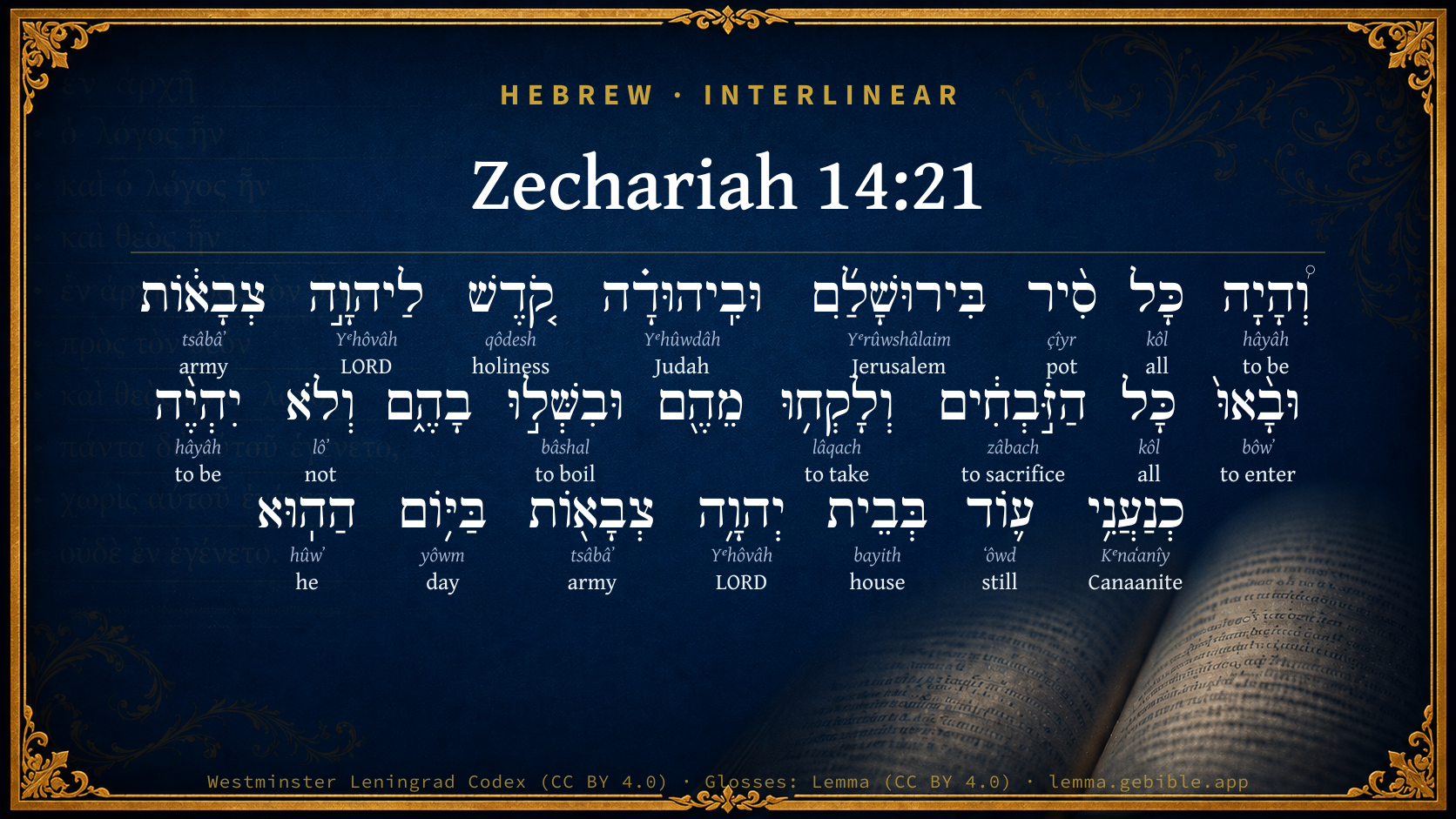
Zechariah 14:21

Hebrew (Westminster Leningrad Codex) Zechariah 14:21 appears in the Hebrew Old Testament. The text above is from the Westminster Leningrad Codex. Each word links to its Strong’s number, a concise gloss, and parsing drawn from the Open Scriptures Hebrew Bible morphology. Click any word for its full Brown-Driver-Briggs (BDB) entry.
Download image
Cite this verse

Zechariah 14:21 (World English Bible). Public Domain. Lemma interlinear Bible study tool, https://lemma.gebible.app/v/zechariah/14/21.

Show BibTeX & RIS
BibTeX
RIS
English Translation
Yes, every pot in Jerusalem and in Judah will be holy to Yahweh of Hosts; and all those who sacrifice will come and take of them, and cook in them. In that day there will no longer be a Canaanite in the house of Yahweh of Hosts.
World English Bible · Public Domain
Download a study sheet

One document with this verse’s original text, its word-by-word gloss line, the meaning frame, cross-references with their text, attributed commentary, and full source and license credits — printable, and it pastes into notes with its structure intact.

This verse Autodidact and up

Study sheet (.html) Plain text (.txt)

A passage Seminary Student

Up to 50 verses in one chapter. A passage sheet keeps up to 6 commentary sources and 12 cross-references per verse, in the order this page ranks them, and says so on the sheet whenever that leaves anything out. Ask for a single verse and you get the Autodidact verse sheet above.

Everything on this page stays free to read, with no account — the sheet is a download of what is already on screen, not access to it.

Want to remove ads? Support Godless Engineer
Compare translations 3

The same verse in 3 English versions, stacked beneath the original-language interlinear above. Click any original word for its lexicon entry.

Each is an independent rendering of the whole verse — the interlinear is not word-aligned to these translations.

Highlighted words mark where these versions differ — a whole-verse word diff, not a word-by-word alignment.

  • World English Bible Public Domain
    Yes, every pot in Jerusalem and in Judah will be holy to Yahweh of Hosts; and all those who sacrifice will come and take of them, and cook in them. In that day there will no longer be a Canaanite in the house of Yahweh of Hosts.
  • King James Version Public Domain
    Yea, every pot in Jerusalem and in Judah shall be holiness unto the LORD of hosts: and all they that sacrifice shall come and take of them, and seethe therein: and in that day there shall be no more the Canaanite in the house of the LORD of hosts.
  • unfoldingWord Literal Text CC BY-SA 4.0
    For every pot in Jerusalem and Judah will be set apart to Yahweh of hosts and everyone who brings a sacrifice will eat from them and boil in them. On that day traders will no longer be in the house of Yahweh of hosts.

unfoldingWord Literal Text — © unfoldingWord, licensed CC BY-SA 4.0. Word-aligned USFM3 via Door43 (git.door43.org/unfoldingWord/en_ult).

Versions to compare (up to 4)

3 of 4 selected

Show all 18 translations

Every available English version of this verse, each an independent rendering of the whole verse.

  • World English Bible Public Domain
    Yes, every pot in Jerusalem and in Judah will be holy to Yahweh of Hosts; and all those who sacrifice will come and take of them, and cook in them. In that day there will no longer be a Canaanite in the house of Yahweh of Hosts.
  • Berean Standard Bible Public Domain
    Indeed, every pot in Jerusalem and Judah will be holy to the LORD of Hosts, and all who sacrifice will come and take some pots and cook in them. And on that day there will no longer be a Canaanite in the house of the LORD of Hosts.
  • Majority Standard Bible Public Domain
    Indeed, every pot in Jerusalem and Judah will be holy to the LORD of Hosts, and all who sacrifice will come and take some pots and cook in them. And on that day there will no longer be a Canaanite in the house of the LORD of Hosts.
  • King James Version Public Domain
    Yea, every pot in Jerusalem and in Judah shall be holiness unto the LORD of hosts: and all they that sacrifice shall come and take of them, and seethe therein: and in that day there shall be no more the Canaanite in the house of the LORD of hosts.
  • American Standard Version (1901) Public Domain
    Yea, every pot in Jerusalem and in Judah shall be holy unto Jehovah of hosts; and all they that sacrifice shall come and take of them, and boil therein: and in that day there shall be no more a Canaanite in the house of Jehovah of hosts.
  • Revised Version (1885) Public Domain
    Yea, every pot in Jerusalem and in Judah shall be holy unto the LORD of hosts: and all they that sacrifice shall come and take of them, and seethe therein: and in that day there shall be no more a Canaanite in the house of the LORD of hosts.
  • Geneva Bible (1599) Public Domain
    Yea, euery potte in Ierusalem and Iudah shall be holy vnto the Lord of hostes, and all they that sacrifice, shall come and take of them, and seethe therein: and in that day there shall be no more the Canaanite in the House of the Lord of hostes.
  • Douay-Rheims (1899) Public Domain
    And every caldron in Jerusalem and Juda shall be sanctified to the Lord of hosts: and all that sacrifice shall come, and take of them, and shall seethe in them: and the merchant shall be no more in the house of the Lord of hosts in that day.
  • Young's Literal Translation Public Domain
    And every pot in Jerusalem, and in Judah, Have been holy to Jehovah of Hosts, And all those sacrificing have come in, And have taken of them, and boiled in them, And there is no merchant any more in the house of Jehovah of Hosts in that day!
  • Literal Standard Version CC BY-SA 4.0
    And every pot in Jerusalem and in Judah, || Have been holy to YHWH of Hosts, || And all those sacrificing have come in, || And have taken of them, and boiled in them, || And in that day there is no merchant anymore in the house of YHWH of Hosts!
  • Unlocked Literal Bible CC BY-SA 4.0
    For every pot in Jerusalem and Judah will be set apart to Yahweh of hosts and everyone who brings a sacrifice will eat from them and boil in them. On that day traders will no longer be in the house of Yahweh of hosts.
  • unfoldingWord Literal Text CC BY-SA 4.0
    For every pot in Jerusalem and Judah will be set apart to Yahweh of hosts and everyone who brings a sacrifice will eat from them and boil in them. On that day traders will no longer be in the house of Yahweh of hosts.
  • Darby Bible Public Domain
    And every pot in Jerusalem and in Judah shall be holiness unto Jehovah of hosts; and all they that sacrifice shall come and take of them, and seethe therein. And in that day there shall be no more a Canaanite in the house of Jehovah of hosts.
  • World Messianic Bible Public Domain
    Yes, every pot in Jerusalem and in Judah will be holy to the LORD of Hosts; and all those who sacrifice will come and take of them, and cook in them. In that day there will no longer be a Canaanite in the house of the LORD of Hosts.
  • Webster's Bible Public Domain
    Yes, every pot in Jerusalem and in Judah shall be holiness to the LORD of hosts: and all they that sacrifice shall come and take of them, and seethe in them: and in that day there shall be no more the Canaanite in the house of the LORD of hosts.
  • Free Bible Version CC BY-SA 4.0
    Every pot in Jerusalem and in Judah will be holy to the Lord Almighty, so that everyone who comes to sacrifice can take them and cook their sacrificial meat in them. On that day there will no longer be traders in the Lord's Temple.
  • Bible in Basic English Public Domain
    And every pot in Jerusalem and in Judah will be holy to the Lord of armies: and all those who make offerings will come and take them for boiling their offerings: in that day there will be no more traders in the house of the Lord of armies.
  • JPS Tanakh (1917) Public Domain
    Yea, every pot in Jerusalem and in Judah shall be holy unto the LORD of hosts; and all they that sacrifice shall come and take of them, and seethe therein; and in that day there shall be no more a trafficker in the house of the LORD of hosts.

Literal Standard Version (2020), Covenant Press — licensed CC BY-SA 4.0. Text via the HelloAO Bible API (eBible.org). Unlocked Literal Bible (unfoldingWord) — licensed CC BY-SA 4.0. Text via the HelloAO Bible API (eBible.org). unfoldingWord Literal Text — © unfoldingWord, licensed CC BY-SA 4.0. Word-aligned USFM3 via Door43 (git.door43.org/unfoldingWord/en_ult). Free Bible Version, Dr. Jonathan Gallagher — licensed CC BY-SA 4.0. Text via the HelloAO Bible API (eBible.org).

Word by word

More ways to search: Search by grammar → Find every occurrence → Compare this word →

Practice this passage: Drill this verse → Learn its vocabulary →

וּבִשְּׁל֣וּ
bâshal
H1310
“and · to boil”
Conjunction + Verb, Piel, Sequential Perfect, 3rd Person, Common, Plural
Part of Speech
Conjunction + Verb
Stem
Piel
Form
Sequential Perfect
Person
3rd Person
Gender
Common
Number
Plural
Full BDB Definition

Origin: a primitive root

TWOT: 292

to boil, cook, bake, roast, ripen, grow ripe - (Qal) - to boil, cook - to grow ripe, ripen - (Piel) - to boil - to cook - (Pual) - to be boiled - to be sodden - (Hiphil) - to ripen - ripen, brought to ripeness
  1. וְ֠הָיָה hâyâh H1961 “and · to be” Conjunction + Verb, Qal, Sequential Perfect, 3rd Person, Masculine, Singular
  2. כָּל kôl H3605 “all of” Noun, Common, Masculine, Singular, Construct
  3. סִ֨יר çîyr H5518 “pot” Noun, Common, Both, Singular, Absolute
  4. בִּירוּשָׁלִַ֜ם Yᵉrûwshâlaim H3389 “in/at · Jerusalem” Preposition + Noun, Proper
  5. וּבִֽיהוּדָ֗ה Yᵉhûwdâh H3063 “and · in/at · Judah” Conjunction + Preposition + Noun, Proper
  6. קֹ֚דֶשׁ qôdesh H6944 “holiness” Noun, Common, Masculine, Singular, Absolute
  7. לַיהוָ֣ה Yᵉhôvâh H3068 “to/for · LORD” Preposition + Noun, Proper
  8. צְבָא֔וֹת tsâbâʼ H6635 “armies” Noun, Common, Both, Plural, Absolute
  9. וּבָ֨אוּ֙ bôwʼ H935 “and · to enter” Conjunction + Verb, Qal, Sequential Perfect, 3rd Person, Common, Plural
  10. כָּל kôl H3605 “all of” Noun, Common, Masculine, Singular, Construct
  11. הַזֹּ֣בְחִ֔ים zâbach H2076 “the · sacrificing” Particle, Definite Article + Verb, Qal, Participle Active, Masculine, Plural, Absolute
  12. וְלָקְח֥וּ lâqach H3947 “and · to take” Conjunction + Verb, Qal, Sequential Perfect, 3rd Person, Common, Plural
  13. וְלֹא lôʼ H3808 “and · not” Conjunction + Particle, Negative
  14. יִהְיֶ֨ה hâyâh H1961 “to be” Verb, Qal, Imperfect, 3rd Person, Masculine, Singular
  15. כְנַעֲנִ֥י Kᵉnaʻanîy H3669 “Canaanite” Noun, Gentilic, Masculine, Singular, Absolute
  16. ע֛וֹד ʻôwd H5750 “still” Adverb
  17. בְּבֵית bayith H1004 “in/at · house of” Preposition + Noun, Common, Masculine, Singular, Construct
  18. יְהוָ֥ה Yᵉhôvâh H3068 “LORD” Noun, Proper
  19. צְבָא֖וֹת tsâbâʼ H6635 “armies” Noun, Common, Both, Plural, Absolute
  20. בַּיּ֥וֹם yôwm H3117 “in/at the · day” Preposition, Determined + Noun, Common, Masculine, Singular, Absolute
  21. הַהֽוּא hûwʼ H1931 “the · he” Particle, Definite Article + Pronoun, Personal, 3rd Person, Masculine, Singular

About this verse

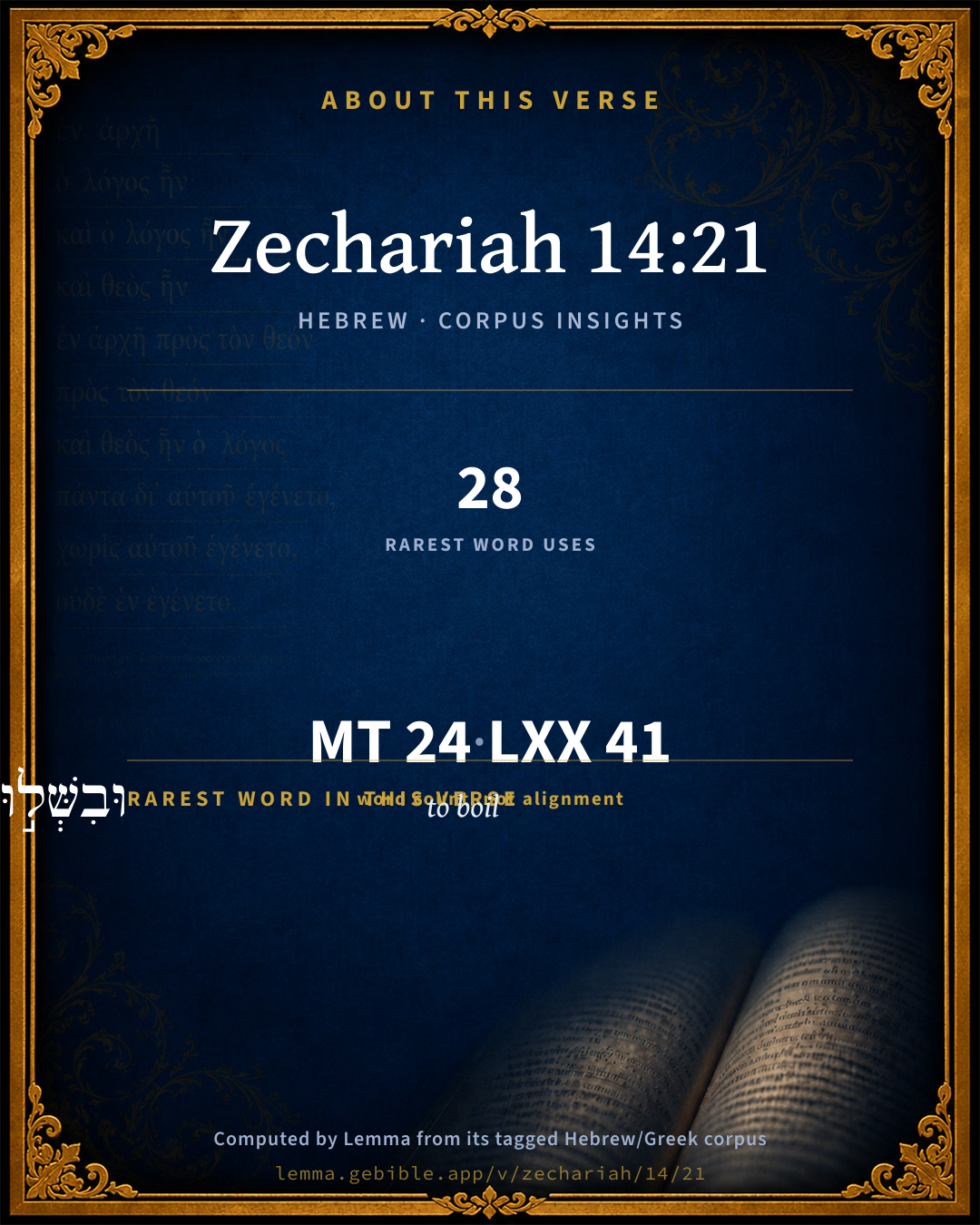
These counts appear in no published source. They are computed here, from the morphology-tagged text and Lemma’s own curated glosses. What Lemma adds →

24
words
18
distinct lemmas
Prophets
section

Shared distinctive vocabulary

וּבִשְּׁל֣וּ to boil H1310 occurs in 24 verses of the Hebrew Bible. Also found in:

Grammatical profile

  • 6 verbs
  • 13 nouns
  • 1 pronoun
  • 2 prepositions
  • 1 adverb
  • 1 particle

Verb forms

  • וְ֠הָיָה Qal · Sequential Perfect
  • וּבָ֨אוּ֙ Qal · Sequential Perfect
  • הַזֹּ֣בְחִ֔ים Qal · Participle Active
  • וְלָקְח֥וּ Qal · Sequential Perfect
  • וּבִשְּׁל֣וּ Piel · Sequential Perfect
  • יִהְיֶ֨ה Qal · Imperfect

Repetition

Words recur within this verse — often emphatic in Hebrew:

  • וְ֠הָיָה to be H1961 ×2
  • כָּל all H3605 ×2
  • לַיהוָ֣ה LORD H3068 ×2
  • צְבָא֔וֹת army H6635 ×2

Hebrew & Septuagint length

In English translation the verse runs 47 words from the Hebrew and 49 from the Septuagint (LXX English) — closely comparable.

A rough comparison of the two English renderings, which tokenize alike — not a word-level alignment.

Word counts can differ between the Hebrew and the Greek without any difference in meaning — e.g. the Hebrew direct-object marker אֵת has no separate Greek word, and Greek often adds the article ὁ.

In the original languages it is 24 Hebrew tokens and 41 Greek tokens — but the two are counted differently (Hebrew bundles its prefixes and suffixes into one token; the Greek is in lemma form), so that isn’t a like-for-like length.

Cross-references

24

Topical passages linked to Zechariah 14:21 in the Treasury of Scripture Knowledge — connected by theme and wording, ordered by reader-vote popularity; previews shown in the World English Bible.

  • Ezekiel 44:9 Thus says the Lord Yahweh, No foreigner, uncircumcised in heart and uncircumcised in flesh, shall enter into my sanctuary, of any foreigners who are among the children of Israel.
  • Joel 3:17 "So you will know that I am Yahweh, your God, Dwelling in Zion, my holy mountain. Then Jerusalem will be holy, And no strangers will pass through her any more.
  • Romans 14:6–7 He who observes the day, observes it to the Lord; and he who does not observe the day, to the Lord he does not observe it. He who eats, eats to the Lord, for he gives God thanks. He who doesn't eat, to the Lord he doesn't eat, and gives God thanks.
  • 1 Corinthians 10:31 Whether therefore you eat, or drink, or whatever you do, do all to the glory of God.
  • Mark 11:15–17 They came to Jerusalem, and Jesus entered into the temple, and began to throw out those who sold and those who bought in the temple, and overthrew the tables of the money-changers, and the seats of those who sold the doves.
  • Revelation 22:15 Outside are the dogs, the sorcerers, the sexually immoral, the murderers, the idolaters, and everyone who loves and practices falsehood.
  • Nehemiah 8:10 Then he said to them, Go your way, eat the fat, and drink the sweet, and send portions to him for whom nothing is prepared; for this day is holy to our Lord: neither be you grieved; for the joy of Yahweh is your strength.
  • Matthew 21:12–13 Jesus entered into the temple of God, and drove out all of those who sold and bought in the temple, and overthrew the money-changers' tables and the seats of those who sold the doves.
  • John 2:15–16 He made a whip of cords, and threw all out of the temple, both the sheep and the oxen; and he poured out the changers' money, and overthrew their tables.
  • Ephesians 2:19–22 So then you are no longer strangers and foreigners, but you are fellow citizens with the saints, and of the household of God,
  • Revelation 18:11–15 The merchants of the earth weep and mourn over her, for no one buys their merchandise any more;
  • Revelation 21:27 There will in no way enter into it anything profane, or one who causes an abomination or a lie, but only those who are written in the Lamb's book of life.
  • Deuteronomy 12:7 and there you shall eat before Yahweh your God, and you shall rejoice in all that you put your hand to, you and your households, in which Yahweh your God has blessed you.
  • Deuteronomy 12:12 You shall rejoice before Yahweh your God, you, and your sons, and your daughters, and your men-servants, and your maid-servants, and the Levite who is within your gates, because he has no portion nor inheritance with you.
  • Isaiah 4:3 It will happen, that he who is left in Zion, and he who remains in Jerusalem, shall be called holy, even everyone who is written among the living in Jerusalem;
  • Isaiah 35:8 A highway shall be there, and a way, and it shall be called The way of holiness. The unclean shall not pass over it, but is shall be for for him who walks in the Way. Wicked fools will not go there.
  • Hosea 12:7 A merchant has dishonest scales in his hand. He loves to defraud.
  • Zechariah 7:6 When you eat, and when you drink, don't you eat for yourselves, and drink for yourselves?
  • Zechariah 14:20 In that day there will be on the bells of the horses, "HOLY TO YAHWEH;" and the pots in Yahweh's house will be like the bowls before the altar.
  • 1 Corinthians 6:9–11 Or don't you know that the unrighteous will not inherit the Kingdom of God? Don't be deceived. Neither the sexually immoral, nor idolaters, nor adulterers, nor male prostitutes, nor homosexuals,
  • 1 Timothy 3:15 but if I wait long, that you may know how men ought to behave themselves in the house of God, which is the assembly of the living God, the pillar and ground of the truth.
  • 1 Timothy 4:3–5 forbidding marriage and commanding to abstain from foods which God created to be received with thanksgiving by those who believe and know the truth.
  • Hebrews 3:6 but Christ is faithful as a Son over his house; whose house we are, if we hold fast our confidence and the glorying of our hope firm to the end.
  • 1 Peter 4:17 For the time has come for judgment to begin at the house of God. If it begins first with us, what will happen to those who don't obey the Gospel of God?

Cross-references courtesy of OpenBible.info (CC BY 4.0).

Hebrew and Greek witnesses Masoretic Hebrew ↔ Greek Septuagint

The same verse in the two great witnesses to the Old Testament, shown verse-for-verse.

These are two independent witnesses, not word-aligned to each other, and the Septuagint is shown in lemma (dictionary) form.

Hebrew Zechariah 14:21 Masoretic · Westminster Leningrad Codex

וְ֠הָיָה כָּל סִ֨יר בִּירוּשָׁלִַ֜ם וּבִֽיהוּדָ֗ה קֹ֚דֶשׁ לַיהוָ֣ה צְבָא֔וֹת וּבָ֨אוּ֙ כָּל הַזֹּ֣בְחִ֔ים וְלָקְח֥וּ מֵהֶ֖ם וּבִשְּׁל֣וּ בָהֶ֑ם וְלֹא יִהְיֶ֨ה כְנַעֲנִ֥י ע֛וֹד בְּבֵית יְהוָ֥ה צְבָא֖וֹת בַּיּ֥וֹם הַהֽוּא

Yes, every pot in Jerusalem and in Judah will be holy to Yahweh of Hosts; and all those who sacrifice will come and take of them, and cook in them. In that day there will no longer be a Canaanite in the house of Yahweh of Hosts.

World English Bible · Public Domain

Greek LXX Zechariah 14:21 Septuagint · lemma form

καί εἰμί πᾶς λέβης ἐν ἰερουσαλήμ καί ἐν ὁ ιουδα ἅγιος ὁ κύριος παντοκράτωρ καί ἥκω πᾶς ὁ θυσιάζω καί λαμβάνω ἐκ αὐτός καί ἕψω ἐν αὐτός καί οὐ εἰμί χαναναῖος οὐκέτι ἐν ὁ οἶκος κύριος παντοκράτωρ ἐν ὁ ἡμέρα ἐκεῖνος

And every pot in Jerusalem and in Juda shall be holy to the Lord Almighty: and all that sacrifice shall come and take of them, and shall seethe meat in them: and in that day there shall be no more the Chananite in the house of the Lord Almighty.

LXX2012 (modern English Septuagint) · Public Domain

Hebrew: Westminster Leningrad Codex (CC BY 4.0). Greek: Septuagint (public domain); English from LXX2012 (modern English Septuagint) (Public Domain). How the Septuagint differs from the Hebrew →

Targum (Aramaic paraphrase)

1

The Targum is the ancient Jewish Aramaic paraphrase of the Hebrew Scriptures — an interpretive translation, not the Hebrew text itself. Onkelos (literal) and Pseudo-Jonathan (expansive) render the Torah, and Jonathan the Prophets. Coverage is partial: where no permissively-licensed English translation exists for a verse, only the Aramaic is shown. This is verse-level text, not a word-by-word alignment to the Hebrew.

  1. Targum Jonathan Prophets (Joshua–Malachi)
    וִיהֵי כָּל דוּד בִּירוּשְׁלֵם וּבִיהוּדָה קוּדְשָׁא קֳדָם יְיָ צְבָאוֹת וְיֵיתוּן כָּל דָבְחִין וְיִסְבוּן מִנְהוֹן וִיבַשְּׁלוּן בְּהוֹן וְלָא יְהֵי עָבֵיד תַּגְרָא עוֹד בְּבֵית מַקְדְשָׁא דַייָ צְבָאוֹת בְּעִדָנָא הַהִיא:

    (no public-domain English translation for this verse)

    Targum Jonathan — Aramaic: “Mikraot Gedolot” (public domain). English: “Sefaria Community Translation” (CC0 1.0 (public-domain dedication)); “London "Chaldee Paraphrase," 1871” (public domain). Text via Sefaria.

Commentary

Notes on Zechariah 14:21 from classic Christian and Jewish commentators (each source and its license shown beneath its notes). The classic Christian expositions comment on the surrounding passage and are grouped to its opening verse, so a note may address several verses; the Jewish commentaries on the Tanakh (Rashi and others) are per-verse, so they appear only where the commentator wrote on this verse.

Lemma curates 59 commentaries, every one of them public domain or Creative Commons licensed, each selected and text-cleaned for this edition rather than reprinted as found. About our sources →

Trapp's Complete Commentary

John Trapp

Zec 14:21 Yea, every pot in Jerusalem and in Judah shall be holiness unto the LORD of hosts: and all they that sacrifice shall come and take of them, and seethe therein: and in that day there shall be no more the Canaanite in the house of the LORD of hosts.

Ver. 21. Yea, every pot in Jerusalem, &c.] That is, saith Danaeus, God shall as Godlike be worshipped of every faithful person in his own house, as he was of old in his temple by the Jews. Calvin adds, ut quicquid aggrediantur homines sit sacrificium, so that whatsoever good men enterprise shall be a sacrifice. God shall smell a savour of rest from them, they of life and peace from him.

There shall be no more the Canaanite] The merchant, saith the Vulgate, after Aquila and the Chaldee; that is, the Simoniac, the Churchchopper, such money-merchants as Christ whipped out of the temple, Mat 21:12 Joh 2:15. But better render it Canaanite, who were indeed great merchants, Hos 12:7 Eze 17:4 (the Phenicians, those great merchants, were Canaanites), but here it stands for a wicked man, a hypocrite, that botch of Christian society. Pura erit Ecclesia ab omnibus inquinamentis, saith Calvin; the Church shall be purged of all such pests, see Rev 22:2-7, no such owls shall be seen flying in the Church’s welkin. God will, by the due exercise of discipline and otherwise, be daily purging out all scandals, as such men are called, Mat 13:41, and causing the unclean spirit to pass out of the land, Zec 13:2. I conclude, with Theodoret, Dominus Omnipotens hanc vocem veram esse hoc tempore praestet, &c. God Almighty make good this promise unto us at this time: that there may be no cursed Canaanite found among us; but that we may all live according to the doctrine of the gospel, and expect that blessed hope and coming of the great God our Saviour Jesus; to whom with the Father and Holy Spirit be glory for ever. Amen.

John Trapp, A Commentary or Exposition upon All the Books of the Old and New Testament (1647–1656) — public domain. Text from a community e-Sword module.

Tyndale Open Study Notes

Tyndale Open Resources

14:21 every cooking pot: The holiness of God’s kingdom will transform even mundane utensils into sacred vessels like those used in the sacrificial ritual of the Temple, eliminating all Old Testament distinctions between the sacred and the profane. • traders (literally Canaanites): Commercial activity was associated with the Canaanites (see Hos 12:7; Zeph 1:11). The expression might be a euphemism for idolaters or another way of saying that under God’s rule, traditional ethnic boundaries will be dissolved. The passage may anticipate the work of Jesus in cleansing the Jerusalem Temple as a prelude to the greater work of cleansing the heart of those who believe in him by the Holy Spirit (see John 2:13-16; 1 Cor 6:11; Titus 3:5).

Tyndale Open Study Notes — © Tyndale Open Resources, licensed CC BY-SA 4.0. Text via the HelloAO Bible API.

Geneva Bible (1599)

Geneva Bible translators

But all shall be pure and clean, and there shall neither be hypocrites, nor any that shall corrupt the true service of God.

Geneva Bible (1599) marginal notes — public domain. Text via Bolls.life.

Jamieson, Fausset & Brown

Robert Jamieson, A. R. Fausset & David Brown

every pot--even in private houses, as in the temple, shall be deemed holy, so universal shall be the consecration of all things and persons to Jehovah.

take of them--as readily as they would take of the pots of the temple itself, whatever number they wanted for sacrifice.

no . . . Canaanite--no unclean or ungodly person (Isa 35:8; Isa 52:1; Joe 3:17). Compare as to the final state subsequent to the millennium, Rev 21:27; Rev 22:15. MAURER not so well translates "merchant" here, as in Pro 31:24. If a man would have the beginnings of heaven, it must be by absolute consecration of everything to God on earth. Let his life be a liturgy, a holy service of acted worship [MOORE].

Next: Malachi Introduction

Jamieson, Fausset & Brown — Commentary Critical and Explanatory on the Whole Bible (1871) — public domain (CC PDM 1.0). Text via the HelloAO Bible API.

Adam Clarke's Commentary

Verse 21. Yea, every pot in Jerusalem] "The utensils of the Jews shall be treated as holy, and the worshippers shall use them reverently. The idea of preparing food in them (they that - seethe therein) is taken from the custom of feasting after sacrifice. And no trafficker (see Eze 18:4) shall pollute the house of God, as was the custom when our blessed Lord cleansed the temple." - See Newcome. This is what is called the Canaanite in the house of God. The Canaanite is the merchant; and where such are tolerated in a place dedicated to Divine worship, that is not the house of the Lord of hosts. In churches and chapels, collections may be made for the simple purpose of supporting and extending the worship of Jehovah; but for no other purpose, especially on the Lord's day. Amen.

Adam Clarke's Commentary on the Bible (1810–1826) — public domain. Text from a community e-Sword/MySword module.

John Calvin's Commentaries

The Prophet explains here more clearly what we have already considered — that such would be the reverence for God, and the fear of him through the whole world, that whatever men undertook would be a sacrifice to him: he therefore says, that all the kettles, or pots, or vessels, would be sacred to God. And this is fulfilled when men regard this end — to glorify God through their whole life, as Paul exhorts us to do. (1 Corinthians 10:31.) Our provisions and our beds, and all other things, become then holy to God, when we really devote ourselves to him, and regard in all the actions of our life the end which I have mentioned, even to testify in truth that he is our God, and that we are under his guidance. By such comparisons then does Zechariah teach us, that men will be sacred to God; for nothing they touch shall be unclean, but what was before profane shall be sanctified to his glory.

Come, he says, shall they who sacrifice, and shall boil flesh in pots; as though he had said, That such would be the multitude of men who would ascend to offer sacrifices to God, that the vessels of the temple before in use would not be sufficient. It would hence be necessary to apply for that purpose what was previously profane. The language of Isaiah is similar, for he says that they who were Levites would become priests of the first order, and that those of the common people would become Levites, so that they might all come nigh to God. (Isaiah 66:20,21.) The meaning then of the Prophet is now clear — that he wished to stir up the Jews to constancy and firmness, who regarded their small number as their reproach and were almost disheartened: as then they thought that they had in vain returned to their own country, as the Lord did not gather the whole people, he says that God’s worship would become more celebrated than at the time when the state of things was most flourishing in Judea; for assemble they would, from the whole world, to offer sacrifices to God at Jerusalem, so that the whole city, with all its utensils, would be sacred to God, for the pots and the sacred vessels of the temple, used before under the law, would not be sufficient.

And he adds, And there shall be no Canaanite in the land: the meaning is, that the Church would become pure from all defilements: and this change ought to have given no small comfort to the Jews in their sad and calamitous state; for God had used no small severity, when all were driven into exile; and many tokens of this dreadful rigour still remained, since very few worshipped God, and were despised by all, so that true religion was exposed to the contempt and ridicule of all nations. This compensation then, that the Lord would by this remedy cleanse his Church from its filth, must have greatly allayed their sorrow: on this subject I have already said much.

Zechariah now briefly promises that the Church would become pure, so that all would from the heart and sincerely worship God, and that there would be no mixture of hypocrites to pollute the temple and holy things. But this seems strange, since the Church has ever been contaminated by many pollutions: and hence John the Baptist compares it to a floor, where the chaff is mixed with the wheat; and it is also compared to a net, into which are gathered many fishes, some good and some bad; and also at this day, in the kingdom of Christ, the Church is subject to this evils that it cannot cast out all corruptions: it seems then that the Prophet has spoken hyperbolically. But what we have elsewhere said ought to be borne in mind — that a comparison is made between the ancient state of the people and their second state, when the Church was renewed. As the religion had been in the most disgraceful manner corrupted, and as the Jews had impudently boasted that they were the holy people of God, while they were the most wicked of men, the Prophet justly says, that the Church when renewed would be purer; for the Lord would cleanse it by the cross, as gold and silver are cleansed, which are not only tried by the fire, but become also brighter, because the dross is removed. This is simply what the Prophet means when he says, that there will be no Canaanite among the people of God; that is, there will be no foreign or profane men, mingled with the faithful, to pollute the pure worship of God.

Some have wrested the passage and applied it to the last coming of Christ. But this is inconsistent with the subject in hand. At the same time I allow that the kingdom of Christ, according to the prophetic mode of writing, is here described from its commencement to its end. When God therefore purposed to renew his Church, he cleansed it from much filth, and still daily cleanses it, nor will he cease to do so, until, after all the defilements of the world having been removed, we shall be received into the celestial kingdom. Whenever then the Prophets speak of perfection under the reign of Christ, we ought not to confine what they say to one day or to a short time, but we ought to include the whole time from the beginning to the end. Hence when Christ appeared in the world, then began to shine the splendor of which Zechariah now speaks: but the Lord will go on until that shall be completed which now makes continual progress.

Some read, There shall be a merchant no more, etc.; and they have some reason for what they say, for the word is sometimes rendered merchant: but as in this case, we must have recourse to allegories, and take merchants for impious corrupters who make a merchandise of God’s worship, or give this interpretation, that there shall be no merchant any more, because all would freely bring their offerings, — as these explanations are not appropriate, it is better to take the passage simply as it is — that the Lord will gather his elect, so that pure sacrifices will be offered by them all; and that there will be no hypocrites any more to contaminate and corrupt the Church, or to adulterate the worship of God.

John Calvin's Commentaries (1540-1563) — public domain. Text from the Calvin Translation Society English edition (1840s-50s) via the Christian Classics Ethereal Library (ccel.org). Calvin's coverage is partial (roughly two-thirds of the Bible); uncommented books and verses are honest gaps, never fabricated. The 19th-century editor's footnotes and remarks are omitted so the notes are faithfully Calvin's own voice.

The Cambridge Bible for Schools and Colleges

gen. ed. J. J. S. Perowne

21. take of them] All distinction between sacred and secular shall be at an end, because all shall now be alike holy.

the Canaanite] a Canaanite, R. V. Some would render, the merchant, a meaning which the word bears in Job_41:6 [Heb., 40:30]; Pro_31:24, and understand the prediction to be, that as any and every vessel that came to hand would serve his purpose, the sacrificer would no longer need to buy a special vessel, and therefore the traffickers in such wares (comp. Joh_2:14; Mat_21:12) would cease to frequent the Temple courts. The whole scope of the passage, however, is in favour of the view that “the Canaanite” here means any unclean person, whether heathen who had not accepted the religion and consecrated himself to the service of Jehovah (Neh_13:4-9; Act_21:28-29), or Jew who in heart and life was no better than a heathen (comp. “O thou seed of Chanaan and not of Juda,” Story of Susanna, ver. 56). The true scope of the prophecy is that city of which it is written, “There shall in no wise enter into it any thing that defileth, neither whatsoever worketh abomination or maketh a lie: but they which are written in the Lamb’s book of life,” Rev_21:27.

ἸΔΟΥ ΚΑΙΝΑ ΠΑΝΤΑ ΠΟΙΩ.

The Cambridge Bible for Schools and Colleges (gen. ed. J. J. S. Perowne; Cambridge University Press, 1878–1918) — public domain. Text from a community e-Sword module.

John Gill's Exposition

Yea, every pot in Jerusalem and in Judah shall be holiness unto the Lord of hosts,.... Such will be the number of sacrifices and sacrificers, that the pots in the Lord's house will not be sufficient; wherefore every pot, in city or country, shall be sanctified and devoted to holy uses:

and all they that sacrifice shall come and take of them, and seethe therein; this denotes, as before, the general holiness of the professors of religion in those times; and that there will be no difference in the vessels of the Lord's house, or any distinction of Jew and Gentile; but they will be all spiritual worshippers, and offer up the spiritual sacrifices of prayer and praise to the Lord:

and in that day there shall be no more the Canaanite in the house of the Lord of hosts; the Targum paraphrases it,

"there shall be no more a merchant in the house of the sanctuary of the Lord;''

in the temple, where were buyers and sellers of sheep, oxen, and doves, for sacrifice, such as our Lord drove out; but now there shall be no more of them, all legal sacrifices being at an end. The word here used does signify a merchant, and is so rendered in Hos 12:7 and by some here (m); and the Jews (n) have a saying, that

"there are no Canaanites but merchants;''

or the word always so signifies, referring to the above places, and having quoted Job 41:6 but it is to be applied to another sort of merchants; to false teachers, that make merchandise of the souls of men; to all merit mongers and Papists; and particularly to the great merchant of all, the pope of Rome, and to all inferior merchants under him, who sell pardons, indulgences, &c. and are called the merchants of the earth, Rev 18:3 these are the Heathen that shall perish out of the land, and the sinners that shall be no more; antichrist shall no longer sit in the temple of God, showing himself to be God; nor will there be any, in the spiritual reign of Christ, that will buy Rome's merchandise any more. Moreover, a Canaanite may design an impure person, a hypocrite; and though there have been many such in the church of God in all ages, yet at this time there will be few or none, comparatively speaking; and in the personal reign of Christ there will be no wicked men at all: in the new heavens and new earth will dwell righteousness, or only righteous persons; all the wicked of the earth will be destroyed before this state takes place; only raised ones, the saints that partake of the first resurrection, will be there; they will be all holy and righteous persons; nothing shall enter into it that defiles or makes an abomination or a lie, only those that do the commandments of God; nor will there be any manner of sin or wickedness there: sin, like the Canaanites of old, continues in the saints as long as they are in the present state; and though it has not the dominion over them, yet is as grievous pricks and thorns unto them, and is left in them to prove them; but in this happy state there will be no more sin, no more this pricking brier and grieving thorn. That the word Canaanite is here to be taken in a figurative sense is certain; for, literally understood, there is no such person in the world now, nor has been for many hundreds of years, even an inhabitant of Canaan, or one so called.

(m) "mercator", V. L. Montanus, Vatablus, Grotius, Burkius. (n) T. Bab. Bava Bathra, fol. 75. 1.

Next: Malachi Introduction

John Gill's Exposition of the Whole Bible (1746–1763) — public domain (CC PDM 1.0). Text via the HelloAO Bible API.

Albert Barnes' Notes on the Bible

And every pot in Jerusalem and in Judah shall be holiness to the Lord - Everything is to be advanced in holiness. All the common utensils everywhere in the people of God shall not only be holy, but “holiness,” and capable of the same use as the vessels of the temple.

And there shall be no more the Canaanite in the house of the Lord of hosts - The actual Canaanite had long since ceased to be; the Gibeonites, the last remnant of them, had been absorbed among the people of God. But “all Israel” were not “of Israel.” Isaiah had called its princes and people, “rulers of Sodom, people of Gomorrah” Isa 1:10. Ezekiel had said, “Thus saith the Lord God unto Jerusalem; Thy birth and thy nativity is of the land of Canaan; thy father was an Amorite, and thy mother a Hittite” Eze 16:3. Hosea used at least the term of two-fold meaning, “Canaan, in whose hands are the balances of deceit” Hos 12:7; and Zephaniah, “All the people of Canaan are destroyed” Zep 1:11. After the time of the Canon, Daniel is introduced saying, “O thou seed of Canaan and not of Judah” . Ezekiel had spoken of ungodly priests, not only as uncircumcised in heart (according to the language of Deuteronomy Deu 10:16; Deu 30:6), but uncircumcised in flesh also, altogether alien from the people of God Eze 44:7. The prophet then speaks, as Isaiah, “It shall be called the way of holiness; the unclean shall not pass over it” Isa 35:8, and Joel, “then shall Jerusalem be holy, and there shall no strangers pass through her any more” Joe 3:17 This shall have its full fulfillment in the time of the end. “There shall in no wise enter into it anything that defileth, neither” whatsoever “worketh abomination or a lie;” and, “without” are “dogs and sorcerers and whoremongers and murderers and idolaters, and whatsoever loveth and maketh a lie” Rev 21:27; Rev 22:15.

Cyril: “Although born of the blood of Israel, those of old eagerly imitated the alien Canaanites. But after that the Only-Begotten Word of God came among us, and, having justified by faith sealed with the Holy Spirit, those who came to His grace, our mind hath been steadfast, unshaken, fixed in piety. Nor will anyone persuade those who are sanctified, to honor any other god save Him who is, by nature and in truth, God, whom we have known in Christ. For in Himself He hath shown us the Father, saying, “He that hath seen Me hash seen the Father” Joh 14:9. Wherefore “in that” day, that is, at that time, he says, “there shall be no Canaanite,” that is, alien and idolater, “in the house of the Lord Almighty?” Theodoret: “But may the Almighty God bring the saying true at this time also, that no Canaanite should be seen among us, but that all should live according to the Gospellaws. and await that blessed hope and the appearance of our great God and Saviour Jesus Christ, with whom be glory to the Father with the Holy Spirit, now and ever and to endless ages. Amen.”

Albert Barnes' Notes on the Bible (1834–1885) — public domain. Text from a community e-Sword/MySword module.

Haydock's Catholic Bible Commentary

Merchant; or, as some render it, the Chanaanite shall be no more, &c., that is, the profane and unbelievers shall have no title to be in the house of the Lord; or, there shall be no occasion for buyers or sellers of oxen, or sheep, or doves, in the house of God, such as Jesus Christ cast out of the temple. (Challoner) (John ii. 16.) --- All former distinction of Jew and Gentile shall cease in the Church. Past faults shall be forgotten. (Calmet)

George Leo Haydock (1774–1849), Haydock's Catholic Family Bible and Commentary, 1859 edition — public domain. Excludes Psalms (Douay-Rheims chapter numbering differs from Protestant) and Deuterocanonical books (Catholic canon only).

Matthew Poole's English Annotations

Every pot; the utensils of private houses shall be so dedicated to God’s service, that without scruple they shall on occasion be used, or might be used, in the worship of God.

In Jerusalem and in Judah; the types, but the gospel church is the antitype; in the times hereof every family shall be a temple in which God shall be worshipped, and their house-pots in the worship of God shall be in extraordinary cases used without scruples.

Holiness unto the Lord of hosts: see Zec 14:20.

All they that sacrifice: in allusion to sacrifices, the prophet expresseth all religious affections, practice, and worship, which shall be as pleasing to God as were the sacrifices of his people offered up with Divine warrant and approbation.

Shall come and take of them, freely, without scruple,

and seethe therein; seethe that part of the sacrifice which pertaineth to the priests and to the offerer to feast on, in their house-pots.

There shall be no more the Canaanite in the house of the Lord of hosts; any of the accursed nation, or one who makes merchandise of religion. In a word, by allusion used here, we understand that time will come, when scrupulous adhering to ceremonies shall not be, as formerly it was, deemed so necessary, so material in the worship; but all shall know that the Lord hath greatest pleasure in upright, hearty, and sincere love and holiness.

Matthew Poole's English Annotations on the Holy Bible (1683–1685) — public domain. Text from a community e-Sword/MySword module.

The Pulpit Commentary

The last announcement is amplified. Every pot. All the vessels of the country shall be consecrated and used in Divine service. The Levitical distinction shall be abolished, and the Lord"s service shall be perfect freedom. Every member of the Church, however humble his station or mean his acquirements, shall be a saint and fit for the Lord"s use. (comp. 2Ti_2:21) The Canaanite; mercator (Vulgate). The word is used in the sense of "trafficker," or "merchant," in Job_41:6 Pro_31:24. (comp. Zep_1:11) If any vessel might now be used in God"s service, worshippers would no longer be obliged to buy special bowls from those who sold in the temple courts. (Mat_21:12) But it is best in agreement with the context to take "Canaanite" to mean any unclean or profane person. (comp. Gen_9:25 Lev_18:28, etc.) Thus Daniel, in the History of Susanna, ver. 56, addresses the wicked elder, "Thou seed of Chanaan, and not of Jude;" and Isaiah (Isa_1:10) calls the chiefs of Israel "rulers of Sodom," and "people of Gomorrah." Henceforward the "people shall be all righteous". (Isa_60:21) There shall be one, holy, Catholic Church. Thus the vision of the golden candlestick (Zec 4) is fulfilled; and that this should come to pass is the design of God"s manifold providences and operations. (comp. Rev_21:27 Rev_22:15)

The Pulpit Commentary (1880–1919), ed. H.D.M. Spence-Jones & Joseph S. Exell — public domain. Text from a community e-Sword module.

John Wesley's Explanatory Notes

Every pot - The utensils of private houses shall be all dedicated to God's service. That sacrifice - So the prophet expresses all religious affections, practice, and worship, which shall be as pleasing to God, as were the sacrifices of his people offered up with divine warrant and approbation. Seethe therein - That part of the sacrifice which pertaineth to the priests, and to the offerer to feast on. The Canaanite - Any of the accursed nation, or one who makes merchandise of religion. But all shall know that the Lord hath the greatest pleasure in upright, and sincere love and holiness.

John Wesley, Explanatory Notes Upon the Whole Bible (1754–1765) — public domain. Text via the GEBible commentary corpus.

Rashi

Rabbi Shlomo Yitzchaki (Rashi)

and there will no longer be a trafficker They will not require trafficking, as in (Isa. 23:8): “whose traffickers were the honored of the earth.” Another explanation: There is no poor man here.

Rashi on the Tanakh — English translations: “The Judaica Press complete Tanach with Rashi, translated by A. J. Rosenberg” (CC BY 4.0); “Pentateuch with Rashi's commentary by M. Rosenbaum and A.M. Silbermann, 1929-1934” (public domain); “The Metsudah Tanach series, Lakewood, N.J” (CC BY 4.0); and “The Book of Joshua, Metsudah Publications, 1997” (CC BY 4.0). Text via Sefaria.

Lesson kit

Teaching starters — assembled from the data on this page, not authored interpretation. Every prompt links to the verse data it draws on. Edit before teaching.

Zechariah, in the Prophets, opens this verse with 24 words (18 distinct Hebrew lemmas). Its most distinctive word is bâshal (“to boil”). A historical commentator’s framing appears above. Read the whole chapter for the surrounding context.

Discussion questions

  1. How does “to boil” (bâshal) shape what this verse is saying?
  2. How does Genesis 40:10, which shares the word «to boil», read alongside this verse?
  3. What does the repetition of “to be” (2× in this one verse) do in this verse?
  4. These translations render this verse differently; the difference is in the English rendering, not the original. What questions does that raise?
  5. «וְ֠הָיָה» is a Qal Sequential Perfect verb. How does that grammatical form shape the action described?
  6. Compare how Trapp's Complete Commentary and Tyndale Open Study Notes read this verse. Where do they agree or differ?

Things to notice

Reading settings

Reading text

Shown beneath each verse's original-language words.

Old Testament
Old Testament edition

Read the OT as the Masoretic Hebrew (MT) or the Greek Septuagint (LXX).

English shown for the Greek Septuagint (in the Hebrew ↔ Greek comparison).

Comparing translations? Open the Compare panel on any verse page to stack up to four side by side.