
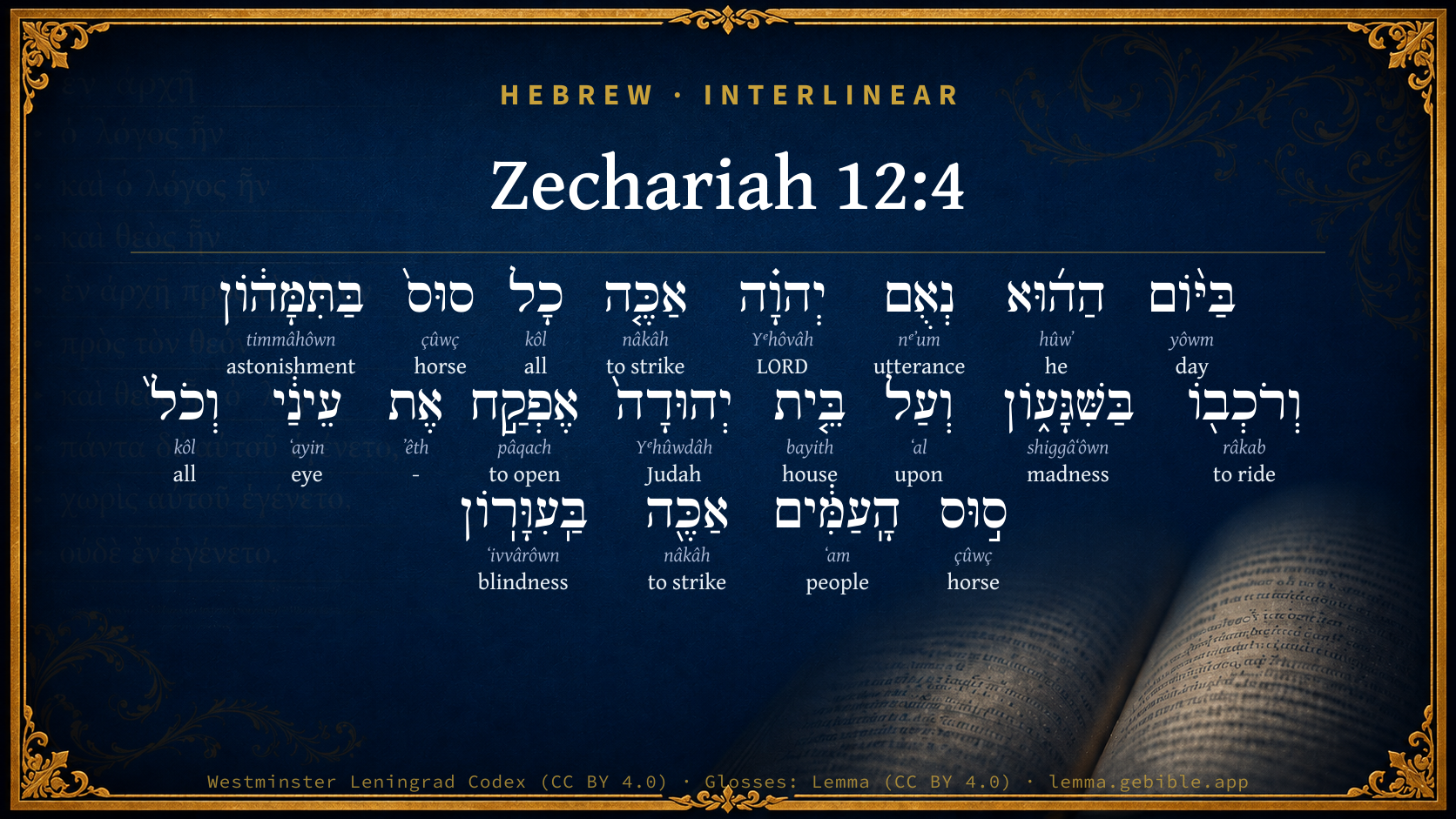
Zechariah 12:4

Hebrew (Westminster Leningrad Codex) Zechariah 12:4 appears in the Hebrew Old Testament. The text above is from the Westminster Leningrad Codex. Each word links to its Strong’s number, a concise gloss, and parsing drawn from the Open Scriptures Hebrew Bible morphology. Click any word for its full Brown-Driver-Briggs (BDB) entry.
Download image
Cite this verse

Zechariah 12:4 (World English Bible). Public Domain. Lemma interlinear Bible study tool, https://lemma.gebible.app/v/zechariah/12/4.

Show BibTeX & RIS
BibTeX
RIS
English Translation
In that day," says Yahweh, "I will strike every horse with terror, and his rider with madness; and I will open my eyes on the house of Judah, and will strike every horse of the peoples with blindness.
World English Bible · Public Domain
Download a study sheet

One document with this verse’s original text, its word-by-word gloss line, the meaning frame, cross-references with their text, attributed commentary, and full source and license credits — printable, and it pastes into notes with its structure intact.

This verse Autodidact and up

Study sheet (.html) Plain text (.txt)

A passage Seminary Student

Up to 50 verses in one chapter. A passage sheet keeps up to 6 commentary sources and 12 cross-references per verse, in the order this page ranks them, and says so on the sheet whenever that leaves anything out. Ask for a single verse and you get the Autodidact verse sheet above.

Everything on this page stays free to read, with no account — the sheet is a download of what is already on screen, not access to it.

Want to remove ads? Support Godless Engineer
Compare translations 3

The same verse in 3 English versions, stacked beneath the original-language interlinear above. Click any original word for its lexicon entry.

Each is an independent rendering of the whole verse — the interlinear is not word-aligned to these translations.

Highlighted words mark where these versions differ — a whole-verse word diff, not a word-by-word alignment.

  • World English Bible Public Domain
    In that day," says Yahweh, "I will strike every horse with terror, and his rider with madness; and I will open my eyes on the house of Judah, and will strike every horse of the peoples with blindness.
  • King James Version Public Domain
    In that day, saith the LORD, I will smite every horse with astonishment, and his rider with madness: and I will open mine eyes upon the house of Judah, and will smite every horse of the people with blindness.
  • unfoldingWord Literal Text CC BY-SA 4.0
    On that day—this is Yahweh’s declaration—I will strike every horse with confusion and its rider with madness. Over the house of Judah I will open my eyes, but every horse of the peoples I will strike with blindness.

unfoldingWord Literal Text — © unfoldingWord, licensed CC BY-SA 4.0. Word-aligned USFM3 via Door43 (git.door43.org/unfoldingWord/en_ult).

Versions to compare (up to 4)

3 of 4 selected

Show all 18 translations

Every available English version of this verse, each an independent rendering of the whole verse.

  • World English Bible Public Domain
    In that day," says Yahweh, "I will strike every horse with terror, and his rider with madness; and I will open my eyes on the house of Judah, and will strike every horse of the peoples with blindness.
  • Berean Standard Bible Public Domain
    On that day, declares the LORD, I will strike every horse with panic, and every rider with madness. I will keep a watchful eye on the house of Judah, but I will strike with blindness all the horses of the nations.
  • Majority Standard Bible Public Domain
    On that day, declares the LORD, I will strike every horse with panic, and every rider with madness. I will keep a watchful eye on the house of Judah, but I will strike with blindness all the horses of the nations.
  • King James Version Public Domain
    In that day, saith the LORD, I will smite every horse with astonishment, and his rider with madness: and I will open mine eyes upon the house of Judah, and will smite every horse of the people with blindness.
  • American Standard Version (1901) Public Domain
    In that day, saith Jehovah, I will smite every horse with terror, and his rider with madness; and I will open mine eyes upon the house of Judah, and will smite every horse of the peoples with blindness.
  • Revised Version (1885) Public Domain
    In that day, saith the LORD, I will smite every horse with astonishment, and his rider with madness: and I will open mine eyes upon the house of Judah, and will smite every horse of the peoples with blindness.
  • Geneva Bible (1599) Public Domain
    In that day, sayeth the Lord, I will smite euery horse with astonishment, and his rider with madnesse, and I will open mine eyes vpon the house of Iudah, and will smite euery horse of the people with blindnesse.
  • Douay-Rheims (1899) Public Domain
    In that day, saith the Lord, I will strike every horse with astonishment, and his rider with madness: and I will open my eyes upon the house of Juda, and will strike every horse of the nations with blindness.
  • Young's Literal Translation Public Domain
    In that day -- an affirmation of Jehovah, I do smite every horse with astonishment, And its rider with madness, And on the house of Judah I open My eyes, And every horse of the peoples I smite with blindness.
  • Literal Standard Version CC BY-SA 4.0
    In that day,” a declaration of YHWH, || “I strike every horse with astonishment, || And its rider with madness, || And on the house of Judah I open My eyes, || And every horse of the peoples I strike with blindness.
  • Unlocked Literal Bible CC BY-SA 4.0
    On that day—this is Yahweh's declaration—I will strike every horse with confusion and its rider with madness. Over the house of Judah I will open my eyes, but every horse of the peoples I will strike with blindness.
  • unfoldingWord Literal Text CC BY-SA 4.0
    On that day—this is Yahweh’s declaration—I will strike every horse with confusion and its rider with madness. Over the house of Judah I will open my eyes, but every horse of the peoples I will strike with blindness.
  • Darby Bible Public Domain
    In that day, saith Jehovah, I will smite every horse with astonishment, and his rider with madness; but I will open mine eyes upon the house of Judah, and will smite every horse of the peoples with blindness.
  • World Messianic Bible Public Domain
    In that day,” says the LORD, “I will strike every horse with terror and his rider with madness. I will open my eyes on the house of Judah, and will strike every horse of the peoples with blindness.
  • Webster's Bible Public Domain
    In that day, saith the LORD, I will smite every horse with astonishment, and his rider with madness: and I will open my eyes upon the house of Judah, and will smite every horse of the people with blindness.
  • Free Bible Version CC BY-SA 4.0
    On that day I will make every horse panic-stricken and every rider go mad, declares the Lord, but I will watch over the people of Judah while I blind all the horses of their enemies.
  • Bible in Basic English Public Domain
    In that day, says the Lord, I will put fear into every horse and make every horseman go off his head: and my eyes will be open on the people of Judah, and I will make every horse of the peoples blind.
  • JPS Tanakh (1917) Public Domain
    In that day, saith the LORD, I will smite every horse with bewilderment, and his rider with madness; and I will open Mine eyes upon the house of Judah, and will smite every horse of the peoples with blindness.

Literal Standard Version (2020), Covenant Press — licensed CC BY-SA 4.0. Text via the HelloAO Bible API (eBible.org). Unlocked Literal Bible (unfoldingWord) — licensed CC BY-SA 4.0. Text via the HelloAO Bible API (eBible.org). unfoldingWord Literal Text — © unfoldingWord, licensed CC BY-SA 4.0. Word-aligned USFM3 via Door43 (git.door43.org/unfoldingWord/en_ult). Free Bible Version, Dr. Jonathan Gallagher — licensed CC BY-SA 4.0. Text via the HelloAO Bible API (eBible.org).

Word by word

More ways to search: Search by grammar → Find every occurrence → Compare this word →

Practice this passage: Drill this verse → Learn its vocabulary →

בַּתִּמָּה֔וֹן
timmâhôwn
H8541
“in/at the · astonishment”
Preposition, Determined + Noun, Common, Masculine, Singular, Absolute
Part of Speech
Preposition + Noun
Type
Common
Gender
Masculine
Number
Singular
State
Absolute
Full BDB Definition

Origin: from H8539

TWOT: 2518a

astonishment, bewilderment, stupefaction
  1. בַּיּ֨וֹם yôwm H3117 “in/at the · day” Preposition, Determined + Noun, Common, Masculine, Singular, Absolute
  2. הַה֜וּא hûwʼ H1931 “the · he” Particle, Definite Article + Pronoun, Personal, 3rd Person, Masculine, Singular
  3. נְאֻם nᵉʼum H5002 “utterance of” Noun, Common, Masculine, Singular, Construct
  4. יְהוָ֗ה Yᵉhôvâh H3068 “LORD” Noun, Proper
  5. אַכֶּ֤ה nâkâh H5221 “to strike” Verb, Hiphil, Imperfect, 1st Person, Common, Singular
  6. כָל kôl H3605 “all of” Noun, Common, Masculine, Singular, Construct
  7. סוּס֙ çûwç H5483 “horse” Noun, Common, Masculine, Singular, Absolute
  8. וְרֹכְב֖וֹ râkab H7392 “and · riding · him” Conjunction + Verb, Qal, Participle Active, Masculine, Singular, Construct + Suffix, Personal, 3rd Person, Masculine, Singular
  9. בַּשִּׁגָּע֑וֹן shiggâʻôwn H7697 “in/at the · madness” Preposition, Determined + Noun, Common, Masculine, Singular, Absolute
  10. וְעַל ʻal H5921 “and · upon” Conjunction + Preposition
  11. בֵּ֤ית bayith H1004 “house of” Noun, Common, Masculine, Singular, Construct
  12. יְהוּדָה֙ Yᵉhûwdâh H3063 “Judah” Noun, Proper
  13. אֶפְקַ֣ח pâqach H6491 “to open” Verb, Qal, Imperfect, 1st Person, Common, Singular
  14. אֶת ʼêth H853 “-” Particle, Direct Object
  15. עֵינַ֔י ʻayin H5869 “eyes · my” Noun, Common, Both, Dual, Construct + Suffix, Personal, 1st Person, Common, Singular
  16. וְכֹל֙ kôl H3605 “and · all of” Conjunction + Noun, Common, Masculine, Singular, Construct
  17. ס֣וּס çûwç H5483 “horse of” Noun, Common, Masculine, Singular, Construct
  18. הָֽעַמִּ֔ים ʻam H5971 “the · peoples” Particle, Definite Article + Noun, Common, Masculine, Plural, Absolute
  19. אַכֶּ֖ה nâkâh H5221 “to strike” Verb, Hiphil, Imperfect, 1st Person, Common, Singular
  20. בַּֽעִוָּרֽוֹן ʻivvârôwn H5788 “in/at the · blindness” Preposition, Determined + Noun, Common, Masculine, Singular, Absolute

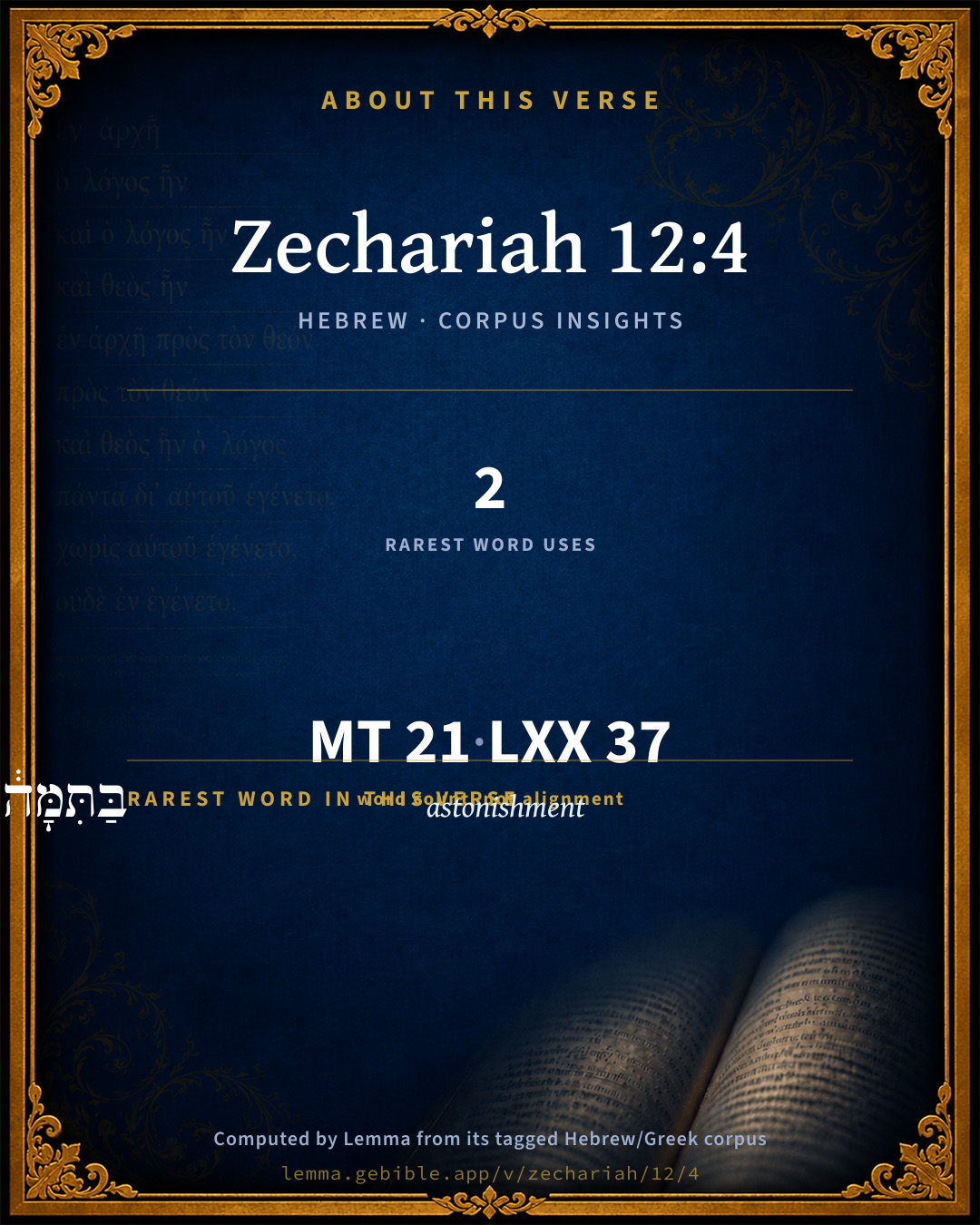
About this verse

These counts appear in no published source. They are computed here, from the morphology-tagged text and Lemma’s own curated glosses. What Lemma adds →

21
words
18
distinct lemmas
Prophets
section

Notable vocabulary

The rarest word here is בַּתִּמָּה֔וֹן astonishment H8541 — appearing just 2 times in the whole Hebrew Bible.

Shared distinctive vocabulary

בַּתִּמָּה֔וֹן astonishment H8541 occurs in 2 verses of the Hebrew Bible. Also found in:

Grammatical profile

  • 4 verbs
  • 14 nouns
  • 1 pronoun
  • 1 preposition
  • 1 particle

Verb forms

  • אַכֶּ֤ה Hiphil · Imperfect
  • וְרֹכְב֖וֹ Qal · Participle Active
  • אֶפְקַ֣ח Qal · Imperfect
  • אַכֶּ֖ה Hiphil · Imperfect

Repetition

Words recur within this verse — often emphatic in Hebrew:

  • אַכֶּ֤ה to strike H5221 ×2
  • כָל all H3605 ×2
  • סוּס֙ horse H5483 ×2

Hebrew & Septuagint length

In English translation the verse runs 38 words from the Hebrew and 42 from the Septuagint (LXX English) — closely comparable.

A rough comparison of the two English renderings, which tokenize alike — not a word-level alignment.

Word counts can differ between the Hebrew and the Greek without any difference in meaning — e.g. the Hebrew direct-object marker אֵת has no separate Greek word, and Greek often adds the article ὁ.

In the original languages it is 21 Hebrew tokens and 37 Greek tokens — but the two are counted differently (Hebrew bundles its prefixes and suffixes into one token; the Greek is in lemma form), so that isn’t a like-for-like length.

Cross-references

23

Topical passages linked to Zechariah 12:4 in the Treasury of Scripture Knowledge — connected by theme and wording, ordered by reader-vote popularity; previews shown in the World English Bible.

  • Deuteronomy 28:28 Yahweh will strike you with madness, and with blindness, and with astonishment of heart;
  • Zechariah 12:3 It will happen in that day, that I will make Jerusalem a burdensome stone for all the peoples. All who burden themselves with it will be severely wounded, and all the nations of the earth will be gathered together against it.
  • Zechariah 12:6 In that day I will make the chieftains of Judah like a pan of fire among wood, and like a flaming torch among sheaves; and they will devour all the surrounding peoples, on the right hand and on the left; and Jerusalem will yet again dwell in their own place, even in Jerusalem.
  • Acts 17:30 The times of ignorance therefore God overlooked. But now he commands that all people everywhere should repent,
  • 1 Kings 8:29 that your eyes may be open toward this house night and day, even toward the place of which you have said, My name shall be there; to listen to the prayer which your servant shall pray toward this place.
  • 2 Kings 6:14 Therefore sent he there horses, and chariots, and a great host: and they came by night, and surrounded the city.
  • 2 Kings 6:18 When they came down to him, Elisha prayed to Yahweh, and said, Please smite this people with blindness. He struck them with blindness according to the word of Elisha.
  • 2 Chronicles 6:20 that your eyes may be open toward this house day and night, even toward the place where you have said that you would put your name there; to listen to the prayer which your servant shall pray toward this place.
  • 2 Chronicles 6:40 Now, my God, let, I beg you, your eyes be open, and let your ears be attentive, to the prayer that is made in this place.
  • 2 Chronicles 7:15 Now my eyes shall be open, and my ears attentive, to the prayer that is made in this place.
  • Nehemiah 1:6 Let your ear now be attentive, and your eyes open, that you may listen to the prayer of your servant, which I pray before you at this time, day and night, for the children of Israel your servants while I confess the sins of the children of Israel, which we have sinned against you. Yes, I and my father's house have sinned:
  • Psalms 76:5–7 Valiant men lie plundered, They have slept their last sleep. None of the men of war can lift their hands.
  • Isaiah 24:21 It shall happen in that day, that Yahweh will punish the host of the high ones on high, and the kings of the earth on the earth.
  • Isaiah 37:17 Turn your ear, Yahweh, and hear; open your eyes, Yahweh, and behold; and hear all the words of Sennacherib, who has sent to defy the living God.
  • Jeremiah 24:6 For I will set my eyes on them for good, and I will bring them again to this land: and I will build them, and not pull them down; and I will plant them, and not pluck them up.
  • Ezekiel 38:4 and I will turn you about, and put hooks into your jaws, and I will bring you forth, and all your army, horses and horsemen, all of them clothed in full armor, a great company with buckler and shield, all of them handling swords;
  • Ezekiel 39:20 You shall be filled at my table with horses and chariots, with mighty men, and with all men of war, says the Lord Yahweh.
  • Daniel 9:18 My God, turn your ear, and hear; open your eyes, and see our desolations, and the city which is called by your name: for we do not present our petitions before you for our righteousness, but for your great mercies' sake.
  • Zechariah 9:8 I will encamp around my house against the army, That none pass through or return; And no oppressor will pass through them any more: For now I have seen with my eyes.
  • Zechariah 10:5 They shall be as mighty men, Treading down muddy streets in the battle; And they shall fight, because Yahweh is with them; And the riders on horses will be confounded.
  • Zechariah 12:8–9 In that day Yahweh will defend the inhabitants of Jerusalem. He who is feeble among them at that day will be like David, and the house of David will be like God, like the angel of Yahweh before them.
  • Zechariah 12:11 In that day there will be a great mourning in Jerusalem, like the mourning of Hadadrimmon in the valley of Megiddon.
  • Zechariah 14:15 So will be the plague of the horse, of the mule, of the camel, and of the donkey, and of all the animals that will be in those camps, as that plague.

Cross-references courtesy of OpenBible.info (CC BY 4.0).

Hebrew and Greek witnesses Masoretic Hebrew ↔ Greek Septuagint

The same verse in the two great witnesses to the Old Testament, shown verse-for-verse.

These are two independent witnesses, not word-aligned to each other, and the Septuagint is shown in lemma (dictionary) form.

Hebrew Zechariah 12:4 Masoretic · Westminster Leningrad Codex

בַּיּ֨וֹם הַה֜וּא נְאֻם יְהוָ֗ה אַכֶּ֤ה כָל סוּס֙ בַּתִּמָּה֔וֹן וְרֹכְב֖וֹ בַּשִּׁגָּע֑וֹן וְעַל בֵּ֤ית יְהוּדָה֙ אֶפְקַ֣ח אֶת עֵינַ֔י וְכֹל֙ ס֣וּס הָֽעַמִּ֔ים אַכֶּ֖ה בַּֽעִוָּרֽוֹן

In that day," says Yahweh, "I will strike every horse with terror, and his rider with madness; and I will open my eyes on the house of Judah, and will strike every horse of the peoples with blindness.

World English Bible · Public Domain

Greek LXX Zechariah 12:4 Septuagint · lemma form

ἐν ὁ ἡμέρα ἐκεῖνος λέγω κύριος παντοκράτωρ πατάσσω πᾶς ἵππος ἐν ἔκστασις καί ὁ ἀναβάτης αὐτός ἐν παραφρόνησις ἐπί δέ ὁ οἶκος ιουδα δια ἀναοἴγω ὁ ὀφθαλμός ἐγώ καί πᾶς ὁ ἵππος ὁ λαός πατάσσω ἐν ἀποτύφλωσις

In that day, says the Lord Almighty, I will strike every horse with amazement, and his rider with madness: but I will open my eyes upon the house of Juda, and I will strike all the horses of the nations with blindness.

LXX2012 (modern English Septuagint) · Public Domain

Hebrew: Westminster Leningrad Codex (CC BY 4.0). Greek: Septuagint (public domain); English from LXX2012 (modern English Septuagint) (Public Domain). How the Septuagint differs from the Hebrew →

Targum (Aramaic paraphrase)

1

The Targum is the ancient Jewish Aramaic paraphrase of the Hebrew Scriptures — an interpretive translation, not the Hebrew text itself. Onkelos (literal) and Pseudo-Jonathan (expansive) render the Torah, and Jonathan the Prophets. Coverage is partial: where no permissively-licensed English translation exists for a verse, only the Aramaic is shown. This is verse-level text, not a word-by-word alignment to the Hebrew.

  1. Targum Jonathan Prophets (Joshua–Malachi)
    בְּעִדָנָא הַהִיא אֲמַר יְיָ אֶמְחֵי כָּל סוּסְוַת עַמְמַיָא בְּטִפְּשׁוּתָא וְרוֹכְבֵיהוֹן בְּשִׁעֲמָמוּתָא וְעַל דְבֵית יְהוּדָה אֲגַלֵי יַת גְבוּרְתִּי לַאֲטָבָא לְהוֹן וְכָל סוּסְוַת עַמְמַיָא אֶמְחֵי בְּסַמָיוּתָא:

    (no public-domain English translation for this verse)

    Targum Jonathan — Aramaic: “Mikraot Gedolot” (public domain). English: “Sefaria Community Translation” (CC0 1.0 (public-domain dedication)); “London "Chaldee Paraphrase," 1871” (public domain). Text via Sefaria.

Commentary

Notes on Zechariah 12:4 from classic Christian and Jewish commentators (each source and its license shown beneath its notes). The classic Christian expositions comment on the surrounding passage and are grouped to its opening verse, so a note may address several verses; the Jewish commentaries on the Tanakh (Rashi and others) are per-verse, so they appear only where the commentator wrote on this verse.

Lemma curates 59 commentaries, every one of them public domain or Creative Commons licensed, each selected and text-cleaned for this edition rather than reprinted as found. About our sources →

Trapp's Complete Commentary

John Trapp

Zec 12:4 In that day, saith the LORD, I will smite every horse with astonishment, and his rider with madness: and I will open mine eyes upon the house of Judah, and will smite every horse of the people with blindness.

Ver. 4. I will smite every horse with astonishment] Great is the strength of the horse and the rage of his rider: Jehu marched furiously; Bajazet, the Great Turk, of his fierce and furious riding was surnamed Gilderun, or Lightning; but God can make the Egyptians to appear men, and not gods, and their horses flesh, and not spirit; "When the Lord shall but stretch out his hand" (and that is no hard matter of motion), "both he that helpeth shall fall and he that is helped shall fall down, and they shall all fail together," Isa 31:8. See Psa 76:5-6 "An horse is a vain thing for safety," Psa 33:17, though a warlike creature full of terror; but safety or victory is of the Lord, Pro 21:31 "In nothing be terrified," saith the apostle, Php 1:28. The Greek word is a metaphor from horses when they tremble and are sore frightened; as it happened in the Philistines’ army, when the angels made a bustle among the mulberry trees, 2Sa 5:24; in the Syrians’ army, when the angels likewise made a hurrying noise in the air, of chariots, of horses, and of a great host, 2Ki 7:6; in the army of Sennacherib, when at God’s sole rebuke "both the chariot and horse were cast into a dead sleep," Psa 76:6. Lastly, in the German wars against Zisca and the Hussites in Bohemia, where God smote every horse with astonishment, and his rider with madness; such a panic terror seized upon the enemies of the truth, though they came in with three potent armies at once, that they fled before ever they looked the enemy in the face. How this prophecy was literally fulfilled to the Maccabees, see 2Ma 10:30.

And I will open mine eyes upon the house of Judah] Who before seemed to wink, or to be asleep. Now will I awake, saith the Lord, Now will I arise, now will I lift up myself, Isa 33:10, for the relief and rescue of my poor people; and that because they called them outcasts, saying, "This is Zion, whom no man looketh after," Jer 33:17.

John Trapp, A Commentary or Exposition upon All the Books of the Old and New Testament (1647–1656) — public domain. Text from a community e-Sword module.

The Biblical Illustrator

Joseph S. Exell

Zec_12:4-9

In that day, saith the Lord, I will smite every horse with astonishment

A good time for good people

I.

It is a time when their enemies shall be vanquished. In that day, saith the Lord, I will smite every horse with astonishment, etc.

II. It is a time when their power shall be augmented. The power here promised is--

1. The power of unity. The governors of Judah shall say in their heart, The inhabitants of Jerusalem shall be my strength in the Lord of hosts their God.

III. It is a time when they shall be settled in their home. And Jerusalem shall be inhabited again in her own place, even in Jerusalem. Here they are strangers and pilgrims, and have no abiding city.

IV. It is a time when they shall be blessed with equal privileges.

1. They were to have equal honour. The Lord also shall save the tents of Judah first, that the glory of the house of David and the glory of the inhabitants of Jerusalem do not magnify themselves against Judah.

2. They were to have equal protection. In that day shall the Lord defend the inhabitants of Jerusalem, etc. Now, there is a good time coming, when all good people shall have distinguished honour and complete protection. They shall settle down in the heavenly Jerusalem, and what a city is that! (Homilist.)

The Biblical Illustrator, edited by Joseph S. Exell (c. 1880s–1900s) — public domain. Text from a community e-Sword module.

Joseph Benson's Commentary

Zec 12:4-5. In that day — This expression, in the prophetical writings, is of large extent, and not only signifies that particular point of time last spoken of, but some time afterward. I will smite every horse with astonishment — Many commentators explain this of the victories which Judas Maccabæus gained over Antiochus’s captains, whose chief force consisted in cavalry. But, as Archbishop Newcome observes, the language is much too strong, as it is also Zec 12:6-9, to denote the successes of the Maccabees against the Seleucidæ. This prophecy therefore, he thinks, remains to be accomplished. And many commentators, who are of the same opinion, consider it as a prediction of victories that will be obtained over Gog and Magog by the Jews, upon their restoration to their own land. One circumstance in favour of this interpretation is, that Gog and Magog are represented, Eze 38:15, as riders on horses. And if by that people the Turks be intended, we know that they have been, and still are, famous for their cavalry, wherein chiefly the strength of their armies consists. But it is here foretold, that in order to their discomfiture God will send such distraction among their horses and their riders, and throw them into such a state of confusion, that they shall fall foul one upon another,

(see Zec 14:13,) and not be able to distinguish between their friends and their foes. And I will turn mine eyes upon the house of Judah — I will have an especial concern for their preservation. And the governors of Judah shall say in their heart — Shall say within themselves, The inhabitants of Jerusalem shall be my strength in the Lord — “The text here,” says Blayney,” has been supposed corrupt, and many attempts have been made to amend it. But, without any alteration, it well expresses the sentiments of the men of Judah, concerning the interest they had in the safety of Jerusalem and its inhabitants, on which their own strength and security depended in a great degree; so that they would, of course, be influenced to bring that assistance, the efficacy of which is set forth in the verse that follows.”

Joseph Benson's Commentary on the Old and New Testaments (1811–1818) — public domain. Text from a community e-Sword module.

Whedon's Commentary on the Bible

Daniel D. Whedon

Zec_12:4 describes more minutely the overthrow of the nations announced in figurative terms in Zec_12:2-3.

In that day — When the nations of the earth are gathered against the city.

Horse… rider — The cavalry, which here represents the entire military force of the enemy.

Astonishment,… madness — For the former R.V. reads “terror.” The soldiers will be thrown into hopeless confusion, so that they will rush headlong to destruction.

Smite… with blindness — When this happens to the enemies they will be unable to distinguish between friend and foe, and they will turn their swords against their own fellows (Jdg_7:22; 2Ki_6:18; compare Deu_28:28).

Of the people — Better, R.V., “peoples.” Meanwhile Jerusalem will be safe.

I will open mine eyes — In watchful care, so that no harm can come near (1Ki_8:29; Psa_32:8).

The house of Judah — Jerusalem and Judah. Marti omits the last clause, as also Zec_12:5, and reads following “the house of Judah” Zec_12:6. In this way he gets rid of several troublesome clauses, while at the same time the thought connection is improved; but in the absence of all external evidence many will hesitate to accept the suggestion. To make the reading smoother he omits also Zec_12:7-8.

Daniel D. Whedon (gen. ed.), Commentary on the Old and New Testaments (1874–1909) — public domain. Text from a community e-Sword module.

Tyndale Open Study Notes

Tyndale Open Resources

12:4 Madness, blindness, and panic were among the curses threatened against Israel for covenant disobedience (Deut 28:28). The day of the Lord will witness a reversal as these curses are turned against Israel’s enemies (see 2 Kgs 7:6-7). • watch over (literally open my eyes): The open eyes of God represent divine provision for those in desperate need (see Gen 16:13-14; 21:19-21).

Tyndale Open Study Notes — © Tyndale Open Resources, licensed CC BY-SA 4.0. Text via the HelloAO Bible API.

Jamieson, Fausset & Brown

Robert Jamieson, A. R. Fausset & David Brown

I will smite . . . horse--The arm of attack especially formidable to Judah, who was unprovided with cavalry. So in the overthrow of Pharaoh (Exo 15:19, Exo 15:21).

open mine eyes upon . . . Judah--to watch over Judah's safety. Heretofore Jehovah seemed to have shut His eyes, as having no regard for her.

blindness--so as to rush headlong on to their own ruin (compare Zac 14:12-13).

Jamieson, Fausset & Brown — Commentary Critical and Explanatory on the Whole Bible (1871) — public domain (CC PDM 1.0). Text via the HelloAO Bible API.

Adam Clarke's Commentary

Verse 4. I will smite every horse] Some apply this to the wars of the Maccabees with the Syrians; but it is more likely to be a prophecy not yet accomplished. The terms are too strong for such petty and evanescent victories as those of the Maccabees.

Adam Clarke's Commentary on the Bible (1810–1826) — public domain. Text from a community e-Sword/MySword module.

John Calvin's Commentaries

He pursues here the same subject, but in other words, — that multiplicity of means is in God’s hand, by which he can drive away and break down the fury of enemies. By the words horse and its rider, the Prophet, stating a part for the whole, means whatever is strong, and intimates that it can be easily overcome by divine power

He says first, I will smite every horse with stupor Military strength, we know, is in horses and horsemen; but he says that the horses would be stunned, and the horsemen seized as it were with madness, so that they would destroy themselves, and could do no harm to the Church. He then confirms what he said before — that though the whole world conspired against the Church, there would yet be sufficient power in God to repel and check all their assaults and he mentions stupor, madness, and blindness, that the faithful might know that God can by hidden means either destroy or put to flight all their enemies. Though then God fights not with drawn swords, nor uses the common mode of warfare, yet the Prophet says, that he is prepared with other means to lay prostrate their enemies; for even the most powerful in the world cannot proceed so far as to confound their enemies by blindness and madness; but the Prophet here shows, that though no way appears to us by which God may deliver us, we are yet to entertain firm hope, for he can by his breath destroy all enemies, as he can render then blind, and take from them understanding, and wisdom, and strength.

Then he adds, I will open mine eyes on the house of Judah. A reason is here given why all enemies would be smitten with stupor and madness, because the Lord would have a regard for his Church; for to open the eyes means the same thing as to have a care for a thing. It had seemed good to God to neglect his people for a time, and this neglect was as it were an oblivion. Hence the saints often complain “How longs wilt thou sleep! how long wilt thou close thine eyes! Look down, O Lord, and see.” So in this place Zechariah means that God would yet care for his people, so as to subdue their enemies.

We may hence learn a useful doctrine — that, in the first place, there is nothing better for us than to be gathered under the shadow of God’s protection, however destitute of any fortress the Church may be, yea, were she to have innumerable enemies hostile to her, and to be without any strength to resist them. Though then the Church were thus grievously tried, and be in the midst of many dangers, and exposed even to death, let us learn from this passage that those are miserable indeed who through fear or cowardice separate themselves from her, and that they who call on God, and cast on him the care of their safety, shall be made blessed, though the whole world were mad against them, though the weapons of all nations were prepared for their ruin, and horses and horsemen were assembled to overwhelm them; for the defense of God is a sufficient protection to his Church. This is one thing. Then let us learn to exercise our faith, when God seems to cast us as it were between the teeth of wolves; for though he may not afford any visible aid, yet he knows how to deliver us, and possesses hidden means of help, which we may not perceive, because his purpose is to try our faith and our patience. And lastly, let us learn, that when God connives at our miseries, as though he had forgotten us, yet our hope, founded on him, can never be disappointed; for if we abide among his flock, he will at length open his eyes upon us, he will really show that he cares for our safety. It now follows —

John Calvin's Commentaries (1540-1563) — public domain. Text from the Calvin Translation Society English edition (1840s-50s) via the Christian Classics Ethereal Library (ccel.org). Calvin's coverage is partial (roughly two-thirds of the Bible); uncommented books and verses are honest gaps, never fabricated. The 19th-century editor's footnotes and remarks are omitted so the notes are faithfully Calvin's own voice.

Ellicott's Commentary for English Readers

(4) Horse—viz., of the enemy. (Comp. Deu_28:28 with Deu_30:7.)

Open mine eyes.—Comp. 1Ki_8:29.

A Bible Commentary for English Readers, edited by Charles John Ellicott (1878–1897) — public domain. Text from a community e-Sword module.

The Cambridge Bible for Schools and Colleges

gen. ed. J. J. S. Perowne

4. astonishment] This and the two following words, madness, blindness, occur together also in Deu_28:28, in a description of God’s judgments upon Israel, as here upon the armies that gather against Jerusalem.

I will open mine eyes upon] i.e. will regard with favour. Comp. Psa_32:8.

The Cambridge Bible for Schools and Colleges (gen. ed. J. J. S. Perowne; Cambridge University Press, 1878–1918) — public domain. Text from a community e-Sword module.

John Gill's Exposition

In that day, saith the Lord, I will smite every horse with astonishment, and his rider with madness,.... The meaning is, the enemies of God's people shall be astonished at the failure of their attempts, and be filled with fury and madness because they cannot accomplish their designs; and shall be at their wits' end, not knowing what course to take: perhaps reference is had to the Turkish armies, that shall be brought against Jerusalem to recover it into their possession, which generally consist of a large cavalry; see Rev 9:16,

and I will open mine eyes upon the house of Judah; which phrase is sometimes used, as expressive of the wrath of God against his enemies, Amo 9:4 and, if the house of Judah signifies the same as Judah, joined with the nations of the earth in the siege, Zac 12:2, it must be so understood here; but rather it seems to be different, and to intend those who will inhabit other parts of Judea, and who will be truly the people of God, Jews not only literally, but spiritually; and so is to be interpreted in a good sense, of the divine love to them, care of them, and protection over them; see Job 14:13 and so the Targum paraphrases it,

"and upon those of the house of Judah, I will reveal my power to do them good:''

and will smite every horse of the people with blindness: that is, every rider of them, either with blindness of mind or body, or both. It may be, as the former smiting, mentioned in the beginning of the verse, respects the mind, this may regard the body; so that they shall not see their way, and their hands shall not perform their enterprise.

John Gill's Exposition of the Whole Bible (1746–1763) — public domain (CC PDM 1.0). Text via the HelloAO Bible API.

Albert Barnes' Notes on the Bible

In that day, saith the Lord, I will smite every horse with astonishment, stupefying - Zechariah revives the words concentrated by Moses, to express the stupefaction at their ills, which God would accumulate upon His people, if they perseveringly rebelled against Him. Each expresses the intensity of the visitation. “The horse and his rider” Deut. 27:28 had, through Moses’ song at the Red Sea, become the emblem of worldly power, overthrown. That song opens; “I will sing unto the Lord; for He hath triumphed gloriously: the horse and his rider hath He cast into the sea” Exo 15:1. The scared cavalry throws into confusion the ranks, of which it was the boast and strength.

And on the house of Judah I will open My eyes - In pity and love and guidance, as the Psalmist says, “I will counsel, with Mine eye upon thee” Psa 32:8, in contrast with “the blindness” with which God would smite the powers arrayed against them.

Albert Barnes' Notes on the Bible (1834–1885) — public domain. Text from a community e-Sword/MySword module.

Haydock's Catholic Bible Commentary

Blindness. The cavalry of the Syrians proved useless against a few (Calmet) champions under God’s protection. (Haydock)

George Leo Haydock (1774–1849), Haydock's Catholic Family Bible and Commentary, 1859 edition — public domain. Excludes Psalms (Douay-Rheims chapter numbering differs from Protestant) and Deuterocanonical books (Catholic canon only).

Matthew Poole's English Annotations

In that day: see Zec 4:3.

I will smite every horse: horses are of very great use in wars; they were the main strength of Antiochus Epiphanes, his best preparations. With astonishment; a dull, sottish fear and perplexity.

And his rider with madness; an impotency of mind both in the understanding, which is folly and imprudence, and in the will and resolution, which is either cowardice or unconstancy, like madmen that neither know how to resolve or act. God will turn all their counsel into foolishness, their strength into weakness, their courage into fear, and so overturn them all.

I will open mine eyes upon the house of Judah; a while I seemed as one that slept or winked at the proceedings of my church’s enemies, yet now I will open mine eyes, and see all that is going forward against them, and I will watch over my people for good; against their enemies, to confound and destroy them and their enterprises: this eye of God open upon his people is his wise, powerful, gracious providence for them, Psa 31:22; Jer 24:6.

I will smite every horse of the people with blindness; all their warriors in their projecting and consults shall be as full of improvidence, and have as little foresight, as a stark blind man hath of sight to see by.

Matthew Poole's English Annotations on the Holy Bible (1683–1685) — public domain. Text from a community e-Sword/MySword module.

The Pulpit Commentary

I will smite every horse with astonishment (consternation). Cavalry represents the forces of the enemy. Astonishment, madness, and blindness are threatened against Israel in Deu_28:28; here they arc inflicted on the enemy. Madness. The riders should be so panic stricken that they knew not what they did, and shall turn their arms against each other. (Hag_2:22) Open mine eyes upon the house of Judah; i.e. will regard with favour and protect. (Deu_11:12 1Ki_8:29 Isa_32:8) With blindness. They shall be blinded with terror. The previous threat is repeated with this emphatic addition.

Vers. 4-9. A good time for good people.

"In that day, saith the Lord, I will smite every horse with astonishment, and his rider with madness: and I will open mine eyes upon the house of Judah, and will smite every horse of the people with blindness," etc. These words, which are confessedly difficult if not impossible to interpret correctly (for some say they are to be taken literally, others spiritually; some historically, others prophetically), may be fairly used to illustrate a good time for good people. In relation to this good time, I observe

I IT IS A TIME WHEN THEIR ENEMIES SHALL BE VANQUISHED. "In that day, saith the Lord, I will smite every horse with astonishment, and his rider with madness: and I will open mine eyes upon the house of Judah, and wilt smite every horse of the people with blindness." Here the overthrow of the enemies of Jerusalem is threatened. "The Lord," says Keil, "will throw the mind and spirit of the military force of the enemy into such confusion that, instead of injuring Jerusalem and Judah, it will rush forward to its own destruction. Horses and riders individualize the warlike forces of the enemy. The rider, smitten with madness, turns his sword against his own comrades in battle. On the other hand, Jehovah will open his eyes upon Judah for its protection. (1Ki_8:29 Neh_1:6 Psa_32:8) This promise is strengthened by the repetition of the punishment to be inflicted upon the enemy. Not only with alarm, but with blindness, will the Lord smite their horses. We have an example of this in 2Ki_6:18, where the Lord smote the enemy with blindness in answer to Elisha"s prayer, i.e. with mental blindness, so that, instead of seizing the prophet, they fell into the hands of Israel. The three plagues, timmahon, shigga"on, and ivvaron, are those with which rebellious Israelites are threatened in Deu_28:28. The house of Judah is the covenant nation, the population of Judah, including the inhabitants of Jerusalem, as we may see from what follows." Now, whether this conquest refers to the triumphs of the Maccabees, or to some wonderful victories of the Jews in some future times, one thing is clear to us, that the time will come for all good people when their enemies shall be entirely destroyed.

To every good man this victory is promised. "Be thou faithful unto death, and I will give thee a crown of life.

II IT IS A TIME WHEN THEIR POWER SHALL BE AUGMENTED. The power here promised is:

1. The power of unity. "The governors of Judah shall say in their heart, The inhabitants of Jerusalem shall be my strength in the Lord of hosts their God" "Observe here" says Dr. Wardlaw, "the confidence of the leaders in the people. Without the people"s concurrent aid, their counsels and plans and directions could, of course, be of little avail This the rulers should feel, and should exult in seeing what ground they had for full reliance on them in time of pressure and danger, which implies unanimity and intrepid valour, combined with persevering effort, on the part of the inhabitants. This union and valour would be the "strength" of their leaders, without which they must find themselves utterly powerless. A divided, dispirited. heartless, dastardly soldiery or populace, is weakness, disappointment, and discomfiture to the best-conceived plans of the most bold, prudent, and experienced leaders." All good people over all the earth will one day be thoroughly united united, not in opinion, for this would be, if possible, undesirable; but in devotion to Christ, the common Centre. This union is strength, Divine strength, "strength in the Lord of hosts." "Strong in the Lord and in the power of his might.

2. The power of conquest. "In that day will I make the governors of Judah like a hearth of fire among the wood, and like a torch of fire in a sheaf; and they shall devour all the people round about, on the right hand and on the left;" or, as Dr. Henderson renders it, "In that day will I make the chiefs of Judah like a fire pot among sticks of wood, and like a torch of fire in a sheaf, and they shall consume all the people around, on the right hand and on the left." As the fire consumes the wood and the sheaf of straw, so would the men of Jerusalem have power to conquer all the people "round about, on the right hand and on the left." God invests all good men with power to conquer their spiritual foes; this is the power of faith faith that overcometh the world. This power, though weak in most, is triumphant in many (see Hebrews 11). It shall be all-conquering one day.

III IT IS A TIME WHEN THEY SHALL BE SETTLED IN THEIR HOME. "And Jerusalem shall be inhabited again in her own place, even in Jerusalem." Jerusalem, in the first instance, stands for the Jews, and in the second instance for the city or the country. It means, therefore, that in this good time whether it is past or to come some, if not all, the Jews that were scattered abroad will return and settle in their own home. The language expresses reoccupancy and permanent possession. Those who return whether from Egypt, Babylon, or elsewhere will return and settle down in their old home. A time comes for all good people when they shall settle down in a permanent dwelling place. Here they are "strangers and pilgrims," and have "no abiding city." But a glorious country awaits them, an "inheritance incorruptible, undefiled, and that fadeth not away.

IV IT IS A TIME WHEN THEY SHALL BE BLESSED WITH EQUAL PRIVILEGES.

1. They were to have equal honour. "The Lord also shall save the tents of Judah first, that the glory of the house of David and the glory of the inhabitants of Jerusalem do not magnify themselves against Judah." Dr. Henderson"s translation expresses this: "And Jehovah shall deliver the tents of Judah first, in order that the splendour of the house of David and the splendour of the inhabitants of Jerusalem may not be magnified above Judah.

2. They were to have equal protection. "In that day shall the Lord defend the inhabitants of Jerusalem; and he that is feeble among them at that day shall be as David; and the house of David shall be as God, as the angel of the Lord Before them. And it shall come to pass in that day, that I will seek to destroy all the nations that come against Jerusalem." Hero Jerusalem is promised protection against the foe, and "he that is feeble among them at that day shall be as David." "To the Jew, David was the highest type of strength and glory on earth, (2Sa_17:8) a man of war; (2Sa_18:3) such shall the weakest citizen of Jerusalem become." (Joe_3:10) "And the house of David shall be as God, as the angel of the Lord before them." "The Divine Angel that went before them through the desert, the highest type of strength and glory in heaven. (Exo_23:20 Exo_32:34) The house of David is the prince and his family sprung from David. (Eze_45:7, Eze_45:9) David"s house was then in a comparatively weak state." Now, there is a time coming when all good people shall have distinguished honour and complete protection. They shall settle down in the heavenly Jerusalem; and what a city is that! (see Re 21)

CONCLUSION. Though I have not been able to put forth what I feel to be a satisfactory interpretation of these words, or attempted to give to them a spiritual signification, I trust that, in using them as an illustration of the good time coming for the good, I have presented a legitimate and a useful application. A glorious time awaits all good men, in all lands, Churches, nations a time when they shall be delivered from all evil and be put in permanent possession of all good. Seeing we look for such things, "what manner of persons ought we to Be in all holy conversation and godliness?" etc. D.T.

The Pulpit Commentary (1880–1919), ed. H.D.M. Spence-Jones & Joseph S. Exell — public domain. Text from a community e-Sword module.

John Wesley's Explanatory Notes

I will open mine eyes - I will watch over my people for good. This eye of God open upon his people, is his wise, powerful, gracious providence for them. With blindness - All their warriors in their consults shall have as little of foresight, as a blind man hath of sight.

John Wesley, Explanatory Notes Upon the Whole Bible (1754–1765) — public domain. Text via the GEBible commentary corpus.

unfoldingWord translationNotes

Door43 World Missions Community

General Information:

These verses continue telling about the coming attack against Jerusalem and how God will rescue the city.

On that day

"At the time when the armies attack Jerusalem"

this is Yahweh's declaration

Yahweh speaks of himself by name to express the certainty of what he is declaring. See how you translated this in Zechariah 1:4. AT: "this is what Yahweh has declared" or "this is what I, Yahweh, have declared" (See: First, Second, or Third Person)

Over the house of Judah I will open my eyes

Opening eyes over someone here is a metaphor for wanting to do good things for that person. AT: "I will do good things for the house of Judah" or "I will protect the house of Judah"

the house of Judah

Here "house" represents people. AT: "the people of Judah" (See: Metonymy)

say in their hearts

Here "hearts" represents a person's mind. AT: "think to themselves" or "say to themselves" (See: Metonymy)

are our strength

The abstract noun "strength" can be stated as "strong" or "encourage." AT: "make us strong" or "encourage us" (See: Abstract Nouns)

Yahweh of hosts, their God

"Yahweh of hosts, the God they worship"

translationWords

Yahweh

Judah

heart

Jerusalem

Yahweh of hosts

unfoldingWord translationNotes — © Distant Shores Media and the Door43 World Missions Community, licensed CC BY-SA 4.0. Source: git.door43.org/Door43/en_tn.

Rashi

Rabbi Shlomo Yitzchaki (Rashi)

I will smite every horse of those gathered there with bewilderment and blindness, and their riders with madness (Shem Ephraim). But upon the [members of the] house of Judah, who are among those gathered against their will, I will open My eyes to protect them from this plague.

Rashi on the Tanakh — English translations: “The Judaica Press complete Tanach with Rashi, translated by A. J. Rosenberg” (CC BY 4.0); “Pentateuch with Rashi's commentary by M. Rosenbaum and A.M. Silbermann, 1929-1934” (public domain); “The Metsudah Tanach series, Lakewood, N.J” (CC BY 4.0); and “The Book of Joshua, Metsudah Publications, 1997” (CC BY 4.0). Text via Sefaria.

Lesson kit

Teaching starters — assembled from the data on this page, not authored interpretation. Every prompt links to the verse data it draws on. Edit before teaching.

Zechariah, in the Prophets, opens this verse with 21 words (18 distinct Hebrew lemmas). Its most distinctive word is timmâhôwn (“astonishment”). A historical commentator’s framing appears above. Read the whole chapter for the surrounding context.

Discussion questions

  1. The word timmâhôwn carries the sense “astonishment.” How does it shape the verse?
  2. Deuteronomy 28:28 shares the word «astonishment» with this verse. How do the two illuminate each other?
  3. “to strike” occurs 2× in this one verse. What is the effect of the repetition?
  4. These translations render this verse differently; the difference is in the English rendering, not the original. What questions does that raise?
  5. The verb «אַכֶּ֤ה» is Hiphil Imperfect. How does its form color the action?
  6. Reading how Trapp's Complete Commentary and The Biblical Illustrator read this verse, where do the two commentators agree and where do they part?

Things to notice

Reading settings

Reading text

Shown beneath each verse's original-language words.

Old Testament
Old Testament edition

Read the OT as the Masoretic Hebrew (MT) or the Greek Septuagint (LXX).

English shown for the Greek Septuagint (in the Hebrew ↔ Greek comparison).

Comparing translations? Open the Compare panel on any verse page to stack up to four side by side.