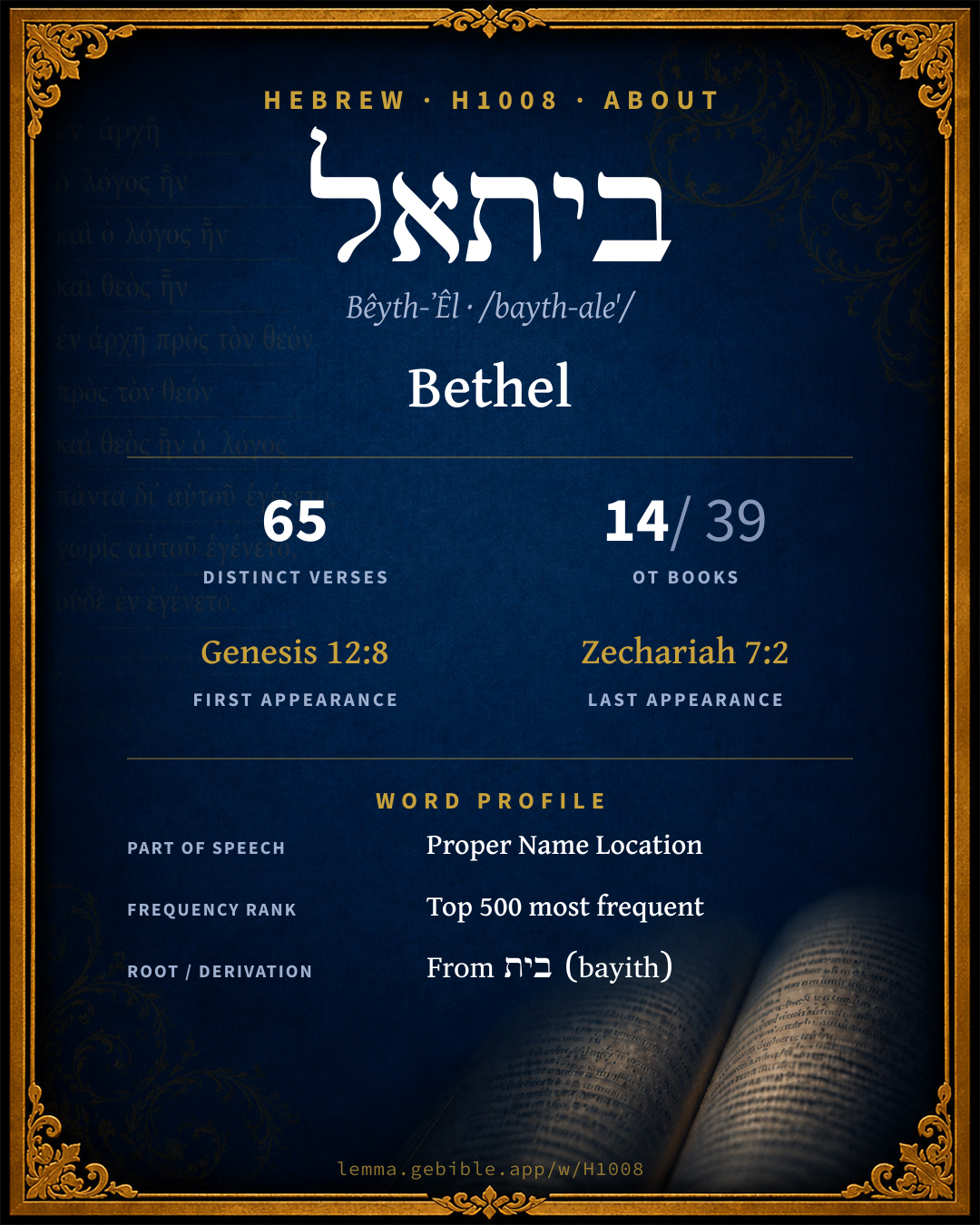
בֵּֽיתְ־אֵל
Bethel
BDB lists 3 entries for ‘Bethel’ fuller range ↓
Full lexicon entry — Brown-Driver-Briggs (BDB)
From Brown-Driver-Briggs (BDB)
Where this word appears
Grammar key — what these labels mean
Part of speech
- Noun
- A naming word — a person, place, thing, or idea.
Noun type
- Proper
- A name of a specific person, place, or people (e.g. Abraham, Zion, Israel).
Every verse where H1008 appears — 65 distinct verses across 14 books. Click any verse to open its interlinear word-by-word view. Verse text shown in the World English Bible for context — . Each verse’s Hebrew form is shown with its reference; the English is not keyword-highlighted, since the data carries no word-level English alignment. Use “Compare translations” on any verse to read it across multiple English versions. This concordance covers the Hebrew Bible; Septuagint (Greek Old Testament) occurrences are not indexed here.
Genesis 11 verses
- Genesis 12:8 לְ/בֵֽית אֵ֖ל בֵּֽית אֵ֤ל prep + n Proper n Proper n Proper n Proper He left from there to the mountain on the east of Bethel, and pitched his tent, having Bethel on the west, and Ai on the east. There he built an altar to Yahweh, and called on the name of Yahweh.
- Genesis 13:3 בֵּֽית אֵ֑ל בֵּֽית אֵ֖ל n Proper n Proper n Proper n Proper He went on his journeys from the South even to Bethel, to the place where his tent had been at the beginning, between Bethel and Ai,
- Genesis 28:19 בֵּֽית אֵ֑ל n Proper n Proper He called the name of that place Bethel, but the name of the city was Luz at the first.
- Genesis 31:13 בֵּֽית אֵ֔ל n Proper n Proper I am the God of Bethel, where you anointed a pillar, where you vowed a vow to me. Now arise, get out from this land, and return to the land of your birth."
- Genesis 35:1 בֵֽית אֵ֖ל n Proper n Proper God said to Jacob, "Arise, go up to Bethel, and live there. Make there an altar to God, who appeared to you when you fled from the face of Esau your brother."
- Genesis 35:3 בֵּֽית אֵ֑ל n Proper n Proper Let us arise, and go up to Bethel. I will make there an altar to God, who answered me in the day of my distress, and was with me in the way which I went."
- Genesis 35:6 בֵּֽית אֵ֑ל n Proper n Proper So Jacob came to Luz, which is in the land of Canaan (the same is Bethel), he and all the people who were with him.
- Genesis 35:7 בֵּֽית אֵ֑ל n Proper n Proper He built an altar there, and called the place El Beth El; because there God was revealed to him, when he fled from the face of his brother.
- Genesis 35:8 לְ/בֵֽית אֵ֖ל prep + n Proper n Proper Deborah, Rebekah's nurse, died, and she was buried below Bethel under the oak; and the name of it was called Allon Bacuth.
- Genesis 35:15 בֵּֽית אֵֽל n Proper n Proper Jacob called the name of the place where God spoke with him "Bethel."
- Genesis 35:16 מִ/בֵּ֣ית אֵ֔ל prep + n Proper n Proper They traveled from Bethel. There was still some distance to come to Ephrath, and Rachel travailed. She had hard labor.
Joshua 10 verses
- Joshua 7:2 לְ/בֵֽית אֵ֔ל prep + n Proper n Proper Joshua sent men from Jericho to Ai, which is beside Beth Aven, on the east side of Bethel, and spoke to them, saying, Go up and spy out the land. The men went up and spied out Ai.
- Joshua 8:9 בֵּֽית אֵ֛ל n Proper n Proper Joshua sent them forth; and they went to set up the ambush, and stayed between Bethel and Ai, on the west side of Ai: but Joshua lodged that night among the people.
- Joshua 8:12 בֵּֽית אֵ֛ל n Proper n Proper He took about five thousand men, and set them in ambush between Bethel and Ai, on the west side of the city.
- Joshua 8:17 וּ/בֵ֣ית אֵ֔ל conj + n Proper n Proper There was not a man left in Ai or Beth El, who didn't go out after Israel: and they left the city open, and pursued after Israel.
- Joshua 12:9 בֵּֽית אֵ֖ל n Proper n Proper the king of Jericho, one; the king of Ai, which is beside Bethel, one;
- Joshua 12:16 בֵּֽית אֵ֖ל n Proper n Proper the king of Makkedah, one; the king of Bethel, one;
- Joshua 16:1 בֵּֽית אֵֽל n Proper n Proper The lot came out for the children of Joseph from the Jordan at Jericho, at the waters of Jericho on the east, even the wilderness, going up from Jericho through the hill-country to Bethel;
- Joshua 16:2 מִ/בֵּֽית אֵ֖ל prep + n Proper n Proper and it went out from Bethel to Luz, and passed along to the border of the Archites to Ataroth;
- Joshua 18:13 בֵּֽית אֵ֑ל n Proper n Proper The border passed along from there to Luz, to the side of Luz (the same is Bethel), southward; and the border went down to Ataroth Addar, by the mountain that lies on the south of Beth Horon the lower.
- Joshua 18:22 וּ/בֵֽית אֵֽל conj + n Proper n Proper and Beth Arabah, and Zemaraim, and Bethel,
Judges 8 verses
- Judges 1:22 בֵּֽית אֵ֑ל n Proper n Proper The house of Joseph, they also went up against Bethel; and Yahweh was with them.
- Judges 1:23 בְּ/בֵֽית אֵ֑ל prep + n Proper n Proper The house of Joseph sent to spy out Bethel. (Now the name of the city before was Luz.)
- Judges 4:5 בֵּֽית אֵ֖ל n Proper n Proper She lived under the palm tree of Deborah between Ramah and Bethel in the hill-country of Ephraim: and the children of Israel came up to her for judgment.
- Judges 20:18 בֵֽית אֵל֮ n Proper n Proper The children of Israel arose, and went up to Bethel, and asked counsel of God; and they said, Who shall go up for us first to battle against the children of Benjamin? Yahweh said, Judah [shall go up] first.
- Judges 20:26 בֵֽית אֵ֗ל n Proper n Proper Then all the children of Israel, and all the people, went up, and came to Bethel, and wept, and sat there before Yahweh, and fasted that day until even; and they offered burnt-offerings and peace-offerings before Yahweh.
- Judges 20:31 בֵֽית אֵ֗ל n Proper n Proper The children of Benjamin went out against the people, and were drawn away from the city; and they began to strike and kill of the people, as at other times, in the highways, of which one goes up to Bethel, and the other to Gibeah, in the field, about thirty men of Israel.
- Judges 21:2 בֵּֽית אֵ֔ל n Proper n Proper The people came to Bethel, and sat there until evening before God, and lifted up their voices, and wept sore.
- Judges 21:19 לְ/בֵֽית אֵל֙ מִ/בֵּֽית אֵ֖ל prep + n Proper n Proper prep + n Proper n Proper They said, Behold, there is a feast of Yahweh from year to year in Shiloh, which is on the north of Bethel, on the east side of the highway that goes up from Bethel to Shechem, and on the south of Lebonah.
1 Samuel 4 verses
- 1 Samuel 7:16 בֵּֽית אֵ֔ל n Proper n Proper He went from year to year in circuit to Bethel and Gilgal, and Mizpah; and he judged Israel in all those places.
- 1 Samuel 10:3 בֵּֽית אֵ֑ל n Proper n Proper Then shall you go on forward from there, and you shall come to the oak of Tabor; and there shall meet you there three men going up to God to Bethel, one carrying three kids, and another carrying three loaves of bread, and another carrying a bottle of wine:
- 1 Samuel 13:2 בֵּֽית אֵ֔ל n Proper n Proper Saul chose him three thousand men of Israel, of which two thousand were with Saul in Michmash and in the Mount of Bethel, and one thousand were with Jonathan in Gibeah of Benjamin: and the rest of the people he sent every man to his tent.
- 1 Samuel 30:27 בְּ/בֵֽית אֵ֛ל prep + n Proper n Proper To those who were in Bethel, and to those who were in Ramoth of the South, and to those who were in Jattir,
1 Kings 8 verses
- 1 Kings 12:29 בְּ/בֵֽית אֵ֑ל prep + n Proper n Proper He set the one in Bethel, and the other put he in Dan.
- 1 Kings 12:32 בְּ/בֵֽית אֵ֔ל בְּ/בֵ֣ית אֵ֔ל prep + n Proper n Proper prep + n Proper n Proper Jeroboam ordained a feast in the eighth month, on the fifteenth day of the month, like the feast that is in Judah, and he went up to the altar; so did he in Bethel, sacrificing to the calves that he had made: and he placed in Bethel the priests of the high places that he had made.
- 1 Kings 12:33 בְּ/בֵֽית אֵ֗ל prep + n Proper n Proper He went up to the altar which he had made in Bethel on the fifteenth day in the eighth month, even in the month which he had devised of his own heart: and he ordained a feast for the children of Israel, and went up to the altar, to burn incense.
- 1 Kings 13:1 בֵּֽית אֵ֑ל n Proper n Proper Behold, there came a man of God out of Judah by the word of Yahweh to Beth El: and Jeroboam was standing by the altar to burn incense.
- 1 Kings 13:4 בְּ/בֵֽית אֵ֔ל prep + n Proper n Proper It happened, when the king heard the saying of the man of God, which he cried against the altar in Bethel, that Jeroboam put forth his hand from the altar, saying, Lay hold on him. His hand, which he put forth against him, dried up, so that he could not draw it back again to him.
- 1 Kings 13:10 בֵּֽית אֵֽל n Proper n Proper So he went another way, and didn't return by the way that he came to Bethel.
- 1 Kings 13:11 בְּ/בֵֽית אֵ֑ל בְּ/בֵֽית אֵ֗ל prep + n Proper n Proper prep + n Proper n Proper Now there lived an old prophet in Bethel; and one of his sons came and told him all the works that the man of God had done that day in Bethel: the words which he had spoken to the king, them also they told to their father.
- 1 Kings 13:32 בְּ/בֵֽית אֵ֑ל prep + n Proper n Proper For the saying which he cried by the word of Yahweh against the altar in Bethel, and against all the houses of the high places which are in the cities of Samaria, shall surely happen.
2 Kings 9 verses
- 2 Kings 2:2 בֵּֽית אֵ֔ל בֵּֽית אֵֽל n Proper n Proper n Proper n Proper Elijah said to Elisha, Please wait here, for Yahweh has sent me as far as Bethel. Elisha said, As Yahweh lives, and as your soul lives, I will not leave you. So they went down to Bethel.
- 2 Kings 2:3 בֵּֽית אֵל֮ n Proper n Proper The sons of the prophets who were at Bethel came forth to Elisha, and said to him, "Do you know that Yahweh will take away your master from your head today?" He said, "Yes, I know it; hold your peace."
- 2 Kings 2:23 בֵּֽית אֵ֑ל n Proper n Proper He went up from there to Bethel; and as he was going up by the way, there came forth young lads out of the city, and mocked him, and said to him, Go up, you baldy; go up, you baldhead.
- 2 Kings 10:29 בֵּֽית אֵ֖ל n Proper n Proper However from the sins of Jeroboam the son of Nebat, with which he made Israel to sin, Jehu didn't depart from after them, [to wit], the golden calves that were in Bethel, and that were in Dan.
- 2 Kings 17:28 בְּ/בֵֽית אֵ֑ל prep + n Proper n Proper So one of the priests whom they had carried away from Samaria came and lived in Bethel, and taught them how they should fear Yahweh.
- 2 Kings 23:4 בֵּֽית אֵֽל n Proper n Proper The king commanded Hilkiah the high priest, and the priests of the second order, and the keepers of the threshold, to bring forth out of the temple of Yahweh all the vessels that were made for Baal, and for the Asherah, and for all the host of the sky, and he burned them outside of Jerusalem in the fields of the Kidron, and carried the ashes of them to Bethel.
- 2 Kings 23:15 בְּ/בֵֽית אֵ֗ל prep + n Proper n Proper Moreover the altar that was at Bethel, and the high place which Jeroboam the son of Nebat, who made Israel to sin, had made, even that altar and the high place he broke down; and he burned the high place and beat it to dust, and burned the Asherah.
- 2 Kings 23:17 בֵּֽית אֵֽל n Proper n Proper Then he said, What monument is that which I see? The men of the city told him, It is the tomb of the man of God, who came from Judah, and proclaimed these things that you have done against the altar of Bethel.
- 2 Kings 23:19 בְּ/בֵֽית אֵֽל prep + n Proper n Proper All the houses also of the high places that were in the cities of Samaria, which the kings of Israel had made to provoke [Yahweh] to anger, Josiah took away, and did to them according to all the acts that he had done in Bethel.
1 Chronicles 1 verse
2 Chronicles 1 verse
Ezra 1 verse
Nehemiah 2 verses
Jeremiah 1 verse
Hosea 2 verses
- Hosea 10:15 בֵּֽית אֵ֔ל n Proper n Proper So Bethel will do to you because of your great wickedness. At daybreak the king of Israel will be destroyed.
- Hosea 12:4 בֵּֽית אֵל֙ n Proper n Proper Indeed, he had power over the angel, and prevailed; He wept, and made supplication to him. He found him at Bethel, and there he spoke with us,
Amos 6 verses
- Amos 3:14 בֵּֽית אֵ֔ל n Proper n Proper "For in the day that I visit the transgressions of Israel on him, I will also visit the altars of Bethel; And the horns of the altar will be cut off, And fall to the ground.
- Amos 4:4 בֵֽית אֵל֙ n Proper n Proper "Go to Bethel, and sin; To Gilgal, and sin more. Bring your sacrifices every morning, Your tithes every three days,
- Amos 5:5 בֵּֽית אֵ֔ל וּ/בֵֽית אֵ֖ל n Proper n Proper conj + n Proper n Proper But don't seek Bethel, Nor enter into Gilgal, And don't pass to Beersheba: For Gilgal shall surely go into captivity, And Bethel shall come to nothing.
- Amos 5:6 לְ/בֵֽית אֵֽל prep + n Proper n Proper Seek Yahweh, and you will live; Lest he break out like fire in the house of Joseph, And it devour, and there be no one to quench it in Bethel.
- Amos 7:10 בֵּֽית אֵ֔ל n Proper n Proper Then Amaziah the priest of Beth El sent to Jeroboam king of Israel, saying, "Amos has conspired against you in the midst of the house of Israel. The land is not able to bear all his words.
- Amos 7:13 וּ/בֵֽית אֵ֔ל conj + n Proper n Proper but don't prophesy again any more at Bethel; for it is the king's sanctuary, and it is a royal house!"
Zechariah 1 verse
About this entry
At a glance — auto-summarized from this page’s data, not written by a person. Every figure links to its source below. This summary describes the numbers; it doesn’t interpret them.
“Bethel” is the headline sense of the Hebrew name ביתאל (Bêyth-ʼÊl). First canonically at Genesis 12:8, it enters the text early. It turns up in 65 verses across 14 books, a moderately common footprint. The sections below give every occurrence and version rendering.
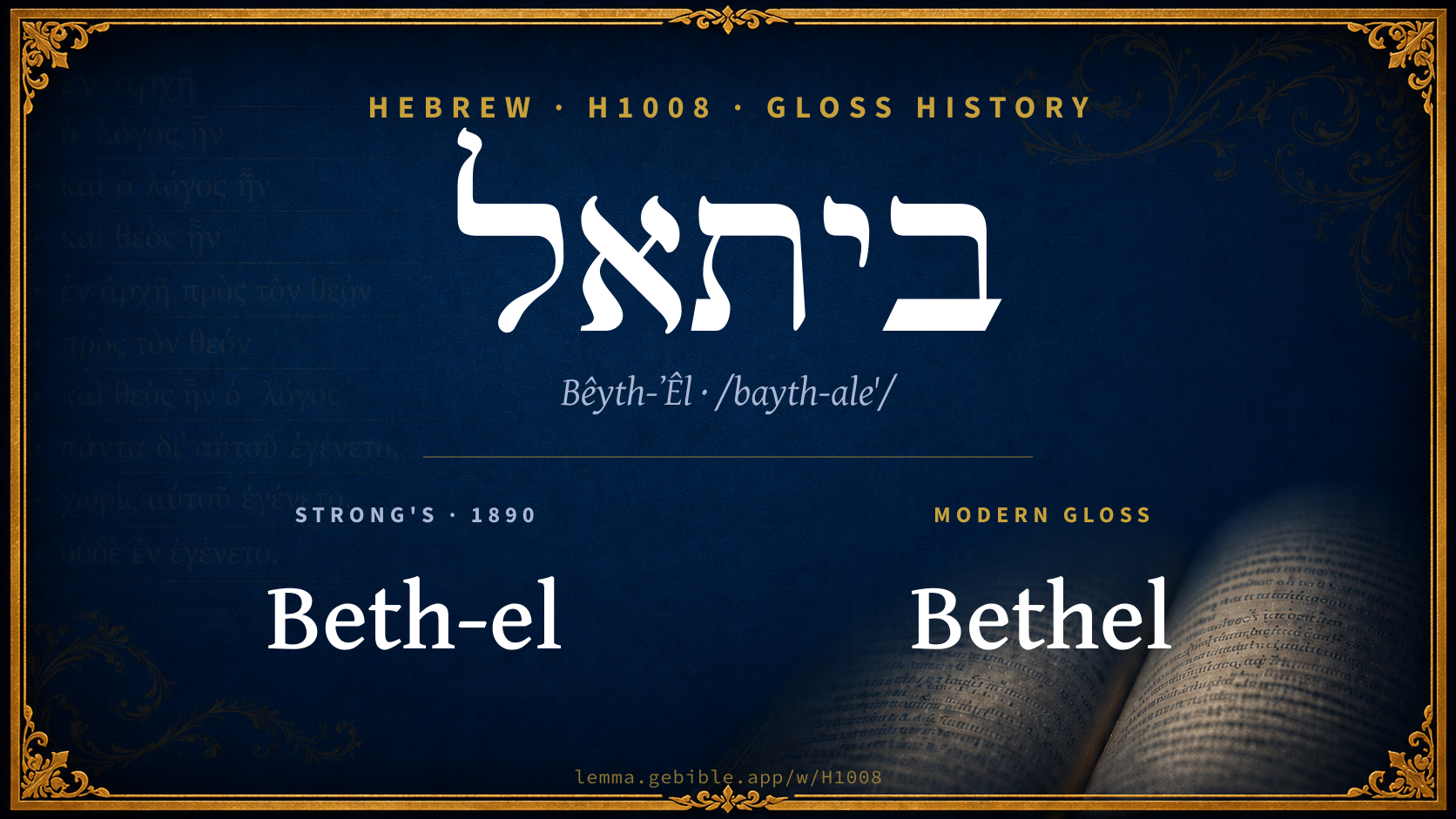
Gloss history
Strong's 1890 vs modern scholarship
About this word
Strong's H1008 catalogs a Hebrew word from the Hebrew Old Testament.
These counts are not copied from any lexicon or concordance. They are computed here, from the morphology-tagged Hebrew Old Testament. What Lemma adds →
- 65
- distinct verses
- The word appears in 65 distinct verses.
- 14 / 39
- OT books
- The word appears in 14 of 39 Old Testament books.
- #312
- by frequency
- Top 500 most frequent Hebrew words (rank 312 of 8,640 Hebrew words by occurrence).
View all 65 occurrences in the concordance →
By section of the Old Testament
By traditional corpus
Conventional, traditional groupings — biblical authorship is debated, so this is a traditional corpus grouping, not an authorship claim. Each share is this word’s portion of its verses in that division of the Hebrew canon. Each figure is a share of the word’s 65 distinct verses.
- Prophets (Nevi'im) 49 verses · 75%
- Torah (Pentateuch) 11 verses · 17%
- Writings (Ketuvim) 5 verses · 8%
How translations render this word
Counts come from each version’s own published word-to-Strong’s tagging or interlinear alignment — an approximate guide to how each version renders this word, not a word-level alignment the data otherwise carries. Because each total is that version’s own tagged count, the per-version totals vary from one another and need not match the appearance or distinct-verse counts above. These counts may also differ from a printed concordance because Lemma counts each distinctly tagged rendering and does not collapse phrase taggings into a single head-word total. This is a fixed set of word-tagged versions (KJV, ASV, BSB, ULT) and does not change with the reading translation you choose elsewhere. Each version’s license is shown beside its name below (and on Sources).
- King James Version: Bethel 48×, Between bethel 3×, Is bethel 2×
- American Standard Version: Beth-el 43×, Between beth-el 3×, Him 2×
- Berean Standard Bible: Bethel 68×, Of 5×, To 5×
- unfoldingWord Literal Text: Bethel 128×, Was in bethel 4×, Were in bethel 4×
King James Version Public Domain
Renders H1008 across 66 tagged occurrences — most commonly:
Plus 11 renderings that appear only once — usually multi-word phrases or single function words the recovered tagging swept in, not distinct renderings. Not rendered by a distinct English word in 4 further occurrences.
American Standard Version Public Domain
Renders H1008 across 66 tagged occurrences — most commonly:
Plus 14 renderings that appear only once — usually multi-word phrases or single function words the recovered tagging swept in, not distinct renderings.
Berean Standard Bible Public Domain
Renders H1008 across 88 tagged occurrences — most commonly:
Plus 7 renderings that appear only once — usually multi-word phrases or single function words the recovered tagging swept in, not distinct renderings. Not rendered by a distinct English word in 8 further occurrences.
unfoldingWord Literal Text CC BY-SA 4.0
Renders H1008 across 144 tagged occurrences — most commonly:
Senses in the full BDB
What do BDB’s symbols mean?
BDB uses these scholarly abbreviations:
| Symbol | Meaning |
|---|---|
| 𝔊 | the Septuagint (the ancient Greek translation, LXX) |
| 𝔙 | the Vulgate (the Latin translation) |
| 𝔖 | the Syriac version (the Peshitta) |
| 𝔗 | the Targum (the Aramaic translation) |
| ψ | the Psalms |
| √ | root (the underlying root or stem) |
| ‖ | parallel passage (a synonymous or contrasted parallel) |
| † | the dagger: every passage where the word occurs is cited |
The 2 senses and sub-senses the full Brown-Driver-Briggs lexicon distinguishes for this word, in lexicon order (not ranked by frequency), with BDB’s own verbatim wording and sub-sense lettering. Shown in Hebrew script with BDB’s own scholarly abbreviations. The condensed entry is in the Lexicon Entry tab. See also the Forms in the corpus table below.
- 1. ancient place and seat of worship in Ephraim on border of Benjamin, identif. with Luz (former name) Gn 28:19; 35:6 Jos 18:13 Ju 1:23; appar. distinguished from Luz Jos 16:2 (yet cf. Di); name connected with vision of Jacob when journeying to Paddan-Aramaic (JE) Gn 28:19; 35:7 (where אֵל בֵּֽיתְאֵל, but 𝔊 𝔖 𝔙 Ol del. אֵל; Di maintains); cf. Ho 12:5; when journeying from P.-A. 35:15 (P); name appar. given first to a stone (Gn 28:18; 35:14) cf. WeSkizzen iii. 70; הַר בֵּֽיתְאֵל 1 S 13:2; later important place of worship 1 S 10:3 עָלָה אֶל־הָאֱלֹהִיס בֵּיתְאֵל; abode of prophet 1 K 13:11 2 K 2:3; Jeroboam set up one of the golden calves at Bethel 1 K 12:29f. cf. also 13:1f. 2 K 10:29; 23:15 Je 48:13 v. further 2 K 17:28; 2 K 23:15 Th prop. on internal grounds, בֵּית אַל house of nothingness, or בּ׳ אָלָה house of execration; בּ׳ אָלָה also RenanHist. iii. 185; in proph. Am 3:14; 4:4; 5:5(×2), 6; 7:10, 13 Ho 10:15; note especially Am 5:5 ביתאל יִהְיֶה לְאָ֑וֶן, & בֵּית אָוֶן (house of iniquity) as substit. for ביתאל Ho 4:15; 5:8; 10:5 (עֶגְּלוֹת בית און);—mod. Beitîn RobBR i. 448 f. GuérinJudée iii. 14–27 cf. BdPal. 215 Surveyiii. 305. e.g. Genesis 28:19
- 2. place in south country of Judah, not far from Beersheba & Ziklag 1 S 30:27 cf. We Dr; = MT כסיל Jos 15:30 (textual error; 𝔊 Βαιθηλ); also בְּתוּל Jos 19:4, בְּתוּאֵל 1 Ch 4:30. e.g. 1 Samuel 30:27
Senses from the full Brown-Driver-Briggs lexicon (Brown, Driver, Briggs; Oxford 1906 — public domain), digitized via Sefaria, supplemented by the OpenScriptures HebrewLexicon (CC BY 4.0). Full attribution on Sources.
Word origin
n.pr.loc. Bethel (so read, not בֵּית־אֵל as Jos 7:2 + according to v. d. H; cf. Baer Gn 12:8; house of God, or house of Ēl)—
— Brown-Driver-Briggs (Oxford 1906, public domain), digitized via Sefaria, supplemented by the OpenScriptures HebrewLexicon (CC BY 4.0). See Sources.
Derived from בית (bayith) (H1004) — house.
Forms in the corpus
The 19 distinct written forms H1008 takes in the Hebrew Bible, most frequent first — each parse links to that state’s occurrences in the concordance. Hebrew forms include their vowel points and cantillation, so a single lemma takes many written forms.
| Form | Parsing | Example | Uses |
|---|---|---|---|
| בֵּֽית | Noun, Proper | Amos 3:14 | 38 |
| אֵ֔ל | Noun, Proper | Amos 3:14 | 17 |
| אֵ֑ל | Noun, Proper | Genesis 13:3 | 15 |
| אֵ֖ל | Noun, Proper | Amos 5:5 | 14 |
| בְּ/בֵֽית | Noun, Proper | 1 Kings 12:29 | 12 |
| אֵֽל | Noun, Proper | Amos 5:6 | 9 |
| בֵֽית | Noun, Proper | Amos 4:4 | 7 |
| אֵל֙ | Noun, Proper | Amos 4:4 | 6 |
| אֵ֗ל | Noun, Proper | 1 Kings 12:33 | 5 |
| לְ/בֵֽית | Noun, Proper | Amos 5:6 | 5 |
| וּ/בֵֽית | Noun, Proper | Amos 5:5 | 4 |
| אֵ֛ל | Noun, Proper | 1 Samuel 30:27 | 3 |
| אֵל֮ | Noun, Proper | 2 Kings 2:3 | 2 |
| מִ/בֵּֽית | Noun, Proper | Joshua 16:2 | 2 |
| אֵ֤ל | Noun, Proper | Genesis 12:8 | 1 |
| בְּ/בֵ֣ית | Noun, Proper | 1 Kings 12:32 | 1 |
| וּ/בֵ֣ית | Noun, Proper | Joshua 8:17 | 1 |
| מִ/בֵּ֣ית | Noun, Proper | Genesis 35:16 | 1 |
| מִ/בֵּ֥ית | Noun, Proper | Jeremiah 48:13 | 1 |
Same root — word family
Other BDB entries built from the same root as H1008, grouped by Strong’s listed origin. These share a root / origin per the lexicon — not necessarily a shared meaning. Each links to that word’s own entry.
Derives from
Shares the same root
Proper names from this root
People and places named from this root — a name, not an additional meaning of the word.
- Βηθαβαρα Bēthabará G962 Bethabara
- בית Bayith H1006 Bajith
- בית און Bêyth ʼÂven H1007 Beth-aven
- בית ארבאל Bêyth ʼArbêʼl H1009 Beth-Arbel
- בית בעל מעון Bêyth Baʻal Mᵉʻôwn H1010 Beth-baal-meon
- בית בראי Bêyth Birʼîy H1011 Beth-birei
- בית ברה Bêyth Bârâh H1012 Beth-barah
- ביתגדר Bêyth-Gâdêr H1013 Beth-gader
- בית גמול Bêyth Gâmûwl H1014 Beth-gamul
- בית דבלתים Bêyth Diblâthayim H1015 Beth-diblathaim
- ביתדגון Bêyth-Dâgôwn H1016 Beth-dagon
- בית האצל Bêyth hâʼêtsel H1018 Beth-ezel
- בית הגלגל Bêyth hag-Gilgâl H1019 Beth-gilgal
- בית הישימות Bêyth ha-Yshîy-môwth H1020 Beth-jesimoth
- בית הכרם Bêyth hak-Kerem H1021 Beth-haccerem
- בית המרחק Bêyth ham-Merchâq H1023 Beth Ham-merchaq
- בית המרכבות Bêyth ham-Markâbôwth H1024 Beth-marcaboth
- בית העמק Bêyth hâ-ʻÊmeq H1025 Beth-emek
- בית הערבה Bêyth hâ-ʻĂrâbâh H1026 Beth-arabah
- בית הרם Bêyth hâ-Râm H1027 Beth-aram
- בית השטה Bêyth hash-Shiṭṭâh H1029 Beth-shittah
- בית חגלה Bêyth Choglâh H1031 Beth-hoglah
- בית חורון Bêyth Chôwrôwn H1032 Beth-horon
- בית כר Bêyth Kar H1033 Beth-car
- בית האלי Bêyth hâ-ʼĔlîy H1017 Bethelite
+20 more proper names from this root (not shown).
Compare all same-root words → Showing 4 of 49 — not the complete family. 45 of the same-root words are proper names (people or places). They share a root, not necessarily a meaning.
Bible dictionary
Public-domain dictionary articles matched to this entry by name (Bethel). A biblical name can be shared by more than one person or place, so an article may treat several.
Easton's Bible Dictionary · M. G. Easton, 1897
House of God. (1.) A place in Central Palestine, about 10 miles north of Jerusalem, at the head of the pass of Michmash and Ai. It was originally the royal Canaanite city of Luz (Gen. 28:19). The name Bethel was at first apparently given to the sanctuary in the neighbourhood of Luz, and was not given to the city itself till after its conquest by the tribe of Ephraim. When Abram entered Canaan he formed his second encampment between Bethel and Hai (Gen. 12:8); and on his return from Egypt he came back to it, and again "called upon the name of the Lord" (13:4). Here Jacob, on his way from Beersheba to Haran, had a vision of the angels of God ascending and descending on the ladder whose top reached unto heaven (28:10, 19); and on his return he again visited this place, "where God talked with him" (35:1-15), and there he "built an altar, and called the place El-beth-el" (q.v.). To this second occasion of God's speaking with Jacob at Bethel, Hosea (12:4, 5) makes reference.
In troublous times the people went to Bethel to ask counsel of God (Judg. 20:18, 31; 21:2). Here the ark of the covenant was kept for a long time under the care of Phinehas, the grandson of Aaron (20:26-28). Here also Samuel held in rotation his court of justice (1 Sam. 7:16). It was included in Israel after the kingdom was divided, and it became one of the seats of the worship of the golden calf (1 Kings 12:28-33; 13:1). Hence the prophet Hosea (Hos. 4:15; 5:8; 10:5, 8) calls it in contempt Beth-aven, i.e., "house of idols." Bethel remained an abode of priests even after the kingdom of Israel was desolated by the king of Assyria (2 Kings 17:28, 29). At length all traces of the idolatries were extirpated by Josiah, king of Judah (2 Kings 23:15-18); and the place was still in existence after the Captivity (Ezra 2:28; Neh. 7:32). It has been identified with the ruins of Beitin, a small village amid extensive ruins some 9 miles south of Shiloh.
(2.) Mount Bethel was a hilly district near Bethel (Josh. 16:1; 1 Sam. 13:2).
(3.) A town in the south of Judah (Josh. 8:17; 12:16).
Smith's Bible Dictionary · William Smith, 1863
(the house of God) well known city and holy place of central Palestine, about 12 mlles north of Jerusalem. If we are to accept the precise definition of (Genesis 12:8) the name of Bethel would appear to have existed at this spot even before the arrival of Abram in Canaan. (Genesis 12:8; 13:3,4) Bethel was the scene of Jacob's vision. (Genesis 28:11-19; 31:13) Jacob lived there. (Genesis 35:1-8) The original name was Luz. (Judges 1:22,23) After the conquest Bethel is frequently heard of. In the troubled times when there was no king in Israel, it was to Bethel that the people went up in their distress to ask counsel of God. (Judges 20:18,26,31; 21:2) Authorized Version, "house of God." Here was the ark of the covenant. (Judges 20:26-28; 21:4) Later it is named as one of the holy cities to which Samuel went on circuit. (1 Samuel 7:16) Here Jeroboab placed one of the two calves of gold. Toward the end of Jeroboam's life Bethel fell into the hands of Judah. (2 Chronicles 13:19) Elijah visited Bethel, and we hear of "sons of the prophets" as resident there. (2 Kings 2:2,3) But after the destruction of Baal worship by Jehu Bethel comes once more into view. (2 Kings 10:29) After the desolation of the northern kingdom by the king of Assyria, Bethel still remained an abode of priests. (2 Kings 17:27,28) In later times Bethel is named only once under the scarcely-altered name of Beitin . Its ruins still lie on the righthand side of the road from Jerusalem to Nablus.
+ A town in the south part of Judah, named in (Joshua 12:16) and 1Sam 30:27 In (Joshua 15:30; 19:4; 1 Chronicles 4:29,30) the place appears under the name of Chesil, Bethul and Bethuel. Hiel the Bethelite is recorded as the rebuilder of Jericho. (1 Kings 16:34) + In (Joshua 16:1) and 1Sam 13:2 Mount Bethel, a hilly section near Beth-el, is referred to.
Hitchcock's Bible Names Dictionary · Roswell D. Hitchcock, 1869
the house of God
Classic public-domain reference works; full attribution on Sources.
Septuagint verse parallels
This word appears in 63 verses that also exist in the Greek Old Testament (Septuagint), out of the 65 Hebrew verses it occurs in. You can read those verses in Greek by switching the Old Testament edition to the Septuagint.
Read these verses in the Septuagint
- Genesis 12:8
- Joshua 7:2
- Judges 1:22
- 1 Samuel 7:16
- 1 Kings 12:29
- 2 Kings 2:2
- 1 Chronicles 7:28
- 2 Chronicles 13:19
- Ezra 2:28
- Jeremiah 48:13
- Hosea 10:15
- Amos 3:14
This is a verse-level parallel only — the same verses exist in both the Hebrew and Greek Old Testaments. No word-level Hebrew↔Greek correspondence is claimed: the data carries no such alignment, so no Greek word is shown as this Hebrew word’s translation. Coverage is not total — the Septuagint omits the deuterocanon and renumbers the Psalms, so some Hebrew verses have no direct Greek parallel.