
Zechariah 6:10

Hebrew (Westminster Leningrad Codex) Zechariah 6:10 appears in the Hebrew Old Testament. The text above is from the Westminster Leningrad Codex. Each word links to its Strong’s number, a concise gloss, and parsing drawn from the Open Scriptures Hebrew Bible morphology. Click any word for its full Brown-Driver-Briggs (BDB) entry.
Download image
Cite this verse

Zechariah 6:10 (World English Bible). Public Domain. Lemma interlinear Bible study tool, https://lemma.gebible.app/v/zechariah/6/10.

Show BibTeX & RIS
BibTeX
RIS
English Translation
"Take of them of the captivity, even of Heldai, of Tobijah, and of Jedaiah; and come the same day, and go into the house of Josiah the son of Zephaniah, where they have come from Babylon.
World English Bible · Public Domain
Download a study sheet

One document with this verse’s original text, its word-by-word gloss line, the meaning frame, cross-references with their text, attributed commentary, and full source and license credits — printable, and it pastes into notes with its structure intact.

This verse Autodidact and up

Study sheet (.html) Plain text (.txt)

A passage Seminary Student

Up to 50 verses in one chapter. A passage sheet keeps up to 6 commentary sources and 12 cross-references per verse, in the order this page ranks them, and says so on the sheet whenever that leaves anything out. Ask for a single verse and you get the Autodidact verse sheet above.

Everything on this page stays free to read, with no account — the sheet is a download of what is already on screen, not access to it.

Want to remove ads? Support Godless Engineer
Compare translations 3

The same verse in 3 English versions, stacked beneath the original-language interlinear above. Click any original word for its lexicon entry.

Each is an independent rendering of the whole verse — the interlinear is not word-aligned to these translations.

Highlighted words mark where these versions differ — a whole-verse word diff, not a word-by-word alignment.

  • World English Bible Public Domain
    "Take of them of the captivity, even of Heldai, of Tobijah, and of Jedaiah; and come the same day, and go into the house of Josiah the son of Zephaniah, where they have come from Babylon.
  • King James Version Public Domain
    Take of them of the captivity, even of Heldai, of Tobijah, and of Jedaiah, which are come from Babylon, and come thou the same day, and go into the house of Josiah the son of Zephaniah;
  • unfoldingWord Literal Text CC BY-SA 4.0
    “Take from the exiles— from Heldai, and from Tobijah, and from Jedaiah— and you shall come on that day, and you shall come to the house of Josiah the son of Zephaniah, who have come from Babylon.

unfoldingWord Literal Text — © unfoldingWord, licensed CC BY-SA 4.0. Word-aligned USFM3 via Door43 (git.door43.org/unfoldingWord/en_ult).

Versions to compare (up to 4)

3 of 4 selected

Show all 18 translations

Every available English version of this verse, each an independent rendering of the whole verse.

  • World English Bible Public Domain
    "Take of them of the captivity, even of Heldai, of Tobijah, and of Jedaiah; and come the same day, and go into the house of Josiah the son of Zephaniah, where they have come from Babylon.
  • Berean Standard Bible Public Domain
    “Take an offering from the exiles—from Heldai, Tobijah, and Jedaiah, who have arrived from Babylon—and go that same day to the house of Josiah son of Zephaniah.
  • Majority Standard Bible Public Domain
    “Take an offering from the exiles—from Heldai, Tobijah, and Jedaiah, who have arrived from Babylon—and go that same day to the house of Josiah son of Zephaniah.
  • King James Version Public Domain
    Take of them of the captivity, even of Heldai, of Tobijah, and of Jedaiah, which are come from Babylon, and come thou the same day, and go into the house of Josiah the son of Zephaniah;
  • American Standard Version (1901) Public Domain
    Take of them of the captivity, even of Heldai, of Tobijah, and of Jedaiah; and come thou the same day, and go into the house of Josiah the son of Zephaniah, whither they are come from Babylon;
  • Revised Version (1885) Public Domain
    Take of them of the captivity, even of Heldai, of Tobijah, and of Jedaiah; and come thou the same day, and go into the house of Josiah the son of Zephaniah, whither they are come from Babylon;
  • Geneva Bible (1599) Public Domain
    Take of them of ye captiuitie, euen of Heldai, and of Tobijah, and Iedaiah, which are come from Babel, and come thou the same day, and goe vnto the house of Ioshiah, the sonne of Zephaniah.
  • Douay-Rheims (1899) Public Domain
    Take of them of the captivity, of Holdai, and of Tobias, and of Idaias; thou shalt come in that day, and shalt go into the house of Josias, the son of Sophonias, who came out of Babylon.
  • Young's Literal Translation Public Domain
    to take of the captivity (who came from Babylon) from Heldai, from Tobijah, and from Jedaiah, `and thou hast come in -- thou, in that day, yea, thou hast come into the house of Josiah son of Zephaniah,
  • Literal Standard Version CC BY-SA 4.0
    “Take of the captivity (who came from Babylon) from Heldai, from Tobijah, and from Jedaiah, and you have come in—you, in that day, indeed, you have come into the house of Josiah son of Zephaniah,
  • Unlocked Literal Bible CC BY-SA 4.0
    “Take an offering from the exiles—from Heldai, Tobijah, and Jedaiah—and go this same day and take it into the house of Josiah son of Zephaniah, who has come from Babylon.
  • unfoldingWord Literal Text CC BY-SA 4.0
    “Take from the exiles— from Heldai, and from Tobijah, and from Jedaiah— and you shall come on that day, and you shall come to the house of Josiah the son of Zephaniah, who have come from Babylon.
  • Darby Bible Public Domain
    Take [gifts] of them of the captivity, of Heldai, of Tobijah, and of Jedaiah, and come thou the same day, and enter into the house of Josiah the son of Zephaniah, whither they are come from Babylon;
  • World Messianic Bible Public Domain
    “Take of them of the captivity, even of Heldai, of Tobijah, and of Jedaiah; and come the same day, and go into the house of Josiah the son of Zephaniah, where they have come from Babylon.
  • Webster's Bible Public Domain
    Take of them of the captivity, even of Heldai, of Tobijah, and of Jedaiah, who are come from Babylon, and come thou the same day, and go into the house of Josiah the son of Zephaniah;
  • Free Bible Version CC BY-SA 4.0
    Take the gifts brought by Heldai, Tobijah, and Jedaiah, the exiles returning from Babylon, and go immediately to the house of Josiah son of Zephaniah.
  • Bible in Basic English Public Domain
    Take the offerings of those who went away as prisoners, from Heldai, Tobijah, and Jedaiah, and from the family of Josiah, the son of Zephaniah, who have come from Babylon;
  • JPS Tanakh (1917) Public Domain
    'Take of them of the captivity, even of Heldai, of Tobijah, and of Jedaiah, that are come from Babylon; and come thou the same day, and go into the house of Josiah the son of Zephaniah;

Literal Standard Version (2020), Covenant Press — licensed CC BY-SA 4.0. Text via the HelloAO Bible API (eBible.org). Unlocked Literal Bible (unfoldingWord) — licensed CC BY-SA 4.0. Text via the HelloAO Bible API (eBible.org). unfoldingWord Literal Text — © unfoldingWord, licensed CC BY-SA 4.0. Word-aligned USFM3 via Door43 (git.door43.org/unfoldingWord/en_ult). Free Bible Version, Dr. Jonathan Gallagher — licensed CC BY-SA 4.0. Text via the HelloAO Bible API (eBible.org).

Word by word

More ways to search: Search by grammar → Find every occurrence → Compare this word →

Practice this passage: Drill this verse → Learn its vocabulary →

מֵחֶלְדַּ֕י
Chelday
H2469
“from · Heldai”
Preposition + Noun, Proper
Part of Speech
Preposition + Noun
Type
Proper
Full BDB Definition

Origin: from H2466

TWOT: None

Heldai = "worldly" - one of David's mighty warriors and the 12th captain of the monthly courses for the temple service - a returning exile in the time of Zechariah
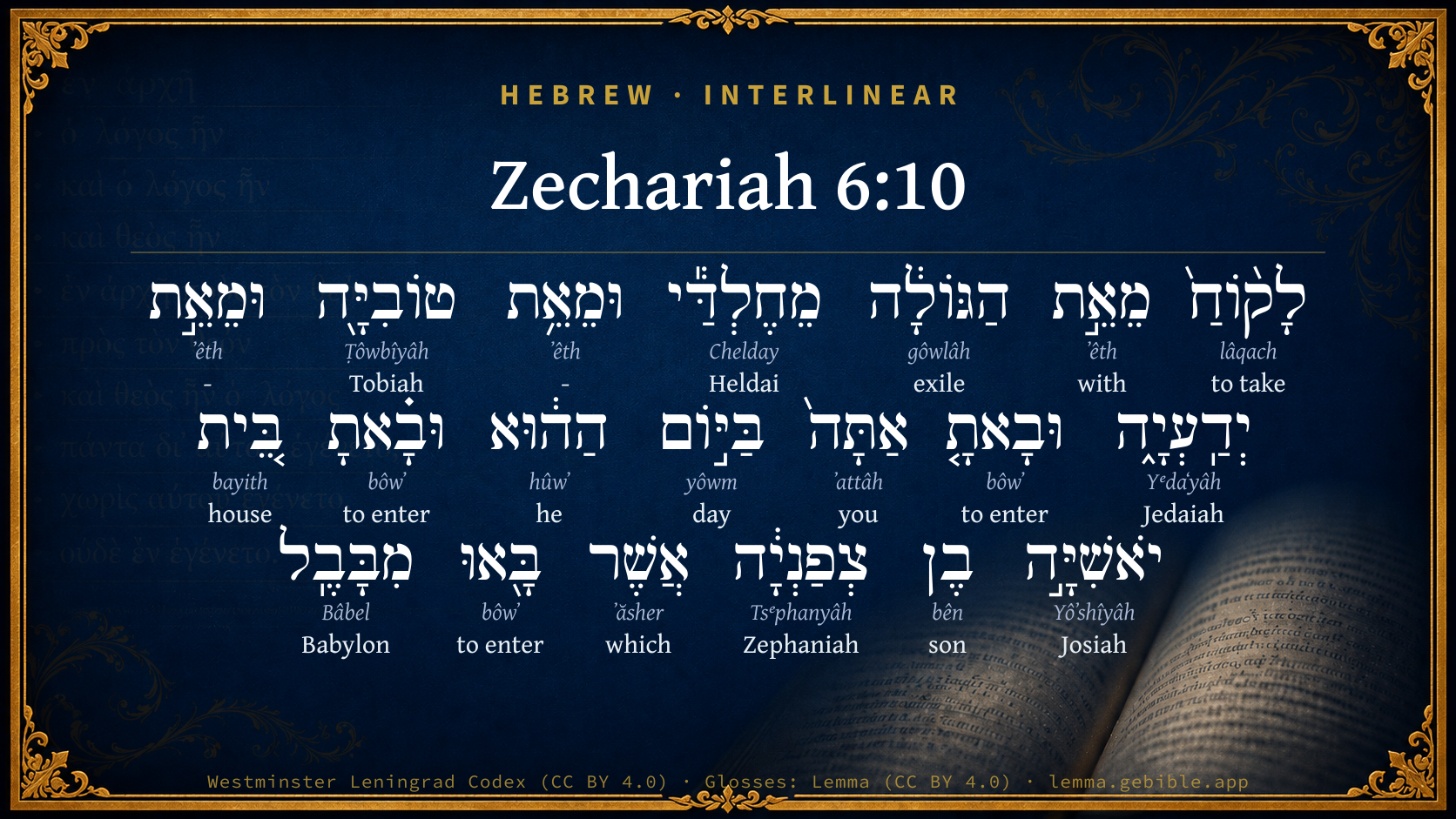
  1. לָק֨וֹחַ֙ lâqach H3947 “to take” Verb, Qal, Infinitive Absolute
  2. מֵאֵ֣ת ʼêth H854 “from · with” Preposition + Preposition
  3. הַגּוֹלָ֔ה gôwlâh H1473 “the · exile” Particle, Definite Article + Noun, Common, Feminine, Singular, Absolute
  4. וּמֵאֵ֥ת ʼêth H853 “and · from · -” Conjunction + Preposition + Particle, Direct Object
  5. טוֹבִיָּ֖ה Ṭôwbîyâh H2900 “Tobiah” Noun, Proper
  6. וּמֵאֵ֣ת ʼêth H853 “and · from · -” Conjunction + Preposition + Particle, Direct Object
  7. יְדַֽעְיָ֑ה Yᵉdaʻyâh H3048 “Jedaiah” Noun, Proper
  8. וּבָאתָ֤ bôwʼ H935 “and · to enter” Conjunction + Verb, Qal, Perfect, 2nd Person, Masculine, Singular
  9. אַתָּה֙ ʼattâh H859 “you” Pronoun, Personal, 2nd Person, Masculine, Singular
  10. בַּיּ֣וֹם yôwm H3117 “in/at the · day” Preposition, Determined + Noun, Common, Masculine, Singular, Absolute
  11. הַה֔וּא hûwʼ H1931 “the · he” Particle, Definite Article + Pronoun, Personal, 3rd Person, Masculine, Singular
  12. וּבָ֗אתָ bôwʼ H935 “and · to enter” Conjunction + Verb, Qal, Perfect, 2nd Person, Masculine, Singular
  13. בֵּ֚ית bayith H1004 “house of” Noun, Common, Masculine, Singular, Construct
  14. יֹאשִׁיָּ֣ה Yôʼshîyâh H2977 “Josiah” Noun, Proper
  15. בֶן bên H1121 “son of” Noun, Common, Masculine, Singular, Construct
  16. צְפַנְיָ֔ה Tsᵉphanyâh H6846 “Zephaniah” Noun, Proper
  17. אֲשֶׁר ʼăsher H834 “which” Particle, Relative
  18. בָּ֖אוּ bôwʼ H935 “to enter” Verb, Qal, Perfect, 3rd Person, Common, Plural
  19. מִבָּבֶֽל Bâbel H894 “from · Babylon” Preposition + Noun, Proper

About this verse

These counts appear in no published source. They are computed here, from the morphology-tagged text and Lemma’s own curated glosses. What Lemma adds →

20
words
17
distinct lemmas
Prophets
section

Notable vocabulary

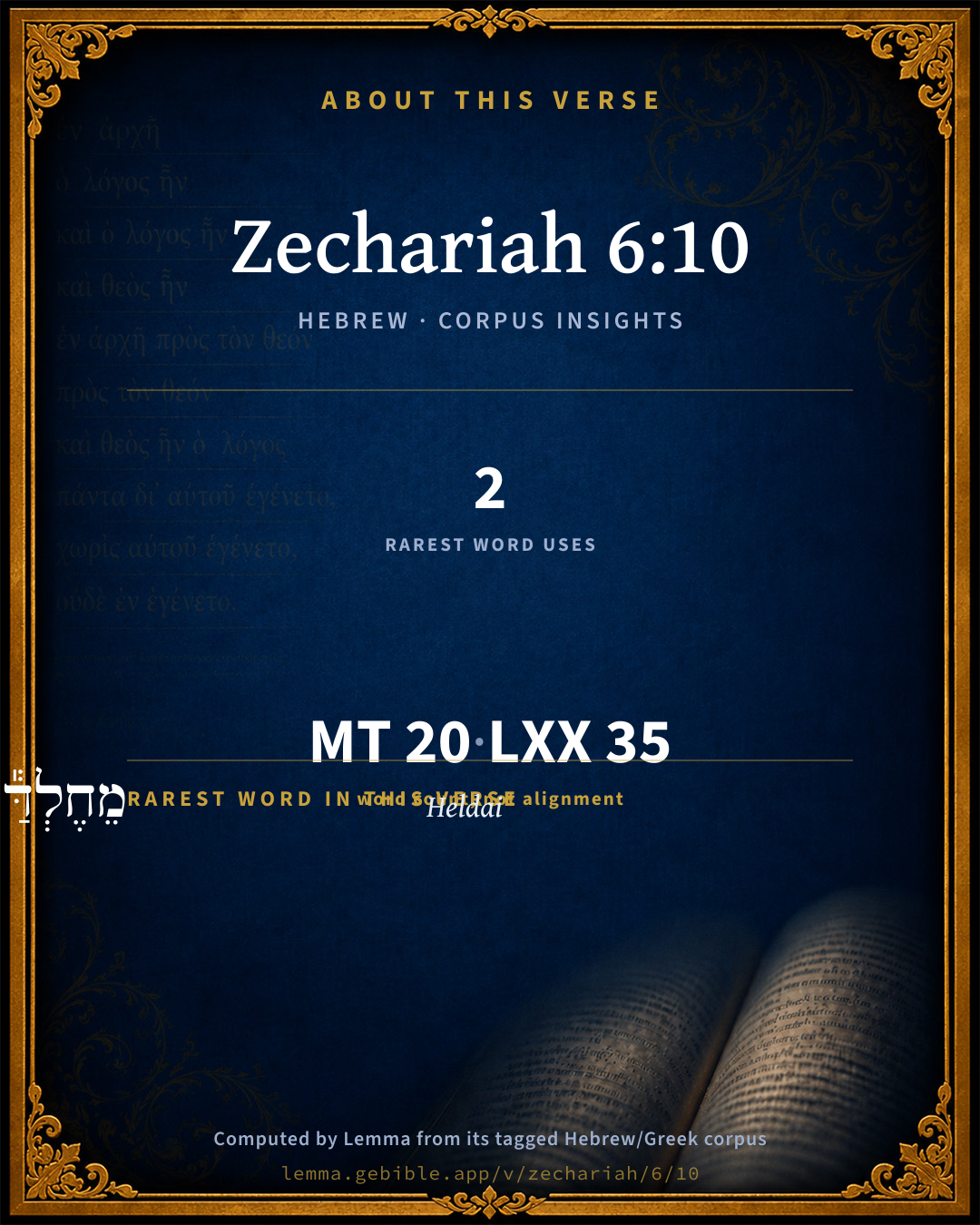
The rarest word here is מֵחֶלְדַּ֕י Heldai H2469 — appearing just 2 times in the whole Hebrew Bible.

Shared distinctive vocabulary

מֵחֶלְדַּ֕י Heldai H2469 occurs in 2 verses of the Hebrew Bible. Also found in:

Grammatical profile

  • 4 verbs
  • 10 nouns
  • 2 pronouns
  • 1 preposition
  • 3 particles

Verb forms

  • לָק֨וֹחַ֙ Qal · Infinitive Absolute
  • וּבָאתָ֤ Qal · Perfect
  • וּבָ֗אתָ Qal · Perfect
  • בָּ֖אוּ Qal · Perfect

Repetition

A word recurs within this verse — often emphatic in Hebrew:

  • וּבָאתָ֤ to enter H935 ×3

Hebrew & Septuagint length

In English translation the verse runs 36 words from the Hebrew and 45 from the Septuagint (LXX English) — closely comparable.

A rough comparison of the two English renderings, which tokenize alike — not a word-level alignment.

Word counts can differ between the Hebrew and the Greek without any difference in meaning — e.g. the Hebrew direct-object marker אֵת has no separate Greek word, and Greek often adds the article ὁ.

In the original languages it is 20 Hebrew tokens and 35 Greek tokens — but the two are counted differently (Hebrew bundles its prefixes and suffixes into one token; the Greek is in lemma form), so that isn’t a like-for-like length.

Cross-references

6

Topical passages linked to Zechariah 6:10 in the Treasury of Scripture Knowledge — connected by theme and wording, ordered by reader-vote popularity; previews shown in the World English Bible.

  • Ezra 7:14–16 Because you are sent of the king and his seven counselors, to inquire concerning Judah and Jerusalem, according to the law of your God which is in your hand,
  • Ezra 8:26–30 I weighed into their hand six hundred fifty talents of silver, and silver vessels one hundred talents; of gold one hundred talents;
  • Isaiah 66:20 They shall bring all your brothers out of all the nations for an offering to Yahweh, on horses, and in chariots, and in litters, and on mules, and on dromedaries, to my holy mountain Jerusalem, says Yahweh, as the children of Israel bring their offering in a clean vessel into the house of Yahweh.
  • Jeremiah 28:6 even the prophet Jeremiah said, Amen: Yahweh do so; Yahweh perform your words which you have prophesied, to bring again the vessels of Yahweh's house, and all them of the captivity, from Babylon to this place.
  • Acts 24:17 Now after some years, I came to bring gifts for the needy to my nation, and offerings;
  • Romans 15:25–26 But now, I say, I am going to Jerusalem, serving the saints.

Cross-references courtesy of OpenBible.info (CC BY 4.0).

Hebrew and Greek witnesses Masoretic Hebrew ↔ Greek Septuagint

The same verse in the two great witnesses to the Old Testament, shown verse-for-verse.

These are two independent witnesses, not word-aligned to each other, and the Septuagint is shown in lemma (dictionary) form.

Hebrew Zechariah 6:10 Masoretic · Westminster Leningrad Codex

לָק֨וֹחַ֙ מֵאֵ֣ת הַגּוֹלָ֔ה מֵחֶלְדַּ֕י וּמֵאֵ֥ת טוֹבִיָּ֖ה וּמֵאֵ֣ת יְדַֽעְיָ֑ה וּבָאתָ֤ אַתָּה֙ בַּיּ֣וֹם הַה֔וּא וּבָ֗אתָ בֵּ֚ית יֹאשִׁיָּ֣ה בֶן צְפַנְיָ֔ה אֲשֶׁר בָּ֖אוּ מִבָּבֶֽל

"Take of them of the captivity, even of Heldai, of Tobijah, and of Jedaiah; and come the same day, and go into the house of Josiah the son of Zephaniah, where they have come from Babylon.

World English Bible · Public Domain

Greek LXX Zechariah 6:10 Septuagint · lemma form

λαμβάνω ὁ ἐκ ὁ αἰχμαλωσία παρά ὁ ἄρχων καί παρά ὁ χρήσιμος αὐτός καί παρά ὁ ἐπιγιγνώσκω αὐτός καί εἰςἔρχομαι σύ ἐν ὁ ἡμέρα ἐκεῖνος εἰς ὁ οἶκος ιωσείας ὁ σοφονίας ὁ ἥκω ἐκ βαβυλών

Take the things of the captivity from the chief men, and from the useful men of it, and from them that have understood it; and you shall enter in that day into the house of Josias the son of Sophonias that came out of Babylon.

LXX2012 (modern English Septuagint) · Public Domain

On this verse, Ellicott's Commentary for English Readers discusses the Septuagint’s reading. Read the note in Commentary ↓

Hebrew: Westminster Leningrad Codex (CC BY 4.0). Greek: Septuagint (public domain); English from LXX2012 (modern English Septuagint) (Public Domain). How the Septuagint differs from the Hebrew →

Targum (Aramaic paraphrase)

1

The Targum is the ancient Jewish Aramaic paraphrase of the Hebrew Scriptures — an interpretive translation, not the Hebrew text itself. Onkelos (literal) and Pseudo-Jonathan (expansive) render the Torah, and Jonathan the Prophets. Coverage is partial: where no permissively-licensed English translation exists for a verse, only the Aramaic is shown. This is verse-level text, not a word-by-word alignment to the Hebrew.

  1. Targum Jonathan Prophets (Joshua–Malachi)
    סַב מִן בְּנֵי גָלוּתָא מֵחֶלְדֵי וּמִן טוֹבִיָה וּמִן יְדַעְיָה וְתֵיתֵי אַתְּ בְּיוֹמָא הַהוּא וְתֵיעוֹל לְבֵית יֹאשִׁיָה בַּר צְפַנְיָה דְאָתֵי מִבָּבֶל:

    (no public-domain English translation for this verse)

    Targum Jonathan — Aramaic: “Mikraot Gedolot” (public domain). English: “Sefaria Community Translation” (CC0 1.0 (public-domain dedication)); “London "Chaldee Paraphrase," 1871” (public domain). Text via Sefaria.

Commentary

Notes on Zechariah 6:10 from classic Christian and Jewish commentators (each source and its license shown beneath its notes). The classic Christian expositions comment on the surrounding passage and are grouped to its opening verse, so a note may address several verses; the Jewish commentaries on the Tanakh (Rashi and others) are per-verse, so they appear only where the commentator wrote on this verse.

Lemma curates 59 commentaries, every one of them public domain or Creative Commons licensed, each selected and text-cleaned for this edition rather than reprinted as found. About our sources →

Trapp's Complete Commentary

John Trapp

Zec 6:10 Take of [them of] the captivity, [even] of Heldai, of Tobijah, and of Jedaiah, which are come from Babylon, and come thou the same day, and go into the house of Josiah the son of Zephaniah;

Ver. 10. Take of them of the captivity] i.e. Of the returned captives,

even of Heldai, of Tobijah, and of Jedaiah] Men famous in the congregation, men of renown, Num 16:2. That these four mentioned here (taking in Josiah, who is also called Hen, Zec 6:14), were ambassadors from the godly Jews in Babylon, and brought their gifts, as Junius thinketh, I cannot affirm; but that they were the same with Daniel, Shadrach, Meshach, and Abednego, as the Jews and Jerome tell us, I do not believe. Josiah seemeth to be the host to the other three; as Gaius was to St Paul, and other good people; though some think, rather, he was either treasurer for the temple, or else a goldsmith, and one that could make crowns. Calvin conjectures from Zec 6:14 (where it is said, that the crown shall be to these men for a memorial), that being men of authority, they were deeply guilty of infidelity and impatience, because they saw not a present performance of the promises; they were discontented themselves, and discouraged others, "Ye have need of patience," saith the apostle to those short spirited Hebrews, Heb 10:36, who found it more easy to suffer evil than to wait for the promised good.

And come thou the same day] Either the same day these men came from Babylon, or the selfsame day that the Lord spake to the prophet, is he commanded to go, not to put it off a day longer; for the people needed a speedy and hasty comfort. No sooner had God prepared the people, but the thing was done suddenly, as 2Ch 29:36. No sooner were they ripe, but he was ready. He is a God of judgment, a wise God, that knows when to deal forth his favours; as till then he waits to be gracious, Isa 30:18. His fingers itch to be doing good in his good pleasure to Zion; as the mother’s breasts ache when now it is time the child had suck. He exalteth the lowly, he filleth the hungry with good things. When once David is poor and needy God will make no tarriance, Psa 40:17; when his soul is even as a weaned child, then he shall have the kingdom, Psa 131:2.

John Trapp, A Commentary or Exposition upon All the Books of the Old and New Testament (1647–1656) — public domain. Text from a community e-Sword module.

Tyndale Open Study Notes

Tyndale Open Resources

6:10 Heldai, Tobijah, and Jedaiah were apparently couriers designated by Jews in Babylon to carry donations to the Temple building fund.

Tyndale Open Study Notes — © Tyndale Open Resources, licensed CC BY-SA 4.0. Text via the HelloAO Bible API.

Geneva Bible (1599)

Geneva Bible translators

To receive of him and the other three, money to make the two crowns: which were men of great authority among the Jews, and doubted of the restitution of the kingdom, and of the Priesthood, and hurt others by their example.

Geneva Bible (1599) marginal notes — public domain. Text via Bolls.life.

Jamieson, Fausset & Brown

Robert Jamieson, A. R. Fausset & David Brown

NINTH VISION. THE CROWNING OF JOSHUA. (Zac 6:9-15)

Take of them of the captivity--Take silver and gold (Zac 6:11) from them. The three named came from Babylon (where some of the exiled Jews still were left) to present gifts of silver and gold towards the building of the temple. But in Zac 6:11, Zac 6:14, "crowns" are directed to be made of them, then to be set on Joshua's head, and to be deposited in the temple as a memorial of the donors, until Messiah shall appear.

Heldai--meaning "robust." Called Helem below.

Tobijah--that is, "the goodness of God."

Jedaiah--that is, "God knows."

which are come from Babylon--This clause in the Hebrew comes after "Josiah son of Zephaniah." Therefore, MOORE thinks Josiah as well as the three "came from Babylon." But as he has a "house" at Jerusalem, he is plainly a resident, not a visitor. Therefore English Version is right; or MAURER, "Josiah son of Zephaniah, to whom they are come (as guests) from Babylon."

the same day--No time was to be lost to mark the significancy of their coming from afar to offer gifts to the temple, typifying, in the double crown made of their gifts and set on Joshua's head, the gathering in of Israel's outcasts to Messiah hereafter, who shall then be recognized as the true king and priest.

Jamieson, Fausset & Brown — Commentary Critical and Explanatory on the Whole Bible (1871) — public domain (CC PDM 1.0). Text via the HelloAO Bible API.

Adam Clarke's Commentary

Verse 10. Take of them of the captivity] The names that follow were probably those to whom the silver and golden vessels of the temple were intrusted; and who might have had bullion of silver and gold, for particular purposes, about the ornaments of the temple.

The house of Josiah] Probably an artificer in silver, gold, &c.

Adam Clarke's Commentary on the Bible (1810–1826) — public domain. Text from a community e-Sword/MySword module.

John Calvin's Commentaries

Let us now inquire, why the Prophet was bid to take gold from four men; for he says, Take from the transmigration. The word הגולה, egule, is to be taken in a collective sense, as in many other places. Take then from the exiles, who have now returned from Babylon to their own country. But he afterwards mentions four men; and there is some abruptness in the passage, but nothing that obscures the meaning of the Prophet; for he says, Take frown Heldai, and from Tobiah, and from Jedaiah; and then he adds, go in that day, enter the house of Josiah, the son of Zephaniah. The Prophet no doubt had been commanded to go to these four, and to enter the house of one of them; and this is evident from the end of the tenth verse, where he says, who have come from Babylon He had spoken only of Josiah the son of Zephaniah; and then he adds, that they had come from Babylon. I come now to the answer. Some interpreters think that these four men supplied the gold and the silver, because they were chief men among the people, and excelled others in piety. Hence they think that these four men were chosen, as a mark of distinction, to supply the gold and the silver to make the crowns: but I conjecture from the end of the chapter that their weakness is here pointed out, even because they were weak in faith and did not believe the promises of God, and thus disheartened others by their example. It is indeed certain that they were men in high authority, and excelled all others, so that the eyes of all were fixed on them; this is certain. But yet their want of faith is what is here reproved, because they did not attend sufficiently to God’s promises, and thought themselves disappointed of their hope; for they had left Babylon, where they enjoyed great abundance, and returned to the holy land, and found it uncultivated and desolate. There was indeed required great patience, when they had to plow among thorns and brambles; for that land, as I have already said, had not been regularly cultivated. Those indeed who had been sent from the East, dwelt here and there in it; but lions and wild beasts had come into it, so that the desolation of the land rendered much work necessary, when the Jews returned. I hence doubt not but that the Holy Spirit does here reprove these four men, who ought to have been leaders and standard-bearers to others; on the contrary, they broke down the confidence of the common people. And this, I say, may be learnt from the end of the chapter, where God commands the two crowns to be placed in the temple, to be a memorial to them, that they might see there the condemnation of their unbelief, as we shall show in its place.

John Calvin's Commentaries (1540-1563) — public domain. Text from the Calvin Translation Society English edition (1840s-50s) via the Christian Classics Ethereal Library (ccel.org). Calvin's coverage is partial (roughly two-thirds of the Bible); uncommented books and verses are honest gaps, never fabricated. The 19th-century editor's footnotes and remarks are omitted so the notes are faithfully Calvin's own voice.

Ellicott's Commentary for English Readers

THE SYMBOLICAL CROWNING OF JOSHUA.

(10) Of them of the captivity.—Even those who had returned from the Captivity were so called (Ezr_4:1; Ezr_6:19). These were probably, however, Jews who intended to remain in the land of their exile, but who were come on a visit to Jerusalem, bringing offerings of silver and gold, to show their sympathy with their brethren who were carrying on the work of the rebuilding of the Temple.

Heldai is called “Helem” in Zec_6:14, and Josiah seems to be called “Hen.” It is very common for a person to be called by several different names in the Bible; thus Hobab, Jethro, Reuel, &c., are some of the names of Moses’ father-in-law. LXX. interpret the proper names as follows:—Heldai as “rulers,” Tobijah as “their useful men,” Jedaiah as “those who understood them.”

The same day.—Literally, on that day: viz., on the same day on which thou takest, &c.

A Bible Commentary for English Readers, edited by Charles John Ellicott (1878–1897) — public domain. Text from a community e-Sword module.

The Cambridge Bible for Schools and Colleges

gen. ed. J. J. S. Perowne

10. Take] Lit. to take. This has been thought to be a general direction, extending to all that they had brought, “let (their offerings) be received, or accepted;” the special taking of silver and gold for a particular purpose by the prophet being mentioned in the next verse. But there is no reason whatever to suppose that the Jews who were rebuilding the temple had ever any scruple about receiving such offerings even from heathens (Ezr_1:4; Ezr_1:6-7; Ezr_6:8-10), so that such a direction would have been superfluous. It is better, therefore, to render with A. V. “take (thou)” sc. “silver and gold,” the direction being interrupted to tell the prophet where to meet with these men, and resumed at the beginning of Zec_6:11.

the captivity] used of the Jews who had returned from exile to their own land, Ezr_9:4; Ezr_10:8; but also, as here, of those who were still in exile, Eze_1:1; Eze_3:11; Eze_3:15.

which are come from Babylon] This clause is transposed in A. V. from the end of the verse where it stands in the Hebrew. It should be left there, as in R. V., and rendered, to which they are come from Babylon. It will then read: Take of the captivity, even of Heldai of Tobijah and of Jedaiah (their messengers and representatives)—and come thou (thyself to take it in person), even come into the house of Josiah the son of Zephaniah, to which they have come from Babylon—and take silver and gold, &c.

The Cambridge Bible for Schools and Colleges (gen. ed. J. J. S. Perowne; Cambridge University Press, 1878–1918) — public domain. Text from a community e-Sword module.

John Gill's Exposition

Then take silver and gold, &c. Which the Jewish writers suppose were brought by the above men from their brethren in Babylon, as a free will offering towards the building of the temple:

and make crowns; two at least, one of silver, and another of gold; the one to be put upon the head of Joshua the high priest; the other upon the head of Zerubbabel, as Kimchi conjectures; though, according to the text, they seem to be both, or all of them, be they as many as they will, to be put upon the head of Joshua; and may signify the different states of the priesthood in the present time, and when in its pristine glory; or that both the crown of the priesthood and the crown of the kingdom should meet in his antitype Christ, who is said to have on his head many crowns, Rev 19:12. The Targum renders it, "thou shalt make a great crown"; as if only one crown was to be made of gold and silver mixed together; and so the Arabic version renders it; but more are certainly meant, for it follows:

and set them upon the head of Joshua the son of Josedech the high priest; on whose head a fair mitre was set; see Zac 3:5 and with the mitre was wore by the high priest the holy crown, made of pure gold; and which was no other than the plate or "flower" of gold, on which was engraved "Holiness to the Lord", Exo 28:36 and this, according to the Jewish writers (b), was a plate of gold two fingers broad, and reached from ear to ear; though Josephus (c) seems to give a different account of it; he says,

"the golden crown surrounds (either the mitre, or perhaps rather the forehead or temples); and on it were three rows of cups or flowers, like those of the herb we call "saccharus"; and the Grecian botanists "hyosciamus";''

or henbane; and after describing the herb, and the figure of the buds, cups, or flowers of it, he adds,

"like to these is made a crown reaching from the hinder part of the head unto both temples; for the flowers do not encompass the forehead; but there is a golden plate, which has the name of God engraved in sacred letters;''

which seems to disagree with the accounts of other Jewish writers; unless, as Braunius (d) observes, they may be thus reconciled, that the crown was nothing else but the plate that was two fingers broad, and was in length from ear to ear; so that about the temples it was ornamented with three rows of henbane flowers on each side: and these three rows may give occasion for the use of the word in the plural number; and some have called it a triple crown (e); and Popish writers fail not to improve it in favour of the crown their pontiff wears; and Lyra (f) speaks of little crowns or coronets, even in the mitres of the common priests; which (he says) were circles in the lower part of them so called; wherefore the rows of flowers in the high priest's crown, from whence it might be called a flower, might with more propriety bear that name. Philo the Jew (g), speaking of the golden plate, says it was like a crown engraven with four letters of the name (Jehovah); and further observes, that

"the mitre under it kept the plate from touching the head, on which the "cidaris" or diadem was put; for it was like the cidaris which the eastern kings used for a diadem:''

and indeed this crown, and the three rows of flowers in it, were a hieroglyphic or emblem of the threefold office of Christ, whom the high priest represented, kingly, priestly, and prophetic; and so may be fitly signified here by crowns in the plural number; and it is usual with the Jewish writers to speak of three crowns, the crown of the law, the crown of the kingdom, and the crown of the priesthood (h); and very probably from the high priest among the Jews wearing crowns it was that the priests among the Heathens had the same ornaments on their heads; and to be crowned was with them the same as to exercise the office of priesthood (i), and who was an eminent type of the Messiah, and in this of having crowns put upon his head, as the following words show.

(b) Maimon. Cele Hamikdash, c. 9. sect. 1. Jarchi in Exod. xxviii. 36. (c) Antiqu. l. 3. c. 7. sect. 7. (d) De Vestitu Sacerdot. Hebr. l. 2. c. 28. sect. 18. p. 807. (e) Fortunatus Scacchus in Myrothec. l. 3. c. 40. p. 1000. Solerius de Pileo, sect. 13. p. 266. (f) In Exod. xxxix. 27. (g) De Vita Mosis, l. 3. p. 670, 671. (h) Pirke Abot, c. 4. sect. 13. (i) Paschalius de Coronis, l. 4. c. 13.

John Gill's Exposition of the Whole Bible (1746–1763) — public domain (CC PDM 1.0). Text via the HelloAO Bible API.

Albert Barnes' Notes on the Bible

Take of the captivity - Of that which they had brought with them. “The captivity” was, in Jeremiah ), and Ezekiel Eze 1:2; Eze 3:11, Eze 3:15; Eze 11:24-25, the title of those who had been actually carried captive and were at that moment in captivity. Ezra continues it of those who had been in captivity, though now returned from exile. Yet not without a reference to the circumstances or causes of that captivity. It is the “captivity” Ezr 1:11 which Sheshbazzar brings from Babylon, or Ezra subsequently; the “children of the captivity” Ezr 8:35, who set themselves to build the temple of God Ezr 4:1; who dedicated it and kept the passover . The title is used apparently as an aggravation of sin, like that which had been chastened by that captivity. Here, the term seems to imply some blame, that they remained of their own accord in this state of severance from the altar, where alone special worship of God and sacrifice could be offered. They had been removed against their will; yet, as Christians often do, acquiesced in the loss, rather than forego their temporal advantages. Still they wished to take part in the work of restoring the public worship, and so sent these men, with their contribution of gold and silver, to their brethren, who had returned; as, in the first times of the Gospel, the Christians everywhere made collections for the poor saints, who dwelt in Jerusalem. And this their imperfect zeal was instantly accepted.

And go thyself - To make the act more impressive, “on that same day,” as matter of urgency, “and thou shalt come to the house of Josiah son of Zephaniah, whither they have come from Babylon” . The exiles who had brought presents for the building of the temple, lodged, it seems, in the house of Josiah, whether they doubted or no that their presents would be accepted, since they chose Babylon, not Jerusalem for their abode. This acceptance of their gifts symbolized the incoming of those from afar. It is remarkable that all five names express a relation to God. “Tobiah” in Neh 2:10; Neh 6:1; 3) the Tobias here and 14; 4) Tobit and Tobias in his book), “The Lord is my good;” “Yedaiah,” “God knoweth” or “careth for;” Josiah, “The Lord supporteth” ; “Zephaniah,” “The Lord hideth,” and perhaps “Cheldai,” “The Lord’s world” . They had taken religious instead of worldly names. Probably Zechariah was first to accept the offerings from the three exiles, and then to take the actual gold from the house of Josiah whither they had brought it. The pilgrims from Babylon and their host are included in one common blessing.

Albert Barnes' Notes on the Bible (1834–1885) — public domain. Text from a community e-Sword/MySword module.

Haydock's Catholic Bible Commentary

Holdai, &c. They had brought presents for the temple, which are to be used to make crowns for Jesus and Zorobabel, ver. 13. (Calmet) --- The names are interpreted by the Septuagint, "of the princes and of its useful things, and of those who have known it, (captivity) and thou," &c. (Haydock) --- Helem and Hem are afterwards mentioned instead of Holdai, ver. 14. (St. Jerome)

George Leo Haydock (1774–1849), Haydock's Catholic Family Bible and Commentary, 1859 edition — public domain. Excludes Psalms (Douay-Rheims chapter numbering differs from Protestant) and Deuterocanonical books (Catholic canon only).

Matthew Poole's English Annotations

Take, gold and silver, of those that are come out of Babylon lately, to make their oblation to the Lord, or to bring the oblation of them who yet were in Babylon, but remembered Jerusalem and the temple.

And come thou; go fetch them if they lodge elsewhere, and bring them in thy company.

The same day; the same day in which they come, or else in the same day that I speak unto thee, delay not.

And go into the house of Josiah: some say he was a goldsmith, others, that he was treasurer for the temple, and that these persons before named had brought a rich present to him for the temple and the service of the Lord.

Matthew Poole's English Annotations on the Holy Bible (1683–1685) — public domain. Text from a community e-Sword/MySword module.

The Pulpit Commentary

Take of them of the Captivity. The verb is in the infinitive for the imperative, "take thou from the Captivity;" what he is to take is noted in the next verse. "Those of the Captivity" are certain envoys sent by the Jews who still dwelt in Babylon, (Eze_1:1 Eze_3:11) bearing gifts for the temple. These messengers the prophet was to visit at the house of Josiah, their host. Heldai; or, Cheldai, in ver. 14 "Helem" or "Chelem," "The Enduring One" (Keil); "The Lord"s Word" (Pussy). The name occurs in 1Ch_27:15. Tobijah; "The Lord is good," a well known name. Jedaiah; "God careth." The name is found in 1Ch_9:10 1Ch_24:7. The LXX explains the names in symbolical fashion, Para twn arcontwn kai para twn crhsimwn authv kai para twn epegnwkotwn authn . "From the chief men, and from its good men, and from those that have understood it." Which are come from Babylon. This clause in the Authorized Version is transposed from its place in the Hebrew, which is at the end of the verse, where it refers to the house of Josiah, and should be rendered, "to which," or "whither they have come from Babylon." Septuagint, Toou ... tou hkontov ek Babulwnov , "The house of Josiah... who came from Babylon." The same day. There was to be no delay; the transaction was to be carried out "on that day," the day made known to the prophet, and by himself in person. The house of Josiah the son of Zephaniah. He was, perhaps, treasurer. At any rate, at his house the envoys were entertained, and there were stored the contributions which the Jews in exile had sent to their brethren in Jerusalem. Josiah is the same person as Hen, according to the Authorized Version and the Vulgate, in ver. 14 (where see note). He was probably son of the Zephaniah mentioned in 2Ki_25:18 as in the second rank of priests among those who were deported to Babylon. (comp. Jer_21:1 Jer_37:3)

The Pulpit Commentary (1880–1919), ed. H.D.M. Spence-Jones & Joseph S. Exell — public domain. Text from a community e-Sword module.

John Wesley's Explanatory Notes

Take - Of those that are come out of Babylon. Come thou - Go fetch them, if they lodge elsewhere. The same day - The same day in which they come.

John Wesley, Explanatory Notes Upon the Whole Bible (1754–1765) — public domain. Text via the GEBible commentary corpus.

Rashi

Rabbi Shlomo Yitzchaki (Rashi)

Take from the exiles - from Heldai, etc., who have come from Babylon All these people.

Rashi on the Tanakh — English translations: “The Judaica Press complete Tanach with Rashi, translated by A. J. Rosenberg” (CC BY 4.0); “Pentateuch with Rashi's commentary by M. Rosenbaum and A.M. Silbermann, 1929-1934” (public domain); “The Metsudah Tanach series, Lakewood, N.J” (CC BY 4.0); and “The Book of Joshua, Metsudah Publications, 1997” (CC BY 4.0). Text via Sefaria.

Lesson kit

Teaching starters — assembled from the data on this page, not authored interpretation. Every prompt links to the verse data it draws on. Edit before teaching.

Zechariah, in the Prophets, opens this verse with 20 words (17 distinct Hebrew lemmas). Its most distinctive word is Chelday (“Heldai”). A historical commentator’s framing appears above. Read the whole chapter for the surrounding context.

Discussion questions

  1. How does “Heldai” (Chelday) shape what this verse is saying?
  2. 1 Chronicles 27:15 shares the word «Heldai» with this verse. How do the two illuminate each other?
  3. “to enter” occurs 3× in this one verse. What is the effect of the repetition?
  4. The translations on this page render this verse differently — a whole-verse word diff, not a word-by-word alignment. What might account for the different wordings?
  5. The verb «לָק֨וֹחַ֙» is Qal Infinitive Absolute. How does its form color the action?
  6. Reading how Trapp's Complete Commentary and Tyndale Open Study Notes read this verse, where do the two commentators agree and where do they part?

Things to notice

Reading settings

Reading text

Shown beneath each verse's original-language words.

Old Testament
Old Testament edition

Read the OT as the Masoretic Hebrew (MT) or the Greek Septuagint (LXX).

English shown for the Greek Septuagint (in the Hebrew ↔ Greek comparison).

Comparing translations? Open the Compare panel on any verse page to stack up to four side by side.