Jeremiah 51:29

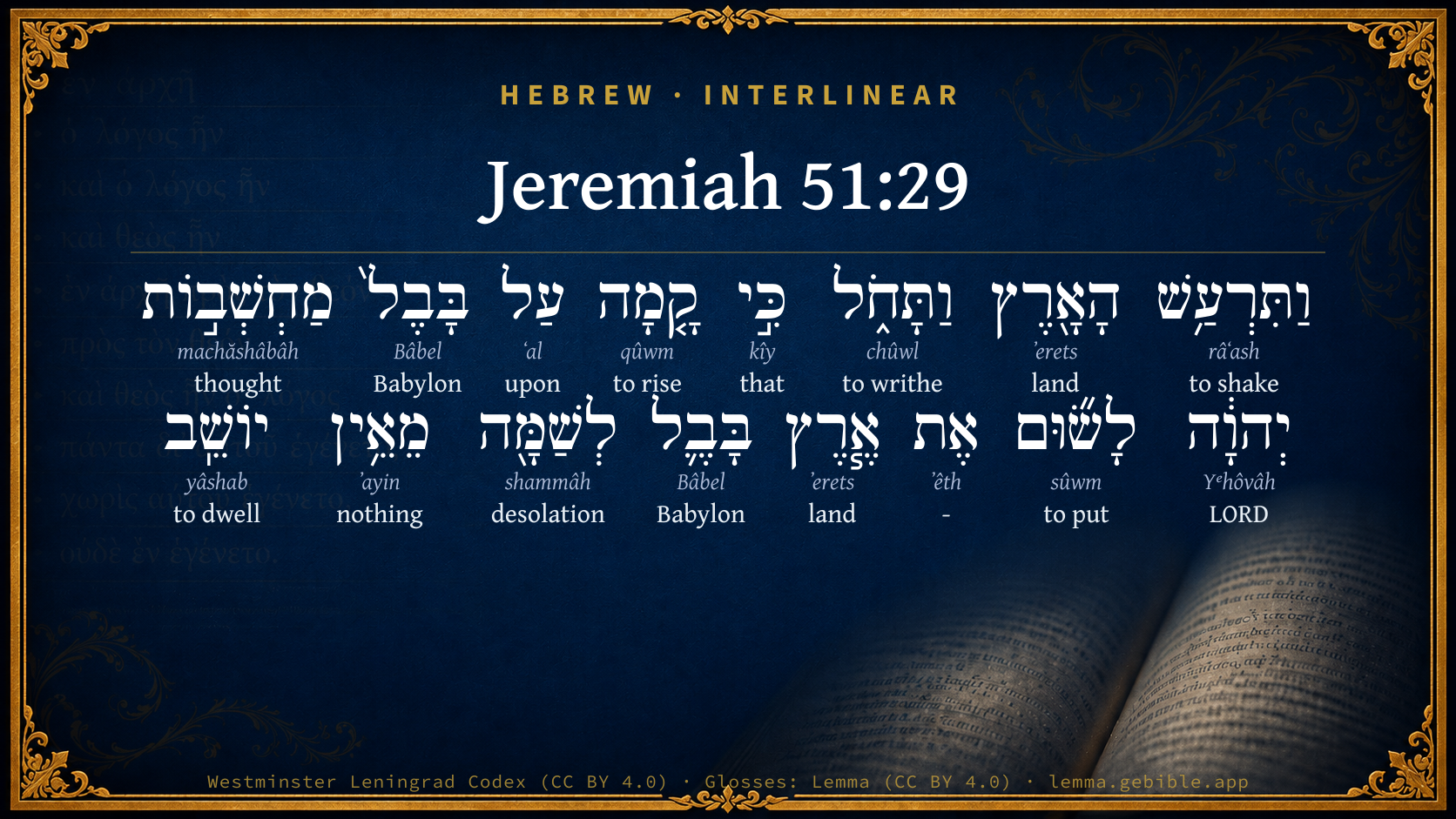
Hebrew (Westminster Leningrad Codex) Jeremiah 51:29 appears in the Hebrew Old Testament. The text above is from the Westminster Leningrad Codex. Each word links to its Strong’s number, a concise gloss, and parsing drawn from the Open Scriptures Hebrew Bible morphology. Click any word for its full Brown-Driver-Briggs (BDB) entry.
Download image
Cite this verse

Jeremiah 51:29 (World English Bible). Public Domain. Lemma interlinear Bible study tool, https://lemma.gebible.app/v/jeremiah/51/29.

Show BibTeX & RIS
BibTeX
RIS
English Translation
The land trembles and is in pain; for the purposes of Yahweh against Babylon do stand, to make the land of Babylon a desolation, without inhabitant.
World English Bible · Public Domain
Download a study sheet

One document with this verse’s original text, its word-by-word gloss line, the meaning frame, cross-references with their text, attributed commentary, and full source and license credits — printable, and it pastes into notes with its structure intact.

This verse Autodidact and up

Study sheet (.html) Plain text (.txt)

A passage Seminary Student

Up to 50 verses in one chapter. A passage sheet keeps up to 6 commentary sources and 12 cross-references per verse, in the order this page ranks them, and says so on the sheet whenever that leaves anything out. Ask for a single verse and you get the Autodidact verse sheet above.

Everything on this page stays free to read, with no account — the sheet is a download of what is already on screen, not access to it.

Want to remove ads? Support Godless Engineer
Compare translations 3

The same verse in 3 English versions, stacked beneath the original-language interlinear above. Click any original word for its lexicon entry.

Each is an independent rendering of the whole verse — the interlinear is not word-aligned to these translations.

Highlighted words mark where these versions differ — a whole-verse word diff, not a word-by-word alignment.

  • World English Bible Public Domain
    The land trembles and is in pain; for the purposes of Yahweh against Babylon do stand, to make the land of Babylon a desolation, without inhabitant.
  • King James Version Public Domain
    And the land shall tremble and sorrow: for every purpose of the LORD shall be performed against Babylon, to make the land of Babylon a desolation without an inhabitant.
  • unfoldingWord Literal Text CC BY-SA 4.0
    For the land will shake and be in anguish, since Yahweh’s plans continue against Babylon, to make the land of Babylon a wasteland where there is no inhabitant.

unfoldingWord Literal Text — © unfoldingWord, licensed CC BY-SA 4.0. Word-aligned USFM3 via Door43 (git.door43.org/unfoldingWord/en_ult).

Versions to compare (up to 4)

3 of 4 selected

Show all 18 translations

Every available English version of this verse, each an independent rendering of the whole verse.

  • World English Bible Public Domain
    The land trembles and is in pain; for the purposes of Yahweh against Babylon do stand, to make the land of Babylon a desolation, without inhabitant.
  • Berean Standard Bible Public Domain
    The earth quakes and writhes because the LORD’s intentions against Babylon stand: to make the land of Babylon a desolation, without inhabitant.
  • Majority Standard Bible Public Domain
    The earth quakes and writhes because the LORD’s intentions against Babylon stand: to make the land of Babylon a desolation, without inhabitant.
  • King James Version Public Domain
    And the land shall tremble and sorrow: for every purpose of the LORD shall be performed against Babylon, to make the land of Babylon a desolation without an inhabitant.
  • American Standard Version (1901) Public Domain
    And the land trembleth and is in pain; for the purposes of Jehovah against Babylon do stand, to make the land of Babylon a desolation, without inhabitant.
  • Revised Version (1885) Public Domain
    And the land trembleth and is in pain: for the purposes of the LORD against Babylon do stand, to make the land of Babylon a desolation, without inhabitant.
  • Geneva Bible (1599) Public Domain
    And the land shall tremble and sorow: for the deuise of the Lord shalbe performed against Babel, to make the lande of Babel waste without an inhabitant.
  • Douay-Rheims (1899) Public Domain
    And the land shall be in a commotion, and shall be troubled: for the design of the Lord against Babylon shall awake, to make the land of Babylon desert and uninhabitable.
  • Young's Literal Translation Public Domain
    And shake doth the land, and it is pained, For stood against Babylon have the purposes of Jehovah, To make the land of Babylon a desolation without inhabitant.
  • Literal Standard Version CC BY-SA 4.0
    And the land shakes, and it is pained, || For the purposes of YHWH have stood against Babylon, || To make the land of Babylon a desolation without inhabitant.
  • Unlocked Literal Bible CC BY-SA 4.0
    For the land will shake and be in anguish, since Yahweh's plans continue against Babylon, to make the land of Babylon a wasteland where there is no inhabitant.
  • unfoldingWord Literal Text CC BY-SA 4.0
    For the land will shake and be in anguish, since Yahweh’s plans continue against Babylon, to make the land of Babylon a wasteland where there is no inhabitant.
  • Darby Bible Public Domain
    And the land trembleth and is in pain; for the purposes of Jehovah against Babylon do stand, to make the land of Babylon a desolation, without inhabitant.
  • World Messianic Bible Public Domain
    The land trembles and is in pain; for the purposes of the LORD against Babylon stand, to make the land of Babylon a desolation, without inhabitant.
  • Webster's Bible Public Domain
    And the land shall tremble and sorrow: for every purpose of the LORD shall be performed against Babylon, to make the land of Babylon a desolation without an inhabitant.
  • Free Bible Version CC BY-SA 4.0
    The earth quakes and trembles because the Lord is determined to carry out what he threatened against Babylon—to turn Babylonia into a wasteland where no one lives.
  • Bible in Basic English Public Domain
    And the land is shaking and in pain: for the purposes of the Lord are fixed, to make the land of Babylon an unpeopled waste.
  • JPS Tanakh (1917) Public Domain
    And the land quaketh and is in pain; for the purposes of the LORD are performed against Babylon, to make the land of Babylon a desolation, without inhabitant.

Literal Standard Version (2020), Covenant Press — licensed CC BY-SA 4.0. Text via the HelloAO Bible API (eBible.org). Unlocked Literal Bible (unfoldingWord) — licensed CC BY-SA 4.0. Text via the HelloAO Bible API (eBible.org). unfoldingWord Literal Text — © unfoldingWord, licensed CC BY-SA 4.0. Word-aligned USFM3 via Door43 (git.door43.org/unfoldingWord/en_ult). Free Bible Version, Dr. Jonathan Gallagher — licensed CC BY-SA 4.0. Text via the HelloAO Bible API (eBible.org).

Word by word

More ways to search: Search by grammar → Find every occurrence → Compare this word →

Practice this passage: Drill this verse → Learn its vocabulary →

וַתִּרְעַ֥שׁ
râʻash
H7493
“and · to shake”
Conjunction + Verb, Qal, Sequential Imperfect, 3rd Person, Feminine, Singular
Part of Speech
Conjunction + Verb
Stem
Qal
Form
Sequential Imperfect
Person
3rd Person
Gender
Feminine
Number
Singular
Full BDB Definition

Origin: a primitive root

TWOT: 2195

to quake, shake - (Qal) to quake, shake - (Niphal) to be made to quake - (Hiphil) - to cause to quake - to cause to spring or leap (of horse)
  1. הָאָ֖רֶץ ʼerets H776 “the · land” Particle, Definite Article + Noun, Common, Both, Singular, Absolute
  2. וַתָּחֹ֑ל chûwl H2342 “and · to writhe” Conjunction + Verb, Qal, Sequential Imperfect, 3rd Person, Feminine, Singular
  3. כִּ֣י kîy H3588 “that” Conjunction
  4. קָ֤מָה qûwm H6965 “to rise” Verb, Qal, Perfect, 3rd Person, Feminine, Singular
  5. עַל ʻal H5921 “upon” Preposition
  6. בָּבֶל֙ Bâbel H894 “Babylon” Noun, Proper
  7. מַחְשְׁב֣וֹת machăshâbâh H4284 “thoughts of” Noun, Common, Feminine, Plural, Construct
  8. יְהוָ֔ה Yᵉhôvâh H3068 “LORD” Noun, Proper
  9. לָשׂ֞וּם sûwm H7760 “to put” Preposition + Verb, Qal, Infinitive Construct
  10. אֶת ʼêth H853 “-” Particle, Direct Object
  11. אֶ֧רֶץ ʼerets H776 “land of” Noun, Common, Both, Singular, Construct
  12. בָּבֶ֛ל Bâbel H894 “Babylon” Noun, Proper
  13. לְשַׁמָּ֖ה shammâh H8047 “to/for · desolation” Preposition + Noun, Common, Feminine, Singular, Absolute
  14. מֵאֵ֥ין ʼayin H369 “from · nothing” Preposition + Particle, Negative
  15. יוֹשֵֽׁב yâshab H3427 “dwelling” Verb, Qal, Participle Active, Masculine, Singular, Absolute

About this verse

These counts appear in no published source. They are computed here, from the morphology-tagged text and Lemma’s own curated glosses. What Lemma adds →

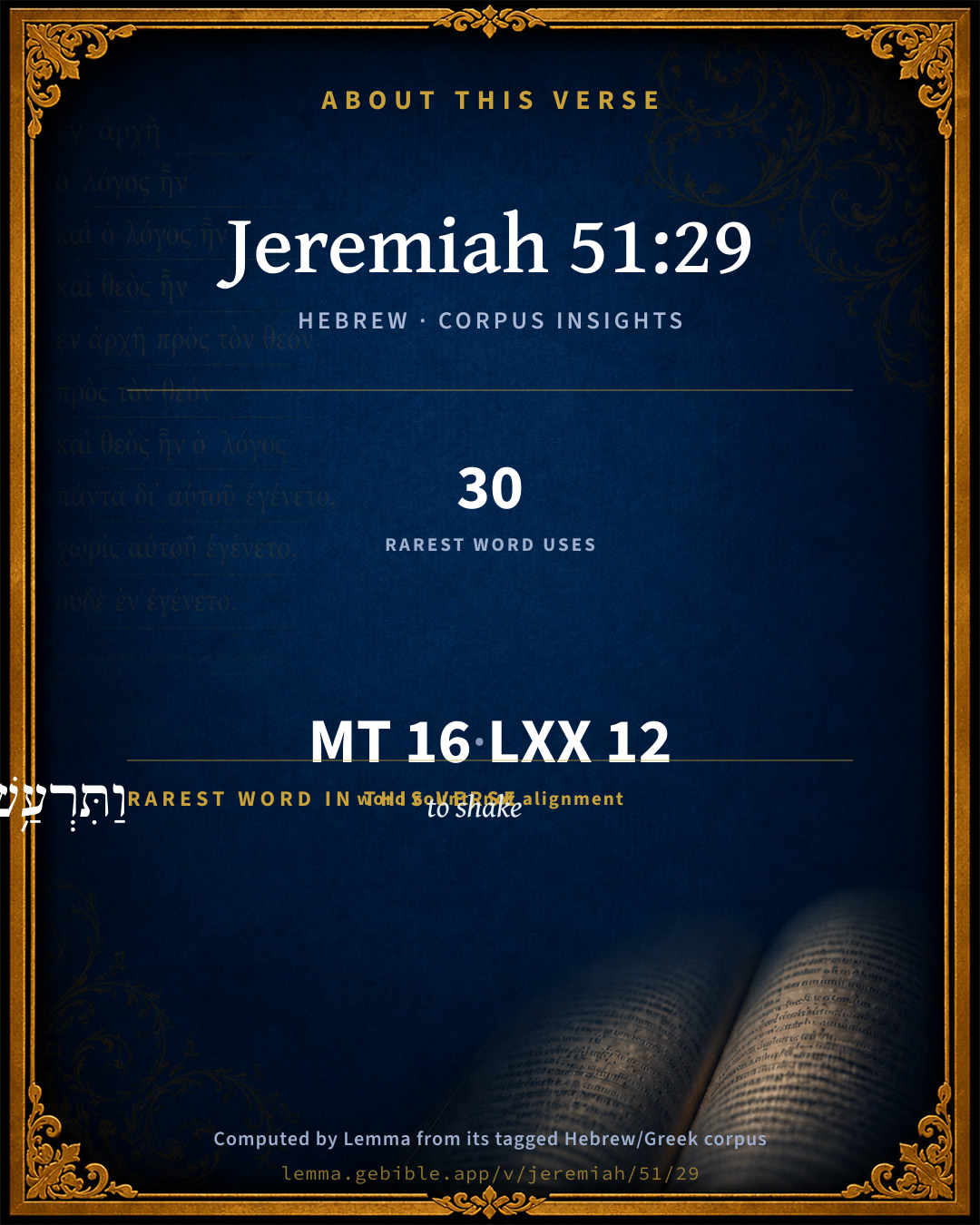
16
words
14
distinct lemmas
Prophets
section

Shared distinctive vocabulary

וַתִּרְעַ֥שׁ to shake H7493 occurs in 30 verses of the Hebrew Bible. Also found in:

Grammatical profile

  • 5 verbs
  • 7 nouns
  • 1 preposition
  • 1 conjunction
  • 2 particles

Verb forms

  • וַתִּרְעַ֥שׁ Qal · Sequential Imperfect
  • וַתָּחֹ֑ל Qal · Sequential Imperfect
  • קָ֤מָה Qal · Perfect
  • לָשׂ֞וּם Qal · Infinitive Construct
  • יוֹשֵֽׁב Qal · Participle Active

Repetition

Words recur within this verse — often emphatic in Hebrew:

  • הָאָ֖רֶץ land H776 ×2
  • בָּבֶל֙ Babylon H894 ×2

Hebrew & Septuagint length

In the original languages it is 16 Hebrew tokens and 12 Greek tokens — but the two are counted differently (Hebrew bundles its prefixes and suffixes into one token; the Greek is in lemma form), so that isn’t a like-for-like length.

Cross-references

20

Topical passages linked to Jeremiah 51:29 in the Treasury of Scripture Knowledge — connected by theme and wording, ordered by reader-vote popularity; previews shown in the World English Bible.

  • Jeremiah 8:16 The snorting of his horses is heard from Dan: at the sound of the neighing of his strong ones the whole land trembles; for they are come, and have devoured the land and all that is in it; the city and those who dwell therein.
  • Jeremiah 51:11–12 Make sharp the arrows; hold firm the shields: Yahweh has stirred up the spirit of the kings of the Medes; because his purpose is against Babylon, to destroy it: for it is the vengeance of Yahweh, the vengeance of his temple.
  • Jeremiah 51:43 Her cities are become a desolation, a dry land, and a desert, a land in which no man dwells, neither does any son of man pass thereby.
  • Isaiah 13:19–20 Babylon, the glory of kingdoms, the beauty of the Chaldeans' pride, shall be as when God overthrew Sodom and Gomorrah.
  • Jeremiah 10:10 But Yahweh is the true God; he is the living God, and an everlasting King: at his wrath the earth trembles, and the nations are not able to abide his indignation.
  • Jeremiah 50:13 Because of the wrath of Yahweh she shall not be inhabited, but she shall be wholly desolate: everyone who goes by Babylon shall be astonished, and hiss at all her plagues.
  • Jeremiah 50:45 Therefore hear the counsel of Yahweh, that he has taken against Babylon; and his purposes, that he has purposed against the land of the Chaldeans: Surely they shall drag them away, [even] the little ones of the flock; surely he shall make their habitation desolate over them.
  • Amos 8:8 Won't the land tremble for this, And everyone mourn who dwells in it? Yes, it will rise up wholly like the River; And it will be stirred up and sink again, like the River of Egypt.
  • Isaiah 13:13–14 Therefore I will make the heavens to tremble, and the earth shall be shaken out of its place, in the wrath of Yahweh of hosts, and in the day of his fierce anger.
  • Isaiah 14:16 Those who see you shall gaze at you, they shall consider you, [saying], "Is this the man who made the earth to tremble, who shook kingdoms;
  • Isaiah 14:23–24 I will also make it a possession for the porcupine, and pools of water: and I will sweep it with the broom of destruction, says Yahweh of Hosts.
  • Isaiah 46:10–11 declaring the end from the beginning, and from ancient times things that are not [yet] done; saying, My counsel shall stand, and I will do all my pleasure;
  • Isaiah 47:1–15 Come down, and sit in the dust, virgin daughter of Babylon; sit on the ground without a throne, daughter of the Chaldeans: for you shall no more be called tender and delicate.
  • Jeremiah 50:39–40 Therefore the wild animals of the desert with the wolves shall dwell there, and the ostriches shall dwell therein: and it shall be no more inhabited forever; neither shall it be lived in from generation to generation.
  • Jeremiah 50:43 The king of Babylon has heard the news of them, and his hands wax feeble: anguish has taken hold of him, [and] pangs as of a woman in travail.
  • Jeremiah 51:62–64 and say, Yahweh, you have spoken concerning this place, to cut it off, that none shall dwell therein, neither man nor animal, but that it shall be desolate forever.
  • Joel 2:10 The earth quakes before them. The heavens tremble. The sun and the moon are darkened, And the stars withdraw their shining.
  • Revelation 18:2 He cried with a mighty voice, saying, "Fallen, fallen is Babylon the great, and she has become a habitation of demons, a prison of every unclean spirit, and a prison of every unclean and hateful bird!
  • Revelation 18:21–24 A mighty angel took up a stone like a great millstone and cast it into the sea, saying, "Thus with violence will Babylon, the great city, be thrown down, and will be found no more at all.
  • Jeremiah 50:36 A sword is on the boasters, and they shall become fools; a sword is on her mighty men, and they shall be dismayed.

Cross-references courtesy of OpenBible.info (CC BY 4.0).

Hebrew and Greek witnesses Masoretic Hebrew ↔ Greek Septuagint

The same verse in the two great witnesses to the Old Testament, shown verse-for-verse.

These are two independent witnesses, not word-aligned to each other, and the Septuagint is shown in lemma (dictionary) form.

Hebrew Jeremiah 51:29 Masoretic · Westminster Leningrad Codex

וַתִּרְעַ֥שׁ הָאָ֖רֶץ וַתָּחֹ֑ל כִּ֣י קָ֤מָה עַל בָּבֶל֙ מַחְשְׁב֣וֹת יְהוָ֔ה לָשׂ֞וּם אֶת אֶ֧רֶץ בָּבֶ֛ל לְשַׁמָּ֖ה מֵאֵ֥ין יוֹשֵֽׁב

The land trembles and is in pain; for the purposes of Yahweh against Babylon do stand, to make the land of Babylon a desolation, without inhabitant.

World English Bible · Public Domain

Greek LXX Structure differs

In the Septuagint, Jeremiah is about an eighth shorter than the Hebrew and arranges its material differently — the Oracles Against the Nations (Hebrew chapters 46–51) appear in the middle of the Greek book, after 25:13. Because the chapter and verse boundaries do not line up, a verse-for-verse comparison with the Hebrew is not shown.

A verse-for-verse comparison isn’t shown here because the chapters and verses don’t line up. Switch to the LXX edition with the MT / LXX toggle above to read the Greek directly.

Hebrew: Westminster Leningrad Codex (CC BY 4.0). Greek: Septuagint (public domain); English from a public-domain English Septuagint. How the Septuagint differs from the Hebrew →

Targum (Aramaic paraphrase)

1

The Targum is the ancient Jewish Aramaic paraphrase of the Hebrew Scriptures — an interpretive translation, not the Hebrew text itself. Onkelos (literal) and Pseudo-Jonathan (expansive) render the Torah, and Jonathan the Prophets. Coverage is partial: where no permissively-licensed English translation exists for a verse, only the Aramaic is shown. This is verse-level text, not a word-by-word alignment to the Hebrew.

  1. Targum Jonathan Prophets (Joshua–Malachi)
    וּתְזוּעַ אַרְעָא וְתִתְמְרַע אֲרֵי קָמָא עַל בָּבֶל מַחְשְׁבָתָא דַייָ לְשַׁוָאָה יַת אַרְעָא דְבָּבֶל לְצָדוּ מִבְּלִי יָתֵיב:

    (no public-domain English translation for this verse)

    Targum Jonathan — Aramaic: “Mikraot Gedolot” (public domain). English: “Sefaria Community Translation” (CC0 1.0 (public-domain dedication)); “London "Chaldee Paraphrase," 1871” (public domain). Text via Sefaria.

Commentary

Notes on Jeremiah 51:29 from classic Christian and Jewish commentators (each source and its license shown beneath its notes). The classic Christian expositions comment on the surrounding passage and are grouped to its opening verse, so a note may address several verses; the Jewish commentaries on the Tanakh (Rashi and others) are per-verse, so they appear only where the commentator wrote on this verse.

Lemma curates 59 commentaries, every one of them public domain or Creative Commons licensed, each selected and text-cleaned for this edition rather than reprinted as found. About our sources →

Trapp's Complete Commentary

John Trapp

Jer 51:29 And the land shall tremble and sorrow: for every purpose of the LORD shall be performed against Babylon, to make the land of Babylon a desolation without an inhabitant.

Ver. 29. And the land shall tremble and sorrow.] As a travailing woman, so shall it be pained.

John Trapp, A Commentary or Exposition upon All the Books of the Old and New Testament (1647–1656) — public domain. Text from a community e-Sword module.

Tyndale Open Study Notes

Tyndale Open Resources

51:29-30 The terrible fall of Babylon happened just as the Lord had planned. The Babylonian soldiers lost all desire to fight, and the Persian invaders quickly penetrated the city walls.

Tyndale Open Study Notes — © Tyndale Open Resources, licensed CC BY-SA 4.0. Text via the HelloAO Bible API.

Adam Clarke's Commentary

Verse 29. And the land shall tremble] It is represented here as trembling under the numerous armies that are passing over it, and the prancing of their horses.

Adam Clarke's Commentary on the Bible (1810–1826) — public domain. Text from a community e-Sword/MySword module.

John Calvin's Commentaries

The Prophet no doubt endeavored to remove all doubts from the minds of the godly, which would have otherwise weakened confidence in his doctrine. It might have occurred to the minds of all, that the whole world would sooner come to nothing than that Babylon should fall. Though it were so, says the Prophet, that the whole earth trembled, yet Babylon will be destroyed. Hence, he says, Tremble shall the land and be in pain, even because confirmed, etc. There is here a striking contrast between the moving of the earth and the stability of God’s purpose. The verb means properly to rise, but it is taken in many places in the sense of confirming or establishing, and necessarily so in this passage. he then says, Tremble shall the land, even because confirmed shall be the thoughts of God respecting Babylon

But he mentions thoughts in the plural number, as though he had said, that whatever God had appointed and decreed would be unchangeable, and that the whole earth would sooner be shaken than that the truth of God should lose its effect. Then this verse contains nothing else but a confirmation of the whole prophecy. But the Prophet shows, that if even all the hindrances of the world were in favor of the perpetuity of Babylon, yet what God had decreed respecting its destruction, would be fixed and unchangeable. It afterwards follows, —

John Calvin's Commentaries (1540-1563) — public domain. Text from the Calvin Translation Society English edition (1840s-50s) via the Christian Classics Ethereal Library (ccel.org). Calvin's coverage is partial (roughly two-thirds of the Bible); uncommented books and verses are honest gaps, never fabricated. The 19th-century editor's footnotes and remarks are omitted so the notes are faithfully Calvin's own voice.

Ellicott's Commentary for English Readers

(29) And the land shall tremble and sorrow.—The verbs in the Hebrew are in the past tense, the prophet seeing, as it were, the very event which he portrays passing before him in his vision.

A Bible Commentary for English Readers, edited by Charles John Ellicott (1878–1897) — public domain. Text from a community e-Sword module.

John Gill's Exposition

One post shall run to meet another, and one messenger to meet another,.... That is, one post should be after another, and one messenger after another, post upon post, and messenger upon messenger, as fast as they could run; when one had been with his message, and delivered it, and returned, he meets another; or they met one another, coming from different places:

to show the king of Babylon his city is taken at one end; or, "at the end" (l); we render it "one end", as Kimchi does; at the end where Cyrus's army first landed, when they came up the channel of the river Euphrates they had drained. And so Herodotus (m) says, that when the Babylonians, which inhabited the "extreme parts" of the city, were taken, they that were in the middle of it were not sensible of it, because of the greatness of the city; and the rather, because they were engaged that night in feasting and dancing. Nay, Aristotle (n) says, it was reported that one part of the city was taken three days before the other end knew it, it being more like a country than a city; which does not seem credible, nor is it consistent with the Scripture account of it; however, it was taken by surprise, and some parts of it before the king was aware of it; who very probably had his palace in the middle of it, whither these messengers ran one after another, or from different parts, to acquaint him with it.

(l) "a fine", Montanus; "ab extremitate", Calvin, Junius & Tremellius, Piscator, De Dieu, Schmidt. (m) L. 1. sive Clio, c. 191. (n) Politic. l. 3. c. 3.

John Gill's Exposition of the Whole Bible (1746–1763) — public domain (CC PDM 1.0). Text via the HelloAO Bible API.

Albert Barnes' Notes on the Bible

The literal translation is:

Then the earth quaked and writhed;

For the thoughts of Yahweh against

Babel have stood fast;

To make Babel a waste without inhabitant.

Albert Barnes' Notes on the Bible (1834–1885) — public domain. Text from a community e-Sword/MySword module.

Matthew Poole's English Annotations

That is, Babylon, or the land of Chaldea, shall tremble and sorrow; for God hath determined to destroy it, and to leave it wholly desolate, so as none should dwell in it.

Matthew Poole's English Annotations on the Holy Bible (1683–1685) — public domain. Text from a community e-Sword/MySword module.

Whedon's Commentary on the Bible

Daniel D. Whedon

29. The land shall tremble — The Hebrew of this passage is more expressive than the common English Version: Then the earth quaked and trembled. For the purposes of Jehovah against Babylon have stood fast — To make Babylon a waste without inhabitant.

Daniel D. Whedon (gen. ed.), Commentary on the Old and New Testaments (1874–1909) — public domain. Text from a community e-Sword module.

The Pulpit Commentary

Shall tremble and sorrow. The Hebrew has "trembled and sorrowed" (or, "quaked and writhed for pain"); and in the sequel, have stood. (i.e. been ratified by the event, as Jer_44:28) The prophet here, as so often, regards what is still future as past from the point of view of eternity.

The Pulpit Commentary (1880–1919), ed. H.D.M. Spence-Jones & Joseph S. Exell — public domain. Text from a community e-Sword module.

John Wesley's Explanatory Notes

The land - Babylon, or the land of Chaldea.

John Wesley, Explanatory Notes Upon the Whole Bible (1754–1765) — public domain. Text via the GEBible commentary corpus.

Keil & Delitzsch

C. F. Keil & F. Delitzsch

On the advance of this mighty host against Babylon, to execute the judgment determined by the Lord, the earth quakes. The mighty men of Babylon cease to offer resistance, and withdraw dispirited, like women, into inaccessible places, while the enemy sets fire to the houses, breaks the bars, and captures the city. The prophet views all this in spirit as already present, and depicts in lively colours the attack on the city and its capture. Hence the historic tenses, ותּרעשׁ, ותּחל, חדלוּ, etc. קמה is used of the permanence, i.e., of the realization of the divine counsels, as in Jer 44:23. On the singular, see Ewald, 317, a. "To make the land," etc., as in Jer 4:7; Jer 18:16, etc. "They sit (have taken up their position) in the strongholds" (Mountain fastnesses), i.e., in inaccessible places; cf. Sa1 13:16; Sa2 23:14. נשׁתה is but to be regarded as a Kal form from נשׁת; on its derivation from שׁתת, see on Isa 41:17. "They have become women;" cf. Jer 50:37. The subject of the verb הצּיעתוּ is the enemy, who set fire to the dwellings in Babylon. "Runner runs against runner," i.e., from opposite sides of the city there come messengers, who meet each other running to tell the king in his castle that the city is taken. The king is therefore (as Graf correctly remarks against Hitzig) not to be thought of as living outside of the city, for "in this case לקראת would have no meaning," but as living in the royal castle, which was situated in the middle of the city, on the Euphrates. Inasmuch as the city is taken "from the end" (מקּצה), i.e., on all sides, the messengers who bring the news to the king's fortress must meet each other.

Keil & Delitzsch — Biblical Commentary on the Old Testament (1861–1891) — public domain (CC PDM 1.0). Text via the HelloAO Bible API. (Old Testament only.)

unfoldingWord translationNotes

Door43 World Missions Community

the land will shake and be in anguish

The land is a metonym for the people who live on the land. Shaking and being in anguish are metonyms for being very afraid. AT: "the people who live in Babylon will shake with fear and be in anguish" (See: Metonymy)

anguish

suffering and grief that would bring a person to tears

against Babylon

The city of Babylon is a metonym for the people of Babylon. AT: "against the people of Babylon" (See: Metonymy)

there is no inhabitant

"no one lives"

translationWords

Yahweh

Babylon

waste

unfoldingWord translationNotes — © Distant Shores Media and the Door43 World Missions Community, licensed CC BY-SA 4.0. Source: git.door43.org/Door43/en_tn.

Rashi

Rabbi Shlomo Yitzchaki (Rashi)

and was in pain Heb. ותחל, an expression of חַלְחָלָה pain.

Rashi on the Tanakh — English translations: “The Judaica Press complete Tanach with Rashi, translated by A. J. Rosenberg” (CC BY 4.0); “Pentateuch with Rashi's commentary by M. Rosenbaum and A.M. Silbermann, 1929-1934” (public domain); “The Metsudah Tanach series, Lakewood, N.J” (CC BY 4.0); and “The Book of Joshua, Metsudah Publications, 1997” (CC BY 4.0). Text via Sefaria.

Lesson kit

Teaching starters — assembled from the data on this page, not authored interpretation. Every prompt links to the verse data it draws on. Edit before teaching.

Jeremiah, in the Prophets, opens this verse with 16 words (14 distinct Hebrew lemmas). Its most distinctive word is râʻash (“to shake”). A historical commentator’s framing appears above. Read the whole chapter for the surrounding context.

Discussion questions

  1. What does “to shake” (râʻash) contribute to the verse as a whole?
  2. Judges 5:4 shares the word «to shake» with this verse. How do the two illuminate each other?
  3. “land” occurs 2× in this one verse. What is the effect of the repetition?
  4. These translations render this verse differently. What is at stake in choosing one wording over another?
  5. The verb «וַתִּרְעַ֥שׁ» is Qal Sequential Imperfect. How does its form color the action?
  6. Reading how Trapp's Complete Commentary and Tyndale Open Study Notes read this verse, where do the two commentators agree and where do they part?

Things to notice

Reading settings

Reading text

Shown beneath each verse's original-language words.

Old Testament
Old Testament edition

Read the OT as the Masoretic Hebrew (MT) or the Greek Septuagint (LXX).

English shown for the Greek Septuagint (in the Hebrew ↔ Greek comparison).

Comparing translations? Open the Compare panel on any verse page to stack up to four side by side.