Judges 8:35

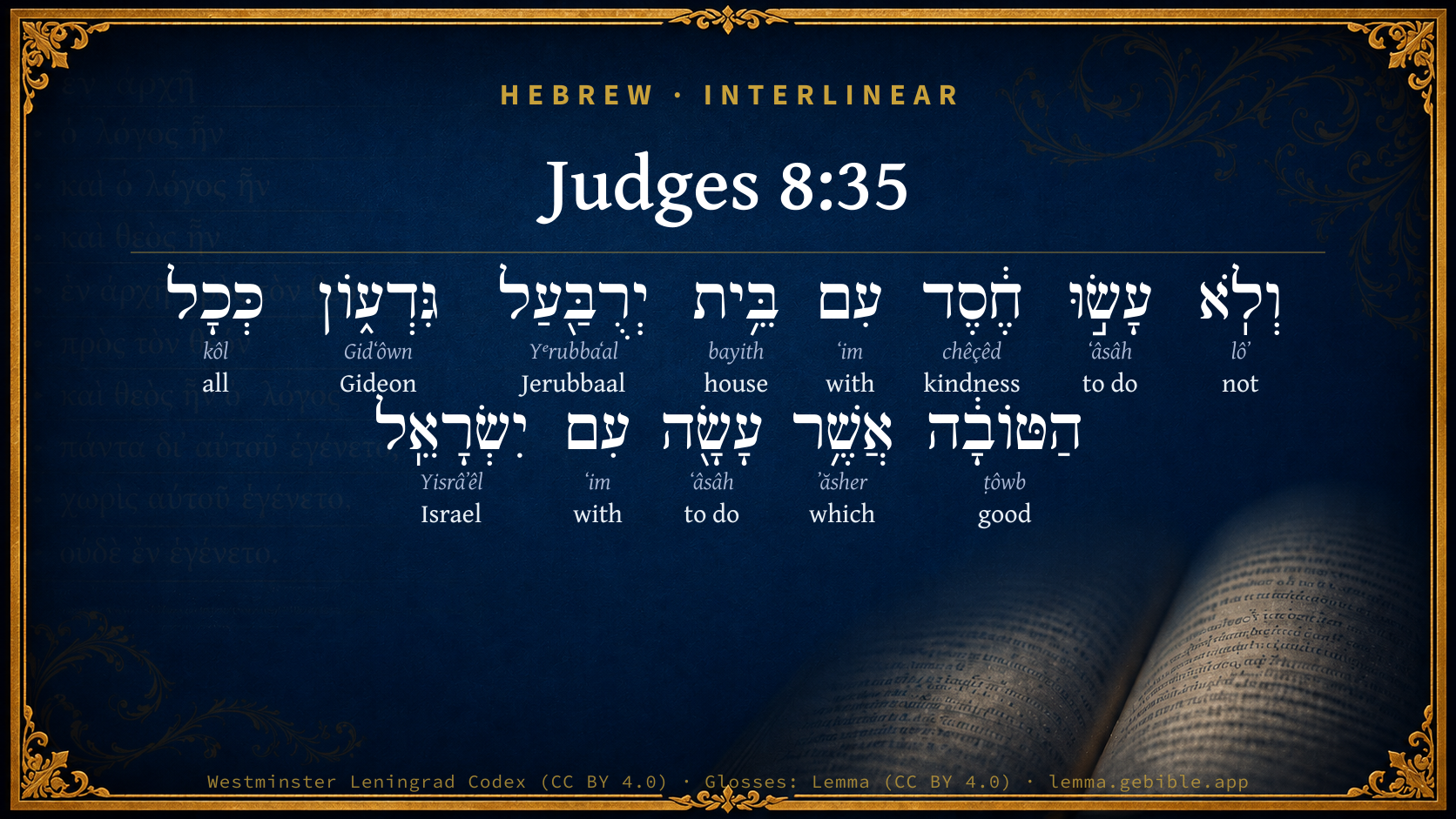
Hebrew (Westminster Leningrad Codex) Judges 8:35 appears in the Hebrew Old Testament. The text above is from the Westminster Leningrad Codex. Each word links to its Strong’s number, a concise gloss, and parsing drawn from the Open Scriptures Hebrew Bible morphology. Click any word for its full Brown-Driver-Briggs (BDB) entry.
Download image
Cite this verse

Judges 8:35 (World English Bible). Public Domain. Lemma interlinear Bible study tool, https://lemma.gebible.app/v/judges/8/35.

Show BibTeX & RIS
BibTeX
RIS
English Translation
neither shown they kindness to the house of Jerubbaal, [who is] Gideon, according to all the goodness which he had shown to Israel.
World English Bible · Public Domain
Download a study sheet

One document with this verse’s original text, its word-by-word gloss line, the meaning frame, cross-references with their text, attributed commentary, and full source and license credits — printable, and it pastes into notes with its structure intact.

This verse Autodidact and up

Study sheet (.html) Plain text (.txt)

A passage Seminary Student

Up to 50 verses in one chapter. A passage sheet keeps up to 6 commentary sources and 12 cross-references per verse, in the order this page ranks them, and says so on the sheet whenever that leaves anything out. Ask for a single verse and you get the Autodidact verse sheet above.

Everything on this page stays free to read, with no account — the sheet is a download of what is already on screen, not access to it.

Want to remove ads? Support Godless Engineer
Compare translations 3

The same verse in 3 English versions, stacked beneath the original-language interlinear above. Click any original word for its lexicon entry.

Each is an independent rendering of the whole verse — the interlinear is not word-aligned to these translations.

Highlighted words mark where these versions differ — a whole-verse word diff, not a word-by-word alignment.

  • World English Bible Public Domain
    neither shown they kindness to the house of Jerubbaal, [who is] Gideon, according to all the goodness which he had shown to Israel.
  • King James Version Public Domain
    Neither showed they kindness to the house of Jerubbaal, namely, Gideon, according to all the goodness which he had showed unto Israel.
  • unfoldingWord Literal Text CC BY-SA 4.0
    And they did not do covenant faithfulness with the house of Jerubbaal, Gideon, according to all of the good that he did with Israel.

unfoldingWord Literal Text — © unfoldingWord, licensed CC BY-SA 4.0. Word-aligned USFM3 via Door43 (git.door43.org/unfoldingWord/en_ult).

Versions to compare (up to 4)

3 of 4 selected

Show all 18 translations

Every available English version of this verse, each an independent rendering of the whole verse.

  • World English Bible Public Domain
    neither shown they kindness to the house of Jerubbaal, [who is] Gideon, according to all the goodness which he had shown to Israel.
  • Berean Standard Bible Public Domain
    They did not show kindness to the house of Jerubbaal (that is, Gideon) for all the good things he had done for Israel.
  • Majority Standard Bible Public Domain
    They did not show kindness to the house of Jerubbaal (that is, Gideon) for all the good things he had done for Israel.
  • King James Version Public Domain
    Neither showed they kindness to the house of Jerubbaal, namely, Gideon, according to all the goodness which he had showed unto Israel.
  • American Standard Version (1901) Public Domain
    neither showed they kindness to the house of Jerubbaal, `who is' Gideon, according to all the goodness which he had showed unto Israel.
  • Revised Version (1885) Public Domain
    neither shewed they kindness to the house of Jerubbaal, who is Gideon, according to all the goodness which he had shewed unto Israel.
  • Geneva Bible (1599) Public Domain
    Neither shewed they mercy on the house of Ierubbaal, or Gideon, according to al the goodnesse which he had shewed vnto Israel.
  • Douay-Rheims (1899) Public Domain
    Neither did they shew mercy to the house of Jerobaal Gedeon, according to all the good things he had done to Israel.
  • Young's Literal Translation Public Domain
    neither have they done kindness with the house of Jerubbaal -- Gideon -- according to all the good which he did with Israel.
  • Literal Standard Version CC BY-SA 4.0
    neither have they done kindness with the house of Jerubba‘al—Gideon—according to all the good which he did with Israel.
  • Unlocked Literal Bible CC BY-SA 4.0
    They did not keep their promises to the house of Jerub Baal (that is, Gideon), in return for all the good he had done in Israel.
  • unfoldingWord Literal Text CC BY-SA 4.0
    And they did not do covenant faithfulness with the house of Jerubbaal, Gideon, according to all of the good that he did with Israel.
  • Darby Bible Public Domain
    and they did not show kindness to the family of Jerubba'al (that is, Gideon) in return for all the good that he had done to Israel.
  • World Messianic Bible Public Domain
    neither did they show kindness to the house of Jerubbaal, that is, Gideon, according to all the goodness which he had shown to Israel.
  • Webster's Bible Public Domain
    Neither showed they kindness to the house of Jerubbaal, namely Gideon, according to all the goodness which he had shown to Israel.
  • Free Bible Version CC BY-SA 4.0
    They did not show any respect to the family of Jerub-baal (Gideon) for all the good he had done for Israel.
  • Bible in Basic English Public Domain
    And they were not kind to the house of Jerubbaal, that is, Gideon, in reward for all the good he had done to Israel.
  • JPS Tanakh (1917) Public Domain
    neither showed they kindness to the house of Jerubbaal, namely Gideon, according to all the goodness which he had shown unto Israel.

Literal Standard Version (2020), Covenant Press — licensed CC BY-SA 4.0. Text via the HelloAO Bible API (eBible.org). Unlocked Literal Bible (unfoldingWord) — licensed CC BY-SA 4.0. Text via the HelloAO Bible API (eBible.org). unfoldingWord Literal Text — © unfoldingWord, licensed CC BY-SA 4.0. Word-aligned USFM3 via Door43 (git.door43.org/unfoldingWord/en_ult). Free Bible Version, Dr. Jonathan Gallagher — licensed CC BY-SA 4.0. Text via the HelloAO Bible API (eBible.org).

Word by word

More ways to search: Search by grammar → Find every occurrence → Compare this word →

Practice this passage: Drill this verse → Learn its vocabulary →

יְרֻבַּ֖עַל
Yᵉrubbaʻal
H3378
“Jerubbaal”
Noun, Proper
Part of Speech
Noun
Type
Proper
Full BDB Definition

Origin: from H7378 and H1168

TWOT: None

Jerubbaal = "let Baal contend" - name given to Gideon by his father when he destroyed the altar of Baal
  1. וְלֹֽא lôʼ H3808 “and · not” Conjunction + Particle, Negative
  2. עָשׂ֣וּ ʻâsâh H6213 “to do” Verb, Qal, Perfect, 3rd Person, Common, Plural
  3. חֶ֔סֶד chêçêd H2617 “kindness” Noun, Common, Masculine, Singular, Absolute
  4. עִם ʻim H5973 “with” Preposition
  5. בֵּ֥ית bayith H1004 “house of” Noun, Common, Masculine, Singular, Construct
  6. גִּדְע֑וֹן Gidʻôwn H1439 “Gideon” Noun, Proper
  7. כְּכָל kôl H3605 “like/as · all of” Preposition + Noun, Common, Masculine, Singular, Construct
  8. הַטּוֹבָ֔ה ṭôwb H2896 “the · good” Particle, Definite Article + Adjective, Adjective, Feminine, Singular, Absolute
  9. אֲשֶׁ֥ר ʼăsher H834 “which” Particle, Relative
  10. עָשָׂ֖ה ʻâsâh H6213 “to do” Verb, Qal, Perfect, 3rd Person, Masculine, Singular
  11. עִם ʻim H5973 “with” Preposition
  12. יִשְׂרָאֵֽל Yisrâʼêl H3478 “Israel” Noun, Proper

About this verse

These counts appear in no published source. They are computed here, from the morphology-tagged text and Lemma’s own curated glosses. What Lemma adds →

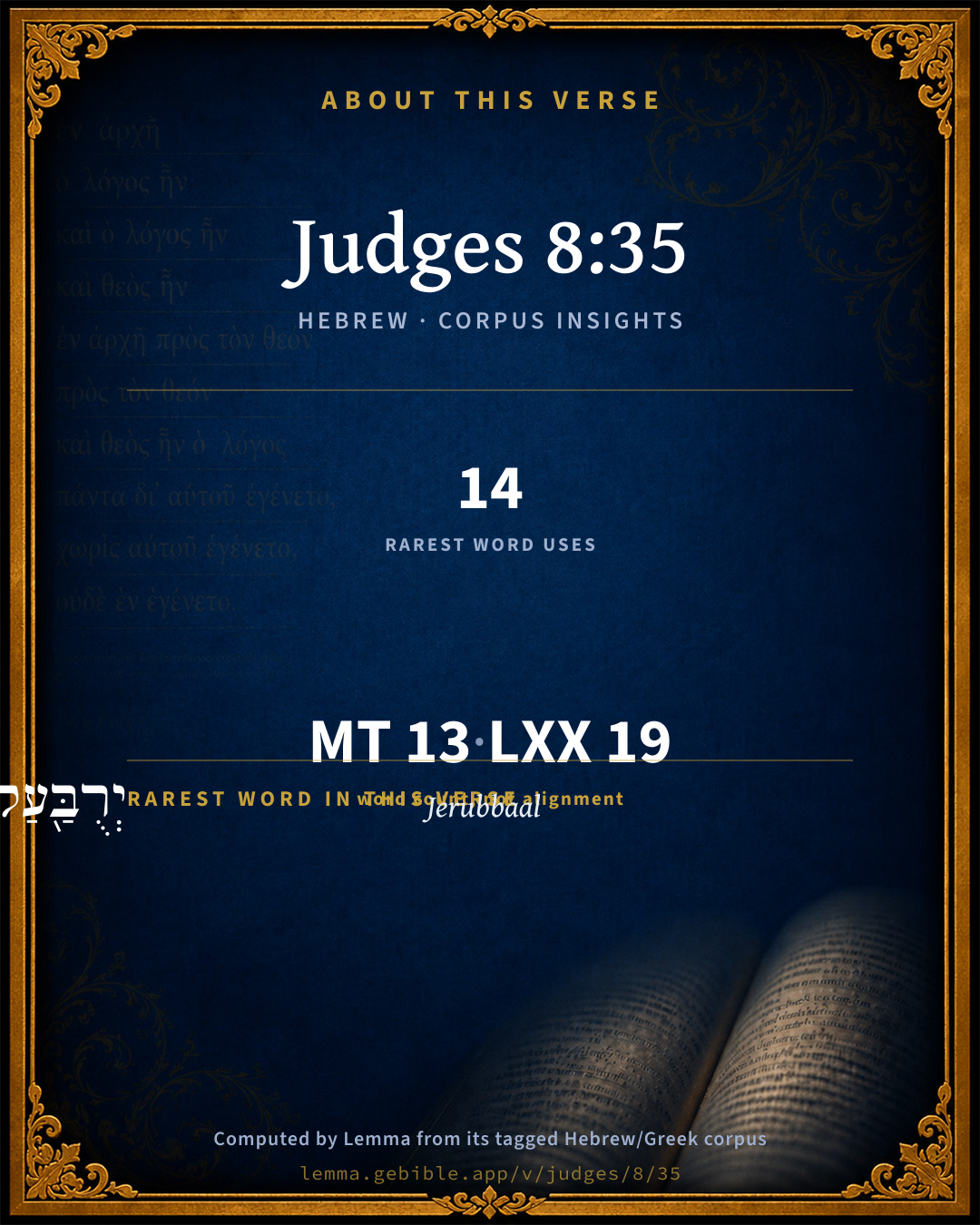
13
words
11
distinct lemmas
Historical
section

Notable vocabulary

The rarest word here is יְרֻבַּ֖עַל Jerubbaal H3378 — appearing just 14 times in the whole Hebrew Bible.

Shared distinctive vocabulary

יְרֻבַּ֖עַל Jerubbaal H3378 occurs in 13 verses of the Hebrew Bible. Also found in:

Grammatical profile

  • 2 verbs
  • 6 nouns
  • 1 adjective
  • 2 prepositions
  • 2 particles

Verb forms

  • עָשׂ֣וּ Qal · Perfect
  • עָשָׂ֖ה Qal · Perfect

Repetition

Words recur within this verse — often emphatic in Hebrew:

  • עָשׂ֣וּ to do H6213 ×2
  • עִם with H5973 ×2

Hebrew & Septuagint length

In English translation the verse runs 23 words from the Hebrew and 25 from the Septuagint (LXX English) — closely comparable.

A rough comparison of the two English renderings, which tokenize alike — not a word-level alignment.

Word counts can differ between the Hebrew and the Greek without any difference in meaning — e.g. the Hebrew direct-object marker אֵת has no separate Greek word, and Greek often adds the article ὁ.

In the original languages it is 13 Hebrew tokens and 19 Greek tokens — but the two are counted differently (Hebrew bundles its prefixes and suffixes into one token; the Greek is in lemma form), so that isn’t a like-for-like length.

Cross-references

3

Topical passages linked to Judges 8:35 in the Treasury of Scripture Knowledge — connected by theme and wording, ordered by reader-vote popularity; previews shown in the World English Bible.

  • Ecclesiastes 9:14–15 There was a little city, and few men within it; and a great king came against it, besieged it, and built great bulwarks against it.
  • Judges 9:5 He went to his father's house at Ophrah, and killed his brothers the sons of Jerubbaal, being seventy persons, on one stone: but Jotham the youngest son of Jerubbaal was left; for he hid himself.
  • Judges 9:16–19 Now therefore, if you have dealt truly and righteously, in that you have made Abimelech king, and if you have dealt well with Jerubbaal and his house, and have done to him according to the deserving of his hands

Cross-references courtesy of OpenBible.info (CC BY 4.0).

Hebrew and Greek witnesses Masoretic Hebrew ↔ Greek Septuagint

The same verse in the two great witnesses to the Old Testament, shown verse-for-verse.

These are two independent witnesses, not word-aligned to each other, and the Septuagint is shown in lemma (dictionary) form.

Hebrew Judges 8:35 Masoretic · Westminster Leningrad Codex

וְלֹֽא עָשׂ֣וּ חֶ֔סֶד עִם בֵּ֥ית יְרֻבַּ֖עַל גִּדְע֑וֹן כְּכָל הַטּוֹבָ֔ה אֲשֶׁ֥ר עָשָׂ֖ה עִם יִשְׂרָאֵֽל

neither shown they kindness to the house of Jerubbaal, [who is] Gideon, according to all the goodness which he had shown to Israel.

World English Bible · Public Domain

Greek LXX Judges 8:35 Septuagint · lemma form

καί οὐ ποιέω ἔλεος μετά ὁ οἶκος ιεροβααλ αὐτός εἰμί γεδεων κατά πᾶς ὁ ἀγαθός ὅς ποιέω μετά ἰσραήλ

And they did not deal mercifully with the house of Jerobaal, (the same is Gedeon) according to all the good which he did to Israel.

LXX2012 (modern English Septuagint) · Public Domain

Hebrew: Westminster Leningrad Codex (CC BY 4.0). Greek: Septuagint (public domain); English from LXX2012 (modern English Septuagint) (Public Domain). How the Septuagint differs from the Hebrew →

Targum (Aramaic paraphrase)

1

The Targum is the ancient Jewish Aramaic paraphrase of the Hebrew Scriptures — an interpretive translation, not the Hebrew text itself. Onkelos (literal) and Pseudo-Jonathan (expansive) render the Torah, and Jonathan the Prophets. Coverage is partial: where no permissively-licensed English translation exists for a verse, only the Aramaic is shown. This is verse-level text, not a word-by-word alignment to the Hebrew.

  1. Targum Jonathan Prophets (Joshua–Malachi)
    וְלָא עֲבָדוּ טֵיבוּ עִם בֵּית יְרֻבַּעַל גִדְעוֹן כְּכָל טַבְתָא דִי עֲבַד עִם יִשְׂרָאֵל:

    (no public-domain English translation for this verse)

    Targum Jonathan — Aramaic: “Mikraot Gedolot” (public domain). English: “Sefaria Community Translation” (CC0 1.0 (public-domain dedication)); “London "Chaldee Paraphrase," 1871” (public domain). Text via Sefaria.

Commentary

Notes on Judges 8:35 from classic Christian and Jewish commentators (each source and its license shown beneath its notes). The classic Christian expositions comment on the surrounding passage and are grouped to its opening verse, so a note may address several verses; the Jewish commentaries on the Tanakh (Rashi and others) are per-verse, so they appear only where the commentator wrote on this verse.

Lemma curates 59 commentaries, every one of them public domain or Creative Commons licensed, each selected and text-cleaned for this edition rather than reprinted as found. About our sources →

Trapp's Complete Commentary

John Trapp

Jdg 8:35 Neither shewed they kindness to the house of Jerubbaal, [namely], Gideon, according to all the goodness which he had shewed unto Israel.

Ver. 35. Neither showed they kindness.] No wonder that apostates from God prove unkind and unthankful to men.

John Trapp, A Commentary or Exposition upon All the Books of the Old and New Testament (1647–1656) — public domain. Text from a community e-Sword module.

Joseph Benson's Commentary

Jdg 8:35. Neither showed they kindness to the house of Gideon — No wonder they were so ungrateful to the family of this illustrious man, when they were so forgetful of the God of all their mercies; according to the goodness he had showed unto Israel — In hazarding his life for their service, and accomplishing a glorious deliverance in their favour; and in leaving them in the full enjoyment of their liberty, by refusing the despotic power with which they offered to invest him, and in governing them for the space of so many years with so much prudence, that he left them in a happy state of tranquillity, having the worship of the true God established among them when he died.

Joseph Benson's Commentary on the Old and New Testaments (1811–1818) — public domain. Text from a community e-Sword module.

Geneva Bible (1599)

Geneva Bible translators

They were unmindful of God and unkind toward him, by whom they had received so great a benefit.

Geneva Bible (1599) marginal notes — public domain. Text via Bolls.life.

Adam Clarke's Commentary

Verse 35. Neither showed they kindness to the house of - Gideon] They were both unthankful and unholy. Though they had the clearest proofs of God's power and goodness before their eyes, yet they forgot him. And although they were under the greatest obligations to Gideon, and were once so sensible of them that they offered to settle the kingdom on him and his family, yet they forgot him also; for, becoming foes to GOD, they could not be friends to MAN.

Jerubbaal, namely, Gideon. - This is improper; it should be Jerubbaal Gideon, as we say Simon Peter, or call any man by his Christian name and surname.

THE ancients, particularly St. Ambrose and Augustine, have endeavoured to find out a parallel between our blessed Lord and Gideon. We have already seen what Origen has made of the whole account, who is followed in the main by the above Latin fathers. As I believe no such parallel was intended by the Spirit of God, I must be excused from going into their details. It is no credit either to Christ or Christianity to be compared to such persons and their transactions.

1. Of Gideon the most we can say is that which the angel said, he was a mighty man of valour.

2. He was also a true patriot, he loved his country, and hazarded his life for it; and yet he would not stir till he had the most incontestable proofs that God would, by his supernatural assistance, make him victorious.

3. He was most evidently disinterested, and void of ambition; he refused the kingdom when it was offered to him and to his heirs after him. But, consistently with the belief he had in God, he could not accept it, as this would have been a complete alteration of the Jewish constitution, which acknowledged no ruler but God himself.

4. His motive in making the ephod is not well understood; probably it was done with no reprehensible design. But the act was totally wrong; he had no Divine authority to make such an innovation in the religious worship of his country. The ark was at Shechem; and there was the proper and only accredited priest. The act therefore can never be excused, whatever may be said of his motive.

5. His private character does not appear to have been very exemplary; he had many wives, and seventy sons by them, besides one by a concubine, which he kept at Shechem, where he was often obliged to go as judge, for the purpose of administering justice. In short, there is scarcely a trait in his character worthy to be compared with any thing in the conduct of the Redeemer of mankind.

6. Parallels to Christ, and the work of his Spirit in the salvation of men, have been diligently sought in the sacred writings, by both commentators and preachers; and we have had voluminous treaties on types and antitypes; and how little has sound doctrine or true piety derived from them! They have often served to unsettle the former, and have been rather inimical than favourable to the interests of the latter. When the Spirit of God says such things are types and such things are allegories, it is our duty to believe and examine; when men produce their types and metaphors, it may be our duty to doubt, be suspicious, and pass on.

Adam Clarke's Commentary on the Bible (1810–1826) — public domain. Text from a community e-Sword/MySword module.

Ellicott's Commentary for English Readers

(35) Jerubbaal, namely, Gideon.—It is doubtful whether we should not join the two names (Jerubbaal-Gideon), as in the Vulgate. Both names may be here allusive. He had been the “hewer” of their enemies and a “pleader against Baal,” yet they were ungrateful to him, and apostatised to Baal-worship.

According to all the goodness which he had shewed unto Israel.—See Jdg_9:17-18.

A Bible Commentary for English Readers, edited by Charles John Ellicott (1878–1897) — public domain. Text from a community e-Sword module.

Haydock's Catholic Bible Commentary

Mercy is here put for many virtues: gratitude, justice, kindness, &c. (Menochius) --- The Israelites did not take care to provide for (Calmet) the family of one who had rendered them such essential services. (Haydock)

George Leo Haydock (1774–1849), Haydock's Catholic Family Bible and Commentary, 1859 edition — public domain. Excludes Psalms (Douay-Rheims chapter numbering differs from Protestant) and Deuterocanonical books (Catholic canon only).

Whedon's Commentary on the Bible

Daniel D. Whedon

35. Neither showed they kindness — They proved ungrateful as well as idolatrous. Instead of making one of Gideon’s legitimate sons ruler, (Jdg_8:22,) they saw all these cruelly slaughtered, and chose their murderer, an illegitimate son, to reign over them for three years. Jdg_9:22.

Jerubbaal, namely, Gideon — The names should be written Jerubbaal-Gideon. The double name is here apparently used as a reflection on Israel’s baseness in neglecting the memory of the distinguished Baal-fighter, to whom they owed so much. Note, Jdg_6:32.

Thus closes the history of Gideon, another of the mixed and mysterious characters of the age of the Judges. He is the first of the deliverers of Israel whose history is given as a detailed narrative. He possessed gentleness and grace of heart and manner, with a lofty heroism and nobleness of character. This was enhanced by his commanding and kingly form.

As the deliverer of Israel, following out the instructions of Jehovah, we see in him every thing to praise: as the retired warrior, peacefully living at his native city, and apparently refusing to exercise the ordinary office of judge, there is something about him that is at least strangely unambitious; and in his setting up the costly ephod in Ophrah, and allowing all Israel to go whoring after it, we discover that which resembles a Jeroboam-like attempt to establish a new and unauthorized form and place of worship in Israel, and in this he bears the censure of the sacred historian himself. Gideon was manifestly a great character, but not well balanced. “There is a sweetness and nobleness blended with his courage, such as lifts us into a higher region — something of the past greatness of Joshua, something of the future grace of David. But he was, as we should say, before his age. The attempt to establish a more settled form of government ended in disaster and crime. He himself remains as a character apart, faintly understood by others, imperfectly fulfilling his own ideas, staggering under a burden to which he was not equal.” — Stanley.

The attempt of some expositors, ancient and modern, to make Gideon a type of Christ, is justly condemned by Dr. Clarke. It is farfetched and useless, and does more to confuse the sacred history than to explain it. The history of the Judges is manifestly designed, not to give us types of the Messiah, but rather to show up the lower and higher aspects of human character in the development of history. We see in this book the natural workings of humanity when confronted on the one side by the world, the flesh, and the devil, and on the other by the law and revelations of God.

The conflict too often results in the victory of the flesh over the Spirit.

Daniel D. Whedon (gen. ed.), Commentary on the Old and New Testaments (1874–1909) — public domain. Text from a community e-Sword module.

The Pulpit Commentary

Neither showed they kindness, etc. Forgetfulness of God is often the parent of ingratitude to men. The heart of stone which is not touched by the love of Christ is also insensible to the kindness of man.

The Pulpit Commentary (1880–1919), ed. H.D.M. Spence-Jones & Joseph S. Exell — public domain. Text from a community e-Sword module.

Rashi

Rabbi Shlomo Yitzchaki (Rashi)

They did not act benevolently. They murdered his children, as stated in the narrative.

Rashi on the Tanakh — English translations: “The Judaica Press complete Tanach with Rashi, translated by A. J. Rosenberg” (CC BY 4.0); “Pentateuch with Rashi's commentary by M. Rosenbaum and A.M. Silbermann, 1929-1934” (public domain); “The Metsudah Tanach series, Lakewood, N.J” (CC BY 4.0); and “The Book of Joshua, Metsudah Publications, 1997” (CC BY 4.0). Text via Sefaria.

Lesson kit

Teaching starters — assembled from the data on this page, not authored interpretation. Every prompt links to the verse data it draws on. Edit before teaching.

Judges, in the Historical, opens this verse with 13 words (11 distinct Hebrew lemmas). Its most distinctive word is Yᵉrubbaʻal (“Jerubbaal”). A historical commentator’s framing appears above. Read the whole chapter for the surrounding context.

Discussion questions

  1. The word Yᵉrubbaʻal carries the sense “Jerubbaal.” How does it shape the verse?
  2. Judges 6:32 shares the word «Jerubbaal» with this verse. How do the two illuminate each other?
  3. “to do” occurs 2× in this one verse. What is the effect of the repetition?
  4. The translations on this page render this verse differently — a whole-verse word diff, not a word-by-word alignment. What might account for the different wordings?
  5. The verb «עָשׂ֣וּ» is Qal Perfect. How does its form color the action?
  6. Reading how Trapp's Complete Commentary and Joseph Benson's Commentary read this verse, where do the two commentators agree and where do they part?

Things to notice

Reading settings

Reading text

Shown beneath each verse's original-language words.

Old Testament
Old Testament edition

Read the OT as the Masoretic Hebrew (MT) or the Greek Septuagint (LXX).

English shown for the Greek Septuagint (in the Hebrew ↔ Greek comparison).

Comparing translations? Open the Compare panel on any verse page to stack up to four side by side.