Judges 9:11

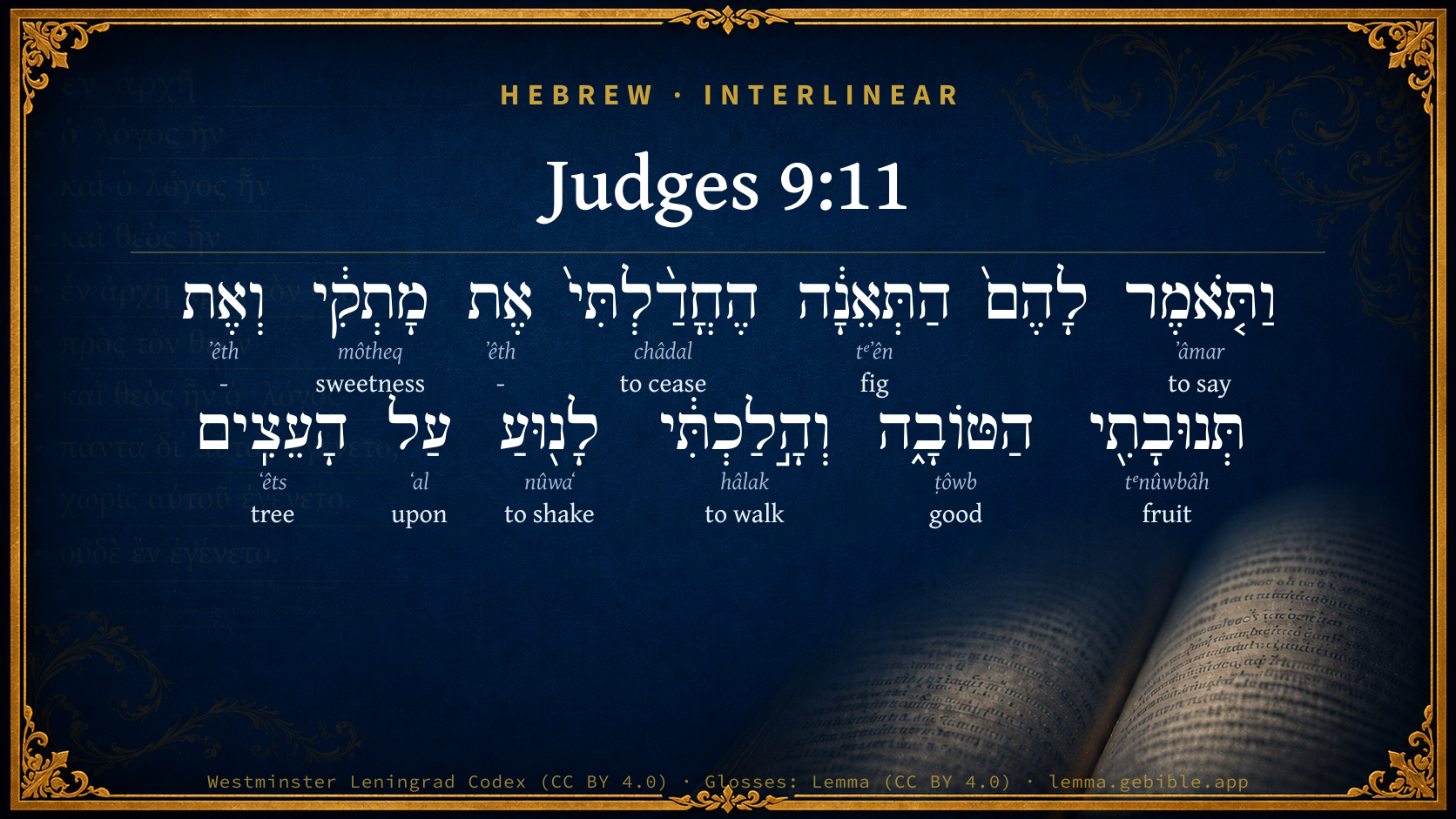
Hebrew (Westminster Leningrad Codex) Judges 9:11 appears in the Hebrew Old Testament. The text above is from the Westminster Leningrad Codex. Each word links to its Strong’s number, a concise gloss, and parsing drawn from the Open Scriptures Hebrew Bible morphology. Click any word for its full Brown-Driver-Briggs (BDB) entry.
Download image
Cite this verse

Judges 9:11 (World English Bible). Public Domain. Lemma interlinear Bible study tool, https://lemma.gebible.app/v/judges/9/11.

Show BibTeX & RIS
BibTeX
RIS
English Translation
But the fig tree said to them, Should I leave my sweetness, and my good fruit, and go to wave back and forth over the trees?
World English Bible · Public Domain
Highlights
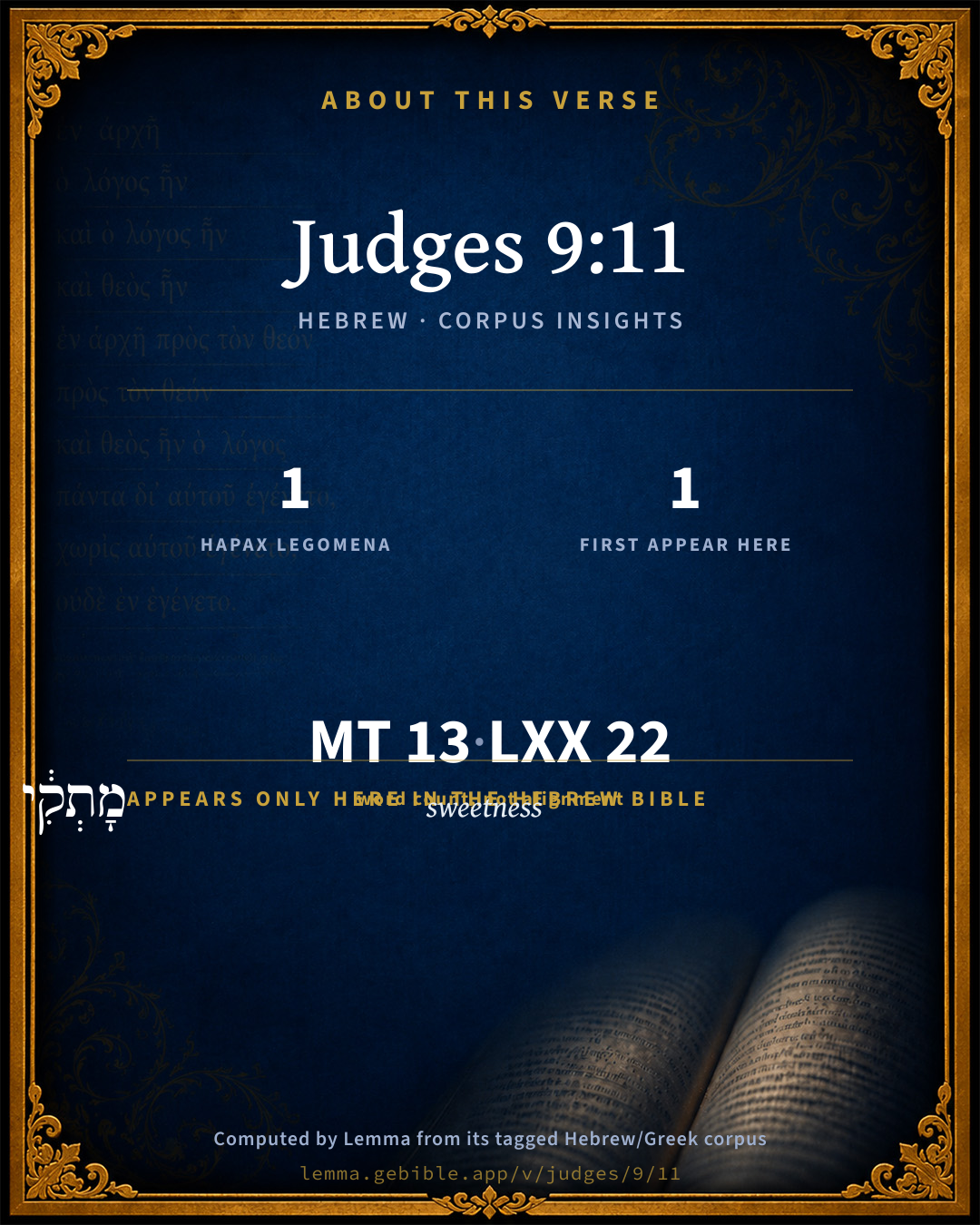
  • 1 hapax legomenon — only here in the Hebrew Bible
  • 1 first appearance in the Hebrew Bible
Full analysis ↓
Download a study sheet

One document with this verse’s original text, its word-by-word gloss line, the meaning frame, cross-references with their text, attributed commentary, and full source and license credits — printable, and it pastes into notes with its structure intact.

This verse Autodidact and up

Study sheet (.html) Plain text (.txt)

A passage Seminary Student

Up to 50 verses in one chapter. A passage sheet keeps up to 6 commentary sources and 12 cross-references per verse, in the order this page ranks them, and says so on the sheet whenever that leaves anything out. Ask for a single verse and you get the Autodidact verse sheet above.

Everything on this page stays free to read, with no account — the sheet is a download of what is already on screen, not access to it.

Want to remove ads? Support Godless Engineer
Compare translations 3

The same verse in 3 English versions, stacked beneath the original-language interlinear above. Click any original word for its lexicon entry.

Each is an independent rendering of the whole verse — the interlinear is not word-aligned to these translations.

Highlighted words mark where these versions differ — a whole-verse word diff, not a word-by-word alignment.

  • World English Bible Public Domain
    But the fig tree said to them, Should I leave my sweetness, and my good fruit, and go to wave back and forth over the trees?
  • King James Version Public Domain
    But the fig tree said unto them, Should I forsake my sweetness, and my good fruit, and go to be promoted over the trees?
  • unfoldingWord Literal Text CC BY-SA 4.0
    But the fig tree said to them, ‘Should I discontinue my sweetness and my good fruit, that I should go to wave over the trees?’

unfoldingWord Literal Text — © unfoldingWord, licensed CC BY-SA 4.0. Word-aligned USFM3 via Door43 (git.door43.org/unfoldingWord/en_ult).

Versions to compare (up to 4)

3 of 4 selected

Show all 18 translations

Every available English version of this verse, each an independent rendering of the whole verse.

  • World English Bible Public Domain
    But the fig tree said to them, Should I leave my sweetness, and my good fruit, and go to wave back and forth over the trees?
  • Berean Standard Bible Public Domain
    But the fig tree replied, ‘Should I stop giving my sweetness and my good fruit, to hold sway over the trees?’
  • Majority Standard Bible Public Domain
    But the fig tree replied, ‘Should I stop giving my sweetness and my good fruit, to hold sway over the trees?’
  • King James Version Public Domain
    But the fig tree said unto them, Should I forsake my sweetness, and my good fruit, and go to be promoted over the trees?
  • American Standard Version (1901) Public Domain
    But the fig-tree said unto them, Should I leave my sweetness, and my good fruit, and go to wave to and fro over the trees?
  • Revised Version (1885) Public Domain
    But the fig tree said unto them, Should I leave my sweetness, and my good fruit, and go to wave to and fro over the trees?
  • Geneva Bible (1599) Public Domain
    But the fig tree answered them, Should I forsake my sweetenesse, and my good fruite, and goe to aduance me aboue the trees?
  • Douay-Rheims (1899) Public Domain
    And it answered them: Can I leave my sweetness, and my delicious fruits, and go to be promoted among the other trees?
  • Young's Literal Translation Public Domain
    And the fig saith to them, Have I ceased from my sweetness, and my good increase, that I have gone to stagger over the trees?
  • Literal Standard Version CC BY-SA 4.0
    And the fig says to them, Have I ceased from my sweetness, and my good increase, that I have gone to stagger over the trees?
  • Unlocked Literal Bible CC BY-SA 4.0
    But the fig tree said to them, 'Should I give up my sweetness and my good fruit, just so I could return and sway over the other trees?'
  • unfoldingWord Literal Text CC BY-SA 4.0
    But the fig tree said to them, ‘Should I discontinue my sweetness and my good fruit, that I should go to wave over the trees?’
  • Darby Bible Public Domain
    But the fig tree said to them, 'Shall I leave my sweetness and my good fruit, and go to sway over the trees?'
  • World Messianic Bible Public Domain
    “But the fig tree said to them, ‘Should I leave my sweetness, and my good fruit, and go to wave back and forth over the trees?’
  • Webster's Bible Public Domain
    But the fig-tree said to them, Should I forsake my sweetness, and my good fruit, and go to be promoted over the trees?
  • Free Bible Version CC BY-SA 4.0
    But the fig tree replied, ‘Should I stop giving my good sweet fruit just to go and sway to and fro over the trees?’
  • Bible in Basic English Public Domain
    But the fig-tree said to them, Am I to give up my sweet taste and my good fruit and go waving over the trees?
  • JPS Tanakh (1917) Public Domain
    But the fig-tree said unto them: Should I leave my sweetness, and my good fruitage, and go to hold sway over the trees?

Literal Standard Version (2020), Covenant Press — licensed CC BY-SA 4.0. Text via the HelloAO Bible API (eBible.org). Unlocked Literal Bible (unfoldingWord) — licensed CC BY-SA 4.0. Text via the HelloAO Bible API (eBible.org). unfoldingWord Literal Text — © unfoldingWord, licensed CC BY-SA 4.0. Word-aligned USFM3 via Door43 (git.door43.org/unfoldingWord/en_ult). Free Bible Version, Dr. Jonathan Gallagher — licensed CC BY-SA 4.0. Text via the HelloAO Bible API (eBible.org).

Word by word

More ways to search: Search by grammar → Find every occurrence → Compare this word →

Practice this passage: Drill this verse → Learn its vocabulary →

מָתְקִ֔י
môtheq
H4987
“sweetness · my”
Noun, Common, Masculine, Singular, Construct + Suffix, Personal, 1st Person, Common, Singular
Part of Speech
Noun
Type
Common
Gender
Masculine
Number
Singular
State
Construct
Full BDB Definition

Origin: from H4985

TWOT: 1268b

sweetness
  1. וַתֹּ֤אמֶר ʼâmar H559 “and · to say” Conjunction + Verb, Qal, Sequential Imperfect, 3rd Person, Feminine, Singular
  2. הַתְּאֵנָ֔ה tᵉʼên H8384 “the · fig” Particle, Definite Article + Noun, Common, Feminine, Singular, Absolute
  3. הֶחֳדַ֨לְתִּי֙ châdal H2308 “to cease” Particle, Interrogative + Verb, Qal, Perfect, 1st Person, Common, Singular
  4. אֶת ʼêth H853 “-” Particle, Direct Object
  5. וְאֶת ʼêth H853 “and · -” Conjunction + Particle, Direct Object
  6. תְּנוּבָתִ֖י tᵉnûwbâh H8570 “fruit · my” Noun, Common, Feminine, Singular, Construct + Suffix, Personal, 1st Person, Common, Singular
  7. הַטּוֹבָ֑ה ṭôwb H2896 “the · good” Particle, Definite Article + Adjective, Adjective, Feminine, Singular, Absolute
  8. וְהָ֣לַכְתִּ֔י hâlak H1980 “and · to walk” Conjunction + Verb, Qal, Sequential Perfect, 1st Person, Common, Singular
  9. לָנ֖וּעַ nûwaʻ H5128 “to shake” Preposition + Verb, Qal, Infinitive Construct
  10. עַל ʻal H5921 “upon” Preposition
  11. הָעֵצִֽים ʻêts H6086 “the · trees” Particle, Definite Article + Noun, Common, Masculine, Plural, Absolute

About this verse

These counts appear in no published source. They are computed here, from the morphology-tagged text and Lemma’s own curated glosses. What Lemma adds →

13
words
11
distinct lemmas
Historical
section

Notable vocabulary

1 hapax legomenon — a word that appears only here in the entire Hebrew Bible:

  • מָתְקִ֔י sweetness H4987

First appearance in Scripture

This word makes its first canonical appearance in the Hebrew Bible here:

  • מָתְקִ֔י sweetness H4987

Shared distinctive vocabulary

תְּנוּבָתִ֖י fruit H8570 occurs in 5 verses of the Hebrew Bible. Also found in:

Grammatical profile

  • 4 verbs
  • 4 nouns
  • 1 adjective
  • 2 prepositions
  • 2 particles

Verb forms

  • וַתֹּ֤אמֶר Qal · Sequential Imperfect
  • הֶחֳדַ֨לְתִּי֙ Qal · Perfect
  • וְהָ֣לַכְתִּ֔י Qal · Sequential Perfect
  • לָנ֖וּעַ Qal · Infinitive Construct

Hebrew & Septuagint length

In English translation the verse runs 26 words from the Hebrew and 24 from the Septuagint (LXX English) — closely comparable.

A rough comparison of the two English renderings, which tokenize alike — not a word-level alignment.

Word counts can differ between the Hebrew and the Greek without any difference in meaning — e.g. the Hebrew direct-object marker אֵת has no separate Greek word, and Greek often adds the article ὁ.

In the original languages it is 13 Hebrew tokens and 22 Greek tokens — but the two are counted differently (Hebrew bundles its prefixes and suffixes into one token; the Greek is in lemma form), so that isn’t a like-for-like length.

Cross-references

1

Topical passages linked to Judges 9:11 in the Treasury of Scripture Knowledge — connected by theme and wording, ordered by reader-vote popularity; previews shown in the World English Bible.

  • Luke 13:6–7 He spoke this parable. "A certain man had a fig tree planted in his vineyard, and he came seeking fruit on it, and found none.

Cross-references courtesy of OpenBible.info (CC BY 4.0).

Hebrew and Greek witnesses Masoretic Hebrew ↔ Greek Septuagint

The same verse in the two great witnesses to the Old Testament, shown verse-for-verse.

These are two independent witnesses, not word-aligned to each other, and the Septuagint is shown in lemma (dictionary) form.

Hebrew Judges 9:11 Masoretic · Westminster Leningrad Codex

וַתֹּ֤אמֶר לָהֶם֙ הַתְּאֵנָ֔ה הֶחֳדַ֨לְתִּי֙ אֶת מָתְקִ֔י וְאֶת תְּנוּבָתִ֖י הַטּוֹבָ֑ה וְהָ֣לַכְתִּ֔י לָנ֖וּעַ עַל הָעֵצִֽים

But the fig tree said to them, Should I leave my sweetness, and my good fruit, and go to wave back and forth over the trees?

World English Bible · Public Domain

Greek LXX Judges 9:11 Septuagint · lemma form

καί εἶπον αὐτός ὁ συκῆ μή ἀπολείπω ἐγώ ὁ γλυκύτης ἐγώ καί ὁ γένημα ἐγώ ὁ ἀγαθός πορεύομαι κινέω ἐπί ὁ ξύλον

But the fig tree said to them, Shall I leave my sweetness and my good fruits, and go to be promoted over the trees?

LXX2012 (modern English Septuagint) · Public Domain

Hebrew: Westminster Leningrad Codex (CC BY 4.0). Greek: Septuagint (public domain); English from LXX2012 (modern English Septuagint) (Public Domain). How the Septuagint differs from the Hebrew →

Targum (Aramaic paraphrase)

1

The Targum is the ancient Jewish Aramaic paraphrase of the Hebrew Scriptures — an interpretive translation, not the Hebrew text itself. Onkelos (literal) and Pseudo-Jonathan (expansive) render the Torah, and Jonathan the Prophets. Coverage is partial: where no permissively-licensed English translation exists for a verse, only the Aramaic is shown. This is verse-level text, not a word-by-word alignment to the Hebrew.

  1. Targum Jonathan Prophets (Joshua–Malachi)
    וַאֲמָרַת לְהוֹן תֵינָתָא הֲאֶשְׁבוֹק יַת חוּלְיִי וְיַת דְבֵילְתִּי שַׁפִּירְתָּא וְאֵהַךְ לְמֶעְבַּד מַלְכוּ עַל אִילָנַיָא:

    (no public-domain English translation for this verse)

    Targum Jonathan — Aramaic: “Mikraot Gedolot” (public domain). English: “Sefaria Community Translation” (CC0 1.0 (public-domain dedication)); “London "Chaldee Paraphrase," 1871” (public domain). Text via Sefaria.

Commentary

Notes on Judges 9:11 from classic Christian and Jewish commentators (each source and its license shown beneath its notes). The classic Christian expositions comment on the surrounding passage and are grouped to its opening verse, so a note may address several verses; the Jewish commentaries on the Tanakh (Rashi and others) are per-verse, so they appear only where the commentator wrote on this verse.

Lemma curates 59 commentaries, every one of them public domain or Creative Commons licensed, each selected and text-cleaned for this edition rather than reprinted as found. About our sources →

Trapp's Complete Commentary

John Trapp

Jdg 9:11 But the fig tree said unto them, Should I forsake my sweetness, and my good fruit, and go to be promoted over the trees?

Ver. 11. Should I forsake, &c.] See Jdg 9:9.

And my good fruit.] Dioscorides scribit ficum utile alimentum praebere: Figs are good for meat and medicine.

John Trapp, A Commentary or Exposition upon All the Books of the Old and New Testament (1647–1656) — public domain. Text from a community e-Sword module.

Joseph Benson's Commentary

Jdg 9:11. The fig-tree said, &c. — Gideon refused this honour, both for himself, and for his sons; and the sons of Gideon, whom Abimelech had slain, upon pretence of their affecting the kingdom, were as far from such thoughts as their father.

Joseph Benson's Commentary on the Old and New Testaments (1811–1818) — public domain. Text from a community e-Sword module.

Adam Clarke's Commentary

Verse 11. But the fig tree said - Should I forsake my sweetness] The fruit of the fig tree is the sweetest or most luscious of all fruits. A full-ripe fig, in its own climate, has an indescribable sweetness; so much so that it is almost impossible to eat it, till a considerable time after it is gathered from the trees, and has gone through an artificial preparation. This I have often noticed.

Adam Clarke's Commentary on the Bible (1810–1826) — public domain. Text from a community e-Sword/MySword module.

The Cambridge Bible for Schools and Colleges

gen. ed. J. J. S. Perowne

11. my sweetness] The early ripe fig, especially, was and is esteemed for its flavour; see Isa_28:4, Jer_24:2, Hos_9:10, Mic_7:1.

The Cambridge Bible for Schools and Colleges (gen. ed. J. J. S. Perowne; Cambridge University Press, 1878–1918) — public domain. Text from a community e-Sword module.

John Gill's Exposition

And the fig tree said unto them,.... Rejecting the offer made:

should I forsake my sweetness and my good fruit; for such the fruit of the fig tree is, sweet and good: so Julian (d) the emperor shows from various authors, Aristophanes, Herodotus, and Homer, that nothing is sweeter than figs, excepting honey, and that no kind of fruit is better, and, where they are, no good is wanting:

and go to be promoted over the trees? the same is designed by this as the former.

(d) Opera, par. 2. ep. 24. Sarapioni, p. 142.

John Gill's Exposition of the Whole Bible (1746–1763) — public domain (CC PDM 1.0). Text via the HelloAO Bible API.

Haydock's Catholic Bible Commentary

Sweetness. The fig is the sweetest of fruits, and is regarded as the symbol of sweetness. (Aristop.[Aristophanes?]; Bonfrere)

George Leo Haydock (1774–1849), Haydock's Catholic Family Bible and Commentary, 1859 edition — public domain. Excludes Psalms (Douay-Rheims chapter numbering differs from Protestant) and Deuterocanonical books (Catholic canon only).

Matthew Poole's English Annotations

My sweetness; for which that fruit is particularly commended.

Matthew Poole's English Annotations on the Holy Bible (1683–1685) — public domain. Text from a community e-Sword/MySword module.

Whedon's Commentary on the Bible

Daniel D. Whedon

11. The fig tree — Another of the excellent and highly valued trees of Palestine, the sweetness of whose good fruit is proverbial.

Daniel D. Whedon (gen. ed.), Commentary on the Old and New Testaments (1874–1909) — public domain. Text from a community e-Sword module.

Rashi

Rabbi Shlomo Yitzchaki (Rashi)

My sweetness. the honey of dates.

Rashi on the Tanakh — English translations: “The Judaica Press complete Tanach with Rashi, translated by A. J. Rosenberg” (CC BY 4.0); “Pentateuch with Rashi's commentary by M. Rosenbaum and A.M. Silbermann, 1929-1934” (public domain); “The Metsudah Tanach series, Lakewood, N.J” (CC BY 4.0); and “The Book of Joshua, Metsudah Publications, 1997” (CC BY 4.0). Text via Sefaria.

Lesson kit

Teaching starters — assembled from the data on this page, not authored interpretation. Every prompt links to the verse data it draws on. Edit before teaching.

Judges, in the Historical, opens this verse with 13 words (11 distinct Hebrew lemmas). Its most distinctive word is môtheq (“sweetness”). A historical commentator’s framing appears above. Read the whole chapter for the surrounding context.

Discussion questions

  1. The word môtheq carries the sense “sweetness.” How does it shape the verse?
  2. 1 word here appears nowhere else in the Hebrew Bible. Why might the author reach for such rare wording?
  3. This is the first place “sweetness” appears in Scripture (first appears here). What does its debut here establish?
  4. How does Deuteronomy 32:13, which shares the word «fruit», read alongside this verse?
  5. These translations render this verse differently. What is at stake in choosing one wording over another?
  6. «וַתֹּ֤אמֶר» is a Qal Sequential Imperfect verb. How does that grammatical form shape the action described?
  7. Compare how Trapp's Complete Commentary and Joseph Benson's Commentary read this verse. Where do they agree or differ?

Things to notice

Reading settings

Reading text

Shown beneath each verse's original-language words.

Old Testament
Old Testament edition

Read the OT as the Masoretic Hebrew (MT) or the Greek Septuagint (LXX).

English shown for the Greek Septuagint (in the Hebrew ↔ Greek comparison).

Comparing translations? Open the Compare panel on any verse page to stack up to four side by side.