

Titus 2:10
Greek (Tischendorf 8th ed.) Titus 2:10 appears in the Greek New Testament. The text above is from the Tischendorf 8th edition. Each word links to its Strong’s number and a concise gloss. Click any word for its full Thayer’s Greek Lexicon entry.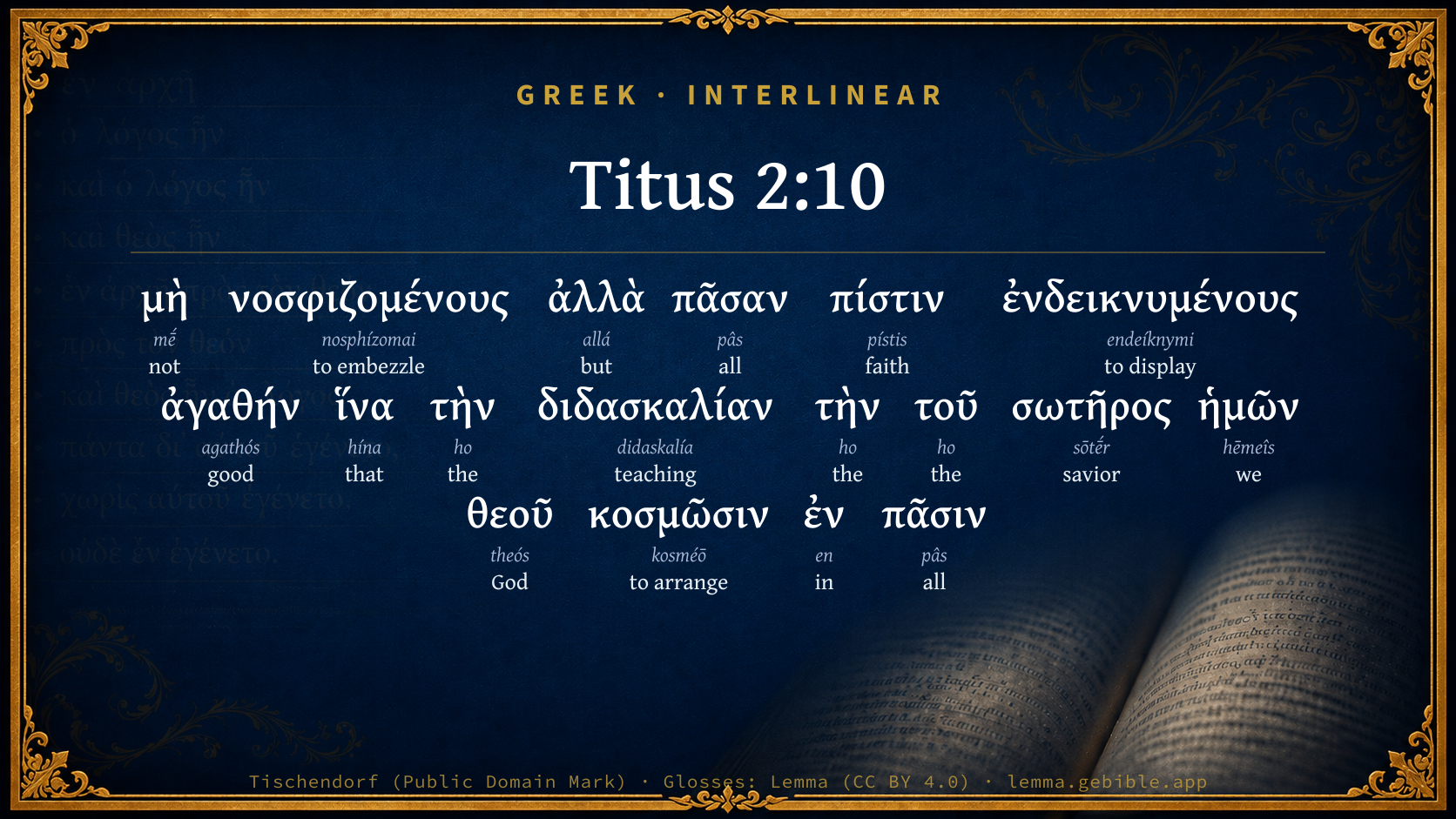
not stealing, but showing all good fidelity; that they may adorn the doctrine of God, our Savior, in all things.
Download a study sheet
One document with this verse’s original text, its word-by-word gloss line, the meaning frame, cross-references with their text, attributed commentary, and full source and license credits — printable, and it pastes into notes with its structure intact.
This verse Autodidact and up
A passage Seminary Student
Up to 50 verses in one chapter. A passage sheet keeps up to 6 commentary sources and 12 cross-references per verse, in the order this page ranks them, and says so on the sheet whenever that leaves anything out. Ask for a single verse and you get the Autodidact verse sheet above.
Everything on this page stays free to read, with no account — the sheet is a download of what is already on screen, not access to it.
Compare translations 3
The same verse in 3 English versions, stacked beneath the original-language interlinear above. Click any original word for its lexicon entry.
Each is an independent rendering of the whole verse — the interlinear is not word-aligned to these translations.
Highlighted words mark where these versions differ — a whole-verse word diff, not a word-by-word alignment.
-
World English Bible Public Domain
not stealing, but showing all good fidelity; that they may adorn the doctrine of God, our Savior, in all things.
-
King James Version Public Domain
Not purloining, but shewing all good fidelity; that they may adorn the doctrine of God our Saviour in all things.
-
unfoldingWord Literal Text CC BY-SA 4.0
not to steal, but to demonstrate all good faith, so that in every way they may show the beauty of the teaching that about God our Savior.
unfoldingWord Literal Text — © unfoldingWord, licensed CC BY-SA 4.0. Word-aligned USFM3 via Door43 (git.door43.org/unfoldingWord/en_ult).
Show all 19 translations
Every available English version of this verse, each an independent rendering of the whole verse.
-
World English Bible Public Domain
not stealing, but showing all good fidelity; that they may adorn the doctrine of God, our Savior, in all things.
-
Berean Standard Bible Public Domain
not stealing from them, but showing all good faith, so that in every respect they will adorn the teaching about God our Savior.
-
Majority Standard Bible Public Domain
not stealing from them, but showing all good faith, so that in every respect they will adorn the teaching about God our Savior.
-
King James Version Public Domain
Not purloining, but shewing all good fidelity; that they may adorn the doctrine of God our Saviour in all things.
-
American Standard Version (1901) Public Domain
not purloining, but showing all good fidelity; that they may adorn the doctrine of God our Saviour in all things.
-
Revised Version (1885) Public Domain
not purloining, but shewing all good fidelity; that they may adorn the doctrine of God our Saviour in all things.
-
Geneva Bible (1599) Public Domain
Neither pickers, but that they shew al good faithfulnesse, that they may adorne the doctrine of God our Sauiour in all things.
-
Douay-Rheims (1899) Public Domain
Not defrauding, but in all things shewing good fidelity, that they may adorn the doctrine of God our Savior in all things:
-
Young's Literal Translation Public Domain
not purloining, but showing all good stedfastness, that the teaching of God our Saviour they may adorn in all things.
-
Literal Standard Version CC BY-SA 4.0
not stealing, but showing all good steadfastness, that the teaching of God our Savior they may adorn in all things.
-
Unlocked Literal Bible CC BY-SA 4.0
to not steal from them, but instead to demonstrate all good faith, so that in every way they may bring credit to the teaching about God our Savior.
-
unfoldingWord Literal Text CC BY-SA 4.0
not to steal, but to demonstrate all good faith, so that in every way they may show the beauty of the teaching that about God our Savior.
-
Darby Bible Public Domain
not robbing [their masters], but shewing all good fidelity, that they may adorn the teaching which [is] of our Saviour God in all things.
-
World Messianic Bible Public Domain
not stealing, but showing all good fidelity, that they may adorn the doctrine of God, our Savior, in all things.
-
Webster's Bible Public Domain
Not purloining, but showing all good fidelity; that they may adorn the doctrine of God our Savior in all things.
-
Free Bible Version CC BY-SA 4.0
They shouldn't steal things for themselves, but show they are completely trustworthy so that they may rightly represent the truth about God our Savior in every way.
-
Bible in Basic English Public Domain
Not taking what is not theirs, but giving clear signs of their good faith, in all things doing credit to the teaching of God our Saviour.
-
Text-Critical English NT CC BY 4.0
not pilfering, but showing all good faith, so that in every way they may adorn the teaching of God our Savior.
-
Tyndale New Testament (1534) Public Domain
nether be pickers but that they shewe all good faythfulnes that they maye do worshippe to the doctryne of oure saveoure God in all thynges.
Literal Standard Version (2020), Covenant Press — licensed CC BY-SA 4.0. Text via the HelloAO Bible API (eBible.org). Unlocked Literal Bible (unfoldingWord) — licensed CC BY-SA 4.0. Text via the HelloAO Bible API (eBible.org). unfoldingWord Literal Text — © unfoldingWord, licensed CC BY-SA 4.0. Word-aligned USFM3 via Door43 (git.door43.org/unfoldingWord/en_ult). Free Bible Version, Dr. Jonathan Gallagher — licensed CC BY-SA 4.0. Text via the HelloAO Bible API (eBible.org).
Word by word
More ways to search: Search by grammar → Find every occurrence → Compare this word →
Practice this passage: Drill this verse → Learn its vocabulary →
- Appears 3× in the Greek New Testament
- First appears at Acts 5:2
- Part of Speech
- Verb
- Tense
- Present
- Voice
- Middle
- Mood
- Participle
- Case
- Accusative
- Number
- Plural
- Gender
- Masculine
Full Thayer's Definition
- μὴ mḗ G3361 “not” Particle, Negative
- νοσφιζομένους nosphízomai G3557 “to embezzle” Verb, Present, Middle, Participle, Accusative, Plural, Masculine
- ἀλλὰ allá G235 “but” Conjunction
- πᾶσαν pâs G3956 “all” Adjective, Accusative, Singular, Feminine
- πίστιν pístis G4102 “faith” Noun, Accusative, Singular, Feminine
- ἐνδεικνυμένους endeíknymi G1731 “to display” Verb, Present, Middle, Participle, Accusative, Plural, Masculine
- ἀγαθήν agathós G18 “good” Adjective, Accusative, Singular, Feminine
- ἵνα hína G2443 “that” Conjunction
- τὴν ho G3588 “the” Article, Accusative, Singular, Feminine
- διδασκαλίαν didaskalía G1319 “teaching” Noun, Accusative, Singular, Feminine
- τὴν ho G3588 “the” Article, Accusative, Singular, Feminine
- τοῦ ho G3588 “the” Article, Genitive, Singular, Masculine
- σωτῆρος sōtḗr G4990 “savior” Noun, Genitive, Singular, Masculine
- ἡμῶν hēmeîs G2249 “we” Personal pronoun, 1st person, Genitive, Plural
- θεοῦ theós G2316 “God” Noun, Genitive, Singular, Masculine
- κοσμῶσιν kosméō G2885 “to arrange” Verb, Present, Active, Subjunctive, 3rd person, Plural
- ἐν en G1722 “in” Preposition
- πᾶσιν pâs G3956 “all” Adjective, Dative, Plural, Neuter
About this verse
These counts appear in no published source. They are computed here, from the morphology-tagged text and Lemma’s own curated glosses. What Lemma adds →
- 18
- words
- 15
- distinct lemmas
- Pauline Epistles
- section
Cross-references
26Topical passages linked to Titus 2:10 in the Treasury of Scripture Knowledge — connected by theme and wording, ordered by reader-vote popularity; previews shown in the World English Bible.
- Matthew 5:16 Even so, let your light shine before men; that they may see your good works, and glorify your Father who is in heaven.
- 1 Peter 2:12 having good behavior among the nations, so in that which they speak against you as evil-doers, they may by your good works, which they see, glorify God in the day of visitation.
- 2 John 1:9 Whoever transgresses and doesn't remain in the teaching of Christ, doesn't have God. He who remains in the teaching, the same has both the Father and the Son.
- 1 Samuel 26:23 Yahweh will render to every man his righteousness and his faithfulness; because Yahweh delivered you into my hand today, and I wouldn't put forth my hand against Yahweh's anointed.
- Psalms 101:6 My eyes will be on the faithful of the land, That they may dwell with me. He who walks in a perfect way, He will serve me.
- Matthew 24:45 "Who then is the faithful and wise servant, whom his lord has set over his household, to give them their food in due season?
- Luke 16:10 He who is faithful in a very little is faithful also in much. He who is dishonest in a very little is also dishonest in much.
- 1 Corinthians 4:2 Here, moreover, it is required of stewards, that they be found faithful.
- 1 Timothy 6:1 Let as many as are bondservants under the yoke count their own masters worthy of all honor, that the name of God and the doctrine not be blasphemed.
- 1 Timothy 6:3 If anyone teaches a different doctrine, and doesn't consent to sound words, the words of our Lord Jesus Christ, and to the doctrine which is according to godliness,
- Titus 1:3 but in his own time revealed his word in the message with which I was entrusted according to the commandment of God our Savior;
- 1 Peter 3:16 having a good conscience; that, while you are spoken against as evildoers, they may be disappointed who curse your good manner of life in Christ.
- Genesis 39:8–9 But he refused, and said to his master's wife, "Behold, my master doesn't know what is with me in the house, and he has put all that he has into my hand.
- 1 Samuel 22:14 Then Ahimelech answered the king, and said, Who among all your servants is so faithful as David, who is the king's son-in-law, and is taken into your council, and is honorable in your house?
- 2 Kings 5:20–24 But Gehazi the servant of Elisha the man of God, said, Behold, my master has spared this Naaman the Syrian, in not receiving at his hands that which he brought: as Yahweh lives, I will run after him, and take somewhat of him.
- Isaiah 12:2 Behold, God is my salvation. I will trust, and will not be afraid; for Yah, Yahweh, is my strength and song; and he has become my salvation."
- Luke 16:6–8 He said, 'A hundred batos of oil.' He said to him, 'Take your bill, and sit down quickly and write fifty.'
- Acts 5:2–3 and kept back part of the price, his wife also being aware of it, and brought a certain part, and laid it at the apostles' feet.
- Ephesians 4:1 I therefore, the prisoner in the Lord, beg you to walk worthily of the calling with which you were called,
- Philippians 1:27 Only let your manner of life be worthy of the Gospel of Christ, that, whether I come and see you or am absent, I may hear of your state, that you stand firm in one spirit, with one soul striving for the faith of the Gospel;
- Philippians 2:15–16 that you may become blameless and harmless, children of God without blemish in the midst of a crooked and perverse generation, among whom you are seen as lights in the world,
- Philippians 4:8 Finally, brothers, whatever things are true, whatever things are honorable, whatever things are just, whatever things are pure, whatever things are lovely, whatever things are of good report; if there is any virtue, and if there is any praise, think about these things.
- 1 Timothy 1:1 Paul, an apostle of Christ Jesus according to the commandment of God our Savior, and Christ Jesus our hope;
- Genesis 31:37–38 Now that you have felt around in all my stuff, what have you found of all your household stuff? Set it here before my relatives and your relatives, that they may judge between us two.
- John 12:6 Now he said this, not because he cared for the poor, but because he was a thief, and having the money box, used to steal what was put into it.
- 1 Timothy 5:17 Let the elders who rule well be counted worthy of double honor, especially those who labor in the word and in teaching.
Cross-references courtesy of OpenBible.info (CC BY 4.0).
Where the printed editions differ
1 variantPlaces in this verse where the major printed Greek editions disagree on the wording in a way that affects the translation — a comparison of editions, not a manuscript-by-manuscript collation. The editions are the modern critical texts (Nestlé-Aland 28/27, SBL, Westcott-Hort, Tregelles, Tyndale House) and the traditional texts behind the KJV (the Textus Receptus and the Byzantine/Majority text). It is not a claim about which reading is original.
-
Different wording
ἡμῶν
“of us”
In NA28NA27TynSBLWHTregByzKJV Not in TRὑμῶν (humōn) 'of you' occurs in a few manuscripts (TR) instead of ἡμῶν (hēmōn) 'of us' in older manuscripts (NA28+NA27+Tyn+SBL+WH+Treg+Byz+KJV)
Textual data: Translators Amalgamated Greek New Testament (STEPBible TAGNT) · CC BY 4.0.
Lesson kit
Teaching starters — assembled from the data on this page, not authored interpretation. Every prompt links to the verse data it draws on. Edit before teaching.
Titus, in the Pauline Epistles, opens this verse with 18 words (15 distinct Greek lemmas). Its most distinctive word is nosphízomai (“to embezzle”). A historical commentator’s framing appears above. Read the whole chapter for the surrounding context.
Discussion questions
- How does “to embezzle” (nosphízomai) shape what this verse is saying?
- Acts 5:2 shares the word «to embezzle» with this verse. How do the two illuminate each other?
- “all” occurs 2× in this one verse. What is the effect of the repetition?
- These translations render this verse differently. What is at stake in choosing one wording over another?
- Reading how MacLaren's Expositions of Holy Scripture and Bengel's Gnomon read this verse, where do the two commentators agree and where do they part?
Things to notice
- These translations choose different wording for 19 words in this verse.
- “all” occurs 2× in this single verse.
- 15 distinct Greek lemmas span 18 words in this verse.
Commentary
Notes on Titus 2:10 from classic Christian and Jewish commentators (each source and its license shown beneath its notes). The classic Christian expositions comment on the surrounding passage and are grouped to its opening verse, so a note may address several verses; the Jewish commentaries on the Tanakh (Rashi and others) are per-verse, so they appear only where the commentator wrote on this verse.
Lemma curates 59 commentaries, every one of them public domain or Creative Commons licensed, each selected and text-cleaned for this edition rather than reprinted as found. About our sources →
MacLaren's Expositions of Holy Scripture
Alexander MacLaren
Alexander MacLaren, Expositions of Holy Scripture (1904–1910) — public domain. Text from a community e-Sword module.
Bengel's Gnomon
Johann Albrecht Bengel
Bengel's Gnomon of the New Testament — English translation (T&T Clark, Edinburgh, 1860) — public domain. Text from a community e-Sword module.
Expositor's Greek Testament
ed. W. Robertson Nicoll
The Expositor's Greek Testament, edited by W. Robertson Nicoll (1897–1910) — public domain. Text from a community e-Sword module.
Jamieson, Fausset & Brown
Robert Jamieson, A. R. Fausset & David Brown
Jamieson, Fausset & Brown — Commentary Critical and Explanatory on the Whole Bible (1871) — public domain (CC PDM 1.0). Text via the HelloAO Bible API.
Adam Clarke's Commentary
Adam Clarke's Commentary on the Bible (1810–1826) — public domain. Text from a community e-Sword/MySword module.
John Calvin's Commentaries
John Calvin's Commentaries (1540-1563) — public domain. Text from the Calvin Translation Society English edition (1840s-50s) via the Christian Classics Ethereal Library (ccel.org). Calvin's coverage is partial (roughly two-thirds of the Bible); uncommented books and verses are honest gaps, never fabricated. The 19th-century editor's footnotes and remarks are omitted so the notes are faithfully Calvin's own voice.
Ellicott's Commentary for English Readers
A Bible Commentary for English Readers, edited by Charles John Ellicott (1878–1897) — public domain. Text from a community e-Sword module.
The Cambridge Bible for Schools and Colleges
gen. ed. J. J. S. Perowne
The Cambridge Bible for Schools and Colleges (gen. ed. J. J. S. Perowne; Cambridge University Press, 1878–1918) — public domain. Text from a community e-Sword module.
John Gill's Exposition
John Gill's Exposition of the Whole Bible (1746–1763) — public domain (CC PDM 1.0). Text via the HelloAO Bible API.
Trapp's Complete Commentary
John Trapp
John Trapp, A Commentary or Exposition upon All the Books of the Old and New Testament (1647–1656) — public domain. Text from a community e-Sword module.
Albert Barnes' Notes on the Bible
Albert Barnes' Notes on the Bible (1834–1885) — public domain. Text from a community e-Sword/MySword module.
Haydock's Catholic Bible Commentary
George Leo Haydock (1774–1849), Haydock's Catholic Family Bible and Commentary, 1859 edition — public domain. Excludes Psalms (Douay-Rheims chapter numbering differs from Protestant) and Deuterocanonical books (Catholic canon only).
Matthew Poole's English Annotations
Matthew Poole's English Annotations on the Holy Bible (1683–1685) — public domain. Text from a community e-Sword/MySword module.
The Pulpit Commentary
The Pulpit Commentary (1880–1919), ed. H.D.M. Spence-Jones & Joseph S. Exell — public domain. Text from a community e-Sword module.
John Wesley's Explanatory Notes
John Wesley, Explanatory Notes Upon the Whole Bible (1754–1765) — public domain. Text via the GEBible commentary corpus.
The People's New Testament
B. W. Johnson
B. W. Johnson's The People's New Testament with Notes (1889–1891) — public domain. Electronic text from the Christian Classics Ethereal Library (CCEL) ThML edition.
Cambridge Greek Testament for Schools and Colleges
Cambridge Greek Testament for Schools and Colleges (Cambridge University Press, 1896; 21 vols, various authors incl. Carr, Maclear, Plummer, Farrar, Lumby, Moule, M. R. James, Simcox) — public domain. Text from a community e-Sword module.
International Critical Commentary
International Critical Commentary — older volumes (1896–1929), various authors — public domain. Text from a community e-Sword module.
Vincent's Word Studies in the New Testament
Marvin R. Vincent
Marvin R. Vincent, Word Studies in the New Testament (1887–1900) — public domain. Text from a community e-Sword/MySword module.