1 Peter 3:16

Greek (Tischendorf 8th ed.) 1 Peter 3:16 appears in the Greek New Testament. The text above is from the Tischendorf 8th edition. Each word links to its Strong’s number and a concise gloss. Click any word for its full Thayer’s Greek Lexicon entry.
Download image
Cite this verse

1 Peter 3:16 (World English Bible). Public Domain. Lemma interlinear Bible study tool, https://lemma.gebible.app/v/1-peter/3/16.

Show BibTeX & RIS
BibTeX
RIS
English Translation
having a good conscience; that, while you are spoken against as evildoers, they may be disappointed who curse your good manner of life in Christ.
World English Bible · Public Domain
Download a study sheet

One document with this verse’s original text, its word-by-word gloss line, the meaning frame, cross-references with their text, attributed commentary, and full source and license credits — printable, and it pastes into notes with its structure intact.

This verse Autodidact and up

Study sheet (.html) Plain text (.txt)

A passage Seminary Student

Up to 50 verses in one chapter. A passage sheet keeps up to 6 commentary sources and 12 cross-references per verse, in the order this page ranks them, and says so on the sheet whenever that leaves anything out. Ask for a single verse and you get the Autodidact verse sheet above.

Everything on this page stays free to read, with no account — the sheet is a download of what is already on screen, not access to it.

Want to remove ads? Support Godless Engineer
Compare translations 3

The same verse in 3 English versions, stacked beneath the original-language interlinear above. Click any original word for its lexicon entry.

Each is an independent rendering of the whole verse — the interlinear is not word-aligned to these translations.

Highlighted words mark where these versions differ — a whole-verse word diff, not a word-by-word alignment.

  • World English Bible Public Domain
    having a good conscience; that, while you are spoken against as evildoers, they may be disappointed who curse your good manner of life in Christ.
  • King James Version Public Domain
    Having a good conscience; that, whereas they speak evil of you, as of evildoers, they may be ashamed that falsely accuse your good conversation in Christ.
  • unfoldingWord Literal Text CC BY-SA 4.0
    but with meekness and fear, having a good conscience so that, in what you are being slandered, the ones reviling your good behavior in Christ may be ashamed.

unfoldingWord Literal Text — © unfoldingWord, licensed CC BY-SA 4.0. Word-aligned USFM3 via Door43 (git.door43.org/unfoldingWord/en_ult).

Versions to compare (up to 4)

3 of 4 selected

Show all 19 translations

Every available English version of this verse, each an independent rendering of the whole verse.

  • World English Bible Public Domain
    having a good conscience; that, while you are spoken against as evildoers, they may be disappointed who curse your good manner of life in Christ.
  • Berean Standard Bible Public Domain
    keeping a clear conscience, so that those who slander you may be put to shame by your good behavior in Christ.
  • Majority Standard Bible Public Domain
    keeping a clear conscience, so that those who slander you as evildoers may be put to shame by your good behavior in Christ.
  • King James Version Public Domain
    Having a good conscience; that, whereas they speak evil of you, as of evildoers, they may be ashamed that falsely accuse your good conversation in Christ.
  • American Standard Version (1901) Public Domain
    having a good conscience; that, wherein ye are spoken against, they may be put to shame who revile your good manner of life in Christ.
  • Revised Version (1885) Public Domain
    having a good conscience; that, wherein ye are spoken against, they may be put to shame who revile your good manner of life in Christ.
  • Geneva Bible (1599) Public Domain
    Hauing a good coscience, that whe they speake euill of you as of euill doers, they may be ashamed, which slander your good conuersation in Christ.
  • Douay-Rheims (1899) Public Domain
    But with modesty and fear, having a good conscience: that whereas they speak evil of you, they may be ashamed who falsely accuse your good conversation in Christ.
  • Young's Literal Translation Public Domain
    having a good conscience, that in that in which they speak against you as evil-doers, they may be ashamed who are traducing your good behaviour in Christ;
  • Literal Standard Version CC BY-SA 4.0
    having a good conscience, so that whenever they speak against you as evildoers, they may be ashamed—[those] who are maligning your good behavior in Christ;
  • Unlocked Literal Bible CC BY-SA 4.0
    Have a good conscience so that the people who insult your good life in Christ may be ashamed because they are speaking against you as if you were evildoers.
  • unfoldingWord Literal Text CC BY-SA 4.0
    but with meekness and fear, having a good conscience so that, in what you are being slandered, the ones reviling your good behavior in Christ may be ashamed.
  • Darby Bible Public Domain
    having a good conscience, that [as to that] in which they speak against you as evildoers, they may be ashamed who calumniate your good conversation in Christ.
  • World Messianic Bible Public Domain
    having a good conscience. Thus, while you are spoken against as evildoers, they may be disappointed who curse your good way of life in Messiah.
  • Webster's Bible Public Domain
    Having a good conscience; that, whereas they speak evil of you, as of evil-doers, they may be ashamed that falsely accuse your good deportment in Christ.
  • Free Bible Version CC BY-SA 4.0
    Make sure your conscience is clear, so that if anyone makes accusations against you, they will be embarrassed for speaking badly about the good way you live your life in Christ.
  • Bible in Basic English Public Domain
    Being conscious that you have done no wrong; so that those who say evil things about your good way of life as Christians may be put to shame.
  • Text-Critical English NT CC BY 4.0
    keeping a clear conscience, so that, when those who revile your good conduct in Christ speak against you as evildoers, they may be put to shame.
  • Tyndale New Testament (1534) Public Domain
    havinge a good consciece that when they backbyte you as evyll doars they maye be ashamed for as moche as they have falsely accused youre good conversacion in Christ.

Literal Standard Version (2020), Covenant Press — licensed CC BY-SA 4.0. Text via the HelloAO Bible API (eBible.org). Unlocked Literal Bible (unfoldingWord) — licensed CC BY-SA 4.0. Text via the HelloAO Bible API (eBible.org). unfoldingWord Literal Text — © unfoldingWord, licensed CC BY-SA 4.0. Word-aligned USFM3 via Door43 (git.door43.org/unfoldingWord/en_ult). Free Bible Version, Dr. Jonathan Gallagher — licensed CC BY-SA 4.0. Text via the HelloAO Bible API (eBible.org).

Word by word

More ways to search: Search by grammar → Find every occurrence → Compare this word →

Practice this passage: Drill this verse → Learn its vocabulary →

ἐπηρεάζοντες
epēreázō
G1908
“to insult”
Verb, Present, Active, Participle, Nominative, Plural, Masculine
Part of Speech
Verb
Tense
Present
Voice
Active
Mood
Participle
Case
Nominative
Number
Plural
Gender
Masculine
Full Thayer's Definition

Origin: from a comparative of G1909 and (probably) areia (threats)

TDNT: None

1. to insult 2. to treat abusively, use despitefully 3. to revile 4. in a forensic sense, to accuse falsely 5. to threaten
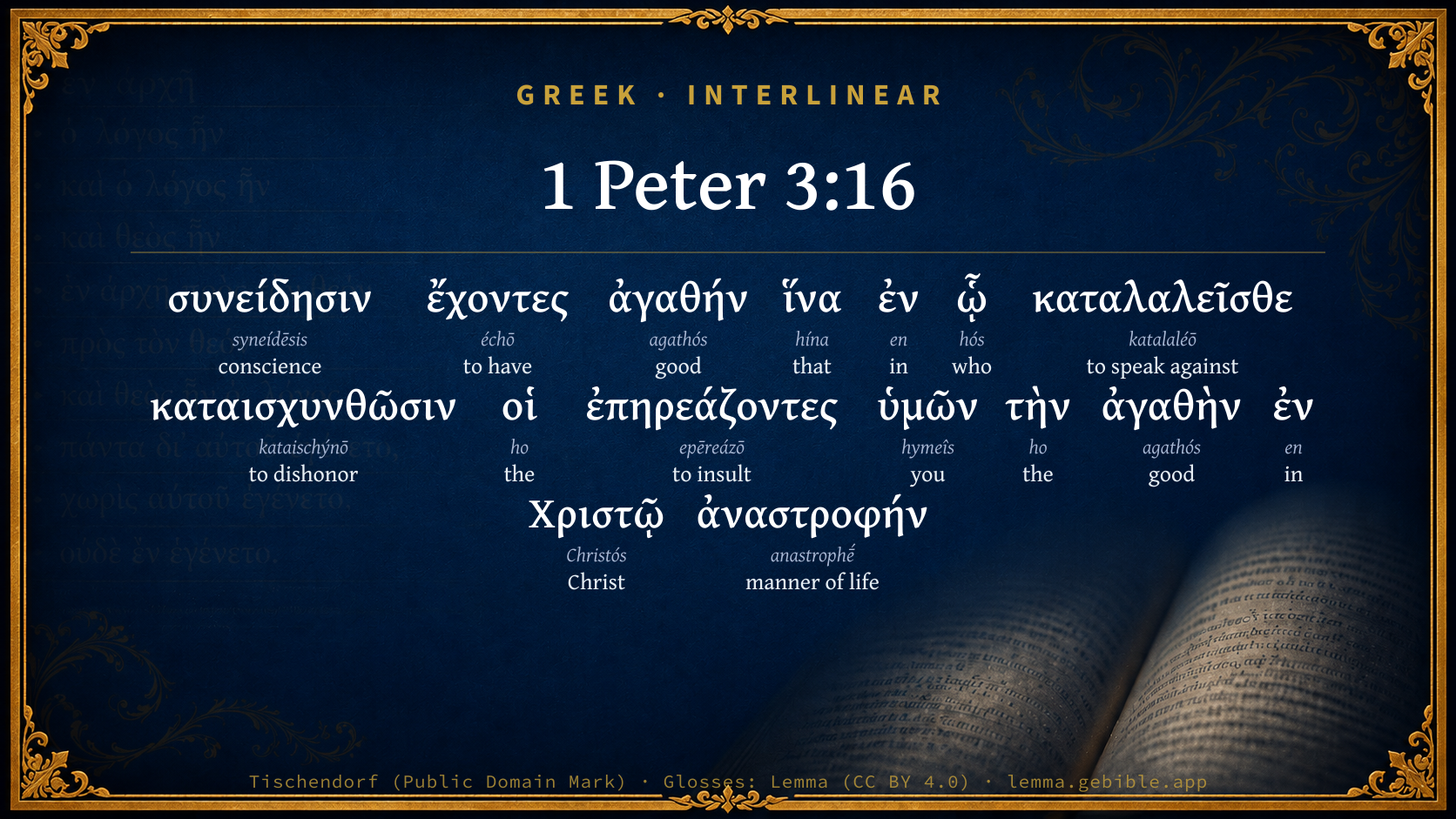
  1. συνείδησιν syneídēsis G4893 “conscience” Noun, Accusative, Singular, Feminine
  2. ἔχοντες échō G2192 “to have” Verb, Present, Active, Participle, Nominative, Plural, Masculine
  3. ἀγαθήν agathós G18 “good” Adjective, Accusative, Singular, Feminine
  4. ἵνα hína G2443 “that” Conjunction
  5. ἐν en G1722 “in” Preposition
  6. ᾧ hós G3739 “who” Relative pronoun, Dative, Singular, Neuter
  7. καταλαλεῖσθε katalaléō G2635 “to speak against” Verb, Present, Passive, Indicative, 2nd person, Plural
  8. καταισχυνθῶσιν kataischýnō G2617 “to dishonor” Verb, Aorist, Passive, Subjunctive, 3rd person, Plural
  9. οἱ ho G3588 “the” Article, Nominative, Plural, Masculine
  10. ὑμῶν hymeîs G5210 “you” Personal pronoun, 2nd person, Genitive, Plural
  11. τὴν ho G3588 “the” Article, Accusative, Singular, Feminine
  12. ἀγαθὴν agathós G18 “good” Adjective, Accusative, Singular, Feminine
  13. ἐν en G1722 “in” Preposition
  14. Χριστῷ Christós G5547 “Christ” Noun, Dative, Singular, Masculine
  15. ἀναστροφήν anastrophḗ G391 “manner of life” Noun, Accusative, Singular, Feminine

About this verse

These counts appear in no published source. They are computed here, from the morphology-tagged text and Lemma’s own curated glosses. What Lemma adds →

16
words
13
distinct lemmas
General Epistles
section

Notable vocabulary

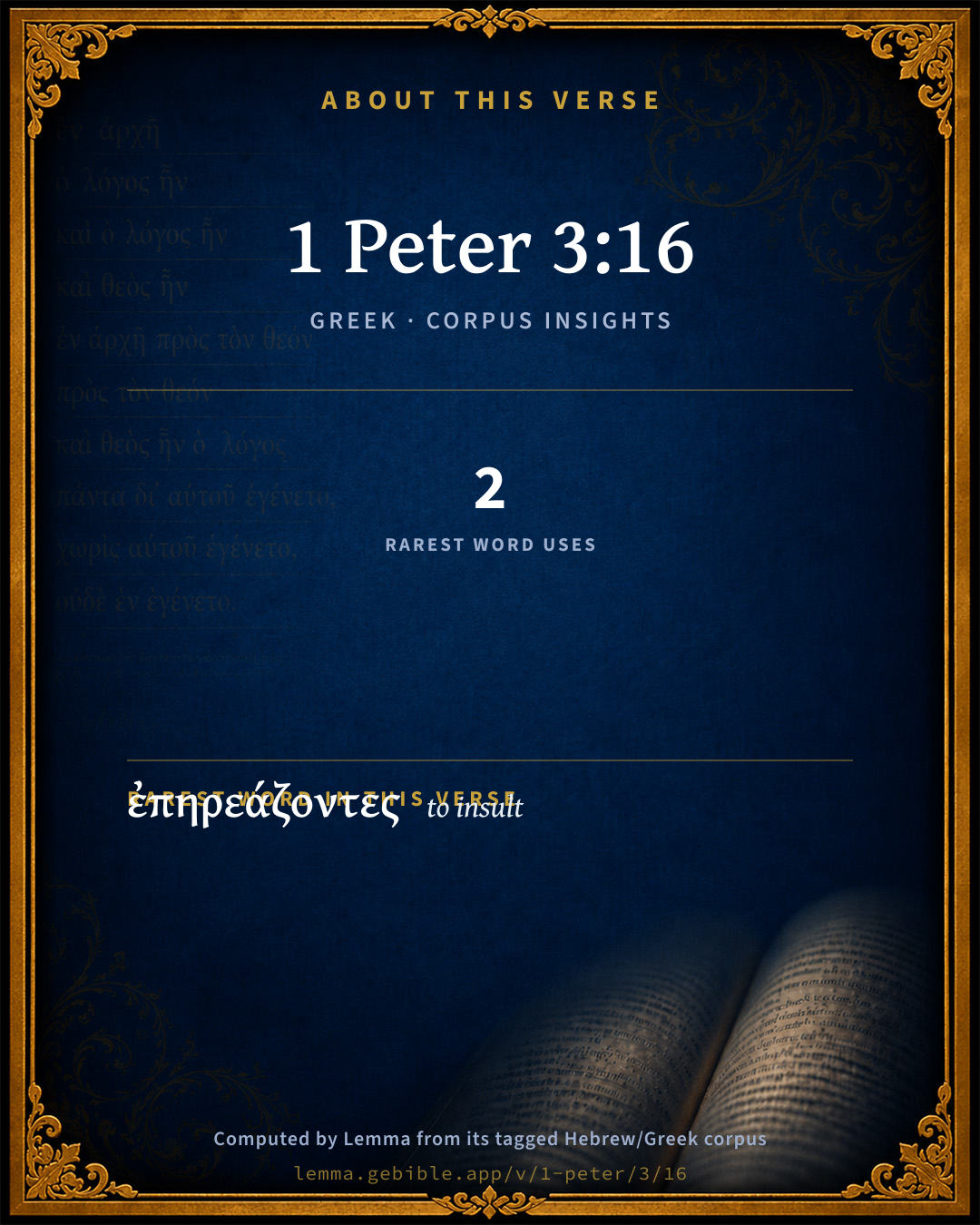
The rarest word here is ἐπηρεάζοντες to insult G1908 — appearing just 2 times in the whole Greek New Testament.

Shared distinctive vocabulary

ἐπηρεάζοντες to insult G1908 occurs in 2 verses of the Greek New Testament. Also found in:

Repetition

Words recur within this verse:

  • ἀγαθήν good G18 ×2
  • ἐν in G1722 ×2
  • οἱ the G3588 ×2

Cross-references

14

Topical passages linked to 1 Peter 3:16 in the Treasury of Scripture Knowledge — connected by theme and wording, ordered by reader-vote popularity; previews shown in the World English Bible.

  • 1 Peter 2:12 having good behavior among the nations, so in that which they speak against you as evil-doers, they may by your good works, which they see, glorify God in the day of visitation.
  • 1 Peter 2:15 For this is the will of God, that by well-doing you should put to silence the ignorance of foolish men:
  • Hebrews 13:18 Pray for us, for we are persuaded that we have a good conscience, desiring to live honorably in all things.
  • Titus 2:8 and soundness of speech that can't be condemned; that he who opposes you may be ashamed, having no evil thing to say about us.
  • Matthew 5:11 "Blessed are you when people reproach you, persecute you, and say all kinds of evil against you falsely, for my sake.
  • 1 Peter 2:19 For it is commendable if someone endures pain, suffering unjustly, because of conscience toward God.
  • Acts 24:16 Herein I also practice always having a conscience void of offense toward God and men.
  • Romans 9:1 I tell the truth in Christ. I am not lying, my conscience testifying with me in the Holy Spirit,
  • 1 Timothy 1:5 but the end of the charge is love, out of a pure heart and a good conscience and unfeigned faith;
  • 2 Corinthians 1:12 For our boasting is this: the testimony of our conscience, that in holiness and sincerity of God, not in fleshly wisdom but in the grace of God we behaved ourselves in the world, and more abundantly toward you.
  • 1 Peter 3:21 This is a symbol of baptism, which now saves you-- not the putting away of the filth of the flesh, but the answer of a good conscience toward God, through the resurrection of Jesus Christ,
  • 2 Corinthians 4:2 But we have renounced the hidden things of shame, not walking in craftiness, nor handling the word of God deceitfully; but by the manifestation of the truth commending ourselves to every man's conscience in the sight of God.
  • Hebrews 9:14 how much more will the blood of Christ, who through the eternal Spirit offered himself without blemish to God, cleanse your conscience from dead works to serve the living God?
  • 1 Peter 3:1–2 In like manner, wives, be in subjection to your own husbands; so that, even if any don't obey the Word, they may be won by the behavior of their wives without a word;

Cross-references courtesy of OpenBible.info (CC BY 4.0).

Where the printed editions differ

1 variant

Places in this verse where the major printed Greek editions disagree on the wording in a way that affects the translation — a comparison of editions, not a manuscript-by-manuscript collation. The editions are the modern critical texts (Nestlé-Aland 28/27, SBL, Westcott-Hort, Tregelles, Tyndale House) and the traditional texts behind the KJV (the Textus Receptus and the Byzantine/Majority text). It is not a claim about which reading is original.

  1. Extra text
    ὑμῶν ὡς κακοποιῶν,

    “you as to evildoers”

    In TregTRByz Not in NA28NA27TynSBLWH

    ὑμῶν ὡς κακοποιῶν, (humōn hōs kakopoiōn) 'you as to evildoers' is only in traditional manuscripts (Treg+TR+Byz)

Textual data: Translators Amalgamated Greek New Testament (STEPBible TAGNT) · CC BY 4.0.

Commentary

Notes on 1 Peter 3:16 from classic Christian and Jewish commentators (each source and its license shown beneath its notes). The classic Christian expositions comment on the surrounding passage and are grouped to its opening verse, so a note may address several verses; the Jewish commentaries on the Tanakh (Rashi and others) are per-verse, so they appear only where the commentator wrote on this verse.

Lemma curates 59 commentaries, every one of them public domain or Creative Commons licensed, each selected and text-cleaned for this edition rather than reprinted as found. About our sources →

Bengel's Gnomon

Johann Albrecht Bengel

1Pe 3:16. Ἔχοντες, having) This is added to the word prepared without a copula.—ἐπηρεάζοντες ὑμῶν—ἀναστροφὴν, who falsely accuse your—conversation) An abbreviated form of speech: that is, who falsely accuse you on account of your good conversation.

Bengel's Gnomon of the New Testament — English translation (T&T Clark, Edinburgh, 1860) — public domain. Text from a community e-Sword module.

Meyer's Critical & Exegetical Commentary

Heinrich August Wilhelm Meyer

1Pe_3:16. συνείδησιν ἔχοντες ἀγαθήν] These words are taken by several interpreters (Bengel, Steiger, de Wette, etc.) with ἁγιάσατε, 1Pe_3:14, as co-ordinate with ἕτοιμοι; Wiesinger construes them with ἕτοιμοι, as subordinate to it. The latter is to be preferred, for συνείδ. ἐχ. denotes the point essentially important, to being ever prepared to give an answer in a right manner (Wiesinger). But it is better still to assume that itlike μετὰ πραΰτητοςbelongs in a loose way to ἀπολογίαν, equivalent to with good conscience, i.e. in that your walk does not give the lie to your confession.[191] Calvin says correctly: quia parum auctoritatis habet sermo absque vita.

ἵνα ἐν ᾧ κ.τ.λ.] The construction is here the same as in chap. 1Pe_2:12; see the exposition of this passage, where, too, Schotts interpretation of ἐν ᾧ, equal to in this, that, is considered. The conjunctive of the Rec. καταλαλῶσιν would represent the case as possible, equal to in which they may possibly slander you.

ἵνα, as a final particle, refers to the whole preceding thought, especially to συνείδ. ἔχ. ἀγαθήν.

καταισχυνθῶσιν] comp. 2Co_7:14 : that they may be put to shame, i.e. since their slanders are openly proved to be lies.

οἱ ἐπηρεάζοντες κ.τ.λ.] The subject stands, by way of emphasis, at the end of the sentence. ἐπηρεάζειν, to revile, Mat_5:44; Luk_6:28. Hensler distinguishes, without any ground, the ἐπηρεάζοντες from the καταλαλοῦντες, as different persons; the former he considers to be the accusers of the Christians, who bring the slanders of others before the judge.

ὑμῶν τὴν ἀγαθὴν ἐν Χριστῷ ἀναστροφήν] i.e. the good life which you lead in Christ (i.e. as Christians).

[191] Hofmann says, that it should not be joined with ἀπολογία, for the meaning is that they should do that whereunto they must be prepared with eagerness, and a good conscience which they should bring to it. To this it is to be replied, that the ἀπολογία itself is precisely the thing for which they are to be ready. It is evidently arbitrary to supplement an imperative (which?) to ἀλλά, and to connect συνείδησιν ἔχοντες ἀγ· with it.

Meyer — Critical and Exegetical Commentary on the New Testament — English translation by Peter Christie, edited by Frederick Crombie (T&T Clark, 1880) — public domain. Text from a community e-Sword module.

Matthew Henry's Commentary

The confession of a Christian's faith cannot credibly be supported but by the two means here specified - a good conscience and a good conversation. conscience is good when it does its office well, when it is kept pure and uncorrupt, and clear from guilt; then it will justify you, though men accuse you. A good conversation in Christ is a holy life, according to the doctrine and example of Christ. "Look well to your conscience, and to your conversation; and then, though men speak evil of you, and falsely accuse you as evil-doers, you will clear yourselves, and bring them to shame. Perhaps you may think it hard to suffer for well-doing, for keeping a good conscience and a good conversation; but be not discouraged, for it is better for you, though worse for your enemies, that you suffer for well-doing than for evil-doing." Learn, 1. The most conscientious persons cannot escape the censures and slanders of evil men; they will speak evil of them, as of evil-doers, and charge them with crimes which their very souls abhor: Christ and his apostles were so used. 2. A good conscience and a good conversation are the best means to secure a good name; these give a solid reputation and a lasting one. 3. False accusation generally turns to the accuser's shame, by discovering at last the accuser's indiscretion, injustice, falsehood, and uncharitableness. 4. It is sometimes the will of God that good people should suffer for well-doing, for their honesty and for their faith. 5. As well-doing sometimes exposes a good man to suffering, so evil-doing will not exempt an evil man from it. The apostle supposes here that a man may suffer for both. If the sufferings of good people for well-doing be so severe, what will the sufferings of wicked people be for evil-doing? It is a sad condition which that person is in upon whom sin and suffering meet together at the same time; sin makes sufferings to be extreme, unprofitable, comfortless, and destructive.

Matthew Henry's Commentary on the Whole Bible (1708–1710) — public domain (CC PDM 1.0). Text via the HelloAO Bible API.

Jamieson, Fausset & Brown

Robert Jamieson, A. R. Fausset & David Brown

Having a good conscience--the secret spring of readiness to give account of our hope. So hope and good conscience go together in Act 24:15-16. Profession without practice has no weight. But those who have a good conscience can afford to give an account of their hope "with meekness."

whereas-- (Pe1 2:12).

they speak evil of you, as of evildoers--One oldest manuscript reads, "ye are spoken against," omitting the rest.

falsely accuse--"calumniate"; the Greek expresses malice shown in deeds as well as in words. It is translated, "despitefully use," Mat 5:44; Luk 6:28.

conversation--life, conduct.

in Christ--who is the very element of your life as Christians. "In Christ" defines "good." It is your good walk as Christians, not as citizens, that calls forth malice (Pe1 4:4-5, Pe1 4:14).

Jamieson, Fausset & Brown — Commentary Critical and Explanatory on the Whole Bible (1871) — public domain (CC PDM 1.0). Text via the HelloAO Bible API.

Adam Clarke's Commentary

Verse 16. Having a good conscience] The testimony of God in your own soul, that in simplicity and godly sincerity you have your conversation in the world. See on the term conscience at the end of Hebrews.

Whereas they speak evil of you] See the same sentiment in 1Pet 2:11, and the note there.

Adam Clarke's Commentary on the Bible (1810–1826) — public domain. Text from a community e-Sword/MySword module.

John Calvin's Commentaries

16 With meekness This is a most necessary admonition; for unless our minds are endued with meekness, contentions will immediately break forth. And meekness is set in opposition to pride and vain ostentation, and also to excessive zeal. To this he justly adds fear; for where reverence for God prevails, it tames all the ferocity of our minds, and it will especially cause us to speak calmly of God’s mysteries. For contentious disputes arise from this, because many think less honourably than they ought of the greatness of divine wisdom, and are carried away by profane audacity. If, then, we would render approved of God the confession of our faith, all boasting must be put aside, all contention must be relinquished.

Having a good conscience What we say without a corresponding life has but little weight; hence he joins to confession a good conscience. For we see that many are sufficiently ready with their tongue, and prate much, very freely, and yet with no fruit, because the life does not correspond. Besides, the integrity of conscience alone is that which gives us confidence in speaking as we ought; for they who prattle much about the gospel, and whose dissolute life is a proof of their impiety, not only make themselves objects of ridicule, but also expose the truth itself to the slanders of the ungodly. For why did he before bid us to be ready to defend the faith, should any one require from us a reason for it, except that it is our duty to vindicate the truth of God against those false suspicions which the ignorant entertain respecting it. But the defense of the tongue will avail but little, except the life corresponds with it.

He therefore says, that they may be ashamed, who blame your good conversation in Christ, and who speak against you as evil-doers; as though he had said, “If your adversaries have nothing to allege against you, except that you follow Christ, they will at length be ashamed of their malicious wickedness, or at least, your innocence will be sufficient to confute them.”

John Calvin's Commentaries (1540-1563) — public domain. Text from the Calvin Translation Society English edition (1840s-50s) via the Christian Classics Ethereal Library (ccel.org). Calvin's coverage is partial (roughly two-thirds of the Bible); uncommented books and verses are honest gaps, never fabricated. The 19th-century editor's footnotes and remarks are omitted so the notes are faithfully Calvin's own voice.

Ellicott's Commentary for English Readers

(16) Having a good conscience.—This strikes the key-note of the paragraph. How vigorously St. Peter repeats it! “Zealous for that which is good,” “for righteousness’ sake,” “sanctify the Lord,” “with meekness and fear,” “a good conscience,” “your good conversation.”

Whereas.—The word means precisely the same as in 1Pe_2:12, where see Note.

They speak evil of you, as of evil doers.—Tischendorf follows one of the best manuscripts and the Pesehito-Syriac version in reading whereas ye are evil spoken of. It is easy to see how the ordinary reading would come in, from the similarity of 1Pe_2:12; and we may pretty confidently adopt the emendation. In any case, the words “as of evil doers” should be removed.

They may be ashamed (or, confounded).—When? St. Peter is evidently thinking of the Christian at the bar of the curator or pro-consul, and the mortification of the delator, or spy, who had given information against him.

Falsely accuse.—Literally, insult, that is, “odiously calumniate.” The word occurs again only in Luk_6:28.

In Christ.—This is the nearest approach in St. Peter to a use of this word as a proper name. Still, it is not so. Other Hebrews, he reminds them in this word, were safe from persecution only by rejecting the national hope of a Messiah. It is simply because these men are “in Christ” that the heathens (perhaps also their fellow Jews) insult their conversation. The phrase “in Christ,” i.e., as members of the Church, occurs again in 1Pe_5:10; 1Pe_5:14, and the thought is common enough in St. John (e.g. 1Jn_5:20), but it does not come in 2 Peter, nor in Hebrews, St. James, or St. Jude. Of course, St. Paul’s writings teem with it. It contains the converse side of the Incarnation doctrine to that involved in 1Pe_3:15; we not only have the whole Christ dwelling in us, but He embraces us all; “Ye in me, and I in you” (Joh_14:20).

A Bible Commentary for English Readers, edited by Charles John Ellicott (1878–1897) — public domain. Text from a community e-Sword module.

The Cambridge Bible for Schools and Colleges

gen. ed. J. J. S. Perowne

16. having a good conscience] We note once more the reproduction by St Peter of one of St Paul’s favourite phrases (Act_23:1; Act_24:16; 1Ti_1:5; 1Ti_1:19). Stress is laid on this condition as warning men that no skill of speech would do the work of the apologist rightly, if his life were inconsistent with his profession. Only when the two were in harmony with each other, could he give his answer at once with becoming boldness and with due reverence.

they may be ashamed that falsely accuse …] The latter verb, translated “despitefully use you,” in Mat_5:44, Luk_6:28, indicates clamorous reviling rather than a formal accusation. On the general character of such revilings, see note on chap. 1Pe_2:12, and on “conversation,” note on chap. 1Pe_1:15. The “conversation” or “conduct” is here defined not only by the adjective, “good,” but as being “in Christ,” i.e. in union with Him, and therefore after His likeness.

The Cambridge Bible for Schools and Colleges (gen. ed. J. J. S. Perowne; Cambridge University Press, 1878–1918) — public domain. Text from a community e-Sword module.

John Gill's Exposition

For it is better, if the will of God be so,.... For all things are ordered by the will of God, even all the sufferings and afflictions of the saints; and which is a reason why they ought to be patiently submitted to, and bore: and "better" it is, more honourable and profitable,

that ye suffer for well doing; for believing in Christ, professing him and his Gospel, giving a free and open reason for so doing, and for exercising a good conscience, and living godly in Christ Jesus:

than for evil doing; as a murderer, a thief, an evildoer, or a busy body in other men's matters, Pe1 4:15.

John Gill's Exposition of the Whole Bible (1746–1763) — public domain (CC PDM 1.0). Text via the HelloAO Bible API.

Trapp's Complete Commentary

John Trapp

16 Having a good conscience; that, whereas they speak evil of you, as of evildoers, they may be ashamed that falsely accuse your good conversation in Christ.

Ver. 16. Having a good conscience] Which you cannot have if you deny or but dissemble the truth. George Marsh, martyr, being examined before the Earl of Derby, kept himself close in the point of the sacrament. But after his departure, thus he writes: I departed much more troubled in my spirit than before, because I had not with more boldness confessed Christ, but in such sort as mine adversaries thereby thought they should prevail against me; whereat I was much grieved, for hitherto I went about, as much as in me lay, to rid myself out of their hands, if by any means, without openly denying Christ and his word, that could be done. (Acts and Mon.)

As of evildoers] Malefactors, not martyrs.

They may be ashamed that falsely accuse] This is an excellent way of stopping an open mouth. Oh, these real apologies are very powerful. Thus did the primitive Christians plead for themselves, Non aliunde noscibiles quam de emendatione vitiorum pristinorura, saith Tertullian (ad Scapulam), known from all others by their reformed lives. Thus did those old Protestants the Waldenses; In moribus sunt compositi et modesti, &c., said that Popish inquisitor their professed adversary. Their doctrine, said he, is naught, but their lives are unblameable. The man’s life (saith Erasmus concerning Luther) is approved of all men; his worst adversaries cannot accuse him of anything in point of practice. Louis king of France, having received certain complaints against the Protestants of Merindol and Chabriers, sent certain to inquire into the business, and hearing what they related to him, he swore a great oath that they were better men than either himself was, or any other of his subjects. (A.D. 1513.)

That falsely accuse your good conversation] We should so carry ourselves, saith Jerome, ut nemo de nobis male loqui absque mendacio possit, that no man might speak evil of us without a manifest lie. Nec hostes reperiant quod calumnientur.

John Trapp, A Commentary or Exposition upon All the Books of the Old and New Testament (1647–1656) — public domain. Text from a community e-Sword module.

Albert Barnes' Notes on the Bible

Having a good conscience - That is, a conscience that does not accuse you of having done wrong. Whatever may be the accusations of your enemies, so live that you may be at all times conscious of uprightness. Whatever you suffer, see that you do not suffer the pangs inflicted by a guilty conscience, the anguish of remorse. On the meaning of the word “conscience,” see the notes at Rom 2:15. The word properly means the judgment of the mind respecting right and wrong; or the judgment which the mind passes on the immorality of its own actions, when it instantly approves or condemns them. There is always a feeling of obligation connected with operations of conscience, which precedes, attends, and follows our actions. “Conscience is first occupied in ascertaining our duty, before we proceed to action; then in judging of our actions when performed.” A “good conscience” implies two things:

(1) That it be properly enlightened to know what is right and wrong, or that it be not under the dominion of ignorance, superstition, or fanaticism, prompting us to do what would be a violation of the divine law; and,

(2) That its dictates must always be obeyed. Without the first of these - clear views of that which is right and wrong - conscience becomes an unsafe guide; for it merely prompts us to do what we esteem to be right, and if our views of what is right and wrong are erroneous, we may be prompted to do what may be a direct violation of the law of God. Paul thought he “ought” to do many things contrary to the name of Jesus of Nazareth Act 26:9; the Saviour said, respecting his disciples, that the time would come when whosoever should kill them would think that they were doing God service, Joh 16:2; and Solomon says, “There is a way which seemeth right unto a man, but the end thereof are the ways of death,” Pro 14:12; Pro 16:25 Under an unenlightened and misguided conscience, with the plea and pretext of religion, the most atrocious crimes have been committed; and no man should infer that he is certainly doing right, because he follows the promptings of conscience.

No man, indeed, should act against the dictates of his conscience; but there may have been a previous wrong in not using proper means to ascertain what is right. Conscience is not revelation, nor does it answer the purpose of a revelation. It communicates no new truth to the soul, and is a safe guide only so far as the mind has been properly enlightened to see what is truth and duty. Its office is “to prompt us to the performance of duty,” not “to determine what is right.” The other thing requisite that we may have a good conscience is, that its decisions should be obeyed. Conscience is appointed to be the “vicegerent” of God in inflicting punishment, if his commands are not obeyed. It pronounces a sentence on our own conduct. Its penalty is remorse; and that penalty will be demanded if its promptings be not regarded. It is an admirable device, as a part of the moral government of God, urging man to the performance of duty, and, in case of disobedience, making the mind its own executioner.

There is no penalty that will more certainly be inflicted, sooner or later, than that incurred by a guilty conscience. It needs no witnesses; no process for arresting the offender; no array of judges and executioners; no stripes, imprisonment, or bonds. Its inflictions will follow the offender into the most secluded retreat; overtake him in his most rapid flight; find him out in northern snows, or on the sands of the equator; go into the most splendid palaces, and seek out the victim when he is safe from all the vengeance that man can inflict; pursue him into the dark valley of the shadow of death, or arrest him as a fugitive in distant worlds. No one, therefore, can over-estimate the importance of having a good conscience. A true Christian should aim, by incessant study and prayer, to know what is right, and then always do it, no matter what may be the consequences.

That, whereas they speak evil of you - They who are your enemies and persecutors. Christians are not to hope that people will always speak well of them, Mat 5:11; Luk 6:26.

As of evildoers - See the notes at 1Pe 2:12.

They may be ashamed - They may see that they have misunderstood your conduct, and regret that they have treated you as they have. We should expect, if we are faithful and true, that even our enemies will yet appreciate our motives, and do us justice. Compare Psa 37:5-6.

That falsely accuse your good conversation in Christ - Your good conduct as Christians. They may accuse you of insincerity, hypocrisy, dishonesty; of being enemies of the state, or of monstrous crimes; but the time will come when they will see their error, and do you justice. See the notes at 1Pe 2:12.

Albert Barnes' Notes on the Bible (1834–1885) — public domain. Text from a community e-Sword/MySword module.

Matthew Poole's English Annotations

Having a good conscience; this may be read either:

1. Indicatively, and joined (as by some it is) to the former verse; and then the sense is: If ye be always ready to answer every one that asketh you a reason of the hope that is in you, ye shall have a good conscience: or rather:

2. Imperatively (which our translation favours); q.d. Not only be ready to make confession of your faith, but let your life and practice be correspondent to it, in keeping yourselves pure from sin, and exercising yourselves unto godliness, from whence a good conscience proceeds; here therefore the effect is put for the cause, a good conscience for a good life, Act 23:1.

That whereas they speak evil of you, &c.; the sense is, that whereas they speak evil of you, as of evil-doers, your good conversation may bear witness for you, confute their calumnies, and make them ashamed, when it appears that their accusations are false, and that they have nothing to charge upon you but your being followers of Christ.

Your good conversation in Christ; i.e. that good conversation which ye lead as being in Christ; viz. according to his doctrine and example, and by the influence of his Spirit.

Matthew Poole's English Annotations on the Holy Bible (1683–1685) — public domain. Text from a community e-Sword/MySword module.

Whedon's Commentary on the Bible

Daniel D. Whedon

16. A good conscience—A consciousness of rectitude. The correct life agreeing with the spoken defence would powerfully tend to make all calumniators ashamed.

In Christ—St. Peter’s idea of good conduct is far higher than a mere worldly, dead morality. It centres in Christ; and in personal union by faith with him the believer lives, walks, and acts.

Daniel D. Whedon (gen. ed.), Commentary on the Old and New Testaments (1874–1909) — public domain. Text from a community e-Sword module.

The Pulpit Commentary

Having a good conscience. This word "conscience" (suneidhsiv) is one of the many links between this Epistle and the writings of St. Paul. St. Peter uses it three times; St. Paul, very frequently. There is a close connection between this clause and the preceding verse. A good conscience is the best reason of the hope that is in us. An apology may be learned, well-expressed, eloquent; but it will not be convincing unless it comes from the heart, and is backed up by the life. Calvin (quoted by Huther) says, "Quid parum auctoritatis habet sermo absque vita." That, whereas they speak evil of you, as of evildoers. The Revised Version follows the Sinaitic Manuscript in reading, "Wherein ye are spoken against," and omitting "as of evil-doers? It is possible that the received reading may have been interpolated from 1Pe_2:12, where the same words occur; except that there the mood is indicative, here, conjunctive, "wherein they may possibly speak evil of you." They may be ashamed that falsely accuse your good conversation in Christ; rather, as the Revised Version, they may be put to shame; that is, "proved to be liars". (2Co_7:14) The word translated "falsely accuse" is that which is rendered "despitefully use" in Mat_5:44. Luk_6:28. It is a strong word. Aristotle defines the corresponding substantive as a thwarting of the wishes of others out of gratuitous malice ("Rhet.," 2:2). For "good conversation," see 1Pe_1:15, 1Pe_1:18. The Christian"s life is in Christ, in the sphere of his presence, he dwelling in us, and we in him. (2Co_5:17, etc.)

The Pulpit Commentary (1880–1919), ed. H.D.M. Spence-Jones & Joseph S. Exell — public domain. Text from a community e-Sword module.

John Wesley's Explanatory Notes

Having a good conscience - So much the more beware of anger, to which the very consciousness of your innocence may betray you. Join with a good conscience meekness and fear, and you obtain a complete victory. Your good conversation in Christ - That is, which flows from faith in him.

John Wesley, Explanatory Notes Upon the Whole Bible (1754–1765) — public domain. Text via the GEBible commentary corpus.

Burkitt's Expository Notes on the New Testament

William Burkitt

Here our apostle adds his advice to Christians, that they silence and put to shame their adversaries, by their holy conversation, together with their rational disputations: he bade them in the former verse be always ready to make a profession of their faith, and to render a reason of their hope; here he bids them confute gainsayers by a good conversation, and in order thereunto to keep continually an innocent mind and a clear conscience, pure from guile, and clear from guilt: Having a good conscience, that such as speak evil of you, as of evil-doers, may be ashamed.

Note here, 1. That let the servants of Christ be never so innocent in their lives, and circumspect in their carriage, yet there are those that will censure them as bad men, and slander them as evil doers.

Note, 2. That a good conscience, accompanied with a good conversation, is the most effectual mean to stop the mouth of slander, and to put such as accuse us falsely, to shame.

Note, 3. That when sufferings and persecutions do come, after all, the consideration that we suffer not for evil, but for well-doing, will be a sufficient support and consolation to us. It is better, if God sill have us suffer, that it be for well-doing; better for us, but worse for our persecutors; for now the body only suffers, while the soul is free.

William Burkitt's Expository Notes on the New Testament (1700–1703) — public domain. Text from a community e-Sword module.

The People's New Testament

B. W. Johnson

16. Having a good conscience. Before God. This is the element of strength when accused. A life holy and pure is the best answer to false accusers.

B. W. Johnson's The People's New Testament with Notes (1889–1891) — public domain. Electronic text from the Christian Classics Ethereal Library (CCEL) ThML edition.

Cambridge Greek Testament for Schools and Colleges

16. συνείδησιν ἀγαθήν, cf. 1Pe 3:21. A good conscience, mens conscia recti, is essential if the defence offered by Christians is to convince their opponents. To this St Paul laid claim in making his defence, Act 23:1; Act 24:16, cf. also 1Ti 1:5; 1Ti 1:19.

ἐν ᾧ, in the matter in which, cf. 1Pe 2:12 with which the T.R. assimilates this verse, reading καταλαλοῦσιν ὑμῶν ὡς κακοποιῶν instead of merely καταλαλεῖσθε.

καταισχυνθῶσιν, may be shamed into silence. Cf. Luk 13:17.

ἐπηρεάζοντες, the word means spiteful abuse in Aristotle but is used of false accusations in other classical writers, and this meaning would be appropriate here, but in Luk 6:28 it is translated “despitefully use.”

ἀγαθὴν ἀναστροφήν. Cf. note on καλὴν ἀναστροφήν, 1Pe 2:12.

ἐν Χριστῷ, in Christ, of whom you claim to be members.

Cambridge Greek Testament for Schools and Colleges (Cambridge University Press, 1896; 21 vols, various authors incl. Carr, Maclear, Plummer, Farrar, Lumby, Moule, M. R. James, Simcox) — public domain. Text from a community e-Sword module.

Alford’s Greek Testament

Henry Alford

16.] having a good conscience (viz. when you make your apology, “quia parum auctoritatis habet sermo absque vita, ideo fidei professioni bonam conscientiam adjungit.” Calv. This is better, seeing that the same subject, that of behaviour under persecution, is afterwards carried on, ver. 17, than with De Wette and Steiger to regard these words as taking up the former part of ver. 15), that in the matter in which (ἐν ᾧ, see note on ch. 2:12) ye are spoken against (see var. readd.) they who traduce (ref. Aristotle, Rhet. ii. 2, gives the idea of ἐπηρεασμός: ἔστιν ὁ ἐπηρεασμὸς ἐμποδισμὸς ταῖς βουλήσεσιν, οὐχ ἵνα τι αὑτῷ, ἀλλʼ ἵνα μὴ ἐκείνῳ. If so, when applied to words, it will mean envious detraction) your good (ἀγαθός = καλός, ch. 2:12) conversation (behaviour in life) in Christ (as Christians,—your whole life being in Christ, as its element: see 1Co 4:17; Col 2:6) may be ashamed.

Henry Alford, The Greek Testament (1849–1861) — public domain. Text from a community e-Sword module.

Vincent's Word Studies in the New Testament

Marvin R. Vincent

Having a good conscience [συνειδησιν εχοντες αγαθην] . The position of the adjective shows that it is used predicatively : having a conscience good or unimpaired. Compare Heb 13:18, "We have a good conscience [καλην συνειδησιν] ." Suneidhsiv, conscience, does not occur in the gospels, unless Joh 8:1 - 11 be admitted into the text. Nor is it a word familiar to classical Greek. It is compounded of sun, together with, and eiJudenai, to know; and its fundamental idea is knowing together with one's self. Hence it denotes the consciousness which one has within himself of his own conduct as related to moral obligation; which consciousness exercises a judicial function, determining what is right or wrong, approving or condemning, urging to performance or abstinence. Hence it is not merely intellectual consciousness directed at conduct, but moral consciousness contemplating duty, testifying to moral obligation, even where God is not known; and, where there is knowledge of God and acquaintance with him, inspired and directed by that fact. A man cannot be conscious of himself without knowing himself as a moral creature. Cremer accordingly defines the word as "the consciousness man has of himself in his relation to God, manifesting itself in the form of a self - testimony, the result of the action of the spirit in the heart." And further, "conscience is, essentially, determining of the self - consciousness by the spirit as the essential principle of life. In conscience man stands face to face with himself." Conscience is, therefore, a law. Thus Bishop Butler : "Conscience does not only offer itself to show us the way we should walk in, but it likewise carries its own authority with it, that it is our natural guide, the guide assigned us by the Author of our nature; it therefore belongs to our condition of being; it is our duty to walk in that path and follow this guide." And again, "That principle by which we survey, and either approve or disapprove our own heart, temper, and actions, is not only to be considered as what it, in its turn, to have some influence, which may be said of every passion, of the lowest appetites; but likewise as being superior; as from its very nature claiming superiority over all others; insomuch that you cannot form a notion of this faculty, conscience, without taking in judgment, direction, superintendency. This is a constituent part of the idea, that is, of the faculty itself; and to preside and govern, from the very economy and constitution of man, belongs to it. Had it strength as it had right; had it power as it had manifest authority, it would absolutely govern the world" (Sermons 2 and 3, " On Human Nature ").

Conscience is a faculty. The mind may "possess reason and distinguish between the true and the false, and yet be incapable of distinguishing between virtue and vice. We are entitled, therefore, to hold that the drawing of moral distinctions is not comprehended in the simple exercise of the reason. The conscience, in short, is a different faculty of the mind from the mere understanding. We must hold it to be simple and unresolvable till we fall in with a successful decomposition of it into its elements. In the absence of any such decomposition we hold that there are no simpler elements in the human mind which will yield us the ideas of the morally good and evil, of moral obligation and guilt, of merit and demerit. Compound and decompound all other ideas as you please, associate them together as you may, they will never give us the ideas referred to, so peculiar and full of meaning, without a faculty implanted in the mind for this very purpose" (McCosh, " Divine Government, Physical and Moral "). Conscience is a sentiment : i e., it contains and implies conscious emotions which arise on the discernment of an object as good or bad. The judgment formed by conscience awakens sensibility. When the judicial faculty pronounces a thing to be lovable, it awakens love. When it pronounces it to be noble or honorable, it awakens respect and admiration. When it pronounces it to be cruel or vile, it awakens disgust and abhorrence. In scripture we are to view conscience, as Bishop Ellicott remarks, not in its abstract nature, but in its practical manifestations. Hence it may be weak (1Co 8:7, 12), unauthoritative, and awakening only the feeblest emotion. It may be evil or defiled (Heb 10:22; Tit 1:15), through consciousness of evil practice. It may be seared (1Ti 4:2), branded by its own testimony to evil practice, hardened and insensible to the appeal of good. On the other hand, it may be pure (2Ti 1:3), unveiled, and giving honest and clear moral testimony. It may be void of offense (Act 24:16), unconscious of evil intent or act; good, as here, or honorable (Heb 13:18). The expression and the idea, in the full Christian sense, are foreign to the Old Testament, where the testimony to the character of moral action and character is born by external revelation rather than by the inward moral consciousness.

Falsely accuse [επηρεαζοντες] . Compare Luk 6:28; the only other passage where the word occurs, Mt 5:44, being rejected from the best texts. The word means to threaten abusively; to act despitefully. Rev., revile.

Marvin R. Vincent, Word Studies in the New Testament (1887–1900) — public domain. Text from a community e-Sword/MySword module.

Lesson kit

Teaching starters — assembled from the data on this page, not authored interpretation. Every prompt links to the verse data it draws on. Edit before teaching.

1 Peter, in the General Epistles, opens this verse with 16 words (13 distinct Greek lemmas). Its most distinctive word is epēreázō (“to insult”). A historical commentator’s framing appears above. Read the whole chapter for the surrounding context.

Discussion questions

  1. What does “to insult” (epēreázō) contribute to the verse as a whole?
  2. How does Luke 6:28, which shares the word «to insult», read alongside this verse?
  3. What does the repetition of “good” (2× in this one verse) do in this verse?
  4. These translations render this verse differently. What is at stake in choosing one wording over another?
  5. Compare how Bengel's Gnomon and Meyer's Critical & Exegetical Commentary read this verse. Where do they agree or differ?

Things to notice

Reading settings

Reading text

Shown beneath each verse's original-language words.

Old Testament
Old Testament edition

Read the OT as the Masoretic Hebrew (MT) or the Greek Septuagint (LXX).

English shown for the Greek Septuagint (in the Hebrew ↔ Greek comparison).

Comparing translations? Open the Compare panel on any verse page to stack up to four side by side.