
Deuteronomy 6:11

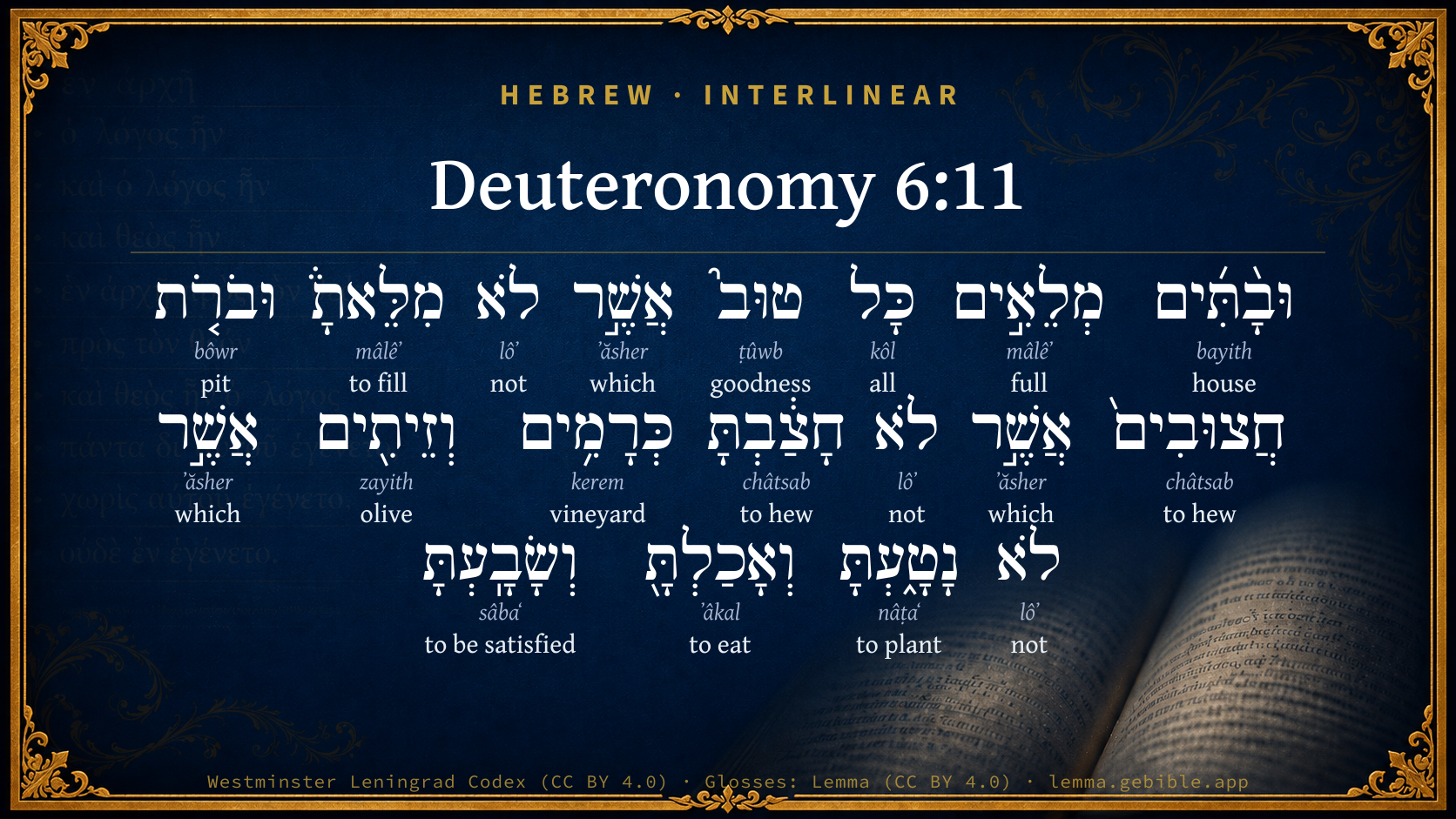
Hebrew (Westminster Leningrad Codex) Deuteronomy 6:11 appears in the Hebrew Old Testament. The text above is from the Westminster Leningrad Codex. Each word links to its Strong’s number, a concise gloss, and parsing drawn from the Open Scriptures Hebrew Bible morphology. Click any word for its full Brown-Driver-Briggs (BDB) entry.
Download image
Cite this verse

Deuteronomy 6:11 (World English Bible). Public Domain. Lemma interlinear Bible study tool, https://lemma.gebible.app/v/deuteronomy/6/11.

Show BibTeX & RIS
BibTeX
RIS
English Translation
and houses full of all good things, which you didn't fill, and cisterns dug out, which you didn't dig, vineyards and olive trees, which you didn't plant, and you shall eat and be full;
World English Bible · Public Domain
Highlights
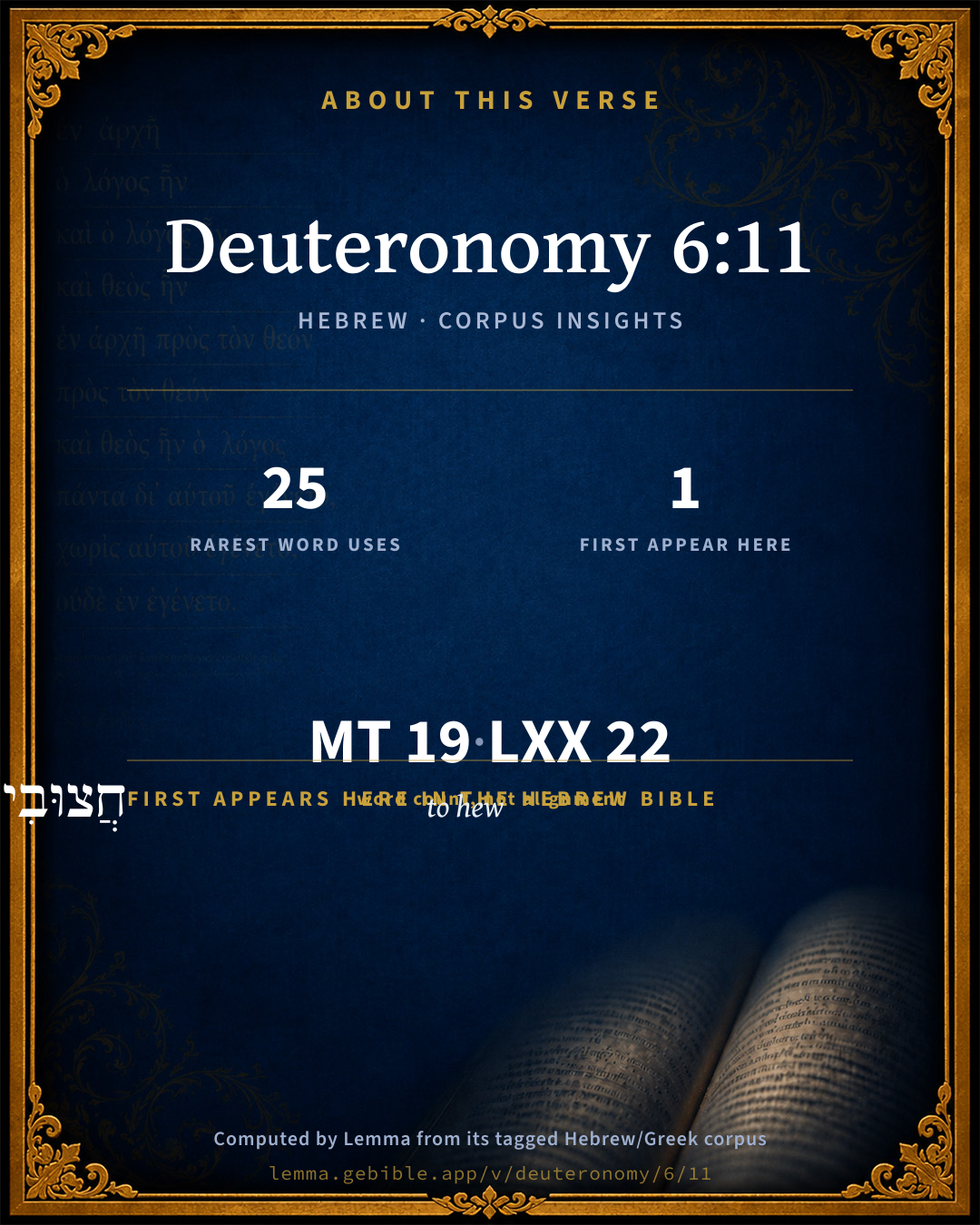
  • 1 first appearance in the Hebrew Bible
Full analysis ↓
Download a study sheet

One document with this verse’s original text, its word-by-word gloss line, the meaning frame, cross-references with their text, attributed commentary, and full source and license credits — printable, and it pastes into notes with its structure intact.

This verse Autodidact and up

Study sheet (.html) Plain text (.txt)

A passage Seminary Student

Up to 50 verses in one chapter. A passage sheet keeps up to 6 commentary sources and 12 cross-references per verse, in the order this page ranks them, and says so on the sheet whenever that leaves anything out. Ask for a single verse and you get the Autodidact verse sheet above.

Everything on this page stays free to read, with no account — the sheet is a download of what is already on screen, not access to it.

Want to remove ads? Support Godless Engineer
Compare translations 3

The same verse in 3 English versions, stacked beneath the original-language interlinear above. Click any original word for its lexicon entry.

Each is an independent rendering of the whole verse — the interlinear is not word-aligned to these translations.

Highlighted words mark where these versions differ — a whole-verse word diff, not a word-by-word alignment.

  • World English Bible Public Domain
    and houses full of all good things, which you didn't fill, and cisterns dug out, which you didn't dig, vineyards and olive trees, which you didn't plant, and you shall eat and be full;
  • King James Version Public Domain
    And houses full of all good things, which thou filledst not, and wells digged, which thou diggedst not, vineyards and olive trees, which thou plantedst not; when thou shalt have eaten and be full;
  • unfoldingWord Literal Text CC BY-SA 4.0
    and houses full of every good thing that you did not gather, and hewn cisterns that you did not dig, vineyards and olive trees that you did not plant. And you will eat and be satisfied.

unfoldingWord Literal Text — © unfoldingWord, licensed CC BY-SA 4.0. Word-aligned USFM3 via Door43 (git.door43.org/unfoldingWord/en_ult).

Versions to compare (up to 4)

3 of 4 selected

Show all 18 translations

Every available English version of this verse, each an independent rendering of the whole verse.

  • World English Bible Public Domain
    and houses full of all good things, which you didn't fill, and cisterns dug out, which you didn't dig, vineyards and olive trees, which you didn't plant, and you shall eat and be full;
  • Berean Standard Bible Public Domain
    with houses full of every good thing with which you did not fill them, with wells that you did not dig, and with vineyards and olive groves that you did not plant—and when you eat and are satisfied,
  • Majority Standard Bible Public Domain
    with houses full of every good thing with which you did not fill them, with wells that you did not dig, and with vineyards and olive groves that you did not plant—and when you eat and are satisfied,
  • King James Version Public Domain
    And houses full of all good things, which thou filledst not, and wells digged, which thou diggedst not, vineyards and olive trees, which thou plantedst not; when thou shalt have eaten and be full;
  • American Standard Version (1901) Public Domain
    and houses full of all good things, which thou filledst not, and cisterns hewn out, which thou hewedst not, vineyards and olive-trees, which thou plantedst not, and thou shalt eat and be full;
  • Revised Version (1885) Public Domain
    and houses full of all good things, which thou filledst not, and cisterns hewn out, which thou hewedst not, vineyards and olive trees, which thou plantedst not, and thou shalt eat and be full;
  • Geneva Bible (1599) Public Domain
    And houses full of all maner of goods which thou filledst not, and welles digged which thou diggedst not, vineyards and oliue trees which thou plantedst not, and when thou hast eaten and art full,
  • Douay-Rheims (1899) Public Domain
    Houses full of riches, which thou didst not set up, cisterns which thou didst not dig, vineyards and oliveyards, which thou didst not plant,
  • Young's Literal Translation Public Domain
    and houses full of all good things which thou hast not filled, and wells digged which thou hast not digged, vineyards and olive-yards which thou hast not planted, and thou hast eaten, and been satisfied;
  • Literal Standard Version CC BY-SA 4.0
    and houses full of all good things which you have not filled, and wells dug which you have not dug, vineyards and olive-yards which you have not planted, that you have eaten and been satisfied.
  • Unlocked Literal Bible CC BY-SA 4.0
    and houses full of all kinds of good things that you did not make, cisterns that you did not dig, and vineyards and olive trees that you did not plant, you will eat and be satisfied—
  • unfoldingWord Literal Text CC BY-SA 4.0
    and houses full of every good thing that you did not gather, and hewn cisterns that you did not dig, vineyards and olive trees that you did not plant. And you will eat and be satisfied.
  • Darby Bible Public Domain
    and houses full of everything good which thou filledst not, and wells digged which thou diggedst not, vineyards and oliveyards which thou plantedst not, and thou shalt have eaten and shalt be full;
  • World Messianic Bible Public Domain
    and houses full of all good things which you didn’t fill, and cisterns dug out which you didn’t dig, vineyards and olive trees which you didn’t plant, and you shall eat and be full;
  • Webster's Bible Public Domain
    And houses full of all good things, which thou didst not fill, and wells digged, which thou didst not dig, vineyards and olive-trees, which thou didst not plant; when thou shalt have eaten and be full;
  • Free Bible Version CC BY-SA 4.0
    with houses full of plenty of good things that you didn't provide, that have wells you didn't dig, and vineyards and olive groves that you did not plant. When you eat and are full
  • Bible in Basic English Public Domain
    And houses full of good things not stored up by you, and places for storing water which you did not make, and vine-gardens and olive-trees not of your planting; and you have taken food and are full;
  • JPS Tanakh (1917) Public Domain
    and houses full of all good things, which thou didst not fill, and cisterns hewn out, which thou the didst not hew, vineyards and olive-trees, which thou didst not plant, and thou shalt eat and be satisfied —

Literal Standard Version (2020), Covenant Press — licensed CC BY-SA 4.0. Text via the HelloAO Bible API (eBible.org). Unlocked Literal Bible (unfoldingWord) — licensed CC BY-SA 4.0. Text via the HelloAO Bible API (eBible.org). unfoldingWord Literal Text — © unfoldingWord, licensed CC BY-SA 4.0. Word-aligned USFM3 via Door43 (git.door43.org/unfoldingWord/en_ult). Free Bible Version, Dr. Jonathan Gallagher — licensed CC BY-SA 4.0. Text via the HelloAO Bible API (eBible.org).

Word by word

More ways to search: Search by grammar → Find every occurrence → Compare this word →

Practice this passage: Drill this verse → Learn its vocabulary →

חֲצוּבִים֙
châtsab
H2672
“hewn”
Verb, Qal, Participle Passive, Masculine, Plural, Absolute
Part of Speech
Verb
Stem
Qal
Form
Participle Passive
Gender
Masculine
Number
Plural
State
Absolute
Full BDB Definition

Origin: a primitive root

TWOT: 718

to dig, cleave, divide, hew, make, cut out, dig out, cut down, quarry, hewer, mason - (Qal) - to hew out, dig - to hew - stone - wood - to hew in pieces (metaphorically) - to divide, cleave - (Niphal) to be cut, be hewn, be engraved - (Hiphil) to hew into pieces, cut up into pieces - (Pual) to be cut from, be hewn from
  1. וּבָ֨תִּ֜ים bayith H1004 “and · houses” Conjunction + Noun, Common, Masculine, Plural, Absolute
  2. מְלֵאִ֣ים mâlêʼ H4392 “full” Adjective, Adjective, Masculine, Plural, Absolute
  3. כָּל kôl H3605 “all of” Noun, Common, Masculine, Singular, Construct
  4. טוּב֮ ṭûwb H2898 “goodness” Noun, Common, Masculine, Singular, Absolute
  5. אֲשֶׁ֣ר ʼăsher H834 “which” Particle, Relative
  6. לֹא lôʼ H3808 “not” Particle, Negative
  7. מִלֵּאתָ֒ mâlêʼ H4390 “to fill” Verb, Piel, Perfect, 2nd Person, Masculine, Singular
  8. וּבֹרֹ֤ת bôwr H953 “and · pits” Conjunction + Noun, Common, Masculine, Plural, Absolute
  9. אֲשֶׁ֣ר ʼăsher H834 “which” Particle, Relative
  10. לֹא lôʼ H3808 “not” Particle, Negative
  11. חָצַ֔בְתָּ châtsab H2672 “to hew” Verb, Qal, Perfect, 2nd Person, Masculine, Singular
  12. כְּרָמִ֥ים kerem H3754 “vineyards” Noun, Common, Both, Plural, Absolute
  13. וְזֵיתִ֖ים zayith H2132 “and · olives” Conjunction + Noun, Common, Masculine, Plural, Absolute
  14. אֲשֶׁ֣ר ʼăsher H834 “which” Particle, Relative
  15. לֹא lôʼ H3808 “not” Particle, Negative
  16. נָטָ֑עְתָּ nâṭaʻ H5193 “to plant” Verb, Qal, Perfect, 2nd Person, Masculine, Singular
  17. וְאָכַלְתָּ֖ ʼâkal H398 “and · to eat” Conjunction + Verb, Qal, Sequential Perfect, 2nd Person, Masculine, Singular
  18. וְשָׂבָֽעְתָּ sâbaʻ H7646 “and · to be satisfied” Conjunction + Verb, Qal, Sequential Perfect, 2nd Person, Masculine, Singular

About this verse

These counts appear in no published source. They are computed here, from the morphology-tagged text and Lemma’s own curated glosses. What Lemma adds →

19
words
14
distinct lemmas
Pentateuch
section

Notable vocabulary

The rarest word here is חֲצוּבִים֙ to hew H2672 — appearing just 25 times in the whole Hebrew Bible.

First appearance in Scripture

This word makes its first canonical appearance in the Hebrew Bible here:

  • חֲצוּבִים֙ to hew H2672

Shared distinctive vocabulary

חֲצוּבִים֙ to hew H2672 occurs in 22 verses of the Hebrew Bible. Also found in:

Grammatical profile

  • 6 verbs
  • 6 nouns
  • 1 adjective
  • 6 particles

Verb forms

  • מִלֵּאתָ֒ Piel · Perfect
  • חֲצוּבִים֙ Qal · Participle Passive
  • חָצַ֔בְתָּ Qal · Perfect
  • נָטָ֑עְתָּ Qal · Perfect
  • וְאָכַלְתָּ֖ Qal · Sequential Perfect
  • וְשָׂבָֽעְתָּ Qal · Sequential Perfect

Repetition

Words recur within this verse — often emphatic in Hebrew:

  • חֲצוּבִים֙ to hew H2672 ×2
  • אֲשֶׁ֣ר which H834 ×3
  • לֹא not H3808 ×3

Hebrew & Septuagint length

In English translation the verse runs 34 words from the Hebrew and 36 from the Septuagint (LXX English) — closely comparable.

A rough comparison of the two English renderings, which tokenize alike — not a word-level alignment.

Word counts can differ between the Hebrew and the Greek without any difference in meaning — e.g. the Hebrew direct-object marker אֵת has no separate Greek word, and Greek often adds the article ὁ.

In the original languages it is 19 Hebrew tokens and 22 Greek tokens — but the two are counted differently (Hebrew bundles its prefixes and suffixes into one token; the Greek is in lemma form), so that isn’t a like-for-like length.

Cross-references

8

Topical passages linked to Deuteronomy 6:11 in the Treasury of Scripture Knowledge — connected by theme and wording, ordered by reader-vote popularity; previews shown in the World English Bible.

  • Deuteronomy 7:12–18 It shall happen, because you listen to these ordinances, and keep and do them, that Yahweh your God will keep with you the covenant and the loving kindness which he swore to your fathers:
  • Deuteronomy 8:10–20 You shall eat and be full, and you shall bless Yahweh your God for the good land which he has given you.
  • Ezekiel 16:10–20 I clothed you also with embroidered work, and shod you with sealskin, and I girded you about with fine linen, and covered you with silk.
  • Jeremiah 2:31–32 Generation, see the word of Yahweh. Have I been a wilderness to Israel? or a land of thick darkness? why say my people, We are broken loose; we will come no more to you?
  • Deuteronomy 32:15 But Jeshurun grew fat, and kicked: You have grown fat, you are grown thick, you are become sleek; Then he forsook God who made him, Lightly esteemed the Rock of his salvation.
  • Proverbs 30:8–9 Remove far from me falsehood and lies. Give me neither poverty nor riches. Feed me with the food that is needful for me;
  • Judges 3:7 The children of Israel did that which was evil in the sight of Yahweh, and forgot Yahweh their God, and served the Baals and the Asheroth.
  • Matthew 19:23–24 Jesus said to his disciples, "Most assuredly I say to you, a rich man will enter into the Kingdom of Heaven with difficulty.

Cross-references courtesy of OpenBible.info (CC BY 4.0).

Hebrew and Greek witnesses Masoretic Hebrew ↔ Greek Septuagint

The same verse in the two great witnesses to the Old Testament, shown verse-for-verse.

These are two independent witnesses, not word-aligned to each other, and the Septuagint is shown in lemma (dictionary) form.

Hebrew Deuteronomy 6:11 Masoretic · Westminster Leningrad Codex

וּבָ֨תִּ֜ים מְלֵאִ֣ים כָּל טוּב֮ אֲשֶׁ֣ר לֹא מִלֵּאתָ֒ וּבֹרֹ֤ת חֲצוּבִים֙ אֲשֶׁ֣ר לֹא חָצַ֔בְתָּ כְּרָמִ֥ים וְזֵיתִ֖ים אֲשֶׁ֣ר לֹא נָטָ֑עְתָּ וְאָכַלְתָּ֖ וְשָׂבָֽעְתָּ

and houses full of all good things, which you didn't fill, and cisterns dug out, which you didn't dig, vineyards and olive trees, which you didn't plant, and you shall eat and be full;

World English Bible · Public Domain

Greek LXX Deuteronomy 6:11 Septuagint · lemma form

οἰκία πλήρης πᾶς ἀγαθός ὅς οὐ ἐνπίμπλημι λάκκος λατομέω ὅς οὐ ἐκλατομέω ἀμπελών καί ἐλαιών ὅς οὐ καταφυτεύω καί ἐσθίω καί ἐνπίμπλημι

houses full of all good things which you did not fill, wells dug in the rock which you did not dig, vineyards and olive yards which you did not plant, then having eaten and been filled,

LXX2012 (modern English Septuagint) · Public Domain

On this verse, The Cambridge Bible for Schools and Colleges discusses the Septuagint’s reading. Read the note in Commentary ↓

Hebrew: Westminster Leningrad Codex (CC BY 4.0). Greek: Septuagint (public domain); English from LXX2012 (modern English Septuagint) (Public Domain). How the Septuagint differs from the Hebrew →

Targum (Aramaic paraphrase)

2

The Targum is the ancient Jewish Aramaic paraphrase of the Hebrew Scriptures — an interpretive translation, not the Hebrew text itself. Onkelos (literal) and Pseudo-Jonathan (expansive) render the Torah, and Jonathan the Prophets. Coverage is partial: where no permissively-licensed English translation exists for a verse, only the Aramaic is shown. This is verse-level text, not a word-by-word alignment to the Hebrew.

  1. Targum Onkelos Torah (Genesis–Deuteronomy)
    וּבָתִּין מְלָן כָּל טוּב דִי לָא מְלֵיתָא וְגֻבִּין פְּסִילָן דִי לָא פְּסַלְתָּא כַּרְמִין וְזֵיתִין דִי לָא נְצֶבְתָּא וְתֵיכוּל וְתִשְׂבָּע

    (no public-domain English translation for this verse)

    Targum Onkelos — Aramaic: “Onkelos Genesis” (public domain); “Onkelos Exodus” (public domain); “Onkelos Leviticus” (public domain); “Onkelos Numbers” (public domain); “Onkelos Deuteronomy” (public domain). English: “Sefaria Community Translation” (CC0 1.0 (public-domain dedication)); “J.W. Etheridge. The Targums of Onkelos and Jonathan Ben Uzziel on the Pentateuch. London: Longmans, Green, 1862” (public domain). Text via Sefaria.

  2. Targum Pseudo-Jonathan Torah (Genesis–Deuteronomy)
    וּבָתִּין דְּמַלְיָין כָּל טוּבָא דְּלָא עָסַקְתָּ לְמִימְלֵי וּבֵירִין פְּסִילָן דְּלָא לָעִית לְמִפְסַל כַּרְמִין וְזֵיתִין דְּלָא טָרַחְתְּ לְמִינְצַב וְתֵיכוֹל וְתִיסְבּוֹעַ

    houses also, filled with all good, which thou wast not occupied in filling, and hewn cisterns in hewing which thou didst not labour, vineyards and olives with planting which thou wast not wearied; and when thou hast eaten. and art satisfied,

    Targum Pseudo-Jonathan — Aramaic: “Targum Jonathan on Genesis” (public domain); “Targum Jonathan on Exodus” (public domain); “Targum Jonathan on Leviticus” (public domain); “Targum Jonathan on Numbers” (public domain); “Targum Jonathan on Deuteronomy” (public domain). English: “The Targum of Jonathan ben Uzziel, trans. J. W. Etheridge, London, 1862” (public domain). Text via Sefaria.

Commentary

Notes on Deuteronomy 6:11 from classic Christian and Jewish commentators (each source and its license shown beneath its notes). The classic Christian expositions comment on the surrounding passage and are grouped to its opening verse, so a note may address several verses; the Jewish commentaries on the Tanakh (Rashi and others) are per-verse, so they appear only where the commentator wrote on this verse.

Lemma curates 59 commentaries, every one of them public domain or Creative Commons licensed, each selected and text-cleaned for this edition rather than reprinted as found. About our sources →

Trapp's Complete Commentary

John Trapp

Deu 6:11 And houses full of all good [things], which thou filledst not, and wells digged, which thou diggedst not, vineyards and olive trees, which thou plantedst not; when thou shalt have eaten and be full;

Ver. 11. When thou shalt have eaten and be full.] Saturity oft breeds security; fulness, forgetfulness. The best, when full fed, are apt to wax wanton and will be dipping their fingers sometimes in the devil’s sauce: Ipsis opibus lascivire coepit ecclesia. {a} The moon never suffers eclipse but at the full, and that by the earth’s interposition. The young mules, when they have sucked, turn up their heels and kick at the dam.

{a} Platina.

John Trapp, A Commentary or Exposition upon All the Books of the Old and New Testament (1647–1656) — public domain. Text from a community e-Sword module.

The Cambridge Bible for Schools and Colleges

gen. ed. J. J. S. Perowne

11. and houses … and cisterns … vineyards and olive trees …] With Sam. and LXX omit and before houses and cisterns. Such things form the principal wealth of the cities, better towns, of Deu_6:10. That grain and flocks are not also mentioned (as in Deu_32:14) is not surprising. The description is a summary one; it is an agricultural civilisation to which Israel is succeeding, and in the agriculture of the W. Palestine hills fruit-trees were more valuable than either wheat or barley, and also their value was more dependent on the labour of previous generations.

and thou shall eat and be full] Deu_8:10; Deu_8:12, Deu_11:15, Deu_31:20; cp. Deu_14:29, Deu_26:12, Deu_32:15 (LXX).

The Cambridge Bible for Schools and Colleges (gen. ed. J. J. S. Perowne; Cambridge University Press, 1878–1918) — public domain. Text from a community e-Sword module.

John Gill's Exposition

And houses full of all good things which thou filledst not,.... Not only full of good, convenient, and rich household furniture, but of the fruits of the earth, of corn, and wine, and oil, and also, perhaps, of gold and silver:

and wells digged which thou diggedst not; which in those hot and dry countries were in much esteem, and of great worth; see Gen 26:18,

vineyards and olive trees which thou plantedst not; which Canaan abounded with much more than Egypt, where there were but few vines and olive trees, though of both these there were more where the Israelites lived than elsewhere; See Gill on Gen 47:11 and these therefore might be such as they had seen in Egypt, in that part of it in which they dwelt, Goshen, which was in the Heracleotic nome, and that Strabo (u) says only produced perfect olives, and fruit bearing trees, but the rest of Egypt wanted oil; and this home is the same which the Arabs now call the province of Fium, of which Leo Africanus (w) says, it produces a large quantity of olives; so that this might be observed for the encouragement of the Israelites:

when thou shalt have eaten and be full; having such plenty of good things the land would furnish them with.

(u) Geograph. l. 17. p. 556. (w) Descriptio Africae, l. 8. p. 722.

John Gill's Exposition of the Whole Bible (1746–1763) — public domain (CC PDM 1.0). Text via the HelloAO Bible API.

Rashi

Rabbi Shlomo Yitzchaki (Rashi)

חצובים [CISTERNS] HEWN OUT — Because it (Palestine) was a country of stony ground and rocks, the term "hewn" is applicable here.

Rashi on the Tanakh — English translations: “The Judaica Press complete Tanach with Rashi, translated by A. J. Rosenberg” (CC BY 4.0); “Pentateuch with Rashi's commentary by M. Rosenbaum and A.M. Silbermann, 1929-1934” (public domain); “The Metsudah Tanach series, Lakewood, N.J” (CC BY 4.0); and “The Book of Joshua, Metsudah Publications, 1997” (CC BY 4.0). Text via Sefaria.

Lesson kit

Teaching starters — assembled from the data on this page, not authored interpretation. Every prompt links to the verse data it draws on. Edit before teaching.

Deuteronomy, in the Pentateuch, opens this verse with 19 words (14 distinct Hebrew lemmas). Its most distinctive word is châtsab (“to hew”). A historical commentator’s framing appears above. Read the whole chapter for the surrounding context.

Discussion questions

  1. What does “to hew” (châtsab) contribute to the verse as a whole?
  2. This is the first place “to hew” appears in Scripture (first appears here). What does its debut here establish?
  3. How does Deuteronomy 8:9, which shares the word «to hew», read alongside this verse?
  4. What does the repetition of “to hew” (2× in this one verse) do in this verse?
  5. The translations on this page render this verse differently — a whole-verse word diff, not a word-by-word alignment. What might account for the different wordings?
  6. «מִלֵּאתָ֒» is a Piel Perfect verb. How does that grammatical form shape the action described?
  7. Compare how Trapp's Complete Commentary and The Cambridge Bible for Schools and Colleges read this verse. Where do they agree or differ?

Things to notice

Reading settings

Reading text

Shown beneath each verse's original-language words.

Old Testament
Old Testament edition

Read the OT as the Masoretic Hebrew (MT) or the Greek Septuagint (LXX).

English shown for the Greek Septuagint (in the Hebrew ↔ Greek comparison).

Comparing translations? Open the Compare panel on any verse page to stack up to four side by side.