Numbers 14:7

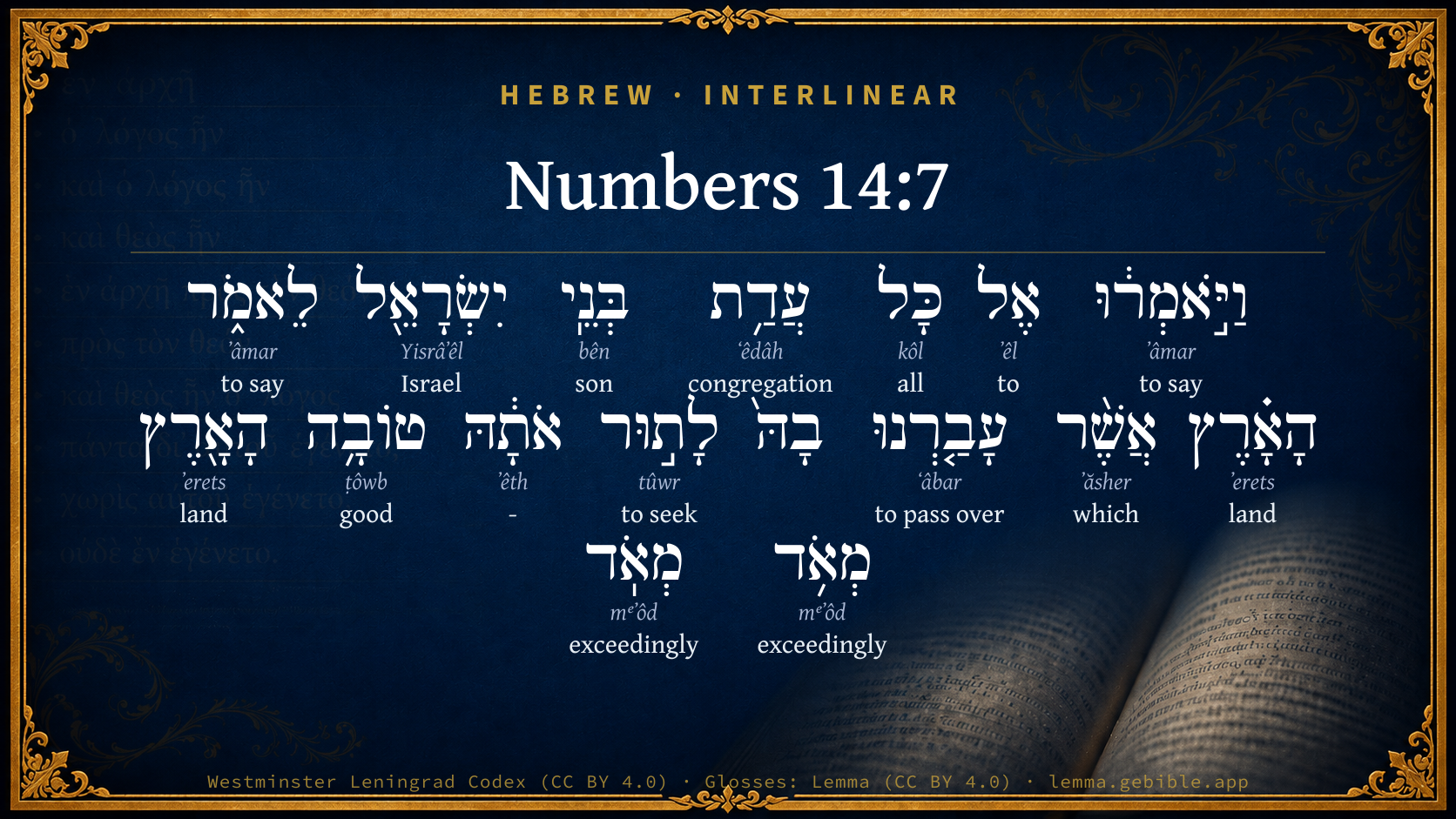
Hebrew (Westminster Leningrad Codex) Numbers 14:7 appears in the Hebrew Old Testament. The text above is from the Westminster Leningrad Codex. Each word links to its Strong’s number, a concise gloss, and parsing drawn from the Open Scriptures Hebrew Bible morphology. Click any word for its full Brown-Driver-Briggs (BDB) entry.
Download image
Cite this verse

Numbers 14:7 (World English Bible). Public Domain. Lemma interlinear Bible study tool, https://lemma.gebible.app/v/numbers/14/7.

Show BibTeX & RIS
BibTeX
RIS
English Translation
and they spoke to all the congregation of the children of Israel, saying, The land, which we passed through to spy it out, is an exceeding good land.
World English Bible · Public Domain
Download a study sheet

One document with this verse’s original text, its word-by-word gloss line, the meaning frame, cross-references with their text, attributed commentary, and full source and license credits — printable, and it pastes into notes with its structure intact.

This verse Autodidact and up

Study sheet (.html) Plain text (.txt)

A passage Seminary Student

Up to 50 verses in one chapter. A passage sheet keeps up to 6 commentary sources and 12 cross-references per verse, in the order this page ranks them, and says so on the sheet whenever that leaves anything out. Ask for a single verse and you get the Autodidact verse sheet above.

Everything on this page stays free to read, with no account — the sheet is a download of what is already on screen, not access to it.

Want to remove ads? Support Godless Engineer
Compare translations 3

The same verse in 3 English versions, stacked beneath the original-language interlinear above. Click any original word for its lexicon entry.

Each is an independent rendering of the whole verse — the interlinear is not word-aligned to these translations.

Highlighted words mark where these versions differ — a whole-verse word diff, not a word-by-word alignment.

  • World English Bible Public Domain
    and they spoke to all the congregation of the children of Israel, saying, The land, which we passed through to spy it out, is an exceeding good land.
  • King James Version Public Domain
    And they spake unto all the company of the children of Israel, saying, The land, which we passed through to search it, is an exceeding good land.
  • unfoldingWord Literal Text CC BY-SA 4.0
    and they said to all the congregation of the sons of Israel, saying, “The land through which we passed to explore it a very, very good land.

unfoldingWord Literal Text — © unfoldingWord, licensed CC BY-SA 4.0. Word-aligned USFM3 via Door43 (git.door43.org/unfoldingWord/en_ult).

Versions to compare (up to 4)

3 of 4 selected

Show all 18 translations

Every available English version of this verse, each an independent rendering of the whole verse.

  • World English Bible Public Domain
    and they spoke to all the congregation of the children of Israel, saying, The land, which we passed through to spy it out, is an exceeding good land.
  • Berean Standard Bible Public Domain
    and said to the whole congregation of Israel, “The land we passed through and explored is an exceedingly good land.
  • Majority Standard Bible Public Domain
    and said to the whole congregation of Israel, “The land we passed through and explored is an exceedingly good land.
  • King James Version Public Domain
    And they spake unto all the company of the children of Israel, saying, The land, which we passed through to search it, is an exceeding good land.
  • American Standard Version (1901) Public Domain
    and they spake unto all the congregation of the children of Israel, saying, The land, which we passed through to spy it out, is an exceeding good land.
  • Revised Version (1885) Public Domain
    and they spake unto all the congregation of the children of Israel, saying, The land, which we passed through to spy it out, is an exceeding good land.
  • Geneva Bible (1599) Public Domain
    And spake vnto all the assemblie of the childre of Israel, saying, The land which we walked through to search it, is a very good lande.
  • Douay-Rheims (1899) Public Domain
    And said to all the multitude of the children of Israel: The land which we have gone round is very good:
  • Young's Literal Translation Public Domain
    and they speak unto all the company of the sons of Israel, saying, `The land into which we have passed over to spy it, `is' a very very good land;
  • Literal Standard Version CC BY-SA 4.0
    and they speak to all the congregation of the sons of Israel, saying, “The land into which we have passed over to spy it out [is] a very, very good land;
  • Unlocked Literal Bible CC BY-SA 4.0
    They spoke to all the community of the people of Israel. They said, “The land that we passed through and examined is a very good land.
  • unfoldingWord Literal Text CC BY-SA 4.0
    and they said to all the congregation of the sons of Israel, saying, “The land through which we passed to explore it a very, very good land.
  • Darby Bible Public Domain
    And they spoke to the whole assembly of the children of Israel, saying, The land, which we passed through to search it out, is a very, very good land.
  • World Messianic Bible Public Domain
    They spoke to all the congregation of the children of Israel, saying, “The land, which we passed through to spy it out, is an exceedingly good land.
  • Webster's Bible Public Domain
    And they spoke to all the company of the children of Israel, saying, The land, which we passed through to search it, is an exceeding good land.
  • Free Bible Version CC BY-SA 4.0
    and told the Israelites, “The country we traveled through and explored has very good land.
  • Bible in Basic English Public Domain
    Said to all the children of Israel, This land which we went through to see is a very good land.
  • JPS Tanakh (1917) Public Domain
    And they spoke unto all the congregation of the children of Israel, saying: 'The land, which we passed through to spy it out, is an exceeding good land.

Literal Standard Version (2020), Covenant Press — licensed CC BY-SA 4.0. Text via the HelloAO Bible API (eBible.org). Unlocked Literal Bible (unfoldingWord) — licensed CC BY-SA 4.0. Text via the HelloAO Bible API (eBible.org). unfoldingWord Literal Text — © unfoldingWord, licensed CC BY-SA 4.0. Word-aligned USFM3 via Door43 (git.door43.org/unfoldingWord/en_ult). Free Bible Version, Dr. Jonathan Gallagher — licensed CC BY-SA 4.0. Text via the HelloAO Bible API (eBible.org).

Word by word

More ways to search: Search by grammar → Find every occurrence → Compare this word →

Practice this passage: Drill this verse → Learn its vocabulary →

לָת֣וּר
tûwr
H8446
“to seek”
Preposition + Verb, Qal, Infinitive Construct
Part of Speech
Preposition + Verb
Stem
Qal
Form
Infinitive Construct
Full BDB Definition

Origin: a primitive root

TWOT: 2500

to seek, search out, spy out, explore - (Qal) - to seek out, select, find out how to do something - to spy out, explore - explorers, spies (participle) - to go about - merchant, trader (participle) - (Hiphil) to make a search, make a reconnaissance
  1. וַיֹּ֣אמְר֔וּ ʼâmar H559 “and · to say” Conjunction + Verb, Qal, Sequential Imperfect, 3rd Person, Masculine, Plural
  2. אֶל ʼêl H413 “to” Preposition
  3. כָּל kôl H3605 “all of” Noun, Common, Masculine, Singular, Construct
  4. עֲדַ֥ת ʻêdâh H5712 “congregation of” Noun, Common, Feminine, Singular, Construct
  5. בְּנֵֽי bên H1121 “sons of” Noun, Common, Masculine, Plural, Construct
  6. יִשְׂרָאֵ֖ל Yisrâʼêl H3478 “Israel” Noun, Proper
  7. לֵאמֹ֑ר ʼâmar H559 “to say” Preposition + Verb, Qal, Infinitive Construct
  8. הָאָ֗רֶץ ʼerets H776 “the · land” Particle, Definite Article + Noun, Common, Both, Singular, Absolute
  9. אֲשֶׁ֨ר ʼăsher H834 “which” Particle, Relative
  10. עָבַ֤רְנוּ ʻâbar H5674 “to pass over” Verb, Qal, Perfect, 1st Person, Common, Plural
  11. אֹתָ֔הּ ʼêth H853 “- · her” Particle, Direct Object + Suffix, Personal, 3rd Person, Feminine, Singular
  12. טוֹבָ֥ה ṭôwb H2896 “good” Adjective, Adjective, Feminine, Singular, Absolute
  13. הָאָ֖רֶץ ʼerets H776 “the · land” Particle, Definite Article + Noun, Common, Both, Singular, Absolute
  14. מְאֹ֥ד mᵉʼôd H3966 “exceedingly” Adverb
  15. מְאֹֽד mᵉʼôd H3966 “exceedingly” Adverb

About this verse

These counts appear in no published source. They are computed here, from the morphology-tagged text and Lemma’s own curated glosses. What Lemma adds →

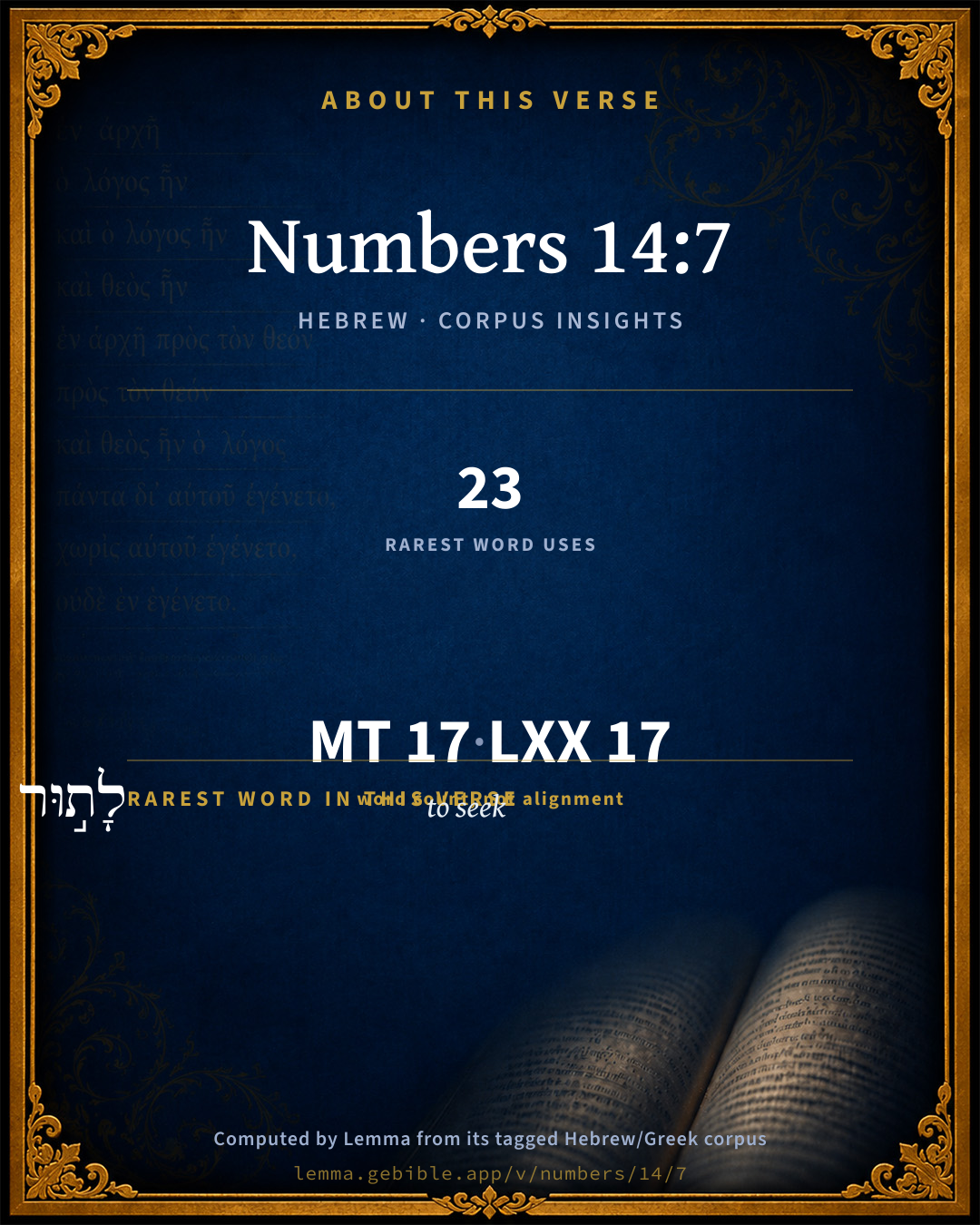
17
words
13
distinct lemmas
Pentateuch
section

Notable vocabulary

The rarest word here is לָת֣וּר to seek H8446 — appearing just 23 times in the whole Hebrew Bible.

Shared distinctive vocabulary

לָת֣וּר to seek H8446 occurs in 22 verses of the Hebrew Bible. Also found in:

Grammatical profile

  • 4 verbs
  • 6 nouns
  • 1 adjective
  • 2 prepositions
  • 2 adverbs
  • 2 particles

Verb forms

  • וַיֹּ֣אמְר֔וּ Qal · Sequential Imperfect
  • לֵאמֹ֑ר Qal · Infinitive Construct
  • עָבַ֤רְנוּ Qal · Perfect
  • לָת֣וּר Qal · Infinitive Construct

Repetition

Words recur within this verse — often emphatic in Hebrew:

  • וַיֹּ֣אמְר֔וּ to say H559 ×2
  • הָאָ֗רֶץ land H776 ×2
  • מְאֹ֥ד exceedingly H3966 ×2

Hebrew & Septuagint length

In English translation the verse runs 28 words from the Hebrew and 21 from the Septuagint (LXX English) — closely comparable.

A rough comparison of the two English renderings, which tokenize alike — not a word-level alignment.

Word counts can differ between the Hebrew and the Greek without any difference in meaning — e.g. the Hebrew direct-object marker אֵת has no separate Greek word, and Greek often adds the article ὁ.

In the original languages it is 17 Hebrew tokens and 17 Greek tokens — but the two are counted differently (Hebrew bundles its prefixes and suffixes into one token; the Greek is in lemma form), so that isn’t a like-for-like length.

Cross-references

4

Topical passages linked to Numbers 14:7 in the Treasury of Scripture Knowledge — connected by theme and wording, ordered by reader-vote popularity; previews shown in the World English Bible.

  • Numbers 13:27 They told him, and said, We came to the land where you sent us; and surely it flows with milk and honey; and this is the fruit of it.
  • Deuteronomy 1:25 They took of the fruit of the land in their hands, and brought it down to us, and brought us word again, and said, It is a good land which Yahweh our God gives to us.
  • Deuteronomy 6:10–11 It shall be, when Yahweh your God shall bring you into the land which he swore to your fathers, to Abraham, to Isaac, and to Jacob, to give you, great and goodly cities, which you didn't build,
  • Deuteronomy 8:7–9 For Yahweh your God brings you into a good land, a land of brooks of water, of springs and springs, flowing forth in valleys and hills;

Cross-references courtesy of OpenBible.info (CC BY 4.0).

Hebrew and Greek witnesses Masoretic Hebrew ↔ Greek Septuagint

The same verse in the two great witnesses to the Old Testament, shown verse-for-verse.

These are two independent witnesses, not word-aligned to each other, and the Septuagint is shown in lemma (dictionary) form.

Hebrew Numbers 14:7 Masoretic · Westminster Leningrad Codex

וַיֹּ֣אמְר֔וּ אֶל כָּל עֲדַ֥ת בְּנֵֽי יִשְׂרָאֵ֖ל לֵאמֹ֑ר הָאָ֗רֶץ אֲשֶׁ֨ר עָבַ֤רְנוּ בָהּ֙ לָת֣וּר אֹתָ֔הּ טוֹבָ֥ה הָאָ֖רֶץ מְאֹ֥ד מְאֹֽד

and they spoke to all the congregation of the children of Israel, saying, The land, which we passed through to spy it out, is an exceeding good land.

World English Bible · Public Domain

Greek LXX Numbers 14:7 Septuagint · lemma form

καί εἶπον πρός πᾶς συναγωγή υἱός ἰσραήλ λέγω ὁ γῆ ὅς κατασκέπτομαι αὐτός ἀγαθός εἰμί σφόδρα σφόδρα

and spoke to all the congregation of the children of Israel, saying, The land which we surveyed is indeed extremely good.

LXX2012 (modern English Septuagint) · Public Domain

Hebrew: Westminster Leningrad Codex (CC BY 4.0). Greek: Septuagint (public domain); English from LXX2012 (modern English Septuagint) (Public Domain). How the Septuagint differs from the Hebrew →

Targum (Aramaic paraphrase)

2

The Targum is the ancient Jewish Aramaic paraphrase of the Hebrew Scriptures — an interpretive translation, not the Hebrew text itself. Onkelos (literal) and Pseudo-Jonathan (expansive) render the Torah, and Jonathan the Prophets. Coverage is partial: where no permissively-licensed English translation exists for a verse, only the Aramaic is shown. This is verse-level text, not a word-by-word alignment to the Hebrew.

  1. Targum Onkelos Torah (Genesis–Deuteronomy)
    וַאֲמָרוּ לְכָל כְּנִשְׁתָּא דִבְנֵי יִשְׂרָאֵל לְמֵימָר אַרְעָא דִי עֲבַרְנָא בָהּ לְאַלָלָא יָתַהּ טָבָא אַרְעָא לְחֲדָא לַחֲדָא

    (no public-domain English translation for this verse)

    Targum Onkelos — Aramaic: “Onkelos Genesis” (public domain); “Onkelos Exodus” (public domain); “Onkelos Leviticus” (public domain); “Onkelos Numbers” (public domain); “Onkelos Deuteronomy” (public domain). English: “Sefaria Community Translation” (CC0 1.0 (public-domain dedication)); “J.W. Etheridge. The Targums of Onkelos and Jonathan Ben Uzziel on the Pentateuch. London: Longmans, Green, 1862” (public domain). Text via Sefaria.

  2. Targum Pseudo-Jonathan Torah (Genesis–Deuteronomy)
    וַאֲמָרוּ לְכָל כְּנִישְׁתָּא לְמֵימָר אַרְעָא דְעָבַרְנָא בָּהּ לְאַלָלָא יָתָהּ טָבָא אַרְעָא לַחֲדָא לַחֲדָא

    and spake to the congregation, saying: The land we went to see is an exceedingly good land.

    Targum Pseudo-Jonathan — Aramaic: “Targum Jonathan on Genesis” (public domain); “Targum Jonathan on Exodus” (public domain); “Targum Jonathan on Leviticus” (public domain); “Targum Jonathan on Numbers” (public domain); “Targum Jonathan on Deuteronomy” (public domain). English: “The Targum of Jonathan ben Uzziel, trans. J. W. Etheridge, London, 1862” (public domain). Text via Sefaria.

Commentary

Notes on Numbers 14:7 from classic Christian and Jewish commentators (each source and its license shown beneath its notes). The classic Christian expositions comment on the surrounding passage and are grouped to its opening verse, so a note may address several verses; the Jewish commentaries on the Tanakh (Rashi and others) are per-verse, so they appear only where the commentator wrote on this verse.

Lemma curates 59 commentaries, every one of them public domain or Creative Commons licensed, each selected and text-cleaned for this edition rather than reprinted as found. About our sources →

Tyndale Open Study Notes

Tyndale Open Resources

14:7-9 Joshua and Caleb understood that Israel’s lack of courage and their criticism of Moses and Aaron were rebellion against the Lord, and they knew what results this would produce. • the Lord is with us: This was the source of their confidence (cp. Rom 8:31).

Tyndale Open Study Notes — © Tyndale Open Resources, licensed CC BY-SA 4.0. Text via the HelloAO Bible API.

John Gill's Exposition

And they spake unto all the company of the children of Israel,.... To as many as could hear them, to the heads of them:

saying, the land which we passed through to search it, is an exceeding good land; they observe that they were of the number of the spies that were appointed and sent to search the land of Canaan, and they had searched it, and therefore could give an account of it from their own knowledge; and they had not only entered into it, or just looked at a part of it, but they had gone through it, and taken a general survey of it; and they could not but in truth and justice say of it, that it was a good land, delightful, healthful, and fruitful; yea, "very, very good" (q), exceeding, exceeding good, superlatively good, good beyond expression; they were not able with words to set forth the goodness of it; this they reported, in opposition to the ill report the other spies had given of it.

(q) "bona terra, valde valde", Montanus, Vatablus.

John Gill's Exposition of the Whole Bible (1746–1763) — public domain (CC PDM 1.0). Text via the HelloAO Bible API.

Whedon's Commentary on the Bible

Daniel D. Whedon

7. They spake unto all the company of the children of Israel — Literalists like Colenso find an insuperable difficulty here. “No human voice, unless strengthened by miracle, of which the Scriptures tell us nothing, could have reached the ears of a crowded mass of people as large as the whole population of London.” But the President of the United States performs a greater feat, standing on the east porch of the capitol and delivering his inaugural address to the whole country, with incidental remarks to all mankind. King Solomon at the dedication “blessed all the congregation of Israel.” 1Ki_8:14. Even the children in the Sunday-school soon learn to understand that “all” has its reasonable limitations when they read that “Jerusalem, and all Judea, and all the region round about Jordan, were baptized of John;” as they do when they read that all New York is taking an airing in Central Park. See Exo_9:6, note.

Exceeding good land — Hebrew, good exceedingly exceedingly. The minority report is more emphatic in its praise than the majority report is in its dispraise of Canaan. The eye of unbelief had seen the dark cloud, the eye of faith had seen both it and its silver lining. A craven fear had tinged all the observations of the one with a sombre hue, while an unfaltering faith had, to the eye of the other, tipped every hilltop with light and filled every valley with splendour. These opposite reports from an observation of the same facts resulted from the difference in the spirit and trust of the men who reported.

Daniel D. Whedon (gen. ed.), Commentary on the Old and New Testaments (1874–1909) — public domain. Text from a community e-Sword module.

Ramban (Nachmanides)

Rabbi Moshe ben Nachman (Ramban / Nachmanides)

IT IS ‘M’OD M’OD’ (AN EXCEEDING) GOOD LAND. The reason [for this emphasis] is in order to contradict the false report [of the spies] and to state that it is not [a Land] that eateth up the inhabitants thereof, for the air is good, and it is a Land flowing with milk and honey. which is taken from Verse 8, ibid.

Ramban (Nachmanides) on the Tanakh — English translation: “Commentary on the Torah by Ramban (Nachmanides). Translated and annotated by Charles B. Chavel. New York, Shilo Pub. House, 1971-1976” (CC BY 4.0). Text via Sefaria.

Lesson kit

Teaching starters — assembled from the data on this page, not authored interpretation. Every prompt links to the verse data it draws on. Edit before teaching.

Numbers, in the Pentateuch, opens this verse with 17 words (13 distinct Hebrew lemmas). Its most distinctive word is tûwr (“to seek”). A historical commentator’s framing appears above. Read the whole chapter for the surrounding context.

Discussion questions

  1. What does “to seek” (tûwr) contribute to the verse as a whole?
  2. Numbers 10:33 shares the word «to seek» with this verse. How do the two illuminate each other?
  3. “to say” occurs 2× in this one verse. What is the effect of the repetition?
  4. The translations on this page render this verse differently — a whole-verse word diff, not a word-by-word alignment. What might account for the different wordings?
  5. The verb «וַיֹּ֣אמְר֔וּ» is Qal Sequential Imperfect. How does its form color the action?
  6. Reading how Tyndale Open Study Notes and John Gill's Exposition read this verse, where do the two commentators agree and where do they part?

Things to notice

Reading settings

Reading text

Shown beneath each verse's original-language words.

Old Testament
Old Testament edition

Read the OT as the Masoretic Hebrew (MT) or the Greek Septuagint (LXX).

English shown for the Greek Septuagint (in the Hebrew ↔ Greek comparison).

Comparing translations? Open the Compare panel on any verse page to stack up to four side by side.