
Romans 12:21

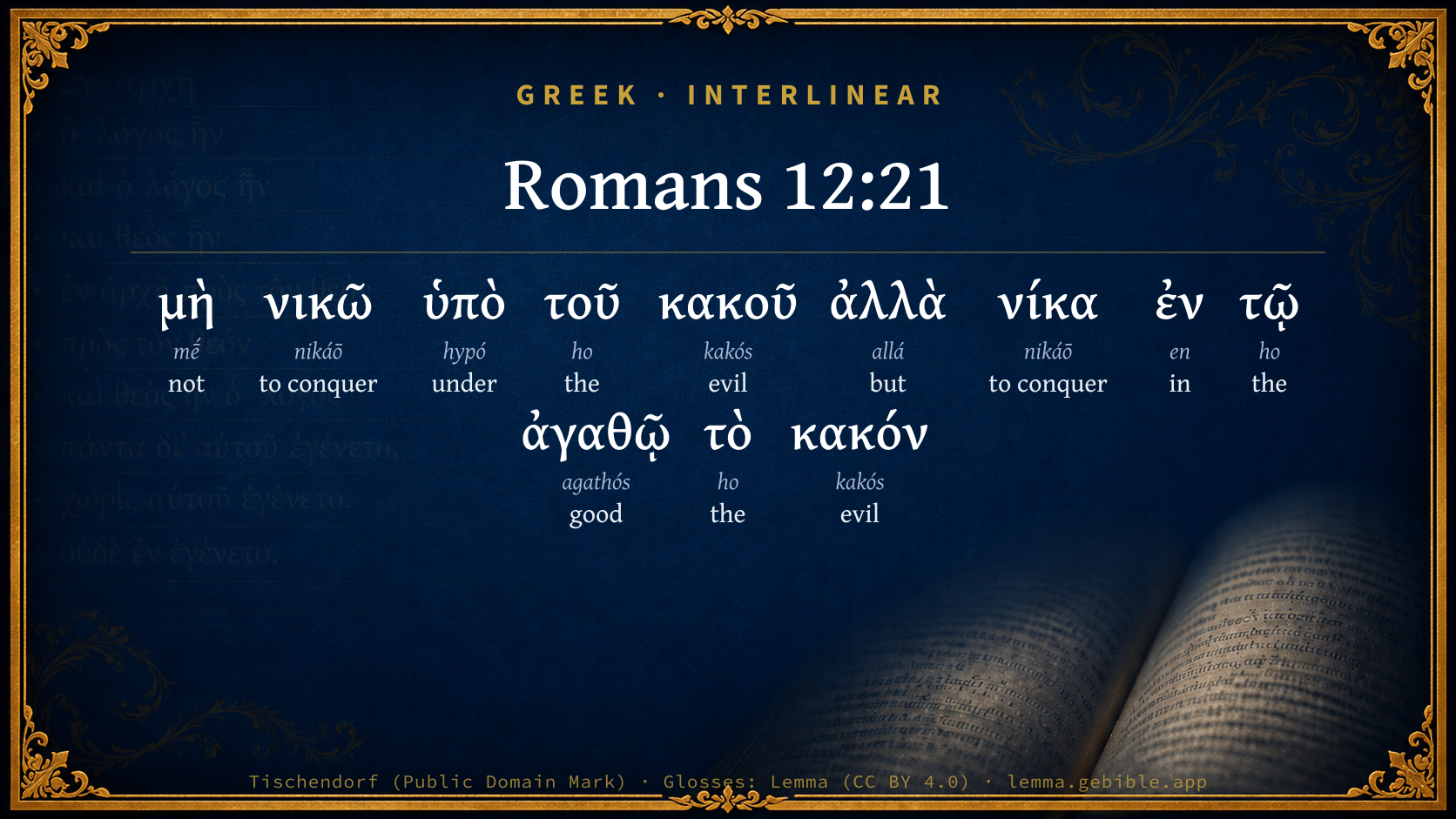
Greek (Tischendorf 8th ed.) Romans 12:21 appears in the Greek New Testament. The text above is from the Tischendorf 8th edition. Each word links to its Strong’s number and a concise gloss. Click any word for its full Thayer’s Greek Lexicon entry.
Download image
Cite this verse

Romans 12:21 (World English Bible). Public Domain. Lemma interlinear Bible study tool, https://lemma.gebible.app/v/romans/12/21.

Show BibTeX & RIS
BibTeX
RIS
English Translation
Don't be overcome by evil, but overcome evil with good.
World English Bible · Public Domain
Download a study sheet

One document with this verse’s original text, its word-by-word gloss line, the meaning frame, cross-references with their text, attributed commentary, and full source and license credits — printable, and it pastes into notes with its structure intact.

This verse Autodidact and up

Study sheet (.html) Plain text (.txt)

A passage Seminary Student

Up to 50 verses in one chapter. A passage sheet keeps up to 6 commentary sources and 12 cross-references per verse, in the order this page ranks them, and says so on the sheet whenever that leaves anything out. Ask for a single verse and you get the Autodidact verse sheet above.

Everything on this page stays free to read, with no account — the sheet is a download of what is already on screen, not access to it.

Want to remove ads? Support Godless Engineer
Compare translations 3

The same verse in 3 English versions, stacked beneath the original-language interlinear above. Click any original word for its lexicon entry.

Each is an independent rendering of the whole verse — the interlinear is not word-aligned to these translations.

Highlighted words mark where these versions differ — a whole-verse word diff, not a word-by-word alignment.

  • World English Bible Public Domain
    Don't be overcome by evil, but overcome evil with good.
  • King James Version Public Domain
    Be not overcome of evil, but overcome evil with good.
  • unfoldingWord Literal Text CC BY-SA 4.0
    Do not be overcome by the evil, but overcome the evil with the good.

unfoldingWord Literal Text — © unfoldingWord, licensed CC BY-SA 4.0. Word-aligned USFM3 via Door43 (git.door43.org/unfoldingWord/en_ult).

Versions to compare (up to 4)

3 of 4 selected

Show all 19 translations

Every available English version of this verse, each an independent rendering of the whole verse.

  • World English Bible Public Domain
    Don't be overcome by evil, but overcome evil with good.
  • Berean Standard Bible Public Domain
    Do not be overcome by evil, but overcome evil with good.
  • Majority Standard Bible Public Domain
    Do not be overcome by evil, but overcome evil with good.
  • King James Version Public Domain
    Be not overcome of evil, but overcome evil with good.
  • American Standard Version (1901) Public Domain
    Be not overcome of evil, but overcome evil with good.
  • Revised Version (1885) Public Domain
    Be not overcome of evil, but overcome evil with good.
  • Geneva Bible (1599) Public Domain
    Bee not ouercome of euill, but ouercome euill with goodnesse.
  • Douay-Rheims (1899) Public Domain
    Be not overcome by evil, but overcome evil by good.
  • Young's Literal Translation Public Domain
    Be not overcome by the evil, but overcome, in the good, the evil.
  • Literal Standard Version CC BY-SA 4.0
    Do not be overcome by the evil, but overcome, in the good, the evil.
  • Unlocked Literal Bible CC BY-SA 4.0
    Do not be overcome by evil, but overcome evil with good.
  • unfoldingWord Literal Text CC BY-SA 4.0
    Do not be overcome by the evil, but overcome the evil with the good.
  • Darby Bible Public Domain
    Be not overcome by evil, but overcome evil with good.
  • World Messianic Bible Public Domain
    Don’t be overcome by evil, but overcome evil with good.
  • Webster's Bible Public Domain
    Be not overcome by evil, but overcome evil with good.
  • Free Bible Version CC BY-SA 4.0
    Don't be defeated by evil—conquer evil with good.
  • Bible in Basic English Public Domain
    Do not let evil overcome you, but overcome evil by good.
  • Text-Critical English NT CC BY 4.0
    Do not be overcome by evil, but overcome evil with good.
  • Tyndale New Testament (1534) Public Domain
    Be not overcome of evyll: But overcome evyll with goodnes.

Literal Standard Version (2020), Covenant Press — licensed CC BY-SA 4.0. Text via the HelloAO Bible API (eBible.org). Unlocked Literal Bible (unfoldingWord) — licensed CC BY-SA 4.0. Text via the HelloAO Bible API (eBible.org). unfoldingWord Literal Text — © unfoldingWord, licensed CC BY-SA 4.0. Word-aligned USFM3 via Door43 (git.door43.org/unfoldingWord/en_ult). Free Bible Version, Dr. Jonathan Gallagher — licensed CC BY-SA 4.0. Text via the HelloAO Bible API (eBible.org).

Word by word

More ways to search: Search by grammar → Find every occurrence → Compare this word →

Practice this passage: Drill this verse → Learn its vocabulary →

νικῶ
nikáō
G3528
“to conquer”
Verb, Present, Passive, Imperative, 2nd person, Singular
Part of Speech
Verb
Tense
Present
Voice
Passive
Mood
Imperative
Person
2nd person
Number
Singular
Full Thayer's Definition

Origin: from G3529

TDNT: 19:42,6

1. to conquer a. to carry off the victory, come off victorious 1. of Christ, victorious over all His foes 2. of Christians, that hold fast their faith even unto death against the power of their foes, and temptations and persecutions 3. when one is arraigned or goes to law, to win the case, maintain one's cause
  1. μὴ mḗ G3361 “not” Particle, Negative
  2. ὑπὸ hypó G5259 “under” Preposition
  3. τοῦ ho G3588 “the” Article, Genitive, Singular, Neuter
  4. κακοῦ kakós G2556 “evil” Adjective, Genitive, Singular, Neuter
  5. ἀλλὰ allá G235 “but” Conjunction
  6. νίκα nikáō G3528 “to conquer” Verb, Present, Active, Imperative, 2nd person, Singular
  7. ἐν en G1722 “in” Preposition
  8. τῷ ho G3588 “the” Article, Dative, Singular, Neuter
  9. ἀγαθῷ agathós G18 “good” Adjective, Dative, Singular, Neuter
  10. τὸ ho G3588 “the” Article, Accusative, Singular, Neuter
  11. κακόν kakós G2556 “evil” Adjective, Accusative, Singular, Neuter

About this verse

These counts appear in no published source. They are computed here, from the morphology-tagged text and Lemma’s own curated glosses. What Lemma adds →

12
words
8
distinct lemmas
Pauline Epistles
section

Shared distinctive vocabulary

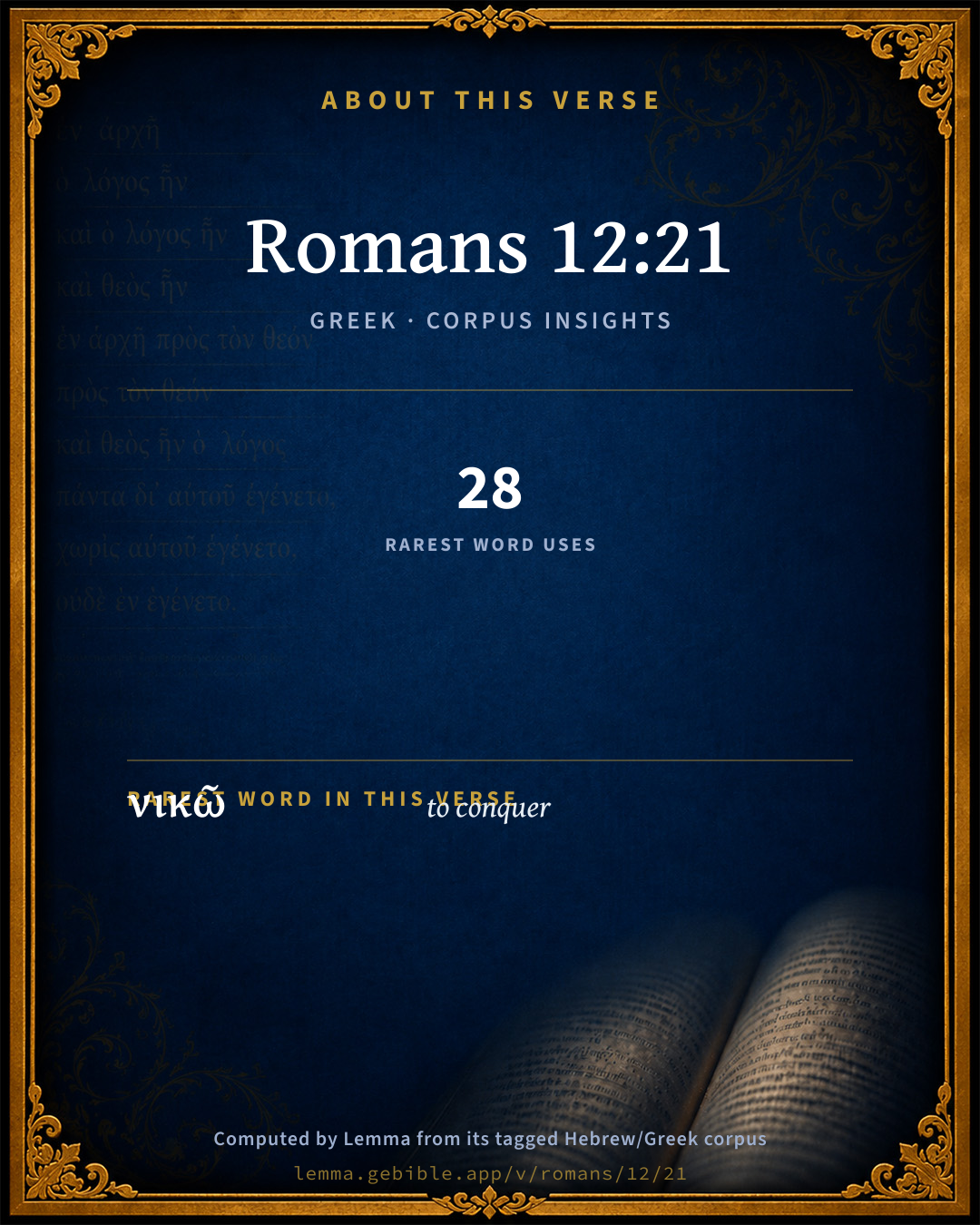
νικῶ to conquer G3528 occurs in 24 verses of the Greek New Testament. Also found in:
Repetition

Words recur within this verse:

  • νικῶ to conquer G3528 ×2
  • κακοῦ evil G2556 ×2
  • τοῦ the G3588 ×3

Cross-references

3

Topical passages linked to Romans 12:21 in the Treasury of Scripture Knowledge — connected by theme and wording, ordered by reader-vote popularity; previews shown in the World English Bible.

  • 1 Peter 3:9 not rendering evil for evil, or reviling for reviling; but instead blessing; knowing that to this were you called, that you may inherit a blessing.
  • Luke 6:27–30 "But I tell you who hear: love your enemies, do good to those who hate you,
  • Proverbs 16:32 One who is slow to anger is better than the mighty; One who rules his spirit, than he who takes a city.

Cross-references courtesy of OpenBible.info (CC BY 4.0).

Commentary

Notes on Romans 12:21 from classic Christian and Jewish commentators (each source and its license shown beneath its notes). The classic Christian expositions comment on the surrounding passage and are grouped to its opening verse, so a note may address several verses; the Jewish commentaries on the Tanakh (Rashi and others) are per-verse, so they appear only where the commentator wrote on this verse.

Lemma curates 59 commentaries, every one of them public domain or Creative Commons licensed, each selected and text-cleaned for this edition rather than reprinted as found. About our sources →

Joseph Benson's Commentary

Rom 12:21. Be not overcome of evil — As all are who avenge themselves; but — Even if you see no present fruit, yet persevere; and overcome evil with good — Conquer your enemies with kindness and patience, which is the most glorious victory, and a victory which may certainly be obtained, if you have the courage to adhere to that which, being good, is always in its own nature, on the whole, invincible, to whatever present disadvantage it may seem obnoxious. Blackwall, after having praised the language in which this precept is delivered, adds, “This is a noble strain of Christian courage, prudence, and goodness, that nothing in Epictetus, Plutarch, or Antonine, can vie with. The moralists and heroes of paganism could not write and act to the height of this.”

Joseph Benson's Commentary on the Old and New Testaments (1811–1818) — public domain. Text from a community e-Sword module.

Bengel's Gnomon

Johann Albrecht Bengel

Rom 12:21. Μὴ νικῶ, be not overcome) νικῶ in the middle voice. They, whom the world consider to be conquerors, are in reality conquered.—κακοῦ) by the evil, of your enemy, and of your own nature.—νίκα, overcome) He is a brave man, who can endure.—ἐν τῷ ἀγαθῷ τὸ κακὸν, evil with good) So also ch. Rom 13:3-4, with which there is a charming connection.

Bengel's Gnomon of the New Testament — English translation (T&T Clark, Edinburgh, 1860) — public domain. Text from a community e-Sword module.

Meyer's Critical & Exegetical Commentary

Heinrich August Wilhelm Meyer

Rom_12:21. Comprehensive summary of Rom_12:19-20.Be not overcome (carried away to revenge and retaliation) by evil (which is committed against thee), but overcome by the good (which thou showest to thine enemy) the evil bringing about the result that the enemy, put to shame by thy noble spirit, ceases to act malignantly against thee and becomes thy friend. Vincit malos pertinax bonitas, Seneca, de benef. vii. 31. Comp. de ira, ii. 32; Valer. Max. iv. 2, 4. On the other hand, Soph. El. 308 f.: ἐν τοῖς κακοῖς | Πολλήʼ στʼ ἀνάγκη κἀπιτηδεύειν κακά. We may add the appropriate remark of Erasmus on the style of expression throughout the chapter: Comparibus membris et incisis, similiter cadentibus ac desinentibus sic totus sermo modulatus est, ut nulla cantio possit esse jucundior.

Meyer — Critical and Exegetical Commentary on the New Testament — English translation by Peter Christie, edited by Frederick Crombie (T&T Clark, 1880) — public domain. Text from a community e-Sword module.

Expositor's Greek Testament

ed. W. Robertson Nicoll

Rom 12:21 . μὴ νικῶ : the absence of any connecting particle gives the last verse the character of a summary: in a word, be not overcome by evil. ὑπὸ τοῦ κακοῦ = by the evil your enemy inflicts. The Christian would be overcome by evil if it were able to compel him to avenge himself by repaying it in kind. Wrong is not defeated but doubly victorious when it is repelled with its own weapons; we can only overcome it ἐν τῷ ἀγαθῷ through the good we do to our adversary, turning him so from an enemy into a friend. Vincit malos , says Seneca, pertinax bonitas: Wetst. accumulates similar examples from classical writers. The ἐν in ἐν τῷ ἀγαθῷ is probably = בְּ : it might be explained as instrumental, or rendered “at the cost of”.

The Expositor's Greek Testament, edited by W. Robertson Nicoll (1897–1910) — public domain. Text from a community e-Sword module.

Hodge's Commentary on Romans, Ephesians & First Corinthians

Charles Hodge

Rom_12:21

Be not overcome of evil, but overcome evil with good. It is only by disconnecting this verse from the preceding, and considering it as nearly independent of it, that any plausibility can be given to the first interpretation mentioned above, of Rom_12:20. That it is not thus independent of it, almost every reader must feel. We are not to conquer evil by evil, but to treat our enemies with kindness. Thus we shall most effectually subdue them. Do not therefore allow yourself to be overcome of evil, (i.e., to be provoked to the indulgence of a spirit of retaliation,) but overcome evil with good; subdue your enemies by kindness, not by injuries.

Doctrine

1. Love is the fulfilling of the law; it leads to the avoiding of everything injurious to our neighbor, and to sedulous attention to everything adapted to promote his welfare, Rom_12:9.

2. The relation in which Christians stand to each other, is that of members of the same family. As, however, it is not a relation constituted by birth, nor secured by the adoption of a name, there is no evidence of its existence but that which consists in the exercise of that brotherly affection (that spiritual στοργή) which brethren in Christ feel for each other, Rom_12:10.

3. Religion is the soul of morality, without which it is but a lovely corpse. Our moral duties we must perform as serving the Lord. The religious affections and emotions do not supersede those of a simply benevolent or social character, but mingle with them, and elevate all social and relative duties into acts of religion and genuine morality, Rom_12:11.

4. The source of our life is in God; without intercourse with him, therefore, we cannot derive those supplies of grace which are requisite to preserve the spirit of piety in our hearts, and to send a vital influence through the various duties and avocations of life. Hence the absolute necessity of being instant in prayer, Rom_12:12.

5. God has made of one blood all men that dwell upon the face of the earth. There is in this fact of a common origin, and the possession of a common nature, a sufficient ground for the inculcation of an universal sympathy with all our fellow men. As he is no true Christian who is destitute of a genuine sympathy for his fellow Christians, so he is very far from being a man such as God approves, who does not rejoice with them that do rejoice, and weep with them that weep, Rom_12:15.

6. A wrong estimate of ourselves is a fruitful source of evil. Viewed in relation to God, and in our own absolute insignificance, we have little reason to be wise or important in our own conceits. A proper self-knowledge will preserve us from pride, ambition, and contempt of others, Rom_12:16.

7. Abstaining from evil is but one half of duty. It is not enough to avoid imprecating evil upon our enemies; we must sincerely desire and pray for their welfare. Nor is it sufficient not to recompense evil for evil; we must return good for evil, Rom_12:17-21.

8. The prerogatives of judgment and vengeance belong to God, we have no right, therefore, to arrogate them to ourselves, except in those cases in which, for his glory and the good of society, he has given us authority. All condemnation of others for self-gratification, and all private revenge is inconsistent with the gospel, Rom_12:11-21.

Remarks

1. Christians should never forget that faith without works is dead. It is not more important to believe what God has revealed, than to do what he has commanded. A faith, therefore, which does not produce love, kindness, sympathy, humility, the forgiveness of injuries, etc., can do us little good, Rom_12:9-21.

2. It is peculiarly characteristic of the spirit of the gospel that it turns the heart towards others, and away from our own interests. Self is not the Christians center; men are loved because they are men, Christians because they are Christians; the former with sincere sympathy and benevolence, the latter with brotherly affection. The happiness and feelings of others, the gospel teaches us to consult in small, as well as in great matters, anticipating each other in all acts of kindness and attention, Rom_12:9-13.

3. The benevolence of the gospel is active and religious; it leads to constant efforts, and is imbued with the spirit of piety, Rom_12:11.

4. We must remember that without Christ we can do nothing; that it is not we that live, but Christ that liveth in us. If, therefore, we attempt to discharge the duties here enjoined apart from him, we shall be as a branch severed from the vine; and unless we are instant in prayer, this union with Christ cannot be kept up, Rom_12:12.

5. Alms-giving and hospitality, in some ages of the church, have been unduly exalted, as though they were the whole of benevolence, and the greater part of piety. While we avoid this extreme, we should remember that we are stewards of God, and that Whoso hath this worlds good, and seeth his brother have need, and shutteth up his bowels of compassion from him, hath not the love of God dwelling in him, Rom_12:13. 1Jo_3:17.

6. One of the most beautiful exhibitions of the character of our Savior was afforded by his conduct under persecution. He was led as a lamb to the slaughter; when he was reviled, he reviled not again; when he suffered, he threatened not. Even martyrs dying for the truth have not always been able to avoid the prediction of evil to their persecutors; so much easier is it to abstain from recompensing evil for evil, than really to love and pray for the good of our enemies. This, however, is Christian duty; such is the spirit of the gospel. Just so far, therefore, as we find our hearts indisposed to bless those who curse us, or inclined to indulge even a secret satisfaction when evil comes upon them, are we unchristian in our temper, Rom_12:19-21.

7. Nothing is so powerful as goodness; it is the most efficacious means to subdue enemies, and put down opposition. Men whose minds can withstand argument, and whose hearts rebel against threats, are not proof against the persuasive influence of unfeigned love; there is, therefore, no more important collateral reason for being good, than that it increases our power to do good, Rom_12:20, Rom_12:21.

Charles Hodge — Commentary on Romans (1835), First Corinthians (1857), and Ephesians (1856) — public domain. Text from a community e-Sword module.

Jamieson, Fausset & Brown

Robert Jamieson, A. R. Fausset & David Brown

Be not overcome of evil--for then you are the conquered party.

but overcome evil with good--and then the victory is yours; you have subdued your enemy in the noblest sense.

Note, (1) The redeeming mercy of God in Christ is, in the souls of believers, the living spring of all holy obedience (Rom 12:1). (2) As redemption under the Gospel is not by irrational victims, as under the law, but "by the precious blood of Christ" (Pe1 1:18-19), and, consequently, is not ritual but real, so the sacrifices which believers are now called to offer are all "living sacrifices"; and these--summed up in self-consecration to the service of God--are "holy and acceptable to God," making up together "our rational service" (Rom 12:1). (3) In this light, what are we to think of the so-called "unbloody sacrifice of the mass, continually offered to God as a propitiation for the sins both of the living and the dead," which the adherents of Rome's corrupt faith have been taught for ages to believe is the highest and holiest act of Christian worship--in direct opposition to the sublimely simple teaching which the Christians of Rome first received (Rom 12:1) --(4) Christians should not feel themselves at liberty to be conformed to the world, if only they avoid what is manifestly sinful; but rather, yielding themselves to the transforming power of the truth as it is in Jesus, they should strive to exhibit before the world an entire renovation of heart and life (Rom 12:2). (5) What God would have men to be, in all its beauty and grandeur, is for the first time really apprehended, when "written not with ink, but with the Spirit of the living God, not on tables of stone, but on the fleshy tables of the heart," Co2 3:3 (Rom 12:2). (6) Self-sufficiency and lust of power are peculiarly unlovely in the vessels of mercy, whose respective graces and gifts are all a divine trust for the benefit of the common body and of mankind at large (Rom 12:3-4). (7) As forgetfulness of this has been the source of innumerable and unspeakable evils in the Church of Christ, so the faithful exercise by every Christian of his own peculiar office and gifts, and the loving recognition of those of his brethren, as all of equal importance in their own place, would put a new face upon the visible Church, to the vast benefit and comfort of Christians themselves and to the admiration of the world around them (Rom 12:6-8). (8) What would the world be, if it were filled with Christians having but one object in life, high above every other--to "serve the Lord"--and throwing into this service "alacrity" in the discharge of all duties, and abiding "warmth of spirit" (Rom 12:11)! (9) Oh, how far is even the living Church from exhibiting the whole character and spirit, so beautifully portrayed in the latter verses of this chapter (Rom 12:12-21)! What need of a fresh baptism of the Spirit in order to this! And how "fair as the moon, clear as the sun, and terrible as an army with banners," will the Church become, when at length instinct with this Spirit! The Lord hasten it in its time!

Next: Romans Chapter 13

Jamieson, Fausset & Brown — Commentary Critical and Explanatory on the Whole Bible (1871) — public domain (CC PDM 1.0). Text via the HelloAO Bible API.

Adam Clarke's Commentary

Verse 21. Be not overcome of evil] Do not, by giving place to evil, become precisely the same character which thou condemnest in another. Overcome evil with good - however frequently he may grieve and injure thee, always repay him with kindness; thy good-will, in the end, may overcome his evil.

1. THOMAS AQUINAS has properly said: Vincitur a malo qui vult peccare in alium, quia ille peccavit in ipsum. "He is overcome of evil who sins against another, because he sins against him." A moral enemy is more easily overcome by kindness than by hostility. Against the latter he arms himself; and all the evil passions of his heart concentrate themselves in opposition to him who is striving to retaliate, by violence, the injurious acts which he has received from him. But where the injured man is labouring to do him good for his evil - to repay his curses with blessings and prayers, his evil passions have no longer any motive, any incentive; his mind relaxes; the turbulence of his passions is calmed; reason and conscience are permitted to speak; he is disarmed, or, in other words, he finds that he has no use for his weapons; he beholds in the injured man a magnanimous friend whose mind is superior to all the insults and injuries which he has received, and who is determined never to permit the heavenly principle that influences his soul to bow itself before the miserable, mean, and wretched spirit of revenge. This amiable man views in his enemy a spirit which he beholds with horror, and he cannot consent to receive into his own bosom a disposition which he sees to be so destructive to another; and he knows that as soon as he begins to avenge himself, he places himself on a par with the unprincipled man whose conduct he has so much reason to blame, and whose spirit he has so much cause to abominate. He who avenges himself receives into his own heart all the evil and disgraceful passions by which his enemy is rendered both wretched and contemptible. There is the voice of eternal reason in "Avenge not yourselves: - overcome evil with good;" as well as the high authority and command of the living God.

2. The reader will, no doubt, have observed with pleasure the skill and address, as well as the Divine wisdom, with which the apostle has handled the important subjects which he has brought forth to view in the preceding chapters. Nothing can be more regular or judicious than his plan of proceeding. He first shows the miserable, wretched, fallen, degraded state of man; next, the merciful provision which God has made for his salvation, and lastly, the use which man should make of the mercies of his God. He shows us, in a most pointed manner, the connection that subsists between the doctrines of the Gospel and practical piety. From the beginning of the first to the end of the eleventh chapter he states and defends the grand truths of Christianity, and from the beginning of the twelfth to the end of the epistle he shows the practical use of these doctrines. This is a point which is rarely considered by professors; multitudes run to the Epistle to the Romans for texts to prop up their peculiar system of doctrine, but how few go to this sacred book for rules relative to holy life! They abound in quotations from the doctrinal parts, but seldom make that use of them which the apostle makes in this chapter. "I beseech you, therefore, brethren, by the mercies of God, that ye present your bodies a living sacrifice, holy, acceptable unto God, which is your reasonable service, and be not conformed to this world, &c." Now we learn from the use which the apostle makes of his doctrines, that whatsoever teaching comes from God leads to a holy and useful life. And if we hold any doctrine that does not excite us to labour after the strictest conformity to the will of God in all our tempers, spirit, and actions, we may rest assured that either that doctrine is not of God, or we make an improper use of it. He that knows God best, loves and resembles him most.

Adam Clarke's Commentary on the Bible (1810–1826) — public domain. Text from a community e-Sword/MySword module.

John Calvin's Commentaries

21. Be not overcome by evil, etc. This sentence is laid down as a confirmation; for in this case our contest is altogether with perverseness, if we try to retaliate it, we confess that we are overcome by it; if, on the contrary, we return good for evil, by that very deed we show the invincible firmness of our mind. This is truly a most glorious kind of victory, the fruit of which is not only apprehended by the mind, but really perceived, while the Lord is giving success to their patience, than which they can wish nothing better. On the other hand, he who attempts to overcome evil with evil, may perhaps surpass his enemy in doing injury, but it is to his own ruin; for by acting thus he carries on war for the devil.

John Calvin's Commentaries (1540-1563) — public domain. Text from the Calvin Translation Society English edition (1840s-50s) via the Christian Classics Ethereal Library (ccel.org). Calvin's coverage is partial (roughly two-thirds of the Bible); uncommented books and verses are honest gaps, never fabricated. The 19th-century editor's footnotes and remarks are omitted so the notes are faithfully Calvin's own voice.

Ellicott's Commentary for English Readers

(21) Be not overcome of evil, but . . .—A fine sentiment. The infliction of vengeance is not a sign of strength, but of weakness. To repress the desire for revenge is to gain a victory over self, which is not only nobler in itself, but will also be much more effectual. It will disarm the enemy, and turn him into a friend.

A Bible Commentary for English Readers, edited by Charles John Ellicott (1878–1897) — public domain. Text from a community e-Sword module.

The Cambridge Bible for Schools and Colleges

gen. ed. J. J. S. Perowne

21. Be not overcome, &c.] The verbs are in the singular; individualizing the appeal. The verse runs, lit., Be not thou overcome by the evil, but overcome the evil in the good.—“The evil,” “the good;”—that of the evil-doer and the sufferer respectively. Q. d., “Do not let his evil principles and acts conquer the better mind that is in thee by grace, but use ‘the good’ given to thee—the good of Divine peace and love shed abroad in thy heart—to subdue the evil in him.”—“In the good:” = under its influence.

Out of countless examples in Christian history we quote a recent one, from the Native Church in China. In 1878 a small and new Christian community was severely persecuted, and some of the converts, grownup men, were cruelly ill-used by a petty official, without the least resistance on their part. Some time after, this official was summoned before a superior officer, and sentenced to severe punishment. But one of his former victims, who meanwhile had not been his accusers, interposed and procured his pardon; and their enemy was turned forthwith into a grateful and cordial friend. (A. E. Moule’s Story of the Chehkiang Mission, ed. 2, p. 120.)

The Cambridge Bible for Schools and Colleges (gen. ed. J. J. S. Perowne; Cambridge University Press, 1878–1918) — public domain. Text from a community e-Sword module.

John Gill's Exposition

Be not overcome of evil,.... Neither of the evil one, Satan, who is very busy to stir up the corruption of nature to an hatred of enemies, and to seek revenge; but give no place nor heed unto him, resist him, and he will flee from you, Jam 4:7; "put on the whole armour of God", Eph 6:11, whereby you may defend yourselves, that he cannot touch you: nor of the evil of sin that dwells in you; "for whom a man is overcome, of the same is he brought in bondage", Pe2 2:19; nor of the evil of the man that has done you an injury, as you will be, if you return evil for evil, or take any steps and measures to avenge yourselves; for then not you, but he that has done you the wrong, will be the conqueror:

but overcome evil with good; overcome the evil man, and the evil he has done you, by doing good to him, by feeding him when hungry, by giving him drink when thirsty, by clothing him when naked, and by doing other offices of kindness and humanity to him; which is most likely to win upon him, and of an enemy to make him your friend: and if not, however it will show that you are conquerors, yea, "more than conquerors", Rom 8:37, through the grace and strength of him that has loved you, over Satan, over the corruptions of your own hearts, and over the malice and wickedness of your enemies.

Next: Romans Chapter 13

John Gill's Exposition of the Whole Bible (1746–1763) — public domain (CC PDM 1.0). Text via the HelloAO Bible API.

Trapp's Complete Commentary

John Trapp

21 Be not overcome of evil, but overcome evil with good.

Ver. 21. Be not overcome] In rixa is inferior est, qui victor est, saith Basil. In revenge of injuries, he is the loser that gets the better. Hence the apostle disgraceth it, by a word that signifieth disgrace or loss of victory, ηττημα, 1Co 6:7. When any one provokes us, we use to say, We will be even with him. There is a way whereby we may be, not even with him, but above him; that is, forgive him, feed him with the best morsels, feed him indulgently (so the apostle’s word ψωμιζε in the former verse signifies), feast him, as Elisha did his persecutors; providing a table for them, who had provided a grave for him. "Set bread and water before them," saith he, and mark what followed; "The bands of Syria came no more after that time," by way of ambush or inroad, "into the bounds of Israel," 2Ki 6:22-23. In doing some good to our enemies (saith a grave divine hereupon) we do most to ourselves: God cannot but love in us that imitation of his mercy, who bids his sun to shine on the wicked and unthankful also; and his love is never fruitless. It is not like the winter sun that gives little heat, but like the sun in his strength, that warms and works effectually upon the rest of the creatures.

But overcome evil] This is the most noble victory. Thus David overcame Saul, and Henry VII, emperor of Germany, overcame the priest that poisoned him at the sacrament; for he pardoned him, and bade him be packing. (Fanc. Chron.) So did not Jacup the Persian king, who perceiving himself poisoned by his adulterous wife, enforced her to drink of the same cup; and because he would be sure she should not escape, with his own hand he struck off her head. (Turkish Hist.) But this (to say truth) was not revenge, but justice. Henry IV of France was wont to say, that he made all the days of those golden, who had most offended him; that so, the lead of their wickedness might be darkened by the gold of his goodness.

John Trapp, A Commentary or Exposition upon All the Books of the Old and New Testament (1647–1656) — public domain. Text from a community e-Sword module.

Albert Barnes' Notes on the Bible

Be not overcome of evil - Be not “vanquished” or “subdued” by injury received from others. Do not suffer your temper to be excited; your Christian principles to be abandoned; your mild, amiable, kind, and benevolent temper to be ruffled by any opposition or injury which you may experience. Maintain your Christian principles amidst all opposition, and thus show the power of the gospel. They are overcome by evil who suffer their temper to be excited, who become enraged and revengeful and who engage in contention with those who injure them; Pro 16:22.

But overcome evil with good - That is, subdue or vanquish evil by doing good to others. Show them the loveliness of a better spirit; the power of kindness and benevolence; the value of an amiable, Christian deportment. So doing, you may disarm them of their rage, and be the means of bringing them to better minds.

This is the noble and grand sentiment of the Christian religion. Nothing like this is to be found in the pagan classics; and nothing like it ever existed among pagan nations. Christianity alone has brought forth this lovely and mighty principle; and one design of it is to advance the welfare of man by promoting peace, harmony, and love. The idea of “overcoming evil with good” never occurred to people until the gospel was preached. It never has been acted on except under the influences of the gospel. On this principle God shows kindness; on this principle the Saviour came, and bled, and died; and on this principle all Christians should act in treating their enemies, and in bringing a world to the knowledge of the Lord Jesus. If Christians will show benevolence, if they will send forth proofs of love to the ends of the earth, the evils of the world will be overcome. Nor can the nations be converted until Christians act on this great and most important principle of their religion, “on the largest scale possible,” to “overcome evil with good.”

Albert Barnes' Notes on the Bible (1834–1885) — public domain. Text from a community e-Sword/MySword module.

Haydock's Catholic Bible Commentary

This is the apostle’s conclusion of the foregoing instructions. Be not overcome by the malice of thy enemy, so as to wish to revenge thyself, without leaving all to the just judgment of God; but overcome his malice by thy kindness. This is complied with, when upon occasion of injuries received we always return a kindness, and in proportion as the malice of our enemies increases, our spirit of benevolence should also increase. (Estius)

George Leo Haydock (1774–1849), Haydock's Catholic Family Bible and Commentary, 1859 edition — public domain. Excludes Psalms (Douay-Rheims chapter numbering differs from Protestant) and Deuterocanonical books (Catholic canon only).

Matthew Poole's English Annotations

This verse is a Divine aphorism: therein the apostle anticipates an objection. Some might be ready to say, If we should follow this advice we should be counted cowards and dastards, &c. To this he answers, that it is the ready way to be triumphers and conquerors. By evil, here, he means, the wrongs and injuries of men; and to be overcome of evil, is to be moved and provoked thereby to impatience or malice. When it is thus with a man, he is overcome, or conquered: in revenge of injuries, he is a loser that gets the better. Therefore he exhorts us, rather to

overcome evil with good; that is a noble victory indeed: this is the way, not to be even with him that wrongs us, but to be above him. Thus David overcame Saul, and Elisha the bands of Syria. This is the way to overcome ourselves, and our adversaries too: ourselves, in denying our lusts that egg us on to revenge; our adversaries, in winning them to relent and acknowledge their miscarriages.

Matthew Poole's English Annotations on the Holy Bible (1683–1685) — public domain. Text from a community e-Sword/MySword module.

Whedon's Commentary on the Bible

Daniel D. Whedon

21. Overcome evil with good—And so you will not only become a true Christian avenger, but a true Christian conqueror. It is wonderful how often love is wiser than wisdom or cunning; disarming its foes and winning its way by animating every body with the spirit to give it its way. We doubt not that Paul, with all the severity which his love sometimes wore, especially in the present epistle, often triumphed by the blessed sorcery of love.

Paul has now in this chapter organized the unity of his Roman Church, with faith in Christ for its basis, and love for its central and vital principle. How shall it deal with the powers of the world? The next chapter will show.

Daniel D. Whedon (gen. ed.), Commentary on the Old and New Testaments (1874–1909) — public domain. Text from a community e-Sword module.

John Wesley's Explanatory Notes

And if you see no present fruit, yet persevere. Be not overcome with evil - As all are who avenge themselves. But overcome evil with good. Conquer your enemies by kindness and patience.

John Wesley, Explanatory Notes Upon the Whole Bible (1754–1765) — public domain. Text via the GEBible commentary corpus.

Burkitt's Expository Notes on the New Testament

William Burkitt

Learn hence, That every Christian should not only take heed that he be not overcome of evil; but also labour and endeavour what in him lieth to overcome evil with good.

Question What are we to understand here by evil?

Answer Any unkind or injurious dealings from others, any mischief or ill turn which our neighbour has done us.

Question What is it to be overcome of evil?

Answer 1. When we dwell in our thoughts too much, too often, and too long, upon the injuries and unkindnesses we have met with. This is, as if a man that was to take down a bitter pill should be continually chomping of it, and rolling it under his tongue.

2. We are overcome of evil, when we are brought over to commit the same evil, by studying to make spiteful returns by way of revenge for the injuries we have received.

Question Wherein consists the duty and excellency of overcoming evil with good?

Answer It renders us like to God, who does good to us daily, though we do evil against him continually, hereby we imitate God in one of the choicest perfections of his divine nature; hereby we overcome ourselves; hereby we overcome our enemies; and make them become our friends.

Question How should we overcome evil with good?

Answer By doing good for evil, by returning courtesies for injuries, speaking well of others, although they speak hardly, yea, very ill of us.

William Burkitt's Expository Notes on the New Testament (1700–1703) — public domain. Text from a community e-Sword module.

Godbey's Commentary on the New Testament

William B. Godbey

21. “Be not overcome of evil, but conquer evil with good.” Your enemy has nothing but an old wooden sword that would break if he were to hit you with it; while you have a Jerusalem blade of shining steel, sharp as lightning and potent as dynamite. So you have nothing to do but use your own weapon, God’s blessed word, truth, grace, love and philanthropy, and you knock your enemy into smithereens, and transform him into a friend ready to die for you. I have seen this wonderfully verified a thousand times.

William B. Godbey, Commentary on the New Testament (1896–1900) — public domain. Text from a community e-Sword module.

McGarvey & Pendleton's Commentaries

J. W. McGarvey

Be not overcome of evil, but overcome evil with good . [Evil is the weak weapon of the sinner; goodness, the puissant, all-conquering blade of the saint. What shame, then, if the saint lose in the unequal conflict! "Thus David overcame Saul" (Trapp). "In revenge," says Basil, "he is the loser who is the victor." When evil leads us to do evil, then are we overcome of evil. When we meet evil with good, we have at least overcome the evil in ourselves, if not in our enemy.]

J. W. McGarvey (with Philip Y. Pendleton), Commentaries on the New Testament (The Fourfold Gospel, 1914; Acts; and the epistles) — public domain. Text from a community e-Sword/MySword module.

The People's New Testament

B. W. Johnson

21. Be not overcome by evil. Don't let the fact that you are treated wickedly induce you to do wrong, but overcome evil by returning good for evil. This sums up the whole matter respecting the treatment of adversaries. Happy would it be if the Christian world could come up to these requirements! The logic of kind deeds is more powerful than the logic of argument.

B. W. Johnson's The People's New Testament with Notes (1889–1891) — public domain. Electronic text from the Christian Classics Ethereal Library (CCEL) ThML edition.

Cambridge Greek Testament for Schools and Colleges

21. μὴ νικῶ κ.τ.λ. sums up 17–20. Comm. qu. Sen. de benef., VII. 31, vincit malos pertinax bonitas. Wetst. gives a long catena of |[256].

[256] | parallel to

Cambridge Greek Testament for Schools and Colleges (Cambridge University Press, 1896; 21 vols, various authors incl. Carr, Maclear, Plummer, Farrar, Lumby, Moule, M. R. James, Simcox) — public domain. Text from a community e-Sword module.

Alford’s Greek Testament

Henry Alford

21.] If you suffered yourselves to be provoked to revenge, you would be yielding to the enemy,—overcome by that which is evil: do not thus,—but in this, and in all things, overcome the evil (in others) by your good.

Henry Alford, The Greek Testament (1849–1861) — public domain. Text from a community e-Sword module.

International Critical Commentary

21. μὴ νικῶ ὑπὸ τοῦ κακοῦ κ.τ.λ., ‘do not allow yourself to be overcome by the evil done to you and be led on to revenge and injury, but conquer your enemies’ evil spirit by your own good disposition.’ A remark which applies to the passage just concluded and shows St. Paul’s object, but is also of more general application.

Tert. Tertullian.

Jos. Josephus.

B Cod. Vaticanus

D Cod. Claromontanus

E Cod. Sangermanensis

F Cod. Augiensis

G Cod. Boernerianus

L Cod. Angelicus

Syrr. Syriac.

Boh. Bohairic.

Sah. Sahidic.

Vulg. Vulgate.

Chrys. Chrysostom.

Latt. Latin.

Eus. Eusebius.

&c. always qualify the word which precedes, not that which follows:

Mey. Meyer.

Go. Godet.

Va. Vaughan.

Gif. Gifford.

Euthym.-Zig. Euthymius Zigabenus.

RV. Revised Version.

AV. Authorized Version.

אԠCod. Sinaiticus

A Cod. Alexandrinus

P Cod. Porphyrianus

Orig.-lat. Latin Version of Origen

Theod.-Mops. Theodore of Mopsuessia.

Ambrstr. Ambrosiaster.

Aug. Augustine.

WH. Westcott and Hort.

Wic. Wiclif.

Tyn. Tyndale.

Cov. Coverdale.

Genev. Geneva.

International Critical Commentary — older volumes (1896–1929), various authors — public domain. Text from a community e-Sword module.

Godet's Commentaries

Frédéric Louis Godet

Vv. 21. To render evil for evil, is to let evil have the victory; to confine oneself to not rendering evil is, if it may be so said, neither to be conqueror nor conquered, though in reality this also is to be conquered. The true victory over evil consists in transforming a hostile relation into one of love by the magnanimity of the benefits bestowed. Thereby it is that good has the last word, that evil itself serves it as an instrument: such is the masterpiece of love.

Frédéric Louis Godet — Commentaries on Luke, John, Romans, and 1 Corinthians — English translation (T&T Clark, Edinburgh, 1870s–1890s) — public domain. Text from a community e-Sword module.

Lesson kit

Teaching starters — assembled from the data on this page, not authored interpretation. Every prompt links to the verse data it draws on. Edit before teaching.

Romans, in the Pauline Epistles, opens this verse with 12 words (8 distinct Greek lemmas). Its most distinctive word is nikáō (“to conquer”). A historical commentator’s framing appears above. Read the whole chapter for the surrounding context.

Discussion questions

  1. How does “to conquer” (nikáō) shape what this verse is saying?
  2. Luke 11:22 shares the word «to conquer» with this verse. How do the two illuminate each other?
  3. “to conquer” occurs 2× in this one verse. What is the effect of the repetition?
  4. These translations render this verse differently. What is at stake in choosing one wording over another?
  5. Reading how Joseph Benson's Commentary and Bengel's Gnomon read this verse, where do the two commentators agree and where do they part?

Things to notice

  • These translations choose different wording for 2 words in this verse.
  • “to conquer” occurs 2× in this single verse.
  • 8 distinct Greek lemmas span 12 words in this verse.

Reading settings

Reading text

Shown beneath each verse's original-language words.

Old Testament
Old Testament edition

Read the OT as the Masoretic Hebrew (MT) or the Greek Septuagint (LXX).

English shown for the Greek Septuagint (in the Hebrew ↔ Greek comparison).

Comparing translations? Open the Compare panel on any verse page to stack up to four side by side.