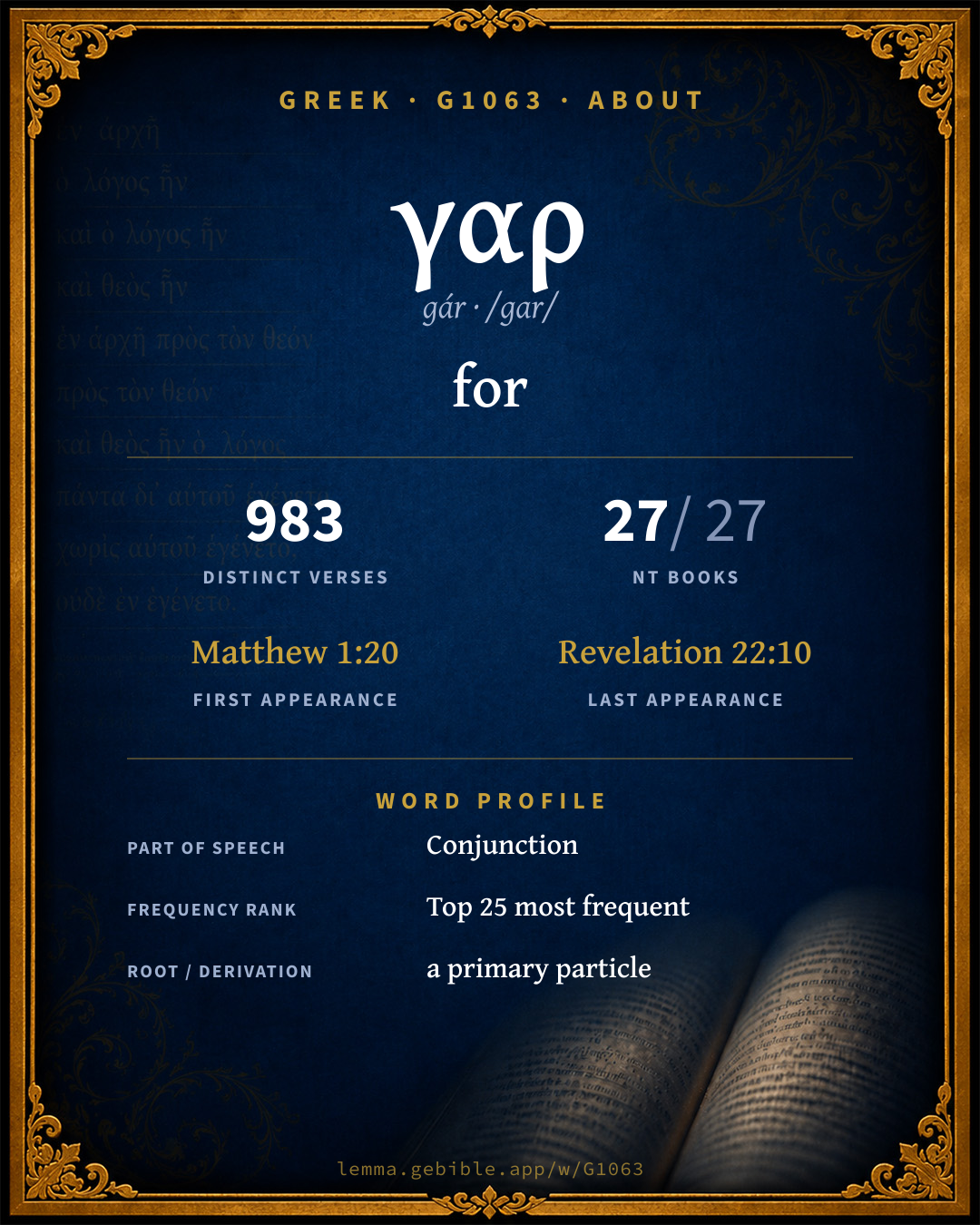
γάρ
for
Full lexicon entry — Thayer's Greek Lexicon
From Thayer's Greek Lexicon
Where this word appears
Grammar key — what these labels mean
Part of speech
- Conjunction
- A joining word linking words or clauses.
Every verse where G1063 appears in the Book of Acts — 74 distinct verses. Click any verse to open its interlinear word-by-word view. Verse text shown in the World English Bible for context — . Each verse’s Greek form is shown with its reference; the English is not keyword-highlighted, since the data carries no word-level English alignment. Use “Compare translations” on any verse to read it across multiple English versions. This concordance covers the Greek New Testament; Septuagint (Greek Old Testament) occurrences of this word are not indexed here.
Acts
- Acts 1:20 γὰρ conj For it is written in the book of Psalms, 'Let his habitation be made desolate, Let no one dwell therein,' and, 'Let another take his office.'
- Acts 2:15 γὰρ γὰρ conj conj For these aren't drunken, as you suppose, seeing it is only the third hour of the day.
- Acts 2:25 γὰρ conj For David says concerning him, 'I saw the Lord always before my face, For he is on my right hand, that I should not be moved.
- Acts 2:34 γὰρ conj For David didn't ascend into the heavens, but he says himself, 'The Lord said to my Lord, "Sit by my right hand,
- Acts 2:39 γάρ conj For to you is the promise, and to your children, and to all who are far off, even as many as the Lord our God will call to himself."
- Acts 4:3 γὰρ conj They laid hands on them, and put them in custody until the next day, for it was now evening.
- Acts 4:12 γὰρ conj There is salvation in none other, for neither is there any other name under heaven, that is given among men, by which we must be saved!"
- Acts 4:16 γὰρ conj saying, "What shall we do to these men? Because indeed a notable miracle has been done through them, as can be plainly seen by all who dwell in Jerusalem, and we can't deny it.
- Acts 4:20 γὰρ conj for we can't help telling the things which we saw and heard."
- Acts 4:22 γὰρ conj For the man on whom this miracle of healing was performed was more than forty years old.
- Acts 4:27 γὰρ conj For truly, in this city against your holy servant, Jesus, whom you anointed, both Herod and Pontius Pilate, with the Gentiles and the people of Israel, were gathered together
- Acts 4:34 γὰρ γὰρ conj conj For neither was there among them any who lacked, for as many as were owners of lands or houses sold them, and brought the proceeds of the things that were sold,
- Acts 5:26 γὰρ conj Then the captain went with the officers, and brought them without violence, for they were afraid that the people might stone them.
- Acts 5:36 γὰρ conj For before these days Theudas rose up, making himself out to be somebody; to whom a number of men, about four hundred, joined themselves: who was slain; and all, as many as obeyed him, were dispersed, and came to nothing.
- Acts 6:14 γὰρ conj For we have heard him say that this Jesus of Nazareth will destroy this place, and will change the customs which Moses delivered to us."
- Acts 7:33 γὰρ conj The Lord said to him, 'Take your sandals off of your feet, for the place where you stand is holy ground.
- Acts 7:40 γὰρ conj saying to Aaron, 'Make us gods that will go before us, for as for this Moses, who led us out of the land of Egypt, we don't know what has become of him.'
- Acts 8:7 γὰρ conj For unclean spirits came out of many of those who had them. They came out, crying with a loud voice. Many who had been paralyzed and lame were healed.
- Acts 8:16 γὰρ conj for as yet he had fallen on none of them. They had only been baptized in the name of Christ Jesus.
- Acts 8:21 γὰρ conj You have neither part nor lot in this matter, for your heart isn't right before God.
- Acts 8:23 γὰρ conj For I see that you are in the gall of bitterness and in the bondage of iniquity."
- Acts 8:31 γὰρ conj He said, "How can I, unless someone explains it to me?" He begged Philip to come up and sit with him.
- Acts 8:39 γὰρ conj When they came up out of the water, the Spirit of the Lord caught Philip away, and the eunuch didn't see him any more, for he went on his way rejoicing.
- Acts 9:11 γὰρ conj The Lord said to him, "Arise, and go to the street which is called Straight, and inquire in the house of Judas for one named Saul, a man of Tarsus. For behold, he is praying,
- Acts 9:16 γὰρ conj For I will show him how many things he must suffer for my name's sake."
- Acts 10:46 γὰρ conj For they heard them speaking in other languages and magnifying God. Then Peter answered,
- Acts 13:8 γὰρ conj But Elymas the sorcerer (for so is his name by interpretation) withstood them, seeking to turn aside the proconsul from the faith.
- Acts 13:27 γὰρ conj For those who dwell in Jerusalem, and their rulers, because they didn't know him, nor the voices of the prophets which are read every Sabbath, fulfilled them by condemning him.
- Acts 13:36 γὰρ conj For David, after he had in his own generation served the counsel of God, fell asleep, and was laid with his fathers, and saw decay.
- Acts 13:47 γὰρ conj For so has the Lord commanded us, saying, 'I have set you as a light for the Gentiles, That you should bring salvation to the uttermost parts of the earth.'"
- Acts 15:21 γὰρ conj For Moses from generations of old has in every city those who preach him, being read in the synagogues every Sabbath."
- Acts 15:28 γὰρ conj For it seemed good to the Holy Spirit, and to us, to lay no greater burden on you than these necessary things:
- Acts 16:3 γὰρ conj Paul wanted to have him go out with him, and he took and circumcised him because of the Jews who were in those parts; for they all knew that his father was a Greek.
- Acts 16:28 γάρ conj But Paul cried with a loud voice, saying, "Don't harm yourself, for we are all here!"
- Acts 16:37 γάρ conj But Paul said to them, "They have beaten us publicly, without a trial, men who are Romans, and have cast us into prison! Do they now release us secretly? No, most assuredly, but let them come themselves and bring us out!"
- Acts 17:20 γάρ conj For you bring certain strange things to our ears. We want to know therefore what these things mean."
- Acts 17:23 γὰρ conj For as I passed along, and observed the objects of your worship, I found also an altar with this inscription: 'TO AN UNKNOWN GOD.' What therefore you worship in ignorance, this I announce to you.
- Acts 17:28 γὰρ γὰρ conj conj 'For in him we live, and move, and have our being.' As some of your own poets have said, 'For we are also his offspring.'
- Acts 18:3 γὰρ conj and because he practiced the same trade, he lived with them and worked, for by trade they were tent makers.
- Acts 18:18 γὰρ conj Paul, having stayed after this many more days, took his leave of the brothers, and sailed from there for Syria, together with Priscilla and Aquila. He shaved his head in Cenchreae, for he had a vow.
- Acts 18:28 γὰρ conj for he powerfully refuted the Jews, publicly showing by the Scriptures that Jesus was the Christ.
- Acts 19:24 γάρ conj For a certain man named Demetrius, a silversmith, who made silver shrines of Artemis, brought no little business to the craftsmen,
- Acts 19:32 γὰρ conj Some therefore cried one thing, and some another, for the assembly was in confusion. Most of them didn't know why they had come together.
- Acts 19:35 γάρ conj When the town clerk had quieted the multitude, he said, "You men of Ephesus, what man is there who doesn't know that the city of the Ephesians is temple-keeper of the great goddess Artemis, and of the image which fell down from Zeus?
- Acts 19:37 γὰρ conj For you have brought these men here, who are neither robbers of temples nor blasphemers of your goddess.
- Acts 19:40 γὰρ conj For indeed we are in danger of being accused concerning this day's riot, there being no cause. Concerning it, we wouldn't be able to give an account of this commotion."
- Acts 20:10 γὰρ conj Paul went down, and fell upon him, and embracing him said, "Don't be troubled, for his life is in him."
- Acts 20:13 γὰρ conj But we who went ahead to the ship set sail for Assos, intending to take Paul aboard there, for he had so arranged, intending himself to go by land.
- Acts 20:16 γὰρ γὰρ conj conj For Paul had determined to sail past Ephesus, that he might not have to spend time in Asia; for he was hastening, if it were possible for him, to be in Jerusalem on the day of Pentecost.
- Acts 20:27 γὰρ conj for I didn't shrink from declaring to you the whole counsel of God.
- Acts 21:3 γὰρ conj When we had come in sight of Cyprus, leaving it on the left hand, we sailed to Syria, and landed at Tyre, for there the ship was to unload her cargo.
- Acts 21:13 γὰρ conj Then Paul answered, "What are you doing, weeping and breaking my heart? For I am ready not only to be bound, but also to die at Jerusalem for the name of the Lord Jesus."
- Acts 21:22 γὰρ conj What then? The assembly must certainly meet, for they will hear that you have come.
- Acts 21:29 γὰρ conj For they had seen Trophimus, the Ephesian, with him in the city, and they supposed that Paul had brought him into the temple.
- Acts 21:36 γὰρ conj for the multitude of the people followed after, crying out, "Away with him!"
- Acts 22:22 γὰρ conj They listened to him until he said that; then they lifted up their voice, and said, "Rid the earth of this fellow, for he isn't fit to live!"
- Acts 22:26 γὰρ conj When the centurion heard it, he went to the commanding officer and told him, "Watch what you are about to do, for this man is a Roman!"
- Acts 23:5 γὰρ conj Paul said, "I didn't know, brothers, that he was high priest. For it is written, 'You shall not speak evil of a ruler of your people.'"
- Acts 23:8 γὰρ conj For the Sadducees say that there is no resurrection, nor angel, nor spirit; but the Pharisees confess all of these.
- Acts 23:11 γὰρ conj The following night, the Lord stood by him, and said, "Cheer up, Paul, for as you have testified about me at Jerusalem, so you must testify also at Rome."
- Acts 23:17 γὰρ conj Paul summoned one of the centurions, and said, "Bring this young man to the commanding officer, for he has something to tell him."
- Acts 23:21 γὰρ conj Therefore don't yield to them, for more than forty men lie in wait for him, who have bound themselves under a curse neither to eat nor to drink until they have killed him. Now they are ready, looking for the promise from you."
- Acts 24:5 γὰρ conj For we have found this man to be a plague, an instigator of insurrections among all the Jews throughout the world, and a ringleader of the sect of the Nazarenes.
- Acts 25:27 γάρ conj For it seems to me unreasonable, in sending a prisoner, not to also specify the charges against him."
- Acts 26:16 γὰρ conj But arise, and stand on your feet, for I have appeared to you for this purpose: to appoint you a servant and a witness both of the things which you have seen, and of the things which I will reveal to you;
- Acts 26:26 γὰρ γὰρ γάρ conj conj conj For the king knows of these things, to whom also I speak freely. For I am persuaded that none of these things is hidden from him, for this has not been done in a corner.
- Acts 27:22 γὰρ conj Now I exhort you to cheer up, for there will be no loss of life among you, but only of the ship.
- Acts 27:23 γάρ conj For there stood by me this night an angel, belonging to the God whose I am and whom I serve,
- Acts 27:25 γὰρ conj Therefore, sirs, cheer up! For I believe God, that it will be just as it has been spoken to me.
- Acts 27:34 γὰρ γὰρ conj conj Therefore I beg you to take some food, for this is for your safety; for not a hair will perish from any of your heads."
- Acts 28:2 γὰρ conj The natives showed us uncommon kindness; for they kindled a fire, and received us all, because of the present rain, and because of the cold.
- Acts 28:20 γὰρ conj For this cause therefore I asked to see you and to speak with you. For because of the hope of Israel I am bound with this chain."
- Acts 28:22 γὰρ conj But we desire to hear from you what you think. For, as concerning this sect, it is known to us that everywhere it is spoken against."
- Acts 28:27 γὰρ conj For this people's heart has grown callous. Their ears are dull of hearing. Their eyes they have closed. Lest they should see with their eyes, Hear with their ears, Understand with their heart, And would turn again, And I would heal them.'
About this entry
At a glance — auto-summarized from this page’s data, not written by a person. Every figure links to its source below. This summary describes the numbers; it doesn’t interpret them.
γαρ — transliterated gár — is a Greek conjunction carrying the sense “for.” Debuting at Matthew 1:20, it then recurs through the corpus. With 983 verses in 27 books, it is one of the most common word in the Greek New Testament. Each statement above links to its evidence; the full detail follows below.
Gloss history
Strong's 1890 vs modern scholarship

About this word
Strong's G1063 catalogs a Greek word from the Greek New Testament.
These counts are not copied from any lexicon or concordance. They are computed here, from the morphology-tagged Greek New Testament. What Lemma adds →
- 983
- distinct verses
- The word appears in 983 distinct verses.
- 27 / 27
- NT books
- The word appears in 27 of 27 New Testament books.
- #18
- by frequency
- Top 25 most frequent Greek words (rank 18 of 5,347 Greek words by occurrence).
View all 983 occurrences in the concordance →
Most concentrated in
- Romans 132 verses 13%
- Matthew 121 verses 12%
- 1 Corinthians 98 verses 10%
By section of the New Testament
By traditional corpus
Conventional, traditional groupings — biblical authorship is debated, so this is a traditional corpus grouping, not an authorship claim. Some books belong to more than one corpus (Luke is in both the Gospels and the Lukan corpus, and so on), so these shares overlap and need not total 100%. Each figure is a share of the word’s 983 distinct verses.
- Pauline corpus 428 verses · 44%
- Gospels 331 verses · 34%
- Lukan (Luke–Acts) 163 verses · 17%
- Hebrews 88 verses · 9%
- Johannine 81 verses · 8%
- General (Catholic) Epistles 46 verses · 5%
- Revelation 16 verses · 2%
How translations render this word
Counts come from each version’s own published word-to-Strong’s tagging or interlinear alignment — an approximate guide to how each version renders this word, not a word-level alignment the data otherwise carries. Because each total is that version’s own tagged count, the per-version totals vary from one another and need not match the appearance or distinct-verse counts above. These counts may also differ from a printed concordance because Lemma counts each distinctly tagged rendering and does not collapse phrase taggings into a single head-word total. This is a fixed set of word-tagged versions (KJV, ASV, BSB, ULT) and does not change with the reading translation you choose elsewhere. Each version’s license is shown beside its name below (and on Sources).
- King James Version: For 1,006×, Why 4×, And 3×
- American Standard Version: For 944×, But 9×, What 4×
- Berean Standard Bible: For 634×, Because 61×, Indeed 19×
- unfoldingWord Literal Text: For 1,011×, Because 19×, Indeed 4×
King James Version Public Domain
Renders G1063 across 1,040 tagged occurrences — most commonly:
Plus 12 renderings that appear only once — usually multi-word phrases or single function words the recovered tagging swept in, not distinct renderings. Not rendered by a distinct English word in 27 further occurrences.
American Standard Version Public Domain
Renders G1063 across 1,011 tagged occurrences — most commonly:
Plus 36 renderings that appear only once — usually multi-word phrases or single function words the recovered tagging swept in, not distinct renderings. Not rendered by a distinct English word in 18 further occurrences.
Berean Standard Bible Public Domain
Renders G1063 across 756 tagged occurrences — most commonly:
Plus 13 renderings that appear only once — usually multi-word phrases or single function words the recovered tagging swept in, not distinct renderings. Not rendered by a distinct English word in 268 further occurrences.
unfoldingWord Literal Text CC BY-SA 4.0
Renders G1063 across 1,043 tagged occurrences — most commonly:
Plus 7 renderings that appear only once — usually multi-word phrases or single function words the recovered tagging swept in, not distinct renderings.
Senses in Thayer's
The 1 sense Thayer's distinguishes for this word, in lexicon order (not ranked by frequency or importance). The full entry — with sub-senses — is in the Lexicon Entry tab.
- for
Word origin
Origin: a primary particle
A primary particle; properly assigning a reason (used in argument explanation or intensification; often with other particles): - and as because (that) but even for indeed no doubt seeing then therefore verily what why yet.
— Strong’s Exhaustive Concordance (1890), public domain.
Forms in the corpus
The 2 distinct written forms G1063 takes in the Greek New Testament, most frequent first — each parse links to that case’s occurrences in the concordance.
| Form | Parsing | Example | Uses |
|---|---|---|---|
| γὰρ gàr | Conjunction | Matthew 1:20 | 921 |
| γάρ gár | Conjunction | Matthew 3:3 | 115 |
Septuagint usage
The same Greek word γαρ appears 894 times in the Greek Old Testament (Septuagint), across 853 verses in 24 books.
- 894
- LXX occurrences
- Tagged occurrences of this Greek word in the Septuagint.
- 853
- verses
- Distinct Septuagint verses containing this word.
- 24 / 39
- OT books
- The word appears in 24 of the 39 Old Testament books.
Sample Septuagint occurrences
- Genesis 2:5 γάρ
- Exodus 1:19 γάρ
- Leviticus 2:11 γάρ
- Numbers 3:13 γάρ
- Deuteronomy 1:42 γάρ
- Joshua 1:6 γάρ
- Ruth 3:11 γάρ
- 1 Samuel 20:30 γάρ
- 2 Samuel 17:9 γάρ
- 1 Chronicles 8:32 γάρ
- 2 Chronicles 12:12 γάρ
- Esther 1:17 γάρ
Septuagint occurrences (same lexeme)
Every verse where the same Strong’s number (G1063) appears in the Greek Septuagint — showing the first 50 of 853. Verse text shown in the World English Bible for context; the Greek form is the matched word — the English is not keyword-highlighted.
- Genesis 2:5 γάρ No plant of the field was yet in the earth, and no herb of the field had yet sprung up; for Yahweh God had not caused it to rain on the earth. There was not a man to till the ground,
- Genesis 3:5 γάρ for God knows that in the day you eat it, your eyes will be opened, and you will be like God, knowing good and evil."
- Genesis 4:25 γάρ Adam knew his wife again. She gave birth to a son, and named him Seth. For, she said, "God has appointed me another child instead of Abel, for Cain killed him."
- Genesis 7:4 γάρ In seven days, I will cause it to rain on the earth for forty days and forty nights. Every living thing that I have made, I will destroy from the surface of the ground."
- Genesis 9:5 γάρ I will surely require your blood of your lives. At the hand of every animal I will require it. At the hand of man, even at the hand of every man's brother, I will require the life of man.
- Genesis 14:12 γάρ They took Lot, Abram's brother's son, who lived in Sodom, and his goods, and departed.
- Genesis 15:16 γάρ In the fourth generation they will come here again, for the iniquity of the Amorite is not yet full."
- Genesis 16:13 γάρ She called the name of Yahweh who spoke to her, "You are a God who sees," for she said, "Have I even stayed alive after seeing him?"
- Genesis 18:15 γάρ Then Sarah denied, saying, "I didn't laugh," for she was afraid." He said, "No, but you did laugh."
- Genesis 18:19 γάρ For I have known him, to the end that he may command his children and his household after him, that they may keep the way of Yahweh, to do righteousness and justice; to the end that Yahweh may bring on Abraham that which he has spoken of him."
- Genesis 19:22 γάρ Hurry, escape there, for I can't do anything until you get there." Therefore the name of the city was called Zoar.
- Genesis 19:30 γάρ Lot went up out of Zoar, and lived in the mountain, and his two daughters with him; for he was afraid to live in Zoar. He lived in a cave with his two daughters.
- Genesis 20:2 γάρ Abraham said about Sarah his wife, "She is my sister." Abimelech king of Gerar sent, and took Sarah.
- Genesis 20:11 γάρ Abraham said, "Because I thought, 'Surely the fear of God is not in this place. They will kill me for my wife's sake.'
- Genesis 20:12 γάρ Moreover she is indeed my sister, the daughter of my father, but not the daughter of my mother; and she became my wife.
- Genesis 21:6 γάρ Sarah said, "God has made me laugh. Everyone who hears will laugh with me."
- Genesis 21:10 γάρ Therefore she said to Abraham, "Cast out this handmaid and her son! For the son of this handmaid will not be heir with my son, even with Isaac."
- Genesis 21:16 γάρ She went and sat down opposite him, a good way off, about a bow shot away. For she said, "Don't let me see the death of the child." She sat over against him, and lifted up her voice, and wept.
- Genesis 21:17 γάρ God heard the voice of the boy. The angel of God called to Hagar out of the sky, and said to her, "What ails you, Hagar? Don't be afraid. For God has heard the voice of the boy where he is.
- Genesis 21:18 γάρ Get up, lift up the boy, and hold him in your hand. For I will make him a great nation."
- Genesis 22:12 γάρ He said, "Don't lay your hand on the boy, neither do anything to him. For now I know that you fear God, seeing you have not withheld your son, your only son, from me."
- Genesis 23:6 γάρ "Hear us, my lord. You are a prince of God among us. In the choice of our tombs bury your dead. None of us will withhold from you his tomb, but that you may bury your dead."
- Genesis 24:41 γάρ Then will you be clear from my oath, when you come to my relatives. If they don't give her to you, you shall be clear from my oath.'
- Genesis 26:3 γάρ Sojourn in this land, and I will be with you, and will bless you. For to you, and to your seed, I will give all these lands, and I will establish the oath which I swore to Abraham your father.
- Genesis 26:7 γάρ The men of the place asked him about his wife. He said, "She is my sister," for he was afraid to say, "My wife," lest, he thought, the men of the place might kill me for Rebekah, because she was beautiful to look on.
- Genesis 26:9 γάρ Abimelech called Isaac, and said, "Behold, surely she is your wife. Why did you say, 'She is my sister?'" Isaac said to him, "Because I said, 'Lest I die because of her.'"
- Genesis 26:20 γάρ The herdsmen of Gerar argued with Isaac's herdsmen, saying, "The water is ours." He called the name of the well Esek, because they contended with him.
- Genesis 26:24 γάρ Yahweh appeared to him the same night, and said, "I am the God of Abraham your father. Don't be afraid, for I am with you, and will bless you, and multiply your seed for my servant Abraham's sake."
- Genesis 27:23 γάρ He didn't recognize him, because his hands were hairy, like his brother, Esau's hands. So he blessed him.
- Genesis 27:36 γάρ He said, "Isn't he rightly named Jacob? For he has supplanted me these two times. He took away my birthright. See, now he has taken away my blessing." He said, "Haven't you reserved a blessing for me?"
- Genesis 28:11 γάρ He came to a certain place, and stayed there all night, because the sun had set. He took one of the stones of the place, and put it under his head, and lay down in that place to sleep.
- Genesis 29:2 γάρ He looked, and behold, a well in the field, and, behold, three flocks of sheep lying there by it. For out of that well they watered the flocks. The stone on the well's mouth was great.
- Genesis 29:9 γάρ While he was yet speaking with them, Rachel came with her father's sheep, for she kept them.
- Genesis 29:15 γάρ Laban said to Jacob, "Because you are my brother, should you therefore serve me for nothing? Tell me, what will your wages be?"
- Genesis 29:21 γάρ Jacob said to Laban, "Give me my wife, for my days are fulfilled, that I may go in to her."
- Genesis 29:34 γάρ She conceived again, and bare a son. Said, "Now this time will my husband be joined to me, because I have borne him three sons." Therefore was his name called Levi.
- Genesis 30:16 γάρ Jacob came from the field in the evening, and Leah went out to meet him, and said, "You must come in to me; for I have surely hired you with my son's mandrakes." He lay with her that night.
- Genesis 30:20 γάρ Leah said, "God has endowed me with a good dowry. Now my husband will live with me, because I have borne him six sons." She named him Zebulun.
- Genesis 30:26 γάρ Give me my wives and my children for whom I have served you, and let me go: for you know my service with which I have served you."
- Genesis 30:27 γάρ Laban said to him, "If now I have found favor in your eyes, stay here, for I have divined that Yahweh has blessed me for your sake."
- Genesis 30:30 γάρ For it was little which you had before I came, and it has increased to a multitude. Yahweh has blessed you wherever I turned. Now when will I provide for my own house also?"
- Genesis 31:12 γάρ He said, 'Now lift up your eyes, and behold, all the male goats which leap on the flock are streaked, speckled, and grizzled, for I have seen all that Laban does to you.
- Genesis 31:15 γάρ Aren't we accounted by him as foreigners? For he has sold us, and has also quite devoured our money.
- Genesis 31:30 γάρ Now, you want to be gone, because you sore longed after your father's house, but why have you stolen my gods?"
- Genesis 31:31 γάρ Jacob answered Laban, "Because I was afraid, for I said, 'Lest you should take your daughters from me by force.'
- Genesis 31:52 γάρ May this heap be a witness, and the pillar be a witness, that I will not pass over this heap to you, and that you will not pass over this heap and this pillar to me, for harm.
- Genesis 32:11 γάρ Please deliver me from the hand of my brother, from the hand of Esau: for I fear him, lest he come and strike me, and the mothers with the children.
- Genesis 32:21 γάρ So the present passed over before him: and he himself lodged that night in the camp.
- Genesis 32:27 γάρ He said to him, "What is your name?" He said, "Jacob."
- Genesis 32:31 γάρ The sun rose on him as he passed over Peniel, and he limped because of his thigh.
These are occurrences of the same Greek lexeme (G1063) in the Septuagint — not a translation of any one Hebrew word. The store carries no word-level Hebrew↔Greek alignment, so no Hebrew original is asserted here. Counts come from the recovered LXX Strong's tagging — high-frequency vocabulary is well covered, while rare or late forms may be untagged — so they reflect tagged occurrences and may slightly undercount.