
Acts 8:23

Greek (Tischendorf 8th ed.) Acts 8:23 appears in the Greek New Testament. The text above is from the Tischendorf 8th edition. Each word links to its Strong’s number and a concise gloss. Click any word for its full Thayer’s Greek Lexicon entry.
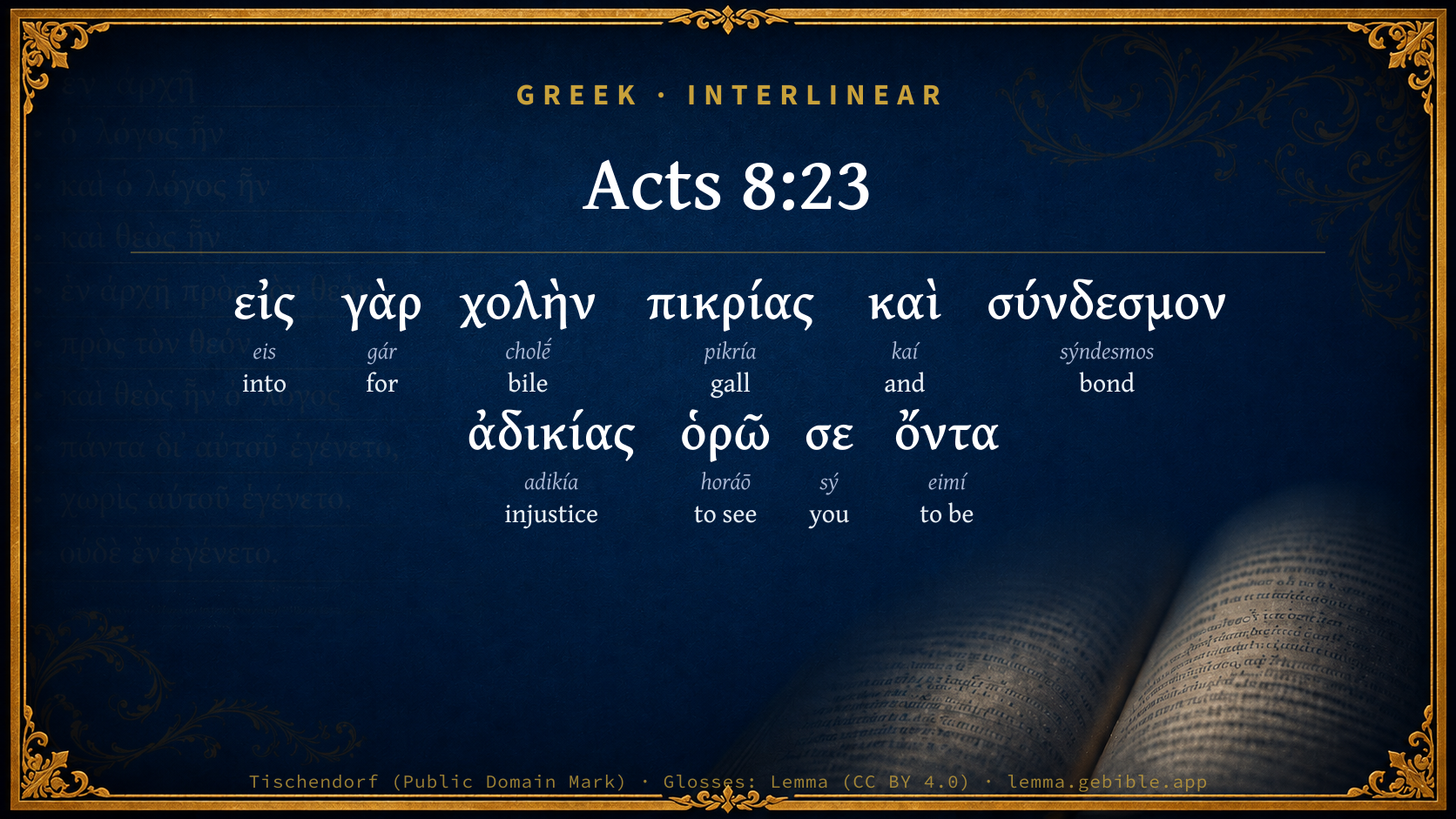
Download image
Cite this verse

Acts 8:23 (World English Bible). Public Domain. Lemma interlinear Bible study tool, https://lemma.gebible.app/v/acts/8/23.

Show BibTeX & RIS
BibTeX
RIS
English Translation
For I see that you are in the gall of bitterness and in the bondage of iniquity."
World English Bible · Public Domain
Highlights
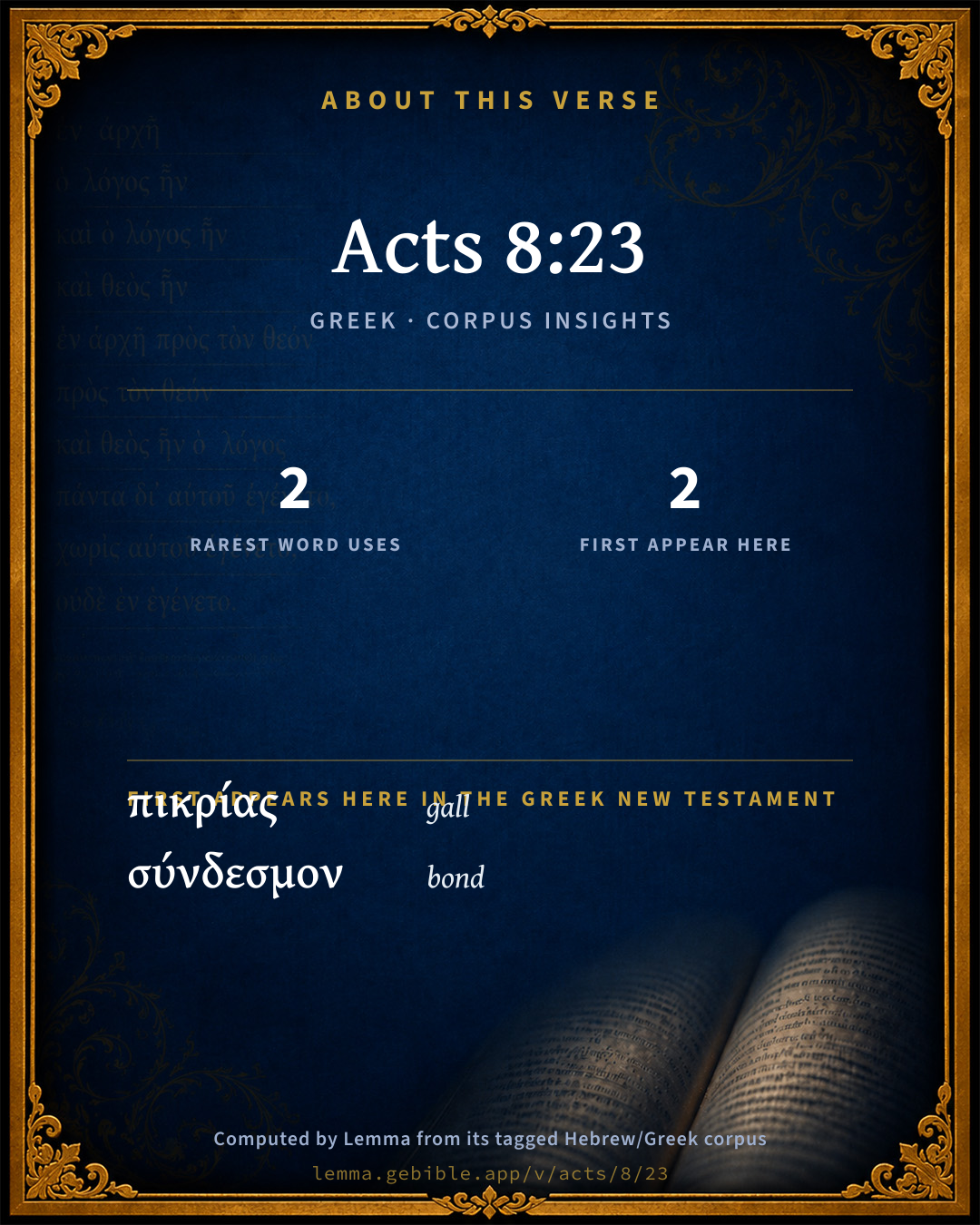
  • 2 first appearances in the Greek New Testament
Full analysis ↓
Download a study sheet

One document with this verse’s original text, its word-by-word gloss line, the meaning frame, cross-references with their text, attributed commentary, and full source and license credits — printable, and it pastes into notes with its structure intact.

This verse Autodidact and up

Study sheet (.html) Plain text (.txt)

A passage Seminary Student

Up to 50 verses in one chapter. A passage sheet keeps up to 6 commentary sources and 12 cross-references per verse, in the order this page ranks them, and says so on the sheet whenever that leaves anything out. Ask for a single verse and you get the Autodidact verse sheet above.

Everything on this page stays free to read, with no account — the sheet is a download of what is already on screen, not access to it.

Want to remove ads? Support Godless Engineer
Compare translations 3

The same verse in 3 English versions, stacked beneath the original-language interlinear above. Click any original word for its lexicon entry.

Each is an independent rendering of the whole verse — the interlinear is not word-aligned to these translations.

Highlighted words mark where these versions differ — a whole-verse word diff, not a word-by-word alignment.

  • World English Bible Public Domain
    For I see that you are in the gall of bitterness and in the bondage of iniquity."
  • King James Version Public Domain
    For I perceive that thou art in the gall of bitterness, and in the bond of iniquity.
  • unfoldingWord Literal Text CC BY-SA 4.0
    For I see you being in the gall of bitterness and the bond of unrighteousness.”

unfoldingWord Literal Text — © unfoldingWord, licensed CC BY-SA 4.0. Word-aligned USFM3 via Door43 (git.door43.org/unfoldingWord/en_ult).

Versions to compare (up to 4)

3 of 4 selected

Show all 19 translations

Every available English version of this verse, each an independent rendering of the whole verse.

  • World English Bible Public Domain
    For I see that you are in the gall of bitterness and in the bondage of iniquity."
  • Berean Standard Bible Public Domain
    For I see that you are poisoned by bitterness and captive to iniquity.”
  • Majority Standard Bible Public Domain
    For I see that you are poisoned by bitterness and captive to iniquity.”
  • King James Version Public Domain
    For I perceive that thou art in the gall of bitterness, and in the bond of iniquity.
  • American Standard Version (1901) Public Domain
    For I see that thou art in the gall of bitterness and in the bond of iniquity.
  • Revised Version (1885) Public Domain
    For I see that thou art in the gall of bitterness and in the bond of iniquity.
  • Geneva Bible (1599) Public Domain
    For I see that thou art in the gall of bitternes, and in the bonde of iniquitie.
  • Douay-Rheims (1899) Public Domain
    For I see thou art in the gall of bitterness, and in the bonds of iniquity.
  • Young's Literal Translation Public Domain
    for in the gall of bitterness, and bond of unrighteousness, I perceive thee being.'
  • Literal Standard Version CC BY-SA 4.0
    for in the gall of bitterness, and bond of unrighteousness, I perceive you being.”
  • Unlocked Literal Bible CC BY-SA 4.0
    For I see that you are in the poison of bitterness and in the bonds of sin.”
  • unfoldingWord Literal Text CC BY-SA 4.0
    For I see you being in the gall of bitterness and the bond of unrighteousness.”
  • Darby Bible Public Domain
    for I see thee to be in the gall of bitterness, and bond of unrighteousness.
  • World Messianic Bible Public Domain
    For I see that you are in the poison of bitterness and in the bondage of iniquity.”
  • Webster's Bible Public Domain
    For I perceive that thou art in the gall of bitterness, and in the bond of iniquity.
  • Free Bible Version CC BY-SA 4.0
    I can see that you are full of bitter envy, and chained down by your sin.”
  • Bible in Basic English Public Domain
    For I see that you are prisoned in bitter envy and the chains of sin.
  • Text-Critical English NT CC BY 4.0
    For I see that yoʋ are bitterly envious and in bondage to unrighteousness.”
  • Tyndale New Testament (1534) Public Domain
    For I perceave that thou arte full of bitter gall and wrapped in iniquite.

Literal Standard Version (2020), Covenant Press — licensed CC BY-SA 4.0. Text via the HelloAO Bible API (eBible.org). Unlocked Literal Bible (unfoldingWord) — licensed CC BY-SA 4.0. Text via the HelloAO Bible API (eBible.org). unfoldingWord Literal Text — © unfoldingWord, licensed CC BY-SA 4.0. Word-aligned USFM3 via Door43 (git.door43.org/unfoldingWord/en_ult). Free Bible Version, Dr. Jonathan Gallagher — licensed CC BY-SA 4.0. Text via the HelloAO Bible API (eBible.org).

Word by word

More ways to search: Search by grammar → Find every occurrence → Compare this word →

Practice this passage: Drill this verse → Learn its vocabulary →

About this verse

These counts appear in no published source. They are computed here, from the morphology-tagged text and Lemma’s own curated glosses. What Lemma adds →

10
words
10
distinct lemmas
Acts
section

Notable vocabulary

The rarest word here is χολὴν bile G5521 — appearing just 2 times in the whole Greek New Testament.

First appearance in Scripture

These words make their first canonical appearance in the Greek New Testament here:

  • πικρίας gall G4088
  • σύνδεσμον bond G4886

Shared distinctive vocabulary

χολὴν bile G5521 occurs in 2 verses of the Greek New Testament. Also found in:
Cross-references

17

Topical passages linked to Acts 8:23 in the Treasury of Scripture Knowledge — connected by theme and wording, ordered by reader-vote popularity; previews shown in the World English Bible.

  • Proverbs 5:22 The evil deeds of the wicked ensnare him. The cords of his sin hold him firmly.
  • Isaiah 58:6 Isn't this the fast that I have chosen: to loose the bonds of wickedness, to undo the bands of the yoke, and to let the oppressed go free, and that you break every yoke?
  • John 8:34 Jesus answered them, "Most assuredly I tell you, everyone who commits sin is the bondservant of sin.
  • Hebrews 12:15 looking carefully lest there be any man who falls short of the grace of God; lest any root of bitterness springing up trouble you, and thereby the many be defiled;
  • Titus 3:3 For we were also once foolish, disobedient, deceived, serving various lusts and pleasures, living in malice and envy, hateful, and hating one another.
  • Deuteronomy 29:18–20 lest there should be among you man, or woman, or family, or tribe, whose heart turns away this day from Yahweh our God, to go to serve the gods of those nations; lest there should be among you a root that bears gall and wormwood;
  • Deuteronomy 32:32–33 For their vine is of the vine of Sodom, Of the fields of Gomorrah: Their grapes are grapes of gall, Their clusters are bitter:
  • Psalms 116:16 Yahweh, truly I am your servant. I am your servant, the son of your handmaid. You have freed me from my chains.
  • Isaiah 28:22 Now therefore don't you be scoffers, lest your bonds be made strong; for a decree of destruction have I heard from the Lord, Yahweh of Hosts, on the whole earth.
  • Jeremiah 4:18 Your way and your doings have procured these things to you; this is your wickedness; for it is bitter, for it reaches to your heart.
  • Jeremiah 9:15 therefore thus says Yahweh of Hosts, the God of Israel, Behold, I will feed them, even this people, with wormwood, and give them water of gall to drink.
  • Lamentations 3:5 He has built against me, and compassed me with gall and travail.
  • Lamentations 3:19 Remember my affliction and my misery, the wormwood and the gall.
  • Romans 6:17–22 But thanks be to God, that, whereas you were bondservants of sin, you became obedient from the heart to that form of teaching whereunto you were delivered.
  • 2 Peter 2:4 For if God didn't spare angels when they sinned, but cast them down to Tartarus, and committed them to pits of darkness, to be reserved to judgment;
  • 2 Peter 2:19 promising them liberty, while they themselves are bondservants of corruption; for by whom a man is overcome, by the same is he also brought into bondage.
  • Job 20:14 Yet his food in his bowels is turned. It is cobra venom within him.

Cross-references courtesy of OpenBible.info (CC BY 4.0).

Commentary

Notes on Acts 8:23 from classic Christian and Jewish commentators (each source and its license shown beneath its notes). The classic Christian expositions comment on the surrounding passage and are grouped to its opening verse, so a note may address several verses; the Jewish commentaries on the Tanakh (Rashi and others) are per-verse, so they appear only where the commentator wrote on this verse.

Lemma curates 59 commentaries, every one of them public domain or Creative Commons licensed, each selected and text-cleaned for this edition rather than reprinted as found. About our sources →

Bengel's Gnomon

Johann Albrecht Bengel

Act 8:23. Εἰς, in) [in the light of, as one who is the gall, etc.: not as Engl. Vers. in the gall, etc.] He calls Simon himself the bitter gall, etc.; and signifies that both he is such already, and that soon he may injure others. Comp. εἰς, Act 8:20 [May thy money be as destruction], ch. Act 4:11, “He who is become the head (εἰς κεφαλὴν) of the corner;” Act 5:36, Act 7:5; Act 7:21, Act 13:47.—πικρίας, of bitterness) Heb 12:15.—σύνδεσμον ἀδικίας) So the LXX., Isa 58:6.—ὁρῶ, I perceive) even from thy deeds.

Bengel's Gnomon of the New Testament — English translation (T&T Clark, Edinburgh, 1860) — public domain. Text from a community e-Sword module.

Expositor's Greek Testament

ed. W. Robertson Nicoll

Act 8:23 . εἰς γὰρ χολὴν : The passages in LXX generally referred to as containing somewhat similar phraseology are Deu 29:18 ; Deu 32:32 , Lam 3:15 . But the word χολή is found in LXX several times, and not always as the equivalent of the same Hebrew. In Deu 29:18 ; Deu 32:32 , Psa 69:21 , Jer 8:14 ; Jer 9:15 , Lam 3:19 , it is used to translate ראֹשׁ ( רוֹשׁ , Deu 32:32 ), a poisonous plant of intense bitterness and of quick growth (coupled with wormwood, cf. Deu 29:18 , Lam 3:19 , Jer 9:15 ). In Job 16:14 (where, however, AS 2 read ζωήν for χολήν ) it is used to translate מְרֵרָה , bile, gall in Act 20:14 of the same book it is the equivalent of מְרֹרָה in the sense of the gall of vipers, i.e. , the poison of vipers, which the ancients supposed to lie in the gall. In Pro 5:4 and Lam 3:15 it is the rendering of לַעֲנָה , wormwood; and in the former passage we have πικρότερον χολῆς . If we take the most usual signification of χολή in the LXX, viz. , that of the gall plant (see R.V., margin, in loco, gall , or a gall root ), the thought of bitterness would naturally be associated with it (in the passage which presents the closest parallel to the verse before us, Deu 29:18 , ἐν χολῇ καὶ πικρίᾳ , πικρία is a translation of the Hebrew word for wormwood ); ἐν χολῇ πικρίας might therefore denote the intefnse malignity which filled the heart ο Simon. (On the word χολή its sense here, and in Mat 27:34 , see Meyer-Weiss, Matth. , p. 546.) The preposition εἰς is generally taken as = ἐν in this passage; but Rendall suggests that here, as is sometimes elsewhere, it = ὡς , and he therefore renders: “I see that thou art as gall of bitterness,” denoting the evil function which Simon would fulfil in the Church if he continued what he was. Westcott’s note on Heb 12:15 should also be consulted. σύνδεσμον ἀδικίας : R.V. translates “thou art … in the bond of iniquity”. But if the passage means that Simon “will become … a bond of iniquity,” R.V., margin, or that he is now as a bond of iniquity (Rendall), the expression denotes, not that Simon is bound, but that he binds others in iniquity. Blass refers to Isa 58:6 , where a similar phrase occurs, σύνδ . ἀδικ ., and explains: “improbitate quasi vinctus es”; so Grimm, while pointing out that the phrase in Isa 58:6 is used in a different sense from here, explains “vinculum improbitatis, i.e. , quod ab improbitate nectitur ad constringendos animos”. Others again take the expression to denote a bundle, fasciculus (Wetstein) ( cf. Hdian., iv., 12, 11), Simon being regarded “quasi ex improbitate concretum,” cf. especially Cicero, in Pison. , ix., 21; but such a rendering is rejected by Grimm, as no examples can be adduced of this tropical use of the noun, and by Wendt, on the ground that ἀδικία is not in the plural, but in the singular. Combinations with ἀδικία are characteristic of St. Luke; cf. Luk 13:27 ; Luk 16:8-9 ; Luk 18:6 ; cf. Act 1:18 ; the word only occurs once elsewhere in the Gospels, Joh 7:18 ; Friedrich, Das Lucasevangelium , p. 23.

The Expositor's Greek Testament, edited by W. Robertson Nicoll (1897–1910) — public domain. Text from a community e-Sword module.

Geneva Bible (1599)

Geneva Bible translators

He calleth the inward malice of the heart, and that venomous and devilish wickedness wherewith this Magician was wholly replenished, the gall of bitterness: and he is said to be in the gall as though he were wholly overwhelmed with gall, and buried in it.

Entangled in the bonds of iniquity.

Geneva Bible (1599) marginal notes — public domain. Text via Bolls.life.

Jamieson, Fausset & Brown

Robert Jamieson, A. R. Fausset & David Brown

in the gall of bitterness and . . . bond of iniquity--expressing both the awfulness of his condition and the captivity to it in which he was held.

Jamieson, Fausset & Brown — Commentary Critical and Explanatory on the Whole Bible (1871) — public domain (CC PDM 1.0). Text via the HelloAO Bible API.

Adam Clarke's Commentary

Verse 23. The gall of bitterness] A Hebraism for excessive bitterness: gall, wormwood, and such like, were used to express the dreadful effects of sin in the soul; the bitter repentance, bitter regret, bitter sufferings, bitter death, c., c., which it produces. In De 29:18, idolatry and its consequences are expressed, by having among them a root that beareth GALL and WORMWOOD. And in Heb 12:15, some grievous sin is intended, when the apostle warns them, lest any root of BITTERNESS springing up, trouble you, and thereby many be defiled.

Bond of iniquity.] An allusion to the mode in which the Romans secured their prisoners, chaining the right hand of the prisoner to the left hand of the soldier who guarded him as if the apostle had said, Thou art tied and bound by the chain of thy sin justice hath laid hold upon thee, and thou hast only a short respite before thy execution, to see if thou wilt repent.

Adam Clarke's Commentary on the Bible (1810–1826) — public domain. Text from a community e-Sword/MySword module.

John Calvin's Commentaries

23. In the gall of bitterness. Peter doth sharply reprove Simon again, and striketh him with God’s judgment. For unless he had been compelled to descend into himself, he would never have been turned in good earnest unto God. For there is nothing more deadly for men which are blockish than when we flatter them, or when we do but a little scrape the skin, whereas they ought rather to be thrust through. Therefore, until such time as a sinner shall conceive sorrow and true heaviness by reason of his sin, we must use such severity as may wound his mind; otherwise the rotten sore shall be nourished within, which shall by little and little consume the man himself. Yet let us always observe this mean, that we provide for men’s salvation so much as in us lieth. Moreover, there be two excellent fine metaphors in Peter’s words; the one whereof seemeth to be taken out of Moses, where he forbiddeth that there be not in us any root, from which springeth gall and wormwood, (Deuteronomy 29.) By which speech is noted the inward wickedness of the heart; when as it hath so conceived the poison of ungodliness, that being therewith infected, it can bring forth nothing but bitterness. To the same end tendeth the binding of iniquity: to wit, when the whole heart is kept bound and tied by Satan. For it falleth out sometimes that men which are otherwise given very godlily, do break out into evil works, who have not their heart corrupt inwardly with poison. We know that hypocrisy is engendered in man’s nature; but when as the Spirit of God doth shine, we are so blinded in our vices, that we nourish them within as if it were some hidden bundle. Therefore Peter’s meaning is, that Simon fell not only in one point, but that his very heart root was corrupt and bitter; that he fell into Satan’s snares not only in one kind of sin, but that all his senses were ensnared, so that he was wholly given over to Satan, and was become the bond-slave of iniquity. In the mean season, we are taught that the greatness of offenses is esteemed not so much according to the fact which appeareth, as according to the affection of the heart.

John Calvin's Commentaries (1540-1563) — public domain. Text from the Calvin Translation Society English edition (1840s-50s) via the Christian Classics Ethereal Library (ccel.org). Calvin's coverage is partial (roughly two-thirds of the Bible); uncommented books and verses are honest gaps, never fabricated. The 19th-century editor's footnotes and remarks are omitted so the notes are faithfully Calvin's own voice.

Ellicott's Commentary for English Readers

(23) In the gall of bitterness, and in the bond of iniquity.—On “gall,” in its literal sense, see Note on Mat_27:34. This is the only passage in the New Testament in which it is used figuratively. “Bitterness” meets us, as expressing extreme moral depravity, in Rom_3:14, Eph_4:31, Heb_12:15. The latter phrase implies that the iniquity of Simon bound him as with the iron chains of a habit from which he could not free himself.

A Bible Commentary for English Readers, edited by Charles John Ellicott (1878–1897) — public domain. Text from a community e-Sword module.

The Cambridge Bible for Schools and Colleges

gen. ed. J. J. S. Perowne

23. For I perceive that thou art in the gall of bitterness, and in the bond of iniquity] The preposition in makes a great difficulty in this verse. The word in the original means into or for. The construction has been compared with that of the Hebrew preposition ל = for after the verb “to be” in passages such as Eze_37:22, “I will make them one nation,” literally, “unto one nation.” But instances of this construction are not common enough in the O.T. for an imitation of it in the N. T. to be probable. It seems better therefore not to take “gall of bitterness” and “bond of iniquity” as thus in apposition with the subject of the sentence, but rather to regard the preposition as used with the sense of motion towards a place or state and subsequent rest there. So it is found in Luk_11:7, “My children are with me in (εἰς) bed,” where the meaning is “They have come into and are remaining in bed.” For the expression “gall of bitterness,” cp. Deu_29:18, where those who serve false gods are spoken of as “a root that beareth gall and wormwood.” See also the “root of bitterness,” Heb_12:15. The second expression is found as “bands of wickedness” (Isa_58:6). The whole sentence would thus imply that Simon had gone from one evil to another till he had reached and was remaining in a stage which deserved the reprobation spoken against idolatry in the O.T., and had allowed evil to make him its prisoner.

The Cambridge Bible for Schools and Colleges (gen. ed. J. J. S. Perowne; Cambridge University Press, 1878–1918) — public domain. Text from a community e-Sword module.

John Gill's Exposition

Then answered Simon, and said,.... Whose conscience might be touched, and smote with what Peter had said; and he might be terrified with the wrath of God, and filled with fear of his judgment coming upon him for his wickedness, and might now stand trembling before the apostles: and if this was not his case, he was a most hardened and audacious wretch; and his following words must be understood in a different sense, from what they might seem to have, when they came out of his mouth:

pray ye to the Lord for me; the Arabic version reads, "pray ye two"; the words are addressed both to Peter and John; for though Peter only spake to him, yet John joined with him, and assented to what he said, and approved of it; and which he might signify either by word or gesture; wherefore Simon desires both of them, that they would pray to the Lord for him; but whether he was serious, and in good earnest in this, is a question; since there is no reason to believe he truly repented, from the accounts given of him by ancient writers; who always represent him as an opposer of the apostles and their doctrine, as the father of all heresies, as a blasphemous wretch; who gave out that he was the Father in Samaria, the Son in Judea, and the Holy Ghost in other places; and as a very lewd and wicked man, who carried about with him a whore, whose name was Helena; whom he called the mother of the universe, and gave out the angels were made by her, and the world by them; with many other errors, blasphemies, and impieties: so that it should rather seem, that though Peter was serious in his advice to Simon, yet he was not so in his request to him; but in a sarcastic sneering way, desired his prayers for him; suggesting, that he was not in any pain about what he had said: and if he was in earnest, he did not take Peter's advice to pray for himself; nor did he declare any repentance for his sin; and his desire that the apostles would pray for him, might not be from any sense he had of the evil of his sin, but from a slavish fear of the evil, or mischief, that was like to come upon him for his sin, as appears by what follows:

that none of these things which ye have spoken come upon me; as that his money should perish with him, and he with that; or that he should go into destruction; that everlasting destruction and ruin would be his portion; and that he should have no part nor lot in eternal life, unless he repented, and his sin was pardoned: and this confirms what has been before observed, that John assented to what Peter spoke, or said the same, or such like things to Simon as he did.

John Gill's Exposition of the Whole Bible (1746–1763) — public domain (CC PDM 1.0). Text via the HelloAO Bible API.

Trapp's Complete Commentary

John Trapp

23 For I perceive that thou art in the gall of bitterness, and in the bond of iniquity.

Ver. 23. Thou art in the gall, &c.] The apostle alludeth to Deu 29:18. Sin is a bitter potion, a deadly poison, which therefore we must quickly cast up again by confession, ere it get to the vitals. Simon Magus is here convinced by the very show of godliness, under which he hoped to have lurked; as the fish sepia is betrayed by the black colour which she casteth out to cover her.

John Trapp, A Commentary or Exposition upon All the Books of the Old and New Testament (1647–1656) — public domain. Text from a community e-Sword module.

Albert Barnes' Notes on the Bible

For I perceive - That is, by the act which he had done. His offer had shown a state of mind that was wholly inconsistent with true religion. One single sin “may” as certainly show that there is no true piety as many acts of iniquity. It may be so decided, so malignant, so utterly inconsistent with just views as at once to determine what the character is. The sin of Simon was of this character. Peter here does not appear to have claimed the power of judging the “heart”; but he judged, as all other people would, by the act.

In the gall - This word denotes properly “bile,” or “that bitter, yellowish-green fluid that is secreted in the liver.” Hence, it means anything very bitter; and also any bad passion of the mind, as anger, malice, etc. We speak of “bitterness” of mind, etc.

Of bitterness - This is a Hebraism; the usual mode of expressing the “superlative,” and means “excessive bitterness.” The phrase is used respecting idolatry Deu 29:18, “Lest there should be among you a root that beareth gall and wormwood.” A similar expression occurs in Heb 12:15, “Lest any root of bitterness springing up, trouble you.” “Sin” is thus represented as a “bitter” or poisonous thing; a tiring not only “unpleasant” in its consequences, but ruinous in its character, as a poisonous plant would be in the midst of other plants, Jer 2:19, “It is an evil and bitter thing that thou hast forsaken the Lord thy God”; Jer 4:18; Rom 3:14, “Whose mouth is full of cursing and bitterness”; Eph 4:31. The meaning here is, that the heart of Simon was full of dreadful, malignant sin.

Bond of iniquity - Or, that thou art “bound by” iniquity. That is, that it has the rule over you, and “binds” you as a captive. Sin is often thus represented as “bondage” and “captivity,” Psa 116:16; Pro 5:22, “He shall be holden with the cords of his sins”; Rom 7:23-24. These expressions prove conclusively that Simon was a stranger to religion.

Albert Barnes' Notes on the Bible (1834–1885) — public domain. Text from a community e-Sword/MySword module.

Haydock's Catholic Bible Commentary

In the gall of bitterness. In the bitter gall of hypocrisy, in the bonds, fetters, and chains of sin and iniquity. (Witham)

George Leo Haydock (1774–1849), Haydock's Catholic Family Bible and Commentary, 1859 edition — public domain. Excludes Psalms (Douay-Rheims chapter numbering differs from Protestant) and Deuterocanonical books (Catholic canon only).

Matthew Poole's English Annotations

The gall of bitterness; the same with gall and wormwood, Deu 29:18; or gall and bitterness; signifying a very bad constitution and disposition of soul or mind, such as may be compared unto that meat which the gall of any creature hath corrupted. And for Simon Magus to be in the gall of bitterness, is yet worse than to have the gall of bitterness in him; as to be born in sin, which the Pharisees upbraided the blind man with, Joh 11:34, denotes more intended thereby than that he had sin from his birth in him: thus David bewails that he was shapen in iniquity, Psa 51:5 and thus may those expressions of St. Paul be understood, of being in the flesh, and being in the Spirit, Rom 8:9. This also shows (if any sensible or outward thing could show it) what a bitter and poison my thing sin is, no gall so bitter, no poison so deadly.

The bond of iniquity; either the judgment St. Peter had threatened to deter him from sin was this bond, or his sin itself might be rather so called: the we read of the bands of wickedness, Isa 58:6. One sin is twisted with another, hard to be severed or broken, and draws on judgment powerfully.

Matthew Poole's English Annotations on the Holy Bible (1683–1685) — public domain. Text from a community e-Sword/MySword module.

The Pulpit Commentary

See for perceive, A.V. In the gall of bitterness, etc. The passage from which both this expression and the similar one in Heb_12:15 are taken is manifestlyza Deu_29:18, where the Greek of the LXX has, rJi anw fuousa ejn colh kaia. The context there also shows conclusively that the "gall and bitterness" ("wormwood," A.V.) of which Moses speaks is the spirit of idolatry or defection from God springing up in some professing member of the Church, and defiling and corrupting others, as it is expounded in Heb_12:15, Heb_12:16. This, as St. Peter saw, was exactly the case with Simon, whose heart was not straight with God, but "had turned away from him," as it is said in Deuteronomy. Though baptized, he was still an idolater in heart, and likely to trouble many. "The gall of bitterness" is the same as "gall and wormwood," or "bitterness." "Gall," or "bile," is in classical Greek and other languages a synonym for "bitterness," especially in a figurative sense. (see Lam_3:15, 19 pikri kai, LXX) The uncommon phrase, the bond of iniquity, seems to be borrowed from Isa_58:6, where the LXX have the same words, lu pandesmon ajdikiav, "loose the bands of wickedness," A.V. Simon was still bound in these bands.

The Pulpit Commentary (1880–1919), ed. H.D.M. Spence-Jones & Joseph S. Exell — public domain. Text from a community e-Sword module.

Godbey's Commentary on the New Testament

William B. Godbey

23. “For I perceive that thou art in the gall of bitterness and the bond of iniquity.” This verse shows clearly that Simon had never been saved from inbred sin abiding in his heart after regeneration, and even amid those wonderful revival scenes getting the upper hand and again slaying him by his old predilection of money-love.

William B. Godbey, Commentary on the New Testament (1896–1900) — public domain. Text from a community e-Sword module.

McGarvey & Pendleton's Commentaries

J. W. McGarvey

See notes on verse 20

J. W. McGarvey (with Philip Y. Pendleton), Commentaries on the New Testament (The Fourfold Gospel, 1914; Acts; and the epistles) — public domain. Text from a community e-Sword/MySword module.

Cambridge Greek Testament for Schools and Colleges

23. εἰς γὰρ χολὴν πικρίας. The preposition εἰς = into is not easy to explain here. Some have thought that εἰς, like ἐν, is used as representing בְּ. By others the construction has been compared with that of the Hebrew preposition ל = for, after the verb ‘to be’ in passages such as Eze 37:22 ‘I will make them one nation,’ literally ‘unto one nation.’ But instances of this construction are not common enough in the O.T. for an imitation of it in the N.T. to be probable. It seems better therefore not to take ‘gall of bitterness’ and ‘bond of iniquity’ as thus in apposition with the subject of the sentence, but rather to regard the preposition as used with the sense of motion towards a place or state and subsequent rest there. So it is found in Luk 11:7, ‘my children are with me in (εἰς) bed,’ where the meaning is, ‘they have come into, and are remaining in, bed.’ So that the sense here would be ‘thou hast advanced towards, and art involved in, the gall of bitterness,’ &c. The expression χολὴ πικρίας is a modification of words which are found more than once in the LXX. Cf. Deu 29:18 ῥίζα ἄνω φύουσα ἐν χολῇ καὶ πικρίᾳ. Similarly Deu 32:32 σταφυλὴ χολῆς, βότρυς πικρίας. See also Lament. Act 3:15.

σύνδεσμον ἀδικίας, the bond of iniquity. The expression is found in the LXX. (Isa 58:6). The whole sentence thus implies that Simon had gone from one evil to another till he had reached and was remaining in a stage which deserved the reprobation spoken against idolatry in the O.T., and that he had allowed evil to make him its prisoner.

Cambridge Greek Testament for Schools and Colleges (Cambridge University Press, 1896; 21 vols, various authors incl. Carr, Maclear, Plummer, Farrar, Lumby, Moule, M. R. James, Simcox) — public domain. Text from a community e-Sword module.

Alford’s Greek Testament

Henry Alford

23.] γάρ gives the reasons, not why it would be difficult for forgiveness to take place, but why he had such extreme need of repentance and prayer, as being tied and bound by the chain of sin.

ὄντα εἰς] a pregnant construction—having fallen into and abiding in: not to be taken (as Kuin., &c.) as ‘amounting to,’—‘totus quantus es, nil nisi venenum amarum es et colligatio iniquitatis,’ which is very harsh, and improbable: nor (as Stier) is it prophetic, as to what would be the consequence, if he did not repent: ‘I see that thou wilt come to,’ &c. Least of all must it be said, here or any where else, that εἰς is put for ἐν. I cannot too often remind my younger readers, that it is a fundamental maxim of all sound scholarship, that no word is ever put for another.

χολ. πικρ.] see reff. ‘the gall which is the very seat and essence of bitterness’—a very gall of bitterness. The poison of serpents was considered to be seated in their gall: so χολὴ ἀσπίδος ἐν γαστρὶ αὐτοῦ, Job 20:14. See Plin. H. N. xi. 37.

Henry Alford, The Greek Testament (1849–1861) — public domain. Text from a community e-Sword module.

Vincent's Word Studies in the New Testament

Marvin R. Vincent

In the gall [εις χολην] . Lit., into. Thou hast fallen into and continuest in. Gall, only here and Mt 27:34. Gall of bitterness is bitter enmity against the Gospel.

Bond of iniquity [συνδεσμον αδικιας] . Thou hast fallen into iniquity as into fetters. The word sundesmon denotes a close, firm bond [συν, τογετηερ] . It is used of the bond of Christian peace (Eph 4:3); of the close compacting of the church represented as a body (Col 2:19); and of love as the bond of perfectness (Col 3:14). See Isa 58:6.

Marvin R. Vincent, Word Studies in the New Testament (1887–1900) — public domain. Text from a community e-Sword/MySword module.

Lesson kit

Teaching starters — assembled from the data on this page, not authored interpretation. Every prompt links to the verse data it draws on. Edit before teaching.

Acts, in the Acts, opens this verse with 10 words (10 distinct Greek lemmas). Its most distinctive word is cholḗ (“bile”). A historical commentator’s framing appears above. Read the whole chapter for the surrounding context.

Discussion questions

  1. How does “bile” (cholḗ) shape what this verse is saying?
  2. 2 words here appear for the first time in Scripture. What is being introduced at this debut?
  3. Matthew 27:34 shares the word «bile» with this verse. How do the two illuminate each other?
  4. These translations render this verse differently. What is at stake in choosing one wording over another?
  5. Reading how Bengel's Gnomon and Expositor's Greek Testament read this verse, where do the two commentators agree and where do they part?

Things to notice

  • 2 words make their first canonical appearance in Scripture here.
  • These translations choose different wording for 8 words in this verse.
  • 10 distinct Greek lemmas span 10 words in this verse.

Reading settings

Reading text

Shown beneath each verse's original-language words.

Old Testament
Old Testament edition

Read the OT as the Masoretic Hebrew (MT) or the Greek Septuagint (LXX).

English shown for the Greek Septuagint (in the Hebrew ↔ Greek comparison).

Comparing translations? Open the Compare panel on any verse page to stack up to four side by side.