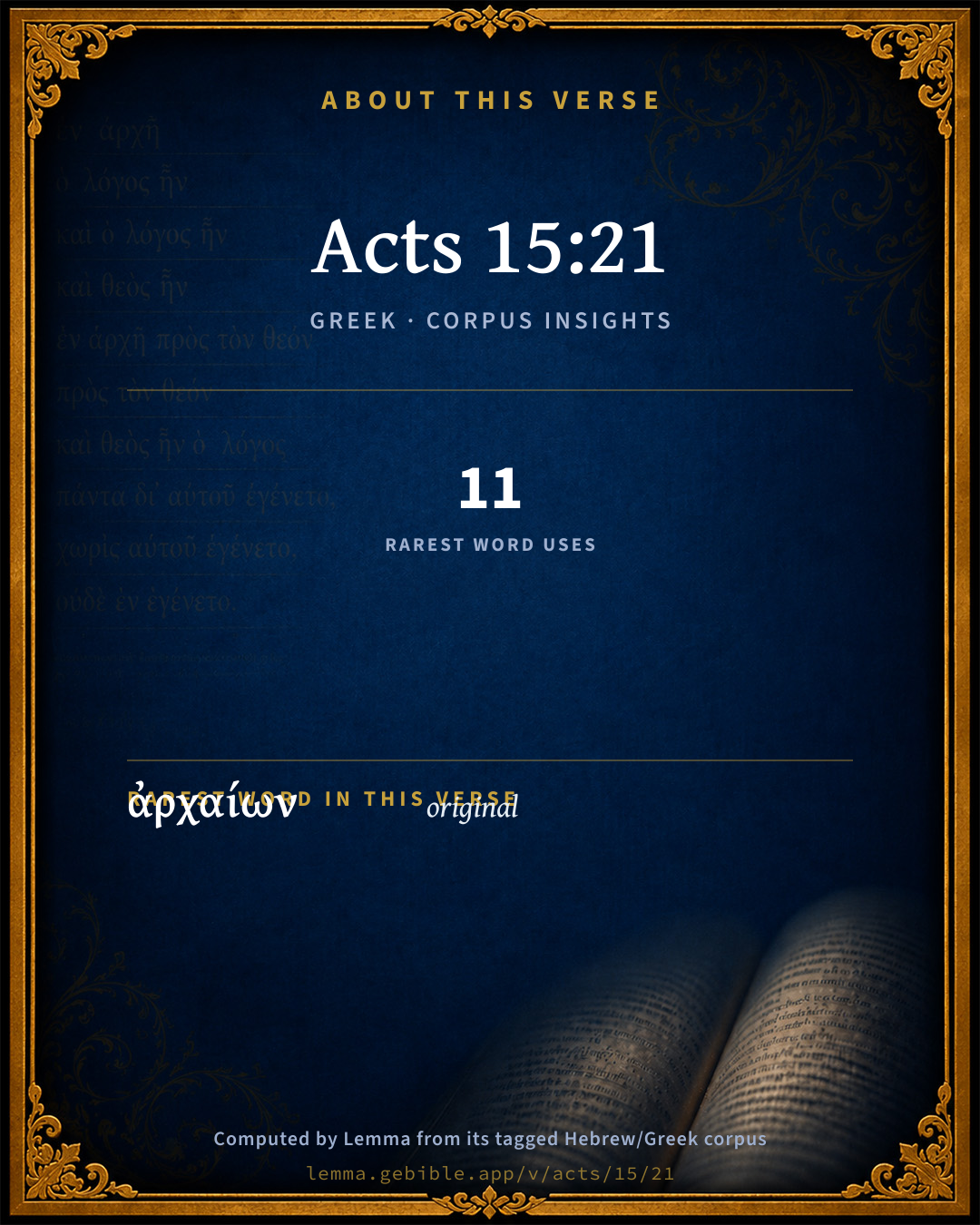
Acts 15:21

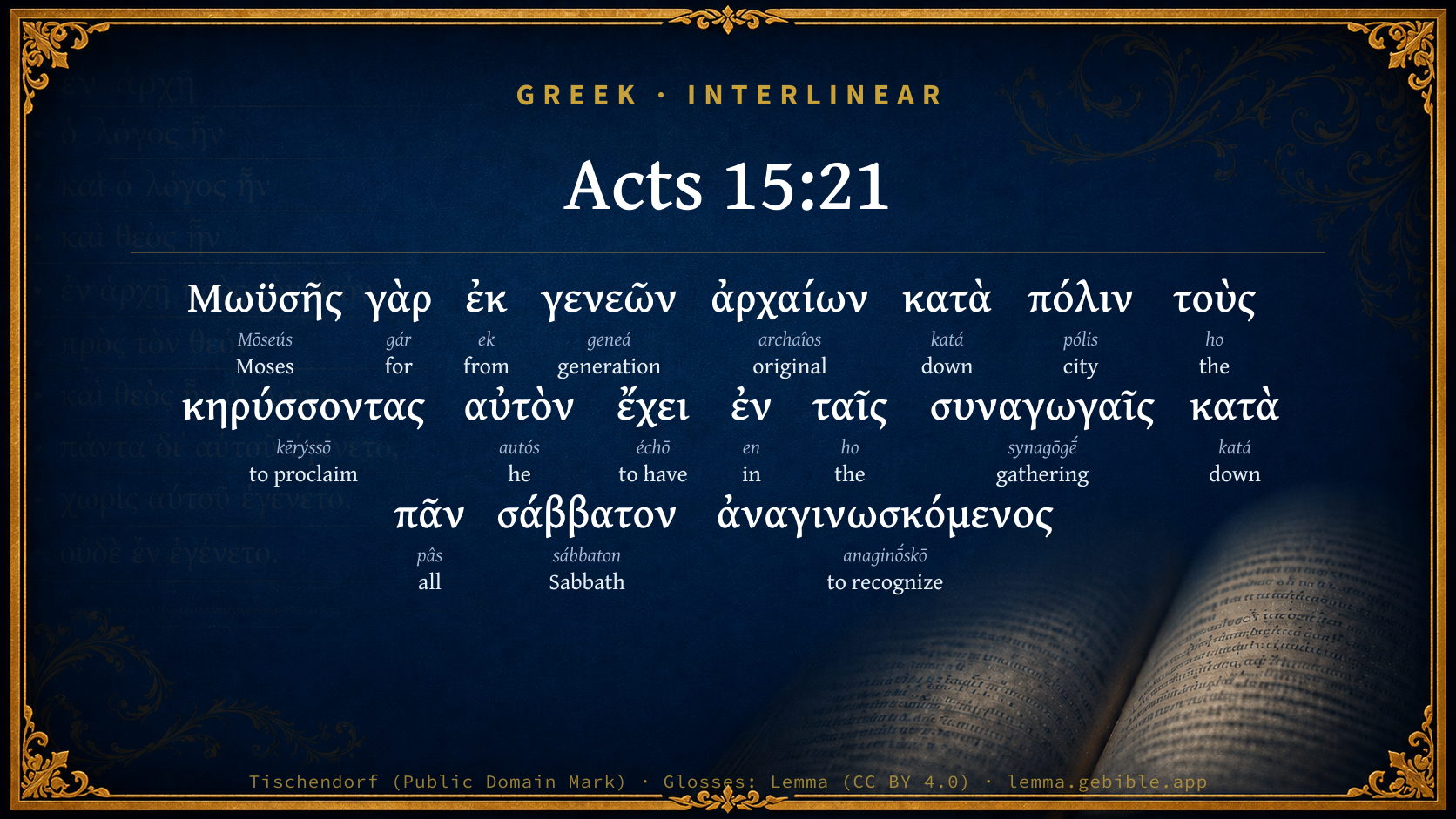
Greek (Tischendorf 8th ed.) Acts 15:21 appears in the Greek New Testament. The text above is from the Tischendorf 8th edition. Each word links to its Strong’s number and a concise gloss. Click any word for its full Thayer’s Greek Lexicon entry.
Download image
Cite this verse

Acts 15:21 (World English Bible). Public Domain. Lemma interlinear Bible study tool, https://lemma.gebible.app/v/acts/15/21.

Show BibTeX & RIS
BibTeX
RIS
English Translation
For Moses from generations of old has in every city those who preach him, being read in the synagogues every Sabbath."
World English Bible · Public Domain
Download a study sheet

One document with this verse’s original text, its word-by-word gloss line, the meaning frame, cross-references with their text, attributed commentary, and full source and license credits — printable, and it pastes into notes with its structure intact.

This verse Autodidact and up

Study sheet (.html) Plain text (.txt)

A passage Seminary Student

Up to 50 verses in one chapter. A passage sheet keeps up to 6 commentary sources and 12 cross-references per verse, in the order this page ranks them, and says so on the sheet whenever that leaves anything out. Ask for a single verse and you get the Autodidact verse sheet above.

Everything on this page stays free to read, with no account — the sheet is a download of what is already on screen, not access to it.

Want to remove ads? Support Godless Engineer
Compare translations 3

The same verse in 3 English versions, stacked beneath the original-language interlinear above. Click any original word for its lexicon entry.

Each is an independent rendering of the whole verse — the interlinear is not word-aligned to these translations.

Highlighted words mark where these versions differ — a whole-verse word diff, not a word-by-word alignment.

  • World English Bible Public Domain
    For Moses from generations of old has in every city those who preach him, being read in the synagogues every Sabbath."
  • King James Version Public Domain
    For Moses of old time hath in every city them that preach him, being read in the synagogues every sabbath day.
  • unfoldingWord Literal Text CC BY-SA 4.0
    For Moses has by city, from ancient generations, ones proclaiming him, being read in the synagogues on every Sabbath.”

unfoldingWord Literal Text — © unfoldingWord, licensed CC BY-SA 4.0. Word-aligned USFM3 via Door43 (git.door43.org/unfoldingWord/en_ult).

Versions to compare (up to 4)

3 of 4 selected

Show all 19 translations

Every available English version of this verse, each an independent rendering of the whole verse.

  • World English Bible Public Domain
    For Moses from generations of old has in every city those who preach him, being read in the synagogues every Sabbath."
  • Berean Standard Bible Public Domain
    For Moses has been proclaimed in every city from ancient times and is read in the synagogues on every Sabbath.”
  • Majority Standard Bible Public Domain
    For Moses has been proclaimed in every city from ancient times and is read in the synagogues on every Sabbath.”
  • King James Version Public Domain
    For Moses of old time hath in every city them that preach him, being read in the synagogues every sabbath day.
  • American Standard Version (1901) Public Domain
    For Moses from generations of old hath in every city them that preach him, being read in the synagogues every sabbath.
  • Revised Version (1885) Public Domain
    For Moses from generations of old hath in every city them that preach him, being read in the synagogues every sabbath.
  • Geneva Bible (1599) Public Domain
    For Moses of olde time hath in euery citie them that preache him, seeing he is read in the Synagogues euery Sabbath day.
  • Douay-Rheims (1899) Public Domain
    For Moses of old time hath in every city them that preach him in the synagogues, where he is read every sabbath.
  • Young's Literal Translation Public Domain
    for Moses from former generations in every city hath those preaching him -- in the synagogues every sabbath being read.'
  • Literal Standard Version CC BY-SA 4.0
    for Moses has those preaching him from former generations in every city—being read every Sabbath in the synagogues.”
  • Unlocked Literal Bible CC BY-SA 4.0
    For Moses has been proclaimed in every city from the ancient times and he is read in the synagogues every Sabbath.”
  • unfoldingWord Literal Text CC BY-SA 4.0
    For Moses has by city, from ancient generations, ones proclaiming him, being read in the synagogues on every Sabbath.”
  • Darby Bible Public Domain
    For Moses, from generations of old, has in every city those who preach him, being read in the synagogues every sabbath.
  • World Messianic Bible Public Domain
    For Moses from generations of old has in every city those who proclaim him, being read in the synagogues every Sabbath.”
  • Webster's Bible Public Domain
    For Moses of old time hath in every city them that preach him, being read in the synagogues every sabbath.
  • Free Bible Version CC BY-SA 4.0
    For the law of Moses has been taught in every town for a long, long time—it's read in the synagogues every Sabbath.”
  • Bible in Basic English Public Domain
    For Moses, from times long past, has his preachers in every town, reading his law in the Synagogues every Sabbath.
  • Text-Critical English NT CC BY 4.0
    For from generations of old, Moses has had those who preach him in every city, because he is read in the synagogues every Sabbath.”
  • Tyndale New Testament (1534) Public Domain
    For Moses of olde tyme hath in every cite that preache him and he is rede in the synagoges every saboth daye.

Literal Standard Version (2020), Covenant Press — licensed CC BY-SA 4.0. Text via the HelloAO Bible API (eBible.org). Unlocked Literal Bible (unfoldingWord) — licensed CC BY-SA 4.0. Text via the HelloAO Bible API (eBible.org). unfoldingWord Literal Text — © unfoldingWord, licensed CC BY-SA 4.0. Word-aligned USFM3 via Door43 (git.door43.org/unfoldingWord/en_ult). Free Bible Version, Dr. Jonathan Gallagher — licensed CC BY-SA 4.0. Text via the HelloAO Bible API (eBible.org).

Word by word

More ways to search: Search by grammar → Find every occurrence → Compare this word →

Practice this passage: Drill this verse → Learn its vocabulary →

ἀρχαίων
archaîos
G744
“original”
Adjective, Genitive, Plural, Feminine
Part of Speech
Adjective
Case
Genitive
Number
Plural
Gender
Feminine
Full Thayer's Definition

Origin: from G746

TDNT: 09:06,8

1. that has been from the beginning, original, primal, old ancient a. of men, things, times, conditions
  1. Μωϋσῆς Mōseús G3475 “Moses” Noun, Nominative, Singular, Masculine
  2. γὰρ gár G1063 “for” Conjunction
  3. ἐκ ek G1537 “from” Preposition
  4. γενεῶν geneá G1074 “generation” Noun, Genitive, Plural, Feminine
  5. κατὰ katá G2596 “down” Preposition
  6. πόλιν pólis G4172 “city” Noun, Accusative, Singular, Feminine
  7. τοὺς ho G3588 “the” Article, Accusative, Plural, Masculine
  8. κηρύσσοντας kērýssō G2784 “to proclaim” Verb, Present, Active, Participle, Accusative, Plural, Masculine
  9. αὐτὸν autós G846 “he” Personal pronoun, Accusative, Singular, Masculine
  10. ἔχει échō G2192 “to have” Verb, Present, Active, Indicative, 3rd person, Singular
  11. ἐν en G1722 “in” Preposition
  12. ταῖς ho G3588 “the” Article, Dative, Plural, Feminine
  13. συναγωγαῖς synagōgḗ G4864 “gathering” Noun, Dative, Plural, Feminine
  14. κατὰ katá G2596 “down” Preposition
  15. πᾶν pâs G3956 “all” Adjective, Accusative, Singular, Neuter
  16. σάββατον sábbaton G4521 “Sabbath” Noun, Accusative, Singular, Neuter
  17. ἀναγινωσκόμενος anaginṓskō G314 “to recognize” Verb, Present, Passive, Participle, Nominative, Singular, Masculine

About this verse

These counts appear in no published source. They are computed here, from the morphology-tagged text and Lemma’s own curated glosses. What Lemma adds →

18
words
16
distinct lemmas
Acts
section

Notable vocabulary

The rarest word here is ἀρχαίων original G744 — appearing just 11 times in the whole Greek New Testament.

Shared distinctive vocabulary

ἀρχαίων original G744 occurs in 11 verses of the Greek New Testament. Also found in:

Repetition

Words recur within this verse:

  • κατὰ down G2596 ×2
  • τοὺς the G3588 ×2

Cross-references

5

Topical passages linked to Acts 15:21 in the Treasury of Scripture Knowledge — connected by theme and wording, ordered by reader-vote popularity; previews shown in the World English Bible.

  • Acts 13:15 After the reading of the law and the prophets, the rulers of the synagogue sent to them, saying, "Brothers, if you have any word of exhortation for the people, speak."
  • Acts 13:27 For those who dwell in Jerusalem, and their rulers, because they didn't know him, nor the voices of the prophets which are read every Sabbath, fulfilled them by condemning him.
  • 2 Corinthians 3:14–15 But their minds were hardened, for until this very day at the reading of the old covenant the same veil remains, because in Christ it passes away.
  • Nehemiah 8:1–12 All the people gathered themselves together as one man into the broad place that was before the water gate; and they spoke to Ezra the scribe to bring the book of the law of Moses, which Yahweh had commanded to Israel.
  • Luke 4:16 He came to Nazareth, where he had been brought up. He entered, as was his custom, into the synagogue on the Sabbath day, and stood up to read.

Cross-references courtesy of OpenBible.info (CC BY 4.0).

Commentary

Notes on Acts 15:21 from classic Christian and Jewish commentators (each source and its license shown beneath its notes). The classic Christian expositions comment on the surrounding passage and are grouped to its opening verse, so a note may address several verses; the Jewish commentaries on the Tanakh (Rashi and others) are per-verse, so they appear only where the commentator wrote on this verse.

Lemma curates 59 commentaries, every one of them public domain or Creative Commons licensed, each selected and text-cleaned for this edition rather than reprinted as found. About our sources →

Bengel's Gnomon

Johann Albrecht Bengel

Act 15:21. Μωσῆς γὰρ, for Moses) The words not merely of the prophets, Act 15:15, but of Moses also, correspond to the sentiment of Peter; but Moses is too well known to need his testimony being quoted. Often the γὰρ has the effect of an Ætiology (reason assigned) for what has been said, that the sense may be this, I have quoted the prophets, not Moses, whose agreement (with Peter’s sentiment) is more open. See Deu 32:21. James seems to have had in his mind this declaration of the Lord by Moses; but, to avoid giving offence (Euphemy, Append.), he did not wish to quote it in this passage: also Gen 12:3, etc. Moses, in mentioning the recency of circumcision as compared with the promise, very much proves the fact (the point at issue).—ἀρχαίων, ancient) The same word as in Act 15:7. Everything that is most ancient in ecclesiastical, and still more in divine institutions, ought to be had respect to.—κηρύσσοντας, who preach him) regularly and periodically.

Bengel's Gnomon of the New Testament — English translation (T&T Clark, Edinburgh, 1860) — public domain. Text from a community e-Sword module.

Meyer's Critical & Exegetical Commentary

Heinrich August Wilhelm Meyer

Act_15:21. See Düsterdieck in the Götting. Monatschr. 1849, p. 282 ff. Γάρ] gives the reason why it was indispensable to enjoin this fourfold ἀπέχεσθαιnamely, because the preaching of the Mosaic law, taking place from ancient generations in every city every Sabbath day by its being read in the synagogues, would only tend to keep alive the offence which the Jewish-Christians (who still adhered to the synagogue[36]) took to their uncircumcised brethren, in view of the complete freedom of the latter from the law, including even these four points.[37] These words thus assign a ground for the proposal on the score of necessity (corresponding to the ἐπάναγκες in the decree, Act_15:28), and, indeed, of the necessity that there must be, at least so far, accommodation to the Mosaic law. Others: περιττὸν τοῖς Ἰουδαίοις ταῦτα ἐπιστέλλειν· ἀπὸ τοῦ νόμου ταῦτα μανθάνουσιν κ.τ.λ., scholion in Matthaei, Chrysostom, Lyra, and many others, and recently Neander. Out of place, as there was no question at all about an instruction for the Jewish-Christians. Erasmus, Wetstein, Thiersch, and others still more arbitrarily import the idea: Neque est metuendum, ut Moses propterea antiquetur; or (so Grotius and Ewald, p. 472): it is not to be feared that the Mosaic law generally will be neglected and despised.[38] Still more freely Gieseler[39] reads between the lines what is supposed to be meant: The Mosaic law already has been so long preached, and yet there are few who submit to embrace it. Now, when the service of the true God is preached without the yoke of the law, many are turning to Him, and it is indisputable that the ceremonial law is the only obstacle to the universal diffusion of true religion. Lange, II. p. 183, likewise imports: We have nothing further to do. To assert the statutes of Moses, is not our office; there are already preachers for that. Similarly Hofmann, Schriftbew. II. 2, p. 41, who, however, discovers under the words of James the presupposition as self-evident, that Gentiles, if they pleased, might along with the faith embrace also the law of Moses; to those, who wished to become Mosaic, nothing need be said about the law, because they would always have an opportunity to become acquainted with it. As if one could read-in such a very important presupposition as self-evident! And as if Paul and Barnabas could have been silent at a proposition so entirely anti-Pauline! Further, we cannot see how what Brenske (Stud. u. Krit. 1859, p. 711 ff.) finds as the meaning, considering the proselytes of the gate as those to whom the κηρύσσειν took place, is contained in the words: the κηρύσσειν has the notion of publicity and solemnity, but not of novelty (Brenske), which even passages such as Gal_5:11, Rom_2:21, should have prevented him from assuming. Lastly, Wieseler (on Gal_2:11 ff., p. 148) finds in the words the designed inference: consequently these statutes have for long been not a thing unheard of and burdensome for these Gentiles, because there are among them many proselytes. But even thus the chief points are mentally supplied.

[36] Comp. Lechler, apost. Zeitalt. p. 291 f.

[37] Lekebusch and Oertel adopt in the main this interpretation, to which Calvin already came very near. Nor is the explanation of Düsterdieck essentially different. Yet he understands ἔχει in the sense: he has in his power, holds in subjection, which, however, appears not to be admissible, as not the Jews generally, but the κηρύσσοντες, are the object of ἔχει. It is the simple: he has them, they do not fail him.

[38] Thus in substance also Schneckenburger, Zeller, Baumgarten, Hilgenfeld. Peculiarly ingenious, but importing what is not in the text, is the view of Bengel: Prophetas citavi, non Mosen, cujus consensus est apertior, holding that James had Deu_32:21 in view.

[39] In Stäudlin und Tzschirners Archiv. f. Kirchengesch. IV. p. 312. Baur, ed. 1, also adopted the explanation of Gieseler. But in the second edition, I. p. 137, he interprets it as if James wished to say: a worship so ancient as the Mosaic is perfectly entitled to such a demand. This, however, is in no way contained in the words, in which, on the contrary, the point is the ancient preaching and the constant reading.

Meyer — Critical and Exegetical Commentary on the New Testament — English translation by Peter Christie, edited by Frederick Crombie (T&T Clark, 1880) — public domain. Text from a community e-Sword module.

Expositor's Greek Testament

ed. W. Robertson Nicoll

Act 15:21 . ἐκ γενεῶν ἀρχαίων : pointing back to the first days when the Diaspora had first spread to any considerable extent in heathen lands: see on Act 15:7 . The exact phrase ( ἀπὸ ) γενεῶν ἀρχ . occurs in Psalms of Solomon , Act 18:14 from the generations of old the lights of heaven have not departed from their path. For the custom referred to here, see Schürer, Jewish People , div. ii., vol. ii., p. 55, E.T. The words seem closely connected in sense with the preceding in this way, viz. , that the Gentile proselytes could long ago in the synagogues have been acquainted week by week with the spirit and enactments of the Mosaic law, and they would thus be the more easily inclined to take upon themselves the few elementary precepts laid down in the decree of the Jerusalem Church, so as to avoid any serious cause of offence to their Jewish-Christian brethren. Others however take the meaning to be that, as the Jewish Christians in their continual association with the synagogue would still hear the law read every Sabbath, there would be no intercourse between them and the Gentile Christians, unless the latter observed the necessary restrictions enjoined by the decree for brotherly intercommunion. There is no occasion to interpret the meaning to be that it is superfluous to write the decree to the Jewish Christians, since they knew its contents already from the law (so St. Chrysostom, and Blass), for a decree for the Jewish Christians is not in question, see Act 15:23 . Others again interpret: there is no fear that the Mosaic law should be neglected or despised “for Moses, etc.”. See further, Wendt, Weiss, McGiftert, Knabenbauer.

The Expositor's Greek Testament, edited by W. Robertson Nicoll (1897–1910) — public domain. Text from a community e-Sword module.

Jamieson, Fausset & Brown

Robert Jamieson, A. R. Fausset & David Brown

For Moses of old time hath in every city them that preach him . . . every sabbath day--thus keeping alive in every Jew those feelings which such practices would shock, and which, therefore, the Gentile converts must carefully respect if the oneness of both classes in Christ was to be practically preserved. The wisdom of these suggestions commended itself to all present.

Jamieson, Fausset & Brown — Commentary Critical and Explanatory on the Whole Bible (1871) — public domain (CC PDM 1.0). Text via the HelloAO Bible API.

Adam Clarke's Commentary

Verse 21. Moses of old time hath in every city] The sense of this verse seems to be this: As it was necessary to write to the Gentiles what was strictly necessary to be observed by them, relative to these points, it was not so to the converted Jews; for they had Moses, that is, the law, preached to them, κατα πολιν, in the city, that is, Antioch; and, by the reading of the law in the synagogues every Sabbath day, they were kept in remembrance of those institutions which the Gentiles, who had not the law, could not know. Therefore, James thought that a letter to the converted Gentiles would be sufficient, as the converted Jews had already ample instruction on these points.

Adam Clarke's Commentary on the Bible (1810–1826) — public domain. Text from a community e-Sword/MySword module.

John Calvin's Commentaries

21. For Moses hath. This place, in my judgment, hath been badly expounded, and drawn into a contrary sense. For interpreters think that James addeth this, because it were superfluous to prescribe anything to the Jews, who were well acquainted with the doctrine of the law, and to whom it was read every Sabbath-day; and they pick out this meaning, Let us be content to require these few things at the hands of the Gentiles, which are not accustomed to bear the yoke of the law; as touching the Jews they have Moses, out of whom they may learn more. Some do also gather out of this place, that circumcision, with its appurtenances, ought to be observed even at this day among the Jews. But they reason unfitly and unskillfully, though that exposition which I have set down were true. But James had a far other meaning; to wit, he teachers that it cannot be that ceremonies can be abolished so quickly, as it were, at the first dash; because the Jews had now a long time been acquainted with the doctrine of the law, and Moses had his preachers; therefore, it stood them upon to redeem concord for a short thee, until such time as the liberty gotten by Christ might, by little and little, appear more plainly. This is that which is said in the common proverb, That it was meet that the old ceremonies should be buried with some honor. Those who are skillful in the Greek tongue shall know that that last member, When he is read every Sabbath-day in the synagogues, was by me changed not without cause, for avoiding of doubtfulness.

John Calvin's Commentaries (1540-1563) — public domain. Text from the Calvin Translation Society English edition (1840s-50s) via the Christian Classics Ethereal Library (ccel.org). Calvin's coverage is partial (roughly two-thirds of the Bible); uncommented books and verses are honest gaps, never fabricated. The 19th-century editor's footnotes and remarks are omitted so the notes are faithfully Calvin's own voice.

Ellicott's Commentary for English Readers

(21) For Moses of old time.—Literally, of ancient generations. The conjunction gives the reason for writing to the Gentiles, and giving them these injunctions. The Jews, who heard the Law in their synagogues every Sabbath, did not need instruction. It might be taken for granted that they would adhere to the rules now specified. So, in Act_15:23, the encyclical letter is addressed exclusively to “the brethren of the Gentiles.”

A Bible Commentary for English Readers, edited by Charles John Ellicott (1878–1897) — public domain. Text from a community e-Sword module.

The Cambridge Bible for Schools and Colleges

gen. ed. J. J. S. Perowne

21. For Moses of old time (lit. from generations of old) hath in every city, &c.] Here we have the reason why these injunctions are to be laid upon the Gentile converts. It is necessary however to take the whole verse into consideration before we can decide on the force of the reason. Laying stress chiefly on the expression “from generations of old,” some have thought that St James’ argument meant that the Mosaic ritual having been preached for so long a time and found to be a load too heavy to bear, must now be given up, except in these specified points. Again the verse has been taken to mean that there was no need for the Christian church to legislate about the observance of the Mosaic law other than in these few points, because there was public teaching on the subject everywhere in the Jewish synagogues. Jewish Christians were therefore supplied with guidance, and would be so supplied until by degrees Judaism had entirely given place to Christianity. No doubt the Apostle contemplates the retention by the Jewish Christians of much of their old ritual, and that they would make no breach with the services of the synagogue. But in these enactments, which were apparently only for a time (since St Paul nowhere alludes to them in his Epistles), and to promote peace between Gentiles and Jews, we must remember that the Jews were regarded as the weaker brethren. And the argument of the council may be supposed to run thus: We may make this concession to the Gentiles without fear of doing any injury to the Jew. It is not probable that his feelings and prejudices will be interfered with, or the Mosaic law in its other portions set aside; ‘For Moses, &c.’

being read in the synagogues] On the Jewish manner of reading the law, see additional note at the end of chap. 13.

The Cambridge Bible for Schools and Colleges (gen. ed. J. J. S. Perowne; Cambridge University Press, 1878–1918) — public domain. Text from a community e-Sword module.

John Gill's Exposition

For Moses of old time hath in every city them that preach him,.... That is, for many years past, even from the times of Ezra, the law of Moses has been publicly expounded by them, whom the Jews call Derashim, preachers, or expounders, in every city where there was a synagogue; and every city belonging to the Jews, were obliged to build a synagogue, yea, they were obliged to do it where there were but ten Israelites (n): this is given by James as a reason why the Gentiles should be wrote unto concerning the above things; because that they hearing the law read and expounded every week, would be ready to conclude that they were obliged to submit unto it, as to circumcision, and other things; unless they were told that they were free from it; only in order to maintain peace with their brethren the Jews, it would be necessary for them to abstain from the above things: and it may also carry in it a reason, why the Jews need not be wrote unto, and why they had no reason to complain for thus writing to the Gentiles; since they had the law read and explained to them every week, and there would be no attempt to make any alteration in that form of service:

being read in the synagogues every sabbath day; See Gill on Act 13:15.

(n) Maimon. Tephilla, c. 11. sect. 1.

John Gill's Exposition of the Whole Bible (1746–1763) — public domain (CC PDM 1.0). Text via the HelloAO Bible API.

Trapp's Complete Commentary

John Trapp

21 For Moses of old time hath in every city them that preach him, being read in the synagogues every sabbath day.

Ver. 21. For Moses of old time, &c.] This is alleged as a reason why they should as yet abstain from those indifferents, because the Jews, having been accustomed to Moses’s writings, could not quickly be drawn to let go the legal ceremonies, which were now to have an honourable burial, by degrees to be abolished. The ceremonies before Christ’s passion were neither deadly nor dead; after his passion they were not deadly for a time (whiles the temple stood), though dead after a sort. But from that time forward they were both dead and deadly, saith Aquinas.

John Trapp, A Commentary or Exposition upon All the Books of the Old and New Testament (1647–1656) — public domain. Text from a community e-Sword module.

Albert Barnes' Notes on the Bible

For Moses - The meaning of this verse is, that the Law of Moses, prohibiting these things, was read in the synagogues constantly. As these commands wore constantly read, and as the Jewish converts would not soon learn that their ceremonial law had ceased to be binding, it was deemed to be a matter of expediency that no needless offence should be given to them. For the sake of peace, it was better that they should abstain from meat offered to idols than to give offence to the Jewish converts. Compare 1Co 8:10-13.Of old time - Greek: from ancient generations. It is an established custom, and therefore his laws are well known, and have, in their view, not only the authority of revelation, but the venerableness of antiquity.

In every city - Where there were Jews. This was the case in all the cities to which the discussion here had reference.

Them that preach him - That is, by reading the Law of Moses. But, in addition to reading the Law, it was customary also to offer an explanation of its meaning. See the notes on Luk 4:16-22.

Albert Barnes' Notes on the Bible (1834–1885) — public domain. Text from a community e-Sword/MySword module.

Haydock's Catholic Bible Commentary

For Moses...hath in every city. Not only the Jews, but the Christians converted from Judaism, still followed the ceremonies of the law of Moses. (Witham) --- Let not the Jews complain, that we abandon Moses, and destroy the law by this regulation. No: it shall subsist for ever in a more perfect state, read in the synagogue, and revered by the Church. (Calmet) --- Others give a different explanation of this verse. Let the Jews, say they, follow Moses, and hear him in their assemblies; we have other laws, and enjoy other privileges. (Tirinus)

George Leo Haydock (1774–1849), Haydock's Catholic Family Bible and Commentary, 1859 edition — public domain. Excludes Psalms (Douay-Rheims chapter numbering differs from Protestant) and Deuterocanonical books (Catholic canon only).

Matthew Poole's English Annotations

The reason why St. James would not have the ceremonies buried as soon as they were dead, was because the Jews had been so long confirmed in them, and bare such a love unto them; and he would purchase concord between them and the Gentile converts; though the Gentiles should bear with some inconvenience into the bargain, as not presently using all the liberty which through Christ they had a right unto.

Matthew Poole's English Annotations on the Holy Bible (1683–1685) — public domain. Text from a community e-Sword/MySword module.

Whedon's Commentary on the Bible

Daniel D. Whedon

21. For Moses—As the synagogues, with their sabbath services, spread the Mosaic doctrines, and the appended Jewish prejudices, far and wide, so far and wide should these cautions be diffused.

Daniel D. Whedon (gen. ed.), Commentary on the Old and New Testaments (1874–1909) — public domain. Text from a community e-Sword module.

The Pulpit Commentary

From generations of old for of old time, A.V.; sabbath for sabbath day, A.V. The meaning of this verse seems to be that, in requiring the above compliances, the council was not enjoining anything new or strange, because the Gentiles who attended the synagogues were familiar with these Mosaic doctrines. It has been often stated that these four prohibitions were in substance the same as the so-called seven precepts of Noah, which were binding upon proselytes of the gate. This is, however, scarcely borne out by the facts. The four prohibitions seem to have been a temporary arrangement adapted to the then condition of the Church, with a view to enabling Christian Jews and Gentiles to live in brotherly fellowship. The Jew was not to require more of his Gentile brother: the Gentile was not to concede less to his Jewish brother. St. Augustine ("Cont. Manich.," 32, 13), quoted by Meyer, ridicules the idea of Christians in his time being bound by the law of things strangled (see Hooker and Bishop Sanderson, quoted by Wordsworth, in the same sense).

The Pulpit Commentary (1880–1919), ed. H.D.M. Spence-Jones & Joseph S. Exell — public domain. Text from a community e-Sword module.

John Wesley's Explanatory Notes

Perhaps the connection is, To the Jews we need write nothing on these heads; for they hear the law continually.

John Wesley, Explanatory Notes Upon the Whole Bible (1754–1765) — public domain. Text via the GEBible commentary corpus.

Burkitt's Expository Notes on the New Testament

William Burkitt

Observe here, 1. That though the apostles were the infallible deciders, yet the elders, and the whole church, were unanimous consenters; for no contradiction to the determination of this controversy did rise from any hand, but there was a happy acquiescence in this apostolical decision: It pleased the elders, and the whole church.

Observe, 2. The decrees of this synod, and the determination of this council at Jerusalem, are committed to writing, and despatched by unprejudiced messengers of their own to the church of the Gentiles, which was at Antioch.

In which decretal epistle, 1. The false apostles who started this controversy are sharply reproved.

2. Paul and Barnabas, for their courage, and constancy, are highly commended.

3. Judas and Silas are mentioned to testify that these decrees were not forced nor counterfeited.

4. That it would conduce much to their advantage to have these decrees duly observed.

Observe, 3. The divine authority of these decrees: they were dictated and directed by the Holy Ghost: It seemed good to the Holy Ghost, and to us.

That is, it seemed good unto us, being directed and assisted by the Holy Ghost, whose inspiration and conduct we have followed, not to impose unnecessary things upon you.

Where note, That the Holy Ghost is against imposing unnecessary things as necessary, and making them the terms of church-communion.

Here are four things imposed; namely, abstaining from meats offered to idols, from blood, from fornication, and from things strangled: but they are called necessary things. Two of them, to wit, abstaining from fornication and from things offered to idols, were of a simple and absolute necessity; the other two, namely, abstaining from things strangled, and from blood, were of an accidental, and temporary necessity, for the present time, and to avoid giving scandal to the weak Jews, till they should be better informed, and better understand their liberty in Christ; for afterwards St. Paul showeth that no creature of God is unclean, but that unto the pure all things are pure. 1Ti 4:4; Tit 1:15

William Burkitt's Expository Notes on the New Testament (1700–1703) — public domain. Text from a community e-Sword module.

Godbey's Commentary on the New Testament

William B. Godbey

21. “For Moses from ancient generations has those preaching him in every city, being read every Sabbath in the synagogues.” At that time the Jews had synagogues in all the prominent cities of the known world. Those apostles expected to fulfill this commission and remain on the earth till the gospel was preached to every nation and actually hail their descending Lord, and in the transfiguration glory fly up to meet Him in the air. Hence that wonderful flying artillery scheme, utterly disencumbered of all human ecclesiasticism and local church machinery, running to the ends of the earth preaching the gospel to every nation, calling out the elect, and thus with all possible expedition preparing the world for their Lord’s return on the throne of His glory, to revive and establish the theocracy of King David in all the earth, thus bringing the Jews again to the front, the custodians of the universal Millennial Kingdom, for which they recognize the universal prevalence of the Jewish theocracy, as at that time adumbratory and preparatory. They had on them the true spirit of prophecy, but little dreaming of the long rolling centuries destined to intervene before the glorious fulfillment, the day of His coming being known to the Father only.

William B. Godbey, Commentary on the New Testament (1896–1900) — public domain. Text from a community e-Sword module.

McGarvey & Pendleton's Commentaries

J. W. McGarvey

See notes on verse 13

J. W. McGarvey (with Philip Y. Pendleton), Commentaries on the New Testament (The Fourfold Gospel, 1914; Acts; and the epistles) — public domain. Text from a community e-Sword/MySword module.

Cambridge Greek Testament for Schools and Colleges

21. Μωϋσῆς γὰρ ἐκ γενεῶν ἀρχαίων κ.τ.λ., for Moses of old time (lit. from generations of old) hath in every city, &c. Here we have the reason why these injunctions are to be laid upon the Gentile converts. It is necessary however to take the whole verse into consideration before we can decide on the force of the reason. Laying stress chiefly on the expression ‘from generations of old,’ some have thought that St James’s argument means that the Mosaic ritual having been preached for so long a time and found to be a load too heavy to bear, must now be given up, except in these specified points. Again, the verse has been taken to mean that there was no need for the Christian Church to legislate about the observance of the Mosaic Law other than in these few points, because there was public teaching on the subject everywhere in the Jewish synagogues. Jewish Christians were therefore supplied with guidance, and would be so supplied until by degrees Judaism had entirely given place to Christianity. No doubt the Apostle contemplates the retention by the Jewish Christians of much of their old ritual, and that they would make no breach with the services of the synagogue. But in these enactments, which were apparently only for a time (since St Paul nowhere alludes to them in his Epistles), and to promote peace between Gentiles and Jews, we must remember that the Jews are the persons who have felt offence, and for whose quieting the decree is put forth. The argument of the council seems to be this: We, Jews, may make this concession to the Gentiles without fear. It is not probable that our feelings and prejudices will be interfered with, or the Mosaic Law in its other portions set aside; ‘for Moses,’ &c.

ἀναγινωσκόμενος, being read. On the reading of the Jewish Scriptures in the synagogues, see the Excursus at the end of chap. 13.

Cambridge Greek Testament for Schools and Colleges (Cambridge University Press, 1896; 21 vols, various authors incl. Carr, Maclear, Plummer, Farrar, Lumby, Moule, M. R. James, Simcox) — public domain. Text from a community e-Sword module.

Alford’s Greek Testament

Henry Alford

21.] Living as the Gentile converts would be in the presence of Jewish Christians, who heard these Mosaic prohibitions read, as they had been from generations past, in their synagogues, it would be well for them to avoid all such conduct and habits as would give unnecessary offence. Other meanings have been proposed: as ‘that it was superfluous to command these things to the Jews, for they would hear them in the synagogues’ (so an ancient Schol., Lyra, and Neander),—whereas no question whatever was raised about Jewish converts:—‘neque est metuendum, ut Moses propterea antiquetur,’ Erasmus, al.: ‘Pudori vobis foret et ignominiæ, si vos, homines Christiani … hac in re inferiores a Judæis deprehenderemini, quod vos communione cum epulis sacrificialibus polytheismo favere videremini, quum illi Judæi … monotheismo adhæreant tenacissime, eumque quavis septimana sibi inculcatum audiant,’ Heinrichs.

‘Nam quod ad Mosen attinet, non possunt, qui ex Judæsis sunt, queri, eum sperni ab alienigenis nostri gregis, quando in nostris (?) non minus quam in Judaicis conventibus Moses, ita ut ab antiquo factum est, legitur, et quidem sabbatis,’ Grot., Hammond. On the reading of the law, &c., in the synagogues, see ch. 13:15, note.

Henry Alford, The Greek Testament (1849–1861) — public domain. Text from a community e-Sword module.

Lesson kit

Teaching starters — assembled from the data on this page, not authored interpretation. Every prompt links to the verse data it draws on. Edit before teaching.

Acts, in the Acts, opens this verse with 18 words (16 distinct Greek lemmas). Its most distinctive word is archaîos (“original”). A historical commentator’s framing appears above. Read the whole chapter for the surrounding context.

Discussion questions

  1. The word archaîos carries the sense “original.” How does it shape the verse?
  2. Matthew 5:21 shares the word «original» with this verse. How do the two illuminate each other?
  3. “down” occurs 2× in this one verse. What is the effect of the repetition?
  4. These translations render this verse differently; the difference is in the English rendering, not the original. What questions does that raise?
  5. Reading how Bengel's Gnomon and Meyer's Critical & Exegetical Commentary read this verse, where do the two commentators agree and where do they part?

Things to notice

Reading settings

Reading text

Shown beneath each verse's original-language words.

Old Testament
Old Testament edition

Read the OT as the Masoretic Hebrew (MT) or the Greek Septuagint (LXX).

English shown for the Greek Septuagint (in the Hebrew ↔ Greek comparison).

Comparing translations? Open the Compare panel on any verse page to stack up to four side by side.