Genesis 31:15

Hebrew (Westminster Leningrad Codex) Genesis 31:15 appears in the Hebrew Old Testament. The text above is from the Westminster Leningrad Codex. Each word links to its Strong’s number, a concise gloss, and parsing drawn from the Open Scriptures Hebrew Bible morphology. Click any word for its full Brown-Driver-Briggs (BDB) entry.
Download image
Cite this verse

Genesis 31:15 (World English Bible). Public Domain. Lemma interlinear Bible study tool, https://lemma.gebible.app/v/genesis/31/15.

Show BibTeX & RIS
BibTeX
RIS
English Translation
Aren't we accounted by him as foreigners? For he has sold us, and has also quite devoured our money.
World English Bible · Public Domain
Highlights
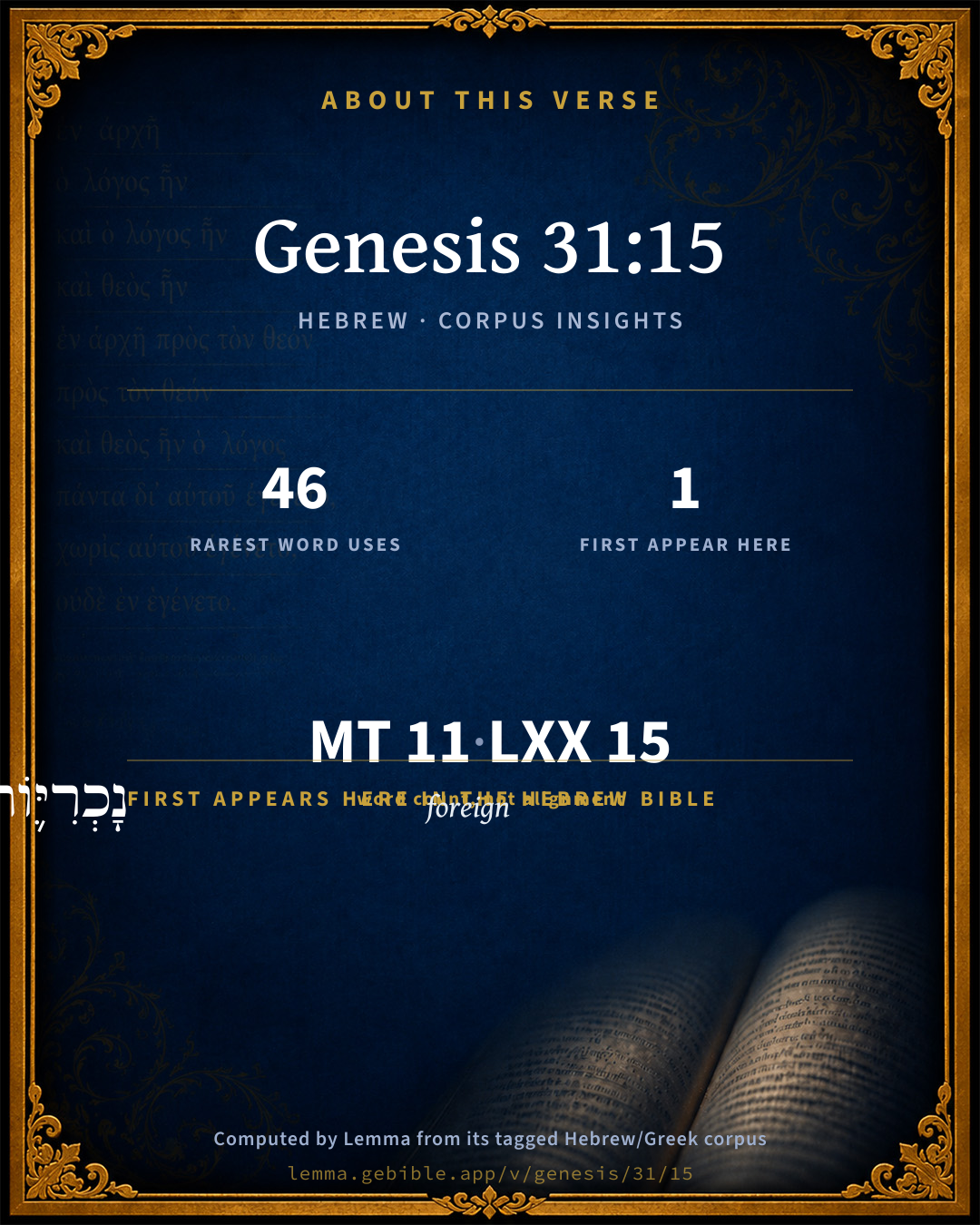
  • 1 first appearance in the Hebrew Bible
Full analysis ↓
Download a study sheet

One document with this verse’s original text, its word-by-word gloss line, the meaning frame, cross-references with their text, attributed commentary, and full source and license credits — printable, and it pastes into notes with its structure intact.

This verse Autodidact and up

Study sheet (.html) Plain text (.txt)

A passage Seminary Student

Up to 50 verses in one chapter. A passage sheet keeps up to 6 commentary sources and 12 cross-references per verse, in the order this page ranks them, and says so on the sheet whenever that leaves anything out. Ask for a single verse and you get the Autodidact verse sheet above.

Everything on this page stays free to read, with no account — the sheet is a download of what is already on screen, not access to it.

Want to remove ads? Support Godless Engineer
Compare translations 3

The same verse in 3 English versions, stacked beneath the original-language interlinear above. Click any original word for its lexicon entry.

Each is an independent rendering of the whole verse — the interlinear is not word-aligned to these translations.

Highlighted words mark where these versions differ — a whole-verse word diff, not a word-by-word alignment.

  • World English Bible Public Domain
    Aren't we accounted by him as foreigners? For he has sold us, and has also quite devoured our money.
  • King James Version Public Domain
    Are we not counted of him strangers? for he hath sold us, and hath quite devoured also our money.
  • unfoldingWord Literal Text CC BY-SA 4.0
    Are we not regarded by him foreigners? For he sold us, and he has indeed completely eaten up our silver.

unfoldingWord Literal Text — © unfoldingWord, licensed CC BY-SA 4.0. Word-aligned USFM3 via Door43 (git.door43.org/unfoldingWord/en_ult).

Versions to compare (up to 4)

3 of 4 selected

Show all 18 translations

Every available English version of this verse, each an independent rendering of the whole verse.

  • World English Bible Public Domain
    Aren't we accounted by him as foreigners? For he has sold us, and has also quite devoured our money.
  • Berean Standard Bible Public Domain
    Are we not regarded by him as outsiders? Not only has he sold us, but he has certainly squandered what was paid for us.
  • Majority Standard Bible Public Domain
    Are we not regarded by him as outsiders? Not only has he sold us, but he has certainly squandered what was paid for us.
  • King James Version Public Domain
    Are we not counted of him strangers? for he hath sold us, and hath quite devoured also our money.
  • American Standard Version (1901) Public Domain
    Are we not accounted by him as foreigners? for he hath sold us, and hath also quite devoured our money.
  • Revised Version (1885) Public Domain
    Are we not counted of him strangers? for he hath sold us, and hath also quite devoured our money.
  • Geneva Bible (1599) Public Domain
    Doeth not he count vs as strangers? for he hath solde vs, and hath eaten vp and consumed our money.
  • Douay-Rheims (1899) Public Domain
    Hath he not counted us as strangers and sold us, and eaten up the price of us?
  • Young's Literal Translation Public Domain
    have we not been reckoned strangers to him? for he hath sold us, and he also utterly consumeth our money;
  • Literal Standard Version CC BY-SA 4.0
    Have we not been reckoned strangers to him? For he has sold us, and he also utterly consumes our money;
  • Unlocked Literal Bible CC BY-SA 4.0
    Are we not treated by him as foreigners? For he has sold us and has also completely devoured our money.
  • unfoldingWord Literal Text CC BY-SA 4.0
    Are we not regarded by him foreigners? For he sold us, and he has indeed completely eaten up our silver.
  • Darby Bible Public Domain
    Are we not reckoned of him strangers? for he has sold us, and has even constantly devoured our money.
  • World Messianic Bible Public Domain
    Aren’t we considered as foreigners by him? For he has sold us, and has also used up our money.
  • Webster's Bible Public Domain
    Are we not counted by him strangers; for he hath sold us, and hath quite consumed also our money.
  • Free Bible Version CC BY-SA 4.0
    “He treats us like foreigners because he sold us to you, and now he's spent all that money.
  • Bible in Basic English Public Domain
    Are we not as people from a strange country to him? for he took a price for us and now it is all used up.
  • JPS Tanakh (1917) Public Domain
    Are we not accounted by him strangers? for he hath sold us, and hath also quite devoured our price.

Literal Standard Version (2020), Covenant Press — licensed CC BY-SA 4.0. Text via the HelloAO Bible API (eBible.org). Unlocked Literal Bible (unfoldingWord) — licensed CC BY-SA 4.0. Text via the HelloAO Bible API (eBible.org). unfoldingWord Literal Text — © unfoldingWord, licensed CC BY-SA 4.0. Word-aligned USFM3 via Door43 (git.door43.org/unfoldingWord/en_ult). Free Bible Version, Dr. Jonathan Gallagher — licensed CC BY-SA 4.0. Text via the HelloAO Bible API (eBible.org).

Word by word

More ways to search: Search by grammar → Find every occurrence → Compare this word →

Practice this passage: Drill this verse → Learn its vocabulary →

נָכְרִיּ֛וֹת
nokrîy
H5237
“foreign”
Adjective, Adjective, Feminine, Plural, Absolute
Part of Speech
Adjective
Type
Adjective
Gender
Feminine
Number
Plural
State
Absolute
Full BDB Definition

Origin: from H5235 (second form)

TWOT: 1368c

foreign, alien - foreign - foreigner (substantive) - foreign woman, harlot - unknown, unfamiliar (figuratively)
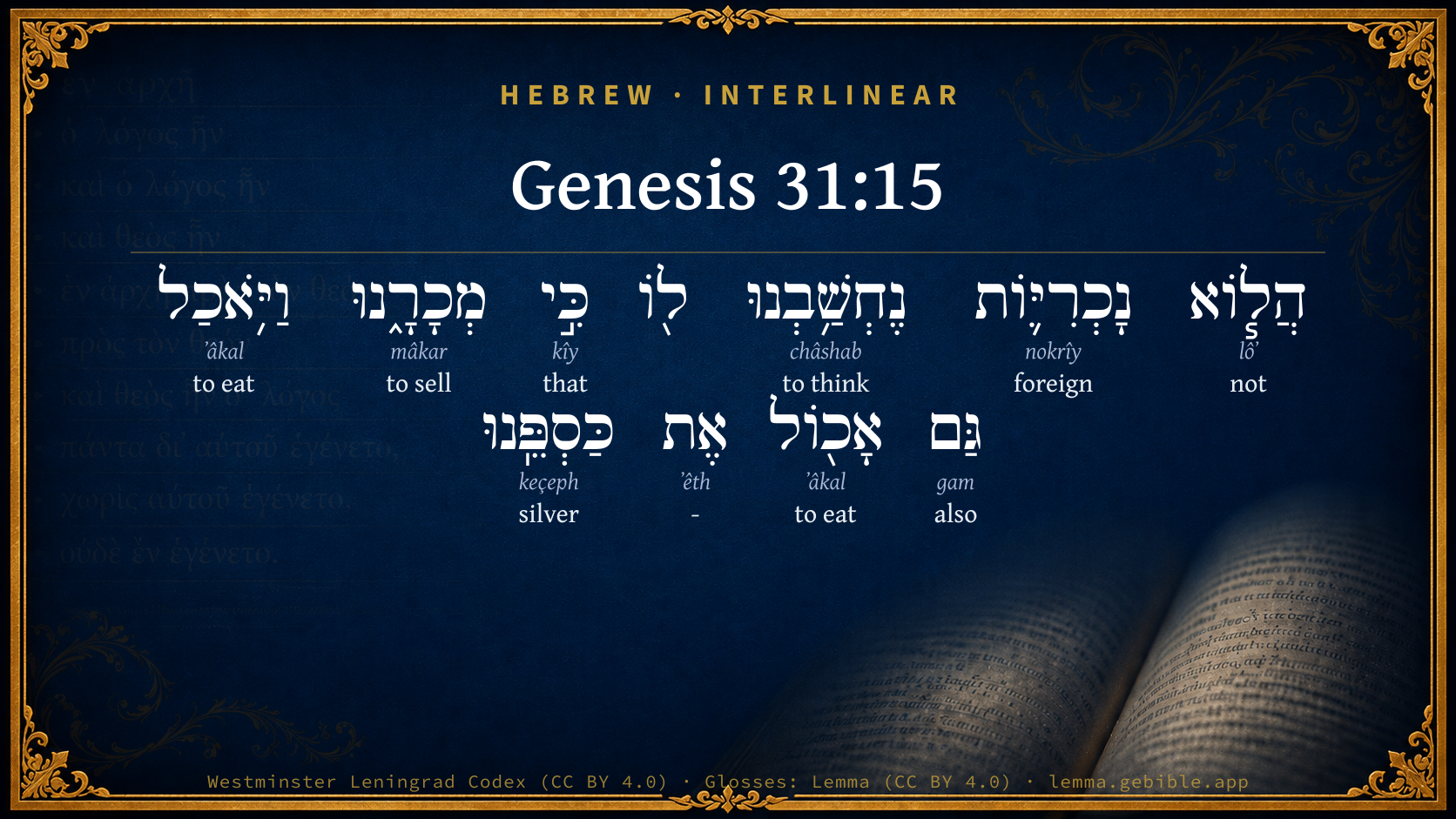
  1. הֲל֧וֹא lôʼ H3808 “not” Particle, Interrogative + Particle, Negative
  2. נֶחְשַׁ֥בְנוּ châshab H2803 “to think” Verb, Niphal, Perfect, 1st Person, Common, Plural
  3. כִּ֣י kîy H3588 “that” Conjunction
  4. מְכָרָ֑נוּ mâkar H4376 “to sell · us” Verb, Qal, Perfect, 3rd Person, Masculine, Singular + Suffix, Personal, 1st Person, Common, Plural
  5. וַיֹּ֥אכַל ʼâkal H398 “and · to eat” Conjunction + Verb, Qal, Sequential Imperfect, 3rd Person, Masculine, Singular
  6. גַּם gam H1571 “also” Particle, Accusative
  7. אָכ֖וֹל ʼâkal H398 “to eat” Verb, Qal, Infinitive Absolute
  8. אֶת ʼêth H853 “-” Particle, Direct Object
  9. כַּסְפֵּֽנוּ keçeph H3701 “silver · our” Noun, Common, Masculine, Singular, Construct + Suffix, Personal, 1st Person, Common, Plural

About this verse

These counts appear in no published source. They are computed here, from the morphology-tagged text and Lemma’s own curated glosses. What Lemma adds →

11
words
9
distinct lemmas
Pentateuch
section

First appearance in Scripture

This word makes its first canonical appearance in the Hebrew Bible here:

  • נָכְרִיּ֛וֹת foreign H5237

Shared distinctive vocabulary

נָכְרִיּ֛וֹת foreign H5237 occurs in 45 verses of the Hebrew Bible. Also found in:

Grammatical profile

  • 4 verbs
  • 1 noun
  • 1 adjective
  • 1 preposition
  • 1 conjunction
  • 3 particles

Verb forms

  • נֶחְשַׁ֥בְנוּ Niphal · Perfect
  • מְכָרָ֑נוּ Qal · Perfect
  • וַיֹּ֥אכַל Qal · Sequential Imperfect
  • אָכ֖וֹל Qal · Infinitive Absolute

Repetition

A word recurs within this verse — often emphatic in Hebrew:

  • וַיֹּ֥אכַל to eat H398 ×2

Hebrew & Septuagint length

In English translation the verse runs 19 words from the Hebrew and 17 from the Septuagint (LXX English) — closely comparable.

A rough comparison of the two English renderings, which tokenize alike — not a word-level alignment.

Word counts can differ between the Hebrew and the Greek without any difference in meaning — e.g. the Hebrew direct-object marker אֵת has no separate Greek word, and Greek often adds the article ὁ.

In the original languages it is 11 Hebrew tokens and 15 Greek tokens — but the two are counted differently (Hebrew bundles its prefixes and suffixes into one token; the Greek is in lemma form), so that isn’t a like-for-like length.

Cross-references

6

Topical passages linked to Genesis 31:15 in the Treasury of Scripture Knowledge — connected by theme and wording, ordered by reader-vote popularity; previews shown in the World English Bible.

  • Genesis 29:15–20 Laban said to Jacob, "Because you are my brother, should you therefore serve me for nothing? Tell me, what will your wages be?"
  • Genesis 29:27–30 Fulfill the week of this one, and we will give you the other also for the service which you will serve with me yet seven other years."
  • Genesis 30:26 Give me my wives and my children for whom I have served you, and let me go: for you know my service with which I have served you."
  • Genesis 31:41 These twenty years have I been in your house. I served you fourteen years for your two daughters, and six years for your flock, and you have changed my wages ten times.
  • Exodus 21:7–11 "If a man sells his daughter to be a maid-servant, she shall not go out as the men-servants do.
  • Nehemiah 5:8 I said to them, We after our ability have redeemed our brothers the Jews, that were sold to the nations; and would you even sell your brothers, and should they be sold to us? Then held they their peace, and found never a word.

Cross-references courtesy of OpenBible.info (CC BY 4.0).

Hebrew and Greek witnesses Masoretic Hebrew ↔ Greek Septuagint

The same verse in the two great witnesses to the Old Testament, shown verse-for-verse.

These are two independent witnesses, not word-aligned to each other, and the Septuagint is shown in lemma (dictionary) form.

Hebrew Genesis 31:15 Masoretic · Westminster Leningrad Codex

הֲל֧וֹא נָכְרִיּ֛וֹת נֶחְשַׁ֥בְנוּ ל֖וֹ כִּ֣י מְכָרָ֑נוּ וַיֹּ֥אכַל גַּם אָכ֖וֹל אֶת כַּסְפֵּֽנוּ

Aren't we accounted by him as foreigners? For he has sold us, and has also quite devoured our money.

World English Bible · Public Domain

Greek LXX Genesis 31:15 Septuagint · lemma form

οὐ ὡς ὁ ἀλλότριος λογίζομαι αὐτός πιπράσκω γάρ ἐγώ καί καταἐσθίω κατάβρωσις ὁ ἀργύριον ἐγώ

Are we not considered strangers by him? for he has sold us, and quite devoured our money.

LXX2012 (modern English Septuagint) · Public Domain

Hebrew: Westminster Leningrad Codex (CC BY 4.0). Greek: Septuagint (public domain); English from LXX2012 (modern English Septuagint) (Public Domain). How the Septuagint differs from the Hebrew →

Targum (Aramaic paraphrase)

2

The Targum is the ancient Jewish Aramaic paraphrase of the Hebrew Scriptures — an interpretive translation, not the Hebrew text itself. Onkelos (literal) and Pseudo-Jonathan (expansive) render the Torah, and Jonathan the Prophets. Coverage is partial: where no permissively-licensed English translation exists for a verse, only the Aramaic is shown. This is verse-level text, not a word-by-word alignment to the Hebrew.

  1. Targum Onkelos Torah (Genesis–Deuteronomy)
    הֲלָא נוּכְרָאָן אִתְחֲשַׁבְנָא לֵהּ אֲרֵי זַבְּנָנָא וַאֲכַל אַף מֵיכַל יָת כַּסְפָּנָא

    (no public-domain English translation for this verse)

    Targum Onkelos — Aramaic: “Onkelos Genesis” (public domain); “Onkelos Exodus” (public domain); “Onkelos Leviticus” (public domain); “Onkelos Numbers” (public domain); “Onkelos Deuteronomy” (public domain). English: “Sefaria Community Translation” (CC0 1.0 (public-domain dedication)); “J.W. Etheridge. The Targums of Onkelos and Jonathan Ben Uzziel on the Pentateuch. London: Longmans, Green, 1862” (public domain). Text via Sefaria.

  2. Targum Pseudo-Jonathan Torah (Genesis–Deuteronomy)
    הֲלָא נוּכְרֵיתָא אִתְחַשַׁבְנָא לֵיהּ אֲרוּם זַבְּנָנָא וְאָכַל אוּף מֵיכַל יַת כַּסְפָּנָא

    are we not considered by him as strangers For he hath sold us, and eating he hath eaten our money.

    Targum Pseudo-Jonathan — Aramaic: “Targum Jonathan on Genesis” (public domain); “Targum Jonathan on Exodus” (public domain); “Targum Jonathan on Leviticus” (public domain); “Targum Jonathan on Numbers” (public domain); “Targum Jonathan on Deuteronomy” (public domain). English: “The Targum of Jonathan ben Uzziel, trans. J. W. Etheridge, London, 1862” (public domain). Text via Sefaria.

Commentary

Notes on Genesis 31:15 from classic Christian and Jewish commentators (each source and its license shown beneath its notes). The classic Christian expositions comment on the surrounding passage and are grouped to its opening verse, so a note may address several verses; the Jewish commentaries on the Tanakh (Rashi and others) are per-verse, so they appear only where the commentator wrote on this verse.

Lemma curates 59 commentaries, every one of them public domain or Creative Commons licensed, each selected and text-cleaned for this edition rather than reprinted as found. About our sources →

Trapp's Complete Commentary

John Trapp

Gen 31:15 Are we not counted of him strangers? for he hath sold us, and hath quite devoured also our money.

Ver. 15. Are we not counted of him strangers?] Well might that father {a} say, Aεινος και παντολμος πης φιλοχρηματιος ερως. "The love of money is the root of all evil," as the apostle hath it. {1Ti 6:10} This kyte-footed corruption, wheresoever it seizeth and domineereth, it blasteth and banisheth all nobleness of spirit, natural affection, humanity, reason, discretion, manliness, mutual entertainment, intercourse of kindness and love: so that, for any fair dealing, a man had as good converse with a cannibal, as with a truly covetous captive. Well might the apostle set "covetousness" and "want of natural affection" together, as signs of a reprobate sense. {Rom 1:29; Rom 1:31} Laban sells his own daughters here, and devours also their price. And the covetous Pharisees taught children to starve their parents, to offer to the altar; that is, to their paunches and purses. {Mat 15:4-6}

{a} Isidor., Pelus., lib. iii. Ep 24.

John Trapp, A Commentary or Exposition upon All the Books of the Old and New Testament (1647–1656) — public domain. Text from a community e-Sword module.

Geneva Bible (1599)

Geneva Bible translators

For they were given to Jacob in recompence of his service, which was a kind of sale.

Geneva Bible (1599) marginal notes — public domain. Text via Bolls.life.

Adam Clarke's Commentary

Verse 15. Are we not counted of him strangers?] Rachel and Leah, who well knew the disposition of their father, gave him here his true character. He has treated us as strangers - as slaves whom he had a right to dispose of as he pleased; in consequence, he hath sold us - disposed of us on the mere principle of gaining by the sale.

And hath quite devoured also our money.] Has applied to his own use the profits of the sale, and has allowed us neither portion nor inheritance.

Adam Clarke's Commentary on the Bible (1810–1826) — public domain. Text from a community e-Sword/MySword module.

Ellicott's Commentary for English Readers

(15) He hath sold us.—There is a marked asperity towards their father in the answer of Jacob’s wives, and not only the petted Rachel but the neglected Leah joins in it. Now, though his sale of them to Jacob had been more open than Oriental good manners usually allowed, and though he seems to have acted meanly in giving no portion with them, yet these were old sores, long since healed and forgiven. Laban must have been stingy, grasping, and over-reaching in recent times, to have kept the memory of old wrongs so fresh in the minds of his daughters.

A Bible Commentary for English Readers, edited by Charles John Ellicott (1878–1897) — public domain. Text from a community e-Sword module.

The Cambridge Bible for Schools and Colleges

gen. ed. J. J. S. Perowne

15. strangers] i.e. foreigners, people of another kindred or country.

sold us] Referring to the bargain by which Jacob had obtained his two wives at the price of fourteen years’ service (Gen_29:15-20; Gen_29:27).

our money] Better, as marg., the price paid for us. Laban had taken to himself the full profits of Jacob’s fourteen years’ service as the gift, or mohar, to the bride’s family; but had assigned nothing of it as the dowry or gift to the two brides. Cf. Gen_24:53. This conduct they imply was contrary to usual custom, and was part of his stinginess. It was too late now to expect him to give anything back.

18 (P). all his substance] It would appear that this verse, taken from P, is the brief summary of Jacob’s departure given in that narrative. The words for “substance” and “his getting,” the mention of “Paddan-aram,” and the redundancy of the language, are characteristic of P.

to Isaac his father] The narrative of JE (Gen_27:1, Gen_28:21) would suggest that Isaac had died long previously.

The Cambridge Bible for Schools and Colleges (gen. ed. J. J. S. Perowne; Cambridge University Press, 1878–1918) — public domain. Text from a community e-Sword module.

John Gill's Exposition

For all the riches which God hath taken from our father,.... And given to Jacob for his labour:

that is ours, and our children's; it belonged to us by the law of nature, before it came into thine hands; and our right unto it is still more manifest, and is confirmed by the service thou hast done for it, by which means it came into thy possession; and therefore it is no point of conscience with us, nor need it be any with thee especially, to go off with it:

now then, whatsoever God hath said unto thee, do; for that must needs be right: this was well spoken indeed; they mean, that he should leave their father's house, and go into the land of Canaan, as God had directed him; and they signified that they were willing: to go along with him.

John Gill's Exposition of the Whole Bible (1746–1763) — public domain (CC PDM 1.0). Text via the HelloAO Bible API.

Haydock's Catholic Bible Commentary

Eaten up. Laban kept for himself the dowry paid by Jacob for his wives, though he ought to have allotted it to them, with the addition of something more, in proportion to his immense wealth. (Menochius)

George Leo Haydock (1774–1849), Haydock's Catholic Family Bible and Commentary, 1859 edition — public domain. Excludes Psalms (Douay-Rheims chapter numbering differs from Protestant) and Deuterocanonical books (Catholic canon only).

Matthew Poole's English Annotations

Are we not confuted of him strangers? as if we had no more right to his estate than strangers? Instead of a good part of his estate, which by the law of God and nature belongs to us, 2Co 12:14, wherewith he should have endowed us upon our marriage, he hath made sale of us for this fourteen years’ hard service, seeking only his own, not our advantage. He hath not only withheld from us, but spent upon himself, that money which he got by thy care and industry, whereof a considerable part was due in equity to us and to our children.

Matthew Poole's English Annotations on the Holy Bible (1683–1685) — public domain. Text from a community e-Sword/MySword module.

Whedon's Commentary on the Bible

Daniel D. Whedon

15. Counted of him strangers — Rachel and Leah both readily sympathize with their husband as against their father, and look upon Laban’s dealings as narrow, unfatherly, and unworthy of him. The last twenty years had largely alienated them from their father’s house.

Daniel D. Whedon (gen. ed.), Commentary on the Old and New Testaments (1874–1909) — public domain. Text from a community e-Sword module.

Rashi

Rabbi Shlomo Yitzchaki (Rashi)

הלא נכריות נחשבנו לו ARE WE NOT THOUGHT ALIENS BY HIM? — Even at a time when it is customary for people to give a dowry to their daughters — at the time of their marriage — he treated us as strangers for he sold us to you in return for your labour during fourteen years

את כספנו [HAS EATEN] OUR MONEY — for he kept for himself the money for the wages of your labour during the next six years.

Rashi on the Tanakh — English translations: “The Judaica Press complete Tanach with Rashi, translated by A. J. Rosenberg” (CC BY 4.0); “Pentateuch with Rashi's commentary by M. Rosenbaum and A.M. Silbermann, 1929-1934” (public domain); “The Metsudah Tanach series, Lakewood, N.J” (CC BY 4.0); and “The Book of Joshua, Metsudah Publications, 1997” (CC BY 4.0). Text via Sefaria.

Radak

Rabbi David Kimhi (Radak)

גם אכול את כספנו, the money he had been supposed to give us to get married. As to the word גם in this verse, the sisters referred to more than one “eating.” Not only did he consume what he had been supposed to give us, but he even consumed the proceeds of your hard work which was intended for the benefit of our family.

Radak on the Tanakh — English translations: “Sefaria Community Translation” (CC0 1.0 (public-domain dedication)); “Eliyahu Munk, HaChut Hameshulash” (CC BY 4.0); “Rabbi Mike Feuer, Jerusalem Anthology” (CC BY 4.0); and “R. David Kimhi on the first book of Psalms, Translated by R.G. Finch, London, 1919” (public domain). Text via Sefaria.

Lesson kit

Teaching starters — assembled from the data on this page, not authored interpretation. Every prompt links to the verse data it draws on. Edit before teaching.

Genesis, in the Pentateuch, opens this verse with 11 words (9 distinct Hebrew lemmas). Its most distinctive word is nokrîy (“foreign”). A historical commentator’s framing appears above. Read the whole chapter for the surrounding context.

Discussion questions

  1. The word nokrîy carries the sense “foreign.” How does it shape the verse?
  2. The word “foreign” first appears here in Scripture. What is being introduced at this debut?
  3. Exodus 2:22 shares the word «foreign» with this verse. How do the two illuminate each other?
  4. “to eat” occurs 2× in this one verse. What is the effect of the repetition?
  5. The translations on this page render this verse differently — a whole-verse word diff, not a word-by-word alignment. What might account for the different wordings?
  6. The verb «נֶחְשַׁ֥בְנוּ» is Niphal Perfect. How does its form color the action?
  7. Reading how Trapp's Complete Commentary and Geneva Bible (1599) read this verse, where do the two commentators agree and where do they part?

Things to notice

Reading settings

Reading text

Shown beneath each verse's original-language words.

Old Testament
Old Testament edition

Read the OT as the Masoretic Hebrew (MT) or the Greek Septuagint (LXX).

English shown for the Greek Septuagint (in the Hebrew ↔ Greek comparison).

Comparing translations? Open the Compare panel on any verse page to stack up to four side by side.