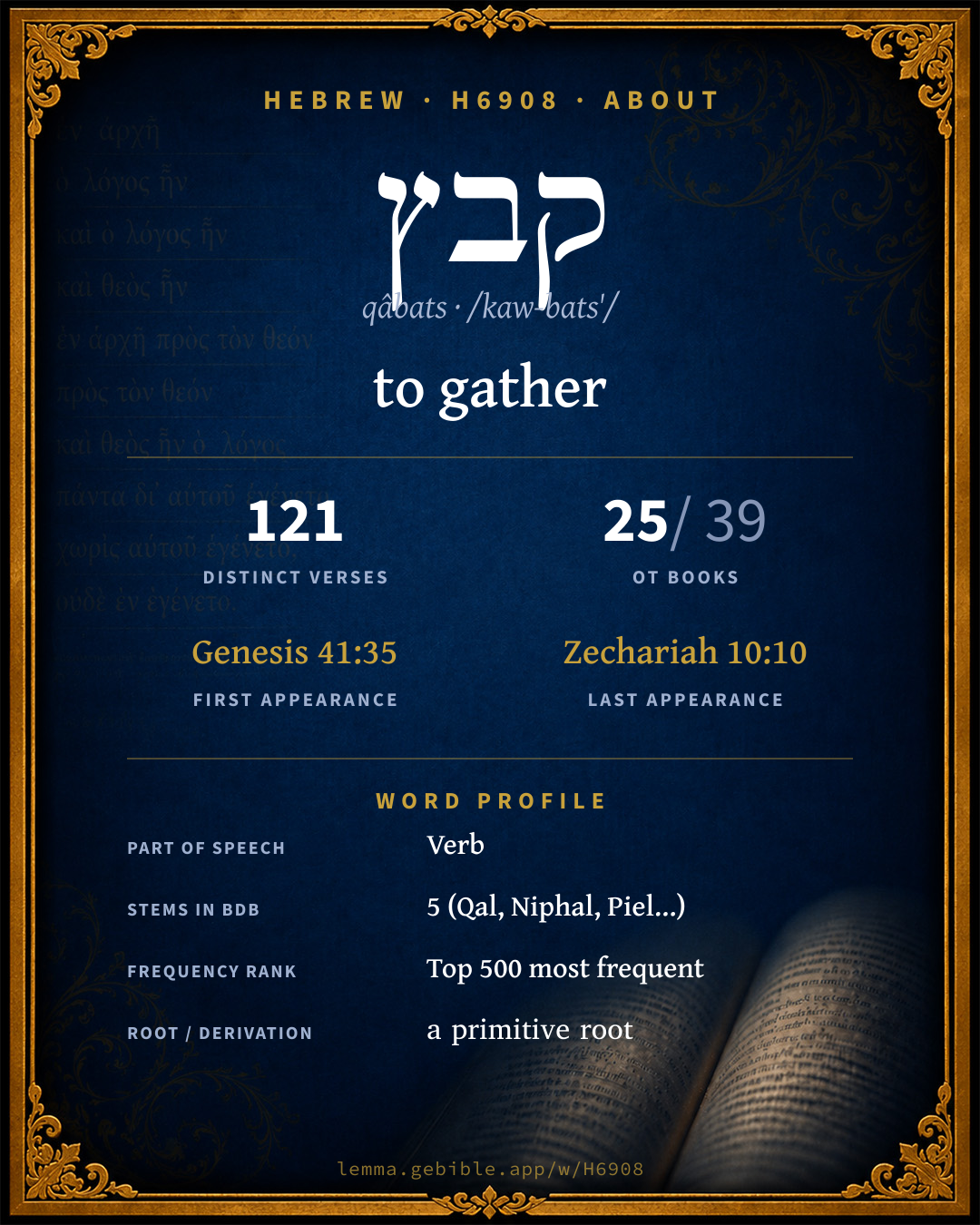
קָבַץ
to gather
‘to gather’ is one of 5 main senses fuller range ↓
Full lexicon entry — Brown-Driver-Briggs (BDB)
From Brown-Driver-Briggs (BDB)
Where this word appears
See every Piel verb in the Hebrew Bible →
Grammar key — what these labels mean
Part of speech
- Verb
- An action or state-of-being word.
Stem
- Qal
- The basic, simple active stem — the plain form of the verb (“he wrote”). Here: ‘c. acc. pers. gather’
- Niphal
- Usually the simple passive or reflexive of the Qal (“he was written”). Here: ‘intrans. assemble’
- Piel
- An intensive or resultative active stem. Here: ‘of’
- Hithpael
- The reflexive or reciprocal stem (the subject acts on itself). Here: ‘gather together’
- Pual
- The passive counterpart of the Piel.
Form
- Sequential Imperfect
- An imperfect with prefixed waw — the standard past-narrative form (waw-consecutive imperfect).
- Sequential Perfect
- A perfect with prefixed waw continuing a preceding imperfect or command (waw-consecutive perfect).
- Perfect
- A completed action or state — Hebrew marks aspect (completeness) more than strict tense (“he wrote”).
- Imperfect
- An incomplete, ongoing, or future action (“he will / would write”).
- Participle Active
- A verbal adjective expressing ongoing or characteristic action (“writing / one who writes”).
- Imperative
- A direct command (“write!”).
- Infinitive Construct
- A bound verbal noun, frequently with prepositions (“to write / in writing”).
- Cohortative
- A first-person volitional form expressing wish or resolve (“let me / let us write”).
- Jussive
- A third- or second-person volitional form expressing wish or command (“let him write”).
- Participle Passive
- A verbal adjective expressing action received (“written”).
- Infinitive Absolute
- An unbound verbal noun, often intensifying or standing in for a finite verb.
State
- Absolute
- The independent form of a noun, not bound to a following word.
- Construct
- A noun bound to a following noun in a possessive / “of” relationship (the construct chain).
Person
- 3rd Person
- The one spoken about (“he / she / it / they”).
- 1st Person
- The speaker (“I / we”).
- 2nd Person
- The one addressed (“you”).
Gender
- Masculine
- Grammatically masculine.
- Common
- Either gender — not distinguished for this form.
- Feminine
- Grammatically feminine.
Number
- Singular
- One.
- Plural
- More than one (in Hebrew, generally three or more).
Grammatical forms 45 distinct
- Verb, Qal, Sequential Imperfect, 3rd Person, Masculine, Singular 15 times (12%)
- Verb, Piel, Sequential Perfect, 1st Person, Common, Singular 11 times (9%)
- Verb, Piel, Imperfect, 1st Person, Common, Singular 11 times (9%)
- Verb, Niphal, Sequential Imperfect, 3rd Person, Masculine, Plural 9 times (7%)
- Verb, Niphal, Perfect, 3rd Person, Common, Plural 6 times (5%)
- Verb, Piel, Participle Active, Masculine, Singular, Absolute 5 times (4%)
- Verb, Hithpael, Sequential Imperfect, 3rd Person, Masculine, Plural 4 times (3%)
- Verb, Niphal, Imperative, 2nd Person, Masculine, Plural 4 times (3%)
+37 more forms (62 occurrences)
Parsed forms decoded from the imported morphology (morphhb / Westminster Leningrad Codex — WLC text public domain, morphhb tagging CC BY 4.0), counted across 127 parsed occurrences — not distinct verses.
Every verse where H6908 appears — 121 distinct verses across 25 books. Click any verse to open its interlinear word-by-word view. Verse text shown in the World English Bible for context — . Each verse’s Hebrew form is shown with its reference; the English is not keyword-highlighted, since the data carries no word-level English alignment. Use “Compare translations” on any verse to read it across multiple English versions. This concordance covers the Hebrew Bible; Septuagint (Greek Old Testament) occurrences are not indexed here.
Genesis 3 verses
- Genesis 41:35 וְ/יִקְבְּצ֗וּ conj + Qal impf 3mp Let them gather all the food of these good years that come, and lay up grain under the hand of Pharaoh for food in the cities, and let them keep it.
- Genesis 41:48 וַ/יִּקְבֹּ֞ץ conj + Qal wimpf 3ms He gathered up all the food of the seven years which were in the land of Egypt, and laid up the food in the cities: the food of the field, which was round about every city, he laid up in the same.
- Genesis 49:2 הִקָּבְצ֥וּ Niphal impv 2mp Assemble yourselves, and hear, you sons of Jacob; Listen to Israel, your father.
Deuteronomy 3 verses
- Deuteronomy 13:16 תִּקְבֹּץ֮ Qal impf 2ms You shall gather all the spoil of it into the midst of the street of it, and shall burn with fire the city, and all the spoil of it every whit, to Yahweh your God: and it shall be a heap forever; it shall not be built again.
- Deuteronomy 30:3 וְ/קִבֶּצְ/ךָ֙ conj + Piel wpf 3ms + sfx pers 2ms that then Yahweh your God will turn your captivity, and have compassion on you, and will return and gather you from all the peoples, where Yahweh your God has scattered you.
- Deuteronomy 30:4 יְקַבֶּצְ/ךָ֙ Piel impf 3ms + sfx pers 2ms If [any of] your outcasts are in the uttermost parts of the heavens, from there will Yahweh your God gather you, and from there will he bring you back:
Joshua 2 verses
- Joshua 9:2 וַ/יִּֽתְקַבְּצ֣וּ conj + Hithpael wimpf 3mp that they gathered themselves together, to fight with Joshua and with Israel, with one accord.
- Joshua 10:6 נִקְבְּצ֣וּ Niphal pf 3cp The men of Gibeon sent to Joshua to the camp to Gilgal, saying, Don't slack your hand from your servants; come up to us quickly, and save us, and help us: for all the kings of the Amorites that dwell in the hill-country are gathered together against us.
Judges 2 verses
- Judges 9:47 הִֽתְקַבְּצ֔וּ Hithpael pf 3cp It was told Abimelech that all the men of the tower of Shechem were gathered together.
- Judges 12:4 וַ/יִּקְבֹּ֤ץ conj + Qal wimpf 3ms Then Jephthah gathered together all the men of Gilead, and fought with Ephraim; and the men of Gilead struck Ephraim, because they said, You are fugitives of Ephraim, you Gileadites, in the midst of Ephraim, [and] in the midst of Manasseh.
1 Samuel 9 verses
- 1 Samuel 7:5 קִבְצ֥וּ Qal impv 2mp Samuel said, Gather all Israel to Mizpah, and I will pray for you to Yahweh.
- 1 Samuel 7:6 וַ/יִּקָּבְצ֣וּ conj + Niphal wimpf 3mp They gathered together to Mizpah, and drew water, and poured it out before Yahweh, and fasted on that day, and said there, We have sinned against Yahweh. Samuel judged the children of Israel in Mizpah.
- 1 Samuel 7:7 הִתְקַבְּצ֤וּ Hithpael pf 3cp When the Philistines heard that the children of Israel were gathered together at Mizpah, the lords of the Philistines went up against Israel. When the children of Israel heard it, they were afraid of the Philistines.
- 1 Samuel 8:4 וַ/יִּֽתְקַבְּצ֔וּ conj + Hithpael wimpf 3mp Then all the elders of Israel gathered themselves together, and came to Samuel to Ramah;
- 1 Samuel 22:2 וַ/יִּֽתְקַבְּצ֣וּ conj + Hithpael wimpf 3mp Everyone who was in distress, and everyone who was in debt, and everyone who was discontented, gathered themselves to him; and he became captain over them: and there were with him about four hundred men.
- 1 Samuel 25:1 וַ/יִּקָּבְצ֤וּ conj + Niphal wimpf 3mp Samuel died; and all Israel gathered themselves together, and lamented him, and buried him in his house at Ramah. David arose, and went down to the wilderness of Paran.
- 1 Samuel 28:1 וַ/יִּקְבְּצ֨וּ conj + Qal wimpf 3mp It happened in those days, that the Philistines gathered their hosts together for warfare, to fight with Israel. Achish said to David, Know you assuredly, that you shall go out with me in the host, you and your men.
- 1 Samuel 28:4 וַ/יִּקָּבְצ֣וּ וַ/יִּקְבֹּ֤ץ conj + Niphal wimpf 3mp conj + Qal wimpf 3ms The Philistines gathered themselves together, and came and encamped in Shunem: and Saul gathered all Israel together, and they encamped in Gilboa.
- 1 Samuel 29:1 וַ/יִּקְבְּצ֧וּ conj + Qal wimpf 3mp Now the Philistines gathered together all their hosts to Aphek: and the Israelites encamped by the spring which is in Jezreel.
2 Samuel 3 verses
- 2 Samuel 2:25 וַ/יִּֽתְקַבְּצ֤וּ conj + Hithpael wimpf 3mp The children of Benjamin gathered themselves together after Abner, and became one band, and stood on the top of a hill.
- 2 Samuel 2:30 וַ/יִּקְבֹּ֖ץ conj + Qal wimpf 3ms Joab returned from following Abner: and when he had gathered all the people together, there lacked of David's servants nineteen men and Asahel.
- 2 Samuel 3:21 וְ/אֶקְבְּצָה֩ conj + Qal coh 1cs Abner said to David, I will arise and go, and will gather all Israel to my lord the king, that they may make a covenant with you, and that you may reign over all that your soul desires. David sent Abner away; and he went in peace.
1 Kings 5 verses
- 1 Kings 11:24 וַ/יִּקְבֹּ֤ץ conj + Qal wimpf 3ms He gathered men to him, and became captain over a troop, when David killed them [of Zobah]: and they went to Damascus, and lived therein, and reigned in Damascus.
- 1 Kings 18:19 קְבֹ֥ץ Qal impv 2ms Now therefore send, and gather to me all Israel to Mount Carmel, and the prophets of Baal four hundred fifty, and the prophets of the Asherah four hundred, who eat at Jezebel's table.
- 1 Kings 18:20 וַ/יִּקְבֹּ֥ץ conj + Qal wimpf 3ms So Ahab sent to all the children of Israel, and gathered the prophets together to Mount Carmel.
- 1 Kings 20:1 קָבַץ֙ Qal pf 3ms Ben Hadad the king of Syria gathered all his host together; and there were thirty-two kings with him, and horses and chariots: and he went up and besieged Samaria, and fought against it.
- 1 Kings 22:6 וַ/יִּקְבֹּ֨ץ conj + Qal wimpf 3ms Then the king of Israel gathered the prophets together, about four hundred men, and said to them, Shall I go against Ramoth-gilead to battle, or shall I forbear? They said, Go up; for the Lord will deliver it into the hand of the king.
2 Kings 2 verses
- 2 Kings 6:24 וַ/יִּקְבֹּ֛ץ conj + Qal wimpf 3ms It happened after this, that Benhadad king of Syria gathered all his host, and went up, and besieged Samaria.
- 2 Kings 10:18 וַ/יִּקְבֹּ֤ץ conj + Qal wimpf 3ms Jehu gathered all the people together, and said to them, Ahab served Baal a little; but Jehu will serve him much.
1 Chronicles 3 verses
- 1 Chronicles 11:1 וַ/יִּקָּבְצ֧וּ conj + Niphal wimpf 3mp Then all Israel gathered themselves to David to Hebron, saying, Behold, we are your bone and your flesh.
- 1 Chronicles 13:2 וְ/יִקָּבְצ֖וּ conj + Niphal impf 3mp David said to all the assembly of Israel, If it seem good to you, and if it be of Yahweh our God, let us send abroad everywhere to our brothers who are left in all the land of Israel, with whom the priests and Levites are in their cities that have suburbs, that they may gather themselves to us;
- 1 Chronicles 16:35 וְ/קַבְּצֵ֥/נוּ conj + Piel impv 2ms + sfx pers 1cp Say you, Save us, God of our salvation, Gather us together and deliver us from the nations, To give thanks to your holy name, To triumph in your praise.
2 Chronicles 10 verses
- 2 Chronicles 13:7 וַ/יִּקָּבְצ֣וּ conj + Niphal wimpf 3mp There were gathered to him worthless men, base fellows, who strengthened themselves against Rehoboam the son of Solomon, when Rehoboam was young and tender-hearted, and could not withstand them.
- 2 Chronicles 15:9 וַ/יִּקְבֹּ֗ץ conj + Qal wimpf 3ms He gathered all Judah and Benjamin, and those who sojourned with them out of Ephraim and Manasseh, and out of Simeon: for they fell to him out of Israel in abundance, when they saw that Yahweh his God was with him.
- 2 Chronicles 15:10 וַ/יִּקָּבְצ֥וּ conj + Niphal wimpf 3mp So they gathered themselves together at Jerusalem in the third month, in the fifteenth year of the reign of Asa.
- 2 Chronicles 18:5 וַ/יִּקְבֹּ֨ץ conj + Qal wimpf 3ms Then the king of Israel gathered the prophets together, four hundred men, and said to them, Shall we go to Ramoth-gilead to battle, or shall I forbear? They said, Go up; for God will deliver it into the hand of the king.
- 2 Chronicles 20:4 וַ/יִּקָּבְצ֣וּ conj + Niphal wimpf 3mp Judah gathered themselves together, to seek [help] of Yahweh: even out of all the cities of Judah they came to seek Yahweh.
- 2 Chronicles 23:2 וַ/יִּקְבְּצ֤וּ conj + Qal wimpf 3mp They went about in Judah, and gathered the Levites out of all the cities of Judah, and the heads of fathers' [houses] of Israel, and they came to Jerusalem.
- 2 Chronicles 24:5 וַ/יִּקְבֹּץ֮ וְ/קִבְצוּ֩ conj + Qal wimpf 3ms conj + Qal impv 2mp He gathered together the priests and the Levites, and said to them, Go out to the cities of Judah, and gather of all Israel money to repair the house of your God from year to year; and see that you hasten the matter. However the Levites didn't hurry.
- 2 Chronicles 25:5 וַ/יִּקְבֹּ֤ץ conj + Qal wimpf 3ms Moreover Amaziah gathered Judah together, and ordered them according to their fathers' houses, under captains of thousands and captains of hundreds, even all Judah and Benjamin: and he numbered them from twenty years old and upward, and found them three hundred thousand chosen men, able to go forth to war, who could handle spear and shield.
- 2 Chronicles 32:4 וַ/יִּקָּבְצ֣וּ conj + Niphal wimpf 3mp So there was gathered much people together, and they stopped all the springs, and the brook that flowed through the midst of the land, saying, Why should the kings of Assyria come, and find much water?
- 2 Chronicles 32:6 וַ/יִּקְבְּצֵ֣/ם conj + Qal wimpf 3ms + sfx pers 3mp He set captains of war over the people, and gathered them together to him in the broad place at the gate of the city, and spoke comfortably to them, saying,
Ezra 5 verses
- Ezra 7:28 וָ/אֶקְבְּצָ֧/ה conj + Qal wimpf 1cs + sfx h and has extended loving kindness to me before the king, and his counselors, and before all the king's mighty princes. I was strengthened according to the hand of Yahweh my God on me, and I gathered together out of Israel chief men to go up with me.
- Ezra 8:15 וָֽ/אֶקְבְּצֵ֗/ם conj + Qal wimpf 1cs + sfx pers 3mp I gathered them together to the river that runs to Ahava; and there we encamped three days: and I viewed the people, and the priests, and found there none of the sons of Levi.
- Ezra 10:1 נִקְבְּצוּ֩ Niphal pf 3cp Now while Ezra prayed and made confession, weeping and casting himself down before the house of God, there was gathered together to him out of Israel a very great assembly of men and women and children; for the people wept very sore.
- Ezra 10:7 לְ/הִקָּבֵ֖ץ prep + Niphal inf.cs They made proclamation throughout Judah and Jerusalem to all the children of the captivity, that they should gather themselves together to Jerusalem;
- Ezra 10:9 וַ/יִּקָּבְצ֣וּ conj + Niphal wimpf 3mp Then all the men of Judah and Benjamin gathered themselves together to Jerusalem within the three days; it was the ninth month, on the twentieth [day] of the month: and all the people sat in the broad place before the house of God, trembling because of this matter, and for the great rain.
Nehemiah 5 verses
- Nehemiah 1:9 אֲקַבְּצֵ֔/ם Piel impf 1cs + sfx pers 3mp but if you return to me, and keep my commandments and do them, though your outcasts were in the uttermost part of the heavens, yet will I gather them from there, and will bring them to the place that I have chosen, to cause my name to dwell there.
- Nehemiah 4:20 תִּקָּבְצ֣וּ Niphal impf 2mp in whatever place you hear the sound of the trumpet, resort you there to us; our God will fight for us.
- Nehemiah 5:16 קְבוּצִ֥ים Qal ptcp.pass mp Yes, also I continued in the work of this wall, neither bought we any land: and all my servants were gathered there to the work.
- Nehemiah 7:5 וָ/אֶקְבְּצָ֞/ה conj + Qal wimpf 1cs + sfx h My God put into my heart to gather together the nobles, and the rulers, and the people, that they might be reckoned by genealogy. I found the book of the genealogy of those who came up at the first, and I found written therein:
- Nehemiah 13:11 וָֽ/אֶ֨קְבְּצֵ֔/ם conj + Qal wimpf 1cs + sfx pers 3mp Then contended I with the rulers, and said, Why is the house of God forsaken? I gathered them together, and set them in their place.
Esther 3 verses
- Esther 2:3 וְ/יִקְבְּצ֣וּ conj + Qal juss 3mp and let the king appoint officers in all the provinces of his kingdom, that they may gather together all the beautiful young virgins to Shushan the palace, to the house of the women, to the custody of Hegai the king's chamberlain, keeper of the women; and let their things for purification be given them;
- Esther 2:8 וּֽ/בְ/הִקָּבֵ֞ץ conj + prep + Niphal inf.cs So it happened, when the king's commandment and his decree was heard, and when many maidens were gathered together to Shushan the palace, to the custody of Hegai, that Esther was taken into the king's house, to the custody of Hegai, keeper of the women.
- Esther 2:19 וּ/בְ/הִקָּבֵ֥ץ conj + prep + Niphal inf.cs When the virgins were gathered together the second time, then Mordecai was sitting in the king's gate.
Psalms 4 verses
- Psalms 41:6 יִקְבָּץ Qal impf 3ms If he comes to see me, he speaks falsehood. His heart gathers iniquity to itself. When he goes abroad, he tells it.
- Psalms 102:22 בְּ/הִקָּבֵ֣ץ prep + Niphal inf.cs When the peoples are gathered together, The kingdoms, to serve Yahweh.
- Psalms 106:47 וְ/קַבְּצֵ/נוּ֮ conj + Piel impv 2ms + sfx pers 1cp Save us, Yahweh, our God, Gather us from among the nations, To give thanks to your holy name, To triumph in your praise!
- Psalms 107:3 קִ֫בְּצָ֥/ם Piel pf 3ms + sfx pers 3mp And gathered out of the lands, From the east and from the west, From the north and from the south.
Proverbs 2 verses
Isaiah 18 verses
- Isaiah 11:12 יְקַבֵּ֔ץ Piel impf 3ms He will set up an ensign for the nations, and will assemble the outcasts of Israel, and gather together the dispersed of Judah from the four corners of the earth.
- Isaiah 13:14 מְקַבֵּ֑ץ Piel ptcp.act ms It shall happen, that as the chased roe, and as sheep that no man gathers, they shall turn every man to his own people, and shall flee every man to his own land.
- Isaiah 22:9 וַֽ/תְּקַבְּצ֔וּ conj + Piel wimpf 2mp You saw the breaches of the city of David, that they were many; and you gathered together the waters of the lower pool;
- Isaiah 34:15 נִקְבְּצ֥וּ Niphal pf 3cp There shall the dart-snake make her nest, and lay, and hatch, and gather under her shade; yes, there shall the kites be gathered, everyone with her mate.
- Isaiah 34:16 קִבְּצָֽ/ן Piel pf 3ms + sfx n Seek you out of the book of Yahweh, and read: no one of these shall be missing, none shall want her mate; for my mouth, it has commanded, and his Spirit, it has gathered them.
- Isaiah 40:11 יְקַבֵּ֣ץ Piel impf 3ms He will feed his flock like a shepherd, he will gather the lambs in his arm, and carry them in his bosom, [and] will gently lead those who have their young.
- Isaiah 43:5 אֲקַבְּצֶֽ/ךָּ Piel impf 1cs + sfx pers 2ms Don't be afraid; for I am with you: I will bring your seed from the east, and gather you from the west;
- Isaiah 43:9 נִקְבְּצ֣וּ Niphal pf 3cp Let all the nations be gathered together, and let the peoples be assembled: who among them can declare this, and show us former things? let them bring their witnesses, that they may be justified; or let them hear, and say, It is truth.
- Isaiah 44:11 יִֽתְקַבְּצ֤וּ Hithpael impf 3mp Behold, all his fellows shall be disappointed; and the workmen, they are of men: let them all be gathered together, let them stand up; they shall fear, they shall be put to shame together.
- Isaiah 45:20 הִקָּבְצ֥וּ Niphal impv 2mp Assemble yourselves and come; draw near together, you who have escaped from the nations: they have no knowledge who carry the wood of their engraved image, and pray to a god that can't save.
- Isaiah 48:14 הִקָּבְצ֤וּ Niphal impv 2mp Assemble yourselves, all you, and hear; who among them has declared these things? He whom Yahweh loves shall perform his pleasure on Babylon, and his arm [shall be on] the Chaldeans.
- Isaiah 49:18 נִקְבְּצ֣וּ Niphal pf 3cp Lift up your eyes round about, and see: all these gather themselves together, and come to you. As I live, says Yahweh, you shall surely clothe you with them all as with an ornament, and gird yourself with them, like a bride.
- Isaiah 54:7 אֲקַבְּצֵֽ/ךְ Piel impf 1cs + sfx pers 2fs For a small moment have I forsaken you; but with great mercies will I gather you.
- Isaiah 56:8 מְקַבֵּ֖ץ אֲקַבֵּ֥ץ לְ/נִקְבָּצָֽי/ו Piel ptcp.act ms Piel impf 1cs prep + Niphal ptcp.act mp cs + sfx pers 3ms The Lord Yahweh, who gathers the outcasts of Israel, says, Yet will I gather [others] to him, besides his own who are gathered.
- Isaiah 60:4 נִקְבְּצ֣וּ Niphal pf 3cp Lift up your eyes round about, and see: they all gather themselves together, they come to you; your sons shall come from far, and your daughters shall be carried in the arms.
- Isaiah 60:7 יִקָּ֣בְצוּ Niphal impf 3mp All the flocks of Kedar shall be gathered together to you, the rams of Nebaioth shall minister to you; they shall come up with acceptance on my altar; and I will glorify the house of my glory.
- Isaiah 62:9 וּֽ/מְקַבְּצָ֥י/ו conj + Piel ptcp.act mp cs + sfx pers 3ms but those who have garnered it shall eat it, and praise Yahweh; and those who have gathered it shall drink it in the courts of my sanctuary.
- Isaiah 66:18 לְ/קַבֵּ֥ץ prep + Piel inf.cs For I [know] their works and their thoughts: [the time] comes, that I will gather all nations and languages; and they shall come, and shall see my glory.
Jeremiah 8 verses
- Jeremiah 23:3 אֲקַבֵּץ֙ Piel impf 1cs I will gather the remnant of my flock out of all the countries where I have driven them, and will bring them again to their folds; and they shall be fruitful and multiply.
- Jeremiah 29:14 וְ/קִבַּצְתִּ֣י conj + Piel wpf 1cs I will be found by you, says Yahweh, and I will turn again your captivity, and I will gather you from all the nations, and from all the places where I have driven you, says Yahweh; and I will bring you again to the place from where I caused you to be carried away captive.
- Jeremiah 31:8 וְ/קִבַּצְתִּי/ם֮ conj + Piel wpf 1cs + sfx pers 3mp Behold, I will bring them from the north country, and gather them from the uttermost parts of the earth, [and] with them the blind and the lame, the woman with child and her who travails with child together: a great company shall they return here.
- Jeremiah 31:10 יְקַבְּצֶ֔/נּוּ Piel impf 3ms + sfx pers 3ms Hear the word of Yahweh, you nations, and declare it in the isles afar off; and say, He who scattered Israel will gather him, and keep him, as shepherd does his flock.
- Jeremiah 32:37 מְקַבְּצָ/ם֙ Piel ptcp.act ms cs + sfx pers 3mp Behold, I will gather them out of all the countries, where I have driven them in my anger, and in my wrath, and in great indignation; and I will bring them again to this place, and I will cause them to dwell safely:
- Jeremiah 40:15 הַ/נִּקְבָּצִ֣ים ptcl def.art + Niphal ptcp.pass mp Then Johanan the son of Kareah spoke to Gedaliah in Mizpah secretly, saying, Please let me go, and I will kill Ishmael the son of Nethaniah, and no man shall know it: why should he take your life, that all the Jews who are gathered to you should be scattered, and the remnant of Judah perish?
- Jeremiah 49:5 מְקַבֵּ֖ץ Piel ptcp.act ms Behold, I will bring a fear on you, says the Lord, Yahweh of Hosts, from all who are round about you; and you shall be driven out every man right forth, and there shall be none to gather together the fugitives.
- Jeremiah 49:14 הִֽתְקַבְּצוּ֙ Hithpael pf 3cp I have heard news from Yahweh, and an ambassador is sent among the nations, [saying], Gather yourselves together, and come against her, and rise up to the battle.
Ezekiel 15 verses
- Ezekiel 11:17 וְ/קִבַּצְתִּ֤י conj + Piel wpf 1cs Therefore say, Thus says the Lord Yahweh: I will gather you from the peoples, and assemble you out of the countries where you have been scattered, and I will give you the land of Israel.
- Ezekiel 16:37 מְקַבֵּ֤ץ וְ/קִבַּצְתִּי֩ Piel ptcp.act ms conj + Piel wpf 1cs therefore see, I will gather all your lovers, with whom you have taken pleasure, and all those who you have loved, with all those who you have hated; I will even gather them against you on every side, and will uncover your nakedness to them, that they may see all your nakedness.
- Ezekiel 20:34 וְ/קִבַּצְתִּ֣י conj + Piel wpf 1cs and I will bring you out from the peoples, and will gather you out of the countries in which you are scattered, with a mighty hand, and with an outstretched arm, and with wrath poured out;
- Ezekiel 20:41 וְ/קִבַּצְתִּ֣י conj + Piel wpf 1cs As a sweet savor will I accept you, when I bring you out from the peoples, and gather you out of the countries in which you have been scattered; and I will be sanctified in you in the sight of the nations.
- Ezekiel 22:19 קֹבֵ֣ץ Qal ptcp.act ms Therefore thus says the Lord Yahweh: Because you are all become dross, therefore, behold, I will gather you into the midst of Jerusalem.
- Ezekiel 22:20 אֶקְבֹּץ֙ Qal impf 1cs As they gather silver and brass and iron and lead and tin into the midst of the furnace, to blow the fire on it, to melt it; so will I gather you in my anger and in my wrath, and I will lay you there, and melt you.
- Ezekiel 28:25 בְּ/קַבְּצִ֣/י prep + Piel inf.cs + sfx pers 1cs Thus says the Lord Yahweh: When I shall have gathered the house of Israel from the peoples among whom they are scattered, and shall be sanctified in them in the sight of the nations, then shall they dwell in their own land which I gave to my servant Jacob.
- Ezekiel 29:5 תִקָּבֵ֑ץ Niphal impf 2ms I will cast you forth into the wilderness, you and all the fish of your rivers: you shall fall on the open field; you shall not be brought together, nor gathered; I have given you for food to the animals of the earth and to the birds of the sky.
- Ezekiel 29:13 אֲקַבֵּ֣ץ Piel impf 1cs For thus says the Lord Yahweh: At the end of forty years will I gather the Egyptians from the peoples where they were scattered;
- Ezekiel 34:13 וְ/קִבַּצְתִּי/ם֙ conj + Piel wpf 1cs + sfx pers 3mp I will bring them out from the peoples, and gather them from the countries, and will bring them into their own land; and I will feed them on the mountains of Israel, by the watercourses, and in all the inhabited places of the country.
- Ezekiel 36:24 וְ/קִבַּצְתִּ֥י conj + Piel wpf 1cs For I will take you from among the nations, and gather you out of all the countries, and will bring you into your own land.
- Ezekiel 37:21 וְ/קִבַּצְתִּ֤י conj + Piel wpf 1cs Say to them, Thus says the Lord Yahweh: Behold, I will take the children of Israel from among the nations, where they are gone, and will gather them on every side, and bring them into their own land:
- Ezekiel 38:8 מְקֻבֶּ֨צֶת֙ Pual ptcp.pass fs After many days you shall be visited: in the latter years you shall come into the land that is brought back from the sword, that is gathered out of many peoples, on the mountains of Israel, which have been a continual waste; but it is brought forth out of the peoples, and they shall dwell securely, all of them.
- Ezekiel 39:17 הִקָּבְצ֤וּ Niphal impv 2mp You, son of man, thus says the Lord Yahweh: Speak to the birds of every sort, and to every animal of the field, Assemble yourselves, and come; gather yourselves on every side to my sacrifice that I do sacrifice for you, even a great sacrifice on the mountains of Israel, that you may eat flesh and drink blood.
- Ezekiel 39:27 וְ/קִבַּצְתִּ֣י conj + Piel wpf 1cs when I have brought them back from the peoples, and gathered them out of their enemies' lands, and am sanctified in them in the sight of many nations.
Hosea 3 verses
- Hosea 1:11 וְ֠/נִקְבְּצוּ conj + Niphal wpf 3cp The children of Judah and the children of Israel will be gathered together, and they will appoint themselves one head, and will go up from the land; for great will be the day of Jezreel.
- Hosea 8:10 אֲקַבְּצֵ֑/ם Piel impf 1cs + sfx pers 3mp But although they sold themselves among the nations, I will now gather them; and they begin to waste away because of the oppression of the king of mighty ones.
- Hosea 9:6 תְּקַבְּצֵ֖/ם Piel impf 3fs + sfx pers 3mp For, behold, they have gone away from destruction. Egypt will gather them up. Memphis will bury them. Nettles will possess their pleasant things of silver. Thorns will be in their tents.
Joel 4 verses
- Joel 2:6 קִבְּצ֥וּ Piel pf 3cp At their presence the peoples are in anguish. All faces have grown pale.
- Joel 2:16 קִבְצ֣וּ Qal impv 2mp Gather the people. Sanctify the assembly. Assemble the elders. Gather the children, and those who suck the breasts. Let the bridegroom go forth from his room, And the bride out of her chamber.
- Joel 3:2 וְ/קִבַּצְתִּי֙ conj + Piel wpf 1cs I will gather all nations, And will bring them down into the valley of Jehoshaphat; And I will execute judgment on them there for my people, And for my heritage, Israel, whom they have scattered among the nations. They have divided my land,
- Joel 3:11 וְ/נִקְבָּ֑צוּ conj + Niphal wpf 3cp Hurry and come, all you surrounding nations, And gather yourselves together." Cause your mighty ones to come down there, Yahweh.
Micah 4 verses
- Micah 1:7 קִבָּ֔צָה Piel pf 3fs All her idols will be beaten to pieces, And all her temple gifts will be burned with fire, And all her images I will destroy; For of the hire of a prostitute has she gathered them, And to the hire of a prostitute shall they return."
- Micah 2:12 קַבֵּ֤ץ אֲקַבֵּץ֙ Piel inf.abs Piel impf 1cs I will surely assemble, Jacob, all of you; I will surely gather the remnant of Israel; I will put them together as the sheep of Bozrah, As a flock in the midst of their pasture; They will swarm with people.
- Micah 4:6 אֲקַבֵּ֑צָה Piel coh 1cs "In that day," says Yahweh, "I will assemble that which is lame, And I will gather that which is driven away, And that which I have afflicted;
- Micah 4:12 קִבְּצָ֖/ם Piel pf 3ms + sfx pers 3mp But they don't know the thoughts of Yahweh, Neither do they understand his counsel; For he has gathered them like the sheaves to the threshing floor.
Nahum 2 verses
- Nahum 2:10 קִבְּצ֥וּ Piel pf 3cp She is empty, void, and waste. The heart melts, the knees knock together, their bodies and faces have grown pale.
- Nahum 3:18 מְקַבֵּֽץ Piel ptcp.act ms Your shepherds slumber, king of Assyria. Your nobles lie down. Your people are scattered on the mountains, and there is no one to gather them.
Habakkuk 1 verse
Zephaniah 3 verses
- Zephaniah 3:8 לְ/קָבְצִ֣/י prep + Qal inf.cs + sfx pers 1cs "Therefore wait for me," says Yahweh, "until the day that I rise up to the prey, for my determination is to gather the nations, that I may assemble the kingdoms, to pour on them my indignation, even all my fierce anger, for all the earth will be devoured with the fire of my jealousy.
- Zephaniah 3:19 אֲקַבֵּ֔ץ Piel impf 1cs Behold, at that time I will deal with all those who afflict you, and I will save those who are lame, and gather those who were driven away. I will give them praise and honor, whose shame has been in all the earth.
- Zephaniah 3:20 קַבְּצִ֣/י Piel inf.cs + sfx pers 1cs At that time will I bring you in, and at that time will I gather you; for I will give you honor and praise among all the peoples of the earth, when I bring back your captivity before your eyes, says Yahweh.
Zechariah 2 verses
- Zechariah 10:8 וַ/אֲקַבְּצֵ֖/ם conj + Piel impf 1cs + sfx pers 3mp I will signal for them, and gather them; For I have redeemed them; And they will increase as they have increased.
- Zechariah 10:10 אֲקַבְּצֵ֑/ם Piel impf 1cs + sfx pers 3mp I will bring them again also out of the land of Egypt, And gather them out of Assyria; And I will bring them into the land of Gilead and Lebanon; And there won't be room enough for them.
About this entry
At a glance — auto-summarized from this page’s data, not written by a person. Every figure links to its source below. This summary describes the numbers; it doesn’t interpret them.
At its core, קבץ (qâbats) means “to gather.” Different stems carry different senses — BDB groups them under 5 stems, among them Qal and Niphal. With 121 verses in 25 books, it is a common word in the Hebrew Bible. Scripture first uses it in Genesis 41:35. Sharing its root, it stands alongside קבוץ, קבצה and יקבצאל. Dig into 121-verse concordance and the renderings breakdown below.
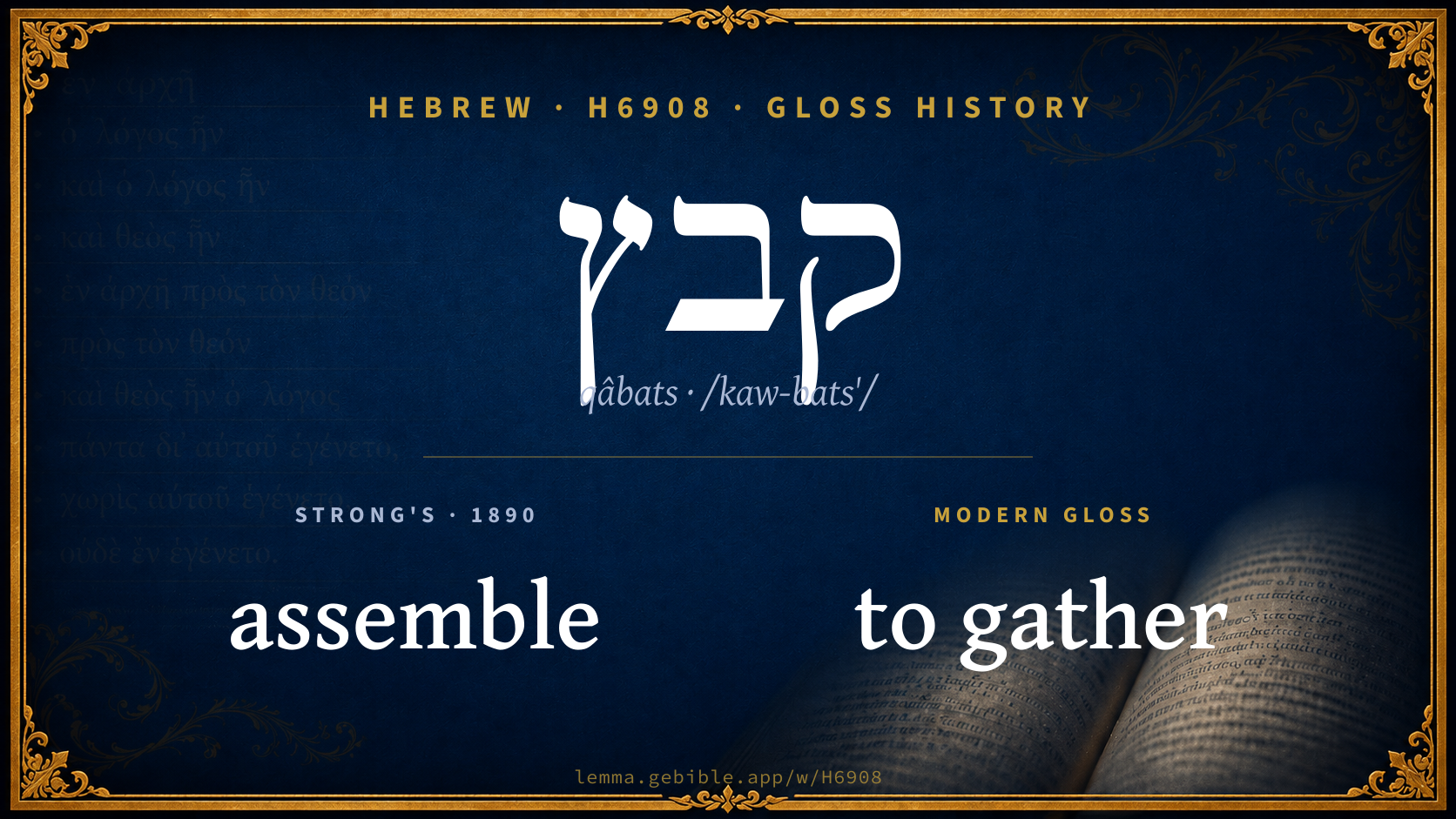
Gloss history
Strong's 1890 vs modern scholarship
About this word
Strong's H6908 catalogs a Hebrew word from the Hebrew Old Testament.
These counts are not copied from any lexicon or concordance. They are computed here, from the morphology-tagged Hebrew Old Testament. What Lemma adds →
- 121
- distinct verses
- The word appears in 121 distinct verses.
- 25 / 39
- OT books
- The word appears in 25 of 39 Old Testament books.
- #348
- by frequency
- Top 500 most frequent Hebrew words (rank 348 of 8,640 Hebrew words by occurrence).
View all 121 occurrences in the concordance →
Most concentrated in
- Isaiah 18 verses 15%
- Ezekiel 15 verses 12%
- 2 Chronicles 10 verses 8%
By section of the Old Testament
By traditional corpus
Conventional, traditional groupings — biblical authorship is debated, so this is a traditional corpus grouping, not an authorship claim. Each share is this word’s portion of its verses in that division of the Hebrew canon. Each figure is a share of the word’s 121 distinct verses.
- Prophets (Nevi'im) 83 verses · 69%
- Writings (Ketuvim) 32 verses · 26%
- Torah (Pentateuch) 6 verses · 5%
How translations render this word
Counts come from each version’s own published word-to-Strong’s tagging or interlinear alignment — an approximate guide to how each version renders this word, not a word-level alignment the data otherwise carries. Because each total is that version’s own tagged count, the per-version totals vary from one another and need not match the appearance or distinct-verse counts above. These counts may also differ from a printed concordance because Lemma counts each distinctly tagged rendering and does not collapse phrase taggings into a single head-word total. This is a fixed set of word-tagged versions (KJV, ASV, BSB, ULT) and does not change with the reading translation you choose elsewhere. Each version’s license is shown beside its name below (and on Sources).
- King James Version: Gather 15×, Gathered 14×, Together 9×
- American Standard Version: Gathered 14×, Gather 12×, Together 10×
- Berean Standard Bible: Gather 14×, Gathered 13×, I will gather 9×
- unfoldingWord Literal Text: Gathered 15×, And 14×, Gather 14×
King James Version Public Domain
Renders H6908 across 136 tagged occurrences — most commonly:
Plus other, less common renderings. Plus 46 renderings that appear only once — usually multi-word phrases or single function words the recovered tagging swept in, not distinct renderings.
American Standard Version Public Domain
Renders H6908 across 136 tagged occurrences — most commonly:
Plus other, less common renderings. Plus 57 renderings that appear only once — usually multi-word phrases or single function words the recovered tagging swept in, not distinct renderings.
Berean Standard Bible Public Domain
Renders H6908 across 126 tagged occurrences — most commonly:
Plus other, less common renderings. Plus 43 renderings that appear only once — usually multi-word phrases or single function words the recovered tagging swept in, not distinct renderings. Not rendered by a distinct English word in 1 further occurrence.
unfoldingWord Literal Text CC BY-SA 4.0
Renders H6908 across 147 tagged occurrences — most commonly:
Plus other, less common renderings. Plus 41 renderings that appear only once — usually multi-word phrases or single function words the recovered tagging swept in, not distinct renderings.
12 senses and sub-senses in the full BDB
Hebrew verbs can shift meaning by stem (binyan): Qal is the basic action, Niphal is often passive or reflexive, Piel often intensifies or makes it factitive, and Hiphil is typically causative. The senses below are grouped under the stem BDB assigns to each. This entry also uses Pual (the passive of Piel) and Hithpael (reflexive or reciprocal).
What do BDB’s symbols mean?
BDB uses these scholarly abbreviations:
| Symbol | Meaning |
|---|---|
| 𝔊 | the Septuagint (the ancient Greek translation, LXX) |
| 𝔙 | the Vulgate (the Latin translation) |
| 𝔖 | the Syriac version (the Peshitta) |
| 𝔗 | the Targum (the Aramaic translation) |
| ψ | the Psalms |
| √ | root (the underlying root or stem) |
| ‖ | parallel passage (a synonymous or contrasted parallel) |
| † | the dagger: every passage where the word occurs is cited |
The 12 senses and sub-senses the full Brown-Driver-Briggs lexicon distinguishes for this word, in lexicon order (not ranked by frequency), with BDB’s own verbatim wording and sub-sense lettering. Shown in Hebrew script with BDB’s own scholarly abbreviations. The condensed entry is in the Lexicon Entry tab. See also the Forms in the corpus table below.
Qal
- Pf. 3 ms. ק׳ 1 K 20:1; Impf. 3 ms. יִקְבָּץ־ ψ 41:7, וַיִּקְבֹּץ Gn 41:48 +, etc.; Imv. ms. קְבֹץ 1 K 18:19, mpl. קִבְצוּ 1 S 7:5 +; Inf. cstr. sf. לְקָבְצִי Zp 3:8; Pt. act. קֹבֵץ Ez 22:19; Pr 13:11; pass. pl. קְבוּצִים Ne 5:16;—gather, collect: e.g. 1 Kings 20:1
- 1. c. acc. rei, grain Gn 41:35, 48 (E), booty Dt 13:17 (+ אֶל loc.), money 2 Ch 24:5 (+ מִן pers.), so Ez 16:31 (Gr Toy Krae, reading לִקְבֹּץ from לְקַלֵּס; v. p. 887); acc. om. קֹבֵץ Pr 13:11 one gathering by degrees; fig. לִבּוֹ וִק׳־אָוֶן לוֹ ψ 41:7 his heart gathereth wickedness to itself. e.g. Genesis 41:35
- 2. usually c. acc. pers. gather, assemble, + ה loc. 1 S 7:5; 29:1 (for battle); + אֶל loc. 1 K 18:20; Ezr 8:15; Est 2:3; + אֶל pers. 2 S 3:21; Hb 2:5 (in fig.; ‖ אָסַף); + עַל (= אֶל) pers. 1 K 11:24; + אֶל pers. et loc. 1 K 18:19; 2 Ch 32:6; + מִן loc. 2 Ch 23:2, cf. Ezr 7:28; acc. pers. alone 1 K 22:6 = 2 Ch 18:5; 2 K 10:18; Ne 7:5 (+ inf. purpose), Jo 2:16 (‖ אָסַף), 2 Ch 15:9; 24:5; 25:5; pass. c. שָׁם + עַל of work Ne 5:16; for י׳’s judgment Zp 3:8 (‖ אָסַף), Ez 22:20 cf. v 19 (+ אֶל־תּוֹךְ fig. of metals into furnace); specif. for war, battle, Ju 12:4; 1 S 28:1; 2 S 2:30; 1 K 20:1; 2 K 6:24; + לַצָּבָא 1 S 28:1 (29:1 v. supr.). e.g. 1 Samuel 7:5
Niphal
- Pf. 3 pl. נִקְבְּצוּ Jos 10:6 +, etc.; Impf. 2 ms. תִּקָּבֵץ Ez 29:5; 3 mpl. וַיִּקָּֽבְצוּ 1 S 7:6 +, etc.; Imv. mpl. הִקָּֽבְצוּ Gn 49:2 +; Inf. cstr. הִקָּבֵץ Ezr 10:7 +; Pt. pl. נִקְבָּצִים Je 40:15, sf. נִקְבָּצָיו Is 56:8;— e.g. Joshua 10:6
- 1. intrans. assemble, gather 1 S 25:1; Gn 49:2; Is 45:20; 48:14; 49:18; 60:4; Jo 4:11; 2 Ch 20:4 (+ inf. purpose) 32:4; for war 1 S 28:4; Jos 10:6 (c. אֶל against); c. ה loc. 1 S 7:6, acc. loc. Ezr 10:7, 9; 2 Ch 15:10; c. אֶל pers. unto Je 40:15 1 Ch 13:2; Ezr 10:1; Ne 4:14, cf. 2 Ch 13:7 (עַל for אֶל); אֶל pers. + ה loc. 1 Ch 11:1; c. יַחְדָּו Ho 2:2; Is 43:9 (‖ אָסַף), ψ 102:23; of birds and beasts Is 34:15 (c. שָׁם), Ez 39:17. e.g. 1 Samuel 25:1
- 2. pass. be gathered Is 60:7 (of flocks, + ל pers.), Est 2:8 (+ אֶל loc.), v 19; pt. c. sf. pers. Is 56:8; Ez 29:5 (‖ אסף) read תִּקָּכֵר Hi (not Sm) Co Berthol Toy Krae. e.g. Isaiah 60:7
Piel
- Pf. 3 ms. sf. וְקִבֶּצְךָ Dt 30:3 consec., קִבְּצָם Mi 4:12 ψ 107:3, קִבְּצָן Is 34:16; 3 fs. קִבָּ֑צָה Mi 1:7, etc.; Impf. יְקַבֵּץ Is 11:12; 40:11, etc.; Imv. ms. sf. קַבְּצֵנוּ 1 Ch 16:35, ψ 106:47; Inf. abs. קַבֵּץ Mi 2:12; cstr. קַבֵּץ Is 66:18 etc.; Pt. מְקַבֵּץ Na 3:18 +, etc.;—gather together: e.g. Deuteronomy 30:3
- 1. usually of י׳ gathering his dispersed people (acc.), sometimes under fig. of flock: Mi 2:12 + inf. abs. (‖ אָסַף), 4:6 Zp 3:19, 20; Je 31:10; Zc 10:8; Is 54:7; 56:8a, cf. also 40:11; c. acc. + מִן loc. Dt 30:3, 4 Je 23:3; 29:14; 31:8; 32:37 Ez 11:17 + 6 times Ez + 37:21 (מִסָּבִיב), Is 11:12; 43:5; Zc 10:10; Ne 1:9 ψ 106:47 cf. ‖ 1 Ch 16:35, ψ 107:3; acc. + עַל pers. Is 56:8b (cf. Niph. Pt.); = (gather and) restrain Ho 8:10 (c. acc. alone); of י׳ gathering dispersed Egyptians, acc. + מִן loc. Ez 29:13; gathering the nations (acc.) for judgment Mi 4:12; Is 66:18; Jo 4:2; gathering lovers of Jerus. (under fig. of harlot) Ez 16:37(×2) (מִסָּבִיב + עַל pers. against); gathering beasts into Edom Is 34:16. e.g. Micah 2:12
- 2. men subj.: מִצְרַיִם תְּקַבְּצֵם מֹף תְּקַבְּרֵם Ho 9:6 (cf. Ez 29:5 Niph. supr.), Ne 13:11; c. acc. rei Mi 1:7 (+ מִן), Is 22:9; 62:9 Pr 28:8; אֵין מְקַבֵּץ none that gathereth Is 13:14 (acc. om.). Na 3:18 (id.), Je 49:5 (sq. לַנֹּדֵד, cf. ל 3 ad fin.). e.g. Hosea 9:6
- 3. perhaps (gather and so) take away (= אָסַף 4), Na 2:11; Jo 2:6, v. פָּארוּר. e.g. Nahum 2:11
Pual
- Pt. מְקֻבֶּצֶת Ez 38:8 (c. מִן) of land (for people) of Isr. e.g. Ezekiel 38:8
Hithpael
- gather together (intrans.), be gathered together. Pf. 3 pl. הִתְקַבְּצוּ Ju 9:47; 1 S 7:7 (+ ה loc.); Impf. 3 mpl. וַיִּתְקַבְּצוּ 1 S 8:4; 22:2 (+ אֶל pers.), יִתְק׳ Is 44:11; for battle, war, Imv. mpl. הִתְקַבְּצוּ Je 49:14; Impf. also Jos 9:2 (c. יַחְדָּו, + inf. purpose), + אַחֲרֵי pers. 2 S 2:25. e.g. Judges 9:47
Senses from the full Brown-Driver-Briggs lexicon (Brown, Driver, Briggs; Oxford 1906 — public domain), digitized via Sefaria, supplemented by the OpenScriptures HebrewLexicon (CC BY 4.0). Full attribution on Sources.
Word origin
vb. gather, collect (syn. אָסַף) (Arabic قَبَضَ grasp, seize; Sab. קבץֿ harvest, in דֿק׳, attrib. of ʿAttar, according to FellZMG liv (1900), 237 f.; Ethiopic ቀብጸ: is fail, despair; NH קִבֵּץ = BH);—
— Brown-Driver-Briggs (Oxford 1906, public domain), digitized via Sefaria, supplemented by the OpenScriptures HebrewLexicon (CC BY 4.0). See Sources.
Origin: a primitive root
Jastrow Dictionary
A second Hebrew/Aramaic lexicon for comparison, covering Aramaic and post-biblical (Talmudic, Targumic, Midrashic) usage that the biblical-Hebrew BDB does not. Matched by lemma rather than by Strong’s number, so a lemma may carry more than one Jastrow headword (shown separately below), and the entries cover usage well beyond the Bible.
קָבַץ
- (b. h.) to press, gather. Ab. Zar. 19ᵃ (ref. to Prov. XIII, 11) ואם קוֹבֵץ על יד ירבה but if he collects learning little by little, he will increase it, v. חֲבִילָה; Erub. 54ᵇ (corr. acc.).—Part. pass. קָבוּץ; pl. קְבוּצִים, קְבוּצִין. Y. Shebi. II, 33ᵈ top נוטל את הק׳ עמו (not עמה) he may take with him the collected rakings. Gitt. 56ᵇ (ref. to Koh. VIII, 10) א"ת קבורים אלא קבוצים read not ḳ’burim (buried) but ḳ’butsim (the wicked taking up heaps of spoil). e.g. Proverbs 13:11
- same, to collect. Ib. 7ᵃ quot. in Ar. (ref. to Josh. XV, 21 קבצאל ועדר ויגור) כל המְקַבֵּץ עדרים … יגור וכ׳ he who gathers flocks (students) to the study of the Law, shall dwell in the partition of the Lord. Midr. Till. to Ps. CVII אני אֲקַבֵּץ וכ׳ I (the Lord) will gather you in due time; a. fr. e.g. Joshua 15:21
- to be collected, gathered. Snh. 112ᵃ נִקְבָּצִין לתוכה those things which can be brought together to the condemned city (with ref. to Deut. XIII, 17). Meg. 17ᵇ כיון שנִתְקַבְּצוּ גליות וכ׳ when the diasporas are collected, judgment is executed on the wicked. Zeb. 116ᵃ נִתְקַבְּצוּ כולם אצל וכ׳ they all gathered themselves around Balaam; a. fr. e.g. Deuteronomy 13:17
קְבַץ
- to leap. Ber. 63ᵃ ed. קְבוֹץ, v. זוּל I ch.; [Rashi = preced. gather].
קֶבֶץ
- (preced.) joint. Tosef. Bekh. IV, 14; (Bekh. 41ᵃ קֶפֶץ), v. עַרְקוּב.
A Dictionary of the Targumim, the Talmud Babli and Yerushalmi, and the Midrashic Literature (Marcus Jastrow; London, Luzac, 1903) — Public Domain. Digitized via Sefaria. Digitized via Sefaria. Full attribution on Sources.
Forms in the corpus
The 102 distinct written forms H6908 takes in the Hebrew Bible, most frequent first — each parse links to that stem’s occurrences in the concordance. Hebrew forms include their vowel points and cantillation, so a single lemma takes many written forms.
The 60 most common forms are shown; 42 rarer forms follow in the full concordance.
Same root — word family
Other BDB entries built from the same root as H6908, grouped by Strong’s listed origin. These share a root / origin per the lexicon — not necessarily a shared meaning. Each links to that word’s own entry.
Derived from this word
Proper names from this root
People and places named from this root — a name, not an additional meaning of the word.
Compare all same-root words → Showing 4 of 6 — not the complete family. 3 of the same-root words are proper names (people or places). They share a root, not necessarily a meaning.
Septuagint verse parallels
This word appears in 109 verses that also exist in the Greek Old Testament (Septuagint), out of the 121 Hebrew verses it occurs in. You can read those verses in Greek by switching the Old Testament edition to the Septuagint.
Read these verses in the Septuagint
- Genesis 41:35
- Deuteronomy 13:16
- Joshua 9:2
- Judges 9:47
- 1 Samuel 7:5
- 2 Samuel 2:25
- 1 Kings 18:19
- 2 Kings 6:24
- 1 Chronicles 11:1
- 2 Chronicles 13:7
- Ezra 7:28
- Esther 2:3
This is a verse-level parallel only — the same verses exist in both the Hebrew and Greek Old Testaments. No word-level Hebrew↔Greek correspondence is claimed: the data carries no such alignment, so no Greek word is shown as this Hebrew word’s translation. Coverage is not total — the Septuagint omits the deuterocanon and renumbers the Psalms, so some Hebrew verses have no direct Greek parallel.