Nahum 2:10

Hebrew (Westminster Leningrad Codex) Nahum 2:10 appears in the Hebrew Old Testament. The text above is from the Westminster Leningrad Codex. Each word links to its Strong’s number, a concise gloss, and parsing drawn from the Open Scriptures Hebrew Bible morphology. Click any word for its full Brown-Driver-Briggs (BDB) entry.
Download image
Cite this verse

Nahum 2:10 (World English Bible). Public Domain. Lemma interlinear Bible study tool, https://lemma.gebible.app/v/nahum/2/10.

Show BibTeX & RIS
BibTeX
RIS
English Translation
She is empty, void, and waste. The heart melts, the knees knock together, their bodies and faces have grown pale.
World English Bible · Public Domain
Highlights Full analysis ↓
Download a study sheet

One document with this verse’s original text, its word-by-word gloss line, the meaning frame, cross-references with their text, attributed commentary, and full source and license credits — printable, and it pastes into notes with its structure intact.

This verse Autodidact and up

Study sheet (.html) Plain text (.txt)

A passage Seminary Student

Up to 50 verses in one chapter. A passage sheet keeps up to 6 commentary sources and 12 cross-references per verse, in the order this page ranks them, and says so on the sheet whenever that leaves anything out. Ask for a single verse and you get the Autodidact verse sheet above.

Everything on this page stays free to read, with no account — the sheet is a download of what is already on screen, not access to it.

Want to remove ads? Support Godless Engineer
Compare translations 3

The same verse in 3 English versions, stacked beneath the original-language interlinear above. Click any original word for its lexicon entry.

Each is an independent rendering of the whole verse — the interlinear is not word-aligned to these translations.

Highlighted words mark where these versions differ — a whole-verse word diff, not a word-by-word alignment.

  • World English Bible Public Domain
    She is empty, void, and waste. The heart melts, the knees knock together, their bodies and faces have grown pale.
  • King James Version Public Domain
    She is empty, and void, and waste: and the heart melteth, and the knees smite together, and much pain is in all loins, and the faces of them all gather blackness.
  • unfoldingWord Literal Text CC BY-SA 4.0
    Empty and desolate and ruined! And the heart is melted, and a shaking of knees, and anguish in all loins, and all of their faces gather beauty.

unfoldingWord Literal Text — © unfoldingWord, licensed CC BY-SA 4.0. Word-aligned USFM3 via Door43 (git.door43.org/unfoldingWord/en_ult).

Versions to compare (up to 4)

3 of 4 selected

Show all 18 translations

Every available English version of this verse, each an independent rendering of the whole verse.

  • World English Bible Public Domain
    She is empty, void, and waste. The heart melts, the knees knock together, their bodies and faces have grown pale.
  • Berean Standard Bible Public Domain
    She is emptied! Yes, she is desolate and laid waste! Hearts melt, knees knock, bodies tremble, and every face grows pale!
  • Majority Standard Bible Public Domain
    She is emptied! Yes, she is desolate and laid waste! Hearts melt, knees knock, bodies tremble, and every face grows pale!
  • King James Version Public Domain
    She is empty, and void, and waste: and the heart melteth, and the knees smite together, and much pain is in all loins, and the faces of them all gather blackness.
  • American Standard Version (1901) Public Domain
    She is empty, and void, and waste; and the heart melteth, and the knees smite together, and anguish is in all loins, and the faces of them all are waxed pale.
  • Revised Version (1885) Public Domain
    She is empty, and void, and waste: and the heart melteth, and the knees smite together, and anguish is in all loins, and the faces of them all are waxed pale.
  • Geneva Bible (1599) Public Domain
    She is emptie and voyde and waste, and the heart melteth, and the knees smite together, and sorowe is in all loynes, and the faces of the all gather blackenesse.
  • Douay-Rheims (1899) Public Domain
    She is destroyed, and rent, and torn: the heart melteth, and the knees fail, and all the loins lose their strength: and the faces of them all are as the blackness of a kettle.
  • Young's Literal Translation Public Domain
    She is empty, yea, emptiness and waste, And the heart hath melted, And the knees have smitten together, And great pain `is' in all loins, And the faces of all of them have gathered paleness.
  • Literal Standard Version CC BY-SA 4.0
    She is empty, indeed, emptiness and waste, || And the heart has melted, || And the knees have struck together, || And great pain [is] in all loins, || And the faces of all of them have gathered paleness.
  • Unlocked Literal Bible CC BY-SA 4.0
    Nineveh is empty and ruined. Everyone's heart melts, everyone's knees strike together, and anguish is in everyone; their faces are all pale.
  • unfoldingWord Literal Text CC BY-SA 4.0
    Empty and desolate and ruined! And the heart is melted, and a shaking of knees, and anguish in all loins, and all of their faces gather beauty.
  • Darby Bible Public Domain
    She is empty, and void, and waste; and the heart melteth, and the knees smite together, and writhing pain is in all loins, and all their faces grow pale.
  • World Messianic Bible Public Domain
    She is empty, void, and waste. The heart melts, the knees knock together, their bodies and faces have grown pale.
  • Webster's Bible Public Domain
    \\2:9\\Take ye the spoil of silver, take the spoil of gold: for there is no end of the store and glory out of all the pleasant furniture.
  • Free Bible Version CC BY-SA 4.0
    Deserted, destroyed, devastated! Hearts faint, knees tremble, stomachs ache. Everyone's faces turn pale.
  • Bible in Basic English Public Domain
    Take silver, take gold; for there is no end to the store; take for yourselves a weight of things to be desired.
  • JPS Tanakh (1917) Public Domain
    (2-11) She is empty, and void, and waste; and the heart melteth, and the knees smite together, and convulsion is in all loins, and the faces of them all have gathered blackness.

Literal Standard Version (2020), Covenant Press — licensed CC BY-SA 4.0. Text via the HelloAO Bible API (eBible.org). Unlocked Literal Bible (unfoldingWord) — licensed CC BY-SA 4.0. Text via the HelloAO Bible API (eBible.org). unfoldingWord Literal Text — © unfoldingWord, licensed CC BY-SA 4.0. Word-aligned USFM3 via Door43 (git.door43.org/unfoldingWord/en_ult). Free Bible Version, Dr. Jonathan Gallagher — licensed CC BY-SA 4.0. Text via the HelloAO Bible API (eBible.org).

Word by word

More ways to search: Search by grammar → Find every occurrence → Compare this word →

Practice this passage: Drill this verse → Learn its vocabulary →

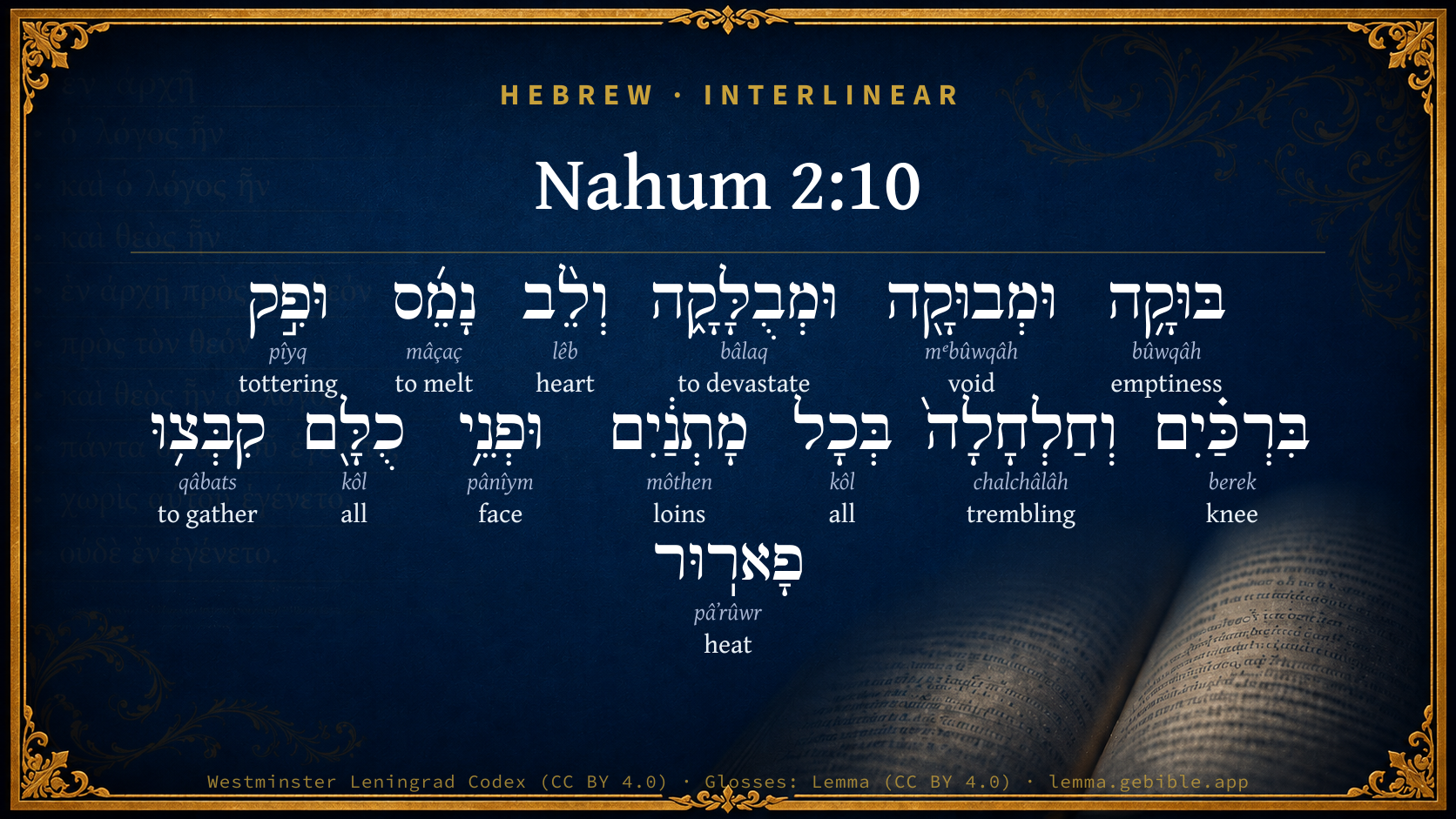
בּוּקָ֥ה
bûwqâh
H950
“emptiness”
Noun, Common, Feminine, Singular, Absolute
Part of Speech
Noun
Type
Common
Gender
Feminine
Number
Singular
State
Absolute
Full BDB Definition

Origin: passive part. of an unused root (meaning to be hollow)

TWOT: 220a

emptiness
  1. וּמְבוּקָ֖ה mᵉbûwqâh H4003 “and · void” Conjunction + Noun, Common, Feminine, Singular, Absolute
  2. וּמְבֻלָּקָ֑ה bâlaq H1110 “and · devastated” Conjunction + Verb, Pual, Participle Passive, Feminine, Singular, Absolute
  3. וְלֵ֨ב lêb H3820 “and · heart” Conjunction + Noun, Common, Masculine, Singular, Absolute
  4. נָמֵ֜ס mâçaç H4549 “to melt” Verb, Niphal, Perfect, 3rd Person, Masculine, Singular
  5. וּפִ֣ק pîyq H6375 “and · tottering of” Conjunction + Noun, Common, Masculine, Singular, Construct
  6. בִּרְכַּ֗יִם berek H1290 “knees” Noun, Common, Feminine, Dual, Absolute
  7. וְחַלְחָלָה֙ chalchâlâh H2479 “and · trembling” Conjunction + Noun, Common, Feminine, Singular, Absolute
  8. בְּכָל kôl H3605 “in/at · all of” Preposition + Noun, Common, Masculine, Singular, Construct
  9. מָתְנַ֔יִם môthen H4975 “loins” Noun, Common, Masculine, Dual, Absolute
  10. וּפְנֵ֥י pânîym H6440 “and · face(s) of” Conjunction + Noun, Common, Both, Plural, Construct
  11. כֻלָּ֖ם kôl H3605 “all · their” Noun, Common, Masculine, Singular, Construct + Suffix, Personal, 3rd Person, Masculine, Plural
  12. קִבְּצ֥וּ qâbats H6908 “to gather” Verb, Piel, Perfect, 3rd Person, Common, Plural
  13. פָארֽוּר pâʼrûwr H6289 “heat” Noun, Common, Masculine, Singular, Absolute

About this verse

These counts appear in no published source. They are computed here, from the morphology-tagged text and Lemma’s own curated glosses. What Lemma adds →

14
words
13
distinct lemmas
Prophets
section

Notable vocabulary

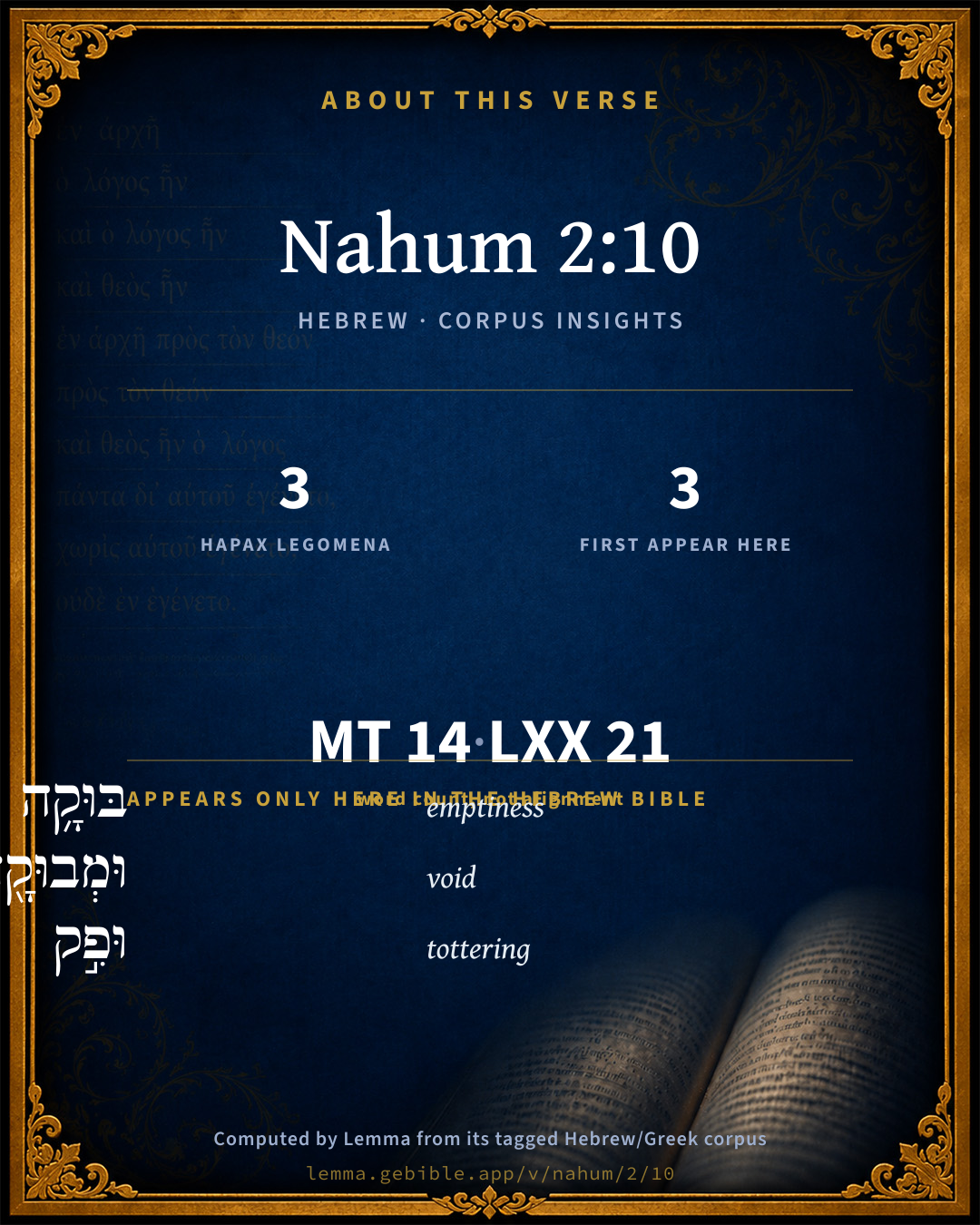
3 hapax legomena — words that appear only here in the entire Hebrew Bible:

  • בּוּקָ֥ה emptiness H950
  • וּמְבוּקָ֖ה void H4003
  • וּפִ֣ק tottering H6375

First appearance in Scripture

These words make their first canonical appearance in the Hebrew Bible here:

  • בּוּקָ֥ה emptiness H950
  • וּמְבוּקָ֖ה void H4003
  • וּפִ֣ק tottering H6375

Shared distinctive vocabulary

וּמְבֻלָּקָ֑ה to devastate H1110 occurs in 2 verses of the Hebrew Bible. Also found in:

Grammatical profile

  • 3 verbs
  • 11 nouns

Verb forms

  • וּמְבֻלָּקָ֑ה Pual · Participle Passive
  • נָמֵ֜ס Niphal · Perfect
  • קִבְּצ֥וּ Piel · Perfect

Repetition

A word recurs within this verse — often emphatic in Hebrew:

  • בְּכָל all H3605 ×2

Hebrew & Septuagint length

In English translation the verse runs 20 words from the Hebrew and 31 from the Septuagint (LXX English) — the Septuagint runs noticeably longer here. See the side-by-side →

A rough comparison of the two English renderings, which tokenize alike — not a word-level alignment.

Word counts can differ between the Hebrew and the Greek without any difference in meaning — e.g. the Hebrew direct-object marker אֵת has no separate Greek word, and Greek often adds the article ὁ.

In the original languages it is 14 Hebrew tokens and 21 Greek tokens — but the two are counted differently (Hebrew bundles its prefixes and suffixes into one token; the Greek is in lemma form), so that isn’t a like-for-like length.

Cross-references

18

Topical passages linked to Nahum 2:10 in the Treasury of Scripture Knowledge — connected by theme and wording, ordered by reader-vote popularity; previews shown in the World English Bible.

  • Psalms 22:14 I am poured out like water. All my bones are out of joint. My heart is like wax; It is melted within me.
  • Daniel 5:6 Then the king's face was changed in him, and his thoughts troubled him; and the joints of his loins were loosened, and his knees struck one against another.
  • Joel 2:6 At their presence the peoples are in anguish. All faces have grown pale.
  • Isaiah 13:7–8 Therefore shall all hands be feeble, and every heart of man shall melt:
  • Jeremiah 30:6 Ask now, and see whether a man does travail with child: why do I see every man with his hands on his loins, as a woman in travail, and all faces are turned into paleness?
  • Isaiah 21:3 Therefore are my loins filled with anguish; pangs have taken hold on me, as the pangs of a woman in travail: I am pained so that I can't hear; I am dismayed so that I can't see.
  • Isaiah 24:1 Behold, Yahweh makes the earth empty, and makes it waste, and turns it upside down, and scatters abroad the inhabitants of it.
  • Zephaniah 2:13–15 He will stretch out his hand against the north, destroy Assyria, and will make Nineveh a desolation, and dry like the wilderness.
  • Joshua 2:11 As soon as we had heard it, our hearts did melt, neither did there remain any more spirit in any man, because of you: for Yahweh your God, he is God in heaven above, and on earth beneath.
  • Isaiah 13:19–22 Babylon, the glory of kingdoms, the beauty of the Chaldeans' pride, shall be as when God overthrew Sodom and Gomorrah.
  • Isaiah 14:23 I will also make it a possession for the porcupine, and pools of water: and I will sweep it with the broom of destruction, says Yahweh of Hosts.
  • Isaiah 34:10–15 It shall not be quenched night nor day; the smoke of it shall go up for ever; from generation to generation it shall lie waste; none shall pass through it forever and ever.
  • Jeremiah 4:23–26 I saw the earth, and, behold, it was waste and void; and the heavens, and they had no light.
  • Jeremiah 51:62 and say, Yahweh, you have spoken concerning this place, to cut it off, that none shall dwell therein, neither man nor animal, but that it shall be desolate forever.
  • Nahum 3:7 It will happen that all those who look at you will flee from you, and say, 'Nineveh is laid waste Who will mourn for her?' Where will I seek comforters for you?"
  • Zephaniah 3:6 I have cut off nations. Their battlements are desolate. I have made their streets waste, so that no one passes by. Their cities are destroyed, so that there is no man, so that there is no inhabitant.
  • Revelation 18:21–23 A mighty angel took up a stone like a great millstone and cast it into the sea, saying, "Thus with violence will Babylon, the great city, be thrown down, and will be found no more at all.
  • Genesis 1:2 Now the earth was formless and empty. Darkness was on the surface of the deep. God's Spirit was hovering over the surface of the waters.

Cross-references courtesy of OpenBible.info (CC BY 4.0).

Hebrew and Greek witnesses Masoretic Hebrew ↔ Greek Septuagint

The same verse in the two great witnesses to the Old Testament, shown verse-for-verse.

Here the Septuagint runs noticeably longer than the Hebrew — LXX2012 (modern English Septuagint) 31 words vs World English Bible 20. A rough length comparison of the two English translations, not a word-level alignment — read both below.

These are two independent witnesses, not word-aligned to each other, and the Septuagint is shown in lemma (dictionary) form.

Hebrew Nahum 2:10 Masoretic · Westminster Leningrad Codex

בּוּקָ֥ה וּמְבוּקָ֖ה וּמְבֻלָּקָ֑ה וְלֵ֨ב נָמֵ֜ס וּפִ֣ק בִּרְכַּ֗יִם וְחַלְחָלָה֙ בְּכָל מָתְנַ֔יִם וּפְנֵ֥י כֻלָּ֖ם קִבְּצ֥וּ פָארֽוּר

She is empty, void, and waste. The heart melts, the knees knock together, their bodies and faces have grown pale.

World English Bible · Public Domain

Greek LXX Nahum 2:10 Septuagint · lemma form

διαἁρπάζω ὁ ἀργύριον διαἁρπάζω ὁ χρυσίον καί οὐ εἰμί πέρας ὁ κόσμος αὐτός βαρύνω ὑπέρ πᾶς ὁ σκεῦος ὁ ἐπιθυμητός αὐτός

There is thrusting forth, and shaking, and tumult, and heart-breaking, and loosing of knees, and pangs on all loins; and the faces of all are as the blackening of a pot.

LXX2012 (modern English Septuagint) · Public Domain

On this verse, The Pulpit Commentary discusses the Septuagint’s reading. Read the note in Commentary ↓

Hebrew: Westminster Leningrad Codex (CC BY 4.0). Greek: Septuagint (public domain); English from LXX2012 (modern English Septuagint) (Public Domain). How the Septuagint differs from the Hebrew →

Targum (Aramaic paraphrase)

1

The Targum is the ancient Jewish Aramaic paraphrase of the Hebrew Scriptures — an interpretive translation, not the Hebrew text itself. Onkelos (literal) and Pseudo-Jonathan (expansive) render the Torah, and Jonathan the Prophets. Coverage is partial: where no permissively-licensed English translation exists for a verse, only the Aramaic is shown. This is verse-level text, not a word-by-word alignment to the Hebrew.

  1. Targum Jonathan Prophets (Joshua–Malachi)
    בּוֹזוּ כַסְפָּא בּוֹזוּ דַהֲבָא וְלֵית סוֹף לְאוֹצְרַיָא סָפוּ מִכָּל מָנֵי חֶמְדָתָא:

    (no public-domain English translation for this verse)

    Targum Jonathan — Aramaic: “Mikraot Gedolot” (public domain). English: “Sefaria Community Translation” (CC0 1.0 (public-domain dedication)); “London "Chaldee Paraphrase," 1871” (public domain). Text via Sefaria.

Commentary

Notes on Nahum 2:10 from classic Christian and Jewish commentators (each source and its license shown beneath its notes). The classic Christian expositions comment on the surrounding passage and are grouped to its opening verse, so a note may address several verses; the Jewish commentaries on the Tanakh (Rashi and others) are per-verse, so they appear only where the commentator wrote on this verse.

Lemma curates 59 commentaries, every one of them public domain or Creative Commons licensed, each selected and text-cleaned for this edition rather than reprinted as found. About our sources →

Trapp's Complete Commentary

John Trapp

Nah 2:10 She is empty, and void, and waste: and the heart melteth, and the knees smite together, and much pain [is] in all loins, and the faces of them all gather blackness.

Ver. 10. She is empty, and void, and waste] An elegant alliteration in the original, beyond translating, בוקה εραεχδ εταμχδ. whereby the utter destruction and consternation of the city and monarchy is graphically depainted, and set forth to the life. See a like elegance Jer 16:15. The last word, rendered waste, signifieth burnt up, or void of all verdure; a place where nothing green groweth. Such a horrible devastation followeth upon God’s word of command to the Chaldees, Nah 2:9, like as when Christ cursed the barren fig tree it withered away immediately, Mat 21:20, though it be the most succulent of any tree, and beareth the brunt of winter blasts unwithered. God’s words, however slighted, are not wind, but fire, Jer 5:13-14.

And the heart melteth] The heart ( in quo fortitude stabulum habet, the seat of courage) fell asunder in their bosoms like drops of water; they were cowed out. See Jos 2:11; Jos 5:1; Jos 7:5 Isa 13:7 Eze 21:12.

And the knees smite together] Genus labant, as is usual in extreme fear; the blood retreating to the heart, to relieve it. See Dan 5:6 Job 4:4 Isa 35:3.

And much pain is in all loins] Such pain as befalleth women in travail, Isa 21:3; Isa 13:8 Joe 2:6 Mic 4:9-10; the doubled form of the Hebrew word implieth the extremity of it. The loins are the seat of strength; whence the Latins call weak men ( Elumbes) loinless men.

And the faces of them all gather blackness] Heb. A pot, i.e. such blackness as is on the sides of a pot ( Olla, lebas, cacabus). See Joe 2:6. Joy and sorrow will show themselves in the face as in a glass. Now if for a temporal mischief there is so great a consternation in wicked men, what shall we think there is in hell?

John Trapp, A Commentary or Exposition upon All the Books of the Old and New Testament (1647–1656) — public domain. Text from a community e-Sword module.

Tyndale Open Study Notes

Tyndale Open Resources

2:10 plundered, empty, and ruined: The Hebrew here is alliterated for effect: buqah umbuqah umbullaqah. The effect might be translated into English as “devastated, despoiled, and destroyed.”

Tyndale Open Study Notes — © Tyndale Open Resources, licensed CC BY-SA 4.0. Text via the HelloAO Bible API.

Geneva Bible (1599)

Geneva Bible translators

That is, Nineveh, and the men thereof shall be after this sort.

Read Joel 2:6.

Geneva Bible (1599) marginal notes — public domain. Text via Bolls.life.

Jamieson, Fausset & Brown

Robert Jamieson, A. R. Fausset & David Brown

Literally, "emptiness, and emptiedness, and devastation." The accumulation of substantives without a verb (as in Nah 3:2), the two first of the three being derivatives of the same root, and like in sound, and the number of syllables in them increasing in a kind of climax, intensify the gloomy effectiveness of the expression. Hebrew, Bukah, Mebukah, Mebullakah (compare Isa 24:1, Isa 24:3-4; Zep 1:15).

faces of all gather blackness--(See on Joe 2:6). CALVIN translates, "withdraw (literally, 'gather up') their glow," or flush, that is grow pale. This is probably the better rendering. So MAURER.

Jamieson, Fausset & Brown — Commentary Critical and Explanatory on the Whole Bible (1871) — public domain (CC PDM 1.0). Text via the HelloAO Bible API.

Adam Clarke's Commentary

Verse 10. She is empty, and void, and waste] The original is strongly emphatic; the words are of the same sound; and increase in their length as they point out great, greater, and greatest desolation.

בוקה ומבוקה ומבלקה

Bukah, umebukah, umebullakah.

She is void, empty, and desolate.

The faces of them all gather blackness.] This marks the diseased state into which the people had been brought by reason of famine, c. for, as Mr. Ward justly remarks, "sickness makes a great change in the countenance of the Hindoos; so that a person who was rather fair when in health, becomes nearly black by sickness." This was a general case with the Asiatics.

Adam Clarke's Commentary on the Bible (1810–1826) — public domain. Text from a community e-Sword/MySword module.

John Calvin's Commentaries

The Prophet here confirms what the last verse contains; for he shows why he had called the Chaldeans to take away the spoil, — because it was to be so. He did not indeed (as I have already said) command the Chaldeans in such a way as that their obedience to God was praiseworthy: but the Prophet speaks here only of His secret counsel. Though then the Chaldeans knew not that it was God’s decree, yet the Prophet reminds the faithful that the Ninevites, when made naked, suffered punishment for their cruelty, especially for having so hostilely conducted themselves towards the Jews: and hence he declares, that Nineveh is emptied, is emptied, and made naked. By repeating the same word, he intimates the certainty of the event: Emptied, emptied, he says, as when one says in our language, videe et revidee We hence see that by this repetition what the Prophet meant is more distinctly expressed that the faithful might not doubt respecting the event: and then for the same purpose he adds, she is made naked.

We now then perceive the Prophet’s design. As in the last verse he shows that he had power given him from above to send armies against Nineveh, and to give up the city to them to be spoiled and plundered; so he now shows that he had not so commanded the Chaldeans, as though they were the legitimate servants of God, and could pretend that they rendered service to Him. He therefore points out for what end he had commanded the Chaldeans to plunder Nineveh; and that was, because God had so decreed; and he had so decreed and commanded, because he would not bear the many wrongs done to his people whom he had taken under his protection. As then Nineveh had so cruelly treated God’s chosen people, it was necessary that the reward she deserved should be repaid to her. But the repetition, which I have noticed, ought to be especially observed; for it teaches us that God’s power is connected with his word, so that he declares nothing inconsiderately or in vain.

He then adds, that knees smite together; and every heart is dissolved, or melted, and also, that all loins tremble We hence learn, that there is in men no courage, except as far as God supplies them with vigor. As soon then as He withdraws his Spirit, those who were before the most valiant become faint-hearted, and those who breathed great ferocity are made soft and effeminate: for by the word heart is meant inward boldness or courage; and by the knees and loins the strength of body is to be understood. There is indeed no doubt but the Assyrians, while they ruled, were a very courageous people, as power ever generates boldness; and it is also probable that they were a warlike people, since all their neighbors had been brought under their power. But the Prophet now shows, that there would be no vigor in their hearts, and no strength in their loins, or in any part of their body. The heart, then, he says, is melted And hence we learn how foolishly men boast of their courage, while they seem to be like lions; for God can in a moment so melt their hearts, that they entirely lose all firmness. Then as to external vigor, we see that it is in God’s hand; there will be, he says, a confriction, or the knees will knock one against another, as they do when they tremble. And he says afterwards, And trembling shall be in all loins He at last adds, And the faces of all shall gather blackness The word פארור, parur, some derive from פאר, par; and so the rendering would be, “all faces shall draw in or withdraw their beauty,” and so also they explain Joel 2:6, for the sentence there is the same. But they who disapprove of this meaning say, that קבף, kobets, cannot mean to draw in or to withdraw; and so they render the noun, blackness. But this is a strained explanation. פארור, parur, [they say,] does not mean a black color but a pot: when therefore a caldron or a kettle contracts blackness from smoke, it is then called פארור, parur: but in this place these interpreters are constrained to take it metaphorically for that color; which is, as I have said, strained and far-fetched. I am therefore inclined to adopt their opinion who render the sentence, all faces shall withdraw their beauty, or their brightness: but as to the import of the passage, there is little or no difference; let then every one have his free choice. With regard to the Prophet’s design, he evidently means, that the faces of all would be sad, for the Lord would fill their minds and thoughts with dread. The withdrawing then of beauty signifies an outward appearance of sorrow, or paleness, or whatever may appear in the countenance of men, when dejected with grief. In short, the Prophet means, that how much soever the Assyrians might have hitherto raised on high their crests, and breathed great swelling words, and conducted themselves insolently, they would now be dejected; for the Lord would prostrate their courage and melt their strength: he would, by casting down their high spirits, constrain them to undergo shame. This is the import of the whole. It now follows —

John Calvin's Commentaries (1540-1563) — public domain. Text from the Calvin Translation Society English edition (1840s-50s) via the Christian Classics Ethereal Library (ccel.org). Calvin's coverage is partial (roughly two-thirds of the Bible); uncommented books and verses are honest gaps, never fabricated. The 19th-century editor's footnotes and remarks are omitted so the notes are faithfully Calvin's own voice.

Ellicott's Commentary for English Readers

(10) And the faces of them all gather blackness.—Better, perhaps, and all faces withdraw their brightness. (See Note on Joe_2:6, where the same expression occurs.)

A Bible Commentary for English Readers, edited by Charles John Ellicott (1878–1897) — public domain. Text from a community e-Sword module.

The Cambridge Bible for Schools and Colleges

gen. ed. J. J. S. Perowne

10. In a series of exclamations the prophet depicts the desolation of the city and the paralysis and helplessness of those remaining in it; Isa_13:7; Isa_21:3; Jos_7:5. The paronomasia in the first words, emptiness and voidness and waste! cannot be reproduced. Isa_24:1; Isa_29:2; Eze_33:29; Zep_1:15.

faces … gather blackness] are waxed pale, lit. have withdrawn their colour; Joe_2:6. Comp. the phrase of Jer_30:6, are turned to greenness (blanched).

The Cambridge Bible for Schools and Colleges (gen. ed. J. J. S. Perowne; Cambridge University Press, 1878–1918) — public domain. Text from a community e-Sword module.

John Gill's Exposition

She is empty, and void, and waste,.... The city of Nineveh, empty of inhabitants, being killed, or having fled; and stripped of all its treasures and riches by the enemies; its walls and houses demolished and pulled down, and laid in ruins, and become a heap of rubbish; See Gill on Nah 1:8. Various words are here used to ascertain and confirm the thing; and there is an elegant play on words or likeness of sounds, which our language will not express:

and the heart melteth; the heart of every inhabitant of Nineveh melted with fear at the approach of their enemies, their entrance into the city, and plunder of it; flowed like water, or melted like wax; see Psa 22:14,

and the knees smite together; like people in a fright, and when a panic has seized them; and as it was with Belshazzar, Dan 5:6,

and much pain is in all loins; like that of women in travail; or of persons in a sudden fright, which gives them a pain in their backs at once:

and the faces of them all gather blackness; like a pot, as the Targum adds; being in great distress and disconsolation, which make men appear in a dismal hue, and their countenances look very dark and gloomy; see Joe 2:6.

John Gill's Exposition of the Whole Bible (1746–1763) — public domain (CC PDM 1.0). Text via the HelloAO Bible API.

Albert Barnes' Notes on the Bible

She is empty and void and waste - The completeness of her judgment is declared first under that solemn number, Three, and the three words in Hebrew are nearly the same , with the same meaning, only each word fuller than the former, as picturing a growing desolation; and then under four heads (in all seven) also a growing fear. First the heart, the seat of courage and resolve and high purpose, melteth; then the knees smite together, tremble, shake, under the frame; then, much pain is in all loins, literally, “strong pains as of a woman in travail,” writhing and doubling the whole body, and making it wholly powerless and unable to stand upright, shall bow the very loins, the seat of strength Pro 31:17, and, lastly, the faces of them all gather blackness (see the note at Joe 2:6), the fruit of extreme pain, and the token of approaching dissolution.

Albert Barnes' Notes on the Bible (1834–1885) — public domain. Text from a community e-Sword/MySword module.

Haydock's Catholic Bible Commentary

Kettle. In mourning they blacken their face. (Tav. Perse.)

George Leo Haydock (1774–1849), Haydock's Catholic Family Bible and Commentary, 1859 edition — public domain. Excludes Psalms (Douay-Rheims chapter numbering differs from Protestant) and Deuterocanonical books (Catholic canon only).

Matthew Poole's English Annotations

She, Nineveh, taken, and under the proud insultings of the barbarous soldiers,

is empty though once full of all store, yet now she is empty enough, many hands have been employed to spoil her, and void, citizens are either slipped away, or carried captives, and waste, desolate, and shall continue so. Here is a threefold expression, to ascertain the thing, and to intimate the greatness of Nineveh’s desolation.

The heart melteth; this devastation hath broken the hearts of the Ninevites.

The knees smite together; not able to go steadily, ready to fall through weakness and faintness of spirits.

Much pain, acute pains and griefs, caused by their troubles, losses, dangers, and frights,

is in all loins; which, in those that are well, are their strength, and which, to diseased and broken bodies, are the seat of pains and griefs.

The faces, which were wont to be haughty and scornful, and as it were sparkle with briskness of spirit,

all gather blackness; now are clouded, sorrowful, and dejected, every one may see their desperate state in this symptom.

Matthew Poole's English Annotations on the Holy Bible (1683–1685) — public domain. Text from a community e-Sword/MySword module.

The Pulpit Commentary

She is empty, and void, and waste. Bukahum" bukah, umbulakah. The three words are of very similar meaning and sound, and express most forcibly the utter ruin of the city. A Latin commentator has endeavoured to imitate the Hebrew paronomasia by rendering them, "vacuitas, evacuatio, evanidatio a translation more ingenious than classical. The paronomasia is better rendered by "vastitas, vastitia, vacuitas," and the German, "leer und ausgeleert und verheert." "Sack and sacking and ransacking" (Gandell). An analogous combination of words is found in Isa_24:3, 4 29:2, 3 Eze_33:29 Zep_1:15. Septuagint, ektinagmov, kai anatinagmo ekbrasmov , "thrusting forth and spurning and tumult." The heart melteth. A common expression for fear and despondency. (Jos_7:5 Isa_13:7 Eze_21:7) The knees smite together. (Dan_5:6) So in Homer continually, luto gounata . Much pain is in all loins. The anguish as of childbirth. Septuagint, wdinev , "labour pains," in contrast with the injunction in ver. 1. (comp. Isa_13:8 Isa_21:3 Jer_30:6) Gather blackness ; (Joe_2:6) or, Withdraw their colour; i.e. wax pale. But the Hebrew rather implies that the faces assume a livid hue, like that of coming death. Hence the LXX renders, wv proskauma cutrav , as the burning of an earthen vessel, which is blackened by the fire; and Jerome, sicut nigredo ollae. (comp. Jer_30:6)

The Pulpit Commentary (1880–1919), ed. H.D.M. Spence-Jones & Joseph S. Exell — public domain. Text from a community e-Sword module.

Rashi

Rabbi Shlomo Yitzchaki (Rashi)

Plunder silver! Plunder gold!—You who come upon Nineveh.

And there is no end—There is no count.

to the treasures Heb. לְתְּכוּנָה, to their treasures. [It is called תְּכוּנָה] because the silver and gold placed in the treasury is placed there with a count, as you say (II Kings 12:12): “The counted (הַמְתֻכּן) money.” [following Jonathan]

to sweep out [Nineveh] of all precious vessels Heb. כָּבֹד, an expression of sweeping, as in (below, 3:15) “You shall be swept out (הִתְכַּבְדִי) like the nibbling locust,” an expression of sweeping the house; escovant, to sweep them out of all their precious vessels. And so did Jonathan render it: All precious vessels have ended. כָּבֹד is like זָכוֹר, to remember, and שָמוֹר, to observe.

Rashi on the Tanakh — English translations: “The Judaica Press complete Tanach with Rashi, translated by A. J. Rosenberg” (CC BY 4.0); “Pentateuch with Rashi's commentary by M. Rosenbaum and A.M. Silbermann, 1929-1934” (public domain); “The Metsudah Tanach series, Lakewood, N.J” (CC BY 4.0); and “The Book of Joshua, Metsudah Publications, 1997” (CC BY 4.0). Text via Sefaria.

Lesson kit

Teaching starters — assembled from the data on this page, not authored interpretation. Every prompt links to the verse data it draws on. Edit before teaching.

Nahum, in the Prophets, opens this verse with 14 words (13 distinct Hebrew lemmas). Its most distinctive word is bûwqâh (“emptiness”). The Greek Septuagint runs longer here. A historical commentator’s framing appears above. Read the whole chapter for the surrounding context.

Discussion questions

  1. The word bûwqâh carries the sense “emptiness.” How does it shape the verse?
  2. This verse holds 3 words here found nowhere else in the Hebrew Bible. What might the rare words draw attention to?
  3. 3 words here appear for the first time in Scripture. What is being introduced at this debut?
  4. Isaiah 24:1 shares the word «to devastate» with this verse. How do the two illuminate each other?
  5. “all” occurs 2× in this one verse. What is the effect of the repetition?
  6. Compared with the Hebrew, the Septuagint runs longer here. What questions does that raise?
  7. The translations on this page render this verse differently — a whole-verse word diff, not a word-by-word alignment. What might account for the different wordings?
  8. The verb «וּמְבֻלָּקָ֑ה» is Pual Participle Passive. How does its form color the action?

Things to notice

  • 3 words in this verse appear nowhere else in the Hebrew Bible.
  • 3 words make their first canonical appearance in Scripture here.
  • This verse counts 14 Hebrew ↔ 21 Greek words.
  • These translations choose different wording for 23 words in this verse.
  • “all” occurs 2× in this single verse.

Reading settings

Reading text

Shown beneath each verse's original-language words.

Old Testament
Old Testament edition

Read the OT as the Masoretic Hebrew (MT) or the Greek Septuagint (LXX).

English shown for the Greek Septuagint (in the Hebrew ↔ Greek comparison).

Comparing translations? Open the Compare panel on any verse page to stack up to four side by side.