Isaiah 34:15

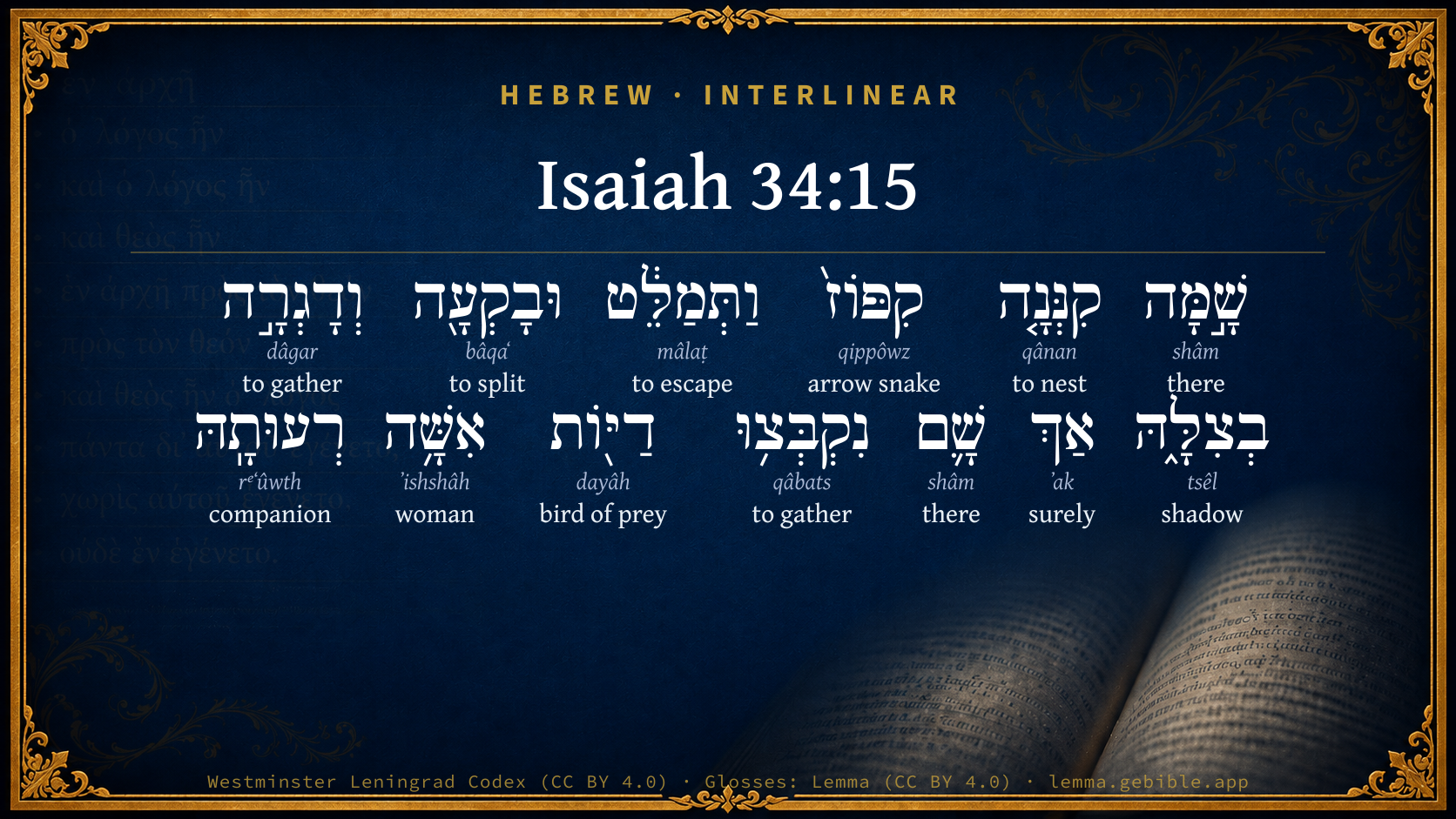
Hebrew (Westminster Leningrad Codex) Isaiah 34:15 appears in the Hebrew Old Testament. The text above is from the Westminster Leningrad Codex. Each word links to its Strong’s number, a concise gloss, and parsing drawn from the Open Scriptures Hebrew Bible morphology. Click any word for its full Brown-Driver-Briggs (BDB) entry.
Download image
Cite this verse

Isaiah 34:15 (World English Bible). Public Domain. Lemma interlinear Bible study tool, https://lemma.gebible.app/v/isaiah/34/15.

Show BibTeX & RIS
BibTeX
RIS
English Translation
There shall the dart-snake make her nest, and lay, and hatch, and gather under her shade; yes, there shall the kites be gathered, everyone with her mate.
World English Bible · Public Domain
Highlights
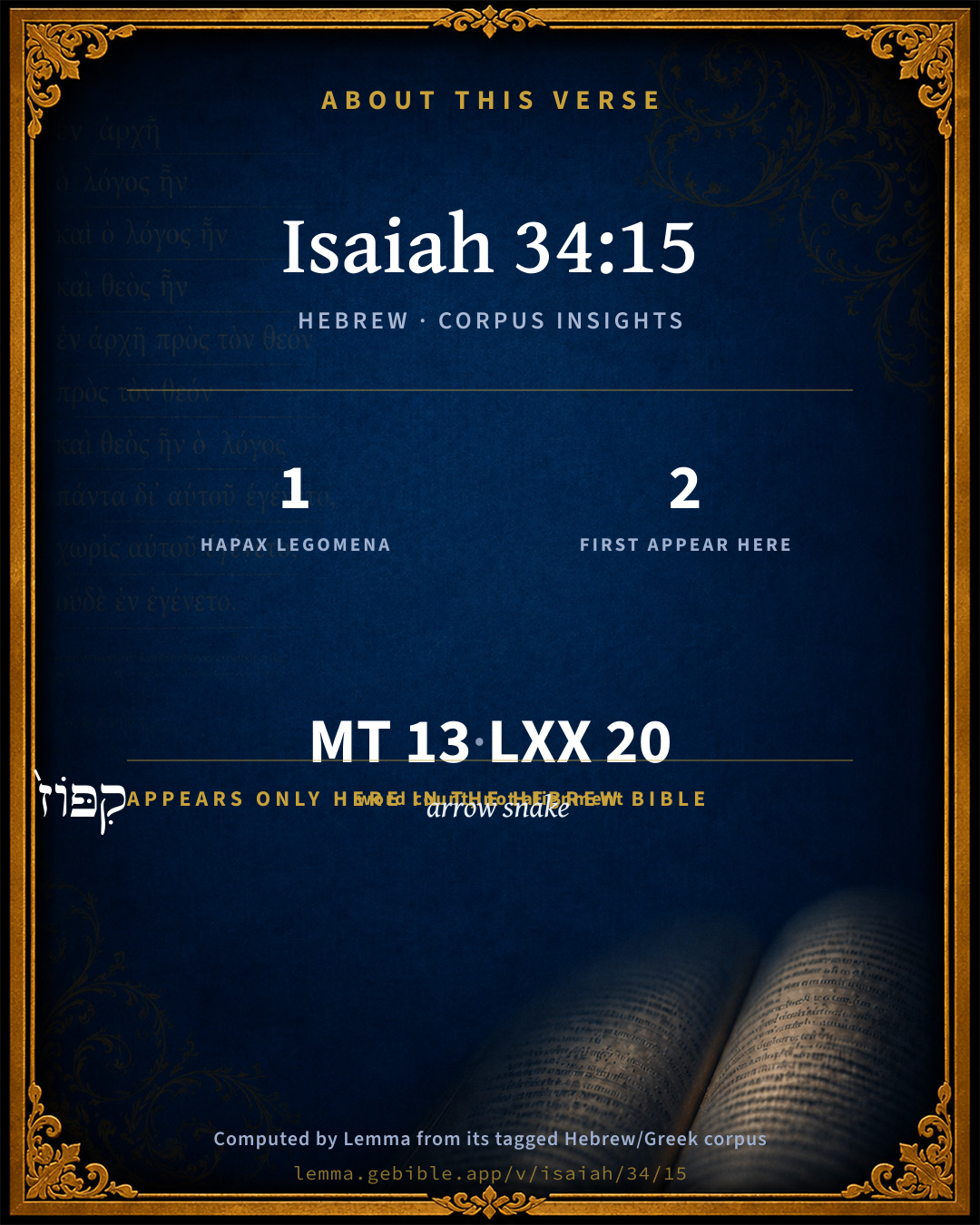
  • 1 hapax legomenon — only here in the Hebrew Bible
  • 2 first appearances in the Hebrew Bible
Full analysis ↓
Download a study sheet

One document with this verse’s original text, its word-by-word gloss line, the meaning frame, cross-references with their text, attributed commentary, and full source and license credits — printable, and it pastes into notes with its structure intact.

This verse Autodidact and up

Study sheet (.html) Plain text (.txt)

A passage Seminary Student

Up to 50 verses in one chapter. A passage sheet keeps up to 6 commentary sources and 12 cross-references per verse, in the order this page ranks them, and says so on the sheet whenever that leaves anything out. Ask for a single verse and you get the Autodidact verse sheet above.

Everything on this page stays free to read, with no account — the sheet is a download of what is already on screen, not access to it.

Want to remove ads? Support Godless Engineer
Compare translations 3

The same verse in 3 English versions, stacked beneath the original-language interlinear above. Click any original word for its lexicon entry.

Each is an independent rendering of the whole verse — the interlinear is not word-aligned to these translations.

Highlighted words mark where these versions differ — a whole-verse word diff, not a word-by-word alignment.

  • World English Bible Public Domain
    There shall the dart-snake make her nest, and lay, and hatch, and gather under her shade; yes, there shall the kites be gathered, everyone with her mate.
  • King James Version Public Domain
    There shall the great owl make her nest, and lay, and hatch, and gather under her shadow: there shall the vultures also be gathered, every one with her mate.
  • unfoldingWord Literal Text CC BY-SA 4.0
    There the great owl will nest and lay and hatch and brood in its shade. Indeed, there hawks will be gathered, each with its companion.

unfoldingWord Literal Text — © unfoldingWord, licensed CC BY-SA 4.0. Word-aligned USFM3 via Door43 (git.door43.org/unfoldingWord/en_ult).

Versions to compare (up to 4)

3 of 4 selected

Show all 18 translations

Every available English version of this verse, each an independent rendering of the whole verse.

  • World English Bible Public Domain
    There shall the dart-snake make her nest, and lay, and hatch, and gather under her shade; yes, there shall the kites be gathered, everyone with her mate.
  • Berean Standard Bible Public Domain
    There the owl will make her nest; she will lay and hatch her eggs and gather her brood under her shadow. Even there the birds of prey will gather, each with its mate.
  • Majority Standard Bible Public Domain
    There the owl will make her nest; she will lay and hatch her eggs and gather her brood under her shadow. Even there the birds of prey will gather, each with its mate.
  • King James Version Public Domain
    There shall the great owl make her nest, and lay, and hatch, and gather under her shadow: there shall the vultures also be gathered, every one with her mate.
  • American Standard Version (1901) Public Domain
    There shall the dart-snake make her nest, and lay, and hatch, and gather under her shade; yea, there shall the kites be gathered, every one with her mate.
  • Revised Version (1885) Public Domain
    There shall the arrowsnake make her nest, and lay, and hatch, and gather under her shadow: yea, there shall the kites be gathered, every one with her mate.
  • Geneva Bible (1599) Public Domain
    There shall the owle make her nest, and laye, and hatche, and gather them vnder her shadowe: there shall the vultures also bee gathered, euery one with her make.
  • Douay-Rheims (1899) Public Domain
    There hath the ericius had its hole, and brought up its young ones, and hath dug round about, and cherished them in the shadow thereof: thither are the kites gathered together one to another.
  • Young's Literal Translation Public Domain
    There made her nest hath the bittern, Yea, she layeth, and hath hatched, And hath gathered under her shadow, Only there gathered have been vultures, Each with its companion.
  • Literal Standard Version CC BY-SA 4.0
    The owl has made her nest there, || Indeed, she lays, and has hatched, || And has gathered under her shadow, || Surely vultures have been gathered there, || Each with its companion.
  • Unlocked Literal Bible CC BY-SA 4.0
    Owls will make nests, lay and hatch their eggs, hatch and protect their young. Yes, there hawks will gather, each one with its mate.
  • unfoldingWord Literal Text CC BY-SA 4.0
    There the great owl will nest and lay and hatch and brood in its shade. Indeed, there hawks will be gathered, each with its companion.
  • Darby Bible Public Domain
    There shall the arrow-snake make her nest, and lay, and hatch, and gather under her shadow; there also shall the vultures be gathered one with another.
  • World Messianic Bible Public Domain
    The arrow snake will make her nest there, and lay, hatch, and gather under her shade. Yes, the kites will be gathered there, every one with her mate.
  • Webster's Bible Public Domain
    There shall the great owl make her nest, and lay, and hatch, and gather under her shadow: there shall the vultures also be gathered, every one with her mate.
  • Free Bible Version CC BY-SA 4.0
    There the owl will build its nest, lay and hatch its eggs, and raise its chicks in the shade of its wings. It has become a roost for birds of prey, each one with its mate.
  • Bible in Basic English Public Domain
    The arrowsnake will make her hole and put her eggs there, and get her young together under her shade: there the hawks will come together by twos.
  • JPS Tanakh (1917) Public Domain
    There shall the arrowsnake make her nest, and lay, and hatch, and brood under her shadow; yea, there shall the kites be gathered, every one with her mate.

Literal Standard Version (2020), Covenant Press — licensed CC BY-SA 4.0. Text via the HelloAO Bible API (eBible.org). Unlocked Literal Bible (unfoldingWord) — licensed CC BY-SA 4.0. Text via the HelloAO Bible API (eBible.org). unfoldingWord Literal Text — © unfoldingWord, licensed CC BY-SA 4.0. Word-aligned USFM3 via Door43 (git.door43.org/unfoldingWord/en_ult). Free Bible Version, Dr. Jonathan Gallagher — licensed CC BY-SA 4.0. Text via the HelloAO Bible API (eBible.org).

Word by word

More ways to search: Search by grammar → Find every occurrence → Compare this word →

Practice this passage: Drill this verse → Learn its vocabulary →

קִפּוֹז֙
qippôwz
H7091
“arrow snake”
Noun, Common, Feminine, Singular, Absolute
Part of Speech
Noun
Type
Common
Gender
Feminine
Number
Singular
State
Absolute
Full BDB Definition

Origin: from an unused root meaning to contract, i.e. spring forward

TWOT: 2050a

arrow snake, owl - meaning dubious
  1. שָׁ֣מָּה shâm H8033 “there · toward” Adverb + Suffix, Demonstrative
  2. קִנְּנָ֤ה qânan H7077 “to nest” Verb, Piel, Perfect, 3rd Person, Feminine, Singular
  3. וַתְּמַלֵּ֔ט mâlaṭ H4422 “and · to escape” Conjunction + Verb, Piel, Sequential Imperfect, 3rd Person, Feminine, Singular
  4. וּבָקְעָ֖ה bâqaʻ H1234 “and · to split” Conjunction + Verb, Qal, Sequential Perfect, 3rd Person, Feminine, Singular
  5. וְדָגְרָ֣ה dâgar H1716 “and · to gather” Conjunction + Verb, Qal, Sequential Perfect, 3rd Person, Feminine, Singular
  6. בְצִלָּ֑הּ tsêl H6738 “in/at · shadow · her” Preposition + Noun, Common, Masculine, Singular, Construct + Suffix, Personal, 3rd Person, Feminine, Singular
  7. אַךְ ʼak H389 “surely” Particle, Accusative
  8. שָׁ֛ם shâm H8033 “there” Adverb
  9. נִקְבְּצ֥וּ qâbats H6908 “to gather” Verb, Niphal, Perfect, 3rd Person, Common, Plural
  10. דַיּ֖וֹת dayâh H1772 “birds of prey” Noun, Common, Feminine, Plural, Absolute
  11. אִשָּׁ֥ה ʼishshâh H802 “woman” Noun, Common, Feminine, Singular, Absolute
  12. רְעוּתָֽהּ rᵉʻûwth H7468 “companion · her” Noun, Common, Feminine, Singular, Construct + Suffix, Personal, 3rd Person, Feminine, Singular

About this verse

These counts appear in no published source. They are computed here, from the morphology-tagged text and Lemma’s own curated glosses. What Lemma adds →

13
words
12
distinct lemmas
Prophets
section

Notable vocabulary

1 hapax legomenon — a word that appears only here in the entire Hebrew Bible:

  • קִפּוֹז֙ arrow snake H7091

First appearance in Scripture

These words make their first canonical appearance in the Hebrew Bible here:

  • קִפּוֹז֙ arrow snake H7091
  • וְדָגְרָ֣ה to gather H1716

Shared distinctive vocabulary

וְדָגְרָ֣ה to gather H1716 occurs in 2 verses of the Hebrew Bible. Also found in:

Grammatical profile

  • 5 verbs
  • 5 nouns
  • 2 adverbs
  • 1 particle

Verb forms

  • קִנְּנָ֤ה Piel · Perfect
  • וַתְּמַלֵּ֔ט Piel · Sequential Imperfect
  • וּבָקְעָ֖ה Qal · Sequential Perfect
  • וְדָגְרָ֣ה Qal · Sequential Perfect
  • נִקְבְּצ֥וּ Niphal · Perfect

Repetition

A word recurs within this verse — often emphatic in Hebrew:

  • שָׁ֣מָּה there H8033 ×2

Hebrew & Septuagint length

In English translation the verse runs 27 words from the Hebrew and 25 from the Septuagint (LXX English) — closely comparable.

A rough comparison of the two English renderings, which tokenize alike — not a word-level alignment.

Word counts can differ between the Hebrew and the Greek without any difference in meaning — e.g. the Hebrew direct-object marker אֵת has no separate Greek word, and Greek often adds the article ὁ.

In the original languages it is 13 Hebrew tokens and 20 Greek tokens — but the two are counted differently (Hebrew bundles its prefixes and suffixes into one token; the Greek is in lemma form), so that isn’t a like-for-like length.

Cross-references

1

Topical passages linked to Isaiah 34:15 in the Treasury of Scripture Knowledge — connected by theme and wording, ordered by reader-vote popularity; previews shown in the World English Bible.

Cross-references courtesy of OpenBible.info (CC BY 4.0).

Hebrew and Greek witnesses Masoretic Hebrew ↔ Greek Septuagint

The same verse in the two great witnesses to the Old Testament, shown verse-for-verse.

These are two independent witnesses, not word-aligned to each other, and the Septuagint is shown in lemma (dictionary) form.

Hebrew Isaiah 34:15 Masoretic · Westminster Leningrad Codex

שָׁ֣מָּה קִנְּנָ֤ה קִפּוֹז֙ וַתְּמַלֵּ֔ט וּבָקְעָ֖ה וְדָגְרָ֣ה בְצִלָּ֑הּ אַךְ שָׁ֛ם נִקְבְּצ֥וּ דַיּ֖וֹת אִשָּׁ֥ה רְעוּתָֽהּ

There shall the dart-snake make her nest, and lay, and hatch, and gather under her shade; yes, there shall the kites be gathered, everyone with her mate.

World English Bible · Public Domain

Greek LXX Isaiah 34:15 Septuagint · lemma form

ἐκεῖ νοσσεύω ἐχῖνος καί σώζω ὁ γῆ ὁ παιδίον αὐτός μετά ἀσφάλεια ἐκεῖ ἔλαφος συνἀντάω καί ὁράω ὁ πρόσωπον ἀλλήλω

There has the hedgehog made its nest, and the earth has safely preserved its young: there have the deer met, and seen one another's faces.

LXX2012 (modern English Septuagint) · Public Domain

Hebrew: Westminster Leningrad Codex (CC BY 4.0). Greek: Septuagint (public domain); English from LXX2012 (modern English Septuagint) (Public Domain). How the Septuagint differs from the Hebrew →

Targum (Aramaic paraphrase)

1

The Targum is the ancient Jewish Aramaic paraphrase of the Hebrew Scriptures — an interpretive translation, not the Hebrew text itself. Onkelos (literal) and Pseudo-Jonathan (expansive) render the Torah, and Jonathan the Prophets. Coverage is partial: where no permissively-licensed English translation exists for a verse, only the Aramaic is shown. This is verse-level text, not a word-by-word alignment to the Hebrew.

  1. Targum Jonathan Prophets (Joshua–Malachi)
    תַּמָן תְּקַנִין קוּפְדָא וּתְשֵׁיזִיב וְקִירֵיהוֹן יְנַצְפוּן בְּטוּרָא בְּרַם לְתַמָן יִתְכַּנְשׁוּן דַיָתָא אִתְּתָא לְוַת חֲבֶרְתָּהּ:

    And the hedgehog shall make its nest there, and shall breed there; partridges shall chirp in the shady boughs: surely, the vultures shall be gathered thither, every one with her mate.

    Targum Jonathan — Aramaic: “Mikraot Gedolot” (public domain). English: “Sefaria Community Translation” (CC0 1.0 (public-domain dedication)); “London "Chaldee Paraphrase," 1871” (public domain). Text via Sefaria.

Commentary

Notes on Isaiah 34:15 from classic Christian and Jewish commentators (each source and its license shown beneath its notes). The classic Christian expositions comment on the surrounding passage and are grouped to its opening verse, so a note may address several verses; the Jewish commentaries on the Tanakh (Rashi and others) are per-verse, so they appear only where the commentator wrote on this verse.

Lemma curates 59 commentaries, every one of them public domain or Creative Commons licensed, each selected and text-cleaned for this edition rather than reprinted as found. About our sources →

Trapp's Complete Commentary

John Trapp

Isa 34:15 There shall the great owl make her nest, and lay, and hatch, and gather under her shadow: there shall the vultures also be gathered, every one with her mate.

Ver. 15. There shall the great owl make her nest.] Heb., Kippoz. The Hebrews themselves agree not what creatures these are here mentioned, so far are they fallen from the knowledge of the Scripture. Their tale about Lilits, once Adam’s first wife, but now a screech owl or an evil spirit, is not worthy the mentioning.

John Trapp, A Commentary or Exposition upon All the Books of the Old and New Testament (1647–1656) — public domain. Text from a community e-Sword module.

Geneva Bible (1599)

Geneva Bible translators

Signifying, that Edom should be an horrible desolation and barren wilderness.

Geneva Bible (1599) marginal notes — public domain. Text via Bolls.life.

Jamieson, Fausset & Brown

Robert Jamieson, A. R. Fausset & David Brown

great owl--rather, "the arrow snake," so called from its darting on its prey [GESENIUS].

lay--namely, eggs.

gather under her shadow--rather, "cherishes" her young under, &c. (Jer 17:11).

Jamieson, Fausset & Brown — Commentary Critical and Explanatory on the Whole Bible (1871) — public domain (CC PDM 1.0). Text via the HelloAO Bible API.

Adam Clarke's Commentary

Verse 15. The great owl] קפוז kippoz, the ακοντιας, or darter, a serpent so called because of its suddenly leaping up or darting on its prey. Probably the mongoz or ichneumon may be intended.

The vultures] דיות daiyoth, the black vultures. My old MS. Bible renders these names curiously: And ageyn cumen schul devylis: the beste, party of an asse, and party of a mam: and the wodwose, the tother schal crien to the tother. There schal byn lamya, that is, thrisse, or a beste, havynge the body liic a woman, and hors feet. Ther hadde dichis, the yrchoun, and nurshide out littil chittis. There ben gadred kiitis, the top to the top. What language!

Every one with her mate.] A MS. adds אל el after אשה ishshah, which seems necessary to the construction; and so the Syriac and Vulgate. Another MS. adds in the same place את eth, which is equivalent.

Adam Clarke's Commentary on the Bible (1810–1826) — public domain. Text from a community e-Sword/MySword module.

Ellicott's Commentary for English Readers

(15) The great owl . . .—Better, the arrow snake.

A Bible Commentary for English Readers, edited by Charles John Ellicott (1878–1897) — public domain. Text from a community e-Sword module.

The Cambridge Bible for Schools and Colleges

gen. ed. J. J. S. Perowne

15. the great owl] the arrowsnake as in R.V.

gather under her shadow] The expression is almost meaningless, when applied to a very small snake. Duhm, by a clever emendation, reads “shall lay and hatch and heap up her eggs” (bêçehâ for bìçillâh).

The Cambridge Bible for Schools and Colleges (gen. ed. J. J. S. Perowne; Cambridge University Press, 1878–1918) — public domain. Text from a community e-Sword module.

John Gill's Exposition

There shall the great owl make her nest,.... Jarchi, Kimchi, and Ben Melech, say that "kippoz" here is the same with "kippod", rendered "bittern" in Isa 34:11 but Aben Ezra takes them to be two different birds; it is hard to say what is designed by it. Bochart thinks that one kind of serpent is here meant, so called from its leaping up, and which may be said to make nests, lay eggs and hatch them, as follows:

and lay, and hatch, and gather under her shadow; lay its eggs, sit upon them, and hatch them; or "break" them (u), that is, the eggs, by sitting on them, when the young ones spring out of them; and then being hatched, and running about, gather them under their wing, especially when in any danger:

there shall the vultures also be gathered, everyone with her mate; which creatures usually gather together where dead carcasses lie.

(u) "et scindet", Pagninus, Montanus; "rumpet", Vatablus; "quumque eruperit", Junius & Tremellius, i.e. "pullities", so Ben Melech.

John Gill's Exposition of the Whole Bible (1746–1763) — public domain (CC PDM 1.0). Text via the HelloAO Bible API.

Albert Barnes' Notes on the Bible

There shall the great owl - (קפוז qı̂pôz). Gesenius supposes that this is the arrow-snake, so called from its darting or springing, in the manner of the rattle-snake - from an obsolete root to draw oneself together, to contract. Bochart (Hieroz. ii. 3. 11. 408-419) has examined the meaning of the word at length, and comes to the conclusion that it means the serpent which the Greeks called acontias, and the Latins, jaculus - the arrow-snake. The serpent is oviparous, and nourishes its young. The ancient versions, however, understand it in the same sense as the קפד qippôd in Isa 34:11 - the hedgehog or porcupine.

Under her shadow - This might be done by the serpent that should coil up and cherish her young.

The vultures ... - The black vulture, according to Bochart; according to Gesenius, the kite, or falcon so called from its swift flight. Either of them will suit the connection.

Also be gathered, every one with her mate - They shall make their nests there; that is, this shall be their secure, undisturbed retreat.

Albert Barnes' Notes on the Bible (1834–1885) — public domain. Text from a community e-Sword/MySword module.

Haydock's Catholic Bible Commentary

Ericius. Hebrew, "kippoz, (Haydock) hath its nest." It may denote the serpent, acontias. (Bochart) --- All this shews the desolation of the country.

George Leo Haydock (1774–1849), Haydock's Catholic Family Bible and Commentary, 1859 edition — public domain. Excludes Psalms (Douay-Rheims chapter numbering differs from Protestant) and Deuterocanonical books (Catholic canon only).

Matthew Poole's English Annotations

The great owl; whether this or what other creature is meant by this Hebrew word, the learned reader may find largely discoursed in my Latin Synopsis upon this place; for others, it may suffice to know, what all agree in, that, whether it be a bird or a serpent, it is a creature that lives in desert places.

Make her nest, and lay, and hatch, and gather under her shadow, as fearing no disturbance from any men.

Matthew Poole's English Annotations on the Holy Bible (1683–1685) — public domain. Text from a community e-Sword/MySword module.

Whedon's Commentary on the Bible

Daniel D. Whedon

15. There shall the great owl make her nest — Bochart regards the rendering here “great owl” as entirely wrong. It is from a word which means to dart, to spring, and most interpreters at present join with him in calling the animal an arrow snake, which springs like the rattlesnake.

Lay… hatch… shadow — This reptile shall make its nest in the ground, or among the ruins, lay eggs, hatch them, and cover its young by its own shadow, or, rather, by its own coiled body. The desert of Sinai, and as far north as Hebron, is full of reptile holes in the ground.

Vultures — Tristram thinks these not to be what we call vultures, but generally a smaller bird of prey like the kite, possibly also including the buzzard. The desolate ruins of Edom shall make a secure and undisturbed retreat for these doleful and dreaded creatures; a sad picture of the consequences — not in Edom only, except as a figure, but in all the world — of fighting against God.

Daniel D. Whedon (gen. ed.), Commentary on the Old and New Testaments (1874–1909) — public domain. Text from a community e-Sword module.

The Pulpit Commentary

The great owl; rather, the arrow-snake (Serpens jaculus). Gather under her shadow; i.e. "gather her young ones under her." There shall the vultures also be gathered; rather, there verily shall the vultures assemble.

The Pulpit Commentary (1880–1919), ed. H.D.M. Spence-Jones & Joseph S. Exell — public domain. Text from a community e-Sword module.

J. A. Alexander on Isaiah

Joseph Addison Alexander

“There shall the great owl make her nest, and lay, and hatch, and gather under her shadow: there shall the vultures also be gathered, every one with her mate.” As to the particular species of animals referred to in this whole passage, there is no need of troubling ourselves much about them. The general sense evidently is, that a human population should be succeeded by wild and lonely animals, who should not only live but breed there, implying total and continued desolation.

Joseph Addison Alexander, The Prophecies of Isaiah (1846–1847; New York: Scribner, 1870–1878) — public domain. Text from a community e-Sword module.

Rashi

Rabbi Shlomo Yitzchaki (Rashi)

has made its nest (קִנְּנָה) an expression related to ‘a bird’s nest’ (קַן) (Deut. 22:6).

owl (קִפּוֹז) that is the owl (קִפֹּד).

and she has laid She laid eggs.

and hatched This is the emerging of the chicks from the egg. Comp. (below 59:5) The eggs of the viper have hatched.

and gathered This is the call that the bird calls with its throat to draw the chicks after it, gloussera in French. Comp. (Jer. 17:11) “A cuckoo gathers (דָגָר) what it did not lay.”

vultures (דַיּוֹת) voltojjrs in O.F.

each one to her friend (lit., each one her friend,) like to her friend.

Rashi on the Tanakh — English translations: “The Judaica Press complete Tanach with Rashi, translated by A. J. Rosenberg” (CC BY 4.0); “Pentateuch with Rashi's commentary by M. Rosenbaum and A.M. Silbermann, 1929-1934” (public domain); “The Metsudah Tanach series, Lakewood, N.J” (CC BY 4.0); and “The Book of Joshua, Metsudah Publications, 1997” (CC BY 4.0). Text via Sefaria.

Ibn Ezra

Rabbi Abraham ibn Ezra

קפוז The great owl. It is not the same as;קפוד it is some other bird.

ותמלט And lay. Comp. והמליטה זכר and she was delivered of a man-child (66:7).

ובקעה And break. It is the nature of this bird to break its eggs.

ודגרה And gather. Comp. דגר he gathereth (Jer. 17:11).

דיות Vultures. It is the plural of דַיָה (Deut. 14:13)

Ibn Ezra on the Tanakh — English translations: “Sefaria Community Translation” (CC0 1.0 (public-domain dedication)); “Yalkut, Sifsei Chachomim Chumash, Metsudah Publications, 2009” (CC BY 4.0); and “Commentary of Ibn Ezra on Isaiah - trans. by M. Friedlander, 1873” (public domain). Text via Sefaria.

Lesson kit

Teaching starters — assembled from the data on this page, not authored interpretation. Every prompt links to the verse data it draws on. Edit before teaching.

Isaiah, in the Prophets, opens this verse with 13 words (12 distinct Hebrew lemmas). Its most distinctive word is qippôwz (“arrow snake”). A historical commentator’s framing appears above. Read the whole chapter for the surrounding context.

Discussion questions

  1. How does “arrow snake” (qippôwz) shape what this verse is saying?
  2. This verse holds 1 word here found nowhere else in the Hebrew Bible. What might the rare word draw attention to?
  3. 2 words here appear for the first time in Scripture. What is being introduced at this debut?
  4. Jeremiah 17:11 shares the word «to gather» with this verse. How do the two illuminate each other?
  5. “there” occurs 2× in this one verse. What is the effect of the repetition?
  6. These translations render this verse differently. What is at stake in choosing one wording over another?
  7. The verb «קִנְּנָ֤ה» is Piel Perfect. How does its form color the action?
  8. Reading how Trapp's Complete Commentary and Geneva Bible (1599) read this verse, where do the two commentators agree and where do they part?

Things to notice

  • 1 word in this verse appears nowhere else in the Hebrew Bible.
  • 2 words make their first canonical appearance in Scripture here.
  • This verse counts 13 Hebrew ↔ 20 Greek words.
  • These translations choose different wording for 23 words in this verse.
  • “there” occurs 2× in this single verse.

Reading settings

Reading text

Shown beneath each verse's original-language words.

Old Testament
Old Testament edition

Read the OT as the Masoretic Hebrew (MT) or the Greek Septuagint (LXX).

English shown for the Greek Septuagint (in the Hebrew ↔ Greek comparison).

Comparing translations? Open the Compare panel on any verse page to stack up to four side by side.