
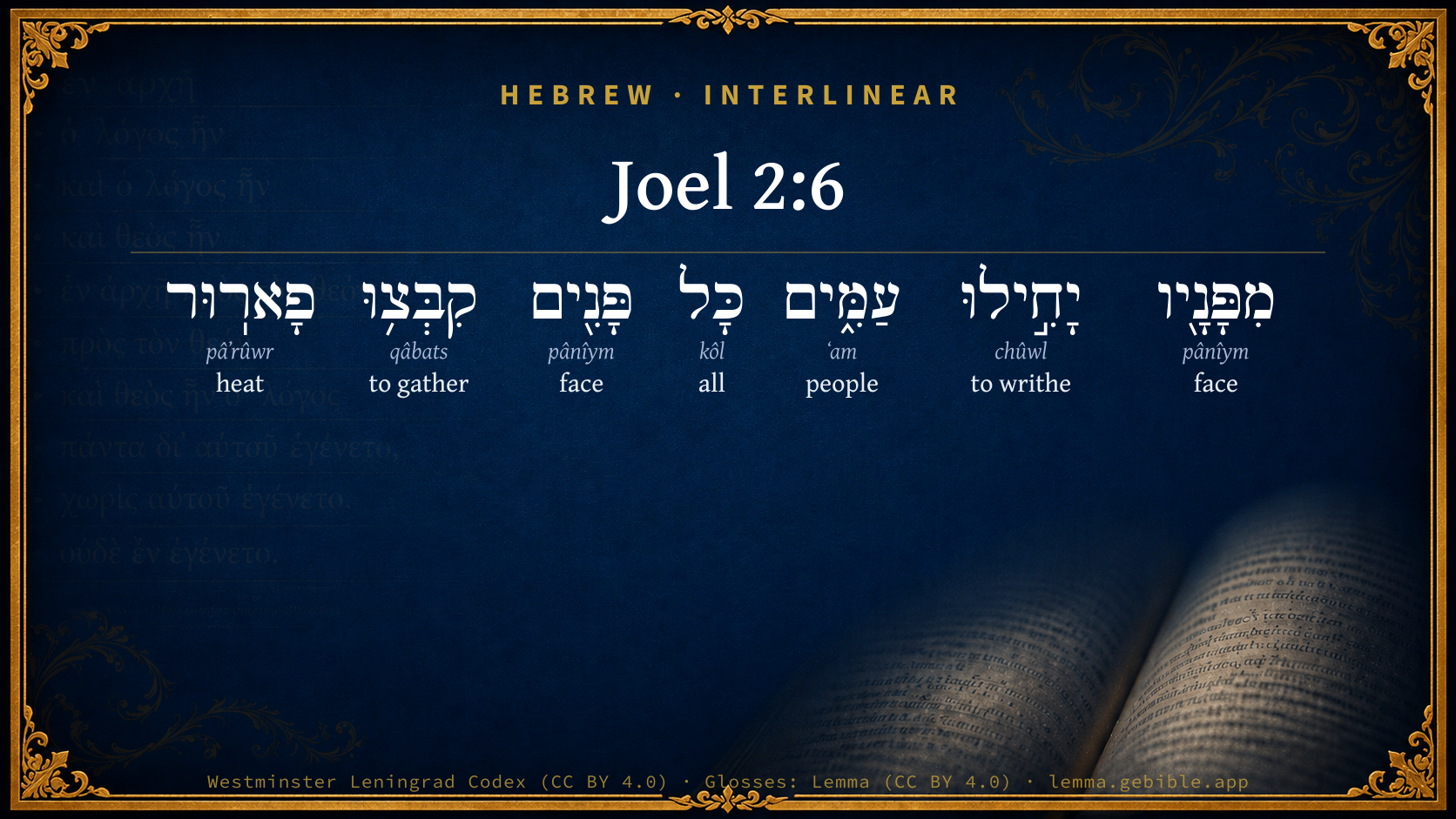
Joel 2:6

Hebrew (Westminster Leningrad Codex) Joel 2:6 appears in the Hebrew Old Testament. The text above is from the Westminster Leningrad Codex. Each word links to its Strong’s number, a concise gloss, and parsing drawn from the Open Scriptures Hebrew Bible morphology. Click any word for its full Brown-Driver-Briggs (BDB) entry.
Download image
Cite this verse

Joel 2:6 (World English Bible). Public Domain. Lemma interlinear Bible study tool, https://lemma.gebible.app/v/joel/2/6.

Show BibTeX & RIS
BibTeX
RIS
English Translation
At their presence the peoples are in anguish. All faces have grown pale.
World English Bible · Public Domain
Highlights
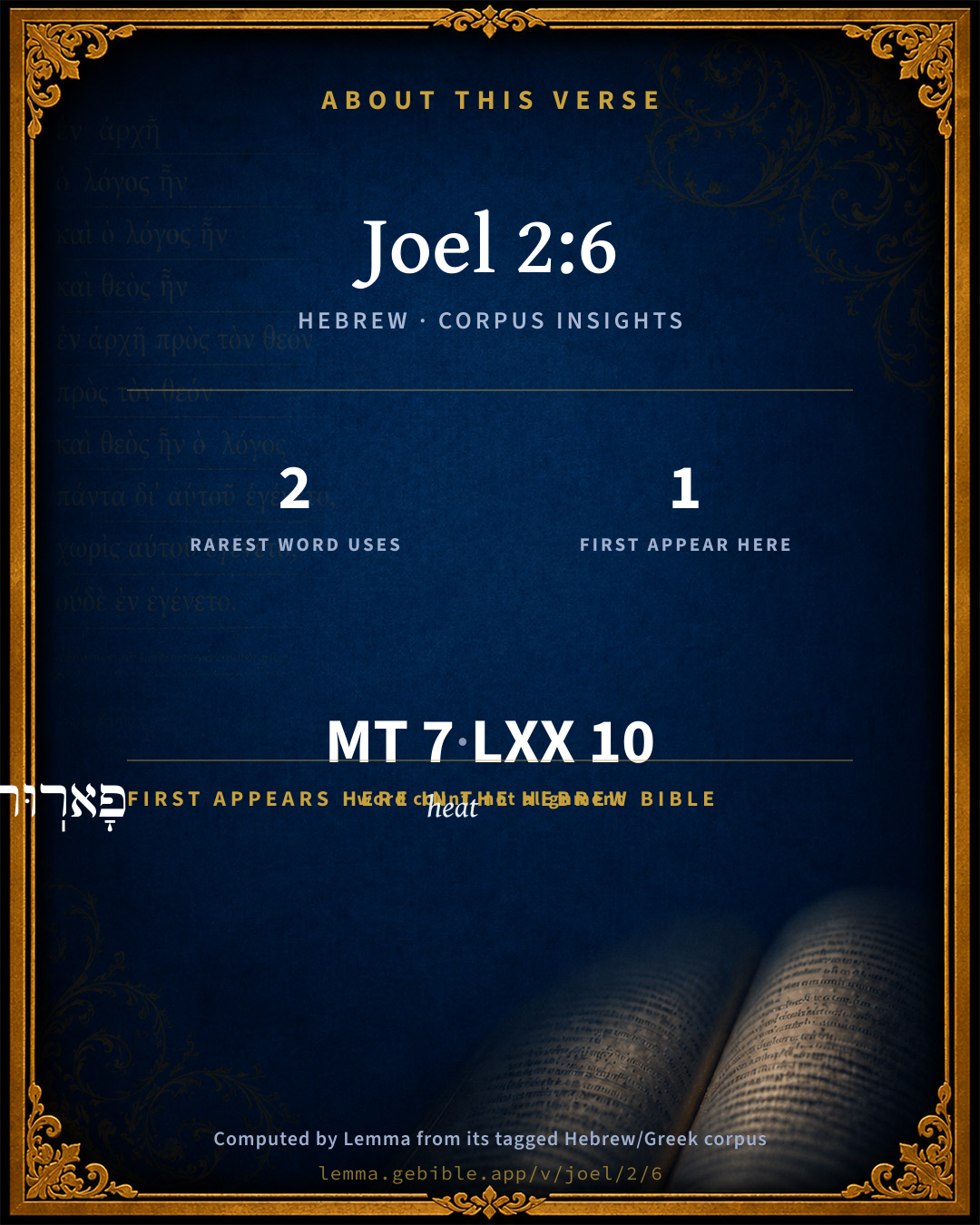
  • 1 first appearance in the Hebrew Bible
Full analysis ↓
Download a study sheet

One document with this verse’s original text, its word-by-word gloss line, the meaning frame, cross-references with their text, attributed commentary, and full source and license credits — printable, and it pastes into notes with its structure intact.

This verse Autodidact and up

Study sheet (.html) Plain text (.txt)

A passage Seminary Student

Up to 50 verses in one chapter. A passage sheet keeps up to 6 commentary sources and 12 cross-references per verse, in the order this page ranks them, and says so on the sheet whenever that leaves anything out. Ask for a single verse and you get the Autodidact verse sheet above.

Everything on this page stays free to read, with no account — the sheet is a download of what is already on screen, not access to it.

Want to remove ads? Support Godless Engineer
Compare translations 3

The same verse in 3 English versions, stacked beneath the original-language interlinear above. Click any original word for its lexicon entry.

Each is an independent rendering of the whole verse — the interlinear is not word-aligned to these translations.

Highlighted words mark where these versions differ — a whole-verse word diff, not a word-by-word alignment.

  • World English Bible Public Domain
    At their presence the peoples are in anguish. All faces have grown pale.
  • King James Version Public Domain
    Before their face the people shall be much pained: all faces shall gather blackness.
  • unfoldingWord Literal Text CC BY-SA 4.0
    From its face peoples writhe; all of faces gather beauty.

unfoldingWord Literal Text — © unfoldingWord, licensed CC BY-SA 4.0. Word-aligned USFM3 via Door43 (git.door43.org/unfoldingWord/en_ult).

Versions to compare (up to 4)

3 of 4 selected

Show all 18 translations

Every available English version of this verse, each an independent rendering of the whole verse.

  • World English Bible Public Domain
    At their presence the peoples are in anguish. All faces have grown pale.
  • Berean Standard Bible Public Domain
    Nations writhe in horror before them; every face turns pale.
  • Majority Standard Bible Public Domain
    Nations writhe in horror before them; every face turns pale.
  • King James Version Public Domain
    Before their face the people shall be much pained: all faces shall gather blackness.
  • American Standard Version (1901) Public Domain
    At their presence the peoples are in anguish; all faces are waxed pale.
  • Revised Version (1885) Public Domain
    At their presence the peoples are in anguish: all faces are waxed pale.
  • Geneva Bible (1599) Public Domain
    Before his face shall the people tremble: all faces shall gather blackenesse.
  • Douay-Rheims (1899) Public Domain
    At their presence the people shall be in grievous pains: all faces shall be made like a kettle.
  • Young's Literal Translation Public Domain
    From its face pained are peoples, All faces have gathered paleness.
  • Literal Standard Version CC BY-SA 4.0
    Pained are peoples from its face, || All faces have gathered paleness.
  • Unlocked Literal Bible CC BY-SA 4.0
    At their presence people are in anguish and all their faces become pale.
  • unfoldingWord Literal Text CC BY-SA 4.0
    From its face peoples writhe; all of faces gather beauty.
  • Darby Bible Public Domain
    Before them the peoples are in anguish: all faces turn pale.
  • World Messianic Bible Public Domain
    At their presence the peoples are in anguish. All faces have grown pale.
  • Webster's Bible Public Domain
    Before their face the people shall be much pained: all faces shall gather blackness.
  • Free Bible Version CC BY-SA 4.0
    Terror seizes all those in their path; all the people's faces grow pale.
  • Bible in Basic English Public Domain
    At their coming the people are bent with pain: all faces become red together.
  • JPS Tanakh (1917) Public Domain
    At their presence the peoples are in anguish; all faces have gathered blackness.

Literal Standard Version (2020), Covenant Press — licensed CC BY-SA 4.0. Text via the HelloAO Bible API (eBible.org). Unlocked Literal Bible (unfoldingWord) — licensed CC BY-SA 4.0. Text via the HelloAO Bible API (eBible.org). unfoldingWord Literal Text — © unfoldingWord, licensed CC BY-SA 4.0. Word-aligned USFM3 via Door43 (git.door43.org/unfoldingWord/en_ult). Free Bible Version, Dr. Jonathan Gallagher — licensed CC BY-SA 4.0. Text via the HelloAO Bible API (eBible.org).

Word by word

More ways to search: Search by grammar → Find every occurrence → Compare this word →

Practice this passage: Drill this verse → Learn its vocabulary →

About this verse

These counts appear in no published source. They are computed here, from the morphology-tagged text and Lemma’s own curated glosses. What Lemma adds →

7
words
6
distinct lemmas
Prophets
section

Notable vocabulary

The rarest word here is פָארֽוּר heat H6289 — appearing just 2 times in the whole Hebrew Bible.

First appearance in Scripture

This word makes its first canonical appearance in the Hebrew Bible here:

  • פָארֽוּר heat H6289

Shared distinctive vocabulary

פָארֽוּר heat H6289 occurs in 2 verses of the Hebrew Bible. Also found in:

Grammatical profile

  • 2 verbs
  • 5 nouns

Verb forms

  • יָחִ֣ילוּ Qal · Imperfect
  • קִבְּצ֥וּ Piel · Perfect

Repetition

A word recurs within this verse — often emphatic in Hebrew:

  • מִפָּנָ֖יו face H6440 ×2

Hebrew & Septuagint length

In English translation the verse runs 13 words from the Hebrew and 17 from the Septuagint (LXX English) — closely comparable.

A rough comparison of the two English renderings, which tokenize alike — not a word-level alignment.

Word counts can differ between the Hebrew and the Greek without any difference in meaning — e.g. the Hebrew direct-object marker אֵת has no separate Greek word, and Greek often adds the article ὁ.

In the original languages it is 7 Hebrew tokens and 10 Greek tokens — but the two are counted differently (Hebrew bundles its prefixes and suffixes into one token; the Greek is in lemma form), so that isn’t a like-for-like length.

Cross-references

6

Topical passages linked to Joel 2:6 in the Treasury of Scripture Knowledge — connected by theme and wording, ordered by reader-vote popularity; previews shown in the World English Bible.

  • Nahum 2:10 She is empty, void, and waste. The heart melts, the knees knock together, their bodies and faces have grown pale.
  • Isaiah 13:8 and they shall be dismayed; pangs and sorrows shall take hold [of them]; they shall be in pain as a woman in travail: they shall look in amazement one at another; their faces [shall be] faces of flame.
  • Jeremiah 30:6 Ask now, and see whether a man does travail with child: why do I see every man with his hands on his loins, as a woman in travail, and all faces are turned into paleness?
  • Lamentations 4:8 Their visage is blacker than a coal; they are not known in the streets: Their skin cleaves to their bones; it is withered, it is become like a stick.
  • Psalms 119:83 For I have become like a wineskin in the smoke. I don't forget your statutes.
  • Jeremiah 8:21 For the hurt of the daughter of my people am I hurt: I mourn; dismay has taken hold on me.

Cross-references courtesy of OpenBible.info (CC BY 4.0).

Hebrew and Greek witnesses Masoretic Hebrew ↔ Greek Septuagint

The same verse in the two great witnesses to the Old Testament, shown verse-for-verse.

These are two independent witnesses, not word-aligned to each other, and the Septuagint is shown in lemma (dictionary) form.

Hebrew Joel 2:6 Masoretic · Westminster Leningrad Codex

מִפָּנָ֖יו יָחִ֣ילוּ עַמִּ֑ים כָּל פָּנִ֖ים קִבְּצ֥וּ פָארֽוּר

At their presence the peoples are in anguish. All faces have grown pale.

World English Bible · Public Domain

Greek LXX Joel 2:6 Septuagint · lemma form

ἀπό πρόσωπον αὐτός συντρίβω λαός πᾶς πρόσωπον ὡς πρόσκαυμα χύτρα

Before them shall the people be crushed: every face shall be as the blackness of a caldron.

LXX2012 (modern English Septuagint) · Public Domain

On this verse, Ellicott's Commentary for English Readers discusses the Septuagint’s reading. Read the note in Commentary ↓

Hebrew: Westminster Leningrad Codex (CC BY 4.0). Greek: Septuagint (public domain); English from LXX2012 (modern English Septuagint) (Public Domain). How the Septuagint differs from the Hebrew →

Targum (Aramaic paraphrase)

1

The Targum is the ancient Jewish Aramaic paraphrase of the Hebrew Scriptures — an interpretive translation, not the Hebrew text itself. Onkelos (literal) and Pseudo-Jonathan (expansive) render the Torah, and Jonathan the Prophets. Coverage is partial: where no permissively-licensed English translation exists for a verse, only the Aramaic is shown. This is verse-level text, not a word-by-word alignment to the Hebrew.

  1. Targum Jonathan Prophets (Joshua–Malachi)
    מִן קֳדָמוֹהִי יְזוּעוּן עַמְמַיָא כָּל אַפַּיָא אִתְחַפִּיאוּ אִיכְרוּם אוּכְמִין כִּקְדֵירָא:

    (no public-domain English translation for this verse)

    Targum Jonathan — Aramaic: “Mikraot Gedolot” (public domain). English: “Sefaria Community Translation” (CC0 1.0 (public-domain dedication)); “London "Chaldee Paraphrase," 1871” (public domain). Text via Sefaria.

Commentary

Notes on Joel 2:6 from classic Christian and Jewish commentators (each source and its license shown beneath its notes). The classic Christian expositions comment on the surrounding passage and are grouped to its opening verse, so a note may address several verses; the Jewish commentaries on the Tanakh (Rashi and others) are per-verse, so they appear only where the commentator wrote on this verse.

Lemma curates 59 commentaries, every one of them public domain or Creative Commons licensed, each selected and text-cleaned for this edition rather than reprinted as found. About our sources →

Trapp's Complete Commentary

John Trapp

Joe 2:6 Before their face the people shall be much pained: all faces shall gather blackness.

Ver. 6. Before their face the people shall be much pained] This is a confirmation of the former assertion. The people when they shall see those swarms of locusts, &c., mustering and marching in the air, they shall be much pained, as a travailing woman is, "pangs and sorrows shall take hold of them, their faces shall be as flames," Isa 13:8, for fear lest they should light on their country and lay all waste.

All faces shall gather blackness] Pallorem, paleness, so Castalio rendereth it; a blackish lead-like paleness, such as on sooty pots. The original here is, "hath gathered a pot," that is, by a metonymy, a pot-like blackness, Nigricantern colorem significat (Mercer). See Nah 3:10 Jer 30:6 Psa 68:13, where, by blackness (such as slaves and scullions contract by lying among the pots, and smokey and sooty chimney corners), is set forth the exceeding great fear and affliction that God’s people are often in and from whence he graciously promiseth to deliver them that trust in him. Such shall not "be afraid whose heart is fixed, trusting in the Lord." It was fear that now caused (the natural heat and the blood retiring to the heart to receive it, as, in a sudden surprise, the soldiers run to the castle) paleness and blackness of face. It was hunger afterwards that burnt them, Deu 32:24, and made their visages blacker than a coal, as Lam 4:8, or, "darker than blackness," as the original hath it.

John Trapp, A Commentary or Exposition upon All the Books of the Old and New Testament (1647–1656) — public domain. Text from a community e-Sword module.

Tyndale Open Study Notes

Tyndale Open Resources

2:6 Fear grips all the people: Anticipating the invasion prepared the people for the call to repentance in 2:12-14.

Tyndale Open Study Notes — © Tyndale Open Resources, licensed CC BY-SA 4.0. Text via the HelloAO Bible API.

Geneva Bible (1599)

Geneva Bible translators

They shall be pale and black for fear, as Nah. 2:10.

Geneva Bible (1599) marginal notes — public domain. Text via Bolls.life.

Jamieson, Fausset & Brown

Robert Jamieson, A. R. Fausset & David Brown

much pained--namely, with terror. The Arab proverb is, "More terrible than the locusts."

faces shall gather blackness-- (Isa 13:8; Jer 30:6; Nah 2:10). MAURER translates, "withdraw their brightness," that is, wax pale, lose color (compare Joe 2:10; Joe 3:15).

Jamieson, Fausset & Brown — Commentary Critical and Explanatory on the Whole Bible (1871) — public domain (CC PDM 1.0). Text via the HelloAO Bible API.

Adam Clarke's Commentary

Verse 6. All faces shall gather blackness.] Universal mourning shall take place, because they know that such a plague is irresistible.

Adam Clarke's Commentary on the Bible (1810–1826) — public domain. Text from a community e-Sword/MySword module.

John Calvin's Commentaries

At length he adds, As a strong people, prepared for battle; their face the people will dread, and all faces shall gather blackness. By these words the Prophet intimates that the Assyrians at their coming would be supplied with such power as would, by report only, lay prostrate all people. But if the Assyrians should be so formidable to all people, what could the Jews do? In short, the Prophet here shows that the Jews would by no means be able to resist enemies so powerful; for they would by their fame alone so lay prostrate all people, that none would dare to rise up against them. He then compares them to giants. As giants, he says, they will run here and there; as men of war they will climb the wall, and man (that is, every one) in his ways shall walk. The Prophet heaps together these various expressions, that the Jews might know that they had to do with the irresistible hand of God, and that they would in vain implore assistance here and there; for they could find no relief in the whole world, when God executed his vengeance in so formidable a manner. He says further, they shall not stop their goings, though some render the words, “They shall not inquire respecting their ways;” for he had said before, “They shall proceed in their ways:” then the meaning is, They shall not come like strangers, who, when they journey through unknown regions, make anxious inquiries, whether any be lying in wait, whether there be any turnings in the road, whether the ways be difficult and perplexed: They shall not inquire, he says; they shall securely proceed, as though the road was open to them, as though the whole country was known to them. This part also serves to show celerity, that the Jews might dread the vengeance of God the same as if it was quite nigh them.

John Calvin's Commentaries (1540-1563) — public domain. Text from the Calvin Translation Society English edition (1840s-50s) via the Christian Classics Ethereal Library (ccel.org). Calvin's coverage is partial (roughly two-thirds of the Bible); uncommented books and verses are honest gaps, never fabricated. The 19th-century editor's footnotes and remarks are omitted so the notes are faithfully Calvin's own voice.

Ellicott's Commentary for English Readers

(6) All faces shall gather blackness.—There are different explanations of this Hebrew phrase, which expresses the result of terror. Some translate it “withdraw their ruddiness,” i.e., grow pale; others, “draw into themselves their colour;” others, “contract a livid character.” The alternative rendering in the margin, “pot,” which is that of the LXX., the Vulg., and of Luther’s translation, is obtained from the similarity of the Hebrew words for “ruddiness” and “pot.” The comparison is in this case between the faces growing black under the influence of fear, and of pots under the action of fire. The prophet Nahum uses the same expression (Joe_2:10).

A Bible Commentary for English Readers, edited by Charles John Ellicott (1878–1897) — public domain. Text from a community e-Sword module.

The Cambridge Bible for Schools and Colleges

gen. ed. J. J. S. Perowne

6. The alarm to be caused by their approach, like that occasioned by the advance of some vast horde of invaders.

At their presence peoples are in anguish] not people, but peoples, i.e. whole nations. For the verb, comp. Deu_2:25, R.V.; Eze_30:16, R.V.: it is a strong word, applied often, and specifically, to the anguish of a woman in travail (see e.g. Isa_13:8, where be in pain should rather be, as here, be in anguish). The ‘panic terror’ (Redtenbacher, p. 4) produced by an invasion of locusts on a large scale, can be readily imagined, if we remember not only the immense loss of property, of which they are the cause, but also the terrible destitution, which often follows in their train. In Algiers, after an invasion of locusts in 1866, 200,000 persons are said to have perished from famine. The destruction wrought frequently by the Rocky Mountain locust, over a large area of the United States, is almost incalculable (C. V. Riley, The Rocky Mountain Locust, chaps. Joe_2:5). Cf. Pliny’s words, below, p. 87.

all faces shall gather blackness] This rendering is not defensible[37]; but the meaning of the phrase (which recurs Nah_2:10) cannot be said to be certain. Modern scholars, following Ibn Ezra and Abul-walid, generally render gather in beauty, i.e. withdraw colour and freshness (paraphrased in R.V. by are waxed pale); but it is some objection to this rendering that it gives to ḳibbçtz a sense which is otherwise only known to be associated with the synonym âsaph (see Joe_2:10).

[37] פארור for פרור would indeed not be impossible; but to suppose that “gather a boiling-pot” could be said for “gather blackness like that of a boiling-pot” is beyond the limits of credibility. Yet several of the ancient versions and mediaeval Rabbis express this sense.

The Cambridge Bible for Schools and Colleges (gen. ed. J. J. S. Perowne; Cambridge University Press, 1878–1918) — public domain. Text from a community e-Sword module.

John Gill's Exposition

Before their face the people shall be much pained,.... Or, "at their presence"; at the sight of them they shall be in pain, as a woman in travail; into such distress an army of locusts would throw them, since they might justly fear all the fruits of the earth would be devoured by them, and they should have nothing left to live upon; and a like consternation and pain the army of the Assyrians or Chaldeans upon sight filled them with, as they expected nothing but ruin and destruction from them:

all faces shall gather blackness; like that of a pot, as the word (m) signifies; or such as appears in persons dying, or in fits and swoons; and this here, through fear and hunger; see Nah 2:10.

(m) "fuliginem", Montanus; "luridum ollae colorem", Tigurine version, Tarnovius; "ollam pro nigore ollae", Drusius.

John Gill's Exposition of the Whole Bible (1746–1763) — public domain (CC PDM 1.0). Text via the HelloAO Bible API.

Albert Barnes' Notes on the Bible

Before their face the people shall be much pained - The locust being such a scourge of God, good reason have men to be terrified at their approach; and those are most terrified who have most felt the affliction. In Abyssinia, some province of which was desolated every year, one relates , “When the locusts travel, the people know of it a day before, not because they see them, but they see the sun yellow and the ground yellow, through the shadow which they cast on it (their wings being yellow) and immediately the people become as dead, saying, ‘we are lost, for the Ambadas (so they call them) are coming.’ I will say what I have seen three times; the first was at Barva. During three years that we were in this land, we often heard them say, ‘such a realm, such a land, is destroyed by locusts:’ and when it was so, we saw this sign, the sun was yellow, and the shadow on the earth the same, and the whole people became as dead.” “The Captain of the place called Coiberia came to me with men, Clerks, and Brothers (Monks) to ask me, for the love God, to help them, that they were all lost through the locusts.” : “There were men, women, children, sitting among these locusts, the young brood, as stupefied. I said to them ‘why do you stay there, dying? Why do you not kill these animals, and avenge you of the evil which their parents have done you? and at least when dead, they will do you no more evil.’ They answered, that they had no courage to resist a plague which God gave them for their sins. We found the roads full of men, women, and children, (some of these on foot, some in arms) their bundles of clothes on their heads, removing to some land where they might find provisions. It was pitiful to see them.”

Burkhardt relates of South Arabia , “The Bedouins who occupy the peninsula of Sinai are frequently driven to despair by the multitudes of locusts, which constitute a land-plague. They remain there generally for forty or fifty days, and then disappear for the rest of the year.” Pliny describes their approach , “they overshadow the sun, the nations looking up with anxiety, lest they should cover their lands. For their strength suffices, and as if it were too little to have passed seas, they traverse immense tracts, and overspread them with a cloud, fatal to the harvest.”

All faces shall gather blackness - Others, of high-authority, have rendered, shall “withdraw (their) beauty” . But the word signifies to collect together, in order that what is so collected should be present, not absent ; and so is very different from another saying, the stars shall withdraw their shining Joe 2:10; Joe 3:15. The “their” had also needed to be expressed.) He expresses how the faces contract a livid color from anxiety and fear, as Jeremiah says of the Nazarites, “Their visage is darker than blackness” (Lam 4:8, see Margin). : “The faces are clothed with lurid hue of coming death; hence they not only grow pale, but are blackened.” A slight fear drives the fresh hue from the cheek: the livid hue comes only with the deepest terror. So Isaiah says; “they look amazed one to the other; faces of flame are their faces” Isa 13:8.

Albert Barnes' Notes on the Bible (1834–1885) — public domain. Text from a community e-Sword/MySword module.

Haydock's Catholic Bible Commentary

Kettle. The Jews were naturally of a dark complexion. Fear causing the blood to retire, would make them black, Isaias xiii. 8., Lamentations iv. 8., and v. 10. (Calmet)

George Leo Haydock (1774–1849), Haydock's Catholic Family Bible and Commentary, 1859 edition — public domain. Excludes Psalms (Douay-Rheims chapter numbering differs from Protestant) and Deuterocanonical books (Catholic canon only).

Matthew Poole's English Annotations

Before their face, at the sight of these locusts, both literally and figuratively considered,

the people of the land shall be much pained; as a woman in travail is in pain, their fears shall be very great, lest these devouring creatures should seize and destroy whatever was for support of their life, and life of their families.

All faces shall gather blackness; such as is the colour of dead men, or as is the dark paleness of men frighted into fits and swoons.

Matthew Poole's English Annotations on the Holy Bible (1683–1685) — public domain. Text from a community e-Sword/MySword module.

The Pulpit Commentary

Before their face the people shall be much pained: all faces shall gather blackness. Peoples or nations writhe in pain or tremble at the sight of them, lest they should settle on their fields and gardens, destroying the "golden glories" of the one, and the "leafy honours" of the other. In the second member the word rWrap is

(1) generally connected with rWrp, a pot, rad. rdp, to break in pieces, and translated accordingly. Thus the Septuagint: "Every face is as the blackness of a pot;" the Syriac also: "Every face shall be black as the blackness of a pot;" in like manner the Chaldee: "All faces are covered with soot, so that they are black as a pot.

(2) But Aben Ezra connects the word with raepe, to beautify, glorify, adorn, and translates, "They withdraw (gather to themselves)their redness (ruddiness);" that is, they become pale. The "Speaker"s Commentary" adopts this view of the expression, and illustrates it by Shakespeare"s fancy of the blood being summoned from the face to help the heart in its death-struggle"Being all descended to the labouring heart; Who, in the conflict that it holds with death, Attracts the same for aidance "gainst the enemy: Which with the heart there cools and ne"er returneth To blush and beautify the cheek again.

The parallel usually cited in favour of asaph being employed in the sense of withdrawing is, "And the stars shall withdraw their shining". (Joe_2:10 Joe_3:15) This proceeds on the supposition that asaph and qabhats have the same meaning of "gathering" gathering up, gathering in, withdrawing. But D. Kimchi quotes his father (Joseph Kimchi) as objecting to this rendering, on the ground of the distinction which he asserts to prevail between them. Asaph, he says, "is used of gathering together, or in, that which is dispersed, or net present; but qabhats is not so used."

The Pulpit Commentary (1880–1919), ed. H.D.M. Spence-Jones & Joseph S. Exell — public domain. Text from a community e-Sword module.

John Wesley's Explanatory Notes

Blackness - Such as is the colour of dead men, or the dark paleness of men frightened into swoons.

John Wesley, Explanatory Notes Upon the Whole Bible (1754–1765) — public domain. Text via the GEBible commentary corpus.

unfoldingWord translationNotes

Door43 World Missions Community

General Information:

Joel continues to describe the locust army of Yahweh.

They run like mighty warriors ... climb the walls like soldiers

The army of locusts acts as real soldiers do. (See: Personification and Simile)

walls

walls around the cities

translationWords

might

unfoldingWord translationNotes — © Distant Shores Media and the Door43 World Missions Community, licensed CC BY-SA 4.0. Source: git.door43.org/Door43/en_tn.

Rashi

Rabbi Shlomo Yitzchaki (Rashi)

gather blackness Heb. קִבְּצוּ פָּארוּר. Blackness like a pot, Cf. (Num. 11:8) “And they cooked in a pot (בַּפָּרוּר).” The “aleph” is superfluous, and it is not read.

Rashi on the Tanakh — English translations: “The Judaica Press complete Tanach with Rashi, translated by A. J. Rosenberg” (CC BY 4.0); “Pentateuch with Rashi's commentary by M. Rosenbaum and A.M. Silbermann, 1929-1934” (public domain); “The Metsudah Tanach series, Lakewood, N.J” (CC BY 4.0); and “The Book of Joshua, Metsudah Publications, 1997” (CC BY 4.0). Text via Sefaria.

Lesson kit

Teaching starters — assembled from the data on this page, not authored interpretation. Every prompt links to the verse data it draws on. Edit before teaching.

Joel, in the Prophets, opens this verse with 7 words (6 distinct Hebrew lemmas). Its most distinctive word is pâʼrûwr (“heat”). A historical commentator’s framing appears above. Read the whole chapter for the surrounding context.

Discussion questions

  1. How does “heat” (pâʼrûwr) shape what this verse is saying?
  2. The word “heat” first appears here in Scripture. What is being introduced at this debut?
  3. Nahum 2:10 shares the word «heat» with this verse. How do the two illuminate each other?
  4. “face” occurs 2× in this one verse. What is the effect of the repetition?
  5. These translations render this verse differently. What is at stake in choosing one wording over another?
  6. The verb «יָחִ֣ילוּ» is Qal Imperfect. How does its form color the action?
  7. Reading how Trapp's Complete Commentary and Tyndale Open Study Notes read this verse, where do the two commentators agree and where do they part?

Things to notice

Reading settings

Reading text

Shown beneath each verse's original-language words.

Old Testament
Old Testament edition

Read the OT as the Masoretic Hebrew (MT) or the Greek Septuagint (LXX).

English shown for the Greek Septuagint (in the Hebrew ↔ Greek comparison).

Comparing translations? Open the Compare panel on any verse page to stack up to four side by side.