2 Samuel 2:25

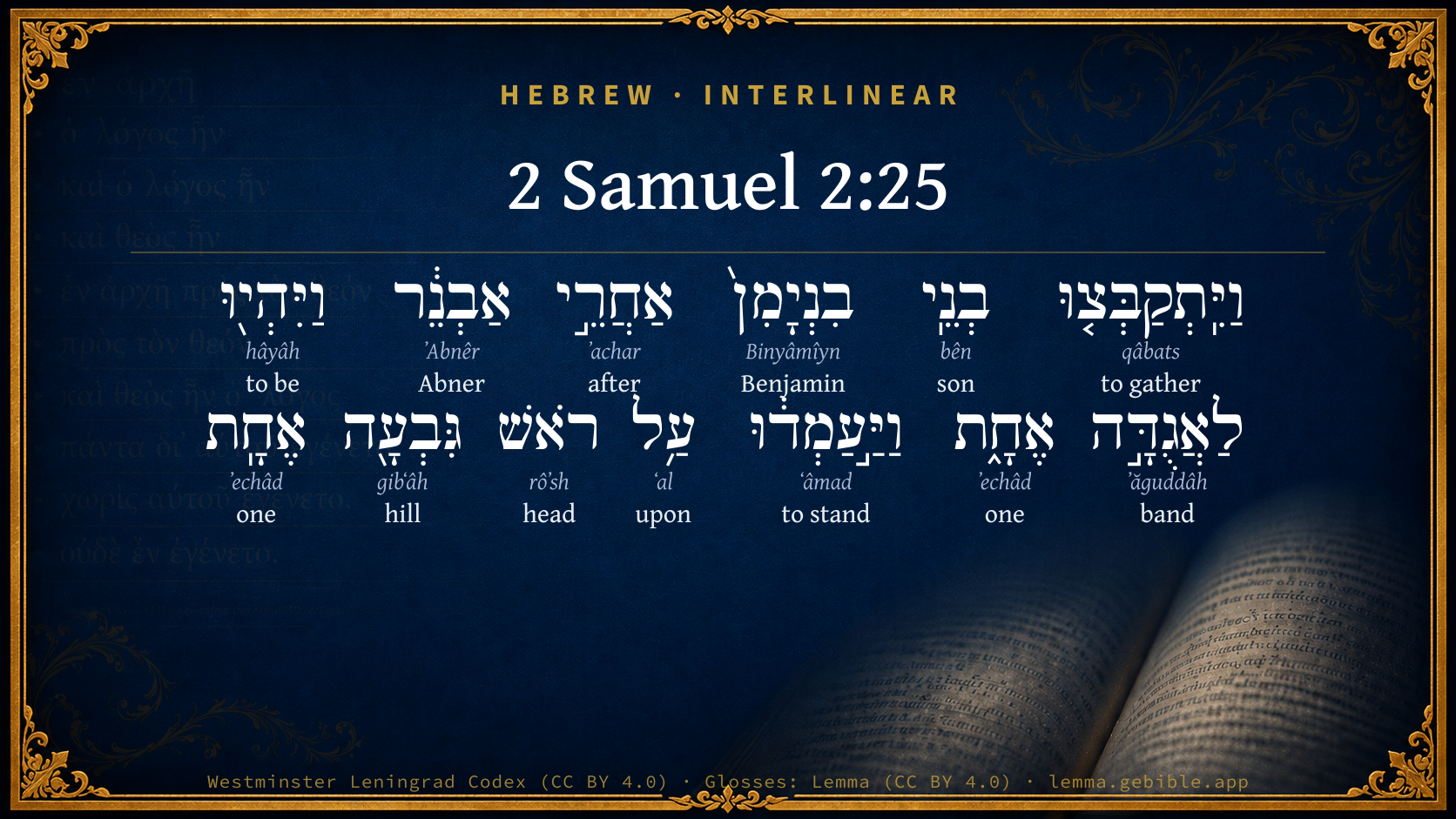
Hebrew (Westminster Leningrad Codex) 2 Samuel 2:25 appears in the Hebrew Old Testament. The text above is from the Westminster Leningrad Codex. Each word links to its Strong’s number, a concise gloss, and parsing drawn from the Open Scriptures Hebrew Bible morphology. Click any word for its full Brown-Driver-Briggs (BDB) entry.
Download image
Cite this verse

2 Samuel 2:25 (World English Bible). Public Domain. Lemma interlinear Bible study tool, https://lemma.gebible.app/v/2-samuel/2/25.

Show BibTeX & RIS
BibTeX
RIS
English Translation
The children of Benjamin gathered themselves together after Abner, and became one band, and stood on the top of a hill.
World English Bible · Public Domain
Download a study sheet

One document with this verse’s original text, its word-by-word gloss line, the meaning frame, cross-references with their text, attributed commentary, and full source and license credits — printable, and it pastes into notes with its structure intact.

This verse Autodidact and up

Study sheet (.html) Plain text (.txt)

A passage Seminary Student

Up to 50 verses in one chapter. A passage sheet keeps up to 6 commentary sources and 12 cross-references per verse, in the order this page ranks them, and says so on the sheet whenever that leaves anything out. Ask for a single verse and you get the Autodidact verse sheet above.

Everything on this page stays free to read, with no account — the sheet is a download of what is already on screen, not access to it.

Want to remove ads? Support Godless Engineer
Compare translations 3

The same verse in 3 English versions, stacked beneath the original-language interlinear above. Click any original word for its lexicon entry.

Each is an independent rendering of the whole verse — the interlinear is not word-aligned to these translations.

Highlighted words mark where these versions differ — a whole-verse word diff, not a word-by-word alignment.

  • World English Bible Public Domain
    The children of Benjamin gathered themselves together after Abner, and became one band, and stood on the top of a hill.
  • King James Version Public Domain
    And the children of Benjamin gathered themselves together after Abner, and became one troop, and stood on the top of an hill.
  • unfoldingWord Literal Text CC BY-SA 4.0
    Now the sons of Benjamin had gathered themselves behind Abner, and they had become one troop. And they stood on the head of one hill.

unfoldingWord Literal Text — © unfoldingWord, licensed CC BY-SA 4.0. Word-aligned USFM3 via Door43 (git.door43.org/unfoldingWord/en_ult).

Versions to compare (up to 4)

3 of 4 selected

Show all 18 translations

Every available English version of this verse, each an independent rendering of the whole verse.

  • World English Bible Public Domain
    The children of Benjamin gathered themselves together after Abner, and became one band, and stood on the top of a hill.
  • Berean Standard Bible Public Domain
    The Benjamites rallied to Abner, formed a single unit, and took their stand atop a hill.
  • Majority Standard Bible Public Domain
    The Benjamites rallied to Abner, formed a single unit, and took their stand atop a hill.
  • King James Version Public Domain
    And the children of Benjamin gathered themselves together after Abner, and became one troop, and stood on the top of an hill.
  • American Standard Version (1901) Public Domain
    And the children of Benjamin gathered themselves together after Abner, and became one band, and stood on the top of a hill.
  • Revised Version (1885) Public Domain
    And the children of Benjamin gathered themselves together after Abner, and became one band, and stood on the top of an hill.
  • Geneva Bible (1599) Public Domain
    And the children of Beniamin gathered them selues together after Abner, and were on an heape and stoode on the top of an hill.
  • Douay-Rheims (1899) Public Domain
    And the children of Benjamin gathered themselves together to Abner: and being joined in one body, they stood on the top of a hill.
  • Young's Literal Translation Public Domain
    And the sons of Benjamin gather themselves together after Abner, and become one troop, and stand on the top of a certain height,
  • Literal Standard Version CC BY-SA 4.0
    And the sons of Benjamin gather themselves together after Abner, and become one troop, and stand on the top of a certain height,
  • Unlocked Literal Bible CC BY-SA 4.0
    The men of Benjamin gathered themselves together behind Abner and stood on the top of the hill.
  • unfoldingWord Literal Text CC BY-SA 4.0
    Now the sons of Benjamin had gathered themselves behind Abner, and they had become one troop. And they stood on the head of one hill.
  • Darby Bible Public Domain
    And the children of Benjamin gathered themselves together after Abner, and became one troop, and stood on the top of a hill.
  • World Messianic Bible Public Domain
    The children of Benjamin gathered themselves together after Abner and became one band, and stood on the top of a hill.
  • Webster's Bible Public Domain
    And the children of Benjamin assembled themselves after Abner, and became one troop, and stood on the top of a hill.
  • Free Bible Version CC BY-SA 4.0
    Abner's men from the tribe of Benjamin rallied to him there, forming a tight group around him standing at the top of the hill.
  • Bible in Basic English Public Domain
    And the men of Benjamin came together after Abner in one band, and took their places on the top of a hill.
  • JPS Tanakh (1917) Public Domain
    And the children of Benjamin gathered themselves together after Abner, and became one band, and stood on the top of a hill.

Literal Standard Version (2020), Covenant Press — licensed CC BY-SA 4.0. Text via the HelloAO Bible API (eBible.org). Unlocked Literal Bible (unfoldingWord) — licensed CC BY-SA 4.0. Text via the HelloAO Bible API (eBible.org). unfoldingWord Literal Text — © unfoldingWord, licensed CC BY-SA 4.0. Word-aligned USFM3 via Door43 (git.door43.org/unfoldingWord/en_ult). Free Bible Version, Dr. Jonathan Gallagher — licensed CC BY-SA 4.0. Text via the HelloAO Bible API (eBible.org).

Word by word

More ways to search: Search by grammar → Find every occurrence → Compare this word →

Practice this passage: Drill this verse → Learn its vocabulary →

לַאֲגֻדָּ֣ה
ʼăguddâh
H92
“to/for · band”
Preposition + Noun, Common, Feminine, Singular, Absolute
Part of Speech
Preposition + Noun
Type
Common
Gender
Feminine
Number
Singular
State
Absolute
Full BDB Definition

Origin: f passive participle of an unused root (meaning to bind)

TWOT: 15a

band, binding - cords, bands, thongs (metaphorical of slavery) - bunch of hyssop - band of men, troops - vault (of the heavens), firmament (binding earth to the heavens)
  1. וַיִּֽתְקַבְּצ֤וּ qâbats H6908 “and · to gather” Conjunction + Verb, Hithpael, Sequential Imperfect, 3rd Person, Masculine, Plural
  2. בְנֵֽי bên H1121 “sons of” Noun, Common, Masculine, Plural, Construct
  3. בִנְיָמִן֙ Binyâmîyn H1144 “Benjamin” Noun, Proper
  4. אַחֲרֵ֣י ʼachar H310 “after” Preposition
  5. אַבְנֵ֔ר ʼAbnêr H74 “Abner” Noun, Proper
  6. וַיִּהְי֖וּ hâyâh H1961 “and · to be” Conjunction + Verb, Qal, Sequential Imperfect, 3rd Person, Masculine, Plural
  7. אֶחָ֑ת ʼechâd H259 “one” Adjective, Cardinal number, Feminine, Singular, Absolute
  8. וַיַּ֣עַמְד֔וּ ʻâmad H5975 “and · to stand” Conjunction + Verb, Qal, Sequential Imperfect, 3rd Person, Masculine, Plural
  9. עַ֥ל ʻal H5921 “upon” Preposition
  10. רֹאשׁ rôʼsh H7218 “head of” Noun, Common, Masculine, Singular, Construct
  11. גִּבְעָ֖ה gibʻâh H1389 “hill” Noun, Common, Feminine, Singular, Absolute
  12. אֶחָֽת ʼechâd H259 “one” Adjective, Cardinal number, Feminine, Singular, Absolute

About this verse

These counts appear in no published source. They are computed here, from the morphology-tagged text and Lemma’s own curated glosses. What Lemma adds →

13
words
12
distinct lemmas
Historical
section

Notable vocabulary

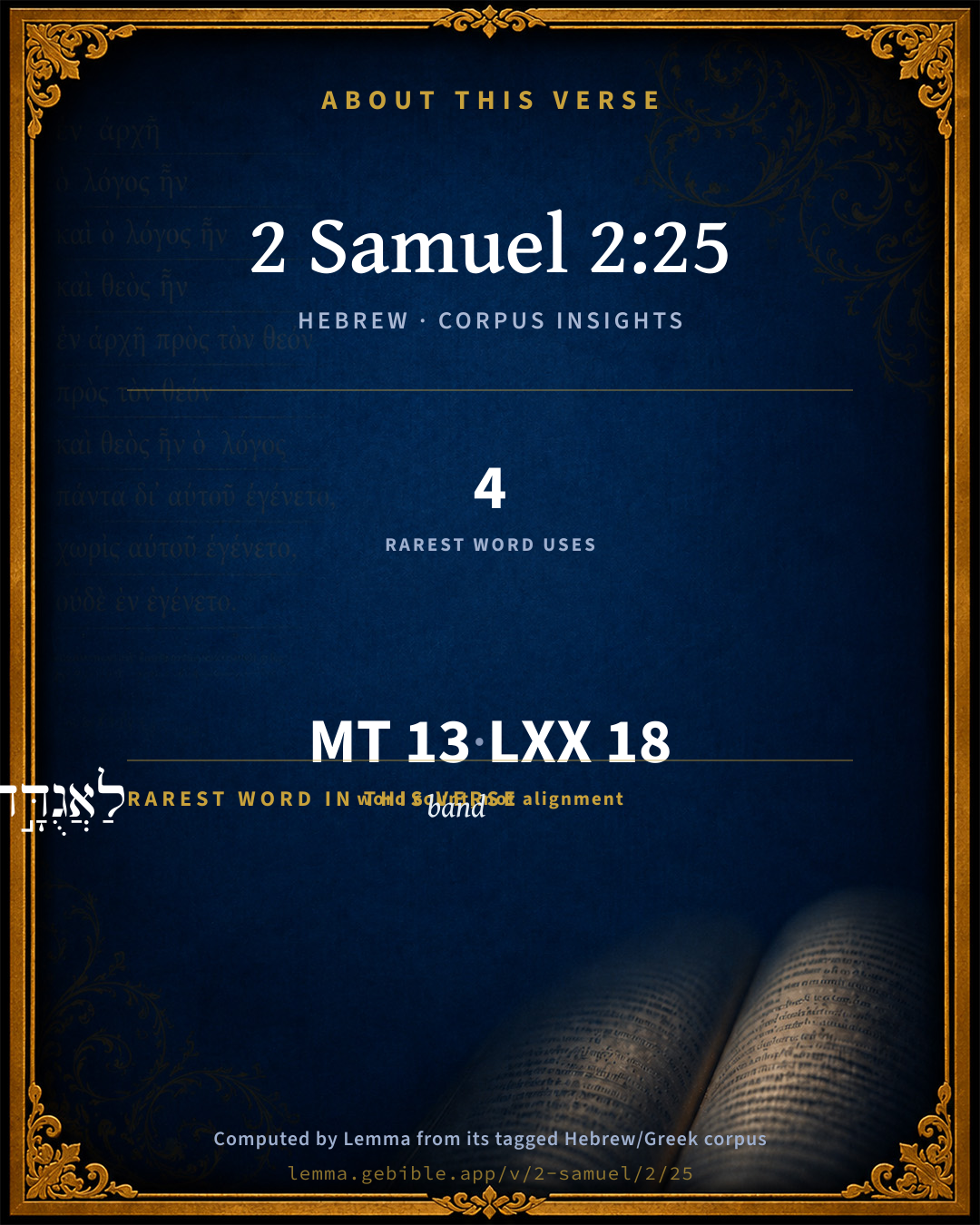
The rarest word here is לַאֲגֻדָּ֣ה band H92 — appearing just 4 times in the whole Hebrew Bible.

Shared distinctive vocabulary

לַאֲגֻדָּ֣ה band H92 occurs in 4 verses of the Hebrew Bible. Also found in:

Grammatical profile

  • 3 verbs
  • 6 nouns
  • 2 adjectives
  • 2 prepositions

Verb forms

  • וַיִּֽתְקַבְּצ֤וּ Hithpael · Sequential Imperfect
  • וַיִּהְי֖וּ Qal · Sequential Imperfect
  • וַיַּ֣עַמְד֔וּ Qal · Sequential Imperfect

Repetition

A word recurs within this verse — often emphatic in Hebrew:

  • אֶחָ֑ת one H259 ×2

Hebrew & Septuagint length

In English translation the verse runs 21 words from the Hebrew and 26 from the Septuagint (LXX English) — closely comparable.

A rough comparison of the two English renderings, which tokenize alike — not a word-level alignment.

Word counts can differ between the Hebrew and the Greek without any difference in meaning — e.g. the Hebrew direct-object marker אֵת has no separate Greek word, and Greek often adds the article ὁ.

In the original languages it is 13 Hebrew tokens and 18 Greek tokens — but the two are counted differently (Hebrew bundles its prefixes and suffixes into one token; the Greek is in lemma form), so that isn’t a like-for-like length.

Hebrew and Greek witnesses Masoretic Hebrew ↔ Greek Septuagint

The same verse in the two great witnesses to the Old Testament, shown verse-for-verse.

These are two independent witnesses, not word-aligned to each other, and the Septuagint is shown in lemma (dictionary) form.

Hebrew 2 Samuel 2:25 Masoretic · Westminster Leningrad Codex

וַיִּֽתְקַבְּצ֤וּ בְנֵֽי בִנְיָמִן֙ אַחֲרֵ֣י אַבְנֵ֔ר וַיִּהְי֖וּ לַאֲגֻדָּ֣ה אֶחָ֑ת וַיַּ֣עַמְד֔וּ עַ֥ל רֹאשׁ גִּבְעָ֖ה אֶחָֽת

The children of Benjamin gathered themselves together after Abner, and became one band, and stood on the top of a hill.

World English Bible · Public Domain

Greek LXX 2 Samuel 2:25 Septuagint · lemma form

καί συνἀθροίζω υἱός βενιαμίν ὁ ὀπίσω αβεννηρ καί γίγνομαι εἰς συνάντησις εἷς καί ἵστημι ἐπί κεφαλή βουνός εἷς

And the children of Benjamin who followed Abenner gather themselves together, and they formed themselves into one body, and stood on the top of a hill.

LXX2012 (modern English Septuagint) · Public Domain

Hebrew: Westminster Leningrad Codex (CC BY 4.0). Greek: Septuagint (public domain); English from LXX2012 (modern English Septuagint) (Public Domain). How the Septuagint differs from the Hebrew →

Targum (Aramaic paraphrase)

1

The Targum is the ancient Jewish Aramaic paraphrase of the Hebrew Scriptures — an interpretive translation, not the Hebrew text itself. Onkelos (literal) and Pseudo-Jonathan (expansive) render the Torah, and Jonathan the Prophets. Coverage is partial: where no permissively-licensed English translation exists for a verse, only the Aramaic is shown. This is verse-level text, not a word-by-word alignment to the Hebrew.

  1. Targum Jonathan Prophets (Joshua–Malachi)
    וְאִתְכְּנִישׁוּ בְּנֵי בִנְיָמִן בָּתַר אַבְנֵר וַהֲווֹ לְסִיעָא חָד וְקָמוּ עַל רֵישׁ רָמָתָא חֲדָא:

    (no public-domain English translation for this verse)

    Targum Jonathan — Aramaic: “Mikraot Gedolot” (public domain). English: “Sefaria Community Translation” (CC0 1.0 (public-domain dedication)); “London "Chaldee Paraphrase," 1871” (public domain). Text via Sefaria.

Commentary

Notes on 2 Samuel 2:25 from classic Christian and Jewish commentators (each source and its license shown beneath its notes). The classic Christian expositions comment on the surrounding passage and are grouped to its opening verse, so a note may address several verses; the Jewish commentaries on the Tanakh (Rashi and others) are per-verse, so they appear only where the commentator wrote on this verse.

Lemma curates 59 commentaries, every one of them public domain or Creative Commons licensed, each selected and text-cleaned for this edition rather than reprinted as found. About our sources →

Matthew Henry's Commentary

Here, I. Abner, being conquered, meanly begs for a cessation of arms. He rallied the remains of his forces on the top of a hill (Sa2 2:25), as if he would have made head again, but becomes a humble supplicant to Joab for a little breathing-time, Sa2 2:26. He that was most forward to fight was the first that had enough of it. He that made a jest of bloodshed (Let the young men arise and play before us, Sa2 2:14) is now shocked at it, when he finds himself on the losing side, and the sword he made so light of drawing threatening to touch himself. Observe how his note is changed. Then it was but playing with the sword; now, Shall the sword devour for ever? It had devoured but one day, yet to him it seemed forever, because it went against him; and very willing he is now that the sun should not go down upon the wrath. Now he can appeal to Joab himself concerning the miserable consequences of a civil war: Knowest thou not that it will be bitterness in the latter end? It will be reflected upon with regret when the account comes to be made up; for, whoever gets in a civil war, the community is sure to lose. Perhaps he refers to the bitterness that there was in the tribes of Israel, in the end of their war with Benjamin, when they wept sorely for the desolations which they themselves had made, Jdg 21:2. Now he begs of Joab to sound a retreat, and pleads that they were brethren, who ought not thus to bite and devour one another. He that in the morning would have Joab bid the people fall upon their brethren now would have him bid them lay down their arms. See here, 1. How easy it is for men to use reason when it makes for them who would not use it if it made against them. If Abner had been the conqueror, we should not have had him complaining of the voraciousness of the sword and the miseries of a civil war, nor pleading that both sides were brethren; but, finding himself beaten, all these reasonings are mustered up and improved for the securing of his retreat and the saving of his scattered troops from being cut off. 2. How the issue of things alters men's minds. The same thing which looked pleasant in the morning at night looked dismal. Those that are forward to enter into contention will perhaps repent it before they have done with it, and therefore had better leave it off before it be meddled with, as Solomon advises. It is true of every sin (O that men would consider it in time!) that it will be bitterness in the latter end. At the last it bites like a serpent those on whom it fawned.

II. Joab, though a conqueror, generously grants it, and sounds a retreat, knowing very well his master's mind and how averse he was to the shedding of blood. He does indeed justly upbraid Abner with his forwardness to engage, and lays the blame upon him that there had been so much bloodshed as there was (Sa2 2:27): "Unless thou hadst spoken," that is, "hadst given orders to fight, hadst bidden the young men arise and play before us, none of us would have struck a stroke, nor drawn a sword against our brethren. Thou complainest that the sword devours, but who first unsheathed it? Who began? Now thou wouldst have the people parted, but remember who set them on to fight. We should have retired in the morning if thou hadst not given the challenge." Those that are forward to make mischief are commonly the first to complain of it. This might have served to excuse Joab if he had pushed on his victory, and made a full end of Abner's forces; but like one that pitied the mistake of his adversaries, and scorned to make an army of Israelites pay dearly for the folly of their commander, he very honourably, by sound of trumpet, put a stop to the pursuit (Sa2 2:28) and suffered Abner to make an orderly retreat. It is good husbandry to be sparing of blood. As the soldiers were here very obsequious to the general's orders, so he, no doubt, observed the instructions of his prince, who sought the welfare of all Israel and therefore not the hurt of any.

III. The armies being separated, both retired to the places whence they came, and both marched in the night, Abner to Mahanaim, on the other side Jordan (Sa2 2:29), and Joab to Hebron, where David was, Sa2 2:32. The slain on both sides are computed. On David's side only nineteen men were missing, besides Asahel (Sa2 2:30), who was worth more than all; on Abner's side 360, Sa2 2:31. In civil wars formerly great slaughters had been made (as Jdg 12:6; Jdg 20:44), in comparison with which this was nothing. It is to be hoped that they had grown wiser and more moderate. Asahel's funeral is here mentioned; the rest they buried in the field of battle, but he was carried to Bethlehem, and buried in the sepulchre of his father, Sa2 2:32. Thus are distinctions made between the dust of some and that of others; but in the resurrection no other difference will be made but that between godly and ungodly, which will remain for ever.

Matthew Henry's Commentary on the Whole Bible (1708–1710) — public domain (CC PDM 1.0). Text via the HelloAO Bible API.

Trapp's Complete Commentary

John Trapp

2Sa 2:25 And the children of Benjamin gathered themselves together after Abner, and became one troop, and stood on the top of an hill.

Ver. 25. And became one troop, and stood on the top of an hill.] They were not so routed but that they could rally: and getting the hill, they stood upon their guard. Cuneati in collis vertice stabant. He that flieth may once fight again.

John Trapp, A Commentary or Exposition upon All the Books of the Old and New Testament (1647–1656) — public domain. Text from a community e-Sword module.

Ellicott's Commentary for English Readers

(25) The children of Benjamin.—The rest of Abner’s force appears to have been hopelessly scattered in the flight, but he succeeded in rallying the Benjamites, his own and Saul’s kinsmen, in a strong position “on the top of an hill.”

A Bible Commentary for English Readers, edited by Charles John Ellicott (1878–1897) — public domain. Text from a community e-Sword module.

The Cambridge Bible for Schools and Colleges

gen. ed. J. J. S. Perowne

25. the children of Benjamin] The men of Saul’s tribe shew themselves prepared to fight for his son’s cause to the last. Cp. 2Sa_2:15.

became one troop] The word means properly a knot or band. Abner chose a strong position in which to rally the remnant of his scattered forces into a solid phalanx.

The Cambridge Bible for Schools and Colleges (gen. ed. J. J. S. Perowne; Cambridge University Press, 1878–1918) — public domain. Text from a community e-Sword module.

John Gill's Exposition

And the children of Benjamin gathered themselves together after Abner,.... Either those that were with him before, who upon the battle were dispersed, but now got together again; or others of that tribe, who, hearing of the defeat of Abner, went out of the several cities after him, to strengthen his hands, and renew the fight with Joab:

and became one troop; were united together in a body, and became a regular troop:

and stood on the top of an hill; which was some advantage to them, and from whence they could take a view of Joab's army, and observe its motions.

John Gill's Exposition of the Whole Bible (1746–1763) — public domain (CC PDM 1.0). Text via the HelloAO Bible API.

Matthew Poole's English Annotations

Where, being upon the upper ground, they might better defend themselves.

Matthew Poole's English Annotations on the Holy Bible (1683–1685) — public domain. Text from a community e-Sword/MySword module.

The Pulpit Commentary

The children of Benjamin became one troop. Benjamin was probably the only tribe that entered keenly into Ishbosheth"s cause; for the maintenance of the kingdom in the family of Saul meant the continuance of that favouritism which had enriched them at the expense of the community. (1Sa_22:7) They were, too, a very warlike tribe, and Abner was one of themselves, and probably, therefore, the main body of his army, and certainly his most trustworthy men, were Benjamites. Profiting by the delay caused by the halting of David"s soldiers round tile body of the fallen Asahel, Abner had rallied his men, and posted them on the top of the hill, where they were prepared now to fight on more equal terms.

The Pulpit Commentary (1880–1919), ed. H.D.M. Spence-Jones & Joseph S. Exell — public domain. Text from a community e-Sword module.

Keil & Delitzsch

C. F. Keil & F. Delitzsch

The Benjaminites then gathered in a crowd behind Abner, and halted upon the top of a hill to beat back their pursuers; and Abner cried out to Joab, "Shall the sword then devour for ever (shall there be no end to the slaughter)? dost thou not know that bitterness arises at last? and how long wilt thou not say to the people, to return from pursuing their brethren?" Thus Abner warns Joab of the consequences of a desperate struggle, and calls upon him to put an end to all further bloodshed by suspending the pursuit.

Keil & Delitzsch — Biblical Commentary on the Old Testament (1861–1891) — public domain (CC PDM 1.0). Text via the HelloAO Bible API. (Old Testament only.)

Lesson kit

Teaching starters — assembled from the data on this page, not authored interpretation. Every prompt links to the verse data it draws on. Edit before teaching.

2 Samuel, in the Historical, opens this verse with 13 words (12 distinct Hebrew lemmas). Its most distinctive word is ʼăguddâh (“band”). A historical commentator’s framing appears above. Read the whole chapter for the surrounding context.

Discussion questions

  1. What does “band” (ʼăguddâh) contribute to the verse as a whole?
  2. Exodus 12:22 shares the word «band» with this verse. How do the two illuminate each other?
  3. “one” occurs 2× in this one verse. What is the effect of the repetition?
  4. The translations on this page render this verse differently — a whole-verse word diff, not a word-by-word alignment. What might account for the different wordings?
  5. The verb «וַיִּֽתְקַבְּצ֤וּ» is Hithpael Sequential Imperfect. How does its form color the action?
  6. Reading how Matthew Henry's Commentary and Trapp's Complete Commentary read this verse, where do the two commentators agree and where do they part?

Things to notice

Reading settings

Reading text

Shown beneath each verse's original-language words.

Old Testament
Old Testament edition

Read the OT as the Masoretic Hebrew (MT) or the Greek Septuagint (LXX).

English shown for the Greek Septuagint (in the Hebrew ↔ Greek comparison).

Comparing translations? Open the Compare panel on any verse page to stack up to four side by side.