Joel 3:11

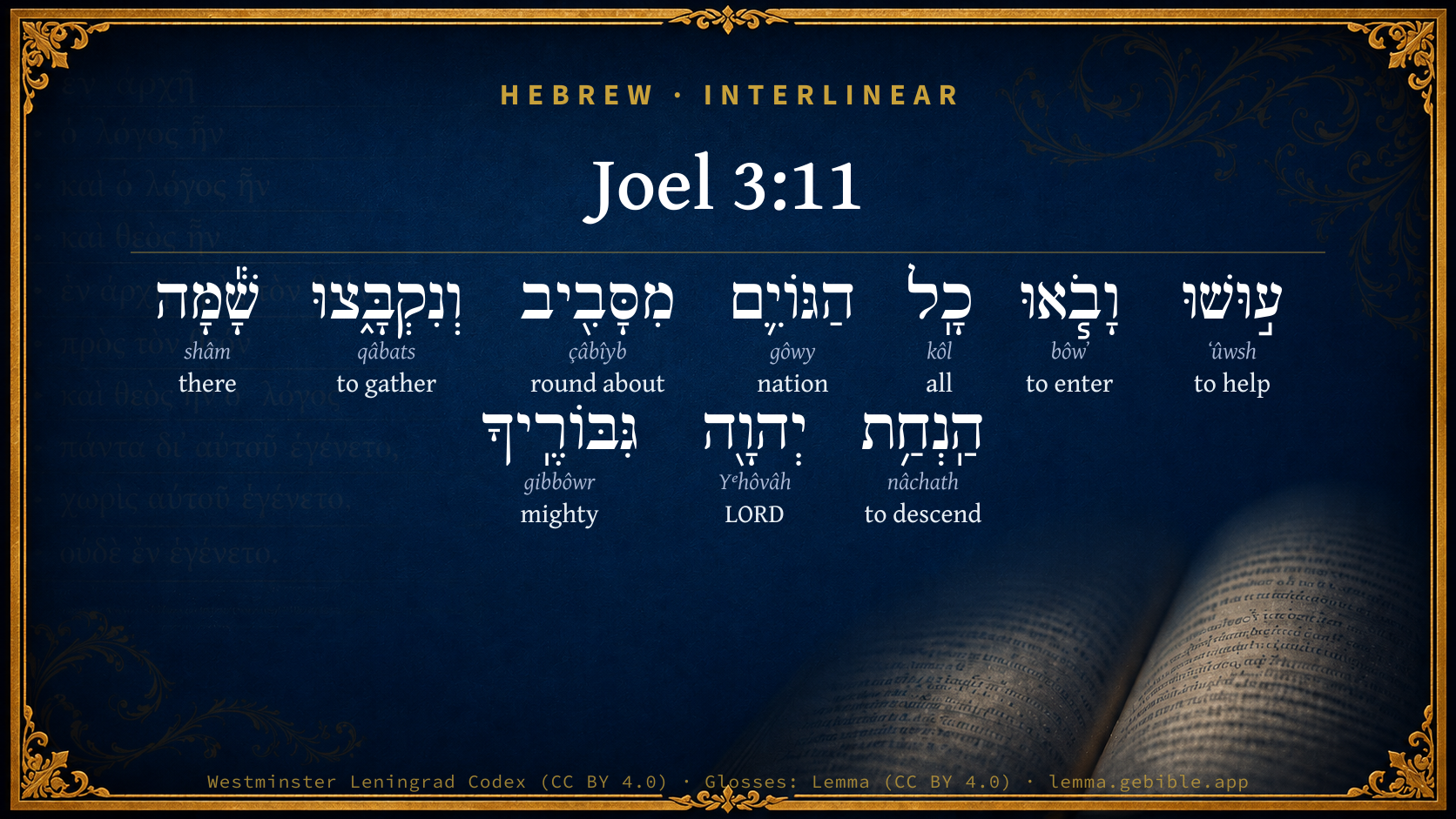
Hebrew (Westminster Leningrad Codex) Joel 3:11 appears in the Hebrew Old Testament. The text above is from the Westminster Leningrad Codex. Each word links to its Strong’s number, a concise gloss, and parsing drawn from the Open Scriptures Hebrew Bible morphology. Click any word for its full Brown-Driver-Briggs (BDB) entry.
Download image
Cite this verse

Joel 3:11 (World English Bible). Public Domain. Lemma interlinear Bible study tool, https://lemma.gebible.app/v/joel/3/11.

Show BibTeX & RIS
BibTeX
RIS
English Translation
Hurry and come, all you surrounding nations, And gather yourselves together." Cause your mighty ones to come down there, Yahweh.
World English Bible · Public Domain
Highlights
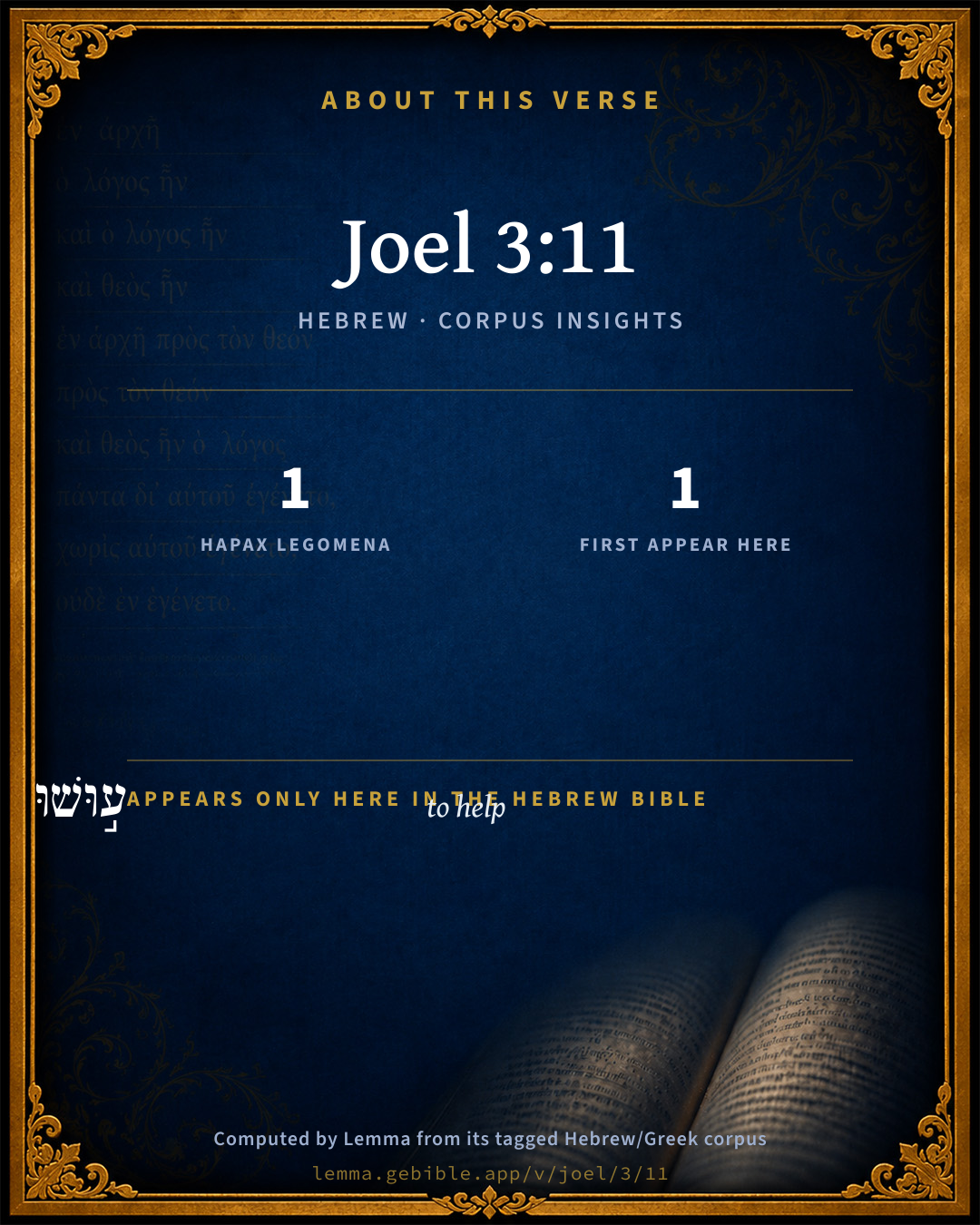
  • 1 hapax legomenon — only here in the Hebrew Bible
  • 1 first appearance in the Hebrew Bible
Full analysis ↓
Download a study sheet

One document with this verse’s original text, its word-by-word gloss line, the meaning frame, cross-references with their text, attributed commentary, and full source and license credits — printable, and it pastes into notes with its structure intact.

This verse Autodidact and up

Study sheet (.html) Plain text (.txt)

A passage Seminary Student

Up to 50 verses in one chapter. A passage sheet keeps up to 6 commentary sources and 12 cross-references per verse, in the order this page ranks them, and says so on the sheet whenever that leaves anything out. Ask for a single verse and you get the Autodidact verse sheet above.

Everything on this page stays free to read, with no account — the sheet is a download of what is already on screen, not access to it.

Want to remove ads? Support Godless Engineer
Compare translations 3

The same verse in 3 English versions, stacked beneath the original-language interlinear above. Click any original word for its lexicon entry.

Each is an independent rendering of the whole verse — the interlinear is not word-aligned to these translations.

Highlighted words mark where these versions differ — a whole-verse word diff, not a word-by-word alignment.

  • World English Bible Public Domain
    Hurry and come, all you surrounding nations, And gather yourselves together." Cause your mighty ones to come down there, Yahweh.
  • King James Version Public Domain
    Assemble yourselves, and come, all ye heathen, and gather yourselves together round about: thither cause thy mighty ones to come down, O LORD.
  • unfoldingWord Literal Text CC BY-SA 4.0
    Hurry and come, all of you surrounding nations, and gather yourselves there.” Yahweh, bring down your warriors!

unfoldingWord Literal Text — © unfoldingWord, licensed CC BY-SA 4.0. Word-aligned USFM3 via Door43 (git.door43.org/unfoldingWord/en_ult).

Versions to compare (up to 4)

3 of 4 selected

Show all 18 translations

Every available English version of this verse, each an independent rendering of the whole verse.

  • World English Bible Public Domain
    Hurry and come, all you surrounding nations, And gather yourselves together." Cause your mighty ones to come down there, Yahweh.
  • Berean Standard Bible Public Domain
    Come quickly, all you surrounding nations, and gather yourselves. Bring down Your mighty ones, O LORD.
  • Majority Standard Bible Public Domain
    Come quickly, all you surrounding nations, and gather yourselves. Bring down Your mighty ones, O LORD.
  • King James Version Public Domain
    Assemble yourselves, and come, all ye heathen, and gather yourselves together round about: thither cause thy mighty ones to come down, O LORD.
  • American Standard Version (1901) Public Domain
    Haste ye, and come, all ye nations round about, and gather yourselves together: thither cause thy mighty ones to come down, O Jehovah.
  • Revised Version (1885) Public Domain
    Haste ye, and come, all ye nations round about, and gather yourselves together: thither cause thy mighty ones to come down, O LORD.
  • Geneva Bible (1599) Public Domain
    Assemble your selues, and come all yee heathen and gather your selues together round about: there shall the Lord cast downe the mightie men.
  • Douay-Rheims (1899) Public Domain
    Break forth, and come, all ye nations, from round about, and gather yourselves together: there will the Lord cause all thy strong ones to fall down.
  • Young's Literal Translation Public Domain
    Haste, and come in, all ye nations round, And be gathered together, Thither cause to come down, O Jehovah, Thy mighty ones.
  • Literal Standard Version CC BY-SA 4.0
    Hurry, and come in, all you nations around, || And be gathered together, || There cause to come down, O YHWH, || Your mighty ones.
  • Unlocked Literal Bible CC BY-SA 4.0
    Hurry and come, all you nearby nations, gather yourselves together there. Yahweh, bring down your mighty warriors.
  • unfoldingWord Literal Text CC BY-SA 4.0
    Hurry and come, all of you surrounding nations, and gather yourselves there.” Yahweh, bring down your warriors!
  • Darby Bible Public Domain
    Haste ye and come, all ye nations round about, and gather yourselves together. Thither cause thy mighty ones to come down, O Jehovah.
  • World Messianic Bible Public Domain
    Hurry and come, all you surrounding nations, and gather yourselves together.” Cause your mighty ones to come down there, LORD.
  • Webster's Bible Public Domain
    \\3:6\\The children also of Judah and the children of Jerusalem have ye sold to the Grecians, that ye might remove them far from their border.
  • Free Bible Version CC BY-SA 4.0
    Hurry up and come, all nations from everywhere, and gather there. Bring down your warriors, Lord!
  • Bible in Basic English Public Domain
    And the children of Judah and the children of Jerusalem you have given for a price to the sons of the Greeks, to send them far away from their land:
  • JPS Tanakh (1917) Public Domain
    (4-11) Haste ye, and come, all ye nations round about, and gather yourselves together; thither cause Thy mighty ones to come down, O LORD!

Literal Standard Version (2020), Covenant Press — licensed CC BY-SA 4.0. Text via the HelloAO Bible API (eBible.org). Unlocked Literal Bible (unfoldingWord) — licensed CC BY-SA 4.0. Text via the HelloAO Bible API (eBible.org). unfoldingWord Literal Text — © unfoldingWord, licensed CC BY-SA 4.0. Word-aligned USFM3 via Door43 (git.door43.org/unfoldingWord/en_ult). Free Bible Version, Dr. Jonathan Gallagher — licensed CC BY-SA 4.0. Text via the HelloAO Bible API (eBible.org).

Word by word

More ways to search: Search by grammar → Find every occurrence → Compare this word →

Practice this passage: Drill this verse → Learn its vocabulary →

ע֣וּשׁוּ
ʻûwsh
H5789
“help”
Verb, Qal, Imperative, 2nd Person, Masculine, Plural
Part of Speech
Verb
Stem
Qal
Form
Imperative
Person
2nd Person
Gender
Masculine
Number
Plural
Full BDB Definition

Origin: a primitive root

TWOT: 1590

(Qal) to lend aid, come to help, hasten
  1. וָבֹ֧אוּ bôwʼ H935 “and · enter” Conjunction + Verb, Qal, Imperative, 2nd Person, Masculine, Plural
  2. כָֽל kôl H3605 “all of” Noun, Common, Masculine, Singular, Construct
  3. הַגּוֹיִ֛ם gôwy H1471 “the · nations” Particle, Definite Article + Noun, Common, Masculine, Plural, Absolute
  4. מִסָּבִ֖יב çâbîyb H5439 “from · round about” Preposition + Noun, Common, Both, Singular, Absolute
  5. וְנִקְבָּ֑צוּ qâbats H6908 “and · to gather” Conjunction + Verb, Niphal, Sequential Perfect, 3rd Person, Common, Plural
  6. שָׁ֕מָּה shâm H8033 “there · toward” Adverb + Suffix, Demonstrative
  7. הַֽנְחַ֥ת nâchath H5181 “descend” Verb, Hiphil, Imperative, 2nd Person, Masculine, Singular
  8. יְהוָ֖ה Yᵉhôvâh H3068 “LORD” Noun, Proper
  9. גִּבּוֹרֶֽיךָ gibbôwr H1368 “mighty · your” Adjective, Adjective, Masculine, Plural, Construct + Suffix, Personal, 2nd Person, Masculine, Singular

About this verse

These counts appear in no published source. They are computed here, from the morphology-tagged text and Lemma’s own curated glosses. What Lemma adds →

10
words
10
distinct lemmas
Prophets
section

Notable vocabulary

1 hapax legomenon — a word that appears only here in the entire Hebrew Bible:

  • ע֣וּשׁוּ to help H5789

First appearance in Scripture

This word makes its first canonical appearance in the Hebrew Bible here:

  • ע֣וּשׁוּ to help H5789

Shared distinctive vocabulary

הַֽנְחַ֥ת to descend H5181 occurs in 9 verses of the Hebrew Bible. Also found in:

Grammatical profile

  • 4 verbs
  • 4 nouns
  • 1 adjective
  • 1 adverb

Verb forms

  • ע֣וּשׁוּ Qal · Imperative
  • וָבֹ֧אוּ Qal · Imperative
  • וְנִקְבָּ֑צוּ Niphal · Sequential Perfect
  • הַֽנְחַ֥ת Hiphil · Imperative

Hebrew & Septuagint length

In English translation the verse runs 20 words from the Hebrew and 21 from the Septuagint (LXX English) — closely comparable.

A rough comparison of the two English renderings, which tokenize alike — not a word-level alignment.

Word counts can differ between the Hebrew and the Greek without any difference in meaning — e.g. the Hebrew direct-object marker אֵת has no separate Greek word, and Greek often adds the article ὁ.

Cross-references

14

Topical passages linked to Joel 3:11 in the Treasury of Scripture Knowledge — connected by theme and wording, ordered by reader-vote popularity; previews shown in the World English Bible.

  • Isaiah 13:3 I have commanded my consecrated ones, yes, I have called my mighty men for my anger, even my proudly exulting ones.
  • Zephaniah 3:8 "Therefore wait for me," says Yahweh, "until the day that I rise up to the prey, for my determination is to gather the nations, that I may assemble the kingdoms, to pour on them my indignation, even all my fierce anger, for all the earth will be devoured with the fire of my jealousy.
  • Isaiah 10:34 He will cut down the thickets of the forest with iron, and Lebanon shall fall by a mighty one.
  • Isaiah 37:36 The angel of Yahweh went forth, and struck in the camp of the Assyrians one hundred and eighty-five thousand; and when men arose early in the morning, behold, these were all dead bodies.
  • Ezekiel 38:9–18 You shall ascend, you shall come like a storm, you shall be like a cloud to cover the land, you, and all your hordes, and many peoples with you.
  • Joel 3:2 I will gather all nations, And will bring them down into the valley of Jehoshaphat; And I will execute judgment on them there for my people, And for my heritage, Israel, whom they have scattered among the nations. They have divided my land,
  • Micah 4:12 But they don't know the thoughts of Yahweh, Neither do they understand his counsel; For he has gathered them like the sheaves to the threshing floor.
  • Zechariah 14:2–3 For I will gather all nations against Jerusalem to battle; and the city will be taken, the houses rifled, and the women ravished. half of the city will go out into captivity, and the rest of the people will not be cut off from the city.
  • 2 Thessalonians 1:7 and to give relief to you that are afflicted with us, when the Lord Jesus is revealed from heaven with his mighty angels in flaming fire,
  • Revelation 16:14–16 for they are spirits of demons, performing signs; which go forth to the kings of the whole inhabited earth, to gather them together for the war of that great day of God, the Almighty.
  • Revelation 19:14 The armies which are in heaven followed him on white horses, clothed in white, pure, fine linen.
  • Revelation 19:19–20 I saw the beast, and the kings of the earth, and their armies, gathered together to make war against him who sat on the horse, and against his army.
  • Revelation 20:8–9 and he will come out to deceive the nations which are in the four corners of the earth, Gog and Magog, to gather them together to the war; the number of whom is as the sand of the sea.
  • Psalms 103:20 Praise Yahweh, you angels of his, Who are mighty in strength, who fulfill his word, Obeying the voice of his word.

Cross-references courtesy of OpenBible.info (CC BY 4.0).

Hebrew and Greek witnesses Masoretic Hebrew ↔ Greek Septuagint

The same verse in the two great witnesses to the Old Testament, shown verse-for-verse.

These are two independent witnesses, not word-aligned to each other, and the Septuagint is shown in lemma (dictionary) form.

Hebrew Joel 3:11 Masoretic · Westminster Leningrad Codex

ע֣וּשׁוּ וָבֹ֧אוּ כָֽל הַגּוֹיִ֛ם מִסָּבִ֖יב וְנִקְבָּ֑צוּ שָׁ֕מָּה הַֽנְחַ֥ת יְהוָ֖ה גִּבּוֹרֶֽיךָ

Hurry and come, all you surrounding nations, And gather yourselves together." Cause your mighty ones to come down there, Yahweh.

World English Bible · Public Domain

Greek LXX Joel 3:11 Septuagint · lemma form
Gather yourselves together, and go in, all you⌃ nations round about, and gather yourselves there; let the timid become a warrior.

LXX2012 (modern English Septuagint) · Public Domain

On this verse, The Cambridge Bible for Schools and Colleges discusses the Septuagint’s reading. Read the note in Commentary ↓

Hebrew: Westminster Leningrad Codex (CC BY 4.0). Greek: Septuagint (public domain); English from LXX2012 (modern English Septuagint) (Public Domain). How the Septuagint differs from the Hebrew →

Commentary

Notes on Joel 3:11 from classic Christian and Jewish commentators (each source and its license shown beneath its notes). The classic Christian expositions comment on the surrounding passage and are grouped to its opening verse, so a note may address several verses; the Jewish commentaries on the Tanakh (Rashi and others) are per-verse, so they appear only where the commentator wrote on this verse.

Lemma curates 59 commentaries, every one of them public domain or Creative Commons licensed, each selected and text-cleaned for this edition rather than reprinted as found. About our sources →

Trapp's Complete Commentary

John Trapp

Joe 3:11 Assemble yourselves, and come, all ye heathen, and gather yourselves together round about: thither cause thy mighty ones to come down, O LORD.

Ver. 11. Assemble yourselves, and come all ye heathen] Come and fetch your bane, whereof by your forwardness to come uncalled ye may seem to be ambitious; judgments need not go to find you out; for you associate yourselves, that ye may be broken in pieces, Isa 8:9, as at Armageddon, Rev 16:16. Come on, therefore, since you will needs be so mad, and take what befalls you. "Who would set the briars and thorns against me in battle? I would go through them, I would burn them together," Isa 27:4; see Zec 14:2-3 Eze 38:4; Eze 38:16-23 Rev 19:17-18. {See Trapp on "Zec 14:2"} {See Trapp on "Zec 14:3"} The word hero Englished assemble is by Jarchi rendered festinate, hasten; by others conglobamini, cluster together, that ye may be the sooner cut off, that the mouth of God s sword may have its full bit, that he may make an utter end, and your affliction may not rise up the second time, Nah 1:9.

Thither cause thy mighty ones to come down] Vel angeles vel alios, saith Mercer, either thine angels (called God’s mighties, Psa 103:20 Isa 10:34 Psa 18:17, where these "mighty ones" are said to make Sion as dreadful to all her enemies as these angels made Sinai at the delivery of the law) or other thine officers and executioners, that by thy command they may fall on, and destroy these heathen armies, see Joe 3:13; the answer to this prayer of the prophet, and the power of prayer which Luther fitly calleth bombardas et instrumenta bellica Christianorum, the great ordnance and warlike weapons of Christians.

John Trapp, A Commentary or Exposition upon All the Books of the Old and New Testament (1647–1656) — public domain. Text from a community e-Sword module.

Joseph Benson's Commentary

Joe 3:11-12. Thither cause thy mighty ones to come down, O Lord — After the prophet has given warning, in the way of irony, to the nations to provide for their defence by all possible means, and to assemble themselves together from all parts, that they might strive with their united force; he, in the conclusion of the verse, calls upon God to cause those to come whom he had appointed to overcome these nations. Some, however, render the clause, the Lord shall cause thy mighty ones to come down, or to be brought low. Let the heathen be awakened — Let their courage be roused up; and come to the valley of Jehoshaphat — To the place of divine judgment.

Joseph Benson's Commentary on the Old and New Testaments (1811–1818) — public domain. Text from a community e-Sword module.

Jamieson, Fausset & Brown

Robert Jamieson, A. R. Fausset & David Brown

Assemble--"Hasten" [MAURER].

thither--to the valley of Jehoshaphat.

thy mighty ones--the warriors who fancy themselves "mighty ones," but who are on that very spot to be overthrown by Jehovah [MAURER]. Compare "the mighty men" (Joe 3:9). Rather, Joel speaks of God's really "mighty ones" in contrast to the self-styled "mighty men" (Joe 3:9; Psa 103:20; Isa 13:3; compare Dan 10:13). AUBERLEN remarks: One prophet supplements the other, for they all prophesied only "in part." What was obscure to one was revealed to the other; what is briefly described by one is more fully so by another. Daniel calls Antichrist a king, and dwells on his worldly conquests; John looks more to his spiritual tyranny, for which reason he adds a second beast, wearing the semblance of spirituality. Antichrist himself is described by Daniel. Isaiah (Isa. 29:1-24), Joel (Joel 3:1-21) describe his army of heathen followers coming up against Jerusalem, but not Antichrist himself.

Jamieson, Fausset & Brown — Commentary Critical and Explanatory on the Whole Bible (1871) — public domain (CC PDM 1.0). Text via the HelloAO Bible API.

John Calvin's Commentaries

At length he concludes, There will Jehovah overthrow thy mighty ones. Though the Prophet uses the singular number, “thy”, he no doubt refers to the whole earth; as though he said, “Whatever enemies there may be to my people, I will cut them down, however strong they may be.” We now perceive that everything the Prophet has hitherto said has been for this end — to show, that God takes care of the safety of his Church, even in its heaviest afflictions, and that he will be the avenger of wrongs, after having for a time tried the patience of his people and chastised their faults — that there will be a turn in the state of things, so that the condition of the Church will be ever more desirable, even under its greatest evils, than of those whom the Lord bears with and indulges, and on whom he does not so quickly take vengeance.

John Calvin's Commentaries (1540-1563) — public domain. Text from the Calvin Translation Society English edition (1840s-50s) via the Christian Classics Ethereal Library (ccel.org). Calvin's coverage is partial (roughly two-thirds of the Bible); uncommented books and verses are honest gaps, never fabricated. The 19th-century editor's footnotes and remarks are omitted so the notes are faithfully Calvin's own voice.

Ellicott's Commentary for English Readers

(11) Thy mighty ones—i.e., thy, because Jehovah had summoned them to take arms, as champions against Him in the final conflict.

A Bible Commentary for English Readers, edited by Charles John Ellicott (1878–1897) — public domain. Text from a community e-Sword module.

The Cambridge Bible for Schools and Colleges

gen. ed. J. J. S. Perowne

11. Assemble yourselves] The word is found only here, and its meaning is very uncertain. A.V. follows LXX., Targ., Syr., Ibn Ezra, and Kimchi; but the rendering rests upon no philological basis, and is merely conjectured from the context. It is best to suppose an error in the text, and for עושו to read חושו, Hasten.

all ye nations (Joe_3:2) round about, and gather yourselves together] In Eze_36:4; Eze_36:7 the nations round about Israel are its more immediate neighbours; but the context (Joe_3:2; Joe_3:9; Joe_3:12 a) shews that the expression is meant here more generally.

thither cause thy mighty ones (or warriors) to come down] the prophet suddenly turns aside to address Jehovah: he has bidden the nations assemble, for the contest against Israel, in the valley of Jehoshaphat (Joe_3:2; Joe_3:12): he now prays Jehovah to cause His warriors also to descend thither to meet them. The mighty ones are, no doubt, the angelic hosts (Psa_68:17; Zec_14:5), whom Joel pictures as the agents of Jehovah’s will, and who are called in Psa_103:20 the “mighty in strength.”

The Cambridge Bible for Schools and Colleges (gen. ed. J. J. S. Perowne; Cambridge University Press, 1878–1918) — public domain. Text from a community e-Sword module.

John Gill's Exposition

Assemble yourselves,.... From divers parts into one place: "be ye gathered"; or "gather yourselves together", as the Targum and Kimchi; get together in a body, muster up all the forces you can collect together, Jarchi, from Menachem, by the change of a letter, renders it, "make ye haste"; lose time in preparing for this battle; get men, and arms for them, as fast as you can; be as expeditious as possible:

and come, all ye Heathen; antichristian nations, Mahometan or Papal; which latter, especially, are sometimes called Heathen and Gentiles, because of the Heathenish rites introduced into their worship, Psa 10:16;

and gather yourselves round about: from all parts, to the valley of Jehoshaphat or Armageddon, Rev 16:14; this is spoken ironically to them, to use their utmost endeavours to get most powerful armies against the people of God, which would be of no avail, but issue in their own destruction; or it may signify what should be done by the providence of God, bringing such large numbers of them together to their own ruin:

thither cause thy mighty ones to come down, O Lord; which is a prayer of the prophet, or of the church, to God, that he would send down his mighty ones, the angels that excel in strength, and destroy this great army thus gathered together, as an angel in one night destroyed the army of Sennacherib. So Kimchi and Aben Ezra interpret if of angels, and many other interpreters; but perhaps it may be better to understand it of Christian princes and their forces, those armies clothed in white, and riding on white horses, in token of victory; with Christ at the head of them, Rev 19:14; who may be said to be caused to "come down"; because, being assembled shall go down into the valley of Jehoshaphat, where their enemies are gathered together, and discomfit them, The Targum is,

"there the Lord shall, break the strength of their strong ones.''

John Gill's Exposition of the Whole Bible (1746–1763) — public domain (CC PDM 1.0). Text via the HelloAO Bible API.

Albert Barnes' Notes on the Bible

Once more all the enemies of God are summoned together. “Assemble yourselves,” (Others in the same sense render, “Haste ye,) and come, all ye pagan, round about,” literally “from round about,” i. e., from every side, so as to compass and hem in the people of God, and then, when the net had been, as it were, drawn closer and closer round them, and no way of escape is left, the prophet prays God to send His aid; “thither cause Thy mighty ones to come down, O Lord.” Against “the mighty ones” of the earth, or “the weak” who “say” they are “mighty,” (the same word is used throughout,) there “come down the mighty ones of God.” The “mighty ones of God,” whom He is prayed to “cause to come down,” i. e., from heaven, can be no other than the mighty angels, of whom it is said, they “are mighty in strength” Psa 103:20 (still the same word,) to whom God gives “charge over” Psa 91:11. His own, “to keep” them “in all” their “ways,” and one of whom, in this place, killed “one hundred and fourscore and five thousand” 2Ki 19:35 of the Assyrians. So our Lord saith, “The Son of man shall send forth His Angels, and they shall gather out of His kingdom all things that offend, and them that do iniquity” Mat 13:41.

Albert Barnes' Notes on the Bible (1834–1885) — public domain. Text from a community e-Sword/MySword module.

Haydock's Catholic Bible Commentary

Down. Many perished in Egypt, the rest in Judea, ver. 2.

Valley, at Jezrahel, the valley of destruction, ver. 14.

George Leo Haydock (1774–1849), Haydock's Catholic Family Bible and Commentary, 1859 edition — public domain. Excludes Psalms (Douay-Rheims chapter numbering differs from Protestant) and Deuterocanonical books (Catholic canon only).

Matthew Poole's English Annotations

Assemble yourselves; the war proclaimed, Joe 3:9, pro vision made, Joe 3:10, now hasten to the general rendezvous; embody yourselves as you march, and hasten what you can, as the word imports.

Come all; not simply and in utmost latitude, but all that are here concerned.

Gather yourselves together round about; all round about Judea, the nations near about this valley of vision.

Thither, toward Judea and Jerusalem, the church and heritage of God, cause thy mighty ones to come down; direct and lead them by thy providence, that they may pitch their tents, or encamp there; let all thy mighty ones, whether enemies of thy church gathered against it, or friends of thy church, and gathered for its defence, let them all here encamp; or all those mighty warriors which thou wilt make use of successively to punish the proud oppressors of thy church; so the Chaldeans punished Assyria, Persians and Medes punished Babylon, Alexander punished the Persians, and the divided captains successors plagued one another with wars within sight, as it were, of Jerusalem and Judah.

O Lord; with which the prophet comforts himself and God’s people, intimating that all these mighty ones are under God’s conduct, and he is in the midst of them to save his own people.

Matthew Poole's English Annotations on the Holy Bible (1683–1685) — public domain. Text from a community e-Sword/MySword module.

The Pulpit Commentary

This verse expresses the precipitancy with which the procession of the hostile nations is hurried on in order to meet their doom, as also the prophet"s prayer for the descent of Jehovah"s mighty ones to the slaughter. Assemble yourselves, and come. It is rather, hasten, and come; the word WvW, only occurring here, being equivalent to WvWj, equivalent to "hasten ye." The LXX and Chaldee, indeed, favour the sense of "assemble;" the former has sunayroizesye . But that idea is expressed afterwards by the verb WxBq, which is an anomalous form of the imperative Niph. for wxbQhi, though some take it for the perfect with vau consec. The word hanchath is usually and properly taken as the imperative Hiph., from nachath, to come down, the pathach taking the place of tzere on account of the guttural and the nun retained without assimilation, as the nun rarely falls away in verbs that have a guttural for their second stem-letter. The meaning

(1) then, is, "Assemble yourselves." The margin,

(2) however, has, "The Lord shall bring down," i.e. cause to succumb, destroy, "thy mighty ones," which must then signify "the mighty ones of the enemy.

This, though supported by the Chaldee, Syriac, Vulgate, and Jerome, is less simple and obvious, necessitating also a corresponding change of the verbal form into tjinji or tyjinhi. The LXX rendering is peculiar, and as follows: "Let the meek become a warrior."

The Pulpit Commentary (1880–1919), ed. H.D.M. Spence-Jones & Joseph S. Exell — public domain. Text from a community e-Sword module.

John Wesley's Explanatory Notes

Round about - All round about Judah. Thither - Toward Jerusalem; the church and heritage of God. Thy mighty ones - All those mighty warriors whom thou wilt make use of successively to punish the oppressors of thy church.

John Wesley, Explanatory Notes Upon the Whole Bible (1754–1765) — public domain. Text via the GEBible commentary corpus.

unfoldingWord translationNotes

Door43 World Missions Community

General Information:

Yahweh continues the speech he began in Joel 2:25, promising good things for the people of Israel.

Hurry and come ... together there

These words continue the ironic call to battle that begins in Joel 3:9. (See: Irony)

gather yourselves together

The purpose of the gathering is for battle. This can be stated explicitly. AT: "gather yourselves together for battle" (See: Assumed Knowledge and Implicit Information)

Yahweh, bring down your mighty warriors

Possible meanings are 1) Joel is telling the people of Judah that this is what they are to "proclaim among the nations" (Joel 3:9) or 2) Joel interrupts the words of Yahweh and prays a short prayer.

translationWords

might

Yahweh

unfoldingWord translationNotes — © Distant Shores Media and the Door43 World Missions Community, licensed CC BY-SA 4.0. Source: git.door43.org/Door43/en_tn.

Lesson kit

Teaching starters — assembled from the data on this page, not authored interpretation. Every prompt links to the verse data it draws on. Edit before teaching.

Joel, in the Prophets, opens this verse with 10 words (10 distinct Hebrew lemmas). Its most distinctive word is ʻûwsh (“to help”). A historical commentator’s framing appears above. Read the whole chapter for the surrounding context.

Discussion questions

  1. How does “to help” (ʻûwsh) shape what this verse is saying?
  2. 1 word here appears nowhere else in the Hebrew Bible. Why might the author reach for such rare wording?
  3. This is the first place “to help” appears in Scripture (first appears here). What does its debut here establish?
  4. How does 1 Samuel 2:10, which shares the word «to descend», read alongside this verse?
  5. These translations render this verse differently. What is at stake in choosing one wording over another?
  6. «ע֣וּשׁוּ» is a Qal Imperative verb. How does that grammatical form shape the action described?
  7. Compare how Trapp's Complete Commentary and Joseph Benson's Commentary read this verse. Where do they agree or differ?

Things to notice

  • 1 word in this verse appears nowhere else in the Hebrew Bible.
  • 1 word makes its first canonical appearance in Scripture here.
  • These translations choose different wording for 19 words in this verse.
  • 10 distinct Hebrew lemmas span 10 words in this verse.

Reading settings

Reading text

Shown beneath each verse's original-language words.

Old Testament
Old Testament edition

Read the OT as the Masoretic Hebrew (MT) or the Greek Septuagint (LXX).

English shown for the Greek Septuagint (in the Hebrew ↔ Greek comparison).

Comparing translations? Open the Compare panel on any verse page to stack up to four side by side.