
Deuteronomy 30:3

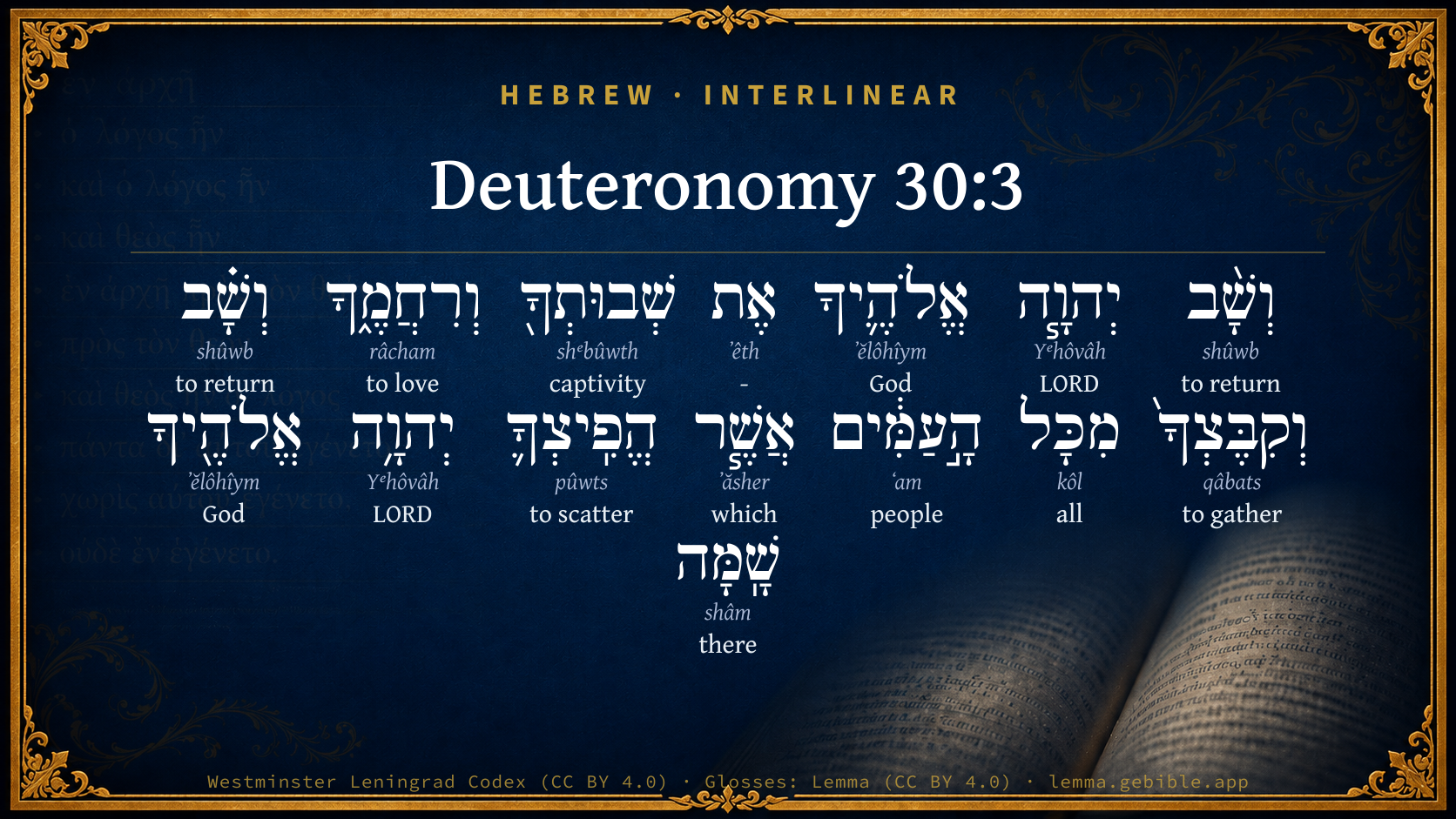
Hebrew (Westminster Leningrad Codex) Deuteronomy 30:3 appears in the Hebrew Old Testament. The text above is from the Westminster Leningrad Codex. Each word links to its Strong’s number, a concise gloss, and parsing drawn from the Open Scriptures Hebrew Bible morphology. Click any word for its full Brown-Driver-Briggs (BDB) entry.
Download image
Cite this verse

Deuteronomy 30:3 (World English Bible). Public Domain. Lemma interlinear Bible study tool, https://lemma.gebible.app/v/deuteronomy/30/3.

Show BibTeX & RIS
BibTeX
RIS
English Translation
that then Yahweh your God will turn your captivity, and have compassion on you, and will return and gather you from all the peoples, where Yahweh your God has scattered you.
World English Bible · Public Domain
Highlights
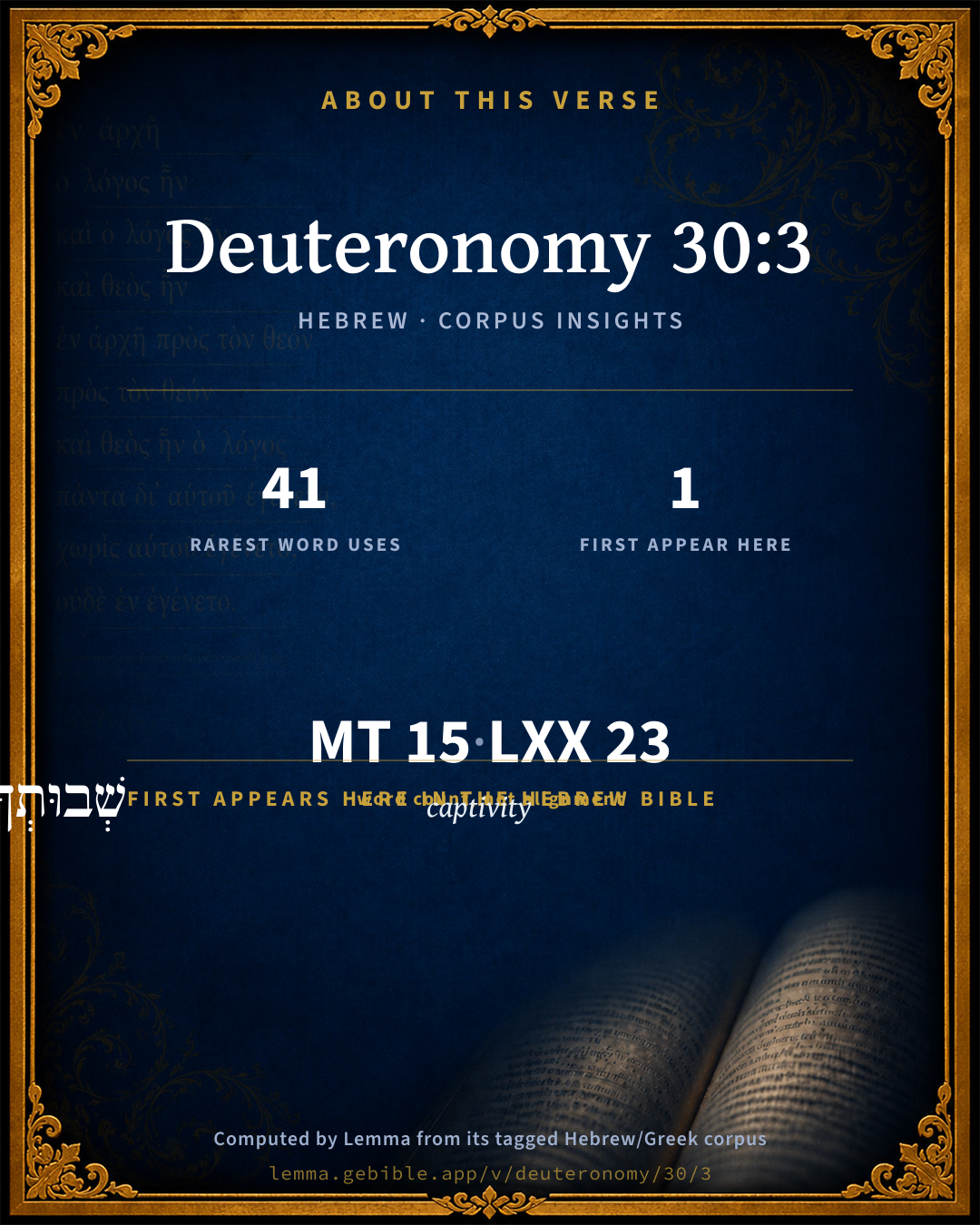
  • 1 first appearance in the Hebrew Bible
Full analysis ↓
Download a study sheet

One document with this verse’s original text, its word-by-word gloss line, the meaning frame, cross-references with their text, attributed commentary, and full source and license credits — printable, and it pastes into notes with its structure intact.

This verse Autodidact and up

Study sheet (.html) Plain text (.txt)

A passage Seminary Student

Up to 50 verses in one chapter. A passage sheet keeps up to 6 commentary sources and 12 cross-references per verse, in the order this page ranks them, and says so on the sheet whenever that leaves anything out. Ask for a single verse and you get the Autodidact verse sheet above.

Everything on this page stays free to read, with no account — the sheet is a download of what is already on screen, not access to it.

Want to remove ads? Support Godless Engineer
Compare translations 3

The same verse in 3 English versions, stacked beneath the original-language interlinear above. Click any original word for its lexicon entry.

Each is an independent rendering of the whole verse — the interlinear is not word-aligned to these translations.

Highlighted words mark where these versions differ — a whole-verse word diff, not a word-by-word alignment.

  • World English Bible Public Domain
    that then Yahweh your God will turn your captivity, and have compassion on you, and will return and gather you from all the peoples, where Yahweh your God has scattered you.
  • King James Version Public Domain
    That then the LORD thy God will turn thy captivity, and have compassion upon thee, and will return and gather thee from all the nations, whither the LORD thy God hath scattered thee.
  • unfoldingWord Literal Text CC BY-SA 4.0
    then Yahweh your God will turn back your captivity and have compassion on you, and he will return and gather you from all the peoples where Yahweh your God has scattered you there.

unfoldingWord Literal Text — © unfoldingWord, licensed CC BY-SA 4.0. Word-aligned USFM3 via Door43 (git.door43.org/unfoldingWord/en_ult).

Versions to compare (up to 4)

3 of 4 selected

Show all 18 translations

Every available English version of this verse, each an independent rendering of the whole verse.

  • World English Bible Public Domain
    that then Yahweh your God will turn your captivity, and have compassion on you, and will return and gather you from all the peoples, where Yahweh your God has scattered you.
  • Berean Standard Bible Public Domain
    then He will restore you from captivity and have compassion on you and gather you from all the nations to which the LORD your God has scattered you.
  • Majority Standard Bible Public Domain
    then He will restore you from captivity and have compassion on you and gather you from all the nations to which the LORD your God has scattered you.
  • King James Version Public Domain
    That then the LORD thy God will turn thy captivity, and have compassion upon thee, and will return and gather thee from all the nations, whither the LORD thy God hath scattered thee.
  • American Standard Version (1901) Public Domain
    that then Jehovah thy God will turn thy captivity, and have compassion upon thee, and will return and gather thee from all the peoples, whither Jehovah thy God hath scattered thee.
  • Revised Version (1885) Public Domain
    that then the LORD thy God will turn thy captivity, and have compassion upon thee, and will return and gather thee from all the peoples, whither the LORD thy God hath scattered thee.
  • Geneva Bible (1599) Public Domain
    Then the Lord thy God wil cause thy captiues to returne, and haue compassion vpon thee, and wil returne, to gather thee out of all the people, where the Lord thy God had scattered thee.
  • Douay-Rheims (1899) Public Domain
    The Lord thy God will bring back again thy captivity, and will have mercy on thee, and gather thee again out of all the nations, into which he scattered thee before.
  • Young's Literal Translation Public Domain
    then hath Jehovah thy God turned back `to' thy captivity, and pitied thee, yea, He hath turned back and gathered thee out of all the peoples whither Jehovah thy God hath scattered thee.
  • Literal Standard Version CC BY-SA 4.0
    then your God YHWH has turned back [to] your captivity and pitied you, indeed, He has turned back and gathered you out of all the peoples to where your God YHWH has scattered you.
  • Unlocked Literal Bible CC BY-SA 4.0
    then Yahweh your God will reverse your captivity and have compassion on you; he will return and gather you from all the peoples where Yahweh your God has scattered you.
  • unfoldingWord Literal Text CC BY-SA 4.0
    then Yahweh your God will turn back your captivity and have compassion on you, and he will return and gather you from all the peoples where Yahweh your God has scattered you there.
  • Darby Bible Public Domain
    that then Jehovah thy God will turn thy captivity, and have compassion upon thee, and will gather thee again from all the peoples whither Jehovah thy God hath scattered thee.
  • World Messianic Bible Public Domain
    that then the LORD your God will release you from captivity, have compassion on you, and will return and gather you from all the peoples where the LORD your God has scattered you.
  • Webster's Bible Public Domain
    That then the LORD thy God will turn thy captivity, and have compassion upon thee, and will return and gather thee from all the nations whither the LORD thy God hath scattered thee.
  • Free Bible Version CC BY-SA 4.0
    He will bring you back home, gathering you from all the nations where he scattered you.
  • Bible in Basic English Public Domain
    Then the Lord will have pity on you, changing your fate, and taking you back again from among all the nations where you have been forced to go.
  • JPS Tanakh (1917) Public Domain
    that then the LORD thy God will turn thy captivity, and have compassion upon thee, and will return and gather thee from all the peoples, whither the LORD thy God hath scattered thee.

Literal Standard Version (2020), Covenant Press — licensed CC BY-SA 4.0. Text via the HelloAO Bible API (eBible.org). Unlocked Literal Bible (unfoldingWord) — licensed CC BY-SA 4.0. Text via the HelloAO Bible API (eBible.org). unfoldingWord Literal Text — © unfoldingWord, licensed CC BY-SA 4.0. Word-aligned USFM3 via Door43 (git.door43.org/unfoldingWord/en_ult). Free Bible Version, Dr. Jonathan Gallagher — licensed CC BY-SA 4.0. Text via the HelloAO Bible API (eBible.org).

Word by word

More ways to search: Search by grammar → Find every occurrence → Compare this word →

Practice this passage: Drill this verse → Learn its vocabulary →

שְׁבוּתְךָ֖
shᵉbûwth
H7622
“captivity · your”
Noun, Common, Feminine, Singular, Construct + Suffix, Personal, 2nd Person, Masculine, Singular
Part of Speech
Noun
Type
Common
Gender
Feminine
Number
Singular
State
Construct
Full BDB Definition

Origin: from H7617

TWOT: 2311d

captivity, captives
  1. וְשָׁ֨ב shûwb H7725 “and · to return” Conjunction + Verb, Qal, Sequential Perfect, 3rd Person, Masculine, Singular
  2. יְהוָ֧ה Yᵉhôvâh H3068 “LORD” Noun, Proper
  3. אֱלֹהֶ֛יךָ ʼĕlôhîym H430 “God(s) · your” Noun, Common, Masculine, Plural, Construct + Suffix, Personal, 2nd Person, Masculine, Singular
  4. אֶת ʼêth H853 “-” Particle, Direct Object
  5. וְרִחֲמֶ֑ךָ râcham H7355 “and · to love · you” Conjunction + Verb, Piel, Sequential Perfect, 3rd Person, Masculine, Singular + Suffix, Personal, 2nd Person, Masculine, Singular
  6. וְשָׁ֗ב shûwb H7725 “and · to return” Conjunction + Verb, Qal, Sequential Perfect, 3rd Person, Masculine, Singular
  7. וְקִבֶּצְךָ֙ qâbats H6908 “and · to gather · you” Conjunction + Verb, Piel, Sequential Perfect, 3rd Person, Masculine, Singular + Suffix, Personal, 2nd Person, Masculine, Singular
  8. מִכָּל kôl H3605 “from · all of” Preposition + Noun, Common, Masculine, Singular, Construct
  9. הָ֣עַמִּ֔ים ʻam H5971 “the · peoples” Particle, Definite Article + Noun, Common, Masculine, Plural, Absolute
  10. אֲשֶׁ֧ר ʼăsher H834 “which” Particle, Relative
  11. הֱפִֽיצְךָ֛ pûwts H6327 “to scatter · you” Verb, Hiphil, Perfect, 3rd Person, Masculine, Singular + Suffix, Personal, 2nd Person, Masculine, Singular
  12. יְהוָ֥ה Yᵉhôvâh H3068 “LORD” Noun, Proper
  13. אֱלֹהֶ֖יךָ ʼĕlôhîym H430 “God(s) · your” Noun, Common, Masculine, Plural, Construct + Suffix, Personal, 2nd Person, Masculine, Singular
  14. שָֽׁמָּה shâm H8033 “there · toward” Adverb + Suffix, Demonstrative

About this verse

These counts appear in no published source. They are computed here, from the morphology-tagged text and Lemma’s own curated glosses. What Lemma adds →

15
words
12
distinct lemmas
Pentateuch
section

First appearance in Scripture

This word makes its first canonical appearance in the Hebrew Bible here:

  • שְׁבוּתְךָ֖ captivity H7622

Shared distinctive vocabulary

שְׁבוּתְךָ֖ captivity H7622 occurs in 26 verses of the Hebrew Bible. Also found in:

Grammatical profile

  • 5 verbs
  • 7 nouns
  • 1 adverb
  • 2 particles

Verb forms

  • וְשָׁ֨ב Qal · Sequential Perfect
  • וְרִחֲמֶ֑ךָ Piel · Sequential Perfect
  • וְשָׁ֗ב Qal · Sequential Perfect
  • וְקִבֶּצְךָ֙ Piel · Sequential Perfect
  • הֱפִֽיצְךָ֛ Hiphil · Perfect

Repetition

Words recur within this verse — often emphatic in Hebrew:

  • וְשָׁ֨ב to return H7725 ×2
  • יְהוָ֧ה LORD H3068 ×2
  • אֱלֹהֶ֛יךָ God H430 ×2

Hebrew & Septuagint length

In English translation the verse runs 31 words from the Hebrew and 28 from the Septuagint (LXX English) — closely comparable.

A rough comparison of the two English renderings, which tokenize alike — not a word-level alignment.

Word counts can differ between the Hebrew and the Greek without any difference in meaning — e.g. the Hebrew direct-object marker אֵת has no separate Greek word, and Greek often adds the article ὁ.

In the original languages it is 15 Hebrew tokens and 23 Greek tokens — but the two are counted differently (Hebrew bundles its prefixes and suffixes into one token; the Greek is in lemma form), so that isn’t a like-for-like length.

Cross-references

16

Topical passages linked to Deuteronomy 30:3 in the Treasury of Scripture Knowledge — connected by theme and wording, ordered by reader-vote popularity; previews shown in the World English Bible.

  • Jeremiah 29:14 I will be found by you, says Yahweh, and I will turn again your captivity, and I will gather you from all the nations, and from all the places where I have driven you, says Yahweh; and I will bring you again to the place from where I caused you to be carried away captive.
  • Ezekiel 36:24 For I will take you from among the nations, and gather you out of all the countries, and will bring you into your own land.
  • Psalms 147:2 Yahweh builds up Jerusalem. He gathers together the outcasts of Israel.
  • Lamentations 3:32 For though he cause grief, yet will he have compassion according to the multitude of his loving kindnesses.
  • Ezekiel 34:12–13 As a shepherd seeks out his flock in the day that he is among his sheep that are scattered abroad, so will I seek out my sheep; and I will deliver them out of all places where they have been scattered in the cloudy and dark day.
  • Zechariah 8:7–8 Thus says Yahweh of Hosts: "Behold, I will save my people from the east country, and from the west country;
  • Jeremiah 31:10 Hear the word of Yahweh, you nations, and declare it in the isles afar off; and say, He who scattered Israel will gather him, and keep him, as shepherd does his flock.
  • Jeremiah 32:37–44 Behold, I will gather them out of all the countries, where I have driven them in my anger, and in my wrath, and in great indignation; and I will bring them again to this place, and I will cause them to dwell safely:
  • Lamentations 3:22 [It is of] Yahweh's loving kindnesses that we are not consumed, because his compassion doesn't fail.
  • Romans 11:31 even so these also have now been disobedient, that by the mercy shown to you they may also obtain mercy.
  • Romans 11:23 They also, if they don't continue in their unbelief, will be grafted in, for God is able to graft them in again.
  • Psalms 106:45–47 He remembered for them his covenant, And repented according to the multitude of his loving kindnesses.
  • Isaiah 56:8 The Lord Yahweh, who gathers the outcasts of Israel, says, Yet will I gather [others] to him, besides his own who are gathered.
  • Romans 11:26 and so all Israel will be saved. Even as it is written, "There will come out of Zion the Deliverer, And he will turn away ungodliness from Jacob.
  • Ezra 1:1–4 Now in the first year of Cyrus king of Persia, that the word of Yahweh by the mouth of Jeremiah might be accomplished, Yahweh stirred up the spirit of Cyrus king of Persia, so that he made a proclamation throughout all his kingdom, and [put it] also in writing, saying,
  • Psalms 126:1–4 When Yahweh brought back those who returned to Zion, We were like those who dream.

Cross-references courtesy of OpenBible.info (CC BY 4.0).

Hebrew and Greek witnesses Masoretic Hebrew ↔ Greek Septuagint

The same verse in the two great witnesses to the Old Testament, shown verse-for-verse.

These are two independent witnesses, not word-aligned to each other, and the Septuagint is shown in lemma (dictionary) form.

Hebrew Deuteronomy 30:3 Masoretic · Westminster Leningrad Codex

וְשָׁ֨ב יְהוָ֧ה אֱלֹהֶ֛יךָ אֶת שְׁבוּתְךָ֖ וְרִחֲמֶ֑ךָ וְשָׁ֗ב וְקִבֶּצְךָ֙ מִכָּל הָ֣עַמִּ֔ים אֲשֶׁ֧ר הֱפִֽיצְךָ֛ יְהוָ֥ה אֱלֹהֶ֖יךָ שָֽׁמָּה

that then Yahweh your God will turn your captivity, and have compassion on you, and will return and gather you from all the peoples, where Yahweh your God has scattered you.

World English Bible · Public Domain

Greek LXX Deuteronomy 30:3 Septuagint · lemma form

καί ἰάομαι κύριος ὁ ἁμαρτία σύ καί ἐλεέω σύ καί πάλιν συνἄγω σύ ἐκ πᾶς ὁ ἔθνος εἰς ὅς διασκορπίζω σύ κύριος ἐκεῖ

then the Lord shall heal your iniquities, and shall pity you, and shall again gather you out from all the nations, among which the Lord has scattered you.

LXX2012 (modern English Septuagint) · Public Domain

On this verse, The Pulpit Commentary discusses the Septuagint’s reading. Read the note in Commentary ↓

Hebrew: Westminster Leningrad Codex (CC BY 4.0). Greek: Septuagint (public domain); English from LXX2012 (modern English Septuagint) (Public Domain). How the Septuagint differs from the Hebrew →

Targum (Aramaic paraphrase)

2

The Targum is the ancient Jewish Aramaic paraphrase of the Hebrew Scriptures — an interpretive translation, not the Hebrew text itself. Onkelos (literal) and Pseudo-Jonathan (expansive) render the Torah, and Jonathan the Prophets. Coverage is partial: where no permissively-licensed English translation exists for a verse, only the Aramaic is shown. This is verse-level text, not a word-by-word alignment to the Hebrew.

  1. Targum Onkelos Torah (Genesis–Deuteronomy)
    וִיתוּב יְיָ אֱלָהָךְ יָת שְׁבִי גַלְוָתָךְ וִירַחַם עֲלָךְ וִיתוּב וְיִכְנְשִׁנָךְ מִכָּל עַמְמַיָא דִי בַדְרָךְ יְיָ אֱלָהָךְ לְתַמָן

    (no public-domain English translation for this verse)

    Targum Onkelos — Aramaic: “Onkelos Genesis” (public domain); “Onkelos Exodus” (public domain); “Onkelos Leviticus” (public domain); “Onkelos Numbers” (public domain); “Onkelos Deuteronomy” (public domain). English: “Sefaria Community Translation” (CC0 1.0 (public-domain dedication)); “J.W. Etheridge. The Targums of Onkelos and Jonathan Ben Uzziel on the Pentateuch. London: Longmans, Green, 1862” (public domain). Text via Sefaria.

  2. Targum Pseudo-Jonathan Torah (Genesis–Deuteronomy)
    וִיקַבֵּיל מֵימְרֵיהּ בְּרַעֲוָא יַת תְּיוּבְתְּכוֹן וִירַחֵם עֲלֵיכוֹן וִיתוּב וְיִכְנוֹשׁ יַתְכוֹן מִכָּל עַמְמַיָא דְבַדַר יְיָ אֱלָהָכוֹן יַתְכוֹן לְתַמָן

    And His Word will accept your repentance with favour, and will have mercy upon you, and He will gather you again from all the nations whither the Lord your God had scattered you.

    Targum Pseudo-Jonathan — Aramaic: “Targum Jonathan on Genesis” (public domain); “Targum Jonathan on Exodus” (public domain); “Targum Jonathan on Leviticus” (public domain); “Targum Jonathan on Numbers” (public domain); “Targum Jonathan on Deuteronomy” (public domain). English: “The Targum of Jonathan ben Uzziel, trans. J. W. Etheridge, London, 1862” (public domain). Text via Sefaria.

Commentary

Notes on Deuteronomy 30:3 from classic Christian and Jewish commentators (each source and its license shown beneath its notes). The classic Christian expositions comment on the surrounding passage and are grouped to its opening verse, so a note may address several verses; the Jewish commentaries on the Tanakh (Rashi and others) are per-verse, so they appear only where the commentator wrote on this verse.

Lemma curates 59 commentaries, every one of them public domain or Creative Commons licensed, each selected and text-cleaned for this edition rather than reprinted as found. About our sources →

Trapp's Complete Commentary

John Trapp

Deu 30:3 That then the LORD thy God will turn thy captivity, and have compassion upon thee, and will return and gather thee from all the nations, whither the LORD thy God hath scattered thee.

Ver. 3. That then the Lord thy God.] Conversio Iudaeorum magnifice hic promittitur, saith one. Here is a stately promise of the conversion of the Jews, concerning which, {See Trapp on "Rom 11:25"} &c.

John Trapp, A Commentary or Exposition upon All the Books of the Old and New Testament (1647–1656) — public domain. Text from a community e-Sword module.

Joseph Benson's Commentary

Deu 30:3. The Lord will turn thy captivity — That is, will bring back thy captives, as the following words imply. Indeed, captivity is often put for captives, Psa 14:7; and Psa 68:18; Jdg 5:12. This was fulfilled in part when they returned from Babylon, and will be more completely fulfilled when they shall turn from ungodliness, and believe with their heart unto righteousness in Jesus of Nazareth, as the Son of God, and true Messiah; but surely not before; for as they were cast out of their own land for rejecting him, it is not to be supposed that they will be restored to it till they receive him. Nor is there any intimation in any part of Scripture that they shall. Their repentance and reformation must precede their obtaining this mercy: see Rom 11:26. Thus Moses here, When thou shalt return unto the Lord with all thy heart and all thy soul, then the Lord will have compassion upon thee, and gather thee from all the nations, &c. Till then any efforts that may be used to re-establish them in Canaan will prove ineffectual.

Joseph Benson's Commentary on the Old and New Testaments (1811–1818) — public domain. Text from a community e-Sword module.

Scofield Reference Notes

C. I. Scofield

turn thy captivity

The Palestinian Covenant gives the conditions under which Israel entered the land of promise. It is important to see that the nation has never as yet taken the land under the unconditional Abrahamic Covenant, nor has it ever possessed the whole land (cf. Gen 15:18; Num 34:1-12. The Palestinian Covenant is in seven parts.

(1) Dispersion for disobedience, Deu 30:1; Deu 28:63-68 (See Scofield "Gen 15:18")

(2) The future repentance of Israel while in the dispersion, Deu 30:2.

(3) The return of the Lord, Deu 30:3; Amo 9:9-14; Act 15:14-17.

(4) Restoration to the land, Deu 30:5; Isa 11:11; Isa 11:12; Jer 23:3-8; Eze 37:21-25

(5) National conversion, Deu 30:6; Rom 11:26; Rom 11:27; Hos 2:14-16

(6) The judgment of Israel’s oppressors, Deu 30:7; Isa 14:1; Isa 14:2; Joe 3:1-8; Mat 25:31-46

(7) National prosperity, Deu 30:9; Amo 9:11-14

For Another Point of View: See Topic 301242

See, for the other seven covenants:

EDENIC (See Scofield "Gen 1:28") ADAMIC See Scofield "Gen 3:15" ABRAHAMIC See Scofield "Gen 15:18" NOAHIC See Scofield "Gen 9:1" MOSAIC See Scofield "Exo 19:25" DAVIDIC See Scofield "2Sa 7:16" NEW See Scofield "Heb 8:8"

The Scofield Reference Bible (1917 edition), notes by C. I. Scofield — public domain. Text from a community e-Sword module.

Adam Clarke's Commentary

Verse 3. Gather thee from all the nations] This must refer to a more extensive captivity than that which they suffered in Babylon.

Adam Clarke's Commentary on the Bible (1810–1826) — public domain. Text from a community e-Sword/MySword module.

Ellicott's Commentary for English Readers

(3) The Lord thy God will turn thy captivity.—The word “turn” is not active as we should expect (in the Hebrew), but neuter, and upon this fact the Rabbis have grounded the following observation that “in some way the Shechinah is abiding upon Israel during the stress of their captivity, and whensoever they are redeemed, He has prescribed Redemption for Himself, that He will return with them.” And further, that the day of the gathering of the captivity is great, and attended with difficulty; as though He Himself must be there to take hold visibly of the hand of each man, and bring him from his place, as it is said, “And ye shall be gathered one by one, O ye children of Israel” (Isa_27:12). But it is observed that the same form of the verb is employed in Jeremiah with respect to Moab (Jer_48:47). This note at least shows that the Jews look for the fulfilment of this prophecy as a thing yet to come.

A Bible Commentary for English Readers, edited by Charles John Ellicott (1878–1897) — public domain. Text from a community e-Sword module.

The Cambridge Bible for Schools and Colleges

gen. ed. J. J. S. Perowne

3. turn thy captivity] The Heb. phrase can hardly mean this, for the return from captivity comes later in this passage, in Deu_30:4, and such a sense is impossible in Job_42:10. Render turn thy fortune. So Amo_9:14, Hos_6:11, Eze_16:53; Eze_16:55, and frequently in Jer.

have compassion upon thee] Deu_13:17.

gather thee] So frequently in Jer. and Ezek.

scattered thee] Deu_28:64.

The Cambridge Bible for Schools and Colleges (gen. ed. J. J. S. Perowne; Cambridge University Press, 1878–1918) — public domain. Text from a community e-Sword module.

John Gill's Exposition

That then the Lord thy God will turn thy captivity, and have compassion on thee,.... Return them from their captivity, or bring them out of it, both in a temporal and spiritual sense; free them from their present exile, and deliver them from the bondage of sin, Satan, and the law; and all this as the effect of his grace and mercy towards them, and compassion on them; see Jer 30:18; The Targum of Jonathan is,"his Word shall receive with good will your repentance;''it being cordial and unfeigned, and fruits meet for it brought forth:

and will return and gather thee from all the nations whither the Lord thy God scattered thee; or, "will again gather thee" (k); as he had gathered them out of all places where they had been scattered, on their return from the Babylonish captivity; so will he again gather them from all the nations of the earth, east, west, north, and south, where they are now dispersed; when they shall turn to the Lord, and seek David their King, the true Messiah. Maimonides (l) understands this passage of their present captivity, and deliverance from it by the Messiah.

(k) , Sept. "et rursum congregabit te", V. L. "et iterum colliget te", Piscator. (l) Hilchot Melachim, c. 11. sect. 1.

John Gill's Exposition of the Whole Bible (1746–1763) — public domain (CC PDM 1.0). Text via the HelloAO Bible API.

Haydock's Catholic Bible Commentary

Before. The Jews are still in expectation of this deliverance, as they say this prediction does not relate to the captivity at Babylon. But Nehemias understood it in this sense, (2 Esdras i. 8,) though it will not have its perfect accomplishment till the latter days, when the Israelites will embrace the true faith, Romans xi. 25.

George Leo Haydock (1774–1849), Haydock's Catholic Family Bible and Commentary, 1859 edition — public domain. Excludes Psalms (Douay-Rheims chapter numbering differs from Protestant) and Deuterocanonical books (Catholic canon only).

Matthew Poole's English Annotations

Turn thy captivity, i.e. bring back thy captives, as captivity is taken, Psa 14:7; Eph 4:8. Gather thee, i.e. thy children; either spiritually such, as it is explained Joh 11:51,52; or literally such, as it is promised Ro 11.

Matthew Poole's English Annotations on the Holy Bible (1683–1685) — public domain. Text from a community e-Sword/MySword module.

Whedon's Commentary on the Bible

Daniel D. Whedon

3. Will turn thy captivity — Will put an end to their distress. Comp. Job_40:10; Jer_30:8; Eze_16:53; Psa_14:7. These promises had a partial fulfilment in the history of Israel restored after the captivity. Their true significance is to be seen in connexion with the promises to Abraham, in whom all the families of the earth are blessed.

Daniel D. Whedon (gen. ed.), Commentary on the Old and New Testaments (1874–1909) — public domain. Text from a community e-Sword module.

The Pulpit Commentary

The Lord thy God will turn thy captivity. This does not mean will cause thy captives to return, for

(1) the verb in Kal (as it is here, bv;) never has the force of the Hiph.; and

(2) the returning of the dispersed is afterwards referred to as consequent on the turning of the captivity. The plural is used here as elsewhere to indicate the cessation of affliction or suffering. (cf. Job_41:10; Psa_14:7 Psa_85:2 Psa_126:1, Psa_126:4; Jer_30:18; Eze_16:53) The rendering of the LXX here is noticeable, kaisetai Kuriov taav: "and the Lord will heal thy sins," i.e. will remit thy guilt and will deliver thee from the pernicious and destructive power of sin. (cf. Psa_41:4; Jer_3:22 Jer_17:14; Hos_14:4; Mat_13:15, etc.)

The Pulpit Commentary (1880–1919), ed. H.D.M. Spence-Jones & Joseph S. Exell — public domain. Text from a community e-Sword module.

Rashi

Rabbi Shlomo Yitzchaki (Rashi)

ושב ה' אלהיך את שבותך THEN THE LORD THY GOD WILL TURN THY CAPTIVITY — To express this idea it ought to have written והשיב את שבותך, “then He will bring back thy captivity”. But our Rabbis learned from this that, if one can say so of God, His Divine presence dwells with Israel in all the misery of their exile, so that when they are redeemed (i.e. when He speaks of their being redeemed), He makes Scripture write “Redemption” of Himself (i.e. He makes it state that He will be redeemed) — that He will return with them (Megillah 29a). Furthermore the following may be said in explaining the strange form ושב... את, — that the day of the gathering of the exiles is so important and is attended with such difficulty that it is as though He (God) Himself must actually seize hold of each individual’s hands dragging him from his place (so that God Himself returns with the exile), as it is said, (Isaiah 27:12) “And ye shall be gathered one by one, O ye children of Israel”. We find, however, the same expression in connection with the gathering of the exiles of other nations also, as e.g. (Jeremiah 48:47): ושבתי שבות מואב "And I shall bring back the exiles of Moab".

Rashi on the Tanakh — English translations: “The Judaica Press complete Tanach with Rashi, translated by A. J. Rosenberg” (CC BY 4.0); “Pentateuch with Rashi's commentary by M. Rosenbaum and A.M. Silbermann, 1929-1934” (public domain); “The Metsudah Tanach series, Lakewood, N.J” (CC BY 4.0); and “The Book of Joshua, Metsudah Publications, 1997” (CC BY 4.0). Text via Sefaria.

Lesson kit

Teaching starters — assembled from the data on this page, not authored interpretation. Every prompt links to the verse data it draws on. Edit before teaching.

Deuteronomy, in the Pentateuch, opens this verse with 15 words (12 distinct Hebrew lemmas). Its most distinctive word is shᵉbûwth (“captivity”). A historical commentator’s framing appears above. Read the whole chapter for the surrounding context.

Discussion questions

  1. What does “captivity” (shᵉbûwth) contribute to the verse as a whole?
  2. This is the first place “captivity” appears in Scripture (first appears here). What does its debut here establish?
  3. How does Job 42:10, which shares the word «captivity», read alongside this verse?
  4. What does the repetition of “to return” (2× in this one verse) do in this verse?
  5. The translations on this page render this verse differently — a whole-verse word diff, not a word-by-word alignment. What might account for the different wordings?
  6. «וְשָׁ֨ב» is a Qal Sequential Perfect verb. How does that grammatical form shape the action described?
  7. Compare how Trapp's Complete Commentary and Joseph Benson's Commentary read this verse. Where do they agree or differ?

Things to notice

Reading settings

Reading text

Shown beneath each verse's original-language words.

Old Testament
Old Testament edition

Read the OT as the Masoretic Hebrew (MT) or the Greek Septuagint (LXX).

English shown for the Greek Septuagint (in the Hebrew ↔ Greek comparison).

Comparing translations? Open the Compare panel on any verse page to stack up to four side by side.