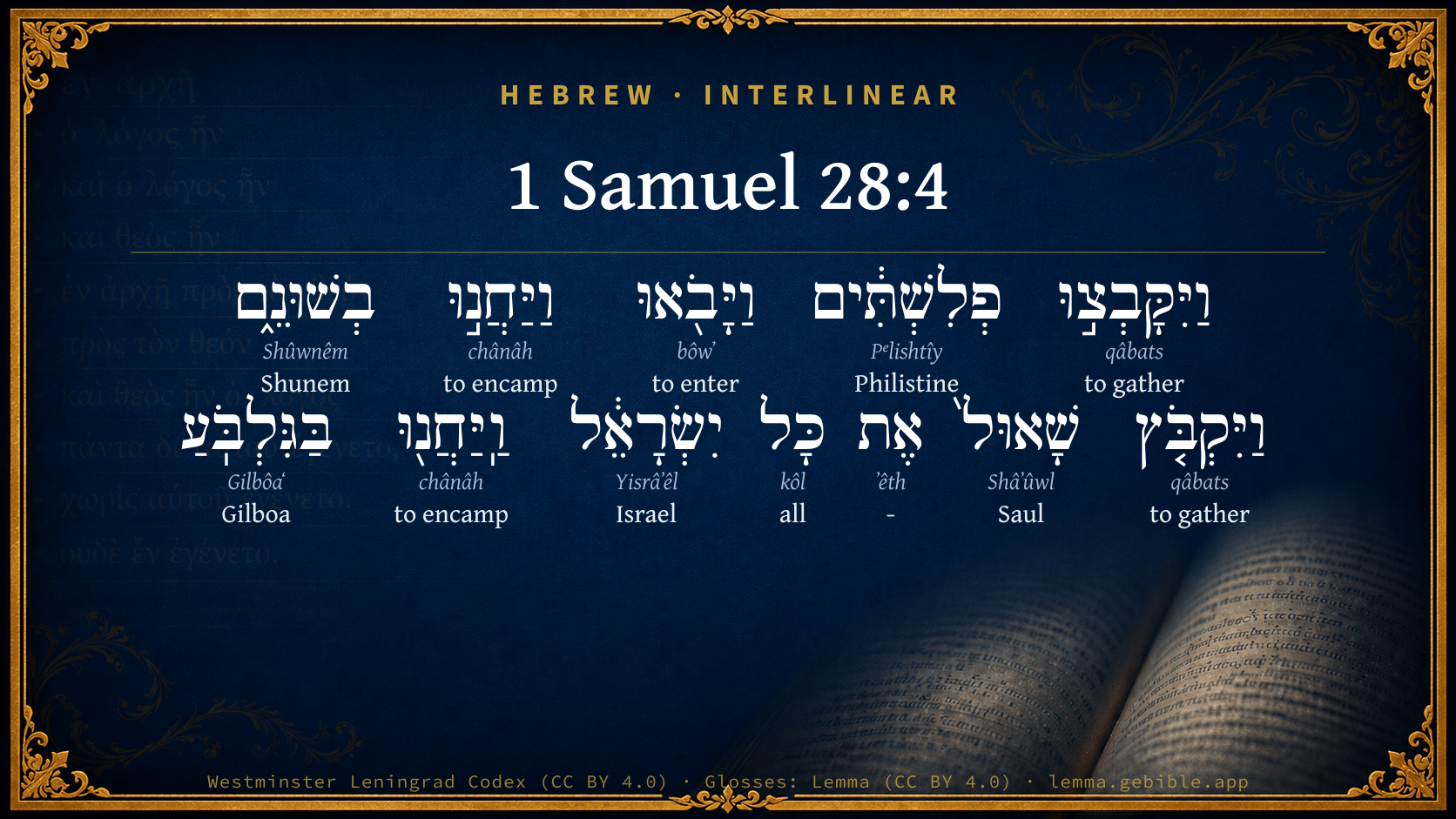
1 Samuel 28:4

Hebrew (Westminster Leningrad Codex) 1 Samuel 28:4 appears in the Hebrew Old Testament. The text above is from the Westminster Leningrad Codex. Each word links to its Strong’s number, a concise gloss, and parsing drawn from the Open Scriptures Hebrew Bible morphology. Click any word for its full Brown-Driver-Briggs (BDB) entry.
Download image
Cite this verse

1 Samuel 28:4 (World English Bible). Public Domain. Lemma interlinear Bible study tool, https://lemma.gebible.app/v/1-samuel/28/4.

Show BibTeX & RIS
BibTeX
RIS
English Translation
The Philistines gathered themselves together, and came and encamped in Shunem: and Saul gathered all Israel together, and they encamped in Gilboa.
World English Bible · Public Domain
Highlights
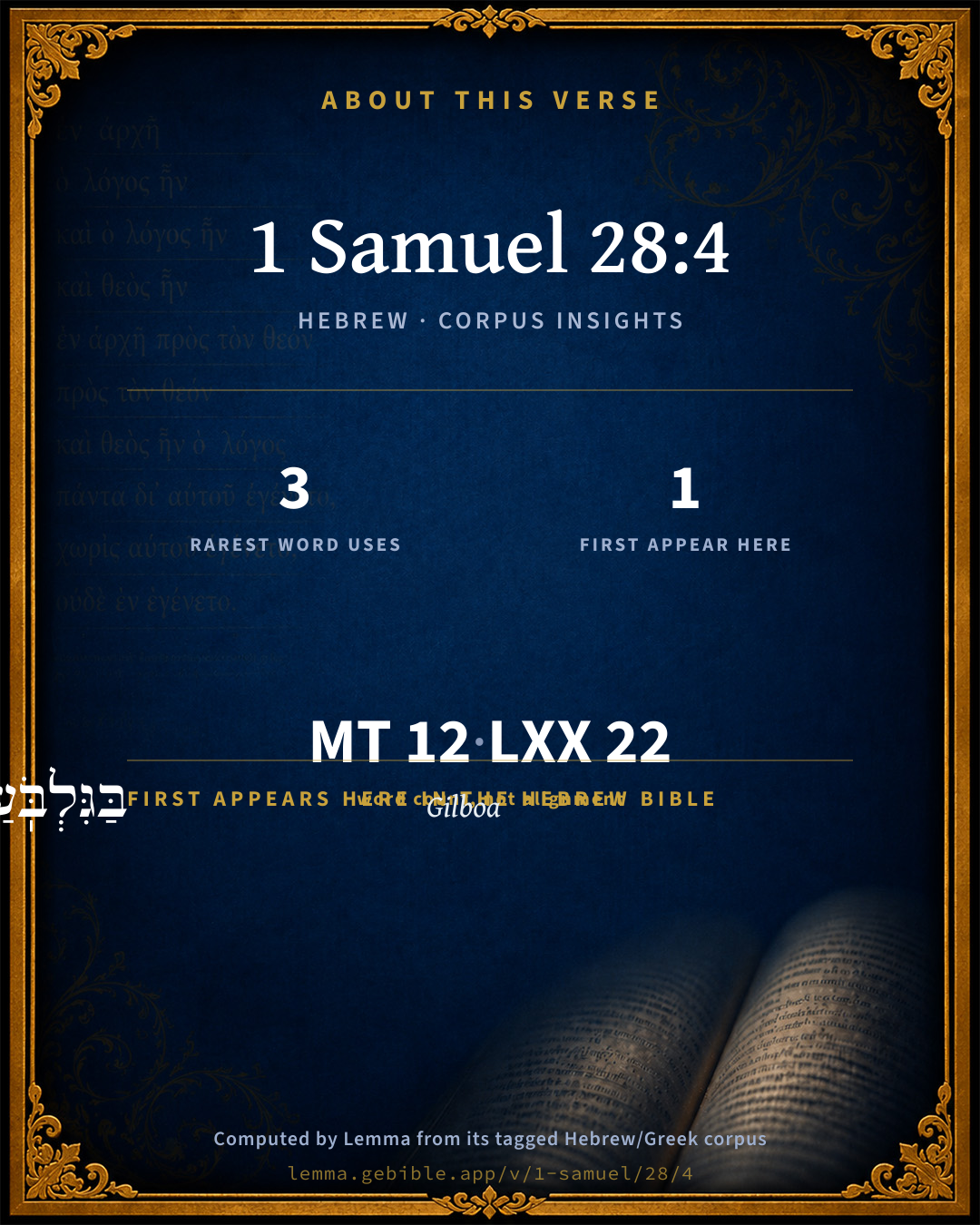
  • 1 first appearance in the Hebrew Bible
Full analysis ↓
Download a study sheet

One document with this verse’s original text, its word-by-word gloss line, the meaning frame, cross-references with their text, attributed commentary, and full source and license credits — printable, and it pastes into notes with its structure intact.

This verse Autodidact and up

Study sheet (.html) Plain text (.txt)

A passage Seminary Student

Up to 50 verses in one chapter. A passage sheet keeps up to 6 commentary sources and 12 cross-references per verse, in the order this page ranks them, and says so on the sheet whenever that leaves anything out. Ask for a single verse and you get the Autodidact verse sheet above.

Everything on this page stays free to read, with no account — the sheet is a download of what is already on screen, not access to it.

Want to remove ads? Support Godless Engineer
Compare translations 3

The same verse in 3 English versions, stacked beneath the original-language interlinear above. Click any original word for its lexicon entry.

Each is an independent rendering of the whole verse — the interlinear is not word-aligned to these translations.

Highlighted words mark where these versions differ — a whole-verse word diff, not a word-by-word alignment.

  • World English Bible Public Domain
    The Philistines gathered themselves together, and came and encamped in Shunem: and Saul gathered all Israel together, and they encamped in Gilboa.
  • King James Version Public Domain
    And the Philistines gathered themselves together, and came and pitched in Shunem: and Saul gathered all Israel together, and they pitched in Gilboa.
  • unfoldingWord Literal Text CC BY-SA 4.0
    And the Philistines gathered and came and camped at Shunem. And Saul gathered all of Israel, and they camped at Gilboa.

unfoldingWord Literal Text — © unfoldingWord, licensed CC BY-SA 4.0. Word-aligned USFM3 via Door43 (git.door43.org/unfoldingWord/en_ult).

Versions to compare (up to 4)

3 of 4 selected

Show all 18 translations

Every available English version of this verse, each an independent rendering of the whole verse.

  • World English Bible Public Domain
    The Philistines gathered themselves together, and came and encamped in Shunem: and Saul gathered all Israel together, and they encamped in Gilboa.
  • Berean Standard Bible Public Domain
    The Philistines came together and camped at Shunem, while Saul gathered all Israel and camped at Gilboa.
  • Majority Standard Bible Public Domain
    The Philistines gathered together and camped at Shunem, while Saul gathered all Israel and camped at Gilboa.
  • King James Version Public Domain
    And the Philistines gathered themselves together, and came and pitched in Shunem: and Saul gathered all Israel together, and they pitched in Gilboa.
  • American Standard Version (1901) Public Domain
    And the Philistines gathered themselves together, and came and encamped in Shunem: and Saul gathered all Israel together, and they encamped in Gilboa.
  • Revised Version (1885) Public Domain
    And the Philistines gathered themselves together, and came and pitched in Shunem: and Saul gathered all Israel together, and they pitched in Gilboa.
  • Geneva Bible (1599) Public Domain
    Then the Philistims assembled themselues, and came, and pitched in Shunem: and Saul assembled all Israel, and they pitched in Gilboa.
  • Douay-Rheims (1899) Public Domain
    And the Philistines were gathered together, and came and camped in Sunam: and Saul also gathered together all Israel, and came to Gelboe.
  • Young's Literal Translation Public Domain
    And the Philistines are gathered, and come in, and encamp in Shunem, and Saul gathereth all Israel, and they encamp in Gilboa,
  • Literal Standard Version CC BY-SA 4.0
    And the Philistines are gathered, and come in, and encamp in Shunem, and Saul gathers all Israel, and they encamp in Gilboa,
  • Unlocked Literal Bible CC BY-SA 4.0
    Then the Philistines gathered themselves together and came and camped at Shunem; and Saul gathered all Israel together, and they camped at Gilboa.
  • unfoldingWord Literal Text CC BY-SA 4.0
    And the Philistines gathered and came and camped at Shunem. And Saul gathered all of Israel, and they camped at Gilboa.
  • Darby Bible Public Domain
    And the Philistines gathered themselves together, and came and encamped in Shunem; and Saul gathered all Israel together, and they encamped in Gilboa.
  • World Messianic Bible Public Domain
    The Philistines gathered themselves together, and came and encamped in Shunem; and Saul gathered all Israel together, and they encamped in Gilboa.
  • Webster's Bible Public Domain
    And the Philistines assembled, and came and encamped in Shunem: and Saul collected all Israel, and they encamped in Gilboa.
  • Free Bible Version CC BY-SA 4.0
    The Philistine armies gathered and set up camp at Shunem. Saul called up all the Israelite army and set up camp at Gilboa.
  • Bible in Basic English Public Domain
    And the Philistines came together and put their forces in position in Shunem; and Saul got all Israel together and they took up their positions in Gilboa.
  • JPS Tanakh (1917) Public Domain
    And the Philistines gathered themselves together, and came and pitched in Shunem; and Saul gathered all Israel together, and they pitched in Gilboa.

Literal Standard Version (2020), Covenant Press — licensed CC BY-SA 4.0. Text via the HelloAO Bible API (eBible.org). Unlocked Literal Bible (unfoldingWord) — licensed CC BY-SA 4.0. Text via the HelloAO Bible API (eBible.org). unfoldingWord Literal Text — © unfoldingWord, licensed CC BY-SA 4.0. Word-aligned USFM3 via Door43 (git.door43.org/unfoldingWord/en_ult). Free Bible Version, Dr. Jonathan Gallagher — licensed CC BY-SA 4.0. Text via the HelloAO Bible API (eBible.org).

Word by word

More ways to search: Search by grammar → Find every occurrence → Compare this word →

Practice this passage: Drill this verse → Learn its vocabulary →

בְשׁוּנֵ֑ם
Shûwnêm
H7766
“in/at · Shunem”
Preposition + Noun, Proper
Part of Speech
Preposition + Noun
Type
Proper
Full BDB Definition

Origin: probably from the same as H7764

TWOT: None

Shunem = "double resting place" - a city in Issachar, located 5 miles (8 kilometers) south of Mount Tabor
  1. וַיִּקָּבְצ֣וּ qâbats H6908 “and · to gather” Conjunction + Verb, Niphal, Sequential Imperfect, 3rd Person, Masculine, Plural
  2. פְלִשְׁתִּ֔ים Pᵉlishtîy H6430 “Philistines” Noun, Gentilic, Masculine, Plural, Absolute
  3. וַיָּבֹ֖אוּ bôwʼ H935 “and · to enter” Conjunction + Verb, Qal, Sequential Imperfect, 3rd Person, Masculine, Plural
  4. וַיַּחֲנ֣וּ chânâh H2583 “and · to encamp” Conjunction + Verb, Qal, Sequential Imperfect, 3rd Person, Masculine, Plural
  5. וַיִּקְבֹּ֤ץ qâbats H6908 “and · to gather” Conjunction + Verb, Qal, Sequential Imperfect, 3rd Person, Masculine, Singular
  6. שָׁאוּל֙ Shâʼûwl H7586 “Saul” Noun, Proper
  7. אֶת ʼêth H853 “-” Particle, Direct Object
  8. כָּל kôl H3605 “all of” Noun, Common, Masculine, Singular, Construct
  9. יִשְׂרָאֵ֔ל Yisrâʼêl H3478 “Israel” Noun, Proper
  10. וַֽיַּחֲנ֖וּ chânâh H2583 “and · to encamp” Conjunction + Verb, Qal, Sequential Imperfect, 3rd Person, Masculine, Plural
  11. בַּגִּלְבֹּֽעַ Gilbôaʻ H1533 “in/at the · Gilboa” Preposition, Determined + Noun, Proper

About this verse

These counts appear in no published source. They are computed here, from the morphology-tagged text and Lemma’s own curated glosses. What Lemma adds →

12
words
10
distinct lemmas
Historical
section

Notable vocabulary

The rarest word here is בְשׁוּנֵ֑ם Shunem H7766 — appearing just 3 times in the whole Hebrew Bible.

First appearance in Scripture

This word makes its first canonical appearance in the Hebrew Bible here:

  • בַּגִּלְבֹּֽעַ Gilboa H1533

Shared distinctive vocabulary

בְשׁוּנֵ֑ם Shunem H7766 occurs in 3 verses of the Hebrew Bible. Also found in:

Grammatical profile

  • 5 verbs
  • 6 nouns
  • 1 particle

Verb forms

  • וַיִּקָּבְצ֣וּ Niphal · Sequential Imperfect
  • וַיָּבֹ֖אוּ Qal · Sequential Imperfect
  • וַיַּחֲנ֣וּ Qal · Sequential Imperfect
  • וַיִּקְבֹּ֤ץ Qal · Sequential Imperfect
  • וַֽיַּחֲנ֖וּ Qal · Sequential Imperfect

Repetition

Words recur within this verse — often emphatic in Hebrew:

  • וַיִּקָּבְצ֣וּ to gather H6908 ×2
  • וַיַּחֲנ֣וּ to encamp H2583 ×2

Hebrew & Septuagint length

In English translation the verse runs 22 words from the Hebrew and 24 from the Septuagint (LXX English) — closely comparable.

A rough comparison of the two English renderings, which tokenize alike — not a word-level alignment.

Word counts can differ between the Hebrew and the Greek without any difference in meaning — e.g. the Hebrew direct-object marker אֵת has no separate Greek word, and Greek often adds the article ὁ.

In the original languages it is 12 Hebrew tokens and 22 Greek tokens — but the two are counted differently (Hebrew bundles its prefixes and suffixes into one token; the Greek is in lemma form), so that isn’t a like-for-like length.

Cross-references

6

Topical passages linked to 1 Samuel 28:4 in the Treasury of Scripture Knowledge — connected by theme and wording, ordered by reader-vote popularity; previews shown in the World English Bible.

  • Joshua 19:18 Their border was to Jezreel, and Chesulloth, and Shunem,
  • 1 Samuel 31:1 Now the Philistines fought against Israel: and the men of Israel fled from before the Philistines, and fell down slain on Mount Gilboa.
  • 2 Kings 4:8 It fell on a day, that Elisha passed to Shunem, where was a great woman; and she constrained him to eat bread. So it was, that as often as he passed by, he turned in there to eat bread.
  • 2 Samuel 1:6 The young man who told him said, As I happened by chance on Mount Gilboa, behold, Saul was leaning on his spear; and, behold, the chariots and the horsemen followed hard after him.
  • 2 Samuel 1:21 You mountains of Gilboa, Let there be no dew nor rain on you, neither fields of offerings: For there the shield of the mighty was vilely cast away, The shield of Saul, not anointed with oil.
  • 2 Samuel 21:12 David went and took the bones of Saul and the bones of Jonathan his son from the men of Jabesh Gilead, who had stolen them from the street of Beth-shan, where the Philistines had hanged them, in the day that the Philistines killed Saul in Gilboa;

Cross-references courtesy of OpenBible.info (CC BY 4.0).

Hebrew and Greek witnesses Masoretic Hebrew ↔ Greek Septuagint

The same verse in the two great witnesses to the Old Testament, shown verse-for-verse.

These are two independent witnesses, not word-aligned to each other, and the Septuagint is shown in lemma (dictionary) form.

Hebrew 1 Samuel 28:4 Masoretic · Westminster Leningrad Codex

וַיִּקָּבְצ֣וּ פְלִשְׁתִּ֔ים וַיָּבֹ֖אוּ וַיַּחֲנ֣וּ בְשׁוּנֵ֑ם וַיִּקְבֹּ֤ץ שָׁאוּל֙ אֶת כָּל יִשְׂרָאֵ֔ל וַֽיַּחֲנ֖וּ בַּגִּלְבֹּֽעַ

The Philistines gathered themselves together, and came and encamped in Shunem: and Saul gathered all Israel together, and they encamped in Gilboa.

World English Bible · Public Domain

Greek LXX 1 Samuel 28:4 Septuagint · lemma form

καί συνἀθροίζω ὁ ἀλλόφυλος καί ἔρχομαι καί παρα ἐνβάλλω εἰς σωμαν καί συνἀθροίζω σαούλ πᾶς ἀνήρ ἰσραήλ καί παρα ἐνβάλλω εἰς γελβουε

And the Philistines assemble themselves, and come and encamp in Sonam: and Saul gathers all the men of Israel, and they encamp in Gelbue.

LXX2012 (modern English Septuagint) · Public Domain

Hebrew: Westminster Leningrad Codex (CC BY 4.0). Greek: Septuagint (public domain); English from LXX2012 (modern English Septuagint) (Public Domain). How the Septuagint differs from the Hebrew →

Targum (Aramaic paraphrase)

1

The Targum is the ancient Jewish Aramaic paraphrase of the Hebrew Scriptures — an interpretive translation, not the Hebrew text itself. Onkelos (literal) and Pseudo-Jonathan (expansive) render the Torah, and Jonathan the Prophets. Coverage is partial: where no permissively-licensed English translation exists for a verse, only the Aramaic is shown. This is verse-level text, not a word-by-word alignment to the Hebrew.

  1. Targum Jonathan Prophets (Joshua–Malachi)
    וְאִתְכְּנִישׁוּ פְּלִשְׁתָּאֵי וַאֲתוֹ וּשְׁרוֹ בְשׁוּנֵם וּכְנַשׁ שָׁאוּל יַת כָּל יִשְׂרָאֵל וּשְׁרוֹ בַּגִלְבּוֹעַ:

    (no public-domain English translation for this verse)

    Targum Jonathan — Aramaic: “Mikraot Gedolot” (public domain). English: “Sefaria Community Translation” (CC0 1.0 (public-domain dedication)); “London "Chaldee Paraphrase," 1871” (public domain). Text via Sefaria.

Commentary

Notes on 1 Samuel 28:4 from classic Christian and Jewish commentators (each source and its license shown beneath its notes). The classic Christian expositions comment on the surrounding passage and are grouped to its opening verse, so a note may address several verses; the Jewish commentaries on the Tanakh (Rashi and others) are per-verse, so they appear only where the commentator wrote on this verse.

Lemma curates 59 commentaries, every one of them public domain or Creative Commons licensed, each selected and text-cleaned for this edition rather than reprinted as found. About our sources →

Trapp's Complete Commentary

John Trapp

1Sa 28:4 And the Philistines gathered themselves together, and came and pitched in Shunem: and Saul gathered all Israel together, and they pitched in Gilboa.

Ver. 4. And pitched in Shunem.] A city in the tribe of Issachar, ennobled afterwards by the good Shunamite with whom Elisha hosted. {2Ki 4:8}

Pitched in Gilboa.] Baleful and baneful to Saul and his sons: and therefore cursed by David. {2Sa 1:21}

John Trapp, A Commentary or Exposition upon All the Books of the Old and New Testament (1647–1656) — public domain. Text from a community e-Sword module.

Tyndale Open Study Notes

Tyndale Open Resources

28:4 Shunem, a border town in the territory of Issachar (Josh 19:18), overlooked the valley of Jezreel. • Mount Gilboa is at the east end of the valley of Jezreel. The mountain took its name from a nearby village.

Tyndale Open Study Notes — © Tyndale Open Resources, licensed CC BY-SA 4.0. Text via the HelloAO Bible API.

Jamieson, Fausset & Brown

Robert Jamieson, A. R. Fausset & David Brown

the Philistines . . . pitched in Shunem--Having collected their forces for a last grand effort, they marched up from the seacoast and encamped in the "valley of Jezreel." The spot on which their encampment was fixed was Shunem (Jos 19:18), now Sulem, a village which still exists on the slope of a range called "Little Hermon." On the opposite side, on the rise of Mount Gilboa, hard by "the spring of Jezreel," was Saul's army--the Israelites, according to their wont, keeping to the heights, while their enemies clung to the plain.

Jamieson, Fausset & Brown — Commentary Critical and Explanatory on the Whole Bible (1871) — public domain (CC PDM 1.0). Text via the HelloAO Bible API.

Ellicott's Commentary for English Readers

(4) And pitched in Shunem.—As has been already described in the Note on 1Sa_27:1, the Philistine army had penetrated into the heart of Palestine, and, marching across the Valley of Jezreel, took up a strong position on the south-western slope of “Little Hermon,” near to the village, or town, of Shunem, a little to the north of Jezreel. Shunem is known in Biblical history as the home of Abishag (1Ki_1:3), and the dwelling-place of the woman who entertained Elisha, and whose dead son he raised to life (2 Kings 4).

It has been identified by modern travellers. Conder speaks of it as being at present only a mud hamlet, with cactus hedges and a spring; but the view, he says, extends as far as Mount Carmel, fifteen miles away. It is now called Sutêm.

And Saul gathered all Israel together, and they pitched in Gilboa.—Saul’s position was only a few miles distant from the camp of his enemies, on the slope of the hills opposite Shunem, but parted by the deep Valley of Jezreel. From the high ground by his camp Saul could plainly see the whole of the Philistine army. Mount Gilboa is the name given to a range of lofty hills, rising 1,500 feet above the sea, and consisting of white chalk.

A Bible Commentary for English Readers, edited by Charles John Ellicott (1878–1897) — public domain. Text from a community e-Sword module.

The Cambridge Bible for Schools and Colleges

gen. ed. J. J. S. Perowne

4. the Philistines gathered themselves together] This was no border foray, but a gathering of the whole force of the confederacy, as is clear from 1Sa_28:1 and 1Sa_29:1-4, for a decisive struggle with Israel. They marched northwards along the coast to the plain of Esdraelon, the great battle-field of Palestine, where their chariots and horsemen could move freely.

in Shunem] Now Sôlam, on the S.W. slope of the range called Little Hermon (Neby Dûhy), opposite Jezreel and Mount Gilboa, having the deep broad valley of Jezreel between, and overlooking the whole western plain to Carmel. Shunem is elsewhere mentioned as the abode of Abishag (1Ki_1:3), and the home of the woman who entertained Elisha (2 King 1Sa_4:8 ff.).

in Gilboa] A mountainous tract on the E. of the plain of Esdraelon. It is now called Jebel Fukûa, but the ancient name is still preserved in the village of Jelbôn, situated on the top of the mountain.

The Cambridge Bible for Schools and Colleges (gen. ed. J. J. S. Perowne; Cambridge University Press, 1878–1918) — public domain. Text from a community e-Sword module.

John Gill's Exposition

And the Philistines gathered themselves together,.... From different parts, and formed a considerable army:

and came and pitched in Shunem; a city, in the borders of the tribe of Issachar, of which See Gill on Jos 19:18,

and Saul gathered all Israel together, and they pitched in Gilboa; a range of mountains, near Jezreel, and which Jerom (b) calls the mountains of the Philistines, six miles from Scythopolis, where there is a large village called Gelbus.

(b) De loc. Heb fol. 92. D.

John Gill's Exposition of the Whole Bible (1746–1763) — public domain (CC PDM 1.0). Text via the HelloAO Bible API.

Albert Barnes' Notes on the Bible

Gilboa - Now called Jebel Fukuak. But the ancient name is preserved in the village of Jelbon, situated on the south side of the mountain. It was separated from Shunem (see the marginal reference) by the deep valley of Jezreel. The Philistines either advanced along the seacoast, and then entered the valley of Jezreel from the west, or they came by the present road right through Samaria, starting from Aphek 1Sa 29:1.

Albert Barnes' Notes on the Bible (1834–1885) — public domain. Text from a community e-Sword/MySword module.

Haydock's Catholic Bible Commentary

Gelboe. So that he occupied the parts south of the vale of Jezrahel, while the Philistines were encamped on the north, in the tribe of Issachar. (Menochius)

George Leo Haydock (1774–1849), Haydock's Catholic Family Bible and Commentary, 1859 edition — public domain. Excludes Psalms (Douay-Rheims chapter numbering differs from Protestant) and Deuterocanonical books (Catholic canon only).

Matthew Poole's English Annotations

Shunem; a town in the tribe of Issachar, Jos 19:18.

Gilboa; a mountain not far from the valley of Jezreel, where the battle was fought, 1Sa 31:1; 2Sa 1:21. So the two armies seem to be placed in the same manner as they were 1Sa 17, each upon a hill, and a valley between them.

Matthew Poole's English Annotations on the Holy Bible (1683–1685) — public domain. Text from a community e-Sword/MySword module.

Whedon's Commentary on the Bible

Daniel D. Whedon

4. Shunem — The modern Solam, on the southwestern declivity of Jebel Duhy, (Little Hermon,) and on the eastern border of the great Plain of Esdraelon. Jos_19:18.

Gilboa — On the mountains of this name, which lie just south of Shunem. From these heights Saul could have seen the assembling hosts of the Philistines. Here Gideon and his host once encamped. Jdg_7:1.

Daniel D. Whedon (gen. ed.), Commentary on the Old and New Testaments (1874–1909) — public domain. Text from a community e-Sword module.

The Pulpit Commentary

The Philistines pitched in Shunem. Having collected their forces, the Philistines entered Palestine as we have seen, by the valley of Jezreel, also called Esdraelon, and, marching eastward, encamped at Shunem. This was a village in the tribe of Issachar, (Jos_19:18) rendered famous as the abode of the woman who made a little chamber for Elisha; (2Ki_4:8) and from thence also came Abishag. (1Ki_1:8) Conder describes it as being at present only a mud hamlet, with cactus hedges and a spring, but the view extends, he says, as far as to Mount Carmel, fifteen miles away ("Tent-Work," 1:123). It is now called Sulem, a name given to it also by Eusebius, and lies upon the slopes of the little Hermon, opposite Mount Gilboa, from which it is separated by the valley of Jezreel. This broad plain "is bounded on the east by the range of Gilboa, rising 1500 feet above the sea, and consisting of white chalk; while on the west a long spur runs out at about the same average elevation with Gilboa, and wends northwest to the ridge of Carmel (Conder, "Handbook," p. 209). As the valley is about 250 feet above the sea level, Saul, from anelevation of 1200 feet, would easily see the camp of the Philistines pitched upon the slopes of the opposite range at a distance of about four miles.

The Pulpit Commentary (1880–1919), ed. H.D.M. Spence-Jones & Joseph S. Exell — public domain. Text from a community e-Sword module.

Lesson kit

Teaching starters — assembled from the data on this page, not authored interpretation. Every prompt links to the verse data it draws on. Edit before teaching.

1 Samuel, in the Historical, opens this verse with 12 words (10 distinct Hebrew lemmas). Its most distinctive word is Shûwnêm (“Shunem”). A historical commentator’s framing appears above. Read the whole chapter for the surrounding context.

Discussion questions

  1. The word Shûwnêm carries the sense “Shunem.” How does it shape the verse?
  2. The word “Gilboa” first appears here in Scripture. What is being introduced at this debut?
  3. Joshua 19:18 shares the word «Shunem» with this verse. How do the two illuminate each other?
  4. “to gather” occurs 2× in this one verse. What is the effect of the repetition?
  5. These translations render this verse differently; the difference is in the English rendering, not the original. What questions does that raise?
  6. The verb «וַיִּקָּבְצ֣וּ» is Niphal Sequential Imperfect. How does its form color the action?
  7. Reading how Trapp's Complete Commentary and Tyndale Open Study Notes read this verse, where do the two commentators agree and where do they part?

Things to notice

Reading settings

Reading text

Shown beneath each verse's original-language words.

Old Testament
Old Testament edition

Read the OT as the Masoretic Hebrew (MT) or the Greek Septuagint (LXX).

English shown for the Greek Septuagint (in the Hebrew ↔ Greek comparison).

Comparing translations? Open the Compare panel on any verse page to stack up to four side by side.