
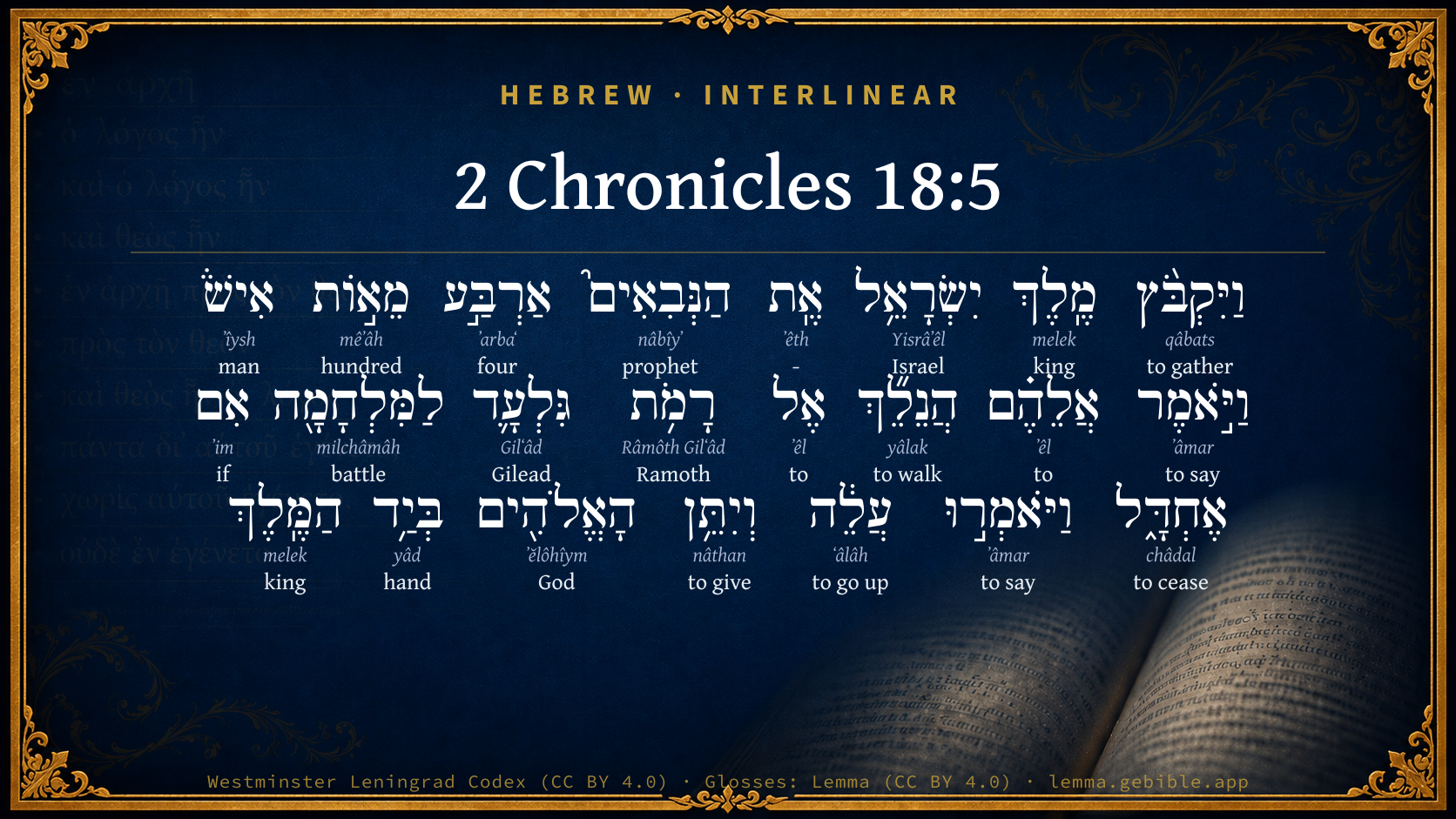
2 Chronicles 18:5

Hebrew (Westminster Leningrad Codex) 2 Chronicles 18:5 appears in the Hebrew Old Testament. The text above is from the Westminster Leningrad Codex. Each word links to its Strong’s number, a concise gloss, and parsing drawn from the Open Scriptures Hebrew Bible morphology. Click any word for its full Brown-Driver-Briggs (BDB) entry.
Download image
Cite this verse

2 Chronicles 18:5 (World English Bible). Public Domain. Lemma interlinear Bible study tool, https://lemma.gebible.app/v/2-chronicles/18/5.

Show BibTeX & RIS
BibTeX
RIS
English Translation
Then the king of Israel gathered the prophets together, four hundred men, and said to them, Shall we go to Ramoth-gilead to battle, or shall I forbear? They said, Go up; for God will deliver it into the hand of the king.
World English Bible · Public Domain
Download a study sheet

One document with this verse’s original text, its word-by-word gloss line, the meaning frame, cross-references with their text, attributed commentary, and full source and license credits — printable, and it pastes into notes with its structure intact.

This verse Autodidact and up

Study sheet (.html) Plain text (.txt)

A passage Seminary Student

Up to 50 verses in one chapter. A passage sheet keeps up to 6 commentary sources and 12 cross-references per verse, in the order this page ranks them, and says so on the sheet whenever that leaves anything out. Ask for a single verse and you get the Autodidact verse sheet above.

Everything on this page stays free to read, with no account — the sheet is a download of what is already on screen, not access to it.

Want to remove ads? Support Godless Engineer
Compare translations 3

The same verse in 3 English versions, stacked beneath the original-language interlinear above. Click any original word for its lexicon entry.

Each is an independent rendering of the whole verse — the interlinear is not word-aligned to these translations.

Highlighted words mark where these versions differ — a whole-verse word diff, not a word-by-word alignment.

  • World English Bible Public Domain
    Then the king of Israel gathered the prophets together, four hundred men, and said to them, Shall we go to Ramoth-gilead to battle, or shall I forbear? They said, Go up; for God will deliver it into the hand of the king.
  • King James Version Public Domain
    Therefore the king of Israel gathered together of prophets four hundred men, and said unto them, Shall we go to Ramothgilead to battle, or shall I forbear? And they said, Go up; for God will deliver it into the king's hand.
  • unfoldingWord Literal Text CC BY-SA 4.0
    And the king of Israel gathered the prophets, 400 men. And he said to them, “Should we go against Ramoth Gilead in battle, or should I refrain?” And they said, “Go up, and God will give into the hand of the king.”

unfoldingWord Literal Text — © unfoldingWord, licensed CC BY-SA 4.0. Word-aligned USFM3 via Door43 (git.door43.org/unfoldingWord/en_ult).

Versions to compare (up to 4)

3 of 4 selected

Show all 18 translations

Every available English version of this verse, each an independent rendering of the whole verse.

  • World English Bible Public Domain
    Then the king of Israel gathered the prophets together, four hundred men, and said to them, Shall we go to Ramoth-gilead to battle, or shall I forbear? They said, Go up; for God will deliver it into the hand of the king.
  • Berean Standard Bible Public Domain
    So the king of Israel assembled the prophets, four hundred men, and asked them, “Should we go to war against Ramoth-gilead, or should we refrain?” “Go up,” they replied, “and God will deliver it into the hand of the king.”
  • Majority Standard Bible Public Domain
    So the king of Israel assembled the prophets, four hundred men, and asked them, “Should we go to war against Ramoth-gilead, or should we refrain?” “Go up,” they replied, “and God will deliver it into the hand of the king.”
  • King James Version Public Domain
    Therefore the king of Israel gathered together of prophets four hundred men, and said unto them, Shall we go to Ramothgilead to battle, or shall I forbear? And they said, Go up; for God will deliver it into the king's hand.
  • American Standard Version (1901) Public Domain
    Then the king of Israel gathered the prophets together, four hundred men, and said unto them, Shall we go to Ramoth-gilead to battle, or shall I forbear? And they said, Go up; for God will deliver it into the hand of the king.
  • Revised Version (1885) Public Domain
    When the king of Israel gathered the prophets together, four hundred men, and said unto them, Shall we go to Ramoth-gilead to battle, or shall I forbear? And they said, Go up; for God shall deliver it into the hand of the king.
  • Geneva Bible (1599) Public Domain
    Therefore the King of Israel gathered of Prophets foure hundreth men, and sayde vnto them, Shall we goe to Ramoth Gilead to battel, or shall I cease? And they sayd, Go vp: for God shall deliuer it into the Kings hand.
  • Douay-Rheims (1899) Public Domain
    So the king of Israel gathered together of the prophets four hundred men, and he said to them: Shall we go to Ramoth Galaad to fight, or shall we forbear? But they said: Go up, and God will deliver it into the king's hand.
  • Young's Literal Translation Public Domain
    And the king of Israel gathereth the prophets, four hundred men, and saith unto them, `Do we go unto Ramoth-Gilead to battle, or do I forbear?' And they say, `Go up, and God doth give `it' into the hand of the king.'
  • Literal Standard Version CC BY-SA 4.0
    And the king of Israel gathers the prophets, four hundred men, and says to them, “Do we go to Ramoth-Gilead to battle, or do I refrain?” And they say, “Go up, and God gives [it] into the hand of the king.”
  • Unlocked Literal Bible CC BY-SA 4.0
    Then the king of Israel gathered the prophets together, four hundred men, and said to them, “Should we go to Ramoth Gilead to battle, or should I not?” They said, “Attack, for God will give it into the hand of the king.”
  • unfoldingWord Literal Text CC BY-SA 4.0
    And the king of Israel gathered the prophets, 400 men. And he said to them, “Should we go against Ramoth Gilead in battle, or should I refrain?” And they said, “Go up, and God will give into the hand of the king.”
  • Darby Bible Public Domain
    And the king of Israel assembled the prophets, four hundred men, and said to them, Shall we go against Ramoth-Gilead to battle, or shall I forbear? And they said, Go up, and God will give it into the king's hand.
  • World Messianic Bible Public Domain
    Then the king of Israel gathered the prophets together, four hundred men, and said to them, “Shall we go to Ramoth Gilead to battle, or shall I forbear?” They said, “Go up, for God will deliver it into the hand of the king.”
  • Webster's Bible Public Domain
    Therefore the king of Israel collected of prophets four hundred men, and said to them, Shall we go to Ramoth-gilead to battle, or shall I forbear? And they said, Go up; for God will deliver it into the king's hand.
  • Free Bible Version CC BY-SA 4.0
    So the king of Israel brought out the prophets—four hundred of them—and he asked them, “Should we go up and attack Ramoth-gilead, or should I not?” “Yes, go ahead,” they replied, “for God will hand it over to the king.”
  • Bible in Basic English Public Domain
    So the king of Israel got together all the prophets, four hundred men, and said to them, Am I to go to Ramoth-gilead to make war or not? And they said, Go up: for God will give it into the hands of the king.
  • JPS Tanakh (1917) Public Domain
    Then the king of Israel gathered the prophets together, four hundred men, and said unto them: 'Shall we go to Ramoth-gilead to battle, or shall I forbear?' And they said: 'Go up; for God will deliver it into the hand of the king.'

Literal Standard Version (2020), Covenant Press — licensed CC BY-SA 4.0. Text via the HelloAO Bible API (eBible.org). Unlocked Literal Bible (unfoldingWord) — licensed CC BY-SA 4.0. Text via the HelloAO Bible API (eBible.org). unfoldingWord Literal Text — © unfoldingWord, licensed CC BY-SA 4.0. Word-aligned USFM3 via Door43 (git.door43.org/unfoldingWord/en_ult). Free Bible Version, Dr. Jonathan Gallagher — licensed CC BY-SA 4.0. Text via the HelloAO Bible API (eBible.org).

Word by word

More ways to search: Search by grammar → Find every occurrence → Compare this word →

Practice this passage: Drill this verse → Learn its vocabulary →

רָמֹ֥ת
Râmôth Gilʻâd
H7433
“Ramoth”
Noun, Proper
Part of Speech
Noun
Type
Proper
Full BDB Definition

Origin: from the pl. of H7413 and H1568

TWOT: None

Ramoth = "heights" - an Israelite who had a foreign wife in the time of Ezra (noun proper masculine) - Ramoth-gilead - a place in Gilead (noun proper locative) - site dubious
  1. וַיִּקְבֹּ֨ץ qâbats H6908 “and · to gather” Conjunction + Verb, Qal, Sequential Imperfect, 3rd Person, Masculine, Singular
  2. מֶֽלֶךְ melek H4428 “king of” Noun, Common, Masculine, Singular, Construct
  3. יִשְׂרָאֵ֥ל Yisrâʼêl H3478 “Israel” Noun, Proper
  4. אֶֽת ʼêth H853 “-” Particle, Direct Object
  5. הַנְּבִאִים֮ nâbîyʼ H5030 “the · prophets” Particle, Definite Article + Noun, Common, Masculine, Plural, Absolute
  6. אַרְבַּ֣ע ʼarbaʻ H702 “four” Adjective, Cardinal number, Feminine, Singular, Absolute
  7. מֵא֣וֹת mêʼâh H3967 “hundred” Adjective, Cardinal number, Both, Plural, Absolute
  8. אִישׁ֒ ʼîysh H376 “man” Noun, Common, Masculine, Singular, Absolute
  9. וַיֹּ֣אמֶר ʼâmar H559 “and · to say” Conjunction + Verb, Qal, Sequential Imperfect, 3rd Person, Masculine, Singular
  10. אֲלֵהֶ֗ם ʼêl H413 “to · them” Preposition + Suffix, Personal, 3rd Person, Masculine, Plural
  11. הֲנֵלֵ֞ךְ yâlak H3212 “to walk” Particle, Interrogative + Verb, Qal, Imperfect, 1st Person, Common, Plural
  12. אֶל ʼêl H413 “to” Preposition
  13. גִּלְעָ֛ד Gilʻâd H1568 “Gilead” Noun, Proper
  14. לַמִּלְחָמָ֖ה milchâmâh H4421 “to/for the · battle” Preposition, Determined + Noun, Common, Feminine, Singular, Absolute
  15. אִם ʼim H518 “if” Conjunction
  16. אֶחְדָּ֑ל châdal H2308 “to cease” Verb, Qal, Imperfect, 1st Person, Common, Singular
  17. וַיֹּאמְר֣וּ ʼâmar H559 “and · to say” Conjunction + Verb, Qal, Sequential Imperfect, 3rd Person, Masculine, Plural
  18. עֲלֵ֔ה ʻâlâh H5927 “go up” Verb, Qal, Imperative, 2nd Person, Masculine, Singular
  19. וְיִתֵּ֥ן nâthan H5414 “and · to give” Conjunction + Verb, Qal, Imperfect, 3rd Person, Masculine, Singular
  20. הָאֱלֹהִ֖ים ʼĕlôhîym H430 “the · God(s)” Particle, Definite Article + Noun, Common, Masculine, Plural, Absolute
  21. בְּיַ֥ד yâd H3027 “in/at · hand of” Preposition + Noun, Common, Both, Singular, Construct
  22. הַמֶּֽלֶךְ melek H4428 “the · king” Particle, Definite Article + Noun, Common, Masculine, Singular, Absolute

About this verse

These counts appear in no published source. They are computed here, from the morphology-tagged text and Lemma’s own curated glosses. What Lemma adds →

23
words
20
distinct lemmas
Historical
section

Notable vocabulary

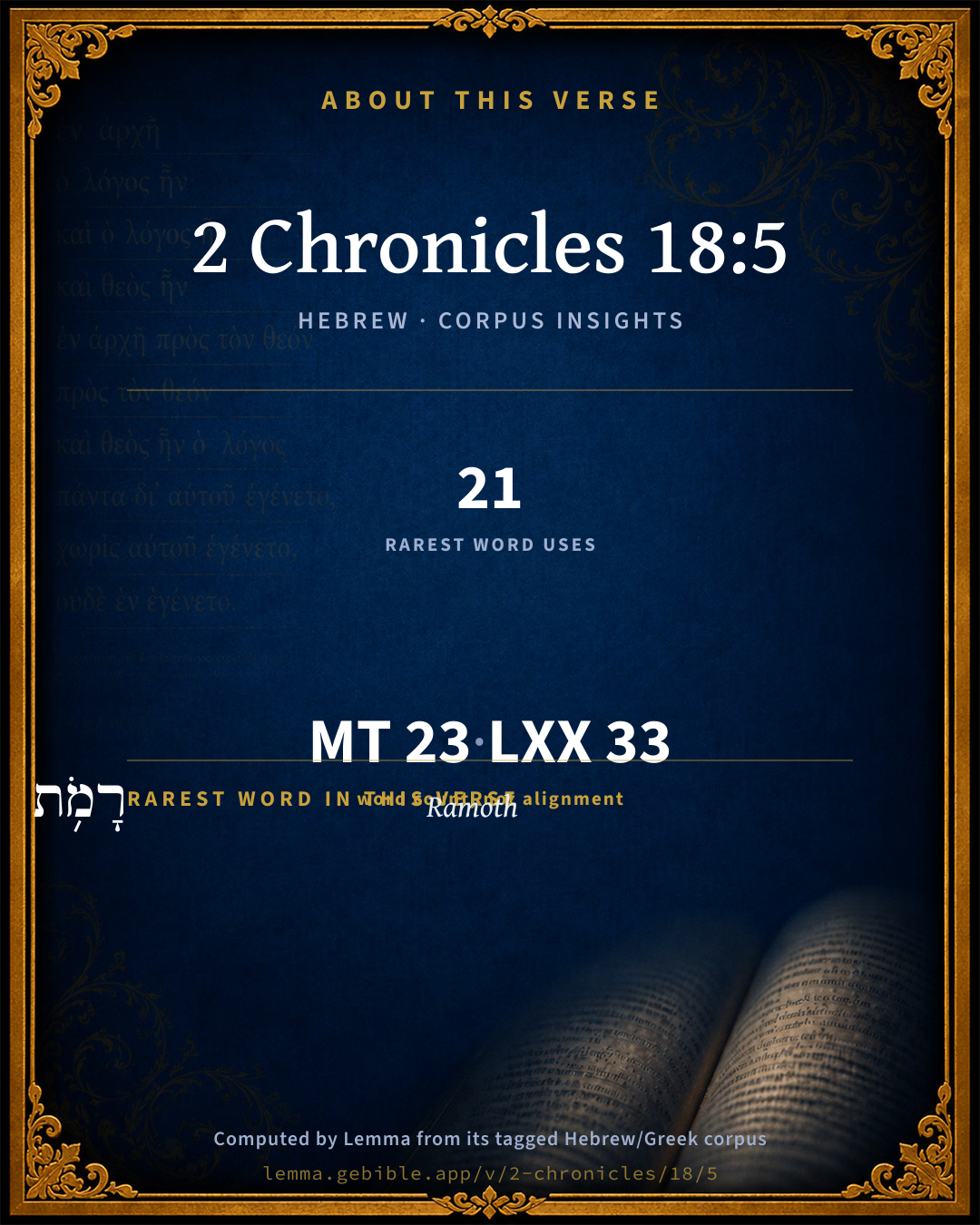
The rarest word here is רָמֹ֥ת Ramoth H7433 — appearing just 21 times in the whole Hebrew Bible.

Shared distinctive vocabulary

רָמֹ֥ת Ramoth H7433 occurs in 21 verses of the Hebrew Bible. Also found in:

Grammatical profile

  • 7 verbs
  • 10 nouns
  • 2 adjectives
  • 2 prepositions
  • 1 conjunction
  • 1 particle

Verb forms

  • וַיִּקְבֹּ֨ץ Qal · Sequential Imperfect
  • וַיֹּ֣אמֶר Qal · Sequential Imperfect
  • הֲנֵלֵ֞ךְ Qal · Imperfect
  • אֶחְדָּ֑ל Qal · Imperfect
  • וַיֹּאמְר֣וּ Qal · Sequential Imperfect
  • עֲלֵ֔ה Qal · Imperative
  • וְיִתֵּ֥ן Qal · Imperfect

Repetition

Words recur within this verse — often emphatic in Hebrew:

  • מֶֽלֶךְ king H4428 ×2
  • וַיֹּ֣אמֶר to say H559 ×2
  • אֲלֵהֶ֗ם to H413 ×2

Hebrew & Septuagint length

In English translation the verse runs 42 words from the Hebrew and 43 from the Septuagint (LXX English) — closely comparable.

A rough comparison of the two English renderings, which tokenize alike — not a word-level alignment.

Word counts can differ between the Hebrew and the Greek without any difference in meaning — e.g. the Hebrew direct-object marker אֵת has no separate Greek word, and Greek often adds the article ὁ.

In the original languages it is 23 Hebrew tokens and 33 Greek tokens — but the two are counted differently (Hebrew bundles its prefixes and suffixes into one token; the Greek is in lemma form), so that isn’t a like-for-like length.

Cross-references

17

Topical passages linked to 2 Chronicles 18:5 in the Treasury of Scripture Knowledge — connected by theme and wording, ordered by reader-vote popularity; previews shown in the World English Bible.

  • 1 Kings 18:19 Now therefore send, and gather to me all Israel to Mount Carmel, and the prophets of Baal four hundred fifty, and the prophets of the Asherah four hundred, who eat at Jezebel's table.
  • 2 Kings 3:13 Elisha said to the king of Israel, What have I to do with you? get you to the prophets of your father, and to the prophets of your mother. The king of Israel said to him, No; for Yahweh has called these three kings together to deliver them into the hand of Moab.
  • 2 Chronicles 18:14 When he was come to the king, the king said to him, Micaiah, shall we go to Ramoth-gilead to battle, or shall I forbear? He said, Go up, and prosper; and they shall be delivered into your hand.
  • 2 Chronicles 18:20–21 There came forth a spirit, and stood before Yahweh, and said, I will entice him. Yahweh said to him, 'How?'
  • Jeremiah 8:10–11 Therefore will I give their wives to others, and their fields to those who shall possess them: for everyone from the least even to the greatest is given to covetousness; from the prophet even to the priest every one deals falsely.
  • Jeremiah 23:14 In the prophets of Jerusalem also I have seen a horrible thing: they commit adultery, and walk in lies; and they strengthen the hands of evil-doers, so that none does return from his wickedness: they are all of them become to me as Sodom, and the inhabitants of it as Gomorrah.
  • Jeremiah 23:17 They say continually to those who despise me, Yahweh has said, You shall have peace; and to everyone who walks in the stubbornness of his own heart they say, No evil shall come on you.
  • Jeremiah 28:1–17 It happened the same year, in the beginning of the reign of Zedekiah king of Judah, in the fourth year, in the fifth month, that Hananiah the son of Azzur, the prophet, who was of Gibeon, spoke to me in the house of Yahweh, in the presence of the priests and of all the people, saying,
  • Jeremiah 38:14–28 Then Zedekiah the king sent, and took Jeremiah the prophet to him into the third entry that is in the house of Yahweh: and the king said to Jeremiah, I will ask you a thing; hide nothing from me.
  • Jeremiah 42:2–3 and said to Jeremiah the prophet, Let, we pray you, our supplication be presented before you, and pray for us to Yahweh your God, even for all this remnant; for we are left but a few of many, as your eyes do see us:
  • Jeremiah 42:20 For you have dealt deceitfully against your own souls; for you sent me to Yahweh your God, saying, Pray for us to Yahweh our God; and according to all that Yahweh our God shall say, so declare to us, and we will do it:
  • Ezekiel 13:3–16 Thus says the Lord Yahweh, Woe to the foolish prophets, who follow their own spirit, and have seen nothing!
  • Ezekiel 13:22 Because with lies you have grieved the heart of the righteous, whom I have not made sad; and strengthened the hands of the wicked, that he should not return from his wicked way, and be saved alive:
  • Micah 2:11 If a man walking in a spirit of falsehood lies: 'I will prophesy to you of wine and of strong drink;' He would be the prophet of this people.
  • Micah 3:11 Her leaders judge for bribes, And her priests teach for a price, And her prophets of it tell forturnes for money: Yet they lean on Yahweh, and say, Isn't Yahweh in the midst of us? No disaster will come on us.
  • 2 Timothy 4:3 For the time will come when they will not listen to the sound doctrine, but, having itching ears, will heap up for themselves teachers after their own lusts;
  • Revelation 19:20 The beast was taken, and with him the false prophet who worked the signs in his sight, with which he deceived those who had received the mark of the beast and those who worshiped his image. These two were thrown alive into the lake of fire that burns with sulfur.

Cross-references courtesy of OpenBible.info (CC BY 4.0).

Hebrew and Greek witnesses Masoretic Hebrew ↔ Greek Septuagint

The same verse in the two great witnesses to the Old Testament, shown verse-for-verse.

These are two independent witnesses, not word-aligned to each other, and the Septuagint is shown in lemma (dictionary) form.

Hebrew 2 Chronicles 18:5 Masoretic · Westminster Leningrad Codex

וַיִּקְבֹּ֨ץ מֶֽלֶךְ יִשְׂרָאֵ֥ל אֶֽת הַנְּבִאִים֮ אַרְבַּ֣ע מֵא֣וֹת אִישׁ֒ וַיֹּ֣אמֶר אֲלֵהֶ֗ם הֲנֵלֵ֞ךְ אֶל רָמֹ֥ת גִּלְעָ֛ד לַמִּלְחָמָ֖ה אִם אֶחְדָּ֑ל וַיֹּאמְר֣וּ עֲלֵ֔ה וְיִתֵּ֥ן הָאֱלֹהִ֖ים בְּיַ֥ד הַמֶּֽלֶךְ

Then the king of Israel gathered the prophets together, four hundred men, and said to them, Shall we go to Ramoth-gilead to battle, or shall I forbear? They said, Go up; for God will deliver it into the hand of the king.

World English Bible · Public Domain

Greek LXX 2 Chronicles 18:5 Septuagint · lemma form

καί συνἄγω ὁ βασιλεύς ἰσραήλ ὁ προφήτης τετρακόσιοι ἀνήρ καί εἶπον αὐτός εἰ πορεύομαι εἰς ραμωθ γαλαάδ εἰς πόλεμος ἤ ἐπιἔχω καί εἶπον ἀναβαίνω καί δίδωμι ὁ θεός εἰς ὁ χείρ ὁ βασιλεύς

And the king of Israel gathered the prophets, four hundred men, and said to them, Shall I go to Ramoth Galaad to battle, or shall I forbear? And they said, Go up, and God shall deliver it into the hands of the king.

LXX2012 (modern English Septuagint) · Public Domain

On this verse, The Cambridge Bible for Schools and Colleges discusses the Septuagint’s reading. Read the note in Commentary ↓

Hebrew: Westminster Leningrad Codex (CC BY 4.0). Greek: Septuagint (public domain); English from LXX2012 (modern English Septuagint) (Public Domain). How the Septuagint differs from the Hebrew →

Commentary

Notes on 2 Chronicles 18:5 from classic Christian and Jewish commentators (each source and its license shown beneath its notes). The classic Christian expositions comment on the surrounding passage and are grouped to its opening verse, so a note may address several verses; the Jewish commentaries on the Tanakh (Rashi and others) are per-verse, so they appear only where the commentator wrote on this verse.

Lemma curates 59 commentaries, every one of them public domain or Creative Commons licensed, each selected and text-cleaned for this edition rather than reprinted as found. About our sources →

Trapp's Complete Commentary

John Trapp

2Ch 18:5 Therefore the king of Israel gathered together of prophets four hundred men, and said unto them, Shall we go to Ramothgilead to battle, or shall I forbear? And they said, Go up; for God will deliver [it] into the king’s hand.

Ver. 5. Four hundred prophets.] An ecumenical council. See on 1Ki 2:6.

John Trapp, A Commentary or Exposition upon All the Books of the Old and New Testament (1647–1656) — public domain. Text from a community e-Sword module.

Tyndale Open Study Notes

Tyndale Open Resources

18:5-7 The 400 prophets were Ahab’s “yes-men.” Jehoshaphat wanted instead to hear from a prophet of the Lord, but Ahab knew in advance that such a prophet would contradict his court prophets.

Tyndale Open Study Notes — © Tyndale Open Resources, licensed CC BY-SA 4.0. Text via the HelloAO Bible API.

Geneva Bible (1599)

Geneva Bible translators

Which were the prophets of Baal, signifying that the wicked esteem none but flatterers, and such as will bear with their inordinate affections.

Geneva Bible (1599) marginal notes — public domain. Text via Bolls.life.

Ellicott's Commentary for English Readers

(5) Therefore.—And.

Of prophets.—Rather, the prophets.

Four hundred.—Kings, “About four hundred.” Also’ Adonai (“the Lord”), instead of ha’elôhîm (“the [true] God”); and “I go against” for “we go to,” where the former is obviously more appropriate.

A Bible Commentary for English Readers, edited by Charles John Ellicott (1878–1897) — public domain. Text from a community e-Sword module.

The Cambridge Bible for Schools and Colleges

gen. ed. J. J. S. Perowne

5. Therefore the king of Israel gathered together of prophets] R.V. Then the king of Israel gathered the prophets together. These no doubt were prophets of Jehovah (not of Baal); cp. 2Ch_18:4 and note on 2Ch_18:6.

Shall we go … or shall I forbear?] in 1 Kin., “Shall I go … or shall I forbear?” (so LXX., but not Pesh., of Chron.).

will deliver it into the king’s hand] R.V. shall deliver it into the hand of the king (as 1 Kin.).

The Cambridge Bible for Schools and Colleges (gen. ed. J. J. S. Perowne; Cambridge University Press, 1878–1918) — public domain. Text from a community e-Sword module.

The Pulpit Commentary

These four hundred prophets, as Keil justly notes, were not prophets of Ashe-rah, nor of Baal, but strictly of Israel, i.e. of the images of the calf. (1Ki_12:26-33) Their word speedily showed itself not the word of the Lord, but the word that was made up to order of the king, and to suit his known wish at any time.

The Pulpit Commentary (1880–1919), ed. H.D.M. Spence-Jones & Joseph S. Exell — public domain. Text from a community e-Sword module.

Rashi

Rabbi Shlomo Yitzchaki (Rashi)

And the king of Israel gathered the prophets, four hundred And they were all true prophets, for he gathered for Jehoshaphat that which he had requested of him. And this is proven in the closely following text (verse 20f.): “And a spirit came forth, etc. and said: ‘I will entice him...and I will be a lying spirit in the mouth of all his prophets,’ for I will inspire them to say to Ahab: Ascend, and the Lord will deliver it into the hands of the king.” From here we can deduce that they were prophets of the Lord, for they prophesied only the word of the Lord, for if they were false prophets, they would not entice, for they would prophesy only that which they were inventing from their minds. Moreover, Jehoshaphat later said, “Is there no other prophet of the Lord?” I know that they are prophets of the Lord, but I have a tradition from my grandfather’s house that two prophets do not prophesy in the same style and with the same language, but all of these [prophets] are [unanimously] prophesying, “Ascend and prosper.”

Rashi on the Tanakh — English translations: “The Judaica Press complete Tanach with Rashi, translated by A. J. Rosenberg” (CC BY 4.0); “Pentateuch with Rashi's commentary by M. Rosenbaum and A.M. Silbermann, 1929-1934” (public domain); “The Metsudah Tanach series, Lakewood, N.J” (CC BY 4.0); and “The Book of Joshua, Metsudah Publications, 1997” (CC BY 4.0). Text via Sefaria.

Lesson kit

Teaching starters — assembled from the data on this page, not authored interpretation. Every prompt links to the verse data it draws on. Edit before teaching.

2 Chronicles, in the Historical, opens this verse with 23 words (20 distinct Hebrew lemmas). Its most distinctive word is Râmôth Gilʻâd (“Ramoth”). A historical commentator’s framing appears above. Read the whole chapter for the surrounding context.

Discussion questions

  1. What does “Ramoth” (Râmôth Gilʻâd) contribute to the verse as a whole?
  2. Joshua 21:38 shares the word «Ramoth» with this verse. How do the two illuminate each other?
  3. “king” occurs 2× in this one verse. What is the effect of the repetition?
  4. The translations on this page render this verse differently — a whole-verse word diff, not a word-by-word alignment. What might account for the different wordings?
  5. The verb «וַיִּקְבֹּ֨ץ» is Qal Sequential Imperfect. How does its form color the action?
  6. Reading how Trapp's Complete Commentary and Tyndale Open Study Notes read this verse, where do the two commentators agree and where do they part?

Things to notice

Reading settings

Reading text

Shown beneath each verse's original-language words.

Old Testament
Old Testament edition

Read the OT as the Masoretic Hebrew (MT) or the Greek Septuagint (LXX).

English shown for the Greek Septuagint (in the Hebrew ↔ Greek comparison).

Comparing translations? Open the Compare panel on any verse page to stack up to four side by side.