
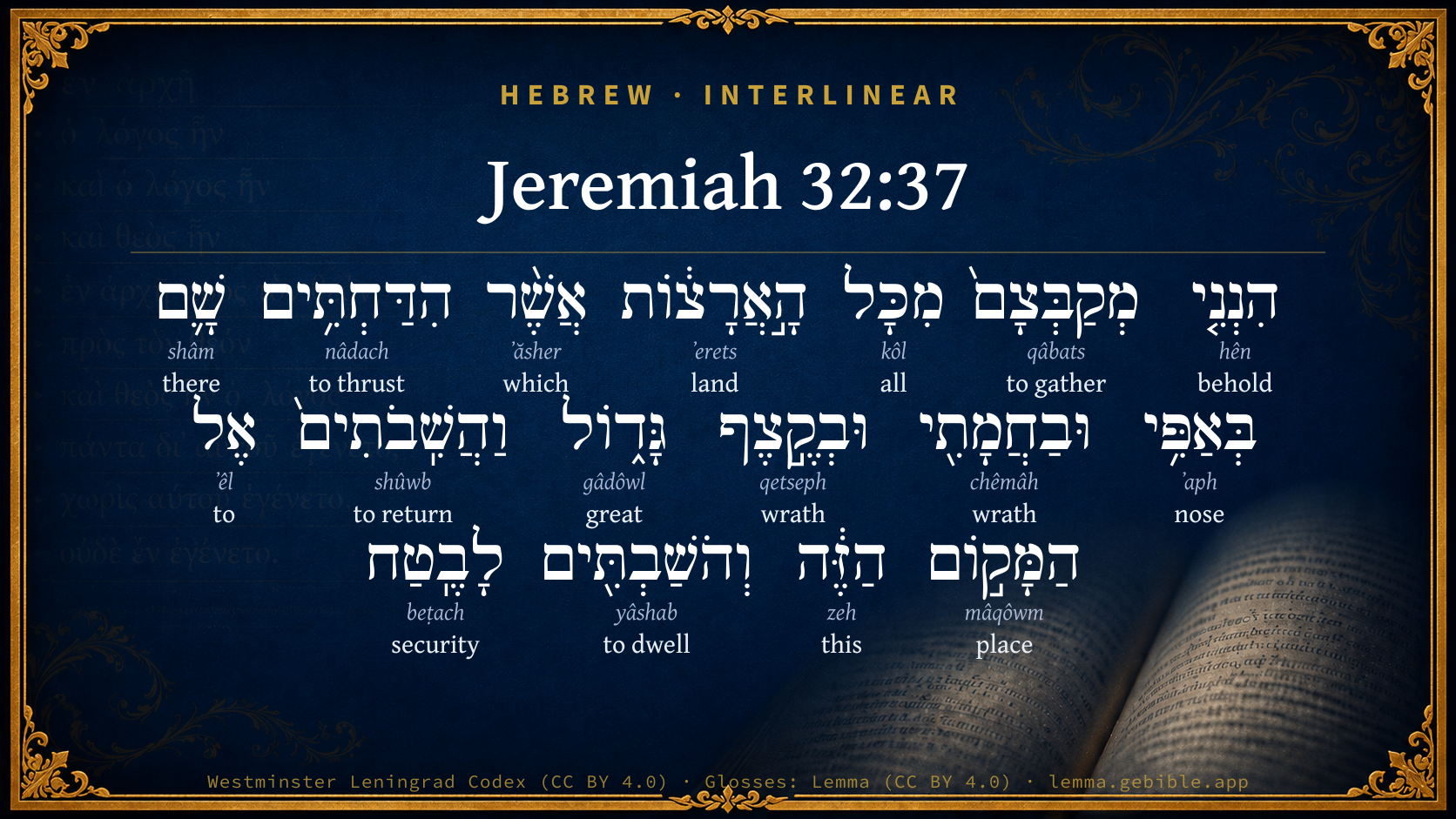
Jeremiah 32:37

Hebrew (Westminster Leningrad Codex) Jeremiah 32:37 appears in the Hebrew Old Testament. The text above is from the Westminster Leningrad Codex. Each word links to its Strong’s number, a concise gloss, and parsing drawn from the Open Scriptures Hebrew Bible morphology. Click any word for its full Brown-Driver-Briggs (BDB) entry.
Download image
Cite this verse

Jeremiah 32:37 (World English Bible). Public Domain. Lemma interlinear Bible study tool, https://lemma.gebible.app/v/jeremiah/32/37.

Show BibTeX & RIS
BibTeX
RIS
English Translation
Behold, I will gather them out of all the countries, where I have driven them in my anger, and in my wrath, and in great indignation; and I will bring them again to this place, and I will cause them to dwell safely:
World English Bible · Public Domain
Download a study sheet

One document with this verse’s original text, its word-by-word gloss line, the meaning frame, cross-references with their text, attributed commentary, and full source and license credits — printable, and it pastes into notes with its structure intact.

This verse Autodidact and up

Study sheet (.html) Plain text (.txt)

A passage Seminary Student

Up to 50 verses in one chapter. A passage sheet keeps up to 6 commentary sources and 12 cross-references per verse, in the order this page ranks them, and says so on the sheet whenever that leaves anything out. Ask for a single verse and you get the Autodidact verse sheet above.

Everything on this page stays free to read, with no account — the sheet is a download of what is already on screen, not access to it.

Want to remove ads? Support Godless Engineer
Compare translations 3

The same verse in 3 English versions, stacked beneath the original-language interlinear above. Click any original word for its lexicon entry.

Each is an independent rendering of the whole verse — the interlinear is not word-aligned to these translations.

Highlighted words mark where these versions differ — a whole-verse word diff, not a word-by-word alignment.

  • World English Bible Public Domain
    Behold, I will gather them out of all the countries, where I have driven them in my anger, and in my wrath, and in great indignation; and I will bring them again to this place, and I will cause them to dwell safely:
  • King James Version Public Domain
    Behold, I will gather them out of all countries, whither I have driven them in mine anger, and in my fury, and in great wrath; and I will bring them again unto this place, and I will cause them to dwell safely:
  • unfoldingWord Literal Text CC BY-SA 4.0
    See, I am about to gather them from every land where I had driven them in my wrath, fury, and great anger. I am about to bring them back to this place and enable them to live in security.

unfoldingWord Literal Text — © unfoldingWord, licensed CC BY-SA 4.0. Word-aligned USFM3 via Door43 (git.door43.org/unfoldingWord/en_ult).

Versions to compare (up to 4)

3 of 4 selected

Show all 18 translations

Every available English version of this verse, each an independent rendering of the whole verse.

  • World English Bible Public Domain
    Behold, I will gather them out of all the countries, where I have driven them in my anger, and in my wrath, and in great indignation; and I will bring them again to this place, and I will cause them to dwell safely:
  • Berean Standard Bible Public Domain
    I will surely gather My people from all the lands to which I have banished them in My furious anger and great wrath, and I will return them to this place and make them dwell in safety.
  • Majority Standard Bible Public Domain
    I will surely gather My people from all the lands to which I have banished them in My furious anger and great wrath, and I will return them to this place and make them dwell in safety.
  • King James Version Public Domain
    Behold, I will gather them out of all countries, whither I have driven them in mine anger, and in my fury, and in great wrath; and I will bring them again unto this place, and I will cause them to dwell safely:
  • American Standard Version (1901) Public Domain
    Behold, I will gather them out of all the countries, whither I have driven them in mine anger, and in my wrath, and in great indignation; and I will bring them again unto this place, and I will cause them to dwell safely:
  • Revised Version (1885) Public Domain
    Behold, I will gather them out of all the countries, whither I have driven them in mine anger, and in my fury, and in great wrath; and I will bring them again unto this place, and I will cause them to dwell safely:
  • Geneva Bible (1599) Public Domain
    Beholde, I will gather them out of all countreys, wherein I haue scattered them in mine anger, and in my wrath, and in great indignation, and I wil bring them againe vnto this place, and I will cause them to dwell safely.
  • Douay-Rheims (1899) Public Domain
    Behold I will gather them together out of all the lands to which I have cast them out in my anger, and in my wrath, and in my great indignation: and I will bring them again into this place, and will cause them to dwell securely.
  • Young's Literal Translation Public Domain
    Lo, I am gathering them out of all the lands whither I have driven them in Mine anger, and in My fury, and in great wrath, and I have brought them back unto this place, and have caused them to dwell confidently;
  • Literal Standard Version CC BY-SA 4.0
    Behold, I am gathering them out of all the lands to where I have driven them in My anger, and in My fury, and in great wrath, and I have brought them back to this place, and have caused them to dwell confidently;
  • Unlocked Literal Bible CC BY-SA 4.0
    See, I am about to gather them from every land where I had driven them in my wrath, fury, and great anger. I am about to bring them back to this place and enable them to live in security.
  • unfoldingWord Literal Text CC BY-SA 4.0
    See, I am about to gather them from every land where I had driven them in my wrath, fury, and great anger. I am about to bring them back to this place and enable them to live in security.
  • Darby Bible Public Domain
    Behold, I will gather them out of all the countries whither I have driven them, in mine anger, and in my fury, and in great wrath; and I will bring them again unto this place, and I will cause them to dwell safely.
  • World Messianic Bible Public Domain
    “Behold, I will gather them out of all the countries where I have driven them in my anger, and in my wrath, and in great indignation; and I will bring them again to this place. I will cause them to dwell safely.
  • Webster's Bible Public Domain
    Behold, I will gather them out of all countries, whither I have driven them in my anger, and in my fury, and in great wrath; and I will bring them again to this place, and I will cause them to dwell in safety.
  • Free Bible Version CC BY-SA 4.0
    I promise to gather my people from all the lands where I exiled them because they made me so very angry. I will bring them back here and they will live in safety.
  • Bible in Basic English Public Domain
    See, I will get them together from all the countries where I have sent them in my wrath and in the heat of my passion and in my bitter feeling; and I will let them come back into this place where they may take their rest safely.
  • JPS Tanakh (1917) Public Domain
    Behold, I will gather them out of all the countries, whither I have driven them in Mine anger, and in My fury, and in great wrath; and I will bring them back unto this place, and I will cause them to dwell safely;

Literal Standard Version (2020), Covenant Press — licensed CC BY-SA 4.0. Text via the HelloAO Bible API (eBible.org). Unlocked Literal Bible (unfoldingWord) — licensed CC BY-SA 4.0. Text via the HelloAO Bible API (eBible.org). unfoldingWord Literal Text — © unfoldingWord, licensed CC BY-SA 4.0. Word-aligned USFM3 via Door43 (git.door43.org/unfoldingWord/en_ult). Free Bible Version, Dr. Jonathan Gallagher — licensed CC BY-SA 4.0. Text via the HelloAO Bible API (eBible.org).

Word by word

More ways to search: Search by grammar → Find every occurrence → Compare this word →

Practice this passage: Drill this verse → Learn its vocabulary →

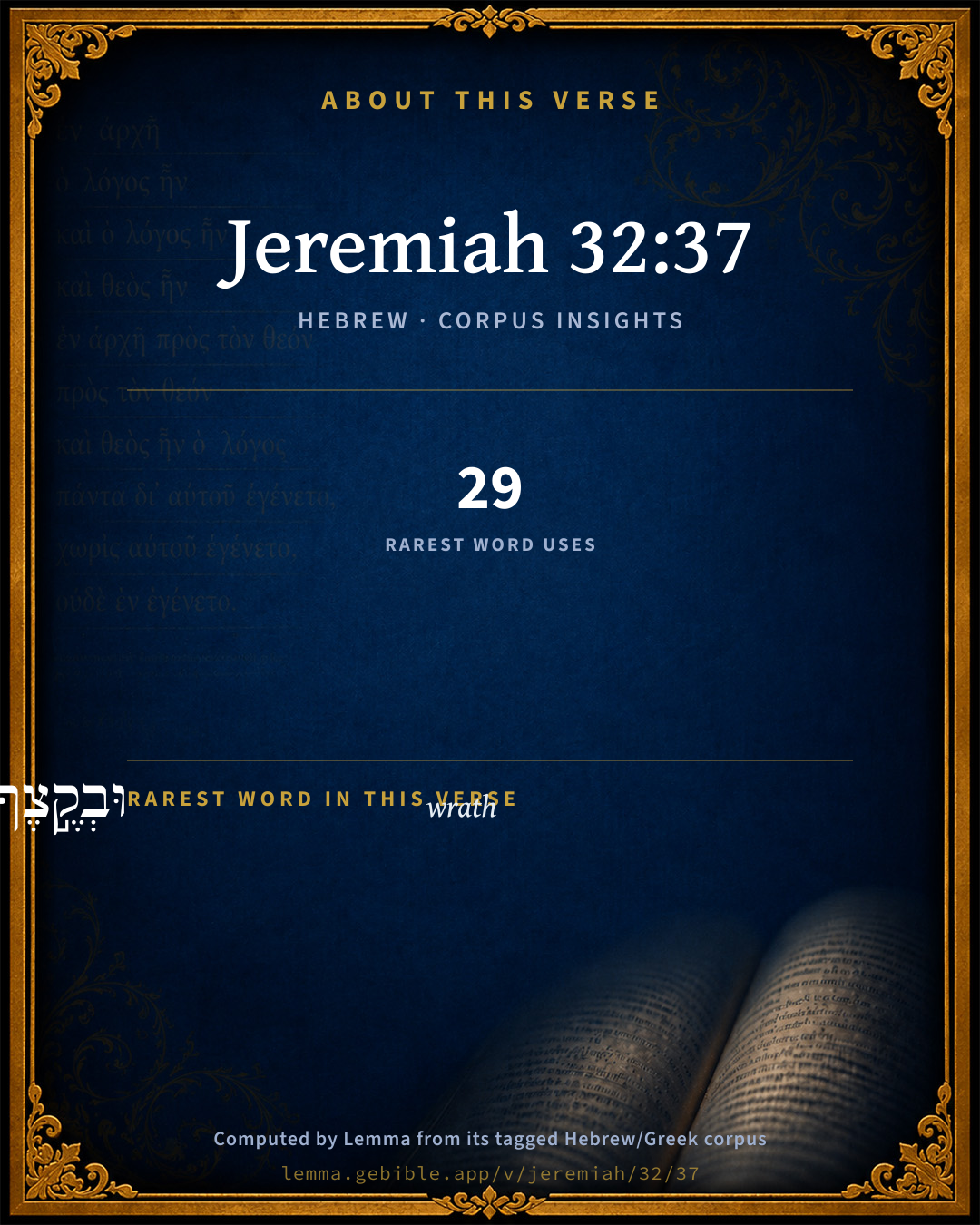
וּבְקֶ֣צֶף
qetseph
H7110
“and · in/at · wrath”
Conjunction + Preposition + Noun, Common, Masculine, Singular, Absolute
Part of Speech
Conjunction + Preposition + Noun
Type
Common
Gender
Masculine
Number
Singular
State
Absolute
Full BDB Definition

Origin: from H7107

TWOT: 2058a , 2059b

wrath, anger - of God - of man - splinter, twig, broken twig - meaning dubious
  1. הִנְנִ֤י hên H2005 “behold · me” Particle, Demonstrative + Suffix, Personal, 1st Person, Common, Singular
  2. מְקַבְּצָם֙ qâbats H6908 “gathering · them” Verb, Piel, Participle Active, Masculine, Singular, Construct + Suffix, Personal, 3rd Person, Masculine, Plural
  3. מִכָּל kôl H3605 “from · all of” Preposition + Noun, Common, Masculine, Singular, Construct
  4. הָ֣אֲרָצ֔וֹת ʼerets H776 “the · lands” Particle, Definite Article + Noun, Common, Both, Plural, Absolute
  5. אֲשֶׁ֨ר ʼăsher H834 “which” Particle, Relative
  6. הִדַּחְתִּ֥ים nâdach H5080 “to thrust · them” Verb, Hiphil, Perfect, 1st Person, Common, Singular + Suffix, Personal, 3rd Person, Masculine, Plural
  7. שָׁ֛ם shâm H8033 “there” Adverb
  8. בְּאַפִּ֥י ʼaph H639 “in/at · nose · my” Preposition + Noun, Common, Masculine, Singular, Construct + Suffix, Personal, 1st Person, Common, Singular
  9. וּבַחֲמָתִ֖י chêmâh H2534 “and · in/at · wrath · my” Conjunction + Preposition + Noun, Common, Feminine, Singular, Construct + Suffix, Personal, 1st Person, Common, Singular
  10. גָּד֑וֹל gâdôwl H1419 “great” Adjective, Adjective, Masculine, Singular, Absolute
  11. וַהֲשִֽׁבֹתִים֙ shûwb H7725 “and · to return · them” Conjunction + Verb, Hiphil, Sequential Perfect, 1st Person, Common, Singular + Suffix, Personal, 3rd Person, Masculine, Plural
  12. אֶל ʼêl H413 “to” Preposition
  13. הַמָּק֣וֹם mâqôwm H4725 “the · place” Particle, Definite Article + Noun, Common, Masculine, Singular, Absolute
  14. הַזֶּ֔ה zeh H2088 “the · this” Particle, Definite Article + Pronoun, Demonstrative, Masculine, Singular
  15. וְהֹשַׁבְתִּ֖ים yâshab H3427 “and · to dwell · them” Conjunction + Verb, Hiphil, Sequential Perfect, 1st Person, Common, Singular + Suffix, Personal, 3rd Person, Masculine, Plural
  16. לָבֶֽטַח beṭach H983 “to/for · security” Preposition + Noun, Common, Masculine, Singular, Absolute

About this verse

These counts appear in no published source. They are computed here, from the morphology-tagged text and Lemma’s own curated glosses. What Lemma adds →

17
words
17
distinct lemmas
Prophets
section

Shared distinctive vocabulary

וּבְקֶ֣צֶף wrath H7110 occurs in 29 verses of the Hebrew Bible. Also found in:

Grammatical profile

  • 4 verbs
  • 7 nouns
  • 1 adjective
  • 1 pronoun
  • 1 preposition
  • 1 adverb
  • 2 particles

Verb forms

  • מְקַבְּצָם֙ Piel · Participle Active
  • הִדַּחְתִּ֥ים Hiphil · Perfect
  • וַהֲשִֽׁבֹתִים֙ Hiphil · Sequential Perfect
  • וְהֹשַׁבְתִּ֖ים Hiphil · Sequential Perfect

Cross-references

26

Topical passages linked to Jeremiah 32:37 in the Treasury of Scripture Knowledge — connected by theme and wording, ordered by reader-vote popularity; previews shown in the World English Bible.

  • Jeremiah 23:3 I will gather the remnant of my flock out of all the countries where I have driven them, and will bring them again to their folds; and they shall be fruitful and multiply.
  • Jeremiah 23:6 In his days Judah shall be saved, and Israel shall dwell safely; and this is his name by which he shall be called: Yahweh our righteousness.
  • Ezekiel 34:12–14 As a shepherd seeks out his flock in the day that he is among his sheep that are scattered abroad, so will I seek out my sheep; and I will deliver them out of all places where they have been scattered in the cloudy and dark day.
  • Psalms 106:47 Save us, Yahweh, our God, Gather us from among the nations, To give thanks to your holy name, To triumph in your praise!
  • Jeremiah 33:16 In those days shall Judah be saved, and Jerusalem shall dwell safely; and this is [the name] by which she shall be called: Yahweh our righteousness.
  • Ezekiel 11:17 Therefore say, Thus says the Lord Yahweh: I will gather you from the peoples, and assemble you out of the countries where you have been scattered, and I will give you the land of Israel.
  • Isaiah 11:11–16 It shall happen in that day, that the Lord will set his hand again the second time to recover the remnant of his people, who shall remain, from Assyria, and from Egypt, and from Pathros, and from Cush, and from Elam, and from Shinar, and from Hamath, and from the islands of the sea.
  • Jeremiah 23:8 but, As Yahweh lives, who brought up and who led the seed of the house of Israel out of the north country, and from all the countries where I had driven them. They shall dwell in their own land.
  • Jeremiah 29:14 I will be found by you, says Yahweh, and I will turn again your captivity, and I will gather you from all the nations, and from all the places where I have driven you, says Yahweh; and I will bring you again to the place from where I caused you to be carried away captive.
  • Jeremiah 31:10 Hear the word of Yahweh, you nations, and declare it in the isles afar off; and say, He who scattered Israel will gather him, and keep him, as shepherd does his flock.
  • Hosea 1:11 The children of Judah and the children of Israel will be gathered together, and they will appoint themselves one head, and will go up from the land; for great will be the day of Jezreel.
  • Amos 9:14–15 I will bring back the captivity of my people Israel, And they will rebuild the ruined cities, and inhabit them; and they will plant vineyards, and drink wine from them. They shall also make gardens, And eat the fruit of them.
  • Zechariah 14:11 Men will dwell therein, and there will be no more curse; but Jerusalem will dwell safely.
  • Deuteronomy 30:3–6 that then Yahweh your God will turn your captivity, and have compassion on you, and will return and gather you from all the peoples, where Yahweh your God has scattered you.
  • Jeremiah 30:18 Thus says Yahweh: Behold, I will turn again the captivity of Jacob's tents, and have compassion on his dwelling-places; and the city shall be built on its own hill, and the palace shall be inhabited after its own manner.
  • Jeremiah 33:7 I will cause the captivity of Judah and the captivity of Israel to return, and will build them, as at the first.
  • Ezekiel 34:25–28 I will make with them a covenant of peace, and will cause evil animals to cease out of the land; and they shall dwell securely in the wilderness, and sleep in the woods.
  • Ezekiel 37:21–25 Say to them, Thus says the Lord Yahweh: Behold, I will take the children of Israel from among the nations, where they are gone, and will gather them on every side, and bring them into their own land:
  • Ezekiel 39:25–29 Therefore thus says the Lord Yahweh: Now will I bring back the captivity of Jacob, and have mercy on the whole house of Israel; and I will be jealous for my holy name.
  • Hosea 3:5 Afterward the children of Israel shall return, and seek Yahweh their God, and David their king, and shall come with trembling to Yahweh and to his blessings in the last days.
  • Joel 3:20 But Judah will be inhabited forever, And Jerusalem from generation to generation.
  • Zephaniah 3:20 At that time will I bring you in, and at that time will I gather you; for I will give you honor and praise among all the peoples of the earth, when I bring back your captivity before your eyes, says Yahweh.
  • Zechariah 2:4–5 and said to him, "Run, speak to this young man, saying, 'Jerusalem will be inhabited as villages without walls, because of the multitude of men and cattle in it.
  • Zechariah 3:10 In that day,' says Yahweh of hosts, 'you will invite every man his neighbor under the vine and under the fig tree.'"
  • Ezekiel 36:24 For I will take you from among the nations, and gather you out of all the countries, and will bring you into your own land.
  • Obadiah 1:17–21 But in Mount Zion, there will be those who escape, and it will be holy. The house of Jacob will possess their possessions.

Cross-references courtesy of OpenBible.info (CC BY 4.0).

Hebrew and Greek witnesses Masoretic Hebrew ↔ Greek Septuagint

The same verse in the two great witnesses to the Old Testament, shown verse-for-verse.

These are two independent witnesses, not word-aligned to each other, and the Septuagint is shown in lemma (dictionary) form.

Hebrew Jeremiah 32:37 Masoretic · Westminster Leningrad Codex

הִנְנִ֤י מְקַבְּצָם֙ מִכָּל הָ֣אֲרָצ֔וֹת אֲשֶׁ֨ר הִדַּחְתִּ֥ים שָׁ֛ם בְּאַפִּ֥י וּבַחֲמָתִ֖י וּבְקֶ֣צֶף גָּד֑וֹל וַהֲשִֽׁבֹתִים֙ אֶל הַמָּק֣וֹם הַזֶּ֔ה וְהֹשַׁבְתִּ֖ים לָבֶֽטַח

Behold, I will gather them out of all the countries, where I have driven them in my anger, and in my wrath, and in great indignation; and I will bring them again to this place, and I will cause them to dwell safely:

World English Bible · Public Domain

Greek LXX Structure differs

In the Septuagint, Jeremiah is about an eighth shorter than the Hebrew and arranges its material differently — the Oracles Against the Nations (Hebrew chapters 46–51) appear in the middle of the Greek book, after 25:13. Because the chapter and verse boundaries do not line up, a verse-for-verse comparison with the Hebrew is not shown.

A verse-for-verse comparison isn’t shown here because the chapters and verses don’t line up. Switch to the LXX edition with the MT / LXX toggle above to read the Greek directly.

Hebrew: Westminster Leningrad Codex (CC BY 4.0). Greek: Septuagint (public domain); English from a public-domain English Septuagint. How the Septuagint differs from the Hebrew →

Targum (Aramaic paraphrase)

1

The Targum is the ancient Jewish Aramaic paraphrase of the Hebrew Scriptures — an interpretive translation, not the Hebrew text itself. Onkelos (literal) and Pseudo-Jonathan (expansive) render the Torah, and Jonathan the Prophets. Coverage is partial: where no permissively-licensed English translation exists for a verse, only the Aramaic is shown. This is verse-level text, not a word-by-word alignment to the Hebrew.

  1. Targum Jonathan Prophets (Joshua–Malachi)
    הָא אֲנָא מְכַנֵשׁ לְהוֹן מִכָּל מְדִינְתָא דְאַגְלֵיתִינוּן לְתַמָן בְּרוּגְזִי וּבְחֵימְתִי וּבִתְקוֹף רַב וַאֲתֵיבִינוּן לְאַתְרָא הָדֵין וְאַשְׁרִינוּן לְרָחְצָן:

    (no public-domain English translation for this verse)

    Targum Jonathan — Aramaic: “Mikraot Gedolot” (public domain). English: “Sefaria Community Translation” (CC0 1.0 (public-domain dedication)); “London "Chaldee Paraphrase," 1871” (public domain). Text via Sefaria.

Commentary

Notes on Jeremiah 32:37 from classic Christian and Jewish commentators (each source and its license shown beneath its notes). The classic Christian expositions comment on the surrounding passage and are grouped to its opening verse, so a note may address several verses; the Jewish commentaries on the Tanakh (Rashi and others) are per-verse, so they appear only where the commentator wrote on this verse.

Lemma curates 59 commentaries, every one of them public domain or Creative Commons licensed, each selected and text-cleaned for this edition rather than reprinted as found. About our sources →

Trapp's Complete Commentary

John Trapp

Jer 32:37 Behold, I will gather them out of all countries, whither I have driven them in mine anger, and in my fury, and in great wrath; and I will bring them again unto this place, and I will cause them to dwell safely:

Ver. 37. Behold, I will gather them.] See Jer 16:15; Jer 23:3. This was fulfilled especially in that golden age, and perpetual jubilee of the gospel, that began five hundred years after.

John Trapp, A Commentary or Exposition upon All the Books of the Old and New Testament (1647–1656) — public domain. Text from a community e-Sword module.

Tyndale Open Study Notes

Tyndale Open Resources

32:37 God would certainly bring his people back again to Jerusalem, where they would live in peace and safety.

Tyndale Open Study Notes — © Tyndale Open Resources, licensed CC BY-SA 4.0. Text via the HelloAO Bible API.

Jamieson, Fausset & Brown

Robert Jamieson, A. R. Fausset & David Brown

(See on Jer 16:15). The "all" countries implies a future restoration of Israel more universal than that from Babylon.

Jamieson, Fausset & Brown — Commentary Critical and Explanatory on the Whole Bible (1871) — public domain (CC PDM 1.0). Text via the HelloAO Bible API.

Adam Clarke's Commentary

Verse 37. Behold, I will gather them out of all countries] A promise often repeated. See Jer 29:14, and See Clarke on Jer 31:8, &c.

Adam Clarke's Commentary on the Bible (1810–1826) — public domain. Text from a community e-Sword/MySword module.

John Calvin's Commentaries

We now understand what the design of the Prophet was, when he spoke of the Jews as saying, that the city was delivered up to the Chaldeans and the Babylonians, even because the promised deliverance could afford them no comfort, inasmuch as they fully believed that their salvation was hopeless. Ye then say, he says, that the city has been delivered up; but I, he adds, will gather them from all the lands to which I shall drive them in my wrath and hot displeasure and great indignation

Here God promises that the exile would only be temporary, because he would at length gather, as it is said in Psalm 147:2, the dispersed of Israel. No name is here expressed, but a pronoun; there is however no ambiguity, for it is sufficiently evident that he speaks of the Jews when he says, I will gather them As they had been scattered here and there, the gathering of them might have appeared incredible; for had they been only driven from their own country, and a place of exile had been granted them where they might have lived together, they might have hoped some time to return: but the scattering took away every hope, for they had been driven into different countries, and far distant from each other. In order then to obviate this difficulty, God expressly says that he would restore them from all the lands into which he had driven them And the Prophet no doubt alludes to a passage in Deuteronomy 30:4,

“Though they be scattered to the four quarters of the world, I will thence gather them.”

As then God had through Moses promised, that though they were banished into the farthest parts of the world, yet their restoration would not be difficult to him; so the Prophet applies this declaration of Moses to his own prophecy, even that God would gather from the whole of the East those who had been scattered.

He adds, in my wrath, hot displeasure, and great indignation God does not here speak of his wrath, but in order that the Jews might perceive that they deserved so great a punishment: for we know that as God is the judge of the world, nothing unjust can belong to him. When therefore God’s wrath is said to be great, we may with certainty conclude that the vices of men are great; for he is never angry with us, except when he is offended by the greatness of our sins. We hence perceive the reason why the Prophet mentions here the wrath, the hot displeasure and great indignation of God, even that the faithful might feel assured that God would be propitious to them, though they were worthy of eternal ruin. In short, Jeremiah shews that there would be a place for God’s mercy, though the Jews had merited destruction a hundred times through their obstinacy.

And he adds that his favor would be continued, And I will cause them to dwell safely After having promised to them a return, he promises now a tranquil condition: for it would have been better for the Jews to remain always in exile and in foreign lands, than to return to their own country and to live there in misery. This was the reason why the Prophet expressly added, that there would be a quiet habitation for them.

But we know that this was not fulfilled when the Jews returned to their own country; for they were greatly harassed by their neighbors, and the building of the Temple was at first hindered, and they endured many troubles from all quarters, and at length they were oppressed with tyranny by the Syrian kings, and reduced to such extremities, that exile would not only have been more tolerable, but even pleasanter and more desirable, in comparison with the many miseries with which they were oppressed. But, as it has been said elsewhere, whenever the Prophets prophesied of the return of the people, they extended what they taught to the whole kingdom of Christ. For liberation from exile was no more than the beginning of God’s favor: God began the work of true and real redemption when he restored his people to their own country; but he gave them but a slight taste of his mercy. This prophecy, then, with those which are like it, ought to be extended to the kingdom of Christ. He afterwards adds, —

John Calvin's Commentaries (1540-1563) — public domain. Text from the Calvin Translation Society English edition (1840s-50s) via the Christian Classics Ethereal Library (ccel.org). Calvin's coverage is partial (roughly two-thirds of the Bible); uncommented books and verses are honest gaps, never fabricated. The 19th-century editor's footnotes and remarks are omitted so the notes are faithfully Calvin's own voice.

John Gill's Exposition

And they shall be my people, and I will be their God. A comprehensive summary of the covenant of grace, which shall be made known to the Jews at the time of their conversion, and the blessings of it applied to them, and bestowed on them; though now a "loammi", Hos 1:9, is written upon them; see Jer 30:21.

.

Jeremiah 32:39

jer 32:39

jer 32:39

jer 32:39And I will give them one heart and one way,.... "One" and the same heart; the same heart to one as to another; gracious souls, truly converted persons, be they Jews or Gentiles, have the same experience; they have all, more or less, a sight and sense of sin, and the evil of it; are brought off of their own righteousness; are led to Christ alone for life and salvation; are made partakers of precious promises; and all have their temptations, afflictions, and trials, and can sympathize with one another: and they have the same things put into their hearts; the laws of God are written there; the doctrines of the Gospel have a place there; Christ is formed in them; the graces of the Spirit are implanted, faith, hope, love, fear, humility, and other graces. Their heart, given them at conversion, is a sincere and upright heart, not a double one; they become Israelites indeed; their faith is unfeigned; their hope is devoid of hypocrisy; their love is without dissimulation; their repentance is genuine; and they serve God uprightly with true hearts. It is also single and alone for God; he has the whole of it; their understandings are enlightened with the knowledge of him; their affections and desires are towards him: their wills are subject to him; their eye is single to his glory; their hearts are not divided between him and another object of worship; and they are also one towards another, as the first Christians were of one heart and of one soul, Act 4:32; and such a heart is a new heart, and the gift of God: "one way" is also promised: one way of salvation, which is Christ; the one and only way of access to God; of acceptance with him; of justification before him; and of forgiveness of sin; the only true way into a Gospel church state, and to eternal glory and happiness; and which is the more excellent way; the good old way; the new and living one: one way of worship may also be intended; one Lord is to be obeyed and worshipped; one doctrine and scheme of faith to be received; one baptism to be administered, in one and the same way, to one and the same subjects, and in one and the same name; one true spiritual manner of worship, all shall come into in the latter day; and there will be no more parties among those that are called Christians; the Jews, when converted, will have no divisions nor different denominations among them; see Eph 4:4, Zac 14:9;

that they may fear me for ever; both internally and externally; the one heart will be given them to fear and reverence him inwardly; and the one way of worship to fear or serve him outwardly, and in which they shall always continue; there will be no apostasy from the true grace of God, and no defection from his worship to superstition and idolatry:

for the good of them, and of their children after them; unity of heart; sincerity and uprightness of soul; a walking in the way of the Lord; having his fear before their eyes, and on their hearts, will issue in their spiritual good here, and in their eternal happiness hereafter; and even their posterity will reap some advantage by their good instructions and example.

John Gill's Exposition of the Whole Bible (1746–1763) — public domain (CC PDM 1.0). Text via the HelloAO Bible API.

Haydock's Catholic Bible Commentary

Lands. What is here said must be understood of the captives, yet in such a manner that Christians are more particularly designated, for the Jews never enjoyed such perfect security, nor followed one way, nor enjoyed the eternal covenant, (ver. 39, 40., and chap. xxxi. 31.; Calmet) except those who embraced the true faith of Christ. At all times one religion alone can be pleasing to God, (ver. 39.) and those who were saved under the old law, must have believed in a Redeemer to come, as we must do in one already past. (Haydock) --- God would not suffer true believers to become extinct under the old law; much less will he since Christ’s coming. (Worthington)

George Leo Haydock (1774–1849), Haydock's Catholic Family Bible and Commentary, 1859 edition — public domain. Excludes Psalms (Douay-Rheims chapter numbering differs from Protestant) and Deuterocanonical books (Catholic canon only).

Matthew Poole's English Annotations

Though the city shall be taken, and you shall go into captivity; yet you shall not be utterly lost, I will gather you again, and you shall have as quiet a habitation as ever.

Matthew Poole's English Annotations on the Holy Bible (1683–1685) — public domain. Text from a community e-Sword/MySword module.

Whedon's Commentary on the Bible

Daniel D. Whedon

37. I will gather them — This is the supreme utterance of the chapter, and is closely connected with Jer_32:27, all the intervening verses being parenthetical.

Daniel D. Whedon (gen. ed.), Commentary on the Old and New Testaments (1874–1909) — public domain. Text from a community e-Sword module.

The Pulpit Commentary

Vers. 37-40. The unities of the Divine kingdom.

Cf. Joh 17

I UNITY THE EXPERIENCE AND PRIVILEGES OF SAVING GRACE. (Ver. 37)

II UNITY WITH GOD.

III UNITY IN SPIRIT AND LABOUR WITH ONE ANOTHER. (Ver. 39)

IV UNITY OF DESTINY. (Ver. 40) M.

The Pulpit Commentary (1880–1919), ed. H.D.M. Spence-Jones & Joseph S. Exell — public domain. Text from a community e-Sword module.

Rashi

Rabbi Shlomo Yitzchaki (Rashi)

Behold I will gather them with mercy from wherever I have driven them with My anger.

Rashi on the Tanakh — English translations: “The Judaica Press complete Tanach with Rashi, translated by A. J. Rosenberg” (CC BY 4.0); “Pentateuch with Rashi's commentary by M. Rosenbaum and A.M. Silbermann, 1929-1934” (public domain); “The Metsudah Tanach series, Lakewood, N.J” (CC BY 4.0); and “The Book of Joshua, Metsudah Publications, 1997” (CC BY 4.0). Text via Sefaria.

Lesson kit

Teaching starters — assembled from the data on this page, not authored interpretation. Every prompt links to the verse data it draws on. Edit before teaching.

Jeremiah, in the Prophets, opens this verse with 17 words (17 distinct Hebrew lemmas). Its most distinctive word is qetseph (“wrath”). A historical commentator’s framing appears above. Read the whole chapter for the surrounding context.

Discussion questions

  1. How does “wrath” (qetseph) shape what this verse is saying?
  2. Numbers 1:53 shares the word «wrath» with this verse. How do the two illuminate each other?
  3. These translations render this verse differently. What is at stake in choosing one wording over another?
  4. The verb «מְקַבְּצָם֙» is Piel Participle Active. How does its form color the action?
  5. Reading how Trapp's Complete Commentary and Tyndale Open Study Notes read this verse, where do the two commentators agree and where do they part?

Things to notice

Reading settings

Reading text

Shown beneath each verse's original-language words.

Old Testament
Old Testament edition

Read the OT as the Masoretic Hebrew (MT) or the Greek Septuagint (LXX).

English shown for the Greek Septuagint (in the Hebrew ↔ Greek comparison).

Comparing translations? Open the Compare panel on any verse page to stack up to four side by side.