Isaiah 43:5

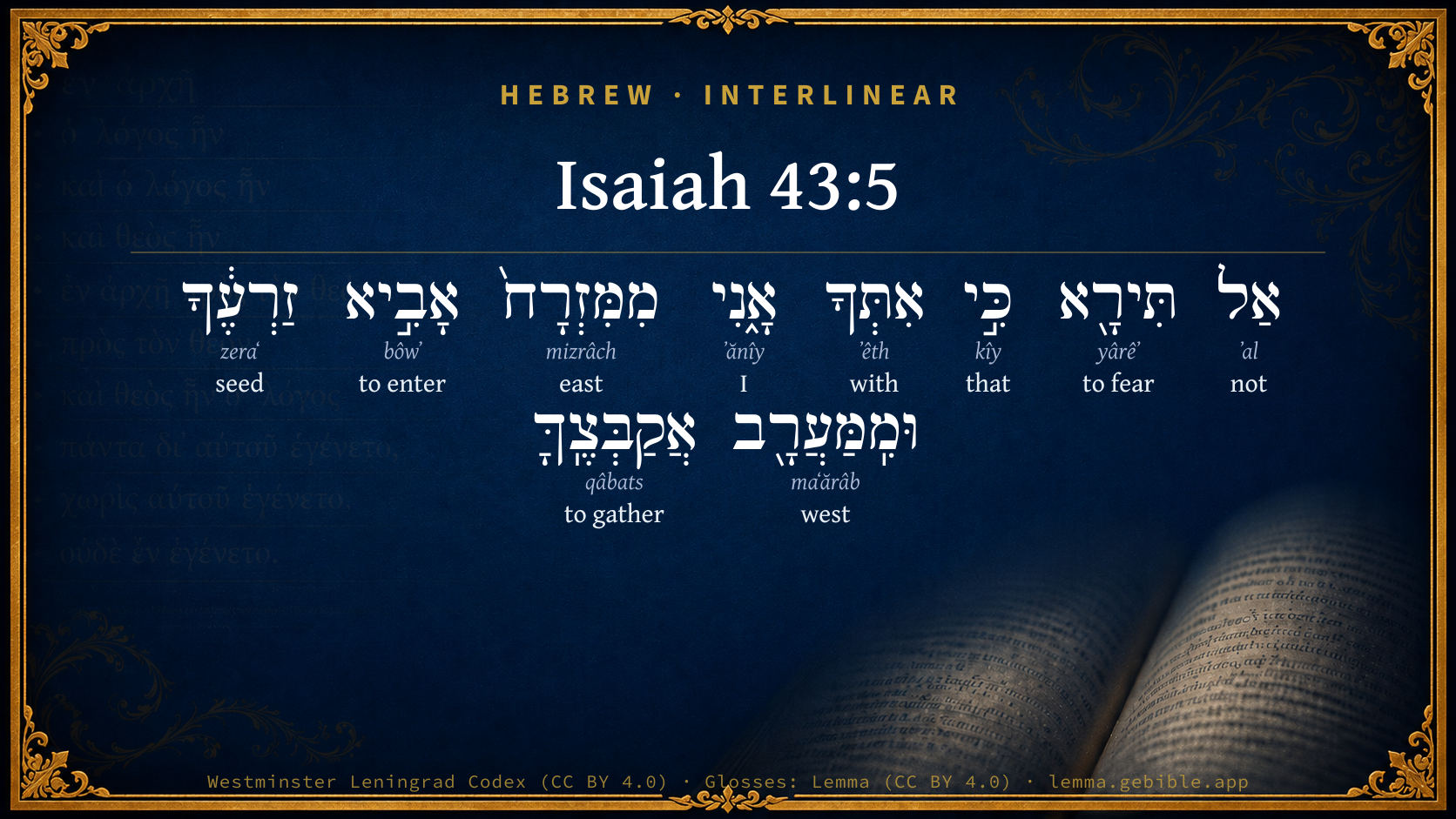
Hebrew (Westminster Leningrad Codex) Isaiah 43:5 appears in the Hebrew Old Testament. The text above is from the Westminster Leningrad Codex. Each word links to its Strong’s number, a concise gloss, and parsing drawn from the Open Scriptures Hebrew Bible morphology. Click any word for its full Brown-Driver-Briggs (BDB) entry.
Download image
Cite this verse

Isaiah 43:5 (World English Bible). Public Domain. Lemma interlinear Bible study tool, https://lemma.gebible.app/v/isaiah/43/5.

Show BibTeX & RIS
BibTeX
RIS
English Translation
Don't be afraid; for I am with you: I will bring your seed from the east, and gather you from the west;
World English Bible · Public Domain
Download a study sheet

One document with this verse’s original text, its word-by-word gloss line, the meaning frame, cross-references with their text, attributed commentary, and full source and license credits — printable, and it pastes into notes with its structure intact.

This verse Autodidact and up

Study sheet (.html) Plain text (.txt)

A passage Seminary Student

Up to 50 verses in one chapter. A passage sheet keeps up to 6 commentary sources and 12 cross-references per verse, in the order this page ranks them, and says so on the sheet whenever that leaves anything out. Ask for a single verse and you get the Autodidact verse sheet above.

Everything on this page stays free to read, with no account — the sheet is a download of what is already on screen, not access to it.

Want to remove ads? Support Godless Engineer
Compare translations 3

The same verse in 3 English versions, stacked beneath the original-language interlinear above. Click any original word for its lexicon entry.

Each is an independent rendering of the whole verse — the interlinear is not word-aligned to these translations.

Highlighted words mark where these versions differ — a whole-verse word diff, not a word-by-word alignment.

  • World English Bible Public Domain
    Don't be afraid; for I am with you: I will bring your seed from the east, and gather you from the west;
  • King James Version Public Domain
    Fear not: for I am with thee: I will bring thy seed from the east, and gather thee from the west;
  • unfoldingWord Literal Text CC BY-SA 4.0
    May you not fear, for I with you; from the rising I will bring your seed, and from the setting I will gather you.

unfoldingWord Literal Text — © unfoldingWord, licensed CC BY-SA 4.0. Word-aligned USFM3 via Door43 (git.door43.org/unfoldingWord/en_ult).

Versions to compare (up to 4)

3 of 4 selected

Show all 18 translations

Every available English version of this verse, each an independent rendering of the whole verse.

  • World English Bible Public Domain
    Don't be afraid; for I am with you: I will bring your seed from the east, and gather you from the west;
  • Berean Standard Bible Public Domain
    Do not be afraid, for I am with you; I will bring your offspring from the east and gather you from the west.
  • Majority Standard Bible Public Domain
    Do not be afraid, for I am with you; I will bring your offspring from the east and gather you from the west.
  • King James Version Public Domain
    Fear not: for I am with thee: I will bring thy seed from the east, and gather thee from the west;
  • American Standard Version (1901) Public Domain
    Fear not; for I am with thee: I will bring thy seed from the east, and gather thee from the west;
  • Revised Version (1885) Public Domain
    Fear not; for I am with thee: I will bring thy seed from the east, and gather thee from the west;
  • Geneva Bible (1599) Public Domain
    Feare not, for I am with thee: I will bring thy seede from the East, and gather thee from the West.
  • Douay-Rheims (1899) Public Domain
    Fear not, for I am with thee: I will. bring thy seed from the east, and gather thee from the west.
  • Young's Literal Translation Public Domain
    Be not afraid, for I `am' with thee, From the east I bring in thy seed, And from the west I gather thee.
  • Literal Standard Version CC BY-SA 4.0
    Do not be afraid, for I [am] with you, || I bring in your seed from the east, || And I gather you from the west.
  • Unlocked Literal Bible CC BY-SA 4.0
    Do not be afraid, for I am with you; I will bring your offspring from the east, and gather you from the west.
  • unfoldingWord Literal Text CC BY-SA 4.0
    May you not fear, for I with you; from the rising I will bring your seed, and from the setting I will gather you.
  • Darby Bible Public Domain
    Fear not, for I [am] with thee: I will bring thy seed from the east, and gather thee from the west;
  • World Messianic Bible Public Domain
    Don’t be afraid, for I am with you. I will bring your offspring from the east, and gather you from the west.
  • Webster's Bible Public Domain
    Fear not: for I am with thee: I will bring thy seed from the east, and gather thee from the west;
  • Free Bible Version CC BY-SA 4.0
    Don't be afraid, for I am with you! I will bring you and your children from the east and the west, and gather you together.
  • Bible in Basic English Public Domain
    Have no fear, for I am with you: I will take your seed from the east, and get you together from the west;
  • JPS Tanakh (1917) Public Domain
    Fear not, for I am with thee; I will bring thy seed from the east, and gather thee from the west;

Literal Standard Version (2020), Covenant Press — licensed CC BY-SA 4.0. Text via the HelloAO Bible API (eBible.org). Unlocked Literal Bible (unfoldingWord) — licensed CC BY-SA 4.0. Text via the HelloAO Bible API (eBible.org). unfoldingWord Literal Text — © unfoldingWord, licensed CC BY-SA 4.0. Word-aligned USFM3 via Door43 (git.door43.org/unfoldingWord/en_ult). Free Bible Version, Dr. Jonathan Gallagher — licensed CC BY-SA 4.0. Text via the HelloAO Bible API (eBible.org).

Word by word

More ways to search: Search by grammar → Find every occurrence → Compare this word →

Practice this passage: Drill this verse → Learn its vocabulary →

וּמִֽמַּעֲרָ֖ב
maʻărâb
H4628
“and · from · west”
Conjunction + Preposition + Noun, Common, Masculine, Singular, Absolute
Part of Speech
Conjunction + Preposition + Noun
Type
Common
Gender
Masculine
Number
Singular
State
Absolute
Full BDB Definition

Origin: from H6150 , in the sense of shading

TWOT: 1689b

setting place, west, westward
  1. אַל ʼal H408 “not” Particle, Negative
  2. תִּירָ֖א yârêʼ H3372 “to fear” Verb, Qal, Jussive, 2nd Person, Masculine, Singular
  3. כִּ֣י kîy H3588 “that” Conjunction
  4. אִתְּךָ ʼêth H854 “with · you” Preposition + Suffix, Personal, 2nd Person, Masculine, Singular
  5. אָ֑נִי ʼănîy H589 “I” Pronoun, Personal, 1st Person, Common, Singular
  6. מִמִּזְרָח֙ mizrâch H4217 “from · east” Preposition + Noun, Common, Masculine, Singular, Absolute
  7. אָבִ֣יא bôwʼ H935 “to enter” Verb, Hiphil, Imperfect, 1st Person, Common, Singular
  8. זַרְעֶ֔ךָ zeraʻ H2233 “seed · your” Noun, Common, Masculine, Singular, Construct + Suffix, Personal, 2nd Person, Masculine, Singular
  9. אֲקַבְּצֶֽךָּ qâbats H6908 “to gather · you” Verb, Piel, Imperfect, 1st Person, Common, Singular + Suffix, Personal, 2nd Person, Masculine, Singular

About this verse

These counts appear in no published source. They are computed here, from the morphology-tagged text and Lemma’s own curated glosses. What Lemma adds →

10
words
10
distinct lemmas
Prophets
section

Notable vocabulary

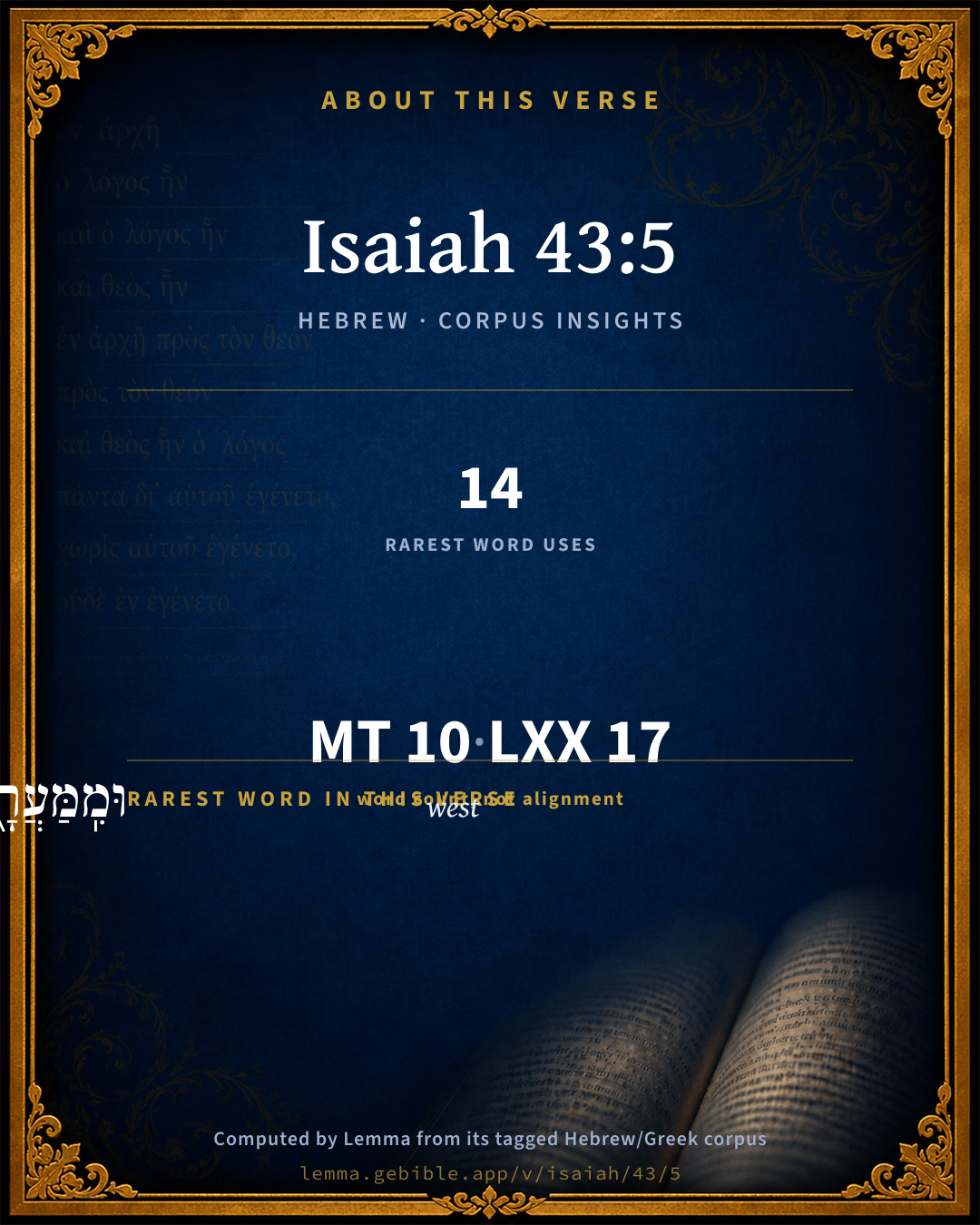
The rarest word here is וּמִֽמַּעֲרָ֖ב west H4628 — appearing just 14 times in the whole Hebrew Bible.

Shared distinctive vocabulary

וּמִֽמַּעֲרָ֖ב west H4628 occurs in 14 verses of the Hebrew Bible. Also found in:

Grammatical profile

  • 3 verbs
  • 3 nouns
  • 1 pronoun
  • 1 preposition
  • 1 conjunction
  • 1 particle

Verb forms

  • תִּירָ֖א Qal · Jussive
  • אָבִ֣יא Hiphil · Imperfect
  • אֲקַבְּצֶֽךָּ Piel · Imperfect

Hebrew & Septuagint length

In English translation the verse runs 22 words from the Hebrew and 22 from the Septuagint (LXX English) — the same length.

A rough comparison of the two English renderings, which tokenize alike — not a word-level alignment.

Word counts can differ between the Hebrew and the Greek without any difference in meaning — e.g. the Hebrew direct-object marker אֵת has no separate Greek word, and Greek often adds the article ὁ.

In the original languages it is 10 Hebrew tokens and 17 Greek tokens — but the two are counted differently (Hebrew bundles its prefixes and suffixes into one token; the Greek is in lemma form), so that isn’t a like-for-like length.

Cross-references

27

Topical passages linked to Isaiah 43:5 in the Treasury of Scripture Knowledge — connected by theme and wording, ordered by reader-vote popularity; previews shown in the World English Bible.

  • Deuteronomy 30:3 that then Yahweh your God will turn your captivity, and have compassion on you, and will return and gather you from all the peoples, where Yahweh your God has scattered you.
  • Isaiah 49:12 Behold, these shall come from far; and, behold, these from the north and from the west; and these from the land of Sinim.
  • Ezekiel 39:25–29 Therefore thus says the Lord Yahweh: Now will I bring back the captivity of Jacob, and have mercy on the whole house of Israel; and I will be jealous for my holy name.
  • Luke 13:29 They will come from the east, west, north, and south, and will sit down in the Kingdom of God.
  • Isaiah 44:2 Thus says Yahweh who made you, and formed you from the womb, who will help you: Don't be afraid, Jacob my servant; and you, Jeshurun, whom I have chosen.
  • Isaiah 60:1–11 Arise, shine; for your light is come, and the glory of Yahweh is risen on you.
  • Ezekiel 36:24–27 For I will take you from among the nations, and gather you out of all the countries, and will bring you into your own land.
  • Acts 18:9–10 The Lord said to Paul in the night by a vision, "Don't be afraid, but speak and don't be silent;
  • Isaiah 43:2 When you pass through the waters, I will be with you; and through the rivers, they shall not overflow you: when you walk through the fire, you shall not be burned, neither shall the flame kindle on you.
  • Jeremiah 30:10–11 Therefore don't you be afraid, O Jacob my servant, says Yahweh; neither be dismayed, Israel: for, behold, I will save you from afar, and your seed from the land of their captivity; and Jacob shall return, and shall be quiet and at ease, and none shall make him afraid.
  • Jeremiah 31:8–9 Behold, I will bring them from the north country, and gather them from the uttermost parts of the earth, [and] with them the blind and the lame, the woman with child and her who travails with child together: a great company shall they return here.
  • Zechariah 8:7 Thus says Yahweh of Hosts: "Behold, I will save my people from the east country, and from the west country;
  • Isaiah 27:12–13 It shall happen in that day, that Yahweh will beat off [his fruit] from the flood of the River to the brook of Egypt; and you shall be gathered one by one, you children of Israel.
  • Isaiah 41:10 Don't you be afraid, for I am with you; don't be dismayed, for I am your God; I will strengthen you; yes, I will help you; yes, I will uphold you with the right hand of my righteousness.
  • Isaiah 41:14 Don't be afraid, you worm Jacob, and you men of Israel; I will help you, says Yahweh, and your Redeemer is the Holy One of Israel.
  • Ezekiel 37:21–28 Say to them, Thus says the Lord Yahweh: Behold, I will take the children of Israel from among the nations, where they are gone, and will gather them on every side, and bring them into their own land:
  • Psalms 22:27–31 All the ends of the earth shall remember and turn to Yahweh. All the relatives of the nations shall worship before you.
  • Psalms 106:47 Save us, Yahweh, our God, Gather us from among the nations, To give thanks to your holy name, To triumph in your praise!
  • Isaiah 41:8 But you, Israel, my servant, Jacob whom I have chosen, the seed of Abraham my friend,
  • Isaiah 66:19–20 I will set a sign among them, and I will send such as escape of them to the nations, to Tarshish, Pul, and Lud, who draw the bow, to Tubal and Javan, to the isles afar off, who have not heard my fame, neither have seen my glory; and they shall declare my glory among the nations.
  • Micah 2:12 I will surely assemble, Jacob, all of you; I will surely gather the remnant of Israel; I will put them together as the sheep of Bozrah, As a flock in the midst of their pasture; They will swarm with people.
  • John 10:16 I have other sheep, which are not of this fold. I must bring them also, and they will hear my voice. They will become one flock with one shepherd.
  • Psalms 107:3 And gathered out of the lands, From the east and from the west, From the north and from the south.
  • Isaiah 11:11–12 It shall happen in that day, that the Lord will set his hand again the second time to recover the remnant of his people, who shall remain, from Assyria, and from Egypt, and from Pathros, and from Cush, and from Elam, and from Shinar, and from Hamath, and from the islands of the sea.
  • Jeremiah 30:18–19 Thus says Yahweh: Behold, I will turn again the captivity of Jacob's tents, and have compassion on his dwelling-places; and the city shall be built on its own hill, and the palace shall be inhabited after its own manner.
  • 1 Kings 8:46–51 If they sin against you (for there is no man who doesn't sin), and you are angry with them, and deliver them to the enemy, so that they carry them away captive to the land of the enemy, far off or near;
  • Jeremiah 46:27–28 But don't be afraid you, Jacob my servant, neither be dismayed, Israel: for, behold, I will save you from afar, and your seed from the land of their captivity; and Jacob shall return, and shall be quiet and at ease, and none shall make him afraid.

Cross-references courtesy of OpenBible.info (CC BY 4.0).

Hebrew and Greek witnesses Masoretic Hebrew ↔ Greek Septuagint

The same verse in the two great witnesses to the Old Testament, shown verse-for-verse.

These are two independent witnesses, not word-aligned to each other, and the Septuagint is shown in lemma (dictionary) form.

Hebrew Isaiah 43:5 Masoretic · Westminster Leningrad Codex

אַל תִּירָ֖א כִּ֣י אִתְּךָ אָ֑נִי מִמִּזְרָח֙ אָבִ֣יא זַרְעֶ֔ךָ וּמִֽמַּעֲרָ֖ב אֲקַבְּצֶֽךָּ

Don't be afraid; for I am with you: I will bring your seed from the east, and gather you from the west;

World English Bible · Public Domain

Greek LXX Isaiah 43:5 Septuagint · lemma form

μή φοβέω ὅτι μετά σύ εἰμί ἀπό ἀνατολή ἄγω ὁ σπέρμα σύ καί ἀπό δυσμή συνἄγω σύ

Fear not; for I am with you: I will bring your seed from the east, and will gather you from the west.

LXX2012 (modern English Septuagint) · Public Domain

Hebrew: Westminster Leningrad Codex (CC BY 4.0). Greek: Septuagint (public domain); English from LXX2012 (modern English Septuagint) (Public Domain). How the Septuagint differs from the Hebrew →

Targum (Aramaic paraphrase)

1

The Targum is the ancient Jewish Aramaic paraphrase of the Hebrew Scriptures — an interpretive translation, not the Hebrew text itself. Onkelos (literal) and Pseudo-Jonathan (expansive) render the Torah, and Jonathan the Prophets. Coverage is partial: where no permissively-licensed English translation exists for a verse, only the Aramaic is shown. This is verse-level text, not a word-by-word alignment to the Hebrew.

  1. Targum Jonathan Prophets (Joshua–Malachi)
    לָא תִדְחַל אֲרֵי בְסַעְדָךְ מֵימְרִי מִמַדִינְחָא אַיְתִי בְנָךְ וּמִמַעֲרְבָא אֱקָרֵיב גַלְוָתָךְ:

    Fear not, for my WORD shall be thy support; I will bring thy children from the east, I will bring together thy captivity from the west.

    Targum Jonathan — Aramaic: “Mikraot Gedolot” (public domain). English: “Sefaria Community Translation” (CC0 1.0 (public-domain dedication)); “London "Chaldee Paraphrase," 1871” (public domain). Text via Sefaria.

Commentary

Notes on Isaiah 43:5 from classic Christian and Jewish commentators (each source and its license shown beneath its notes). The classic Christian expositions comment on the surrounding passage and are grouped to its opening verse, so a note may address several verses; the Jewish commentaries on the Tanakh (Rashi and others) are per-verse, so they appear only where the commentator wrote on this verse.

Lemma curates 59 commentaries, every one of them public domain or Creative Commons licensed, each selected and text-cleaned for this edition rather than reprinted as found. About our sources →

Trapp's Complete Commentary

John Trapp

Isa 43:5 Fear not: for I [am] with thee: I will bring thy seed from the east, and gather thee from the west;

Ver. 5. I will bring thy seed from the east.] From all coasts and quarters. This was a type of the Church in the New Testament; see Mat 8:11 Joh 11:52 Joh 10:16 Gal 3:28; this was also a type of the last resurrection. See Rev 20:13.

John Trapp, A Commentary or Exposition upon All the Books of the Old and New Testament (1647–1656) — public domain. Text from a community e-Sword module.

The Biblical Illustrator

Joseph S. Exell

Isa_43:5-6

I will bring thy seed from the east

Obligations of Christians to labour for the conversion of the Jews

This prophecy looks far beyond the deliverance of the Jews from their former captivity.

It evidently points to that great and glorious deliverance which still awaits them. A deliverance that will eclipse and infinitely outshine their former deliverances from Egypt and from Babylon. Apply the passage to the recall and conversion of the Jews.

I. OUR OBLIGATIONS, AS CHRISTIANS, TO ENGAGE IN THIS WORK.

1. Gratitude for the inestimable benefits which we have derived from them Rom_3:1-2; Rom_9:4-5).

2. As a reparation of the cruel wrongs and injuries which we have inflicted upon them. Every Christian country is deep in this guilt, and every Christian country requires a national expiation of it.

3. From an ardent desire to promote the glory of God.

II. OUR ENCOURAGEMENT TO PROCEED AND PERSEVERE IN IT. To some, the attempt to convert the Jews may appear visionary; to others, inexpedient; but they who are acquainted with their Bibles must know that it is not hopeless. We are encouraged to attempt this work--

1. From the testimony of prophecy.

2. From the very great attention which has already been excited among the Jews.

3. From the present signs of the times.

III. THE GLORIOUS CONSEQUENCES THAT WILL RESULT FROM THE CONVERSION OF THE JEWS.

1. To the world. It will be the commencement of a new and blessed era to all nations.

2. To the Church of God. The conversion of the Jews shall be the means of bringing in the whole fulness of the Gentiles.

(1) To Gods covenant with Abraham and with his seed you owe all that you are, and all that you hope to be.

(2) When Christ sent forth His apostles to preach the Gospel of the kingdom, He particularly charged them to begin at Jerusalem. (Earl Gibbee, D. D.)

The Biblical Illustrator, edited by Joseph S. Exell (c. 1880s–1900s) — public domain. Text from a community e-Sword module.

Joseph Benson's Commentary

Isa 43:5-7. I will bring thy seed from the east, &c. — Although the Jews, for their sins, shall be carried captives out of their own land northward and eastward into Babylon, and the adjacent countries; and others of them shall flee southward and westward, and shall there pine away in their iniquities, as I have threatened; yet I will bring back their posterity into Canaan, from all the places where they are dispersed. I will say to the north, Give up — Thou, who hast so long held my people in bondage, resign them to me, and permit them to return to their own land. He speaks to the countries by a prosopopœia. Bring my sons from far — Not only permit, but assist and further their return. Every one that is called — Rather, every one is called, or, they are all called, by my name — I own them for my people and children; and, therefore, what kindness or cruelty you exercise toward them, I take it as done to myself. I have created him for my glory — And therefore I will glorify my power, and goodness, and faithfulness in delivering them. I have formed him — I have not only created them out of nothing, but I have also formed and made them my peculiar people. We must observe, however, that while Isaiah “appears to speak of one thing only, two are understood: the less includes the greater. Speaking literally and properly of the collection of the dispersed church from Babylon, — a more noble collection, the spiritual one, of the converted Jews and Gentiles to the church of Christ, was in his view; and this is described in expressions taken from the external collection of the church from Babylon, and the restoration of the republic under the Maccabees; exactly in the same manner as in chap. 11:12, which should be compared with this place. The 7th verse plainly shows that the spiritual seed of Israel is spoken of. Every one that is called by my name, means, every one who is truly my son; for to be called by the name of any one is to be his son.” See chap. 45:5, and Vitringa.

Joseph Benson's Commentary on the Old and New Testaments (1811–1818) — public domain. Text from a community e-Sword module.

The Preacher's Complete Homiletical Commentary

Joseph S. Exell (gen. ed.)

FOREBODINGS FORBIDDEN

(A Motto Text for the New Year.)

Isa_43:5. Fear not, for I am with thee.

Again we enter upon the dark of uncertainty. Standing upon the threshold of another year, which we know by experience will have its cares, and its perils, and its sorrows. What is the true antidote of fear? What is the real elixir of the happiness we wish to one another but the presence and protection of the Lord? This He guarantees to us: “Fear not, for I am with thee.”

I. FEAR IS NATURAL TO MAN.

1. As a feeble creature in the midst of the irresistible and mysterious powers of the universe. What can allay this fear but the protection of One who can control those forces, who is mightier than they, and will use that might in my behalf?

2. As a sinner, conscious of violations of the law of the Great Ruler, and therefore justly apprehensive of the divine displeasure. The religion of the Bible reveals the Creator as a Saviour, delighting in mercy. Thus the real language of the Bible is, Fear not. To Abraham, Isaac, Joshua, Gideon, &c. In all these exhortations not to fear, the reason given is Jehovah’s presence; but it is that very presence that makes the conscious sinner afraid (Gen_3:8). Yet in the Bible the presence of God is urged as a dissuasive against fear. Because God is revealed to us as merciful, &c.—in Jesus Christ as the Saviour and the friend of sinners.

II. THOSE QUALITIES WHICH RENDER THE PRESENCE OF GOD AN ANTIDOTE TO FEAR.

The power which any one possesses to dissipate fear by his presence depends upon the qualities of that person, his ability and his willingness to help. The character of God is what He is in Himself, what He has already done, and what He has promised to do; it is this which gives force to the exhortation, “Fear not, for I am with thee.”

III. SOME OF THOSE OCCASIONS TO WHICH THE EXHORTATION IS SPECIALLY APPLICABLE.

The first Sabbath of the year. We walk forward in darkness; what that darkness conceals we cannot even conjecture. Fear may suggest various evils. God says, “Fear not, for I am with thee.” To some the year is sure to prove one of severe trial. To some this year will be the last on earth.

CONCLUSION.—Appeal to those who do not regard the presence of God as the chief element of their joy, as that which chiefly will make the year a happy one.—Newman Hall, LL.B.: The Christian World, January 8, 1864.

The Preacher's Complete Homiletical Commentary (gen. ed. Joseph S. Exell; Funk & Wagnalls, c. 1892) — public domain (pre-1929). A full-Bible homiletical/sermon-outline anthology covering 65 of 66 books (2 John is absent from the source module). Text from a community e-Sword module.

Geneva Bible (1599)

Geneva Bible translators

He prophesieth of their deliverance from the captivity of Babylon, and so of the calling of the universal Church, alluding to that which is written, Deut. 30:3.

Geneva Bible (1599) marginal notes — public domain. Text via Bolls.life.

Jamieson, Fausset & Brown

Robert Jamieson, A. R. Fausset & David Brown

(Deu 30:3).

seed--descendants scattered in all lands. VITRINGA understands it of the spiritual "seed" of the Church produced by mystical regeneration: for the expression is, "bring," not "bring back." This sense is perhaps included, but not to the exclusion of the literal Israel's restoration (Jer 30:10-11; Amo 9:9; Zac 2:6-13).

Jamieson, Fausset & Brown — Commentary Critical and Explanatory on the Whole Bible (1871) — public domain (CC PDM 1.0). Text via the HelloAO Bible API.

Ellicott's Commentary for English Readers

(5) From the east . . .—Even from Isaiah’s stand-point, the dispersion of Israel might well be contemplated in all this wide extent. The Ten Tribes were already carried off to the cities of the Medes (2Ki_17:6). The Babylonian exile had its beginning under Esar-haddon (2Ch_33:11); others may have been found before the time of Zephaniah (Zep_3:10) beyond the rivers of Ethiopia. Even in the time of Joel the slave-trade of the Phœnicians had carried the sons of Judah and Jerusalem to the western isles of Javan, or Ionia (Joe_3:6).

A Bible Commentary for English Readers, edited by Charles John Ellicott (1878–1897) — public domain. Text from a community e-Sword module.

The Cambridge Bible for Schools and Colleges

gen. ed. J. J. S. Perowne

5–7. The ingathering of the Dispersion (cf. ch. Isa_49:12).

The Cambridge Bible for Schools and Colleges (gen. ed. J. J. S. Perowne; Cambridge University Press, 1878–1918) — public domain. Text from a community e-Sword module.

John Gill's Exposition

Fear not, for I am with thee,.... With thy ministers that preach the everlasting Gospel, to make it effectual to the conversion of many everywhere, as well as to bear thee up under all trials, and to cause thee to stand against all opposition:

I will bring thy seed from the east, and gather thee from the west; which is to be understood not literally of the return of the Jews from the Babylonish captivity; for these several quarters, east, west, north, and south, will hardly agree with that, though it may be supposed they were scattered in several countries; but spiritually of the gathering in of God's elect, whether Jews or Gentiles, which were scattered abroad throughout the world, called the "seed" of the church, because born to her, and brought up in her, and of which she consists; and therefore she herself is said to be gathered, converts being brought in from all quarters; from the "east", even from India, where the Apostle Thomas is said to preach the Gospel, and from other "eastern" countries; and from the "west", from the European nations, good part of which lay west of Judea. Our Lord seems to have respect to this passage in Mat 8:12.

John Gill's Exposition of the Whole Bible (1746–1763) — public domain (CC PDM 1.0). Text via the HelloAO Bible API.

Albert Barnes' Notes on the Bible

Fear not - (see the note at Isa 41:10, Isa 41:14; compare Isa 43:1).

I will bring thy seed - Thy children; thy descendants. The sense is, I will re-collect my scattered people from all parts of the world. The passage appears to have been taken from Deu 30:3, where God promises to gather his people together again if they should be scattered among the nations, and should then repent. Vitringa understands this of the spiritual descendants of the Jews, or of those who should believe on the Messiah among the Gentiles, and who should become the people of God. But the more natural interpretation is, to refer it to the Jews who were scattered abroad during the exile at Babylon, and as a promise to re-collect them again in their own land.

From the east ... - From all parts of the earth; from all lands where they were scattered. That they were driven to other places than Babylon on the invasion of their land by the Chaldeans, is abundantly manifest in the historical records Jer 9:16; Eze 5:12; Eze 17:21; Amo 9:9; Zec 2:6.

Albert Barnes' Notes on the Bible (1834–1885) — public domain. Text from a community e-Sword/MySword module.

Haydock's Catholic Bible Commentary

East. Babylon. --- West. The island beyond the Mediterranean.

George Leo Haydock (1774–1849), Haydock's Catholic Family Bible and Commentary, 1859 edition — public domain. Excludes Psalms (Douay-Rheims chapter numbering differs from Protestant) and Deuterocanonical books (Catholic canon only).

Matthew Poole's English Annotations

Although the Jews shall for their sins be carried captives out of their own land northward and eastward into Babylon and the adjacent countries, and others of them shall flee southward and westward, and shall there pine away in their iniquities, as I threatened; yet their posterity I will bring back into Canaan, from all the places where they are dispersed.

Matthew Poole's English Annotations on the Holy Bible (1683–1685) — public domain. Text from a community e-Sword/MySword module.

Whedon's Commentary on the Bible

Daniel D. Whedon

5-7. Fear not — Resumed from Isa_43:1, to add a second reason for Israel’s confidence — because God commands restoration from every quarter — from east, west, north, south. Not literal restoration of all the dispersed of Israel to the literal Zion, but a spiritual restoring, shall occur of every one… called by my name. Thus explaining why God has created… formed… made, Israel. Gentiles are hence intended as included with believing Jews.

Daniel D. Whedon (gen. ed.), Commentary on the Old and New Testaments (1874–1909) — public domain. Text from a community e-Sword module.

The Pulpit Commentary

Fear not: for I am with thee. (comp. Isa_41:10) I will bring thy seed from the east... from the west. The actual extent of the Jewish diaspora in Isaiah"s day has been greatly exaggerated by some modern critics, who say that there were at that date "bands of Jewish exiles in the far lands of the Mediterranean, and even in China" (Cheyne). Israel had been carried captive into Mesopotamia and into Media, (1Ch_5:26) perhaps, also, into other regions belonging at the time to Assyria, as Babylonia, Assyria Proper, Syria. Two hundred thousand Jews had been taken to Nineveh by Sennacherib ("Eponym Canon," p. 134), and planted probably by him m outlying portions of his dominions. But such transplantation would not carry the dispersion further than Cilicia and Cyprus towards the west, Armenia towards the north, Media towards the east, and the shores of the Persian Gulf towards the south. Any scattering of the nation into regions more remote than these, as into Egypt, Ethiopia, Elam, (Isa_11:11) and China if Sinim is (Isa_49:12) must have been seen by Isaiah in vision, or made known to him by revelation. It had not taken place in his day. The expression, "ends of the earth" (ver. 6), must not be pressed in Isaiah any more than in Herodotus, where the escatiai thv oikoumehv are India, Arabia, Ethiopia, and Scythia (3:106-116).

The Pulpit Commentary (1880–1919), ed. H.D.M. Spence-Jones & Joseph S. Exell — public domain. Text from a community e-Sword module.

Keil & Delitzsch

C. F. Keil & F. Delitzsch

The encouraging "Fear not" is here resumed, for the purpose of assigning a still further reason. "Fear not; for I am with thee: I bring thy seed from the east, and from the west will I gather them; I will say to the north, Give up; and to the south, Keep not back: bring my sons from far, and my daughters from the end of the earth; everything that is called by my name, and I have created for my glory, that I have formed, yea finished!" The fact that Jehovah is with Israel will show itself in this, that He effects its complete restoration from all quarters of the heaven (compare the lands of the diaspora in all directions already mentioned by Isaiah in Isa 11:11-12). Jehovah's command is issued to north and south to give up their unrighteous possession, not to keep it back, and to restore His sons and daughters (compare the similar change in the gender in Isa 11:12), which evidently implies the help and escort of the exiles on the part of the heathen (Isa 14:2). The four quarters and four winds are of the feminine gender. In Isa 43:7 the object is more precisely defined from the standpoint of sacred history. The three synonyms bring out the might, the freeness, and the riches of grace, with which Jehovah called Israel into existence, to glorify Himself in it, and that He might be glorified by it. They form a climax, for בּרא signifies to produce as a new thing; יצר, to shape what has been produced; and עשׂה, to make it perfect or complete, hence creavi, formavi, perfeci.

Keil & Delitzsch — Biblical Commentary on the Old Testament (1861–1891) — public domain (CC PDM 1.0). Text via the HelloAO Bible API. (Old Testament only.)

J. A. Alexander on Isaiah

Joseph Addison Alexander

“Fear not, for I (am) with thee; from the east will I make (or let) thy seed come, and from the west will I gather thee.” The reference of this verse to the restoration of the Jews from Babylon is not only arbitrary and without foundation, but forbidden by the mention of the west as well as the east. That it refers to any restoration is the more improbable, because the Prophet does not say bring back but simply bring. The only interpretation which entirely suits the text and context, without supplying or assuming anything beyond what is expressed, is that which makes the verse a promise to the church that she should be completed, that all her scattered members should be ultimately brought together. (Compare Joh 11:52; Rom 3:29; 1Jn 2:2). ‘Thy seed’ has reference to Israel or Jacob as the ideal object of address.

Joseph Addison Alexander, The Prophecies of Isaiah (1846–1847; New York: Scribner, 1870–1878) — public domain. Text from a community e-Sword module.

Ibn Ezra

Rabbi Abraham ibn Ezra

From the east. From Babylon.

From the west. From Egypt and Assyria. Comp. Ezr. 6:22.

Ibn Ezra on the Tanakh — English translations: “Sefaria Community Translation” (CC0 1.0 (public-domain dedication)); “Yalkut, Sifsei Chachomim Chumash, Metsudah Publications, 2009” (CC BY 4.0); and “Commentary of Ibn Ezra on Isaiah - trans. by M. Friedlander, 1873” (public domain). Text via Sefaria.

Lesson kit

Teaching starters — assembled from the data on this page, not authored interpretation. Every prompt links to the verse data it draws on. Edit before teaching.

Isaiah, in the Prophets, opens this verse with 10 words (10 distinct Hebrew lemmas). Its most distinctive word is maʻărâb (“west”). A historical commentator’s framing appears above. Read the whole chapter for the surrounding context.

Discussion questions

  1. What does “west” (maʻărâb) contribute to the verse as a whole?
  2. How does 1 Chronicles 7:28, which shares the word «west», read alongside this verse?
  3. The translations on this page render this verse differently — a whole-verse word diff, not a word-by-word alignment. What might account for the different wordings?
  4. «תִּירָ֖א» is a Qal Jussive verb. How does that grammatical form shape the action described?
  5. Compare how Trapp's Complete Commentary and The Biblical Illustrator read this verse. Where do they agree or differ?

Things to notice

Reading settings

Reading text

Shown beneath each verse's original-language words.

Old Testament
Old Testament edition

Read the OT as the Masoretic Hebrew (MT) or the Greek Septuagint (LXX).

English shown for the Greek Septuagint (in the Hebrew ↔ Greek comparison).

Comparing translations? Open the Compare panel on any verse page to stack up to four side by side.