
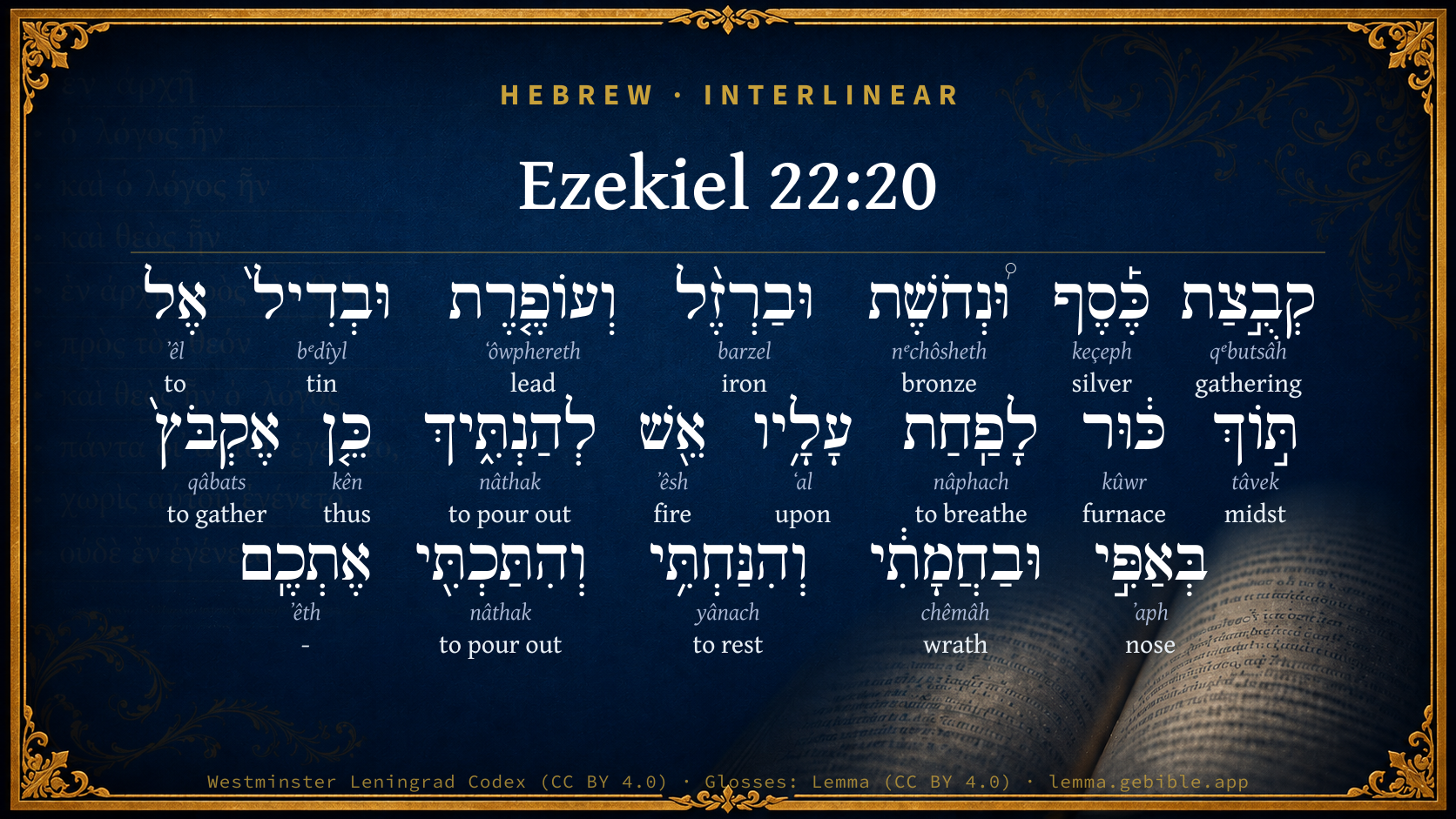
Ezekiel 22:20

Hebrew (Westminster Leningrad Codex) Ezekiel 22:20 appears in the Hebrew Old Testament. The text above is from the Westminster Leningrad Codex. Each word links to its Strong’s number, a concise gloss, and parsing drawn from the Open Scriptures Hebrew Bible morphology. Click any word for its full Brown-Driver-Briggs (BDB) entry.
Download image
Cite this verse

Ezekiel 22:20 (World English Bible). Public Domain. Lemma interlinear Bible study tool, https://lemma.gebible.app/v/ezekiel/22/20.

Show BibTeX & RIS
BibTeX
RIS
English Translation
As they gather silver and brass and iron and lead and tin into the midst of the furnace, to blow the fire on it, to melt it; so will I gather you in my anger and in my wrath, and I will lay you there, and melt you.
World English Bible · Public Domain
Highlights
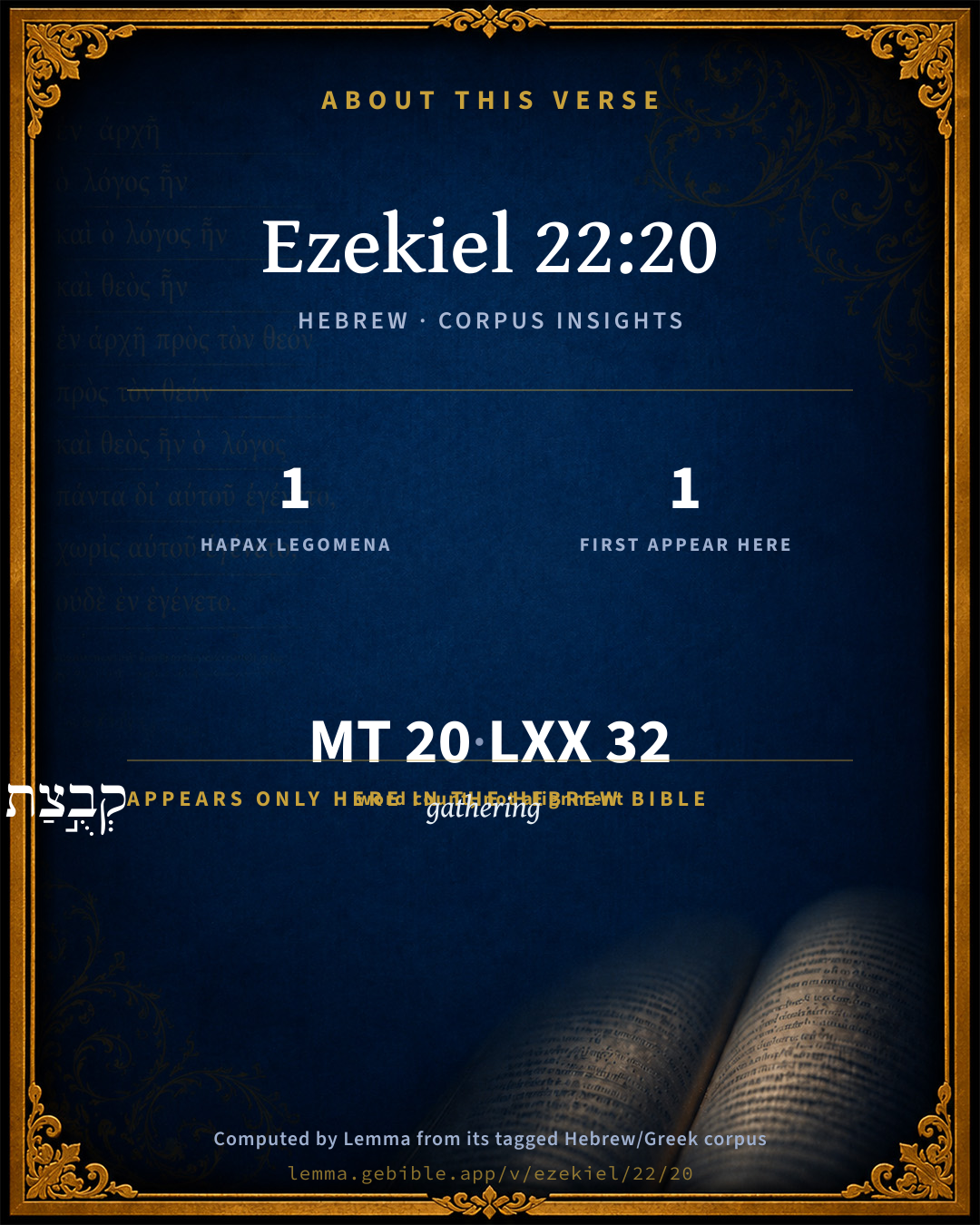
  • 1 hapax legomenon — only here in the Hebrew Bible
  • 1 first appearance in the Hebrew Bible
Full analysis ↓
Download a study sheet

One document with this verse’s original text, its word-by-word gloss line, the meaning frame, cross-references with their text, attributed commentary, and full source and license credits — printable, and it pastes into notes with its structure intact.

This verse Autodidact and up

Study sheet (.html) Plain text (.txt)

A passage Seminary Student

Up to 50 verses in one chapter. A passage sheet keeps up to 6 commentary sources and 12 cross-references per verse, in the order this page ranks them, and says so on the sheet whenever that leaves anything out. Ask for a single verse and you get the Autodidact verse sheet above.

Everything on this page stays free to read, with no account — the sheet is a download of what is already on screen, not access to it.

Want to remove ads? Support Godless Engineer
Compare translations 3

The same verse in 3 English versions, stacked beneath the original-language interlinear above. Click any original word for its lexicon entry.

Each is an independent rendering of the whole verse — the interlinear is not word-aligned to these translations.

Highlighted words mark where these versions differ — a whole-verse word diff, not a word-by-word alignment.

  • World English Bible Public Domain
    As they gather silver and brass and iron and lead and tin into the midst of the furnace, to blow the fire on it, to melt it; so will I gather you in my anger and in my wrath, and I will lay you there, and melt you.
  • King James Version Public Domain
    As they gather silver, and brass, and iron, and lead, and tin, into the midst of the furnace, to blow the fire upon it, to melt it; so will I gather you in mine anger and in my fury, and I will leave you there, and melt you.
  • unfoldingWord Literal Text CC BY-SA 4.0
    As men gather silver, bronze, iron, lead and tin and put it inside a furnace to melt it, and they blow the fire on it in order to melt it, so I will gather you in my anger and my wrath, and I will put you there and melt you.

unfoldingWord Literal Text — © unfoldingWord, licensed CC BY-SA 4.0. Word-aligned USFM3 via Door43 (git.door43.org/unfoldingWord/en_ult).

Versions to compare (up to 4)

3 of 4 selected

Show all 18 translations

Every available English version of this verse, each an independent rendering of the whole verse.

  • World English Bible Public Domain
    As they gather silver and brass and iron and lead and tin into the midst of the furnace, to blow the fire on it, to melt it; so will I gather you in my anger and in my wrath, and I will lay you there, and melt you.
  • Berean Standard Bible Public Domain
    Just as one gathers silver, copper, iron, lead, and tin into the furnace to melt with a fiery blast, so I will gather you in My anger and wrath, leave you there, and melt you.
  • Majority Standard Bible Public Domain
    Just as one gathers silver, copper, iron, lead, and tin into the furnace to melt with a fiery blast, so I will gather you in My anger and wrath, leave you there, and melt you.
  • King James Version Public Domain
    As they gather silver, and brass, and iron, and lead, and tin, into the midst of the furnace, to blow the fire upon it, to melt it; so will I gather you in mine anger and in my fury, and I will leave you there, and melt you.
  • American Standard Version (1901) Public Domain
    As they gather silver and brass and iron and lead and tin into the midst of the furnace, to blow the fire upon it, to melt it; so will I gather you in mine anger and in my wrath, and I will lay you there, and melt you.
  • Revised Version (1885) Public Domain
    As they gather silver and brass and iron and lead and tin into the midst of the furnace, to blow the fire upon it, to melt it; so will I gather you in mine anger and in my fury, and I will lay you there, and melt you.
  • Geneva Bible (1599) Public Domain
    As they gather siluer and brasse, and yron, and leade, and tinne into the middes of the fornace, to blowe the fire vpon it to melt it, so wil I gather you in mine anger and in my wrath, and wil put you there and melt you.
  • Douay-Rheims (1899) Public Domain
    As they gather silver, and brass, and tin, and iron, and lead in the midst of the furnace: that I may kindle a fire in it to melt it: so will I gather you together in my fury and in my wrath, and will take my rest, and I will melt you down.
  • Young's Literal Translation Public Domain
    A gathering of silver, and brass, and iron, and lead, and tin, Unto the midst of a furnace -- to blow on it fire, to melt it, So do I gather in Mine anger and in My fury, And I have let rest, and have melted you.
  • Literal Standard Version CC BY-SA 4.0
    A gathering of silver, and bronze, and iron, and lead, and tin, || Into the midst of a furnace—to blow fire on it, to melt it, || So I gather in My anger and in My fury, || And I have let rest, and have melted you.
  • Unlocked Literal Bible CC BY-SA 4.0
    As men gather silver, bronze, iron, lead and tin and put it inside a furnace to melt it, and they blow the fire on it in order to melt it, so I will gather you in my anger and my wrath, and I will put you there and melt you.
  • unfoldingWord Literal Text CC BY-SA 4.0
    As men gather silver, bronze, iron, lead and tin and put it inside a furnace to melt it, and they blow the fire on it in order to melt it, so I will gather you in my anger and my wrath, and I will put you there and melt you.
  • Darby Bible Public Domain
    [As] they gather silver, and copper, and iron, and lead, and tin, into the midst of the furnace, to blow the fire upon it, to melt it, so will I gather you in mine anger and in my fury, and I will lay you on and melt you.
  • World Messianic Bible Public Domain
    As they gather silver, bronze, iron, lead, and tin into the middle of the furnace, to blow the fire on it, to melt it, so I will gather you in my anger and in my wrath, and I will lay you there and melt you.
  • Webster's Bible Public Domain
    As they gather silver, and brass, and iron, and lead, and tin, into the midst of the furnace, to blow the fire upon it, to melt it; so will I gather you in my anger and in my fury, and I will leave you there, and melt you.
  • Free Bible Version CC BY-SA 4.0
    In the same way a refiner collects silver, copper, iron, lead, and tin and puts them in the blast furnace to melt them with fire, I'm going to collect you in my burning anger, and keep you there until I melt you.
  • Bible in Basic English Public Domain
    As they put silver and brass and iron and lead and tin together inside the oven, heating up the fire on it to make it soft; so will I get you together in my wrath and in my passion, and, heating the fire with my breath, will make you soft.
  • JPS Tanakh (1917) Public Domain
    As they gather silver and brass and iron and lead and tin into the midst of the furnace, to blow the fire upon it, to melt it; so will I gather you in Mine anger and in My fury, and I will cast you in, and melt you.

Literal Standard Version (2020), Covenant Press — licensed CC BY-SA 4.0. Text via the HelloAO Bible API (eBible.org). Unlocked Literal Bible (unfoldingWord) — licensed CC BY-SA 4.0. Text via the HelloAO Bible API (eBible.org). unfoldingWord Literal Text — © unfoldingWord, licensed CC BY-SA 4.0. Word-aligned USFM3 via Door43 (git.door43.org/unfoldingWord/en_ult). Free Bible Version, Dr. Jonathan Gallagher — licensed CC BY-SA 4.0. Text via the HelloAO Bible API (eBible.org).

Word by word

More ways to search: Search by grammar → Find every occurrence → Compare this word →

Practice this passage: Drill this verse → Learn its vocabulary →

קְבֻ֣צַת
qᵉbutsâh
H6910
“gathering of”
Noun, Common, Feminine, Singular, Construct
Part of Speech
Noun
Type
Common
Gender
Feminine
Number
Singular
State
Construct
Full BDB Definition

Origin: pass part of H6908

TWOT: 1983b

gathering, assembly
  1. כֶּ֡סֶף keçeph H3701 “silver” Noun, Common, Masculine, Singular, Absolute
  2. וּ֠נְחֹשֶׁת nᵉchôsheth H5178 “and · bronze” Conjunction + Noun, Common, Feminine, Singular, Absolute
  3. וּבַרְזֶ֨ל barzel H1270 “and · iron” Conjunction + Noun, Common, Masculine, Singular, Absolute
  4. וְעוֹפֶ֤רֶת ʻôwphereth H5777 “and · lead” Conjunction + Noun, Common, Feminine, Singular, Absolute
  5. וּבְדִיל֙ bᵉdîyl H913 “and · tin” Conjunction + Noun, Common, Masculine, Singular, Absolute
  6. אֶל ʼêl H413 “to” Preposition
  7. תּ֣וֹךְ tâvek H8432 “midst of” Noun, Common, Masculine, Singular, Construct
  8. כּ֔וּר kûwr H3564 “furnace” Noun, Common, Masculine, Singular, Absolute
  9. לָפַֽחַת nâphach H5301 “to breathe” Preposition + Verb, Qal, Infinitive Construct
  10. עָלָ֥יו ʻal H5921 “upon · him” Preposition + Suffix, Personal, 3rd Person, Masculine, Singular
  11. אֵ֖שׁ ʼêsh H784 “fire” Noun, Common, Both, Singular, Absolute
  12. לְהַנְתִּ֑יךְ nâthak H5413 “to pour out” Preposition + Verb, Hiphil, Infinitive Construct
  13. כֵּ֤ן kên H3651 “thus” Particle, Demonstrative
  14. אֶקְבֹּץ֙ qâbats H6908 “to gather” Verb, Qal, Imperfect, 1st Person, Common, Singular
  15. בְּאַפִּ֣י ʼaph H639 “in/at · nose · my” Preposition + Noun, Common, Masculine, Singular, Construct + Suffix, Personal, 1st Person, Common, Singular
  16. וּבַחֲמָתִ֔י chêmâh H2534 “and · in/at · wrath · my” Conjunction + Preposition + Noun, Common, Feminine, Singular, Construct + Suffix, Personal, 1st Person, Common, Singular
  17. וְהִנַּחְתִּ֥י yânach H3240 “and · to rest” Conjunction + Verb, Hiphil, Sequential Perfect, 1st Person, Common, Singular
  18. וְהִתַּכְתִּ֖י nâthak H5413 “and · to pour out” Conjunction + Verb, Hiphil, Sequential Perfect, 1st Person, Common, Singular
  19. אֶתְכֶֽם ʼêth H853 “- · you” Particle, Direct Object + Suffix, Personal, 2nd Person, Masculine, Plural

About this verse

These counts appear in no published source. They are computed here, from the morphology-tagged text and Lemma’s own curated glosses. What Lemma adds →

20
words
19
distinct lemmas
Prophets
section

Notable vocabulary

1 hapax legomenon — a word that appears only here in the entire Hebrew Bible:

  • קְבֻ֣צַת gathering H6910

First appearance in Scripture

This word makes its first canonical appearance in the Hebrew Bible here:

  • קְבֻ֣צַת gathering H6910

Shared distinctive vocabulary

וּבְדִיל֙ tin H913 occurs in 6 verses of the Hebrew Bible. Also found in:

Grammatical profile

  • 5 verbs
  • 11 nouns
  • 2 prepositions
  • 2 particles

Verb forms

  • לָפַֽחַת Qal · Infinitive Construct
  • לְהַנְתִּ֑יךְ Hiphil · Infinitive Construct
  • אֶקְבֹּץ֙ Qal · Imperfect
  • וְהִנַּחְתִּ֥י Hiphil · Sequential Perfect
  • וְהִתַּכְתִּ֖י Hiphil · Sequential Perfect

Repetition

A word recurs within this verse — often emphatic in Hebrew:

  • לְהַנְתִּ֑יךְ to pour out H5413 ×2

Hebrew & Septuagint length

In English translation the verse runs 48 words from the Hebrew and 43 from the Septuagint (LXX English) — closely comparable.

A rough comparison of the two English renderings, which tokenize alike — not a word-level alignment.

Word counts can differ between the Hebrew and the Greek without any difference in meaning — e.g. the Hebrew direct-object marker אֵת has no separate Greek word, and Greek often adds the article ὁ.

In the original languages it is 20 Hebrew tokens and 32 Greek tokens — but the two are counted differently (Hebrew bundles its prefixes and suffixes into one token; the Greek is in lemma form), so that isn’t a like-for-like length.

Cross-references

6

Topical passages linked to Ezekiel 22:20 in the Treasury of Scripture Knowledge — connected by theme and wording, ordered by reader-vote popularity; previews shown in the World English Bible.

  • Isaiah 54:16 Behold, I have created the smith who blows the fire of coals, and brings forth a weapon for his work; and I have created the waster to destroy.
  • Jeremiah 4:11–12 At that time shall it be said to this people and to Jerusalem, A hot wind from the bare heights in the wilderness toward the daughter of my people, not to winnow, nor to cleanse;
  • Jeremiah 4:20 Destruction on destruction is cried; for the whole land is laid waste: suddenly are my tents destroyed, [and] my curtains in a moment.
  • Ezekiel 21:31–32 I will pour out my indignation on you; I will blow on you with the fire of my wrath; and I will deliver you into the hand of brutish men, skillful to destroy.
  • Ezekiel 24:13 In your filthiness is lewdness: because I have cleansed you and you weren't cleansed, you shall not be cleansed from your filthiness any more, until I have caused my wrath toward you to rest.
  • Ezekiel 22:21 Yes, I will gather you, and blow on you with the fire of my wrath, and you shall be melted in the midst of it.

Cross-references courtesy of OpenBible.info (CC BY 4.0).

Hebrew and Greek witnesses Masoretic Hebrew ↔ Greek Septuagint

The same verse in the two great witnesses to the Old Testament, shown verse-for-verse.

These are two independent witnesses, not word-aligned to each other, and the Septuagint is shown in lemma (dictionary) form.

Hebrew Ezekiel 22:20 Masoretic · Westminster Leningrad Codex

קְבֻ֣צַת כֶּ֡סֶף וּ֠נְחֹשֶׁת וּבַרְזֶ֨ל וְעוֹפֶ֤רֶת וּבְדִיל֙ אֶל תּ֣וֹךְ כּ֔וּר לָפַֽחַת עָלָ֥יו אֵ֖שׁ לְהַנְתִּ֑יךְ כֵּ֤ן אֶקְבֹּץ֙ בְּאַפִּ֣י וּבַחֲמָתִ֔י וְהִנַּחְתִּ֥י וְהִתַּכְתִּ֖י אֶתְכֶֽם

As they gather silver and brass and iron and lead and tin into the midst of the furnace, to blow the fire on it, to melt it; so will I gather you in my anger and in my wrath, and I will lay you there, and melt you.

World English Bible · Public Domain

Greek LXX Ezekiel 22:20 Septuagint · lemma form

καθώς εἰςδέχομαι ἄργυρος καί χαλκός καί σίδηρος καί κασσίτερος καί μόλιβος εἰς μέσος κάμινος ὁ ἐκφυσάω εἰς αὐτός πῦρ ὁ χωνεύω οὕτως εἰςδέχομαι σύ ἐν ὀργή ἐγώ καί συνἄγω καί χωνεύω σύ

As silver, and brass, and iron, and tin, and lead, are gathered into the midst of the furnace, to blow fire into it, that they may be melted: so will I take you in my wrath, and I will gather and melt you.

LXX2012 (modern English Septuagint) · Public Domain

Hebrew: Westminster Leningrad Codex (CC BY 4.0). Greek: Septuagint (public domain); English from LXX2012 (modern English Septuagint) (Public Domain). How the Septuagint differs from the Hebrew →

Targum (Aramaic paraphrase)

1

The Targum is the ancient Jewish Aramaic paraphrase of the Hebrew Scriptures — an interpretive translation, not the Hebrew text itself. Onkelos (literal) and Pseudo-Jonathan (expansive) render the Torah, and Jonathan the Prophets. Coverage is partial: where no permissively-licensed English translation exists for a verse, only the Aramaic is shown. This is verse-level text, not a word-by-word alignment to the Hebrew.

  1. Targum Jonathan Prophets (Joshua–Malachi)
    כְּמַכְנֵשׁ כְּסַף וּנְחַשׁ וּבַרְזְלָא וַאֲבַר וּבְעִיץ לְגוֹ כוּרָא לְאַתְקָפָא עֲלוֹהִי נוּרָא לְאַמְסָיוּתֵיהּ כֵּן אַכְנֵשׁ בְּרוּגְזִי וּבְחֵימְתִי וְאָסֵיף וֶאֱשֵׁיצֵי יַתְכוֹן:

    (no public-domain English translation for this verse)

    Targum Jonathan — Aramaic: “Mikraot Gedolot” (public domain). English: “Sefaria Community Translation” (CC0 1.0 (public-domain dedication)); “London "Chaldee Paraphrase," 1871” (public domain). Text via Sefaria.

Commentary

Notes on Ezekiel 22:20 from classic Christian and Jewish commentators (each source and its license shown beneath its notes). The classic Christian expositions comment on the surrounding passage and are grouped to its opening verse, so a note may address several verses; the Jewish commentaries on the Tanakh (Rashi and others) are per-verse, so they appear only where the commentator wrote on this verse.

Lemma curates 59 commentaries, every one of them public domain or Creative Commons licensed, each selected and text-cleaned for this edition rather than reprinted as found. About our sources →

Trapp's Complete Commentary

John Trapp

Eze 22:20 [As] they gather silver, and brass, and iron, and lead, and tin, into the midst of the furnace, to blow the fire upon it, to melt [it]; so will I gather [you] in mine anger and in my fury, and I will leave [you there], and melt you.

Ver. 20. As they gather silver and brass.] The righteous perish with the wicked; but either it is temporally only, or else the seemingly righteous, who are no better than "reprobate silver."

And I will leave you there.] A terrible threat. God will bring his enemies into the briers and there leave them. See Eze 29:5. His own he will not leave, or at least not forsake. He will be with them in the fire and water, &c. "Lord, leave us not," saith the Church. {Jer 17:17}

John Trapp, A Commentary or Exposition upon All the Books of the Old and New Testament (1647–1656) — public domain. Text from a community e-Sword module.

Geneva Bible (1599)

Geneva Bible translators

Meaning, hereby that the godly should be tried, and the wicked destroyed.

Geneva Bible (1599) marginal notes — public domain. Text via Bolls.life.

Ellicott's Commentary for English Readers

(20) I will leave you there.—Better, I will cast you in.

A Bible Commentary for English Readers, edited by Charles John Ellicott (1878–1897) — public domain. Text from a community e-Sword module.

John Gill's Exposition

As they gather silver, and brass, and iron, and lead, and tin, into the midst of the furnace,.... As refiners of metal do; though not together, as here, but each metal apart. Silver is here mentioned, to denote that those who were truly good should suffer in this calamity, and be tried and purified by it:

to blow the fire upon it, and to melt it; the metal being covered with fuel, this is kindled and blown upon, to cause the greater heat, in order to melt it down; expressive of the wrath of God, as follows:

so will I gather you in mine anger and in my fury; from the several parts of the land unto the city of Jerusalem: this they thought was for their good and safety, but it was in wrath, and in order to ruin:

and I will leave you there, and melt you; that is, I will leave you in the city of Jerusalem, to the sword, famine, and pestilence, to be destroyed by them; or with fire at the burning of the city: or, "I will rest" (g); as the refiner does; having put his metal into the furnace, and blown the fire, sits still till all is melted.

(g) "et requiescam", Mercerus; "et requiescere faciam", Paguinus, Montanus, Vatablus.

John Gill's Exposition of the Whole Bible (1746–1763) — public domain (CC PDM 1.0). Text via the HelloAO Bible API.

Matthew Poole's English Annotations

They; founders, who melt down metals to prove them.

Gather silver, & c.: if these different kinds of metals be to be gathered into one and the same furnace, it speaks the involving all promiscuously in the same afflictions; if it be meant as each distinct metal is tried by the fire in the furnace, but by fire proportioned to the stubbornness of the metal, then it bespeaks the future affliction shall be such as shall melt down the hardest of the degenerate idolaters and sinners.

To blow the fire; to raise the fierceness of the fire.

To melt it; till it be melted. So will I gather you: see Eze 23:19.

In mine anger; in great but just displeasure, called fury too here, and elsewhere: such were the sins of this people, that they had kindled a fire against them which should surely consume them.

I will leave you there; or, I will sit down and rest me, as the founder, when he hath taken pains to gather in the metal, heaped up the wood, kindled fire, and blown it to its full height, rests himself, observing how the metal melts down: God will so rest himself; after the manner of man it is spoken; the like phrase Eze 5:13; 16:42, which see.

And melt you; he will take care the fire go not out till you are melted, either to the purging away, or consuming you with your dross.

Matthew Poole's English Annotations on the Holy Bible (1683–1685) — public domain. Text from a community e-Sword/MySword module.

unfoldingWord translationNotes

Door43 World Missions Community

General Information:

God continues to describe his punishment of the people of Israel in Jerusalem as if they were metals that he was melting and purifying in a furnace. (See: Metaphor)

I will gather you in my anger and my wrath

The phrases with "anger" and "wrath" are used together to emphasize that he was extremely angry. AT: "Because of my great anger and wrath, I will gather you" or "I will be furiously angry with you, and I will gather you" (See: Abstract Nouns)

I will gather you and blow on you the fire of my wrath

This is the image of a person gathering the metals in the furnace and blowing the fire to make it hotter. Yahweh speaks of the greatness of his wrath as if it were a fire that he was blowing to make it hotter. AT: "I will gather you, and my wrath will be like a fire that I will blow on you" (See: Metaphor)

you will be melted in it

The word "it" refers to Jerusalem.

have poured out my wrath on you

God speaks of punishing the people as if his wrath were a liquid that he would pour on them. AT: "have punished you in my anger" (See: Metaphor)

translationWords

fire

wrath

anger

unfoldingWord translationNotes — © Distant Shores Media and the Door43 World Missions Community, licensed CC BY-SA 4.0. Source: git.door43.org/Door43/en_tn.

Rashi

Rabbi Shlomo Yitzchaki (Rashi)

As they gather silver As the silversmith gathers all the dross into the furnace.

to blow Heb. לָפַחַת, to blow (לְנַפֵּחַ).

to melt Heb. לְהַנְתִּיךְ. (Exod. 25:12) “and cast (וְיָצַקְתָּ)” is translated into Aramaic as וְתַתִּיךְ.

Rashi on the Tanakh — English translations: “The Judaica Press complete Tanach with Rashi, translated by A. J. Rosenberg” (CC BY 4.0); “Pentateuch with Rashi's commentary by M. Rosenbaum and A.M. Silbermann, 1929-1934” (public domain); “The Metsudah Tanach series, Lakewood, N.J” (CC BY 4.0); and “The Book of Joshua, Metsudah Publications, 1997” (CC BY 4.0). Text via Sefaria.

Lesson kit

Teaching starters — assembled from the data on this page, not authored interpretation. Every prompt links to the verse data it draws on. Edit before teaching.

Ezekiel, in the Prophets, opens this verse with 20 words (19 distinct Hebrew lemmas). Its most distinctive word is qᵉbutsâh (“gathering”). A historical commentator’s framing appears above. Read the whole chapter for the surrounding context.

Discussion questions

  1. What does “gathering” (qᵉbutsâh) contribute to the verse as a whole?
  2. 1 word here appears nowhere else in the Hebrew Bible. Why might the author reach for such rare wording?
  3. This is the first place “gathering” appears in Scripture (first appears here). What does its debut here establish?
  4. How does Numbers 31:22, which shares the word «tin», read alongside this verse?
  5. What does the repetition of “to pour out” (2× in this one verse) do in this verse?
  6. These translations render this verse differently; the difference is in the English rendering, not the original. What questions does that raise?
  7. «לָפַֽחַת» is a Qal Infinitive Construct verb. How does that grammatical form shape the action described?
  8. Compare how Trapp's Complete Commentary and Geneva Bible (1599) read this verse. Where do they agree or differ?

Things to notice

  • 1 word in this verse appears nowhere else in the Hebrew Bible.
  • 1 word makes its first canonical appearance in Scripture here.
  • This verse counts 20 Hebrew ↔ 32 Greek words.
  • These translations choose different wording for 14 words in this verse.
  • “to pour out” occurs 2× in this single verse.

Reading settings

Reading text

Shown beneath each verse's original-language words.

Old Testament
Old Testament edition

Read the OT as the Masoretic Hebrew (MT) or the Greek Septuagint (LXX).

English shown for the Greek Septuagint (in the Hebrew ↔ Greek comparison).

Comparing translations? Open the Compare panel on any verse page to stack up to four side by side.