
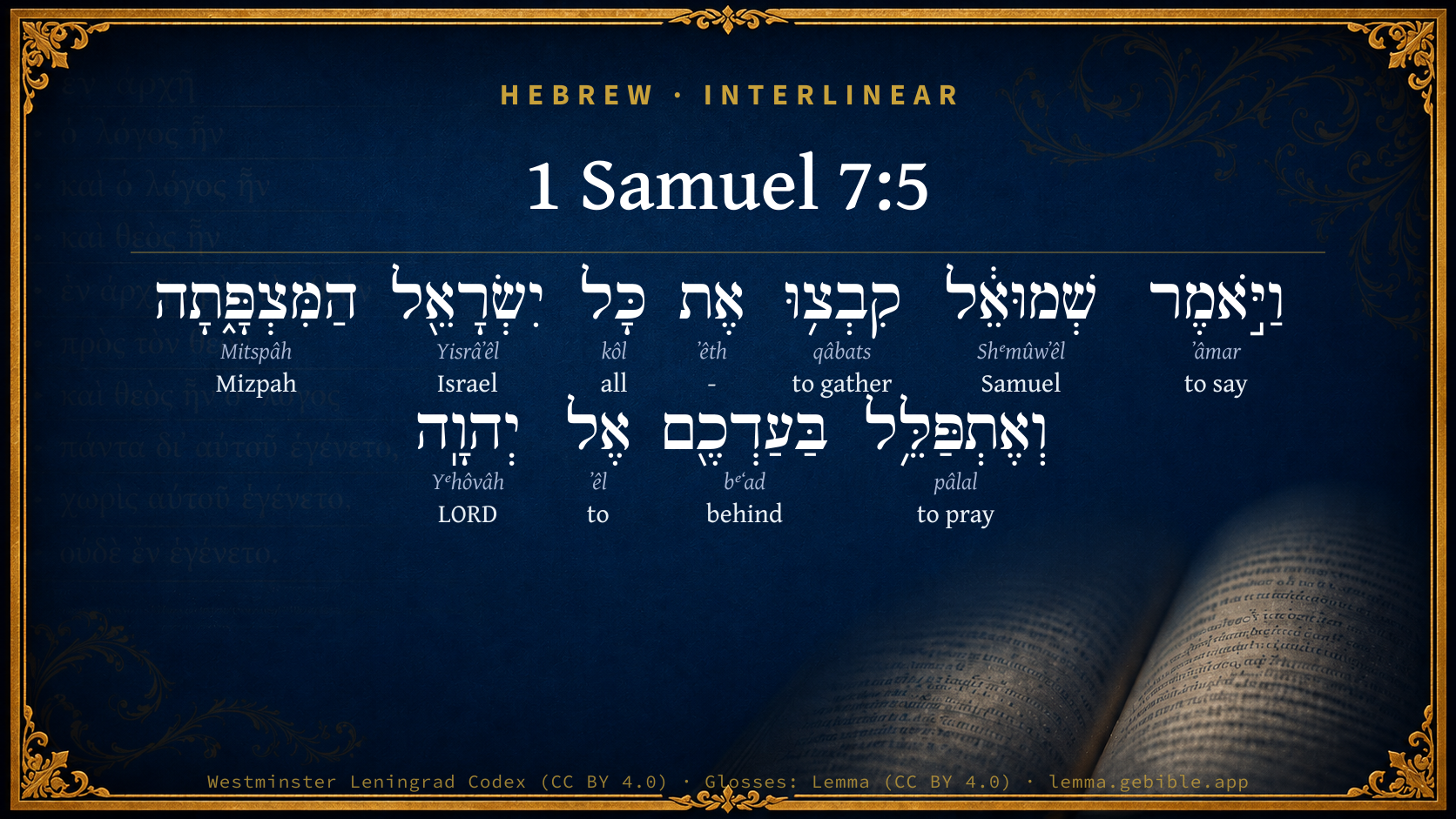
1 Samuel 7:5

Hebrew (Westminster Leningrad Codex) 1 Samuel 7:5 appears in the Hebrew Old Testament. The text above is from the Westminster Leningrad Codex. Each word links to its Strong’s number, a concise gloss, and parsing drawn from the Open Scriptures Hebrew Bible morphology. Click any word for its full Brown-Driver-Briggs (BDB) entry.
Download image
Cite this verse

1 Samuel 7:5 (World English Bible). Public Domain. Lemma interlinear Bible study tool, https://lemma.gebible.app/v/1-samuel/7/5.

Show BibTeX & RIS
BibTeX
RIS
English Translation
Samuel said, Gather all Israel to Mizpah, and I will pray for you to Yahweh.
World English Bible · Public Domain
Download a study sheet

One document with this verse’s original text, its word-by-word gloss line, the meaning frame, cross-references with their text, attributed commentary, and full source and license credits — printable, and it pastes into notes with its structure intact.

This verse Autodidact and up

Study sheet (.html) Plain text (.txt)

A passage Seminary Student

Up to 50 verses in one chapter. A passage sheet keeps up to 6 commentary sources and 12 cross-references per verse, in the order this page ranks them, and says so on the sheet whenever that leaves anything out. Ask for a single verse and you get the Autodidact verse sheet above.

Everything on this page stays free to read, with no account — the sheet is a download of what is already on screen, not access to it.

Want to remove ads? Support Godless Engineer
Compare translations 3

The same verse in 3 English versions, stacked beneath the original-language interlinear above. Click any original word for its lexicon entry.

Each is an independent rendering of the whole verse — the interlinear is not word-aligned to these translations.

Highlighted words mark where these versions differ — a whole-verse word diff, not a word-by-word alignment.

  • World English Bible Public Domain
    Samuel said, Gather all Israel to Mizpah, and I will pray for you to Yahweh.
  • King James Version Public Domain
    And Samuel said, Gather all Israel to Mizpeh, and I will pray for you unto the LORD.
  • unfoldingWord Literal Text CC BY-SA 4.0
    And Samuel said, “Gather all of Israel to Mizpah, and I will pray for you to Yahweh.”

unfoldingWord Literal Text — © unfoldingWord, licensed CC BY-SA 4.0. Word-aligned USFM3 via Door43 (git.door43.org/unfoldingWord/en_ult).

Versions to compare (up to 4)

3 of 4 selected

Show all 18 translations

Every available English version of this verse, each an independent rendering of the whole verse.

  • World English Bible Public Domain
    Samuel said, Gather all Israel to Mizpah, and I will pray for you to Yahweh.
  • Berean Standard Bible Public Domain
    Then Samuel said, “Gather all Israel to Mizpah, and I will pray to the LORD on your behalf.”
  • Majority Standard Bible Public Domain
    Then Samuel said, “Gather all Israel to Mizpah, and I will pray to the LORD on your behalf.”
  • King James Version Public Domain
    And Samuel said, Gather all Israel to Mizpeh, and I will pray for you unto the LORD.
  • American Standard Version (1901) Public Domain
    And Samuel said, Gather all Israel to Mizpah, and I will pray for you unto Jehovah.
  • Revised Version (1885) Public Domain
    And Samuel said, Gather all Israel to Mizpah, and I will pray for you unto the LORD.
  • Geneva Bible (1599) Public Domain
    And Samuel said, Gather all Israel to Mizpeh, and I will pray for you vnto the Lord.
  • Douay-Rheims (1899) Public Domain
    And Samuel said: Gather all Israel to Masphath, that I may pray to the Lord for you.
  • Young's Literal Translation Public Domain
    and Samuel saith, `Gather all Israel to Mizpeh, and I pray for you unto Jehovah.'
  • Literal Standard Version CC BY-SA 4.0
    and Samuel says, “Gather all Israel to Mizpeh, and I pray to YHWH for you.”
  • Unlocked Literal Bible CC BY-SA 4.0
    Then Samuel said, “Bring together all Israel to Mizpah, and I will pray to Yahweh for you.”
  • unfoldingWord Literal Text CC BY-SA 4.0
    And Samuel said, “Gather all of Israel to Mizpah, and I will pray for you to Yahweh.”
  • Darby Bible Public Domain
    And Samuel said, Gather all Israel to Mizpah, and I will pray Jehovah for you.
  • World Messianic Bible Public Domain
    Samuel said, “Gather all Israel to Mizpah, and I will pray to the LORD for you.”
  • Webster's Bible Public Domain
    And Samuel said, Gather all Israel to Mizpeh, and I will pray for you to the LORD.
  • Free Bible Version CC BY-SA 4.0
    Then Samuel said, “Have all the people of Israel gather at Mizpah, and I will pray to the Lord for you.”
  • Bible in Basic English Public Domain
    Then Samuel said, Let all Israel come to Mizpah and I will make prayer to the Lord for you.
  • JPS Tanakh (1917) Public Domain
    And Samuel said: 'Gather all Israel to Mizpah, and I will pray for you unto the LORD.'

Literal Standard Version (2020), Covenant Press — licensed CC BY-SA 4.0. Text via the HelloAO Bible API (eBible.org). Unlocked Literal Bible (unfoldingWord) — licensed CC BY-SA 4.0. Text via the HelloAO Bible API (eBible.org). unfoldingWord Literal Text — © unfoldingWord, licensed CC BY-SA 4.0. Word-aligned USFM3 via Door43 (git.door43.org/unfoldingWord/en_ult). Free Bible Version, Dr. Jonathan Gallagher — licensed CC BY-SA 4.0. Text via the HelloAO Bible API (eBible.org).

Word by word

More ways to search: Search by grammar → Find every occurrence → Compare this word →

Practice this passage: Drill this verse → Learn its vocabulary →

הַמִּצְפָּ֑תָה
Mitspâh
H4709
“the · Mizpah · toward”
Particle, Definite Article + Noun, Proper + Suffix, Demonstrative
Part of Speech
Particle + Noun
Type
Proper
Full BDB Definition

Origin: from H4708

TWOT: None

Mizpah = "watchtower" - a place in Gilead north of Jabbok and location of Laban's cairn - a place in Gilead south of Jabbok; site unknown - a place near Mount Hermon - an old sacred place in Benjamin
  1. וַיֹּ֣אמֶר ʼâmar H559 “and · to say” Conjunction + Verb, Qal, Sequential Imperfect, 3rd Person, Masculine, Singular
  2. שְׁמוּאֵ֔ל Shᵉmûwʼêl H8050 “Samuel” Noun, Proper
  3. קִבְצ֥וּ qâbats H6908 “gather” Verb, Qal, Imperative, 2nd Person, Masculine, Plural
  4. אֶת ʼêth H853 “-” Particle, Direct Object
  5. כָּל kôl H3605 “all of” Noun, Common, Masculine, Singular, Construct
  6. יִשְׂרָאֵ֖ל Yisrâʼêl H3478 “Israel” Noun, Proper
  7. וְאֶתְפַּלֵּ֥ל pâlal H6419 “and · to pray” Conjunction + Verb, Hithpael, Imperfect, 1st Person, Common, Singular
  8. בַּעַדְכֶ֖ם bᵉʻad H1157 “behind · you” Preposition + Suffix, Personal, 2nd Person, Masculine, Plural
  9. אֶל ʼêl H413 “to” Preposition
  10. יְהוָֽה Yᵉhôvâh H3068 “LORD” Noun, Proper

About this verse

These counts appear in no published source. They are computed here, from the morphology-tagged text and Lemma’s own curated glosses. What Lemma adds →

11
words
11
distinct lemmas
Historical
section

Shared distinctive vocabulary

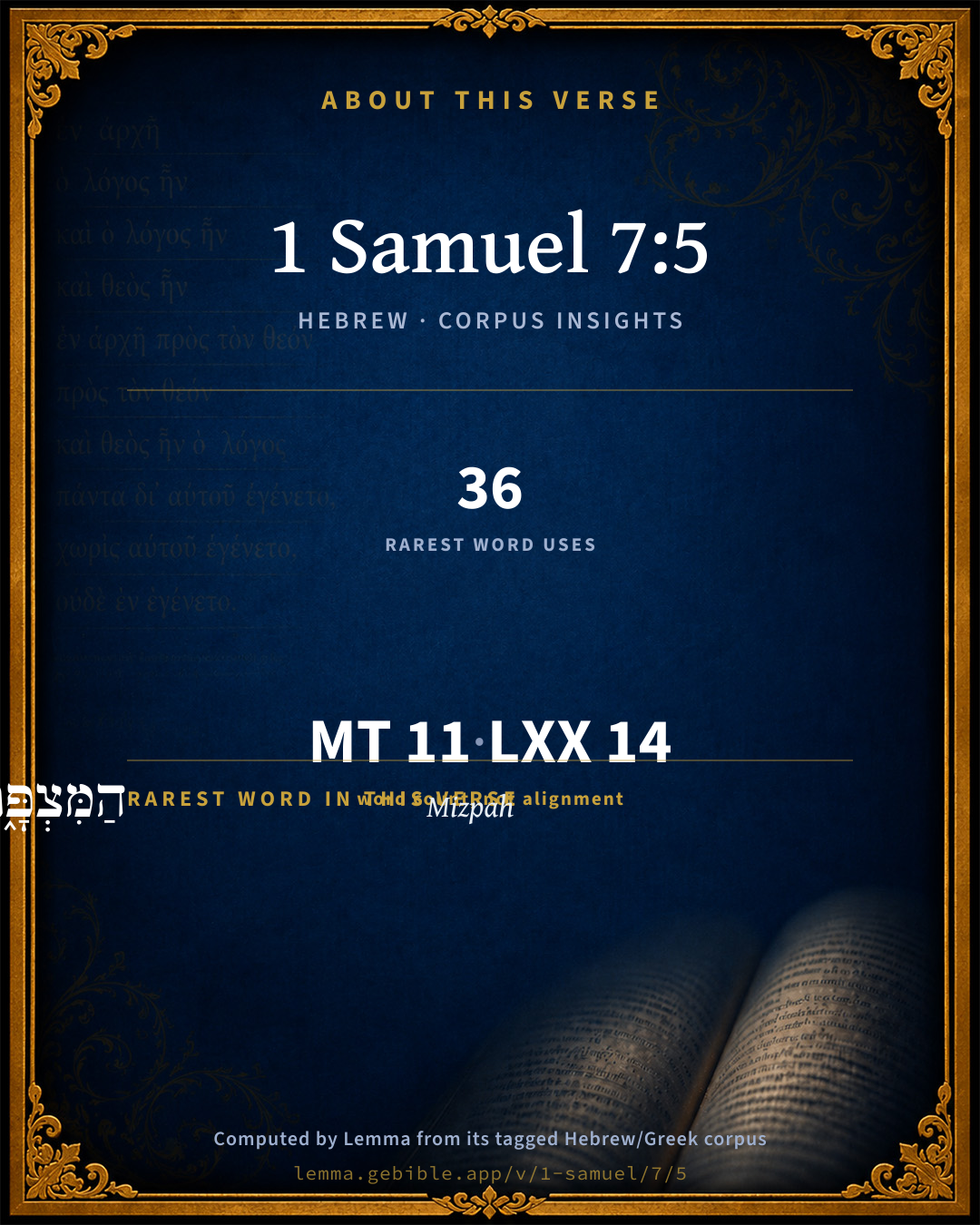
הַמִּצְפָּ֑תָה Mizpah H4709 occurs in 33 verses of the Hebrew Bible. Also found in:

Grammatical profile

  • 3 verbs
  • 5 nouns
  • 2 prepositions
  • 1 particle

Verb forms

  • וַיֹּ֣אמֶר Qal · Sequential Imperfect
  • קִבְצ֥וּ Qal · Imperative
  • וְאֶתְפַּלֵּ֥ל Hithpael · Imperfect

Hebrew & Septuagint length

In English translation the verse runs 15 words from the Hebrew and 17 from the Septuagint (LXX English) — closely comparable.

A rough comparison of the two English renderings, which tokenize alike — not a word-level alignment.

Word counts can differ between the Hebrew and the Greek without any difference in meaning — e.g. the Hebrew direct-object marker אֵת has no separate Greek word, and Greek often adds the article ὁ.

In the original languages it is 11 Hebrew tokens and 14 Greek tokens — but the two are counted differently (Hebrew bundles its prefixes and suffixes into one token; the Greek is in lemma form), so that isn’t a like-for-like length.

Cross-references

9

Topical passages linked to 1 Samuel 7:5 in the Treasury of Scripture Knowledge — connected by theme and wording, ordered by reader-vote popularity; previews shown in the World English Bible.

  • Judges 20:1 Then all the children of Israel went out, and the congregation was assembled as one man, from Dan even to Beersheba, with the land of Gilead, to Yahweh at Mizpah.
  • 1 Samuel 12:23 Moreover as for me, far be it from me that I should sin against Yahweh in ceasing to pray for you: but I will instruct you in the good and the right way.
  • Joshua 15:38 and Dilean, and Mizpeh, and Joktheel,
  • 1 Samuel 7:12 Then Samuel took a stone, and set it between Mizpah and Shen, and called the name of it Ebenezer, saying, Hitherto has Yahweh helped us.
  • 1 Samuel 7:16 He went from year to year in circuit to Bethel and Gilgal, and Mizpah; and he judged Israel in all those places.
  • 1 Samuel 10:17 Samuel called the people together to Yahweh to Mizpah;
  • 2 Kings 25:23 Now when all the captains of the forces, they and their men, heard that the king of Babylon had made Gedaliah governor, they came to Gedaliah to Mizpah, even Ishmael the son of Nethaniah, and Johanan the son of Kareah, and Seraiah the son of Tanhumeth the Netophathite, and Jaazaniah the son of the Maacathite, they and their men.
  • Nehemiah 9:1 Now in the twenty-fourth day of this month the children of Israel were assembled with fasting, and with sackcloth, and earth on them.
  • Joel 2:16 Gather the people. Sanctify the assembly. Assemble the elders. Gather the children, and those who suck the breasts. Let the bridegroom go forth from his room, And the bride out of her chamber.

Cross-references courtesy of OpenBible.info (CC BY 4.0).

Hebrew and Greek witnesses Masoretic Hebrew ↔ Greek Septuagint

The same verse in the two great witnesses to the Old Testament, shown verse-for-verse.

These are two independent witnesses, not word-aligned to each other, and the Septuagint is shown in lemma (dictionary) form.

Hebrew 1 Samuel 7:5 Masoretic · Westminster Leningrad Codex

וַיֹּ֣אמֶר שְׁמוּאֵ֔ל קִבְצ֥וּ אֶת כָּל יִשְׂרָאֵ֖ל הַמִּצְפָּ֑תָה וְאֶתְפַּלֵּ֥ל בַּעַדְכֶ֖ם אֶל יְהוָֽה

Samuel said, Gather all Israel to Mizpah, and I will pray for you to Yahweh.

World English Bible · Public Domain

Greek LXX 1 Samuel 7:5 Septuagint · lemma form

καί εἶπον σαμουηλ ἀθροίζω πᾶς ἰσραήλ εἰς μασσηφαθ καί προςεὔχομαι περί σύ πρός κύριος

And Samuel said, Gather all Israel to Massephath, and I will pray for you to the Lord.

LXX2012 (modern English Septuagint) · Public Domain

Hebrew: Westminster Leningrad Codex (CC BY 4.0). Greek: Septuagint (public domain); English from LXX2012 (modern English Septuagint) (Public Domain). How the Septuagint differs from the Hebrew →

Targum (Aramaic paraphrase)

1

The Targum is the ancient Jewish Aramaic paraphrase of the Hebrew Scriptures — an interpretive translation, not the Hebrew text itself. Onkelos (literal) and Pseudo-Jonathan (expansive) render the Torah, and Jonathan the Prophets. Coverage is partial: where no permissively-licensed English translation exists for a verse, only the Aramaic is shown. This is verse-level text, not a word-by-word alignment to the Hebrew.

  1. Targum Jonathan Prophets (Joshua–Malachi)
    וַאֲמַר שְׁמוּאֵל כְּנִישׁוּ יַת כָּל יִשְׂרָאֵל לְמִצְפַּיָא וַאֲצַלֵי עֲלֵיכוֹן קֳדָם יְיָ:

    (no public-domain English translation for this verse)

    Targum Jonathan — Aramaic: “Mikraot Gedolot” (public domain). English: “Sefaria Community Translation” (CC0 1.0 (public-domain dedication)); “London "Chaldee Paraphrase," 1871” (public domain). Text via Sefaria.

Commentary

Notes on 1 Samuel 7:5 from classic Christian and Jewish commentators (each source and its license shown beneath its notes). The classic Christian expositions comment on the surrounding passage and are grouped to its opening verse, so a note may address several verses; the Jewish commentaries on the Tanakh (Rashi and others) are per-verse, so they appear only where the commentator wrote on this verse.

Lemma curates 59 commentaries, every one of them public domain or Creative Commons licensed, each selected and text-cleaned for this edition rather than reprinted as found. About our sources →

Trapp's Complete Commentary

John Trapp

1Sa 7:5 And Samuel said, Gather all Israel to Mizpeh, and I will pray for you unto the LORD.

Ver. 5. Gather all Israel to Mizpeh.] Heb., In that Mizpeh; famous formerly for the slaughter of those kings of Canaan there, {Jos 11:3} but henceforth more famous for this memorable meet at Mizpeh; which they turned into a Bacha, and God afterwards turned into a Beracha. {a}

{a} Kimchi. Vatab.

John Trapp, A Commentary or Exposition upon All the Books of the Old and New Testament (1647–1656) — public domain. Text from a community e-Sword module.

The Preacher's Complete Homiletical Commentary

Joseph S. Exell (gen. ed.)

CRITICAL AND EXPOSITORY NOTES—

1Sa_7:6. “Drew water, and poured it out before the Lord,” etc. “It is remarkable that two rites are brought together here which belong respectively to the Feast of Tabernacles and the Day of Atonement. The first is not, indeed, prescribed by the law, but it was the custom for the High Priest to fill a golden vessel with water drawn from the fountain of Siloam, and to pour it over the sacrifices on the Feast of Tabernacles. Allusions to this, which was a joyful act, are supposed to be made in Isa_12:3, and Joh_7:37-38.… The only fast enjoined by the law of Moses was on the Day of Atonement, upon the 10th Tisri.… It is likely, as in Ezr_3:4; Ezr_3:6, and in Neh_7:73; Neh_8:1-17, that Samuel also chose the Feast of Tabernacles, and the fast which preceded it, as the occasion for assembling the people. The drawing water being mentioned before the fasting is, it is true, rather against this view, though not conclusively, as the mention of the fasting may be supplemental; the real order being that they first fasted and confessed their sins on the Day of Atonement, and then joyfully kept the Feast of Tabernacles. If the fast here mentioned is not that of the 10th Tisri, it may be compared with that of Ezr_10:6, and those alluded to in Zec_7:5, and perhaps the pouring out of water (which is variously explained), may be taken in connection with the fasting (as Ezra did eat no bread, and drink no water).… Other explanations of the act are (with the Targum), “they poured out their hearts in penitence as it were water,” or that it was a symbolical act of expressing their ruin and helplessness, according to the saying in 2Sa_14:14, or that the water typified their desire that their sins might be forgotten “as waters that pass away” (Job_11:16).—(Biblical Commentary.)

“And Samuel Judged Israel.” “With respect to the position of the judges, it is generally estimated falsely when they are looked upon as proper judicial personages in our sense.… This error has been occasioned by the assumption that the Hebrew word is perfectly synonymous with our judging, while in reality it has a much wider signification. In the Book of Judges it generally denotes the exercise of authority and superiority.… Only of Deborah do we read, in Jdg_4:5, that the Israelites went up to her for judgment. But she cannot be placed upon a level with the judges throughout. She pronounced judgment as a prophetess in matters where no confidence was placed in the ordinary judicial jurisdiction, and a judgment of God in the proper sense was desired, just as, according to Exodus 18, the nation leaving their natural judges, thronged to Moses, to draw justice immediately from its source. Samuel’s position was exactly similar to that of Deborah, he was judge in another sense than the judges of the Book of Judges.—(Hengstenberg.)

(See also on 1Sa_7:15).

MAIN HOMILETICS OF THE PARAGRAPH.—1Sa_7:5-6; 1Sa_7:15-17

THE GATHERING AT MIZPEH

I. If a nation is to have strength and liberty it must have unity. “Gather all Israel to Mizpeh.” If a human body is to be strong, and consequently free to act, there must be a united action of all its members. Every limb and organ must work harmoniously together. So with the human soul. All its powers must gather themselves together—there must be a concentration of all its forces—if there is to be any result of worth. Hence the Psalmist’s prayer—“Unite my heart to fear Thy name” (Psa_86:11), and the Apostle’s declaration, “This one thing I do” (Php_3:13). And the same thing is true of any corporate body, whether it be large or small. It will not have power unless its action is united, and if a nation is not strong by unity it will not long be free. Samuel here aims at the united action of the whole nation. This unity—

1. Is often brought about by a common calamity. Common afflictions and dangers have a wonderful power to bring men together. If the reputation of a family is attacked from without, all its members will forget little differences, and unite to attack a common foe. The Church of God needs nothing but a return of the days of persecution to bring all its members into such a unity of spirit as would astonish all her foes. It would then be seen how strong is the unseen bond which unites them all to a common head. When a nation arrives at a great crisis in its history—especially when it is threatened by a common foe—all minor differences of opinion are forgotten for the time—all party distinctions are laid aside and the nation acts as one man. It was the Philistine oppression which brought the Israelites at this time to such unanimous action. They felt that this was not the time for “Ephraim to envy Judah, nor Judah to vex Ephraim” (Isa_11:13).

2. Such unity can only be real and lasting by being founded on right relations to God. The fear of God is the only solid ground of national unity. When each man is governed by a desire to serve God, a oneness of aim and purpose in the nation must be the result, and in proportion as such feelings sway a people, in such proportion will there be concord in their assemblies, and unanimity in their actions. The unity of Israel at this time was based upon a common conviction of transgression against God, and a desire to return to Him; and in proportion as these feelings were deep and heartfelt, there was ground upon which to build a real and permanent union of the people.

3. It is good for such a national unity to find expression in a national assembly. Such a gathering increases the feeling of unity, and encourages the spirit of the nation by giving it an opportunity of feeling its strength. It likewise intimidates its foes. The national gathering at Mizpeh was helpful to the Israelites themselves, and was a just ground of apprehension to their oppressors.

II. It is a great blessing to a nation to have a head who is both intellectually and morally great. Men must have leaders, and it matters little by what name a national leader is called—whether king, president, or prime minister, provided he exercises his power with intellectual ability and for moral ends. Such a man should, like Samuel, combine in himself something of the prophet, the judge, and the priest. He teaches by his life, and by his words, he is a judge inasmuch as he is a stern reprover of all wrong, and fails not to enforce penalty for transgression of national law, and he is also a priest, for such a man will not fail to bear on his heart before God in prayer those who look up to him for guidance. Such a man is a true king of his nation, whether he wears a crown or not. Samuel was such an uncrowned king—a true father of Israel, a true shepherd of his people. As a prophet, he made known to them the will of Jehovah; as judge, he kept pure the fountains of justice; and as at Mizpeh he “cried unto the Lord for Israel” (1Sa_7:9), we may be sure that upon the altar at Ramah he offered sacrifices, not only for his own sins, but also for those of the people.

OUTLINES AND SUGGESTIVE COMMENTS

1Sa_7:5. Intercession to the Lord for the salvation of others. l. Its exercise unlimited, the individual as well as the whole people being its subject (comp. 1Ti_2:1-2).

2. Its answer conditioned by the need of salvation, and the capacity for salvation of those for whom it is made.

1Sa_7:6. The penitent confession—“We have sinned against the Lord.”

1. Who has to make it, the individual, family, congregation, church, the whole people.

2. How is it to be made, with attestation of its truth and uprightness by deeds of repentance.

3. What are its consequences, forgiveness of sin, deliverance from the power of the wicked one, salvation.—Lange’s Commentary.

1Sa_7:16-17. Simply the vice-regent of God, and no king, Samuel had no palace in Israel. No armed guards protected the person, nor gorgeous retinue attended the steps of Samuel. No pomp of royalty disturbed the simple manner of his life, or distinguished him from other men; yet there rose by his house in Ramah that which proclaimed to all the land the personal character of its ruler, and the principles upon which he was to conduct his government. In a way not to be mistaken, Samuel associated the throne with the altar, earthly power with piety, the good of the country with the glory of God. That altar had a voice no man could mistake. In a manner more expressive than proclamation made by royal heralds with painted tabards and sounding trumpets, it proclaimed to the tribes of Israel that piety was to be the character, and the will of God the rule, of his government.—Guthrie.

The Preacher's Complete Homiletical Commentary (gen. ed. Joseph S. Exell; Funk & Wagnalls, c. 1892) — public domain (pre-1929). A full-Bible homiletical/sermon-outline anthology covering 65 of 66 books (2 John is absent from the source module). Text from a community e-Sword module.

Keil & Delitzsch

C. F. Keil & F. Delitzsch

Victory obtained over the Philistines through Samuel's prayer. - Sa1 7:5, Sa1 7:6. When Israel had turned to the Lord with all its heart, and had put away all its idols, Samuel gathered together all the people at Mizpeh, to prepare them for fighting against the Philistines by a solemn day for penitence and prayer. For it is very evident that the object of calling all the people to Mizpeh was that the religious act performed there might serve as a consecration for battle, not only from the circumstance that, according to Sa1 7:7, when the Philistines heard of the meeting, they drew near to make war upon Israel, but also from the contents of Sa1 7:5 : "Samuel said (sc., to the heads or representatives of the nation), Gather all Israel to Mizpeh, and I will pray for you unto the Lord." His intention could not possibly have been any other than to put the people into the right relation to their God, and thus to prepare the way for their deliverance out of the bondage of the Philistines. Samuel appointed Mizpeh, i.e., Nebi Samwil, on the western boundary of the tribe of Benjamin (see at Jos 18:26), as the place of meeting, partly no doubt on historical grounds, viz., because it was there that the tribes had formerly held their consultations respecting the wickedness of the inhabitants of Gibeah, and had resolved to make war upon Benjamin (Jdg 20:1.), but still more no doubt, because Mizpeh, on the western border of the mountains, was the most suitable place for commencing the conflict with the Philistines.

Sa1 7:6-9

When they had assembled together here, "they drew water and poured it out before Jehovah, and fasted on that day, and said there, We have sinned against the Lord." Drawing water and pouring it out before Jehovah was a symbolical act, which has been thus correctly explained by the Chaldee, on the whole: "They poured out their heart like water in penitence before the Lord." This is evident from the figurative expressions, "poured out like water," in Psa 22:15, and "pour out thy heart like water," in Lam 2:19, which are used to denote inward dissolution through pain, misery, and distress (see Sa2 14:14). Hence the pouring out of water before God was a symbolical representation of the temporal and spiritual distress in which they were at the time, - a practical confession before God, "Behold, we are before Thee like water that has been poured out;" and as it was their own sin and rebellion against God that had brought this distress upon them, it was at the same time a confession of their misery, and an act of the deepest humiliation before the Lord. They gave a still further practical expression to this humiliation by fasting (צוּם), as a sign of their inward distress of mind on account of their sin, and an oral confession of their sin against the Lord. By the word שׁם, which is added to ויּאמרוּ, "they said "there," i.e., at Mizpeh, the oral confession of their sin is formally separated from the two symbolical acts of humiliation before God, though by this very separation it is practically placed on a par with them. What they did symbolically by the pouring out of water and fasting, they explained and confirmed by their verbal confession. שׁם is never an adverb of time signifying "then;" neither in Psa 14:5; Psa 132:17, nor Jdg 5:11. "And thus Samuel judged the children of Israel at Mizpeh." ויּשׁפּט does not mean "he became judge" (Mich. and others), any more than "he punished every one according to his iniquity" (Thenius, after David Kimchi). Judging the people neither consisted in a censure pronounced by Samuel afterwards, nor in absolution granted to the penitent after they had made a confession of their sin, but in the fact that Samuel summoned the nation to Mizpeh to humble itself before Jehovah, and there secured for it, through his intercession, the forgiveness of its sin, and a renewal of the favour of its God, and thus restored the proper relation between Israel and its God, so that the Lord could proceed to vindicate His people's rights against their foes.

When the Philistines heard of the gathering of the Israelites at Mizpeh (Sa1 7:7, Sa1 7:8), their princes went up against Israel to make war upon it; and the Israelites, in their fear of the Philistines, entreated Samuel, "Do not cease to cry for us to the Lord our God, that He may save us out of the hand of the Philistines." Sa1 7:9. "And Samuel took a milk-lamb (a lamb that was still sucking, probably, according to Lev 22:27, a lamb seven days old), and offered it whole as a burnt-offering to the Lord." כּליל is used adverbially, according to its original meaning as an adverb, "whole." The Chaldee has not given the word at all, probably because the translators regarded it as pleonastic, since every burnt-offering was consumed upon the altar whole, and consequently the word כּליל was sometimes used in a substantive sense, as synonymous with עולה (Deu 33:10; Ps. 51:21). But in the passage before us, כּליל is not synonymous with עולה, but simply affirms that the lamb was offered upon the altar without being cut up or divided. Samuel selected a young lamb for the burnt-offering, not "as being the purest and most innocent kind of sacrificial animal," - for it cannot possibly be shown that very young animals were regarded as purer than those that were full-grown, - but as being the most suitable to represent the nation that had wakened up to new life through its conversion to the Lord, and was, as it were, new-born. For the burnt-offering represented the man, who consecrated therein his life and labour to the Lord. The sacrifice was the substratum for prayer. When Samuel offered it, he cried to the Lord for the children of Israel; and the Lord "answered," i.e., granted, his prayer.

Sa1 7:10

When the Philistines advanced during the offering of the sacrifice to fight against Israel, "Jehovah thundered with a great noise," i.e., with loud peals, against the Philistines, and threw them into confusion, so that they were smitten before Israel. The thunder, which alarmed the Philistines and threw them into confusion (יהמּם, as in Jos 10:10), was the answer of God to Samuel's crying to the Lord.

Sa1 7:11

As soon as they took to flight, the Israelites advanced from Mizpeh, and pursued and smote them to below Beth-car. The situation of this town or locality, which is only mentioned here, has not yet been discovered. Josephus (Ant. vi. 2, 2) has μέχρι Κοῤῥαίων.

Sa1 7:12

As a memorial of this victory, Samuel placed a stone between Mizpeh and Shen, to which he gave the name of Eben-ha-ezer, i.e., stone of help, as a standing memorial that the Lord had thus far helped His people. The situation of Shen is also not known. The name Shen (i.e., tooth) seems to indicate a projecting point of rock (see Sa1 14:4), but may also signify a place situated upon such a point.

Sa1 7:13

Through this victory which was obtained by the miraculous help of God, the Philistines were so humbled, that they no more invaded the territory of Israel, i.e., with lasting success, as they had done before. This limitation of the words "they came no more" (lit. "they did not add again to come into the border of Israel"), is implied in the context; for the words which immediately follow, "and the hand of Jehovah was against the Philistines all the days of Samuel," show that they made attempts to recover their lost supremacy, but that so long as Samuel lived they were unable to effect anything against Israel. This is also manifest from the successful battles fought by Saul (1 Samuel 13 and 14), when the Philistines had made fresh attempts to subjugate Israel during his reign. The defeats inflicted upon them by Saul also belong to the days of Samuel, who died but a very few years before Saul himself. Because of these battles which Saul fought with the Philistines, Lyra and Brentius understand the expression "all the days of Samuel" as referring not to the lifetime of Samuel, but simply to the duration of his official life as judge, viz., till the commencement of Saul's reign. But this is at variance with Sa1 7:15, where Samuel is said to have judged Israel all the days of his life. Seb. Schmidt has given, on the whole, the correct explanation of Sa1 7:13 : "They came no more so as to obtain a victory and subdue the Israelites as before; yet they did return, so that the hand of the Lord was against them, i.e., so that they were repulsed with great slaughter, although they were not actually expelled, or the Israelites delivered from tribute and the presence of military garrisons, and that all the days that the judicial life of Samuel lasted, in fact all his life, since they were also smitten by Saul."

Sa1 7:14

In consequence of the defeat at Ebenezer, the Philistines were obliged to restore to the Israelites the cities which they had taken from them, "from Ekron to Gath." This definition of the limits is probably to be understood as exclusive, i.e., as signifying that the Israelites received back their cities up to the very borders of the Philistines, measuring these borders from Ekron to Gath, and not that the Israelites received Ekron and Gath also. For although these chief cities of the Philistines had been allotted to the tribes of Judah and Dan in the time of Joshua (Jos 13:3-4; Jos 15:45-46), yet, notwithstanding the fact that Judah and Simeon conquered Ekron, together with Gaza and Askelon, after the death of Joshua (Jdg 1:18), the Israelites did not obtain any permanent possession. "And their territory" (coasts), i.e., the territory of the towns that were given back to Israel, not that of Ekron and Gath, "did Israel deliver out of the hands of the Philistines. And there was peace between Israel and the Amorites;" i.e., the Canaanitish tribes also kept peace with Israel after this victory of the Israelites over the Philistines, and during the time of Samuel. The Amorites are mentioned, as in Jos 10:6, as being the most powerful of the Canaanitish tribes, who had forced the Danites out of the plain into the mountains (Jdg 1:34-35).

Keil & Delitzsch — Biblical Commentary on the Old Testament (1861–1891) — public domain (CC PDM 1.0). Text via the HelloAO Bible API. (Old Testament only.)

Tyndale Open Study Notes

Tyndale Open Resources

7:5 Mizpah was an administrative center and rallying point for the nation (see 7:16; 10:17; Judg 20:1). • I will pray . . . for you: Eli’s question in 1 Sam 2:25 is answered here; Samuel was the intercessor Israel needed.

Tyndale Open Study Notes — © Tyndale Open Resources, licensed CC BY-SA 4.0. Text via the HelloAO Bible API.

Geneva Bible (1599)

Geneva Bible translators

For Shiloh was now desolate, because the Philistines had taken thence the Ark.

Geneva Bible (1599) marginal notes — public domain. Text via Bolls.life.

Adam Clarke's Commentary

Verse 5. Gather all Israel to Mizpeh] This appears to have been an armed assembly, though probably collected principally for religious and political purposes; but Samuel knew that an unarmed multitude could not safely be convened in the vicinity of the Philistines.

Adam Clarke's Commentary on the Bible (1810–1826) — public domain. Text from a community e-Sword/MySword module.

Ellicott's Commentary for English Readers

(5) Mizpeh.—Or, as it should be spelt, Mizpah, a common name for lofty situations. It signifies a “watch-tower,” a place where an outlook could be kept against an advancing enemy.

Now the assembly of the tribes at Mizpeh marked a new departure for Israel. It was the result of more than twenty years of toil undertaken by the greatest reformer and statesman the chosen race ever knew. The great gathering belonged both to religion and to war. Its first object was solemnly to assure the Lord that the heart of His people, so long estranged from Him, was again His. Its second was to implore that Jehovah might again restore a repentant and sorrowful people to the land of their inheritance. What more likely than that the prophet-statesman—who in that solemn juncture represented priest and judge and seer to Israel—devised on that momentous day new symbolic rites, signifying Israel’s new dedication to the Eternal for the future, Israel’s repentance for the sad past? The solemn pouring out of water before the Lord symbolised, to a people trained so carefully to watch the meaning and signification of symbols and imagery, the heart and whole inner life poured out before the Lord; the fasting represented the repentant humble sinner bowed down in grief before the one true God. Is it not at least probable that the strange, mysterious custom which we hear of in after days—the high priest filling the golden vessel with the waters of Siloam, and then pouring it out silently before the Lord—was the record of one of the holiest memories of the people—their reconciliation with their God-Friend at Mizpeh? Now, after years of estrangement, they repented and were forgiven. The fasting of Mizpeh being a favourite practice, ever much observed by the worshippers in the Temple and synagogue, needed no special record or reminder.

A Bible Commentary for English Readers, edited by Charles John Ellicott (1878–1897) — public domain. Text from a community e-Sword module.

The Cambridge Bible for Schools and Colleges

gen. ed. J. J. S. Perowne

5. to Mizpeh] Mizpah, (in Heb. always with the definite article, as retaining its meaning, “the watch-tower,”) was the meeting-place of the national assembly on two other important occasions in this period: (a) when war was declared against Benjamin (Judges 20); (b) when Saul was elected king (ch. 1Sa_10:17); and (c) once in later times, on an occasion not unlike the present, when Judas Maccabaeus mustered Israel to revolt against the tyranny of Antiochus Epiphanes (1Ma_3:42-46). It belonged to the tribe of Benjamin (Jos_18:26). Its site has not been identified, but is conjectured to be either (a) Neby Samwîl, a conspicuous hill rising to the height of 2935 ft., about 5 miles N.W. of Jerusalem: or (b) Scopus, the broad ridge immediately north of Jerusalem. In favour of the latter site are (a) the similarity of the name (σκόπος = watchman): (b) the description of the place in 1Ma_3:46 as “over against Jerusalem.”

It must be carefully distinguished from Mizpah in Gilead (Jdg_10:17; Jdg_11:11).

I will pray for you unto the Lord] Other instances of Samuel’s prayers are mentioned in 1Sa_8:6, 1Sa_12:17-19; 1Sa_12:23, 1Sa_15:11. He is quoted as the type of successful intercessors in Psa_99:6; Jer_15:1.

The Cambridge Bible for Schools and Colleges (gen. ed. J. J. S. Perowne; Cambridge University Press, 1878–1918) — public domain. Text from a community e-Sword module.

John Gill's Exposition

And Samuel said, gather all Israel to Mizpeh,.... Not Mizpeh in Gilead, on the other side Jordan, but a city which lay on the borders of Judah and Benjamin, where the tribes met on the account of the Levite's concubine, Jdg 20:1. This order Samuel gave by messengers sent to the several tribes, or the heads of them, to meet him at this place:

and I will pray for you unto the Lord; no doubt he prayed for them privately, that the reformation begun might be carried on, and appear to be sincere, and hearty, and general, and universal; but he was desirous that they might appear in a body, and join with him in public prayer for their spiritual and temporal welfare; that they might have true repentance for their sins, reform from them, and have remission of them, and be delivered out of the hands of their enemies.

John Gill's Exposition of the Whole Bible (1746–1763) — public domain (CC PDM 1.0). Text via the HelloAO Bible API.

Haydock's Catholic Bible Commentary

Masphath lay south of Jerusalem, (Calmet) and was a convenient place for all to meet at. (Menochius) They came armed, and the Philistines (Calmet) suspecting their designs, proceeded to attack them. (Haydock)

George Leo Haydock (1774–1849), Haydock's Catholic Family Bible and Commentary, 1859 edition — public domain. Excludes Psalms (Douay-Rheims chapter numbering differs from Protestant) and Deuterocanonical books (Catholic canon only).

Whedon's Commentary on the Bible

Daniel D. Whedon

5. Mizpeh — A city of Benjamin, (Jos_18:26,) principally celebrated for the events recorded in this chapter, and for the inauguration of Saul. 1Sa_10:17. At this place, also, the tribes had once before assembled to counsel revenge on Gibeah for the abuse of the Levite and his concubine, (Jdg_20:1,) and here Gedaliah briefly ruled as governor of the Jews left in the land after the Babylonian exile. 2Ki_25:23. Its site is a point yet in dispute. Robinson and others place it at the modern Neby Samwil, five miles northwest of Jerusalem; but Thomson has doubts of his correctness, (“Land and Book,” vol. ii, p. 545,) and more recently Stanley has suggested Scopus, a height about a mile north of Jerusalem. This latter position is advocated by Dr. Bonar and George Grove, (in Smith’s Dictionary,) but Neby Samwil is best supported by all the evidence in the case.

I will pray for you — The penitence and obedience shown by their putting away the false gods (1Sa_7:4) encouraged the holy prophet to intercede for them, and the result showed that the inworking prayer of a righteous man availeth much. Jas_5:16.

Daniel D. Whedon (gen. ed.), Commentary on the Old and New Testaments (1874–1909) — public domain. Text from a community e-Sword module.

The Pulpit Commentary

Gather all Israel to Mizpeh. Mizpah, for so the place should be spelt, means a watch tower, (Gen_31:49) and so is a not uncommon name for spots among the hills commanding an extensive outlook. This was probably the Mizpah in the tribe of Benjamin, distant about five miles from Jerusalem (see Conder, "Tent Work," 1:25); and though Samuel may have partly chosen it as a holy place, (Jud_1:11:11 20:1) yet the chief reason was probably its lofty situation, 500 feet above the neighbouring tableau, which itself was 2000 feet above the sea level. It was thus difficult to surprise, and admirably adapted for warlike purposes. The gathering of the people at Mizpah was the necessary result of the public insult offered to the Philistine gods, and virtually a declaration of war, as being an assertion of national independence.

The Pulpit Commentary (1880–1919), ed. H.D.M. Spence-Jones & Joseph S. Exell — public domain. Text from a community e-Sword module.

unfoldingWord translationNotes

Door43 World Missions Community

all Israel

"all the people of Israel" or "all the Israelites"

drew water and poured it out before Yahweh

Possible meanings are 1) the people denied themselves water as part of fasting or 2) they got water out of a stream or well and poured it on the ground as an outward sign of being sorry for their sin. (See: Assumed Knowledge and Implicit Information)

translationWords

Israel

Mizpah

pray

fast

sin

unfoldingWord translationNotes — © Distant Shores Media and the Door43 World Missions Community, licensed CC BY-SA 4.0. Source: git.door43.org/Door43/en_tn.

Lesson kit

Teaching starters — assembled from the data on this page, not authored interpretation. Every prompt links to the verse data it draws on. Edit before teaching.

1 Samuel, in the Historical, opens this verse with 11 words (11 distinct Hebrew lemmas). Its most distinctive word is Mitspâh (“Mizpah”). A historical commentator’s framing appears above. Read the whole chapter for the surrounding context.

Discussion questions

  1. How does “Mizpah” (Mitspâh) shape what this verse is saying?
  2. Genesis 31:49 shares the word «Mizpah» with this verse. How do the two illuminate each other?
  3. These translations render this verse differently. What is at stake in choosing one wording over another?
  4. The verb «וַיֹּ֣אמֶר» is Qal Sequential Imperfect. How does its form color the action?
  5. Reading how Trapp's Complete Commentary and The Preacher's Complete Homiletical Commentary read this verse, where do the two commentators agree and where do they part?

Things to notice

Reading settings

Reading text

Shown beneath each verse's original-language words.

Old Testament
Old Testament edition

Read the OT as the Masoretic Hebrew (MT) or the Greek Septuagint (LXX).

English shown for the Greek Septuagint (in the Hebrew ↔ Greek comparison).

Comparing translations? Open the Compare panel on any verse page to stack up to four side by side.