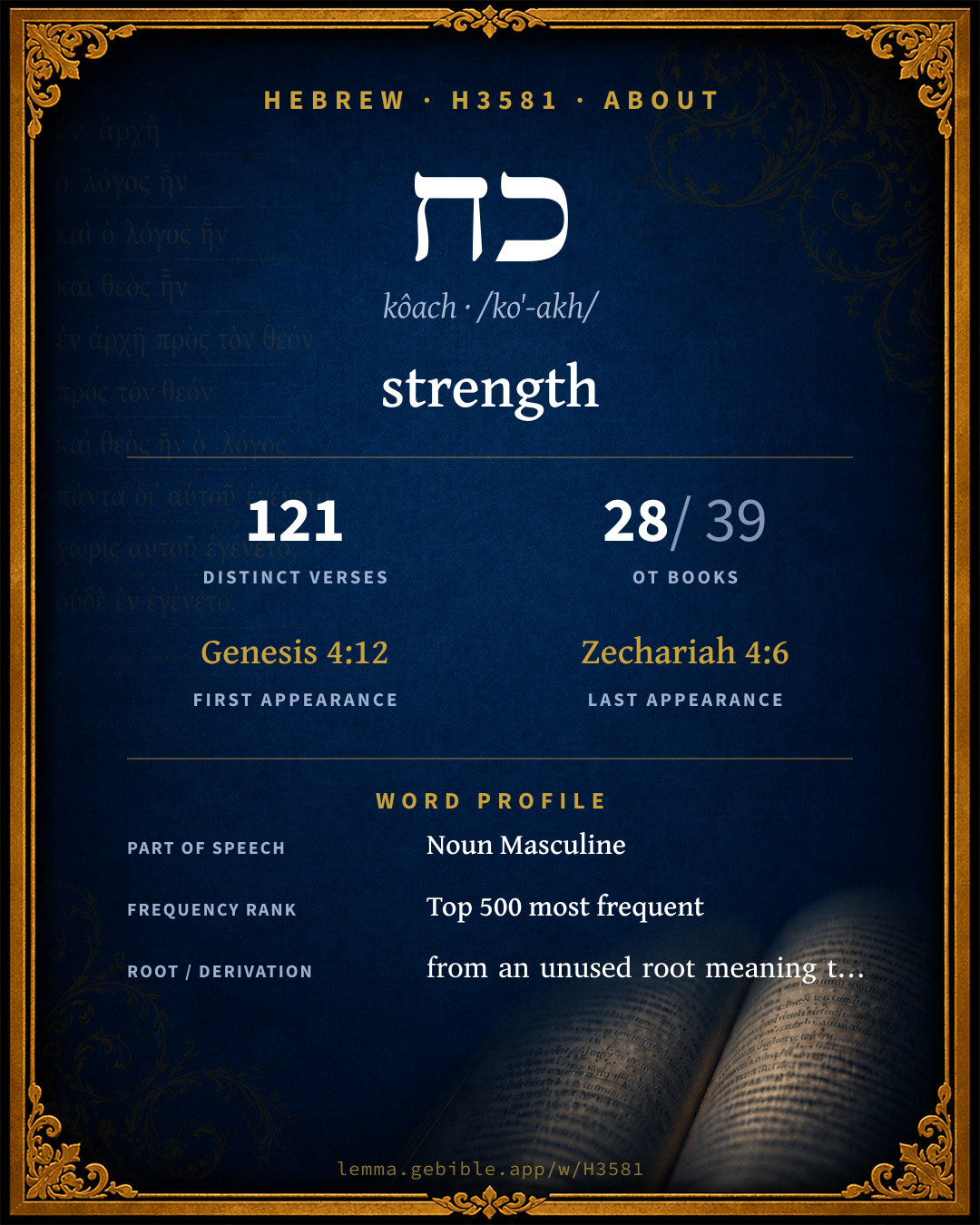
כֹּחַ
strength
also: power, might fuller range ↓
Full lexicon entry — Brown-Driver-Briggs (BDB)
From Brown-Driver-Briggs (BDB)
Where this word appears
See every Construct-state word in the Hebrew Bible →
Grammar key — what these labels mean
Part of speech
- Noun
- A naming word — a person, place, thing, or idea.
Noun type
- Common
- A common noun — a general class of person, place, or thing (“king,” “city,” “water”), not a specific name.
State
- Absolute
- The independent form of a noun, not bound to a following word.
- Construct
- A noun bound to a following noun in a possessive / “of” relationship (the construct chain).
Gender
- Masculine
- Grammatically masculine.
Number
- Singular
- One.
Grammatical forms
- Noun, Common, Masculine, Singular, Construct 69 times (54%)
- Noun, Common, Masculine, Singular, Absolute 58 times (46%)
Parsed forms decoded from the imported morphology (morphhb / Westminster Leningrad Codex — WLC text public domain, morphhb tagging CC BY 4.0), counted across 127 parsed occurrences — not distinct verses.
Every verse where H3581 appears — 121 distinct verses across 28 books. Click any verse to open its interlinear word-by-word view. Verse text shown in the World English Bible for context — . Each verse’s Hebrew form is shown with its reference; the English is not keyword-highlighted, since the data carries no word-level English alignment. Use “Compare translations” on any verse to read it across multiple English versions. This concordance covers the Hebrew Bible; Septuagint (Greek Old Testament) occurrences are not indexed here.
Genesis 3 verses
- Genesis 4:12 כֹּחָ֖/הּ n c ms cs + sfx pers 3fs From now on, when you till the ground, it won't yield its strength to you. You shall be a fugitive and a wanderer in the earth."
- Genesis 31:6 כֹּחִ֔/י n c ms cs + sfx pers 1cs You know that I have served your father with all of my strength.
- Genesis 49:3 כֹּחִ֖/י n c ms cs + sfx pers 1cs "Reuben, you are my firstborn, my might, and the beginning of my strength; The pre-eminence of dignity, and the pre-eminence of power.
Exodus 3 verses
- Exodus 9:16 כֹּחִ֑/י n c ms cs + sfx pers 1cs but indeed for this cause I have made you stand: to show you my power, and that my name may be declared throughout all the earth;
- Exodus 15:6 בַּ/כֹּ֑חַ prep det + n c ms Your right hand, Yahweh, is glorious in power, Your right hand, Yahweh, dashes the enemy in pieces.
- Exodus 32:11 בְּ/כֹ֥חַ prep + n c ms Moses begged Yahweh his God, and said, "Yahweh, why does your wrath burn hot against your people, that you have brought forth out of the land of Egypt with great power and with a mighty hand?
Leviticus 2 verses
- Leviticus 11:30 וְ/הַ/כֹּ֖חַ conj + ptcl def.art + n c ms the gecko, and the monitor lizard, the wall lizard, the skink, and the chameleon.
- Leviticus 26:20 כֹּחֲ/כֶ֑ם n c ms cs + sfx pers 2mp and your strength will be spent in vain; for your land won't yield its increase, neither will the trees of the land yield their fruit.
Numbers 2 verses
Deuteronomy 4 verses
- Deuteronomy 4:37 בְּ/כֹח֥/וֹ prep + n c ms cs + sfx pers 3ms Because he loved your fathers, therefore he chose their seed after them, and brought you out with his presence, with his great power, out of Egypt;
- Deuteronomy 8:17 כֹּחִ/י֙ n c ms cs + sfx pers 1cs and [lest] you say in your heart, My power and the might of my hand has gotten me this wealth.
- Deuteronomy 8:18 כֹּ֖חַ n c ms But you shall remember Yahweh your God, for it is he who gives you power to get wealth; that he may establish his covenant which he swore to your fathers, as at this day.
- Deuteronomy 9:29 בְּ/כֹחֲ/ךָ֣ prep + n c ms cs + sfx pers 2ms Yet they are your people and your inheritance, which you brought out by your great power and by your outstretched arm.
Joshua 2 verses
- Joshua 14:11 כְּ/כֹ֥חִ/י וּ/כְ/כֹ֣חִ/י prep + n c ms cs + sfx pers 1cs conj + prep + n c ms cs + sfx pers 1cs As yet I am as strong this day as I as in the day that Moses sent me: as my strength was then, even so is my strength now, for war, and to go out and to come in.
- Joshua 17:17 וְ/כֹ֤חַ conj + n c ms Joshua spoke to the house of Joseph, even to Ephraim and to Manasseh, saying, You are a great people, and have great power; you shall not have one lot only:
Judges 8 verses
- Judges 6:14 בְּ/כֹחֲ/ךָ֣ prep + n c ms cs + sfx pers 2ms Yahweh looked at him, and said, Go in this your might, and save Israel from the hand of Midian: have not I sent you?
- Judges 16:5 כֹּח֣/וֹ n c ms cs + sfx pers 3ms The lords of the Philistines came up to her, and said to her, Entice him, and see in which his great strength lies, and by what means we may prevail against him, that we may bind him to afflict him: and we will each give you of us eleven hundred [pieces] of silver.
- Judges 16:6 כֹּחֲ/ךָ֣ n c ms cs + sfx pers 2ms Delilah said to Samson, Tell me, Please, in which your great strength lies, and with which you might be bound to afflict you.
- Judges 16:9 כֹּחֽ/וֹ n c ms cs + sfx pers 3ms Now she had liers-in-wait abiding in the inner chamber. She said to him, The Philistines are on you, Samson. He broke the cords, as a string of tow is broken when it touches the fire. So his strength was not known.
- Judges 16:15 כֹּחֲ/ךָ֥ n c ms cs + sfx pers 2ms She said to him, How can you say, I love you, when your heart is not with me? you have mocked me these three times, and have not told me in which your great strength lies.
- Judges 16:17 כֹחִ֔/י n c ms cs + sfx pers 1cs He told her all his heart, and said to her, "No razor has ever come on my head; for I have been a Nazirite to God from my mother's womb. If I am shaved, then my strength will go from me, and I will become weak, and be like any other man."
- Judges 16:19 כֹּח֖/וֹ n c ms cs + sfx pers 3ms She made him sleep on her knees; and she called for a man, and shaved off the seven locks of his head; and she began to afflict him, and his strength went from him.
- Judges 16:30 בְּ/כֹ֔חַ prep + n c ms Samson said, Let me die with the Philistines. He bowed himself with all his might; and the house fell on the lords, and on all the people who were therein. So the dead that he killed at his death were more than those who he killed in his life.
1 Samuel 4 verses
- 1 Samuel 2:9 בְ/כֹ֖חַ prep + n c ms He will keep the feet of his holy ones; But the wicked shall be put to silence in darkness; For by strength shall no man prevail.
- 1 Samuel 28:20 כֹּ֨חַ֙ n c ms Then Saul fell immediately his full length on the earth, and was sore afraid, because of the words of Samuel: and there was no strength in him; for he had eaten no bread all the day, nor all the night.
- 1 Samuel 28:22 כֹּ֔חַ n c ms Now therefore, please listen also to the voice of your handmaid, and let me set a morsel of bread before you; and eat, that you may have strength, when you go on your way.
- 1 Samuel 30:4 כֹּ֖חַ n c ms Then David and the people who were with him lifted up their voice and wept, until they had no more power to weep.
1 Kings 1 verse
2 Kings 2 verses
- 2 Kings 17:36 בְּ/כֹ֧חַ prep + n c ms but Yahweh, who brought you up out of the land of Egypt with great power and with an outstretched arm, him shall you fear, and to him shall you bow yourselves, and to him shall you sacrifice:
- 2 Kings 19:3 וְ/כֹ֥חַ conj + n c ms They said to him, Thus says Hezekiah, This day is a day of trouble, and of rebuke, and of rejection; for the children are come to the birth, and there is not strength to bring forth.
1 Chronicles 4 verses
- 1 Chronicles 26:8 בַּ/כֹּ֖חַ prep det + n c ms All these were of the sons of Obed-edom: they and their sons and their brothers, able men in strength for the service; sixty-two of Obed-edom.
- 1 Chronicles 29:2 כֹּחִ֞/י n c ms cs + sfx pers 1cs Now I have prepared with all my might for the house of my God the gold for the [things of] gold, and the silver for the [things of] silver, and the brass for the [things of] brass, the iron for the [things of] iron, and wood for the [things of] wood; onyx stones, and [stones] to be set, stones for inlaid work, and of various colors, and all manner of precious stones, and marble stones in abundance.
- 1 Chronicles 29:12 כֹּ֣חַ n c ms Both riches and honor come of you, and you rule over all; and in your hand is power and might; and it is in your hand to make great, and to give strength to all.
- 1 Chronicles 29:14 כֹּ֔חַ n c ms But who am I, and what is my people, that we should be able to offer so willingly as this? For all things come of you, and of your own have we given you.
2 Chronicles 8 verses
- 2 Chronicles 2:6 כֹּ֨חַ֙ n c ms But who is able to build him a house, seeing heaven and the heaven of heavens can't contain him? who am I then, that I should build him a house, save only to burn incense before him?
- 2 Chronicles 13:20 כֹּֽחַ n c ms cs Neither did Jeroboam recover strength again in the days of Abijah: and Yahweh struck him, and he died.
- 2 Chronicles 14:11 כֹּ֔חַ n c ms Asa cried to Yahweh his God, and said, Yahweh, there is none besides you to help, between the mighty and him who has no strength: help us, Yahweh our God; for we rely on you, and in your name are we come against this multitude. Yahweh, you are our God; don't let man prevail against you.
- 2 Chronicles 20:6 כֹּ֣חַ n c ms and he said, Yahweh, the God of our fathers, aren't you God in heaven? and aren't you ruler over all the kingdoms of the nations? and in your hand is power and might, so that none is able to withstand you.
- 2 Chronicles 20:12 כֹּ֔חַ n c ms Our God, will you not judge them? for we have no might against this great company that comes against us; neither know we what to do: but out eyes are on you.
- 2 Chronicles 22:9 כֹּ֖חַ n c ms He sought Ahaziah, and they caught him (now he was hiding in Samaria), and they brought him to Jehu, and killed him; and they buried him, for they said, He is the son of Jehoshaphat, who sought Yahweh with all his heart. The house of Ahaziah had no power to hold the kingdom.
- 2 Chronicles 25:8 כֹּ֛חַ n c ms But if you will go, do [valiantly], be strong for the battle: God will cast you down before the enemy; for God has power to help, and to cast down.
- 2 Chronicles 26:13 בְּ/כֹ֣חַ prep + n c ms cs Under their hand was an army, three hundred thousand and seven thousand and five hundred, who made war with mighty power, to help the king against the enemy.
Ezra 2 verses
- Ezra 2:69 כְּ/כֹחָ֗/ם prep + n c ms cs + sfx pers 3mp they gave after their ability into the treasury of the work sixty-one thousand darics of gold, and five thousand minas of silver, and one hundred priests' garments.
- Ezra 10:13 כֹּ֖חַ n c ms But the people are many, and it is a time of much rain, and we are not able to stand outside: neither is this a work of one day or two; for we have greatly transgressed in this matter.
Nehemiah 2 verses
- Nehemiah 1:10 בְּ/כֹחֲ/ךָ֣ prep + n c ms cs + sfx pers 2ms Now these are your servants and your people, whom you have redeemed by your great power, and by your strong hand.
- Nehemiah 4:10 כֹּ֣חַ n c ms cs Judah said, The strength of the bearers of burdens is decayed, and there is much rubbish; so that we are not able to build the wall.
Job 20 verses
- Job 3:17 כֹֽחַ n c ms There the wicked cease from troubling; There the weary are at rest.
- Job 6:11 כֹּחִ֥/י n c ms cs + sfx pers 1cs What is my strength, that I should wait? What is my end, that I should be patient?
- Job 6:12 כֹּ֣חַ כֹּחִ֑/י n c ms cs n c ms cs + sfx pers 1cs Is my strength the strength of stones? Or is my flesh of brass?
- Job 6:22 וּ֝/מִ/כֹּחֲ/כֶ֗ם conj + prep + n c ms cs + sfx pers 2mp Did I say, 'Give to me?' Or, 'Offer a present for me from your substance?'
- Job 9:4 כֹּ֑חַ n c ms God who is wise in heart, and mighty in strength: Who has hardened himself against him, and prospered?
- Job 9:19 לְ/כֹ֣חַ prep + n c ms If it is a matter of strength, behold, he is mighty! If of justice, 'Who,' says he, 'will summon me?'
- Job 23:6 כֹּ֭חַ n c ms Would he contend with me in the greatness of his power? No, but he would listen to me.
- Job 24:22 בְּ/כֹח֑/וֹ prep + n c ms cs + sfx pers 3ms Yet God preserves the mighty by his power. He rises up who has no assurance of life.
- Job 26:2 כֹ֑חַ n c ms "How have you helped him who is without power! How have you saved the arm that has no strength!
- Job 26:12 בְּ֭/כֹח/וֹ prep + n c ms cs + sfx pers 3ms He stirs up the sea with his power, And by his understanding he strikes through Rahab.
- Job 30:2 כֹּ֣חַ n c ms cs Of what use is the strength of their hands to me, Men in whom ripe age has perished?
- Job 30:18 כֹּ֭חַ n c ms By great force is my garment disfigured. It binds me about as the collar of my coat.
- Job 31:39 כֹּ֭חָ/הּ n c ms cs + sfx pers 3fs If I have eaten the fruits of it without money, Or have caused the owners of it to lose their life:
- Job 36:5 כֹּ֣חַֽ n c ms cs "Behold, God is mighty, and doesn't despise anyone. He is mighty in strength of understanding.
- Job 36:19 כֹֽחַ n c ms Would your wealth sustain you in distress, Or all the might of your strength?
- Job 36:22 בְּ/כֹח֑/וֹ prep + n c ms cs + sfx pers 3ms Behold, God is exalted in his power. Who is a teacher like him?
- Job 37:23 כֹ֑חַ n c ms We can't reach the Almighty, He is exalted in power; In justice and great righteousness he will not oppress.
- Job 39:11 כֹּח֑/וֹ n c ms cs + sfx pers 3ms Will you trust him, because his strength is great? Or will you leave to him your labor?
- Job 39:21 בְּ/כֹ֑חַ prep + n c ms He paws in the valley, and rejoices in his strength: He goes out to meet the armed men.
- Job 40:16 כֹח֣/וֹ n c ms cs + sfx pers 3ms Look now, his strength is in his loins, His force is in the muscles of his belly.
Psalms 11 verses
- Psalms 22:15 כֹּחִ֗/י n c ms cs + sfx pers 1cs My strength is dried up like a potsherd. My tongue sticks to the roof of my mouth. You have brought me into the dust of death.
- Psalms 29:4 בַּ/כֹּ֑חַ prep det + n c ms Yahweh's voice is powerful. Yahweh's voice is full of majesty.
- Psalms 31:10 כֹחִ֑/י n c ms cs + sfx pers 1cs For my life is spent with sorrow, My years with sighing. My strength fails because of my iniquity. My bones are wasted away.
- Psalms 33:16 כֹּֽחַ n c ms There is no king saved by the multitude of a host. A mighty man is not delivered by great strength.
- Psalms 38:10 כֹחִ֑/י n c ms cs + sfx pers 1cs My heart throbs. My strength fails me. As for the light of my eyes, it has also left me.
- Psalms 65:6 בְּ/כֹח֑/וֹ prep + n c ms cs + sfx pers 3ms Who by his power forms the mountains, Having armed yourself with strength;
- Psalms 71:9 כֹּ֝חִ֗/י n c ms cs + sfx pers 1cs Don't reject me in my old age. Don't forsake me when my strength fails.
- Psalms 102:23 כח/ו כֹּחִ֗/י n c ms cs + sfx pers 3ms n c ms cs + sfx pers 1cs He weakened my strength along the course. He shortened my days.
- Psalms 103:20 כֹ֭חַ n c ms Praise Yahweh, you angels of his, Who are mighty in strength, who fulfill his word, Obeying the voice of his word.
- Psalms 111:6 כֹּ֣חַ n c ms cs He has shown his people the power of his works, In giving them the heritage of the nations.
- Psalms 147:5 כֹּ֑חַ n c ms Great is our Lord, and mighty in power. His understanding is infinite.
Proverbs 5 verses
- Proverbs 5:10 כֹּחֶ֑/ךָ n c ms cs + sfx pers 2ms Lest strangers feast on your wealth, And your labors enrich another man's house.
- Proverbs 14:4 בְּ/כֹ֣חַ prep + n c ms cs Where no oxen are, the crib is clean, But much increase is by the strength of the ox.
- Proverbs 20:29 כֹּחָ֑/ם n c ms cs + sfx pers 3mp The glory of young men is their strength. The splendor of old men is their gray hair.
- Proverbs 24:5 כֹּֽחַ n c ms A wise man has great power; And a knowledgeable man increases strength;
- Proverbs 24:10 כֹּחֶֽ/כָה n c ms cs + sfx pers 2ms If you falter in the time of trouble, Your strength is small.
Ecclesiastes 2 verses
- Ecclesiastes 4:1 כֹּ֔חַ n c ms Then I returned and saw all the oppressions that are done under the sun: and, behold, the tears of those who were oppressed, and they had no comforter; and on the side of their oppressors there was power; but they had no comforter.
- Ecclesiastes 9:10 בְּ/כֹחֲ/ךָ֖ prep + n c ms cs + sfx pers 2ms Whatever your hand finds to do, do it with your might; for there is no work, nor device, nor knowledge, nor wisdom, in Sheol, where you are going.
Isaiah 11 verses
- Isaiah 10:13 בְּ/כֹ֤חַ prep + n c ms cs For he has said, By the strength of my hand I have done it, and by my wisdom; for I have understanding: and I have removed the bounds of the peoples, and have robbed their treasures, and like a valiant man I have brought down those who sit [on thrones]:
- Isaiah 37:3 וְ/כֹ֥חַ conj + n c ms They said to him, Thus says Hezekiah, This day is a day of trouble, and of rebuke, and of rejection; for the children have come to the birth, and there is no strength to bring forth.
- Isaiah 40:9 בַ/כֹּ֨חַ֙ prep det + n c ms You who tell good news to Zion, go up on a high mountain; you who tell good news to Jerusalem, lift up your voice with strength; lift it up, don't be afraid; say to the cities of Judah, Behold, your God!
- Isaiah 40:26 כֹּ֔חַ n c ms Lift up your eyes on high, and see who has created these, who brings out their host by number; he calls them all by name; by the greatness of his might, and because he is strong in power, not one is lacking.
- Isaiah 40:29 כֹּ֑חַ n c ms He gives power to the faint; and to him who has no might he increases strength.
- Isaiah 40:31 כֹ֔חַ n c ms but those who wait for Yahweh shall renew their strength; they shall mount up with wings as eagles; they shall run, and not be weary; they shall walk, and not faint.
- Isaiah 41:1 כֹ֑חַ n c ms Keep silence before me, islands; and let the peoples renew their strength: let them come near; then let them speak; let us come near together to judgment.
- Isaiah 44:12 כֹּח֔/וֹ כֹּ֔חַ n c ms cs + sfx pers 3ms n c ms The smith [makes] an axe, and works in the coals, and fashions it with hammers, and works it with his strong arm: yes, he is hungry, and his strength fails; he drinks no water, and is faint.
- Isaiah 49:4 כֹּחִ֣/י n c ms cs + sfx pers 1cs But I said, I have labored in vain, I have spent my strength for nothing and vanity; yet surely the justice [due] to me is with Yahweh, and my recompense with my God.
- Isaiah 50:2 כֹ֖חַ n c ms Why, when I came, was there no man? when I called, was there none to answer? Is my hand shortened at all, that it can't redeem? or have I no power to deliver? Behold, at my rebuke I dry up the sea, I make the rivers a wilderness: their fish stink, because there is no water, and die for thirst.
- Isaiah 63:1 כֹּח֑/וֹ n c ms cs + sfx pers 3ms Who is this who comes from Edom, with dyed garments from Bozrah? this who is glorious in his clothing, marching in the greatness of his strength? I who speak in righteousness, mighty to save.
Jeremiah 5 verses
- Jeremiah 10:12 בְּ/כֹח֔/וֹ prep + n c ms cs + sfx pers 3ms He has made the earth by his power, he has established the world by his wisdom, and by his understanding has he stretched out the heavens:
- Jeremiah 27:5 בְּ/כֹחִ/י֙ prep + n c ms cs + sfx pers 1cs I have made the earth, the men and the animals that are on the surface of the earth, by my great power and by my outstretched arm; and I give it to whom it seems right to me.
- Jeremiah 32:17 בְּ/כֹֽחֲ/ךָ֙ prep + n c ms cs + sfx pers 2ms Ah Lord Yahweh! behold, you have made the heavens and the earth by your great power and by your outstretched arm; there is nothing too hard for you,
- Jeremiah 48:45 מִ/כֹּ֣חַ prep + n c ms Those who fled stand without strength under the shadow of Heshbon; for a fire is gone forth out of Heshbon, and a flame from the midst of Sihon, and has devoured the corner of Moab, and the crown of the head of the tumultuous ones.
- Jeremiah 51:15 בְּ/כֹח֔/וֹ prep + n c ms cs + sfx pers 3ms He has made the earth by his power, he has established the world by his wisdom, and by his understanding has he stretched out the heavens:
Lamentations 2 verses
- Lamentations 1:6 כֹ֖חַ n c ms From the daughter of Zion all her majesty is departed: Her princes are become like harts that find no pasture, They are gone without strength before the pursuer.
- Lamentations 1:14 כֹּחִ֑/י n c ms cs + sfx pers 1cs The yoke of my transgressions is bound by his hand; They are knit together, they are come up on my neck; he has made my strength to fail: The Lord has delivered me into their hands, against whom I am not able to stand.
Daniel 11 verses
- Daniel 1:4 כֹּ֣חַ n c ms youths in whom was no blemish, but well-favored, and skillful in all wisdom, and endowed with knowledge, and understanding science, and such as had ability to stand in the king's palace; and that he should teach them the learning and the language of the Chaldeans.
- Daniel 8:6 כֹּחֽ/וֹ n c ms cs + sfx pers 3ms He came to the ram that had the two horns, which I saw standing before the river, and ran on him in the fury of his power.
- Daniel 8:7 כֹ֛חַ n c ms I saw him come close to the ram, and he was moved with anger against him, and struck the ram, and broke his two horns; and there was no power in the ram to stand before him; but he cast him down to the ground, and trampled on him; and there was none who could deliver the ram out of his hand.
- Daniel 8:22 בְ/כֹחֽ/וֹ prep + n c ms cs + sfx pers 3ms As for that which was broken, in the place where four stood up, four kingdoms shall stand up out of the nation, but not with his power.
- Daniel 8:24 כֹּח/וֹ֙ בְ/כֹח֔/וֹ n c ms cs + sfx pers 3ms prep + n c ms cs + sfx pers 3ms His power shall be mighty, but not by his own power; and he shall destroy wonderfully, and shall prosper and do [his pleasure]; and he shall destroy the mighty ones and the holy people.
- Daniel 10:8 כֹּ֑ח כֹּֽחַ n c ms n c ms So I was left alone, and saw this great vision, and there remained no strength in me; for my comeliness was turned in me into corruption, and I retained no strength.
- Daniel 10:16 כֹּֽחַ n c ms Behold, one in the likeness of the sons of men touched my lips: then I opened my mouth, and spoke and said to him who stood before me, my lord, by reason of the vision my sorrows are turned on me, and I retain no strength.
- Daniel 10:17 כֹ֔חַ n c ms For how can the servant of this my lord talk with this my lord? for as for me, immediately there remained no strength in me, neither was there breath left in me.
- Daniel 11:6 כּ֣וֹחַ n c ms cs At the end of years they shall join themselves together; and the daughter of the king of the south shall come to the king of the north to make an agreement: but she shall not retain the strength of her arm; neither shall he stand, nor his arm; but she shall be given up, and those who brought her, and he who became the father of her, and he who strengthened her in those times.
- Daniel 11:15 כֹּ֖חַ n c ms So the king of the north shall come, and cast up a mound, and take a well-fortified city: and the forces of the south shall not stand, neither his chosen people, neither shall there be any strength to stand.
- Daniel 11:25 כֹּח֨/וֹ n c ms cs + sfx pers 3ms He shall stir up his power and his courage against the king of the south with a great army; and the king of the south shall war in battle with an exceeding great and mighty army; but he shall not stand; for they shall devise devices against him.
Hosea 1 verse
Amos 1 verse
Micah 1 verse
Nahum 2 verses
- Nahum 1:3 כֹּ֔חַ n c ms Yahweh is slow to anger, and great in power, and will by no means leave the guilty unpunished. Yahweh has his way in the whirlwind and in the storm, and the clouds are the dust of his feet.
- Nahum 2:1 כֹּ֖חַ n c ms He who dashes in pieces has come up against you. Keep the fortress! Watch the way! Strengthen your loins! Fortify your power mightily!
Habakkuk 1 verse
Zechariah 1 verse
About this entry
At a glance — auto-summarized from this page’s data, not written by a person. Every figure links to its source below. This summary describes the numbers; it doesn’t interpret them.
The Hebrew noun כח centers on the idea of “strength.” Its earliest occurrence is Genesis 4:12. Spanning 121 verses in 28 books, it ranks among the common words of the Hebrew Bible. Beyond “strength” it also covers “power” and “might” — see its full sense range. For the data behind this summary, explore the sense tree and the renderings breakdown below.
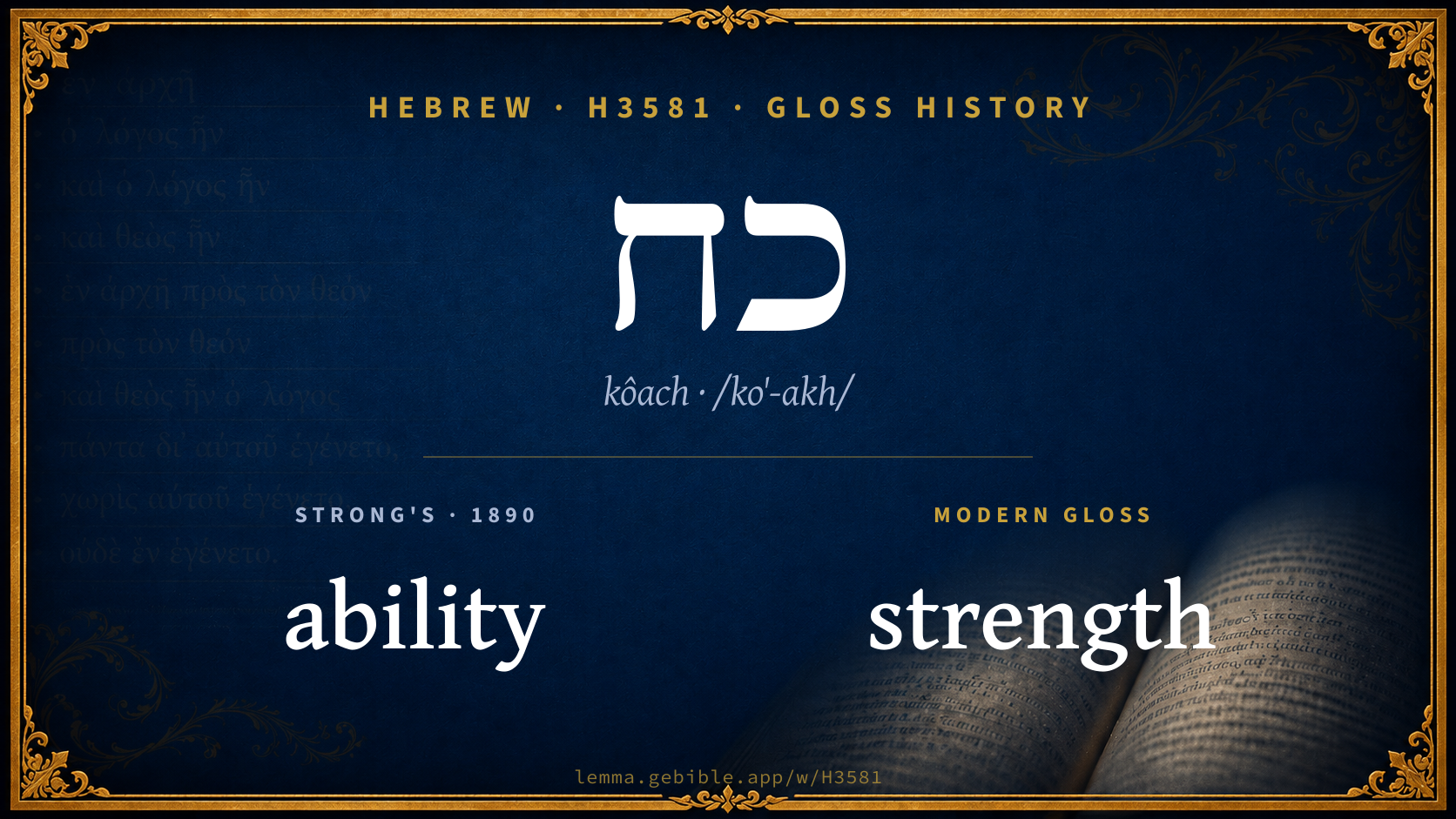
Gloss history
Strong's 1890 vs modern scholarship
About this word
Strong's H3581 catalogs a Hebrew word from the Hebrew Old Testament.
These counts are not copied from any lexicon or concordance. They are computed here, from the morphology-tagged Hebrew Old Testament. What Lemma adds →
- 121
- distinct verses
- The word appears in 121 distinct verses.
- 28 / 39
- OT books
- The word appears in 28 of 39 Old Testament books.
- #348
- by frequency
- Top 500 most frequent Hebrew words (rank 348 of 8,640 Hebrew words by occurrence).
View all 121 occurrences in the concordance →
By section of the Old Testament
By traditional corpus
Conventional, traditional groupings — biblical authorship is debated, so this is a traditional corpus grouping, not an authorship claim. Each share is this word’s portion of its verses in that division of the Hebrew canon. Each figure is a share of the word’s 121 distinct verses.
- Writings (Ketuvim) 67 verses · 55%
- Prophets (Nevi'im) 40 verses · 33%
- Torah (Pentateuch) 14 verses · 12%
How translations render this word
Counts come from each version’s own published word-to-Strong’s tagging or interlinear alignment — an approximate guide to how each version renders this word, not a word-level alignment the data otherwise carries. Because each total is that version’s own tagged count, the per-version totals vary from one another and need not match the appearance or distinct-verse counts above. These counts may also differ from a printed concordance because Lemma counts each distinctly tagged rendering and does not collapse phrase taggings into a single head-word total. This is a fixed set of word-tagged versions (KJV, ASV, BSB, ULT) and does not change with the reading translation you choose elsewhere. Each version’s license is shown beside its name below (and on Sources).
BDB lists this Strong’s number as 3 distinct words (homographs). Each count above pools all of them and is not split by sense — see the Senses section below. A low-frequency rendering may belong to a different one of those words, not the primary meaning.
- King James Version†: Strength 42×, Power 33×, Might 4×
- American Standard Version†: Strength 34×, Power 30×, Might 6×
- Berean Standard Bible†: Strength 46×, Power 33×, Own strength 2×
- unfoldingWord Literal Text†: Strength 53×, Power 34×, Might 5×
King James Version Public Domain
Renders H3581 across 124† tagged occurrences — most commonly:
Plus 38 renderings that appear only once — usually multi-word phrases or single function words the recovered tagging swept in, not distinct renderings. Not rendered by a distinct English word in 2 further occurrences.
American Standard Version Public Domain
Renders H3581 across 123† tagged occurrences — most commonly:
Plus 45 renderings that appear only once — usually multi-word phrases or single function words the recovered tagging swept in, not distinct renderings.
Berean Standard Bible Public Domain
Renders H3581 across 118† tagged occurrences — most commonly:
Plus 31 renderings that appear only once — usually multi-word phrases or single function words the recovered tagging swept in, not distinct renderings. Not rendered by a distinct English word in 8 further occurrences.
unfoldingWord Literal Text CC BY-SA 4.0
Renders H3581 across 141† tagged occurrences — most commonly:
Plus 27 renderings that appear only once — usually multi-word phrases or single function words the recovered tagging swept in, not distinct renderings.
10 senses and sub-senses in the full BDB
What do BDB’s symbols mean?
BDB uses these scholarly abbreviations:
| Symbol | Meaning |
|---|---|
| 𝔊 | the Septuagint (the ancient Greek translation, LXX) |
| 𝔙 | the Vulgate (the Latin translation) |
| 𝔖 | the Syriac version (the Peshitta) |
| 𝔗 | the Targum (the Aramaic translation) |
| ψ | the Psalms |
| √ | root (the underlying root or stem) |
| ‖ | parallel passage (a synonymous or contrasted parallel) |
| † | the dagger: every passage where the word occurs is cited |
The 10 senses and sub-senses the full Brown-Driver-Briggs lexicon distinguishes for this word, in lexicon order (not ranked by frequency), with BDB’s own verbatim wording and sub-sense lettering. Shown in Hebrew script with BDB’s own scholarly abbreviations. The condensed entry is in the Lexicon Entry tab. See also the Forms in the corpus table below.
כח I [m.] a small reptile, prob. a kind of lizard, in list of unclean creeping things Lv 11
כח II and (†Dn 11
- 1. human strength:
- a. physical, of Samson Ju 16:5, 6, 9, 15, 17, 19, 30; strength in toil Is 44:12 (זְרוֹעַ כֹּתוֹ), v 12 Lv 26:20 Ne 4:4; of manly vigour (in procreation) אַתָּה כֹּחִי וְרֵאשִׁית אוֹנִי Gn 49:3 (poem in J; said to Reuben); vigour in gen. Jos 14:11(×2) (JE), Ju 6:14 1 S 28:22 Jb 6:11, 12 ψ 31:11; 38:11; 71:9; 102:24; Pr 20:29; as sustained by food 1 K 19:8; lack of such vigour is לֹא־כֹחַ Jb 26:2, cf. מִכֹּחַ Je 48:45 without strength; בְּלֹא־כ׳ La 1:6; יְגִיעֵי־כ׳ Jb 3:17; כֹּחַ לֹא־הָיָה בוֹ 1 S 28:20, cf. Dn 10:8, 17; in ψ 22:16 read חִכִּי, so Ew Ol Che al.; specif. of power of voice Is 40:9. e.g. Judges 16:5
- b. more inclusively, ability, efficiency: sq. inf., ability to weep 1 S 30:4; to get wealth Dt 8:18; to bring forth (a child; in fig.) 2 K 19:3 = Is 37:3; sq. לַעֲמֹד Dn 1:4 Ezr 10:13, cf. Dn 11:15; without inf. 1 Ch 29:2 Ezr 2:69; of efficiency in battle 2 Ch 14:10; 20:12; 26:13; for porter’s service in temple אִישׁ־חַיִל בַּכֹּחַ לַעֲבֹדָה 1 Ch 26:8; ability or efficiency in gen. Gn 31:6 Pr 24:5, 10 Ec 4:1; 9:10, so prob. כֹּחַ יְדֵיהֶם Jb 30:2; עָצַר כֹּחַ (late, cf. עצר) retain ability or strength, sq. inf.; נַעְצֹר כ׳ לְהִתְנַדֵּב 1 Ch 29:14 that we should retain (have) ability to make freewill-offerings; to build 2 Ch 2:5; c. neg., without inf., Dn 10:8, 16 (cf. 11:6, c.). e.g. 1 Samuel 30:4
- c. power of a people, or king, Jos 17:17 Na 2:2 Hb 1:11 Is 49:4 (of servant of י׳), La 1:14 Dn 8:22, 24a, also v 24b (si vera l., v. Bev), 11:25 (‖ לֵבָב); c. עָצַר 2 Ch 13:20; 22:9 Dn 11:6 (לֹא תַעְצֹר כ׳ הַזְּרוֹעַ, cf. b); in Ho 7:9 fig. of body seems combined with that of land yielding produce (v. 5 infr.) e.g. Joshua 17:17
- d. power opp. to that of God Am 2:14 Is 10:13 (כ׳ יָדִי), Dt 8:17 1 S 2:9 Zc 4:6 Jb 36:19 ψ 33:16. e.g. Amos 2:14
- e. power conferred by God Is 40:29, cf. v 31; 41:1; of prophetic power Mi 3:8. e.g. Isaiah 40:29
- 2. strength of angels ψ 103:20. e.g. Psalms 103:20
- 3. power of God: in creation Je 10:12; 51:51 (see also 32:17 infr.); ψ 65:7; in governing the world 1 Ch 29:12 2 Ch 20:6 ψ 29:4; in acts of deliverance and judgment Ex 9:16; 15:6; 32:11 Nu 14:13, 17 (JE), Is 50:2 2 Ch 25:8 Jb 9:19; 24:22; 26:12; 30:18; 36:22; in combin. כֹּחַ גָּדוֹל Dt 4:37; ‖ יָד חֲזָקָה Ex 32:11 (JE), Ne 1:10; ‖ זְרוֹעַ נְטוּיָה Dt 9:29 2 K 17:36 Je 27:5; 32:17; he is רַב־כֹּחַ ψ 147:5, cf. רֹב כֹּחוֹ Is 63:1 Jb 23:6; also גדול־כֹּחַ Na 1:3; אַמִּיץ כֹּחַ Is 40:26 Jb 9:4, שַׂגִּיא־כֹחַ 37:23; כֹּחַ מַעֲשָׂיו ψ 116:6 the power of his works; קוֹל י׳ בַּכֹּחַ ψ 29:4 (of thunder); specif. of his wisdom (rather peculiarly, Elihu) כַּבִּיר כֹּחַ לֵב Jb 36:5 mighty in strength of mind. e.g. Jeremiah 10:12
- 4. of animals: wild ox Jb 39:11, horse v 21, hippopot. 40:16, bullock Pr 14:4; he-goat Dn 8:6, ram v 7. e.g. Job 39:11
- 5. strength, of soil i.e. produce, Gn 4:12 (J), Jb 31:39; (Ho 7:9 v. 1. c supr.); = wealth (cf. חַיִל Pr 5:10 Jb 6:22. e.g. Genesis 4:12
Senses from the full Brown-Driver-Briggs lexicon (Brown, Driver, Briggs; Oxford 1906 — public domain), digitized via Sefaria, supplemented by the OpenScriptures HebrewLexicon (CC BY 4.0). Full attribution on Sources.
Word origin
I. n.[m.] a small reptile, prob. a kind of lizard, in list of unclean creeping things Lv 11:30; 𝔊 𝔙 AV chameleon; on various opinions v. Di.
III. and (†Dn 11:6) כּוֹחַ n.m. Dt 4:37 strength, power (NH id.);—כ׳ abs. Dt 8:18 +; cstr. Nu 14:17 +; sf. כֹּחִי Gn 31:6 +; כֹּחֲךָ Ju 16:6 +, כֹּחֶ֑ךָ Pr 5:10, כֹּחֶ֑כָה Pr 24:10, etc.; always sg.;—
— Brown-Driver-Briggs (Oxford 1906, public domain), digitized via Sefaria, supplemented by the OpenScriptures HebrewLexicon (CC BY 4.0). See Sources.
Origin: from an unused root meaning to be firm
Jastrow Dictionary
A second Hebrew/Aramaic lexicon for comparison, covering Aramaic and post-biblical (Talmudic, Targumic, Midrashic) usage that the biblical-Hebrew BDB does not. Matched by lemma rather than by Strong’s number, so a lemma may carry more than one Jastrow headword (shown separately below), and the entries cover usage well beyond the Bible.
כָּח
- , v. כָּחַח
כֹּחַ
- v. יָכַח) firmness, strength, power. Hor. 9ᵃ בנוי בכ׳ וכ׳ in beauty, in physical strength, &c. Ḥag. 12ᵃ. Snh. 96ᵃ תשש כֹּחוֹ his strength failed him. Ber. 63ᵃ כל … אין בו כח וכ׳ he who is careless about the study of the Law, will have no strength to endure on the day of trouble; a. v. fr.—Bets. 2ᵇ, a. fr. (mixed diction) להוריעך … כֹּחָן to show the power of …, i.e. how far-reaching are the consequences of the opinion of … Ib., a. fr. כח דהיתרא עדיף showing the power of the more lenient opinion is preferred (as an evidence of courage of conviction, while the more rigid opinion may be the outcome of doubt).—כח כֹּחוֹ indirect action, opp. כֹּחוֹ direct action. B. Kam. 18ᵃ שאני … בין נזק כחו לכח כחו S. distinguishes between direct and indirect injury. Ib. 19ᵃ. Macc. 8ᵃ.—Ab. Zar. 60ᵃ כ׳ כ׳ pressing wine by turning a wheel. B. Kam. 10ᵇ, v. לַאו.—Snh. 77ᵇ כ׳ ראשון direct agency, כ׳ שני indirect agency.—Shebu. 48ᵃ, a. fr. יפה כ׳, v. יָפֶה.—Ohol. XVIII, 6 שכֹּחָן יפה who (which) can endure pressure without shaking, opp. כחן רע; Zab. III, 1; B. Mets. 105ᵇ; a. e.—Gen. R. s. 98, v. לִיבְדְּקוֹס. Y. Pes. I, 27ᶜ bot. ל"ת שבא מכח עשה a prohibition derived from a positive law, v. לַאו; a. fr.—Trnsf. coition. Yeb. 34ᵃ
כֹּחַ ²
- 1. same. Targ. Lam. I, 6.—Bets. 2ᵇ, a. fr. (mostly in Hebrew form), v. supra.
- 2. name of a lizzard. Targ. Lev. XI, 30 (h. text כח).
- 3. בַּר כּוֹחָא pr. n. m. Bar-Koḥa. Y. Sabb. XIV, 14ᵈ bot.
A Dictionary of the Targumim, the Talmud Babli and Yerushalmi, and the Midrashic Literature (Marcus Jastrow; London, Luzac, 1903) — Public Domain. Digitized via Sefaria. Digitized via Sefaria. Full attribution on Sources.
Forms in the corpus
The 78 distinct written forms H3581 takes in the Hebrew Bible, most frequent first — each parse links to that state’s occurrences in the concordance. Hebrew forms include their vowel points and cantillation, so a single lemma takes many written forms.
The 60 most common forms are shown; 18 rarer forms follow in the full concordance.
Septuagint verse parallels
This word appears in 115 verses that also exist in the Greek Old Testament (Septuagint), out of the 121 Hebrew verses it occurs in. You can read those verses in Greek by switching the Old Testament edition to the Septuagint.
Read these verses in the Septuagint
- Genesis 4:12
- Exodus 9:16
- Leviticus 11:30
- Numbers 14:13
- Deuteronomy 4:37
- Joshua 14:11
- Judges 6:14
- 1 Samuel 2:9
- 1 Kings 19:8
- 2 Kings 17:36
- 1 Chronicles 26:8
- 2 Chronicles 2:6
This is a verse-level parallel only — the same verses exist in both the Hebrew and Greek Old Testaments. No word-level Hebrew↔Greek correspondence is claimed: the data carries no such alignment, so no Greek word is shown as this Hebrew word’s translation. Coverage is not total — the Septuagint omits the deuterocanon and renumbers the Psalms, so some Hebrew verses have no direct Greek parallel.