
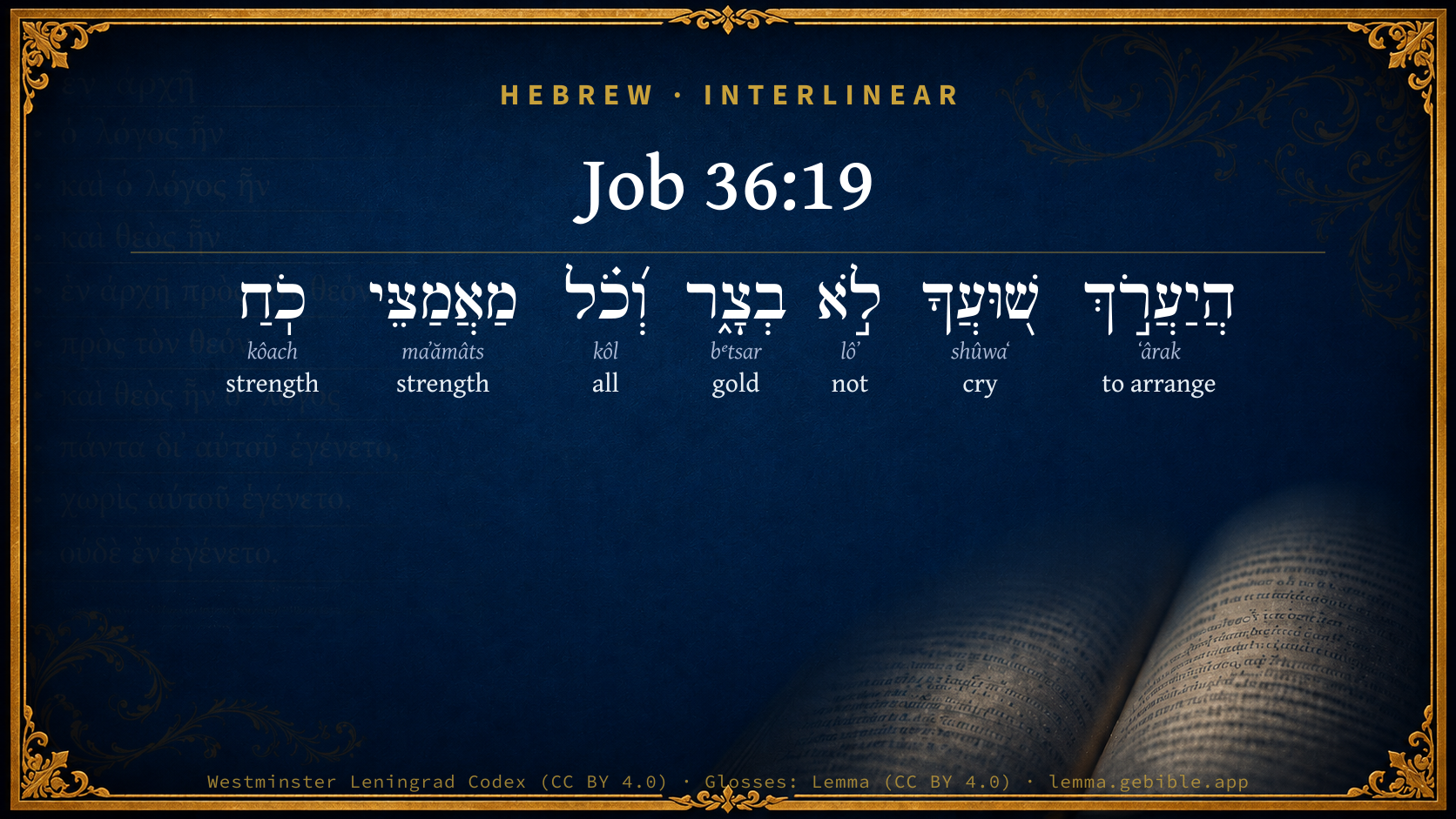
Job 36:19

Hebrew (Westminster Leningrad Codex) Job 36:19 appears in the Hebrew Old Testament. The text above is from the Westminster Leningrad Codex. Each word links to its Strong’s number, a concise gloss, and parsing drawn from the Open Scriptures Hebrew Bible morphology. Click any word for its full Brown-Driver-Briggs (BDB) entry.
Download image
Cite this verse

Job 36:19 (World English Bible). Public Domain. Lemma interlinear Bible study tool, https://lemma.gebible.app/v/job/36/19.

Show BibTeX & RIS
BibTeX
RIS
English Translation
Would your wealth sustain you in distress, Or all the might of your strength?
World English Bible · Public Domain
Highlights
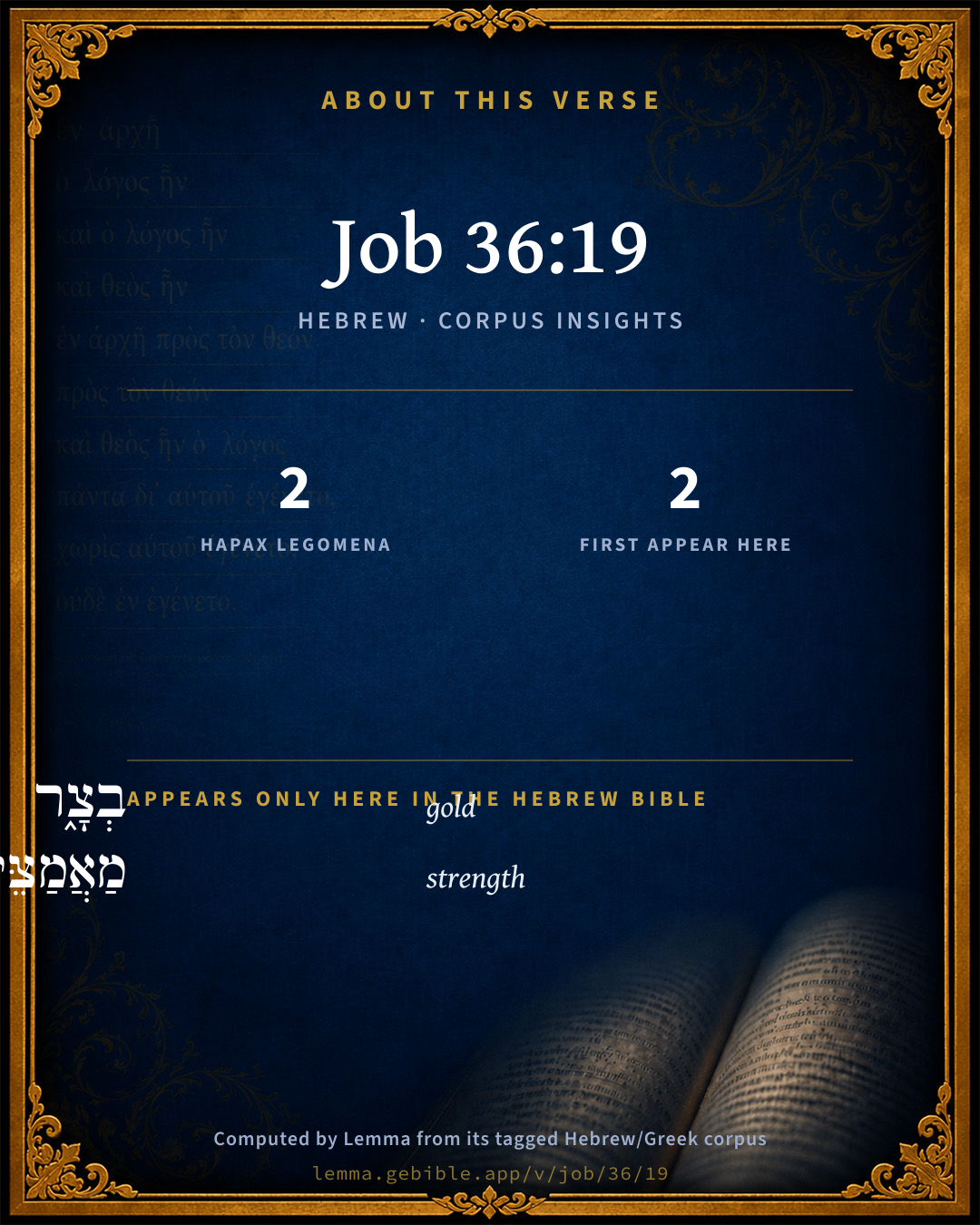
  • 2 hapax legomena — only here in the Hebrew Bible
  • 2 first appearances in the Hebrew Bible
Full analysis ↓
Download a study sheet

One document with this verse’s original text, its word-by-word gloss line, the meaning frame, cross-references with their text, attributed commentary, and full source and license credits — printable, and it pastes into notes with its structure intact.

This verse Autodidact and up

Study sheet (.html) Plain text (.txt)

A passage Seminary Student

Up to 50 verses in one chapter. A passage sheet keeps up to 6 commentary sources and 12 cross-references per verse, in the order this page ranks them, and says so on the sheet whenever that leaves anything out. Ask for a single verse and you get the Autodidact verse sheet above.

Everything on this page stays free to read, with no account — the sheet is a download of what is already on screen, not access to it.

Want to remove ads? Support Godless Engineer
Compare translations 3

The same verse in 3 English versions, stacked beneath the original-language interlinear above. Click any original word for its lexicon entry.

Each is an independent rendering of the whole verse — the interlinear is not word-aligned to these translations.

Highlighted words mark where these versions differ — a whole-verse word diff, not a word-by-word alignment.

  • World English Bible Public Domain
    Would your wealth sustain you in distress, Or all the might of your strength?
  • King James Version Public Domain
    Will he esteem thy riches? no, not gold, nor all the forces of strength.
  • unfoldingWord Literal Text CC BY-SA 4.0
    Will he esteem your riches? Not gold or all of the strengths of wealth!

unfoldingWord Literal Text — © unfoldingWord, licensed CC BY-SA 4.0. Word-aligned USFM3 via Door43 (git.door43.org/unfoldingWord/en_ult).

Versions to compare (up to 4)

3 of 4 selected

Show all 18 translations

Every available English version of this verse, each an independent rendering of the whole verse.

  • World English Bible Public Domain
    Would your wealth sustain you in distress, Or all the might of your strength?
  • Berean Standard Bible Public Domain
    Can your wealth or all your mighty effort keep you from distress?
  • Majority Standard Bible Public Domain
    Can your wealth or all your mighty effort keep you from distress?
  • King James Version Public Domain
    Will he esteem thy riches? no, not gold, nor all the forces of strength.
  • American Standard Version (1901) Public Domain
    Will thy cry avail, `that thou be' not in distress, Or all the forces of `thy' strength?
  • Revised Version (1885) Public Domain
    Will thy riches suffice, that thou be not in distress, or all the forces of thy strength?
  • Geneva Bible (1599) Public Domain
    Wil he regard thy riches? he regardeth not golde, nor all them that excel in strength.
  • Douay-Rheims (1899) Public Domain
    Lay down thy greatness without tribulation, and all the mighty of strength.
  • Young's Literal Translation Public Domain
    Doth He value thy riches? He hath gold, and all the forces of power.
  • Literal Standard Version CC BY-SA 4.0
    Does He value your riches? He has gold, and all the forces of power.
  • Unlocked Literal Bible CC BY-SA 4.0
    Can your wealth benefit you, so that you will not be in distress, or can all the force of your strength help you?
  • unfoldingWord Literal Text CC BY-SA 4.0
    Will he esteem your riches? Not gold or all of the strengths of wealth!
  • Darby Bible Public Domain
    Will he esteem thy riches? Not gold, nor all the resources of strength!
  • World Messianic Bible Public Domain
    Would your wealth sustain you in distress, or all the might of your strength?
  • Webster's Bible Public Domain
    Will he esteem thy riches? no, not gold, nor all the forces of strength.
  • Free Bible Version CC BY-SA 4.0
    Will your cry for help sustain you when troubles come?
  • Bible in Basic English Public Domain
    ...
  • JPS Tanakh (1917) Public Domain
    Will thy riches avail, that are without stint, or all the forces of thy strength?

Literal Standard Version (2020), Covenant Press — licensed CC BY-SA 4.0. Text via the HelloAO Bible API (eBible.org). Unlocked Literal Bible (unfoldingWord) — licensed CC BY-SA 4.0. Text via the HelloAO Bible API (eBible.org). unfoldingWord Literal Text — © unfoldingWord, licensed CC BY-SA 4.0. Word-aligned USFM3 via Door43 (git.door43.org/unfoldingWord/en_ult). Free Bible Version, Dr. Jonathan Gallagher — licensed CC BY-SA 4.0. Text via the HelloAO Bible API (eBible.org).

Word by word

More ways to search: Search by grammar → Find every occurrence → Compare this word →

Practice this passage: Drill this verse → Learn its vocabulary →

About this verse

These counts appear in no published source. They are computed here, from the morphology-tagged text and Lemma’s own curated glosses. What Lemma adds →

7
words
7
distinct lemmas
Wisdom
section

Notable vocabulary

2 hapax legomena — words that appear only here in the entire Hebrew Bible:

  • בְצָ֑ר gold H1222
  • מַאֲמַצֵּי strength H3981

First appearance in Scripture

These words make their first canonical appearance in the Hebrew Bible here:

  • בְצָ֑ר gold H1222
  • מַאֲמַצֵּי strength H3981

Shared distinctive vocabulary

שׁ֭וּעֲךָ cry H7769 occurs in 2 verses of the Hebrew Bible. Also found in:

Grammatical profile

  • 1 verb
  • 4 nouns
  • 1 adjective
  • 1 particle

Verb forms

  • הֲיַעֲרֹ֣ךְ Qal · Imperfect

Hebrew & Septuagint length

In English translation the verse runs 14 words from the Hebrew and 18 from the Septuagint (LXX English) — closely comparable.

A rough comparison of the two English renderings, which tokenize alike — not a word-level alignment.

Word counts can differ between the Hebrew and the Greek without any difference in meaning — e.g. the Hebrew direct-object marker אֵת has no separate Greek word, and Greek often adds the article ὁ.

Cross-references

10

Topical passages linked to Job 36:19 in the Treasury of Scripture Knowledge — connected by theme and wording, ordered by reader-vote popularity; previews shown in the World English Bible.

  • Proverbs 11:4 Riches don't profit in the day of wrath, But righteousness delivers from death.
  • Proverbs 11:21 Most assuredly, the evil man will not be unpunished, But the seed of the righteous will be delivered.
  • Job 9:13 "God will not withdraw his anger; The helpers of Rahab stoop under him.
  • Psalms 33:16–17 There is no king saved by the multitude of a host. A mighty man is not delivered by great strength.
  • Proverbs 10:2 Treasures of wickedness profit nothing, But righteousness delivers from death.
  • Isaiah 2:20 In that day, men shall cast away their idols of silver, And their idols of gold, Which have been made for themselves to worship, To the moles and to the bats;
  • Isaiah 37:36 The angel of Yahweh went forth, and struck in the camp of the Assyrians one hundred and eighty-five thousand; and when men arose early in the morning, behold, these were all dead bodies.
  • Zephaniah 1:18 Neither their silver nor their gold will be able to deliver them in the day of Yahweh's wrath, but the whole land will be devoured by the fire of his jealousy; for he will make an end, yes, a terrible end, of all those who dwell in the land.
  • James 5:3 Your gold and your silver are corroded, and their corrosion will be for a testimony against you, and will eat your flesh like fire. You have laid up your treasure in the last days.
  • Job 34:20 In a moment they die, even at midnight; The people are shaken and pass away, The mighty are taken away without hand.

Cross-references courtesy of OpenBible.info (CC BY 4.0).

Hebrew and Greek witnesses Masoretic Hebrew ↔ Greek Septuagint

The same verse in the two great witnesses to the Old Testament, shown verse-for-verse.

These are two independent witnesses, not word-aligned to each other, and the Septuagint is shown in lemma (dictionary) form.

Hebrew Job 36:19 Masoretic · Westminster Leningrad Codex

הֲיַעֲרֹ֣ךְ שׁ֭וּעֲךָ לֹ֣א בְצָ֑ר וְ֝כֹ֗ל מַאֲמַצֵּי כֹֽחַ

Would your wealth sustain you in distress, Or all the might of your strength?

World English Bible · Public Domain

Greek LXX Job 36:19 Septuagint · lemma form

μή σύ ἐκκλίνω ἑκών ὁ νοῦς δέησις ἐν ἀνάγκη εἰμί ἀδύνατος καί πᾶς ὁ κραταιόω ἰσχύς

Let not your mind willingly turn you aside from the petition of the feeble that are in distress.

LXX2012 (modern English Septuagint) · Public Domain

On this verse, Haydock's Catholic Bible Commentary discusses the Septuagint’s reading. Read the note in Commentary ↓

Hebrew: Westminster Leningrad Codex (CC BY 4.0). Greek: Septuagint (public domain); English from LXX2012 (modern English Septuagint) (Public Domain). How the Septuagint differs from the Hebrew →

Commentary

Notes on Job 36:19 from classic Christian and Jewish commentators (each source and its license shown beneath its notes). The classic Christian expositions comment on the surrounding passage and are grouped to its opening verse, so a note may address several verses; the Jewish commentaries on the Tanakh (Rashi and others) are per-verse, so they appear only where the commentator wrote on this verse.

Lemma curates 59 commentaries, every one of them public domain or Creative Commons licensed, each selected and text-cleaned for this edition rather than reprinted as found. About our sources →

Trapp's Complete Commentary

John Trapp

Job 36:19 Will he esteem thy riches? [no], not gold, nor all the forces of strength.

Ver. 19. Will he esteem thy riches?] Tremellius rendereth it, thy nobility. Others read it thus, Will he regard thy crying in thine adversity? Or, That thou shouldest not abide in adversity? See Pro 10:2; Pro 11:4, {See Trapp on "Pro 10:2"} {See Trapp on "Pro 11:4"}

No, not gold] Which yet can do much with men. The Hebrew word signifieth finest gold, Job 22:24, and hath its name from defending, because gold is a man’s defence: with men it may be so, but not with God, Zep 1:18; see the note there. Others read it, No, not in affliction.

Nor all the forces of strength] Which are poor things in comparison to God, whose weakness is stronger than men, 1Co 1:25. He need but to arise, and his enemies shall be scattered; yea, all that hate him shall fly before him, Psa 68:1. As the rocks repel the greatest waves, so doth God his enemies, Conantia frangere franguut.

John Trapp, A Commentary or Exposition upon All the Books of the Old and New Testament (1647–1656) — public domain. Text from a community e-Sword module.

Whedon's Commentary on the Bible

Daniel D. Whedon

Strophe b — No resources of riches or might will suffice to redeem the soul out of God’s hand; therefore long not for the night, and, above all things, pervert not the afflictions of God into occasions of sin, Job_36:19-21.

19. Will he esteem thy riches — On the supposition that betsar is a compound word, some (Zockler) read, “Shall thy crying put thee out of distress? and all the efforts of strength?” i.e., of thy strength. Gesenius, (Thesaurus, 1069,) Renan, Noyes, Conant, Hitzig, etc., substantially agree with the English version. Thus Hirtzel, “Will thy riches suffice? O not gold, nor all treasures of power!” a reading which quite determines that the preceding verse (18) must accord with the Authorized Version. According to Suidas, the Phoenicians represented their gods with purses of gold as the symbol of power.

Daniel D. Whedon (gen. ed.), Commentary on the Old and New Testaments (1874–1909) — public domain. Text from a community e-Sword module.

Jamieson, Fausset & Brown

Robert Jamieson, A. R. Fausset & David Brown

forces of strength--that is, resources of wealth (Psa 49:7; Pro 11:4).

Jamieson, Fausset & Brown — Commentary Critical and Explanatory on the Whole Bible (1871) — public domain (CC PDM 1.0). Text via the HelloAO Bible API.

Ellicott's Commentary for English Readers

(19) No, not gold, nor all the forces of strength.—The words here are doubtful. Some render, “Will He esteem thy riches, that thou be not in distress?” or, “all the forces of thy strength;” others, “Will thy cry avail, that thou be not in distress?” &c.; but there is authority for the Authorised Version.

A Bible Commentary for English Readers, edited by Charles John Ellicott (1878–1897) — public domain. Text from a community e-Sword module.

The Cambridge Bible for Schools and Colleges

gen. ed. J. J. S. Perowne

19. No other ransom will avail,—not riches nor all the power of wealth. Only the purification of suffering will cleanse him from his evil (cf. ch. Job_34:36), and deliver him. Elihu demands with emphasis whether all his riches will be accepted as a ransom? It need not be said that the question is put merely for the purpose of heightening the effect of the idea in Job_36:18, that suffering is the only ransom possible. A similar thought is expressed in Psa_49:7 : “None of them can by any means redeem his brother, nor give to God a ransom for him; for the redemption of their soul is too precious and it ceaseth for ever.”

The word translated “without stint” (Conant) is lit. without straitness. The word is often used for distress (Job_36:16), and the clause might be rendered: will thy riches suffice (lit. be equal to it, ch. Job_28:19), without distress, i.e. such afflictions as those now suffered? This is rather flat. The A. V. assumes that the expression is the word ore or gold, ch. Job_22:24, differently spelled. This assumption is both improbable in itself and contrary to the balance of the verse.

The Cambridge Bible for Schools and Colleges (gen. ed. J. J. S. Perowne; Cambridge University Press, 1878–1918) — public domain. Text from a community e-Sword module.

John Gill's Exposition

Will he esteem thy riches? no, not gold, nor all the forces of strength. Riches can be of no account, nor bear any weight with God; for they are of him and come from him, and what he has a right to take away and dispose of as he pleases. These cannot ward off the stroke of death, or secure from it; nor can a man possessed of them carry them with him into the other world; nor will they profit in the day of wrath. Mr. Broughton renders it, "will he esteem thy nobleness?" so Junius and Tremellius; thy noble birth, rank and station, thou hast had among men? Not at all. God is no respecter of persons; he regards not the noble and the rich more than the poor: and as for gold, the same may be said of that, which, though the most valuable among men, is of no esteem with God; and besides it is his: "the gold is mine", says he, "and the silver is mine", Hag 2:8. Nor is death to be bribed with it, or put off by it; nor is a "munition" (z) fortress or castle, as some render the word, any defence against it: "nor all the forces of strength". Had a man at his command ever such numerous and powerful armies, they could not protect him from the stroke of death, or deliver him from eternal punishment, the demerit of sin. Though as Job had no riches, no gold, nor troops of soldiers about him; nor was there any great likelihood that this would be his case at death; I should think the words might be better rendered, "will he regard thy cry? no, not in distress; not even the most strong and forcible" cries or entreaties: when the stroke of death is given, the sentence of wrath is passed, and eternal destruction takes place; weeping and wailing will signify nothing: the cries and howlings of the damned in hell are of no avail; their strong cryings, and most intense and earnest entreaties, will have no effect on the Lord; though he is a God of great pity and compassion, and has sympathy with his people in distress, and in all their afflictions is afflicted; yet will have no regard to cries and tears, when the decree is gone forth and carried into execution: the verb from whence the first word is derived is used for "crying" in this chapter, Job 36:13; and the Targum renders it here by supplication and petition; so some other Jewish writers (a) interpret it of crying: and the second word is by several rendered "in straits" (b) and distress; and Cocceius has observed the notion of intense and fervent prayer in the third, and renders the whole pretty near to what has been observed (c).

(z) "non munitionem", Tigurine version. (a) Vid. Aben Ezra, Bar Tzemach, Sephorno. (b) "In angustia", Mercerus, Drusius, Piscator; "in arcto", Cocceius, Schultens. (c) "Num aequalis esset imploration tua non in arcto et omnes contentiones virium", Cocceius.

John Gill's Exposition of the Whole Bible (1746–1763) — public domain (CC PDM 1.0). Text via the HelloAO Bible API.

Albert Barnes' Notes on the Bible

Will he esteem thy riches? - That is God will not regard thy riches as a reason why he should not cut you off, or as a ransom for your forfeited life. The reference here must be to the fact that Job “had been” a rich man, and the meaning is, either that God would not spare him because he “had been” a rich man, or that if he had now all the wealth which he once possessed, it would not be sufficient to be a ransom for his life.

Nor all the forces of his strength - Not all that gives power and influence to a man - wealth, age, wisdom, reputation, authority, and rank. The meaning is, that God would not regard any of these when a man was rebellious in affliction, and refused in a proper manner to acknowledge his Maker. Of the truth of what is here affirmed, there can be no doubt. Riches, rank, and honors cannot redeem the life of a man. They do not save him from the grave, and from all that is gloomy and revolting there. When God comes forth to deal with mankind, he does not regard their gold, their rank, their splendid robes or palaces, but he deals with them as “men” - and the “happy,” the beautiful, the rich, the noble, moulder back, under his hand, to their native dust in the same manner as the most humble peasant. How forcibly should this teach us not to set our hearts on wealth, and not to seek the honors and wealth of the world as our portion!

Albert Barnes' Notes on the Bible (1834–1885) — public domain. Text from a community e-Sword/MySword module.

Haydock's Catholic Bible Commentary

Without, or before thou be forced by tribulation. (Menochius) --- Lay aside all sentiments of pride, (St. Gregory) or keep in awe the mighty, who administer justice in thy name. (Menochius) --- Protestants, "Will he esteem thy riches? No, not gold, nor all the forces of strength." Septuagint, "Let not a willing mind incline thee unjustly to the prayer of the needy in distress." (Haydock)

George Leo Haydock (1774–1849), Haydock's Catholic Family Bible and Commentary, 1859 edition — public domain. Excludes Psalms (Douay-Rheims chapter numbering differs from Protestant) and Deuterocanonical books (Catholic canon only).

Matthew Poole's English Annotations

If thou couldst recover thy lost wealth or strength, or thy friends would employ theirs on thy behalf, neither could the one ransom thee, nor the other rescue thee.

Matthew Poole's English Annotations on the Holy Bible (1683–1685) — public domain. Text from a community e-Sword/MySword module.

The Pulpit Commentary

Will he esteem thy riches! rather, Will thy riches suffice? (Revised Version); or Will they stand the shock of battle? (Schultens). Will they be a sufficient strength to thee in the time of trouble? No, not gold. This rendering is now generally given up, and the words, lo betsar (rxb al), are taken in connection with the preceding sentence, thus: Will thy riches suffice" that thou be not in distress? or, in other words, Will they keep thee out of trouble? If not, will all the forces of thy strength suffice to do so? Assuredly, nothing will avail against the "stroke" of God (ver. 18).

The Pulpit Commentary (1880–1919), ed. H.D.M. Spence-Jones & Joseph S. Exell — public domain. Text from a community e-Sword module.

John Wesley's Explanatory Notes

Thy riches - If thou hadst as much of them as ever. Forces - The strongest forces.

John Wesley, Explanatory Notes Upon the Whole Bible (1754–1765) — public domain. Text via the GEBible commentary corpus.

Keil & Delitzsch

C. F. Keil & F. Delitzsch

19 Shall thy crying place thee beyond distress,

And all the efforts of strength?

20 Long not for the night to come,

Which shall remove people from their place!

21 Take heed, incline not to evil;

For this thou hast desired more than affliction.

Those expositors who found in Job 36:18 the warning, that Job should not imagine that he would be able to redeem himself from judgment by a large ransom, go on to explain: will He esteem thy riches? (Farisol, Rosenm., Umbr., Carey, Ebr., and others); or: will thy riches suffice? (Hirz., Schlottm.); or some other way (Ew.). But apart from the want of connection of this insinuation, which is otherwise not mentioned in the book, and apart from the violence which must be done to היערך to accommodate it to it, שׁוּע, although it might, as the abstract of שׁוע, Job 34:19, signify wealth (comp. Arab. sa‛at, amplitudo), is, however, according to the usage of the language (vid., Job 30:24), so far as we can trace it, a secondary form of שׁוע (שׁועה), a cry for help; and Job 35:9., Job 36:13, and other passages, also point to this signification. What follows is still less appropriate to this thought of ransom; Hirz. translates: Oh, not God and all the treasures of wealth! But בּצר is nowhere equivalent to בּצר, Job 22:24; but צר, Job 36:16, signifies distress; and the expression לא בצר, in a condition devoid of distress, is like לא בחכמה, Job 4:21, and לא ביד, Job 34:20. Finally, אמּיץ כּח signifies mighty in physical strength, Job 9:4, Job 9:19, and מאמצּי־כח strong proofs of strength, not "treasures of wealth." Stick. correctly interprets: "Will thy wild raging cry, then, and all thine exertions, as a warrior puts them forth in the tumult of battle to work his way out, put thee where there is an open space?" but the figure of a warrior is, with Hahn, to be rejected; ערך is only a nice word for שׁית שׂים, to place, set up, Job 37:19.

Job 36:20

Elihu calls upon Job to consider the uselessness of his vehement contending with God, and then warns him against his dreadful provocation of divine judgment: ne anheles (Job 7:2) noctem illam (with the emphatic art.) sublaturam populos loco suo. לעלות is equivalent to futuram (ההוה or העתידה) ut tollat = sublaturam (vid., on Job 5:11, לשׂוּם, collocaturus; Job 30:6, לשׁכּן, habitandum est), syncopated from להעלות, in the sense of Psa 102:25; and תּחתּם signifies, as Job 40:12 (comp. on Hab 3:16), nothing but that just where they are, firmly fixed without the possibility of escape, they are deprived of being. If whole peoples are overtaken by such a fate, how much less shall the individual be able to escape it! And yet Job presses forward on to the tribunal of the terrible Judge, instead of humbling himself under His mighty hand. Oh that in time he would shrink back from this absolute wickedness (און), for he has given it the preference before עני, quiet, resigned endurance. בּחר על signifies, Sa2 19:39, to choose to lay anything on any one; here as בחר בּ, elsewhere to extend one's choice to something, to make something an object of choice; perhaps also under the influence of the phrase התענּג על, and similar phrases. The construction is remarkable, since one would sooner have expected על־עני זה בחרת, hanc elegisti prae toleratione.

Keil & Delitzsch — Biblical Commentary on the Old Testament (1861–1891) — public domain (CC PDM 1.0). Text via the HelloAO Bible API. (Old Testament only.)

unfoldingWord translationNotes

Door43 World Missions Community

Can your wealth benefit you, so that you will not be in distress, or can all the force of your strength help you?

Elihu asks these questions to state that money and power will not be able to help Job if he acts unjustly. AT: "Your wealth cannot cause you to no longer be in distress, and all the force of your strength cannot help you." (See: Rhetorical Question)

all the force of your strength

"all of your great strength" or "all of your mighty efforts"

when peoples are cut off in their place

Possible meanings are 1) that "peoples" refers to people in general and "cut off in their place" is a metaphor for oppressing others by dragging them away from their homes. AT: "when people drag others away from their homes" or 2) that "peoples" represents nations and "cut off in their place" is a metaphor for nations being destroyed. AT: "when nations will perish" (See: Metaphor)

you are being tested by suffering

This can be stated in active form. AT: "God is testing you by making you suffer" (See: Active or Passive)

translationWords

strength

commit

sin

people group

cut off

turn

test

suffer

unfoldingWord translationNotes — © Distant Shores Media and the Door43 World Missions Community, licensed CC BY-SA 4.0. Source: git.door43.org/Door43/en_tn.

Rashi

Rabbi Shlomo Yitzchaki (Rashi)

Will you set up your prayer so that no trouble Have you come to set up a cry that no trouble befall you, or any forces of strength to rob you? If so, with what will He collect His debt?

Rashi on the Tanakh — English translations: “The Judaica Press complete Tanach with Rashi, translated by A. J. Rosenberg” (CC BY 4.0); “Pentateuch with Rashi's commentary by M. Rosenbaum and A.M. Silbermann, 1929-1934” (public domain); “The Metsudah Tanach series, Lakewood, N.J” (CC BY 4.0); and “The Book of Joshua, Metsudah Publications, 1997” (CC BY 4.0). Text via Sefaria.

Lesson kit

Teaching starters — assembled from the data on this page, not authored interpretation. Every prompt links to the verse data it draws on. Edit before teaching.

Job, in the Wisdom, opens this verse with 7 words (7 distinct Hebrew lemmas). Its most distinctive word is bᵉtsar (“gold”). A historical commentator’s framing appears above. Read the whole chapter for the surrounding context.

Discussion questions

  1. What does “gold” (bᵉtsar) contribute to the verse as a whole?
  2. This verse holds 2 words here found nowhere else in the Hebrew Bible. What might the rare words draw attention to?
  3. 2 words here appear for the first time in Scripture. What is being introduced at this debut?
  4. Job 30:24 shares the word «cry» with this verse. How do the two illuminate each other?
  5. These translations render this verse differently. What is at stake in choosing one wording over another?
  6. The verb «הֲיַעֲרֹ֣ךְ» is Qal Imperfect. How does its form color the action?
  7. Reading how Trapp's Complete Commentary and Whedon's Commentary on the Bible read this verse, where do the two commentators agree and where do they part?

Things to notice

  • 2 words in this verse appear nowhere else in the Hebrew Bible.
  • 2 words make their first canonical appearance in Scripture here.
  • These translations choose different wording for 13 words in this verse.
  • 7 distinct Hebrew lemmas span 7 words in this verse.

Reading settings

Reading text

Shown beneath each verse's original-language words.

Old Testament
Old Testament edition

Read the OT as the Masoretic Hebrew (MT) or the Greek Septuagint (LXX).

English shown for the Greek Septuagint (in the Hebrew ↔ Greek comparison).

Comparing translations? Open the Compare panel on any verse page to stack up to four side by side.