
Nahum 1:3

Hebrew (Westminster Leningrad Codex) Nahum 1:3 appears in the Hebrew Old Testament. The text above is from the Westminster Leningrad Codex. Each word links to its Strong’s number, a concise gloss, and parsing drawn from the Open Scriptures Hebrew Bible morphology. Click any word for its full Brown-Driver-Briggs (BDB) entry.
Download image
Cite this verse

Nahum 1:3 (World English Bible). Public Domain. Lemma interlinear Bible study tool, https://lemma.gebible.app/v/nahum/1/3.

Show BibTeX & RIS
BibTeX
RIS
English Translation
Yahweh is slow to anger, and great in power, and will by no means leave the guilty unpunished. Yahweh has his way in the whirlwind and in the storm, and the clouds are the dust of his feet.
World English Bible · Public Domain
Download a study sheet

One document with this verse’s original text, its word-by-word gloss line, the meaning frame, cross-references with their text, attributed commentary, and full source and license credits — printable, and it pastes into notes with its structure intact.

This verse Autodidact and up

Study sheet (.html) Plain text (.txt)

A passage Seminary Student

Up to 50 verses in one chapter. A passage sheet keeps up to 6 commentary sources and 12 cross-references per verse, in the order this page ranks them, and says so on the sheet whenever that leaves anything out. Ask for a single verse and you get the Autodidact verse sheet above.

Everything on this page stays free to read, with no account — the sheet is a download of what is already on screen, not access to it.

Want to remove ads? Support Godless Engineer
Compare translations 3

The same verse in 3 English versions, stacked beneath the original-language interlinear above. Click any original word for its lexicon entry.

Each is an independent rendering of the whole verse — the interlinear is not word-aligned to these translations.

Highlighted words mark where these versions differ — a whole-verse word diff, not a word-by-word alignment.

  • World English Bible Public Domain
    Yahweh is slow to anger, and great in power, and will by no means leave the guilty unpunished. Yahweh has his way in the whirlwind and in the storm, and the clouds are the dust of his feet.
  • King James Version Public Domain
    The LORD is slow to anger, and great in power, and will not at all acquit the wicked: the LORD hath his way in the whirlwind and in the storm, and the clouds are the dust of his feet.
  • unfoldingWord Literal Text CC BY-SA 4.0
    Yahweh long of nostrils and great in power; and to acquit he will not acquit. Yahweh—in whirlwind and storm his way, and cloud the dust of his feet.

unfoldingWord Literal Text — © unfoldingWord, licensed CC BY-SA 4.0. Word-aligned USFM3 via Door43 (git.door43.org/unfoldingWord/en_ult).

Versions to compare (up to 4)

3 of 4 selected

Show all 18 translations

Every available English version of this verse, each an independent rendering of the whole verse.

  • World English Bible Public Domain
    Yahweh is slow to anger, and great in power, and will by no means leave the guilty unpunished. Yahweh has his way in the whirlwind and in the storm, and the clouds are the dust of his feet.
  • Berean Standard Bible Public Domain
    The LORD is slow to anger and great in power; the LORD will by no means leave the guilty unpunished. His path is in the whirlwind and storm, and clouds are the dust beneath His feet.
  • Majority Standard Bible Public Domain
    The LORD is slow to anger and great in power; the LORD will by no means leave the guilty unpunished. His path is in the whirlwind and storm, and clouds are the dust beneath His feet.
  • King James Version Public Domain
    The LORD is slow to anger, and great in power, and will not at all acquit the wicked: the LORD hath his way in the whirlwind and in the storm, and the clouds are the dust of his feet.
  • American Standard Version (1901) Public Domain
    Jehovah is slow to anger, and great in power, and will by no means clear `the guilty': Jehovah hath his way in the whirlwind and in the storm, and the clouds are the dust of his feet.
  • Revised Version (1885) Public Domain
    The LORD is slow to anger, and great in power, and will by no means clear the guilty: the LORD hath his way in the whirlwind and in the storm, and the clouds are the dust of his feet.
  • Geneva Bible (1599) Public Domain
    The Lord is slow to anger, but he is great in power, and will not surely cleare the wicked: the Lord hath his way in ye whirlewind, and in the storme, and the cloudes are the dust of his feete.
  • Douay-Rheims (1899) Public Domain
    The Lord is patient, and great in power, and will not cleanse and acquit the guilty. The Lord's ways are in a tempest, and a whirlwind, and clouds are the dust of his feet.
  • Young's Literal Translation Public Domain
    Jehovah `is' slow to anger, and great in power, And Jehovah doth not entirely acquit, In a hurricane and in a tempest `is' His way, And a cloud `is' the dust of His feet.
  • Literal Standard Version CC BY-SA 4.0
    YHWH [is] slow to anger, and great in power, || And YHWH does not entirely acquit, || In a windstorm and in a storm [is] His way, || And a cloud [is] the dust of His feet.
  • Unlocked Literal Bible CC BY-SA 4.0
    Yahweh is slow to anger and great in power; he will not allow the wicked to go unpunished. Yahweh makes his way in the whirlwind and the storm, and the clouds are the dust of his feet.
  • unfoldingWord Literal Text CC BY-SA 4.0
    Yahweh long of nostrils and great in power; and to acquit he will not acquit. Yahweh—in whirlwind and storm his way, and cloud the dust of his feet.
  • Darby Bible Public Domain
    Jehovah is slow to anger, and great in power, and doth not at all clear [the guilty]: Jehovah, -- his way is in the whirlwind and in the storm, and the clouds are the dust of his feet.
  • World Messianic Bible Public Domain
    The LORD is slow to anger, and great in power, and will by no means leave the guilty unpunished. The LORD has his way in the whirlwind and in the storm, and the clouds are the dust of his feet.
  • Webster's Bible Public Domain
    The LORD is slow to anger, and great in power, and will not at all acquit the wicked: the LORD hath his way in the whirlwind and in the storm, and the clouds are the dust of his feet.
  • Free Bible Version CC BY-SA 4.0
    The Lord is slow to become angry, has great power, and will not leave the guilty unpunished. He walks among the whirlwind and the storm; the clouds are like dust beneath his feet.
  • Bible in Basic English Public Domain
    The Lord is slow to get angry and great in power, and will not let the sinner go without punishment: the way of the Lord is in the wind and the storm, and the clouds are the dust of his feet.
  • JPS Tanakh (1917) Public Domain
    The LORD is long-suffering, and great in power, and will by no means clear the guilty; the LORD, in the whirlwind and in the storm is His way, and the clouds are the dust of His feet.

Literal Standard Version (2020), Covenant Press — licensed CC BY-SA 4.0. Text via the HelloAO Bible API (eBible.org). Unlocked Literal Bible (unfoldingWord) — licensed CC BY-SA 4.0. Text via the HelloAO Bible API (eBible.org). unfoldingWord Literal Text — © unfoldingWord, licensed CC BY-SA 4.0. Word-aligned USFM3 via Door43 (git.door43.org/unfoldingWord/en_ult). Free Bible Version, Dr. Jonathan Gallagher — licensed CC BY-SA 4.0. Text via the HelloAO Bible API (eBible.org).

Word by word

More ways to search: Search by grammar → Find every occurrence → Compare this word →

Practice this passage: Drill this verse → Learn its vocabulary →

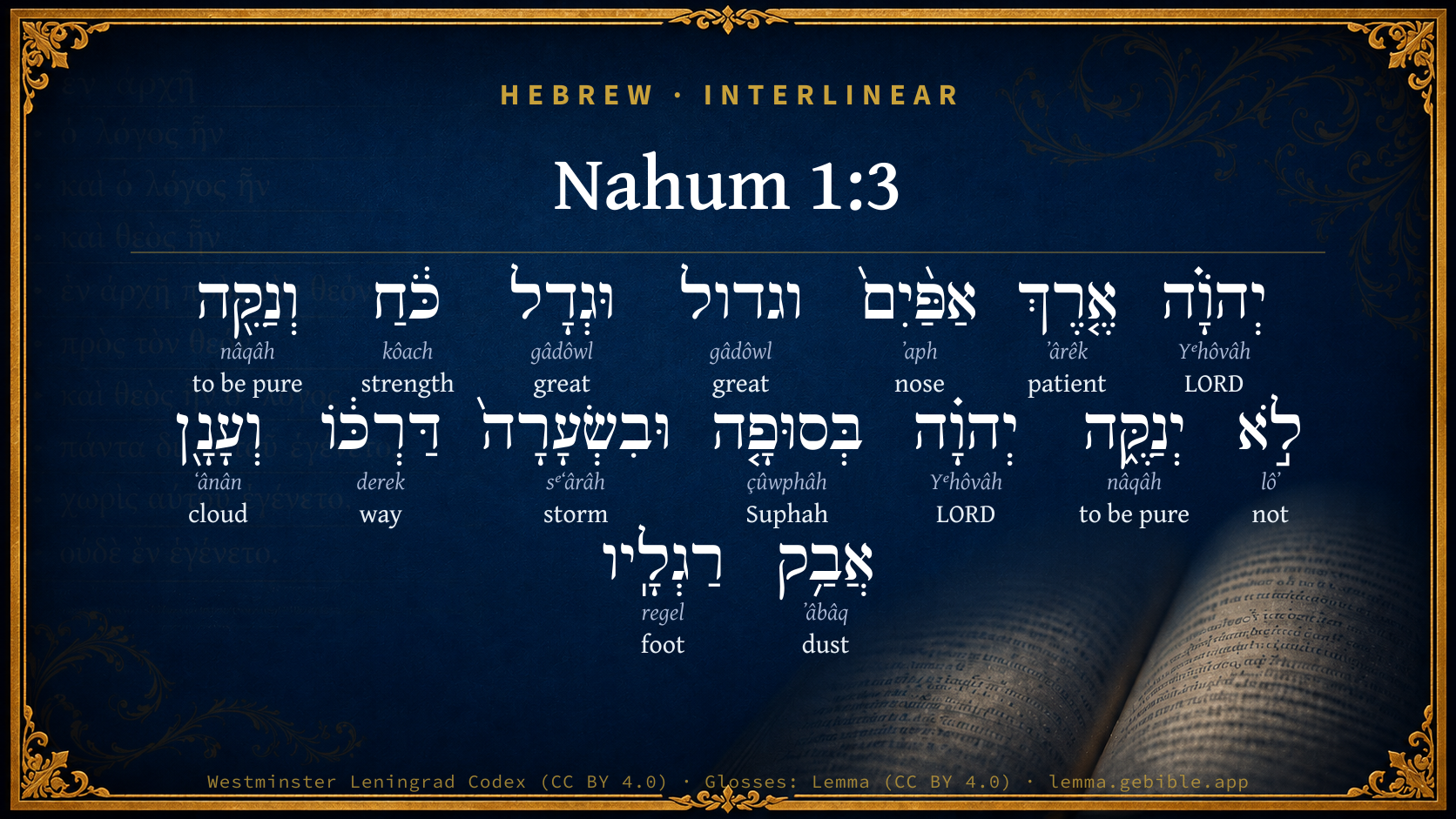
וּבִשְׂעָרָה֙
sᵉʻârâh
H8183
“and · in/at · storm”
Conjunction + Preposition + Noun, Common, Feminine, Singular, Absolute
Part of Speech
Conjunction + Preposition + Noun
Type
Common
Gender
Feminine
Number
Singular
State
Absolute
Full BDB Definition

Origin: from H8178

TWOT: 2275b

storm
  1. יְהֹוָ֗ה Yᵉhôvâh H3068 “LORD” Noun, Proper
  2. אֶ֤רֶךְ ʼârêk H750 “patient of” Adjective, Adjective, Masculine, Singular, Construct
  3. אַפַּ֨יִם֙ ʼaph H639 “nostrils” Noun, Common, Masculine, Dual, Absolute
  4. וגדול gâdôwl H1419 “and · great of” Conjunction + Adjective, Adjective, Masculine, Singular, Construct
  5. וּגְדָל gâdôwl H1419 “and · great of” Conjunction + Adjective, Adjective, Masculine, Singular, Construct
  6. כֹּ֔חַ kôach H3581 “strength” Noun, Common, Masculine, Singular, Absolute
  7. וְנַקֵּ֖ה nâqâh H5352 “and · to be pure” Conjunction + Verb, Piel, Infinitive Absolute
  8. לֹ֣א lôʼ H3808 “not” Particle, Negative
  9. יְנַקֶּ֑ה nâqâh H5352 “to be pure” Verb, Piel, Imperfect, 3rd Person, Masculine, Singular
  10. יְהוָ֗ה Yᵉhôvâh H3068 “LORD” Noun, Proper
  11. בְּסוּפָ֤ה çûwphâh H5492 “in/at · Suphah” Preposition + Noun, Common, Feminine, Singular, Absolute
  12. דַּרְכּ֔וֹ derek H1870 “way · his” Noun, Common, Both, Singular, Construct + Suffix, Personal, 3rd Person, Masculine, Singular
  13. וְעָנָ֖ן ʻânân H6051 “and · cloud” Conjunction + Noun, Common, Masculine, Singular, Absolute
  14. אֲבַ֥ק ʼâbâq H80 “dust of” Noun, Common, Masculine, Singular, Construct
  15. רַגְלָֽיו regel H7272 “feet · his” Noun, Common, Feminine, Dual, Construct + Suffix, Personal, 3rd Person, Masculine, Singular

About this verse

These counts appear in no published source. They are computed here, from the morphology-tagged text and Lemma’s own curated glosses. What Lemma adds →

16
words
13
distinct lemmas
Prophets
section

Notable vocabulary

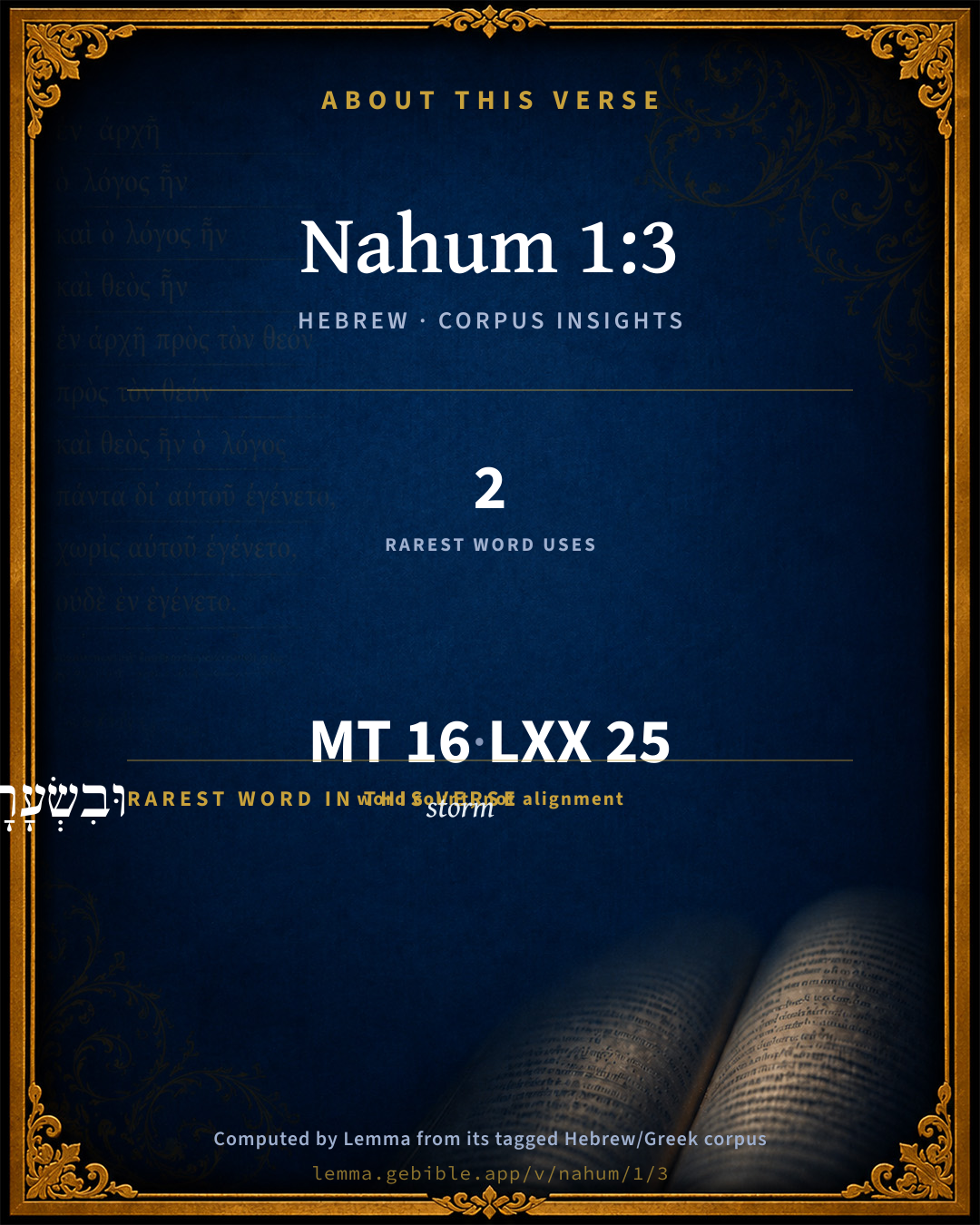
The rarest word here is וּבִשְׂעָרָה֙ storm H8183 — appearing just 2 times in the whole Hebrew Bible.

Shared distinctive vocabulary

וּבִשְׂעָרָה֙ storm H8183 occurs in 2 verses of the Hebrew Bible. Also found in:

Grammatical profile

  • 2 verbs
  • 10 nouns
  • 3 adjectives
  • 1 particle

Verb forms

  • וְנַקֵּ֖ה Piel · Infinitive Absolute
  • יְנַקֶּ֑ה Piel · Imperfect

Repetition

Words recur within this verse — often emphatic in Hebrew:

  • יְהֹוָ֗ה LORD H3068 ×2
  • וגדול great H1419 ×2
  • וְנַקֵּ֖ה to be pure H5352 ×2

Hebrew & Septuagint length

In English translation the verse runs 38 words from the Hebrew and 35 from the Septuagint (LXX English) — closely comparable.

A rough comparison of the two English renderings, which tokenize alike — not a word-level alignment.

Word counts can differ between the Hebrew and the Greek without any difference in meaning — e.g. the Hebrew direct-object marker אֵת has no separate Greek word, and Greek often adds the article ὁ.

In the original languages it is 16 Hebrew tokens and 25 Greek tokens — but the two are counted differently (Hebrew bundles its prefixes and suffixes into one token; the Greek is in lemma form), so that isn’t a like-for-like length.

Cross-references

29

Topical passages linked to Nahum 1:3 in the Treasury of Scripture Knowledge — connected by theme and wording, ordered by reader-vote popularity; previews shown in the World English Bible.

  • Psalms 147:5 Great is our Lord, and mighty in power. His understanding is infinite.
  • Exodus 34:6–7 Yahweh passed by before him, and proclaimed, "Yahweh! Yahweh, a merciful and gracious God, slow to anger, and abundant in loving kindness and truth,
  • Nehemiah 9:17 and refused to obey, neither were mindful of your wonders that you did among them, but hardened their neck, and in their rebellion appointed a captain to return to their bondage. But you are a God ready to pardon, gracious and merciful, slow to anger, and abundant in loving kindness, and didn't forsake them.
  • Psalms 103:8 Yahweh is merciful and gracious, Slow to anger, and abundant in loving kindness.
  • Psalms 104:3 He lays the beams of his chambers in the waters. He makes the clouds his chariot. He walks on the wings of the wind.
  • Psalms 145:8 Yahweh is gracious, merciful, Slow to anger, and of great loving kindness.
  • Psalms 97:2–5 Clouds and darkness are around him. Righteousness and justice are the foundation of his throne.
  • James 1:19 So, then, my beloved brothers, let every man be swift to hear, slow to speak, and slow to anger;
  • 1 Kings 19:11–13 He said, Go forth, and stand on the mountain before Yahweh. Behold, Yahweh passed by, and a great and strong wind tore the mountains, and broke in pieces the rocks before Yahweh; but Yahweh was not in the wind: and after the wind an earthquake; but Yahweh was not in the earthquake:
  • Job 9:4 God who is wise in heart, and mighty in strength: Who has hardened himself against him, and prospered?
  • Isaiah 66:15 For, behold, Yahweh will come with fire, and his chariots shall be like the whirlwind; to render his anger with fierceness, and his rebuke with flames of fire.
  • Zechariah 9:14 Yahweh will be seen over them; And his arrow will go flash like lightning; And the Lord Yahweh will blow the trumpet, And will go with whirlwinds of the south.
  • Ephesians 1:19–20 and what is the exceeding greatness of his power toward us who believe, according to that working of the strength of his might
  • Numbers 14:18 Yahweh is slow to anger, and abundant in loving kindness, forgiving iniquity and disobedience; and that will by no means clear [the guilty], visiting the iniquity of the fathers on the children, on the third and on the fourth generation.
  • Deuteronomy 5:22–24 These words Yahweh spoke to all your assembly on the mountain out of the midst of the fire, of the cloud, and of the thick darkness, with a great voice: and he added no more. He wrote them on two tables of stone, and gave them to me.
  • Job 10:14 If I sin, then you mark me. You will not acquit me from my iniquity.
  • Job 38:1 Then Yahweh answered Job out of the whirlwind,
  • Psalms 62:11 God has spoken once, Twice I have heard this, That power belongs to God.
  • Psalms 66:3 Tell God, "How awesome are your deeds! Through the greatness of your power, your enemies submit themselves to you.
  • Isaiah 19:1 The burden of Egypt. Behold, Yahweh rides on a swift cloud, and comes to Egypt: and the idols of Egypt shall tremble at his presence; and the heart of Egypt shall melt in the midst of it.
  • Daniel 7:13 I saw in the night-visions, and, behold, there came with the clouds of the sky one like a son of man, and he came even to the ancient of days, and they brought him near before him.
  • Joel 2:13 Tear your heart, and not your garments, And turn to Yahweh, your God; For he is gracious and merciful, Slow to anger, and abundant in loving kindness, And relents from sending calamity.
  • Jonah 4:2 He prayed to Yahweh, and said, "Please, Yahweh, wasn't this what I said when I was still in my own country? Therefore I hurried to flee to Tarshish, for I knew that you are a gracious God, and merciful, slow to anger, and abundant in loving kindness, and you repent of the evil.
  • Matthew 26:64 Jesus said to him, "You have said it. Nevertheless, I tell you, henceforth you will see the Son of Man sitting at the right hand of Power, and coming on the clouds of the sky."
  • Revelation 1:7 Behold, he is coming with the clouds, and every eye will see him, including those who pierced him. All the tribes of the earth will mourn over him. Even so, Amen.
  • Exodus 19:16–18 It happened on the third day, when it was morning, that there were thunders and lightnings, and a thick cloud on the mountain, and the sound of an exceedingly loud trumpet; and all the people who were in the camp trembled.
  • Psalms 18:7–15 Then the earth shook and trembled. The foundations also of the mountains quaked and were shaken, Because he was angry.
  • Psalms 50:3 Our God comes, and does not keep silent. A fire devours before him. It is very tempestuous around him.
  • Habakkuk 3:5–15 Plague went before him, And pestilence followed his feet.

Cross-references courtesy of OpenBible.info (CC BY 4.0).

Hebrew and Greek witnesses Masoretic Hebrew ↔ Greek Septuagint

The same verse in the two great witnesses to the Old Testament, shown verse-for-verse.

These are two independent witnesses, not word-aligned to each other, and the Septuagint is shown in lemma (dictionary) form.

Hebrew Nahum 1:3 Masoretic · Westminster Leningrad Codex

יְהֹוָ֗ה אֶ֤רֶךְ אַפַּ֨יִם֙ וגדול וּגְדָל כֹּ֔חַ וְנַקֵּ֖ה לֹ֣א יְנַקֶּ֑ה יְהוָ֗ה בְּסוּפָ֤ה וּבִשְׂעָרָה֙ דַּרְכּ֔וֹ וְעָנָ֖ן אֲבַ֥ק רַגְלָֽיו

Yahweh is slow to anger, and great in power, and will by no means leave the guilty unpunished. Yahweh has his way in the whirlwind and in the storm, and the clouds are the dust of his feet.

World English Bible · Public Domain

Greek LXX Nahum 1:3 Septuagint · lemma form

κύριος μακρόθυμος καί μέγας ὁ ἰσχύς αὐτός καί ἀθῳόω οὐ ἀθῳόω κύριος ἐν συντέλεια καί ἐν συσσεισμός ὁ ὁδός αὐτός καί νεφέλη κονιορτός πούς αὐτός

The Lord is longsuffering, and his power is great, and the Lord will not hold any guiltless: his way is in destruction and in the whirlwind, and the clouds are the dust of his feet.

LXX2012 (modern English Septuagint) · Public Domain

On this verse, Haydock's Catholic Bible Commentary discusses the Septuagint’s reading. Read the note in Commentary ↓

Hebrew: Westminster Leningrad Codex (CC BY 4.0). Greek: Septuagint (public domain); English from LXX2012 (modern English Septuagint) (Public Domain). How the Septuagint differs from the Hebrew →

Targum (Aramaic paraphrase)

1

The Targum is the ancient Jewish Aramaic paraphrase of the Hebrew Scriptures — an interpretive translation, not the Hebrew text itself. Onkelos (literal) and Pseudo-Jonathan (expansive) render the Torah, and Jonathan the Prophets. Coverage is partial: where no permissively-licensed English translation exists for a verse, only the Aramaic is shown. This is verse-level text, not a word-by-word alignment to the Hebrew.

  1. Targum Jonathan Prophets (Joshua–Malachi)
    יְיָ מַרְחֵיק רְגַז וּסְגִי חֵילָא קֳדָמוֹהִי עֲתִיד יְיָ לְאִתְפְּרַע וּסְלַח לִדְתַיְבִין לְאוֹרַיְתָא לִדְלָא תַיְבִין לָא מְזַכֵּי יְיָ בְּעַלְעוֹלָא וּבְרוּחַ מְדַבֵּר וַעֲנַן אֲמִיטְתָא כַּבֵּישׁ קֳדָמוֹהִי:

    (no public-domain English translation for this verse)

    Targum Jonathan — Aramaic: “Mikraot Gedolot” (public domain). English: “Sefaria Community Translation” (CC0 1.0 (public-domain dedication)); “London "Chaldee Paraphrase," 1871” (public domain). Text via Sefaria.

Commentary

Notes on Nahum 1:3 from classic Christian and Jewish commentators (each source and its license shown beneath its notes). The classic Christian expositions comment on the surrounding passage and are grouped to its opening verse, so a note may address several verses; the Jewish commentaries on the Tanakh (Rashi and others) are per-verse, so they appear only where the commentator wrote on this verse.

Lemma curates 59 commentaries, every one of them public domain or Creative Commons licensed, each selected and text-cleaned for this edition rather than reprinted as found. About our sources →

The Cambridge Bible for Schools and Colleges

gen. ed. J. J. S. Perowne

3. Nah_1:3 continues the description of the relation of Jehovah to His enemies: He is longsuffering, delays chastisement long, but eventually takes vengeance. The meaning of the phrase “great in power” is not clear. If employed in the usual objective sense as Job_9:4, the verse would read, The Lord is slow to anger, but great in strength and will by no means leave unpunished (Rom_9:22). If “great in power” had a sense parallel to Job_36:5, “Lo God is great and despises not, great in strength of heart” (mind), that is, if “strength” referred to attributes of the divine mind, magnanimity and longsuffering, the clause would be connected rather with the first, and the verse would read, “The Lord is slow to anger and great in strength, but he will &c.”; see Num_14:17-18, to which the verse has great resemblance. The phrase “will not acquit,” or leave unpunished, is used here absolutely, as Exo_34:7, it being readily understood who it is that He will not let go unpunished; cf. Exo_20:7; Joe_3:21; Jer_25:29. For “great in power” some would read the usual “great in mercy.”

With Nah_1:3 b the prophet passes to the manifestation of these attributes of Jehovah or of Jehovah in these attributes in the tempest. The passage does not seem to possess unity as a description of a single Theophany, but rather accumulates features from various manifestations of the Lord, all illustrating His power and its terrible effects in nature and on men.

hath his way in the whirlwind] i.e. He moves and passes in the whirlwind, which is not the mere wind but also all its accompaniments of cloud and darkness. (The Heb. word for “Storm” is spelled exceptionally here, as Job_9:17.) The meaning is not so much that Jehovah uses the whirlwind and storm as the vehicles of His movement as that these commotions and terrors in nature are created by His presence, of which to men they are the tokens. The splendid words “the clouds are the dust of his feet,” like the others “the earth is his footstool” need to be conceived, not explained.

The Cambridge Bible for Schools and Colleges (gen. ed. J. J. S. Perowne; Cambridge University Press, 1878–1918) — public domain. Text from a community e-Sword module.

Trapp's Complete Commentary

John Trapp

Nah 1:3 The LORD [is] slow to anger, and great in power, and will not at all acquit [the wicked]: the LORD hath his way in the whirlwind and in the storm, and the clouds [are] the dust of his feet.

Ver. 3. The Lord is slow to anger] "Slack he is not, as some men count slackness," saith St Peter, "but longsuffering to us-ward," 2Pe 3:9. The devil stirred up the heathen poets to persuade people that God either knew not or cared not what was done here below; that he was often from home, feasting with the Ethiopians, &c. The Epicureans also taught the like doctrine; and the Sadducees among the Jews, the Manichees among the primitive Christians, the Libertines among us. But they shall one day find that God is slow, but sure; that the higher he lifteth his hand the harder he will strike; the farther he draweth his bow the deeper will be the wound.

And great in power] Heb. Great of power, able to knock down sinners in the very act of their rebellion, and to send them packing to their place in hell. So that it is not for want of power that he is so patient. "For the Lord our God is God of gods, and Lord of lords, a great God, a mighty, and a terrible," Deu 10:17. But what need we go farther than the text, where he is called the strong God, great in power, and

that will not at all acquit the wicked] This is the last letter in his name (that nomen maiestativum, as Tertullian calleth it), Exo 34:7, which he will in nowise forget; as neither must we. He will not take the wicked by the hand, saith Job, Job 8:20, nor wink at the workers of iniquity, saith David, Psa 50:21, but will render a just recompense to every transgression and disobedience, saith Paul, Heb 2:2. "A God of truth, and without iniquity, just and right is he," Deu 32:4.

The Lord hath his way in the whirlwind and in the storm] The word Suphah, here rendered whirlwind, begins with a small Samech, ad minuendum timorem piis, ne propterea terreantur, to take off the saints from their inordinate fears, and to assure the wicked, that when the Lord cometh, imminet inde Soph finis et exitium, there shall be an end of them, and an utter destruction. "As the whirlwind passeth, so is the wicked no more; but the righteous is an everlasting foundation," Pro 10:25. Or, as some read it, The righteous is the foundation of the world, as firm as the world’s foundation, sc. the earth, which is immovable.

And the clouds are the dust of his feet] He walketh upon them as men do upon the dust of the earth; he maketh the clouds his chariot, and rideth upon the wings of the wind, Psa 104:3 : see Isa 60:8; Isa 19:1. The wicked’s happiness shall take its end surely and swiftly, as Ezekiel tells them in his seventh chapter, "An end is come, is come, is come."

John Trapp, A Commentary or Exposition upon All the Books of the Old and New Testament (1647–1656) — public domain. Text from a community e-Sword module.

The Biblical Illustrator

Joseph S. Exell

Nah_1:3

The Lord is slow to anger, and great in power, and win not at all acquit the wicked.

Mercy, omnipotence, and justice

Works of art require some education in the beholder before they can be thoroughly appreciated. There must be something in the man himself before he can understand the wonders either of nature or of art. Certainly this is true of character. By reason of failures in our character, and faults in our life, we are not capable of understanding all the separate beauties and the united perfection of the character of Christ, or of God His Father. Men, through the alienation of their natures, are constantly misrepresenting God, because they cannot appreciate His perfection. This is especially true with regard to certain lights and shadows in the character of God, which He has so marvellously blended in the perfection of His nature, that, although we cannot see the exact point of meeting, yet we are struck with wonder at the sacred harmony. How can God be slow to anger, and yet unwilling to acquit the wicked? Our character is so imperfect that we cannot see the congruity of these two attributes. It is because His character is perfect that we do not see where these two things melt into each other.

I. The first characteristic of God. Slow to anger.

1. Because He never smites without first threatening.

2. But He is very slow to threaten. Gods lips move swiftly when He promises, but slowly when He threatens.

3. When He threatens, how slow He is to sentence the criminal.

4. Even when the sentence against a sinner is signed and sealed, how slow God is to carry it out. Illustrate from case of Sodom. Trace this attribute of God to its source. He is slow to anger because He is infinitely good. And because He is great.

II. The link between the first sentence of the text and the last. He is great in power. He that is great in power has power over Himself. When Gods power doth restrain Himself, then it is power indeed.

III. The last attribute is this--He will not at all acquit the wicked. Never once has God pardoned an unpunished sin. Trace this attribute to its source, and you find it in this, because He is good. (C. H. Spurgeon.)

The patience of God

I. Implies great power. Note--

1. This exquisite sensitiveness. He is sensibility itself.

2. His abhorrence of sin. It is the abominable thing, which He emphatically hates. His whole nature revolts from it. He feels that it is antagonism to His will, and to the order and well-being of the universe.

3. His provocation by the world.

4. His right to do whatever He pleases. He could show His anger, if He pleased, any when, anywhere, or anyhow.

II. His patience precludes not the punishment of the impenitent. And will not at all acquit the wicked.

1. To acquit the impenitent, would be an infraction of His law. He has bound suffering to sin by a law as strong and as inviolable as that which binds the planets to the sun. The wages of sin is death.

2. To acquit the impenitent, would be a violation of His Word.

3. To acquit the impenitent, would be to break the harmony of His universe. If inveterate rebels were acquitted, what an impulse there would be given in Gods moral empire to anarchy. Abuse not the patience of God; nay, avail yourselves of it. (Homilist.)

A discourse upon Gods patience

Slowness to anger, or admirable patience, is the property of the Divine nature. This patience is seen in His providential works in the world. Consider--

I. The nature of this patience.

1. It is a part of the Divine goodness and mercy, yet differs from both. It differs from mercy in the formal consideration of the object. Mercy respects the creature as miserable, patience respects the creature as criminal. Mercy is one end of patience. It differs in regard of the object. The object of goodness is every creature. The object of patience is primarily man.

2. Since it is a part of goodness and mercy, it is not an insensible patience.

3. It is not a constrained or half-hearted patience.

4. Since it is not for want of power over the creature, it is from a fulness of power over Himself.

5. The exercise of this patience is founded in the death of Christ. The natural ness of Gods veracity and holiness, and the strictness of His justice, are no bars to the exercise of His patience.

II. How this patience, or slowness to anger, is manifested.

1. To our first parents.

2. To the Gentiles.

3. To the Israelites. In particular, this patience is manifest--

(1) In His giving warning of judgments before He orders them to go forth. He speaks before He strikes, and speaks that He may not strike.

(2)In long delaying His threatened judgments, though He finds no repentance in the rebels.

(3) In His unwillingness to execute His judgments, when He can delay no longer.

(4) In moderating His judgments, even when He sends them.

(5) In giving great mercies after provocations.

(6) All this is more manifest if we consider the provocations He hath.

III. Why doth God exercise so much patience?

1. To show Himself appeasable.

2. To wait for mens repentance.

3. For the propagation of mankind.

4. For the continuance of the Church.

5. To manifest the equity of His future justice on righteous and wicked.

For instruction--

1. How do men abuse this patience?

2. The second use is for comfort.

3. For exhortation. Meditate often on the patience of God, (C. Charnocke.)

The God of providence a forbearing God

I. The admirable patience of the divine being. The prophet adds a reference to the power of God, and His punishment of the wicked, in order to guard men against presuming on His forbearance. We need not stay to prove that slowness to anger is a property of God. Divine patience could not be displayed unless there were sin. There was abundant evidence of the Divine goodness before man transgressed; but none of the Divine patience. When our race rebelled, Divine patience displayed itself. There could be no forbearance, no long-suffering, in the sense in which we now use the word, unless there were the possibility of ultimate pardon. When the Almighty spares a sinner, He is even more wonderful than when He builds a universe. But the Divine patience is in no degree opposed to the justice and faithfulness of God. It leaves room for the exercise of every other attribute.

II. The mysterious and awful character of divine providential operations. God has everything at His disposal; and He accomplishes His purposes, and works out the counsel of His own will, through a varied instrumentality. Our text, with its sublime and magnificent imagery, is full of consolation to the afflicted as well as terror to the impenitent. (H. Melvill, B. D.)

And will not at all acquit the wicked.--

God both forgiving and unforgiving

Calvins translation is, Jehovah is slow to wrath, and great in power, and by clearing He will not clear. God is irreconcilable to the impenitent. He deals strictly with sinners, so as to remit no punishment. He will not clear by clearing, but will rigidly execute His judgment. There seems to be some inconsistency in saying that God is reconcilable and ready to pardon, and yet that by clearing He will not clear. But the aspect of things is different. The ungodly ever promise impunity to themselves, and in this confidence petulantly deride God Himself. The prophet answers them, and declares that there was no reason why they thus abused Gods forbearance, for he says, By clearing He will not clear, that is, the reprobate: for our salvation consists in a free remission of sins; and whence comes our righteousness but from the imputation of God, and from this--that our sins are buried in oblivion? Yea, our whole clearing depends on the mercy of God. But God then exercises also His judgment, and by clearing He clears, when He remits to the faithful their sins; for the faithful, by repentance, anticipate His judgment; and He searches their hearts, that He may clear them. As then God absolves none but the condemned, our prophet here rightly declares, that by clearing He will not clear, that is, He will not remit their sins, except He tries them, and discharges the office of a judge; in short, that no sin is remitted by God which He does not first condemn. But with regard to the reprobate, who are wholly obstinate in their wickedness, the prophet justly declares this to them,--that they have no hope of pardon, as they perversely adhere to their own devices, and think that they can escape the hand of God: the prophet tells them that they are deceived, for God passes by nothing, and will not blot out one sin, until all be brought to mind. (John Calvin.)

The Lord hath His way in the whirlwind, and in the storm, and the clouds are the dust of His feet.--

The way of the Lord in the whirlwind and in the storm

Philosophers contemplate hurricanes as natural evils, and investigate the material causes of these elementary commotions. But Scripture raises us up to a higher sphere of contemplation, and presents to our minds the terrible operations of nature, under consideration of the works and judgments of the God of nature. He commands the storm, whirls the wind, rules the sea, and superintends the destructions of death. The literal sense of the text appears to have a foundation in fact, and may be traced to the terrible hurricane in which the God of Israel came down, and by a mighty angel destroyed the Assyrian camp before Jerusalem.

1. The way of the Lord in these elementary and violent commotions which have been described.

(1) They are awaked and roused by the Word of the Lord.

(2) They are directed by the will of God.

(3) They are ruled by the providence of God.

(4) They are restrained and moderated by the power of God.

(5) They are calmed by the goodness and mercy of God.

Application--

1. The way of the Lord in whirlwinds and storms, and the illustrations of it, are proofs and demonstrations to the world of His existence and providence.

2. Exhibitions to our senses of the glory and terror of His majesty.

3. Declarations to the world that it is a fearful thing to fall into the hands of the living God.

4. Admonitions to the nations, to consider the miseries of war, and to settle among themselves those differences for which they have taken up arms against one another.

5. Calls to the inhabitants of the world, to turn from ungodliness and unrighteousness, and to serve the Lord with reverence and godly fear. Knowing the terrors, and knowing that they are coming upon all who know not God, and obey not the end unbelief, to foresee the great day of His wrath, to believe your guilt and danger, and to hide yourselves under His righteousness. (A. Shanks.)

The clouds are the dust of His feet.--

What are the clouds

I. The way of God is generally a hidden one. When God works His wonders, He always conceals Himself. Even the motion of His feet causes clouds to arise.

II. Great things with us are little things with God. What great things clouds are to us! Great things are they? Nay, they are only the dust of Gods feet.

III. The most terrible things in nature have no terror to the child of God. Sometimes clouds are fearful things to mariners. But them is nothing terrible now, because it is only the dust of my Fathers feet.

IV. All things in nature are calculated to terrify the ungodly man. Sinner, hast thou ever seen the clouds as they roll along the sky! Those clouds are the dust of the feet of Jehovah. If these clouds are but the dust, what is He Himself? (C. H. Spurgeon.)

Nah_1:3-6

He rebuketh the sea.

Gods power

Here is a description of Gods power unrivalled in its sublimity and soul-stirring force. Power belongeth unto God. It is absolute, inexhaustible, ever and everywhere operative. He fainteth not, neither is weary. His power is here presented in two aspects.

I. As operating irresistibly in nature.

1. It works in the air. The Lord hath His way in the whirlwind and the storm, and the clouds are the dust of His feet.

2. It works in the sea. He rebuketh the sea and maketh it dry, and drieth up all the rivers. There is undoubtedly an allusion here to the Red Sea and the Jordan. He holdeth the winds in His fists, and the waters in the hollow of His hands. His way is in the sea, and His path in the great waters.

3. It works on the earth. Bashan languisheth, and Carmel and the flower of Lebanon languisheth. No spots in Palestine were more fruitful than these three. But their life and their growth depended on the results of Gods power. Nor is His power less active in the inorganic parts of the world. The mountains quake at Him, and the hills melt, and the earth is burned at His presence, yea, the world and all that dwell therein. Gods power is seen in all the phenomena of the material world. How graphically and beautifully is this presented in Psa_104:1-35. The fact that Gods power is ever acting in the material universe is--

(1) The most philosophic explanation of all its phenomena. The men who ascribe all the operations of nature to what they call laws, fail to satisfy my intellect. For what are those laws! The fact that Gods power is ever acting is

(2) The most hallowing aspect of the world we live in. God is in all. Then walk the earth in reverence.

II. As irresistibly opposed to the wicked. Who can stand before His indignation! (Homilist.)

Gods control over nature, and deliverance of His people

In these words them is a striking display of the power, the severity, and the long-suffering and mercy of God.

I. Gods control over the powers of nature. With the terrible effects of His wrath. He ruleth in the heavens above, and in the earth beneath, and in the waters under the earth.

II. The essential goodness of Gods character, and the all-sufficiency of His protection. Both the scenes of external nature, and the general condition of nations and individuals will, on the slightest reflection, convince you of the prevailing goodness of God. If them is any doubt on the subject, turn to the book of inspiration.

III. The means whereby man may avert Gods anger, and secure His favour (ver. 7). He knoweth them that are His. Trust in Him is the grand means to be employed. The faith that is wrought in your hearts by the Holy Spirit of God. This faith will work submission to Him will, and repentance towards Him. This faith will lay hold of the stronghold that can defend in the day of trouble. This faith worketh by love. (Hugh Hughes, B. D.)

The Biblical Illustrator, edited by Joseph S. Exell (c. 1880s–1900s) — public domain. Text from a community e-Sword module.

Whedon's Commentary on the Bible

Daniel D. Whedon

3. While punishment is sure to come, sometimes it is delayed.

Slow to anger — Or, long-suffering. He delays the execution of judgment to give the sinner an opportunity to repent (Exo_34:6).

Great in power — The relation of this clause to its context is uncertain. Some understand it of power of compassion and magnanimity. If this is correct it goes with the preceding, the thought being, “Jehovah is slow to anger and great in power of compassion; nevertheless, he will by no means acquit the wicked.” The postponement of the punishment must not be taken as an indication of weak indulgence. A comparison with Exo_34:6-7; Joe_2:13, leads Nowack to change “power” into “loving-kindness.” Others take “power” in the sense of power to accomplish a thing, or ability to execute judgment; “Jehovah is, indeed, slow to anger, but he is also great in power, and will by no means acquit the wicked.” Either interpretation gives good sense.

Acquit the wicked — R.V., “clear the guilty.” “Wicked” or “guilty” is not in the original. The verb is used absolutely, since the context makes it plain who will not be acquitted or left unpunished (Exo_34:7).

From the description of the divine character the prophet passes to a description of the manifestations of the divine wrath. The appearance of Jehovah in judgment is pictured, as frequently, in the imagery of a fierce thunderstorm.

Jehovah hath his way in the whirlwind and in the storm — A picture of the terribleness of his coming. No wonder his enemies will be thrown into confusion (compare Mic_1:3-4; Psa_18:7 ff.).

Clouds are the dust of his feet — As he advances in the storm he treads upon the clouds as if they were nothing more than the dust of the street. Nowack’s change, “clouds and dust are at his feet,” is a weak emendation in this highly poetic passage. In the alphabetic arrangement of the same author 3a is placed after Nah_1:9 a, which is followed by Nah_1:2 c, d (see p. 435).

Daniel D. Whedon (gen. ed.), Commentary on the Old and New Testaments (1874–1909) — public domain. Text from a community e-Sword module.

Tyndale Open Study Notes

Tyndale Open Resources

1:3 slow to get angry: God’s patience with disobedience is linked to his faithful love (Exod 34:6; Num 14:18; Ps 103:8; Joel 2:13). This trait had disappointed Jonah, who wanted Nineveh destroyed immediately (Jon 4:2). Because God is patient, he sometimes delays the deserved punishment of sinners (Neh 9:29-30; Rom 2:4; 2 Pet 3:9), but those guilty of persisting in sin will ultimately face God’s judgment (Exod 34:7; Rom 14:10; 2 Cor 5:10; Rev 14:6-7). • the whirlwind and the storm: This imagery describes the fury of God’s judgment against the wicked (see also Isa 29:6).

Tyndale Open Study Notes — © Tyndale Open Resources, licensed CC BY-SA 4.0. Text via the HelloAO Bible API.

Geneva Bible (1599)

Geneva Bible translators

Thus the wicked would make God’s mercy an occasion to sin, but the Prophet willeth them to consider his force and justice.

Geneva Bible (1599) marginal notes — public domain. Text via Bolls.life.

Jamieson, Fausset & Brown

Robert Jamieson, A. R. Fausset & David Brown

slow to anger, and great in power--that is, but great in power, so as to be able in a moment, if He pleases, to destroy the wicked. His long-suffering is not from want of power to punish (Exo 34:6-7).

not at all acquit--literally, "will not acquitting acquit," or treat as innocent.

Lord hath his way in the whirlwind--From this to Nah 1:5, inclusive, is a description of His power exhibited in the phenomena of nature, especially when He is wroth. His vengeance shall sweep away the Assyrian foe like a whirlwind (Pro 10:25).

clouds are the dust of his feet--Large as they are, He treads on them, as a man would on the small dust; He is Lord of the clouds, and uses them as He pleases.

Jamieson, Fausset & Brown — Commentary Critical and Explanatory on the Whole Bible (1871) — public domain (CC PDM 1.0). Text via the HelloAO Bible API.

Adam Clarke's Commentary

Verse 3. The Lord is slow to anger] He exercises much longsuffering towards his enemies, that this may lead them to repentance. And it is because of this longsuffering that vengeance is not speedily executed on every evil work.

Great in power] Able at all times to save or to destroy.

The Lord hath his way in the whirlwind and in the storm] These are the effects of his power; and when they appear unusual, they may be considered as the immediate effects of his power: and although he be in them to punish and destroy, he is in them to direct their course, to determine their operations, and to defend his followers from being injured by their violence. The pestilential wind which slew one hundred and eighty-five thousand of the Assyrians did not injure one Israelite. See 2Kg 19:35.

The clouds are the dust of his feet.] This is spoken in allusion to a chariot and horses going on with extreme rapidity: they are all enveloped in a cloud of dust. So Jehovah is represented as coming through the circuit of the heavens as rapidly as lightning; the clouds surrounding him as the dust does the chariot and horses.

Adam Clarke's Commentary on the Bible (1810–1826) — public domain. Text from a community e-Sword/MySword module.

John Calvin's Commentaries

The Prophet goes on with the same subject; and still longer is the preface respecting the nature of God, which however is to be applied, as I have said, to the special objects which hereafter he will state. He says here that God is slow to wrath Though this saying is taken also from Moses yet the Prophet speaks here for the purpose of anticipating an objection; for he obviates the audacity of the ungodly who daringly derided God, when any evil was denounced on them, — Where is the mercy of God? Can God divest himself of his kindness? He cannot deny himself. Thus profane men, under the pretense of honoring God, cast on him the most atrocious slander, for they deprive him of his own power and office: and there is no doubt but that this was commonly done by many of the ungodly in the age of our Prophet. Hence he anticipates this objection, and concedes that God is slow to wrath. There is then a concession here; but at the same time he says that God is great in strength, and this he says, that the ungodly may not flatter and deceive themselves, when they hear these high attributes given to God, that he is patient, slow to wrath, merciful, full of kindness. “Let them,” he says, “at the same time remember the greatness of God’s power, that they may not think that they have to do with a child.”

We now then see the design of the Prophet: for this declaration — that God hastens not suddenly to wrath, but patiently defers and suspends the punishment which the ungodly deserve. This declaration would not have harmonized with the present argument, had not the Prophet introduced it by way of concession; as though he said, — “I see that the world everywhere trifle with God, and that the ungodly delude themselves with such Sophistries, that they reject all threatening. I indeed allow that God is ready to pardon, and that he descends not to wrath, except when he is constrained by extreme necessity: all this is indeed true; but yet know, that God is armed with his own power: escape then shall none of those who allow themselves the liberty of abusing his patience, notwithstanding the insolence they manifest towards him.”

He now adds, By clearing he will not clear. Some translate, “The innocent, he will not render innocent.” But the real meaning of this sentence is the same with that in Exodus 34; and what Moses meant was, that God is irreconcilable to the impenitent. It has another meaning at the end of Joel 3, where it is said, ‘I will cleanse the blood which I have not cleansed.’ On that text interpreters differ; because they regard not the change in the tense of the verb; for God means, that he would cleanse the filth and defilements of his Church, which he had not previously cleansed. But Moses means, that God deals strictly with sinners, so as to remit no punishment. By clearing then I will not clear; that is, God will rigidly demand an account of all the actions of men; and as there is nothing hid from him, so everything done wickedly by men must come forth, when God ascends his tribunal; he will not clear by clearing, but will rigidly execute his judgment.

There seems to be some inconsistency in saying, — that God is reconcilable and ready to pardon, — and yet that by clearing he will not clear. But the aspect of things is different. We have already stated what the Prophet had in view: for inasmuch as the ungodly ever promise impunity to themselves, and in this confidence petulantly deride God himself, the Prophet answers them, and declares, that there was no reason why they thus abused God’s forbearance, for he says, By clearing he will not clear, that is, the reprobate: for our salvation consists in a free remission of sins; and whence comes our righteousness, but from the imputation of God, and from this — that our sins are buried in oblivion? yea, our whole clearing depends on the mercy of God. But God then exercises also his judgment, and by clearing he clears, when he remits to the faithful their sins; for the faithful by repentance anticipate his judgment; and he searches their hearts, that he may clear them. For what is repentance but condemnation, which yet turns out to be the means of salvation? As then God absolves none except the condemned, our Prophet here rightly declares, that by clearing he will not clears that is, he will not remit their sins, except he tries them and discharges the office of a judge; in short, that no sin is remitted by God which he does not first condemn. But with regard to the reprobate, who are wholly obstinate in their wickedness, the Prophet justly declares this to them, — that they have no hope of pardon, as they perversely adhere to their own devices, and think that they can escape the hand of God: the Prophet tells them that they are deceived, for God passes by nothing, and will not blot out one sin, until all be brought to mind.

He afterwards says, that the way of God is in the whirlwind and the tempest; that is, that God, as soon as he shows himself, disturbs the whole atmosphere, and excites storms and tempests: and this must be applied to the subject in hand; for the appearance of God is in other places described as lovely and gracious: nay, what else but the sight of God exhilarated the faithful? As soon as God turns away his face, they must necessarily be immersed in dreadful darkness, and be surrounded with horrible terrors. Why then does the Prophet say here, that the way of God is in the whirlwind and storms? Even because his discourse is addressed to the ungodly, or to the despisers of God himself, as in Psalm 18; where we see him described as being very terrible, — that clouds and darkness are around him, that he moves the whole earth, that he thunders on every side, that he emits smoke frown his nostrils, and that he fills the whole world with fire and burning. For what purpose was this done? Because David’s object was to set forth the judgments of God, which he had executed on the ungodly. So it is in this place; for Nahum speaks of the future vengeance, which was then nigh the Assyrians; hence he says, The way of God is in the whirlwind and tempest; that is, when God goes forth, whirlwinds and tempests are excited by his presence, and the whole world is put in confusion.

He adds, that the clouds are the dust of his feet When any one with his feet only moves the dust within a small space, some dread is produced: but God moves the dust, not only in one place, — what then? he obscures, and thus covers the whole heaven, The clouds then are the dust of his feet We now apprehend the whole meaning of the Prophet, and the purpose for which this description is given. Of the same import is what follows —

John Calvin's Commentaries (1540-1563) — public domain. Text from the Calvin Translation Society English edition (1840s-50s) via the Christian Classics Ethereal Library (ccel.org). Calvin's coverage is partial (roughly two-thirds of the Bible); uncommented books and verses are honest gaps, never fabricated. The 19th-century editor's footnotes and remarks are omitted so the notes are faithfully Calvin's own voice.

Ellicott's Commentary for English Readers

(3) And great in power.—Better, but great in power. Jehovah’s forbearance is not attributable to weakness. To vindicate His power, Nahum, after the manner of other Hebrew poets and prophets, reverts to the wonders of the Exodus (Nah_1:4-5). The pillars of cloud and fire in the desert march; the quaking cliffs of Sinai; the Red Sea and Jordan divided at His word; Canaan succumbing at every point, upwards to mighty Lebanon in the north, and across from Eastern Bashan to Western Carmel—these are the testimonies to Jehovah’s might. (Comp. Hab_3:6-10.)

A Bible Commentary for English Readers, edited by Charles John Ellicott (1878–1897) — public domain. Text from a community e-Sword module.

John Gill's Exposition

The Lord is slow to anger,.... He is not in haste to execute it; he takes time for it, and gives men space for repentance. Nineveh had had a proof of this when it repented at the preaching of Jonah, upon which the Lord deferred the execution of his wrath; but lest they should presume upon this, and conclude the Lord would always bear with them, though they had returned to their former impieties; they are let to know, that this his forbearance was not owing to want of power or will in him to punish: since he is

great in power, and will not at all acquit the wicked; he is able to execute the wrath he threatens, and will by no means clear the guilty, or let them go free and unpunished; though he moves slowly, as he may seem in the execution of his judgments, yet they shall surely be brought on his enemies, and be fully accomplished:

the Lord hath his way in the whirlwind and in the storm, and the clouds are the dust of his feet; he spoke to Job out of the whirlwind; he descended on Mount Sinai in a storm and tempest; and the clouds are his chariots; in which he rides swiftly; and which, for their appearance and number, are like the dust raised by a multitude of horsemen riding full speed, The wrath of God may be compared to a whirlwind, and a storm, which is sometimes hastily and suddenly executed upon men: respect seems to be had to the armies of the Medes and Chaldeans against the Assyrians; who, as the Babylonians against the Jews, came up as clouds, and their chariots as the whirlwind, Jer 4:13; and the figures beautifully describe the numbers of them, the force with which they came; and in an elegant manner represent the vast quantity of dust raised by an army in full march; at the head of which was the Lord himself, ordering, directing, and succeeding, before whom none can stand.

John Gill's Exposition of the Whole Bible (1746–1763) — public domain (CC PDM 1.0). Text via the HelloAO Bible API.

Albert Barnes' Notes on the Bible

The Lord is slow to anger - Nahum takes up the words of Jonah Jon 4:2 as he spoke of God’s attributes toward Nineveh, but only to show the opposite side of them. Jonah declares how God is “slow to anger,” giving men time of repentance, and if they do repent, “repenting Him also of the evil;” Nahum, that the long-suffering of God is not “slackness,” that “He is long-suffering to usward, not willing that any should perish, but that all should come to repentance.”

And strong in power - Divine long-suffering gees along with Divine power. God can be long-suffering, because He can, whenever He sees good, punish. His long-suffering is a token, not of weakness, but of power. He can allow persons the whole extent of trial, because, when they are past cure, He can end it at once. “God is a righteous judge, strong and patient, and God wraths every day” Psa 7:11. The wrath comes only at the last, but it is ever present with God. He cannot but be displeased with the sin; and so the Psalmist describes in the manner of men the gradual approximation to its discharge. “If he (the sinner) will not return (from evil or to God), He will whet His sword; He hath trodden His bow and directed it: He hath prepared for him instruments of death; He hath made his arrows burning” Psa 7:12-13. We see the arrow with unextinguishable fire, ready to be discharged, waiting for the final decision of the wicked, whether he will repent or not, but that still “the Day of the Lord will come” 2Pe 3:9-10. “He will not at all acquit.”

The words occur originally in the great declaration of God’s attributes of mercy by Moses, as a necessary limitation of them ; they are continued to God’s people, yet with the side of mercy predominant Jer 30:11; Jer 46:28; they are pleaded to Himself Num 14:18; they are the sanction of the third commandment Exo 20:7; Deu 5:11. He “will not acquit” of His own will, apart from His justice. So He saith, “I can of Mine own self do nothing” Joh 5:30, i. e., (in part), not as unjust judges, who “call good evil and evil good,” following their own will, not the merits of the case; but, “as I hear, I judge, and My judgment is just.” He cannot even have mercy and spare unjustly, nor without the lowliness of penitence. Even if it is Jerusalem, over which He wept, or His “companion, His own familiar friend” Psa 55:14, He, who is no “accepter of persons,” cannot of mere favor forgive the impenitent.

The Lord hath His way in the whirlwind and in the storm - The vengeance of God comes at last swiftly, vehemently, fearfully, irresistibly. “When they say, Peace and safety, then sudden destruction cometh upon them” 1Th 5:3, and all creation stands at the command of the Creator against His enemies. “He shall take to Him His jealousy for complete armor, and make the creature His weapon, for the revenge of His enemies” (Wisd. 5:17).

And the clouds are the dust of His feet - Perhaps the imagery is from the light dust raised by an earthly army, of which Nahum’s word is used Eze 26:10. The powers of heaven are arrayed against the might of earth. On earth a little dust, soon to subside; in heaven, the whirlwind and the storm, which sweep away what does not bow before them. The vapors, slight on outward seeming, but formed of countless multitudes of mist-drops, are yet dark and lowering, as they burst, and resistless. “The Feet of God are that power whereby He trampleth upon the ungodly.” So it is said to the Son, “Sit Thou on My Right Hand until I make Thine enemies Thy footstool.” Tempests have also, without figure, been used to overthrow God’s enemies (Exo 14:27; Jos 10:11; Jdg 5:20; 1Sa 2:10; and 1Sa 7:10; 2Sa 22:15).

Albert Barnes' Notes on the Bible (1834–1885) — public domain. Text from a community e-Sword/MySword module.

Haydock's Catholic Bible Commentary

Cleanse. Literally, cleansing, he will not make innocent." (Haydock) --- The same expression is rendered, No man of himself is innocent before thee, Exodus xxxiv. 7. (Calmet) --- Septuagint, "the innocent he will not deem innocent." (Haydock) --- No man is perfect in God’s sight, (Calmet) though they may appear to be such to others. (Haydock) --- None can escape punishment, if he be treated with rigour. De Dieu translates, "he will not utterly evacuate," or destroy, which seems very correct, Jeremias xxx. 11., and Numbers xiv. 18. --- Dust. He walks upon them as we do on dry land.

George Leo Haydock (1774–1849), Haydock's Catholic Family Bible and Commentary, 1859 edition — public domain. Excludes Psalms (Douay-Rheims chapter numbering differs from Protestant) and Deuterocanonical books (Catholic canon only).

Matthew Poole's English Annotations

The Lord is slow to anger; not slack, as some count slackness, 2Pe 3:9, either in performing promise, or executing threats; but very wisely patient and long-suffering, which is ever tempered with great mercy, and both are joined together in his providence and in his word: see Exo 34:6; Num 14:18; Neh 9:17; Psa 103:8 145:8; Joe 2:13; Jon 4:2.

Anger; just displeasure conceived and expressed: the Lord doth not presently entertain resentments of displeasure, nor make sinners feel them; he doth now, as he long hath, forborne you, O sinful Ninevites, O cruel Assyrians! but consider it, his slow anger will be the heavier when it falls on you.

Great in power; most mighty in power, which restrains the rage of enemies, defends and supports his oppressed ones, and in a moment can destroy those that have deserved, yet fear not his anger: that the Assyrians are not yet destroyed is the effect of patience, not of impotence, in the God of Israel.

And will. This is spoken to awaken the secure kingdom, in which many, it is like, were as the scoffers, 2Pe 3:4, ready to say, All things do continue as they were, there will be no change, no judgment against the wicked. But our prophet assures such, that as there is great power with God, he can, so there is exact justice and stedfast resolution, he will judge.

Not at all acquit; neither pronounce them innocent by sentence of judgment, nor let them escape as if innocent by a perpetuated forbearance in the course of his providence; but, sooner or later, in due season the wickedness or righteousness of them shall be upon them.

The wicked; the incorrigible, hardened, and persisting sinner.

The Lord hath his way; either the methods of his providence, his usual path; or else his way, intimating the unerring steadiness of providence, the straight and known path; however to us it may seem, yet certainly God knows and keeps the right way.

In the whirlwind; which riseth suddenly, and with violence beareth before it all things that stand in its way; which none can prevent, which no man can calm, which is attended with terror and amazement, Job 27:20; Isa 17:13; 29:6; Amo 1:14; so will destruction from the mighty and just displeasure of God come upon his adversaries, and on you Ninevites and Assyrians, when you shall fall before his whirlwind and tempest; so all impenitent sinners perish, Pro 1:27.

In the storm; the Hebrew speaks a dreadful tempest, which makes men full of horror; it is an elegant ingemination of the same thing, to affect hearers the more.

The clouds are the dust of his feet; though he be surrounded with darkness, yet as an army afar off is discovered by the dust that their feet raise, so will God at last appear as an enemy with great power marching against his enemies, and from above, as well as from the darkness of clouds, destroy them. This is spoken after the manner of man, and must be applied as beseems God.

Matthew Poole's English Annotations on the Holy Bible (1683–1685) — public domain. Text from a community e-Sword/MySword module.

The Pulpit Commentary

Slow to anger. (Exo_34:6, Exo_34:7) Nahum seems to take up the words of Jonah (Jon_4:2) or Joel. (Joe_2:13) God is longsuffering, not from weakness, but because he is great in power, and can punish when he will. Will not at all acquit the wicked; literally, holding pure will not hold pure; i.e. he will not treat the guilty as innocent. Aywwn Alex., aywon ouk aywwsei (Septuagint); Mundans non faciet innocentem. (comp. Exo_20:7 Exo_34:7) The Lord hath his way, etc. The prophet grounds his description of the majesty and might of God upon the revelation at the Exodus and at Sinai. (see Exo_19:16-18 Ps 18 Ps 97) The clouds are the dust of his feet, Large and grand as the clouds look to us, they are to God but as the dust raised by the feet in walking. As an illustration of this statement (though, of course, the fact was utterly unknown to Nahum), it has been remarked that recent scientific discovery asserts that clouds owe their beauty, and even their very existence, to the presence of dust particles in the atmosphere. The aqueous vapour, it is said, condenses on these particles, and thus becomes visible.

Vers. 3-6. God"s power.

"The Lord hath his way in the whirlwind and in the storm, and the clouds are the dust of his feet. He rebuketh the sea, and maketh it dry, and drieth up all the rivers," etc. Here is a description of God"s power unrivalled in its sublimity and soul stirring force. "Power belongeth unto, God." It is absolute, inexhaustible, ever and everywhere operative. "He fainteth not, neither is weary." His power is here presented in two aspects.

I AS OPERATING IRRESISTIBLY IN NATURE.

1. It works in the air. "The Lord hath his way in the whirlwind and in the storm, and the clouds are the dust of his feet." He is in the "whirlwind" and in the "storm," and has his way in the clouds. As men walk on the dust of the earth, he walketh upon the clouds of heaven. He creates the whirlwind and the storm; he controls the whirlwind and the storm; he uses the whirlwind and the storm. "He maketh the clouds his chariot, and rideth upon the wings of the wind." He awakes the tornado and simoom, he forges the thunderbolts, and he kindles the lightnings.

2. It works in the sea. "He rebuketh the sea, and maketh it dry, and drieth up all the rivers." There is undoubtedly an allusion to the Red Sea and the Jordan. "He holdeth the winds in his fists, and the waters in the hollow of iris hands." His "way is in the sea," and his "path in the great waters." The billows that rise into mountains, as well as the smallest wavelets that come rippling softly to the shore, are the creatures of his power and the servants of his will.

3. It works on the earth. "Bashan languisheth, and Carmel, and the flower of Lebanon languisheth." No spots in Palestine were more fruitful than these three; they abounded in vigorous vegetation and majestic forests. But their life and their growth depended on the results of God"s power. All the blades in the fields, all the trees in the forest, would languish and wither did his power cease to operate. Nor is his power less active in the inorganic parts of the world. "The mountains quake at him, and the hills melt, and the earth is burned at his presence, yea, the world, and all that dwell therein." "He looketh on the earth, and it trembleth: he toucheth the hills, and they smoke." He piles up the mountains, and again makes them a plain; he kindles the volcanoes and quenches them at his pleasure. God"s power is seen in all the phenomena of the material world. How graphically and beautifully is this presented in Psa_104:1 The fact that God"s power is ever acting in the material universe is:

(1) The most philosophic explanation of all its phenomena. The men who ascribe all the operations of nature to what they call laws fail to satisfy my intellect. For what are those laws?

(2) The most hallowing aspect of the world we live in. God is in all. "How dreadful is this place! it is none other than the house of God." Walk the earth with reverence. "Take your shoes from off your feet, for the place whereon thou standest is holy ground.

II AS IRRESISTIBLY OPPOSED TO THE WICKED. "Who can stand before his indignation? and who can abide in the fierceness of his anger? his fury is poured out like fire, and the rocks are thrown down by him." The mightiest rocks are but as pebbles in his hands. "He taketh up the isles as a very little thing; he weigheth the mountains in scales, and the hills in a balance" (Isa_40:12, Isa_40:15) His anger, as we have said, is his determination to crush the wrong; and there is no power in the universe that can thwart him in this. Who can stand before this? Were all the creatures in the universe to stand up against it, the attempt would be as feeble and as futile as the attempt of a child to turn back the advancing tides with his little spade. Sinner, why attempt to oppose him? You must submit, either against your will or by your will. If you continue to resist, the former is a necessity. He will break you in pieces like a potter"s vessel. The latter is your duty and your interest. Fall down in penitence before him, yield yourselves to his service, acquiesce in his will, and you are saved. D.T.

The Pulpit Commentary (1880–1919), ed. H.D.M. Spence-Jones & Joseph S. Exell — public domain. Text from a community e-Sword module.

John Wesley's Explanatory Notes

Hath his way - The methods of his providence. The whirlwind - Which beareth before it all things that stand in its way. The dust of his feet - Though he be surrounded with darkness, yet as an army afar off is discovered by the dust that their feet raise, so wilt God appear with great power marching against his enemies.

John Wesley, Explanatory Notes Upon the Whole Bible (1754–1765) — public domain. Text via the GEBible commentary corpus.

Rashi

Rabbi Shlomo Yitzchaki (Rashi)

The Lord is slow to anger and great in power—He is great in power, and He has the ability to wreak vengeance. The reason He did not hasten His revenge is that He is slow to anger, but, in any case, He will not acquit.

the Lord - His way is with a tempest and with a storm—They [the tempest and storm] are His messengers for wreaking retribution upon His enemies, as it is stated concerning Egypt (Exod. 14:21): “with a mighty east wind”; and concerning the generation of the Flood (Job 4:9): “From the breath of God they perish.” Concerning Tyre, it is stated (Ezek. 27:26): “The east wind has broken you.”

and cloud is the dust of His feet—That, too, is the way of His vengeance. (Exod. 14:24) “And the Lord looked over the camp of the Egyptians with a pillar of fire and cloud”; also, (Ezek. 30:18) “As for her, a cloud shall cover her.”

Rashi on the Tanakh — English translations: “The Judaica Press complete Tanach with Rashi, translated by A. J. Rosenberg” (CC BY 4.0); “Pentateuch with Rashi's commentary by M. Rosenbaum and A.M. Silbermann, 1929-1934” (public domain); “The Metsudah Tanach series, Lakewood, N.J” (CC BY 4.0); and “The Book of Joshua, Metsudah Publications, 1997” (CC BY 4.0). Text via Sefaria.

Lesson kit

Teaching starters — assembled from the data on this page, not authored interpretation. Every prompt links to the verse data it draws on. Edit before teaching.

Nahum, in the Prophets, opens this verse with 16 words (13 distinct Hebrew lemmas). Its most distinctive word is sᵉʻârâh (“storm”). A historical commentator’s framing appears above. Read the whole chapter for the surrounding context.

Discussion questions

  1. What does “storm” (sᵉʻârâh) contribute to the verse as a whole?
  2. How does Job 9:17, which shares the word «storm», read alongside this verse?
  3. What does the repetition of “LORD” (2× in this one verse) do in this verse?
  4. These translations render this verse differently. What is at stake in choosing one wording over another?
  5. «וְנַקֵּ֖ה» is a Piel Infinitive Absolute verb. How does that grammatical form shape the action described?
  6. Compare how The Cambridge Bible for Schools and Colleges and Trapp's Complete Commentary read this verse. Where do they agree or differ?

Things to notice

Reading settings

Reading text

Shown beneath each verse's original-language words.

Old Testament
Old Testament edition

Read the OT as the Masoretic Hebrew (MT) or the Greek Septuagint (LXX).

English shown for the Greek Septuagint (in the Hebrew ↔ Greek comparison).

Comparing translations? Open the Compare panel on any verse page to stack up to four side by side.