
Job 30:2

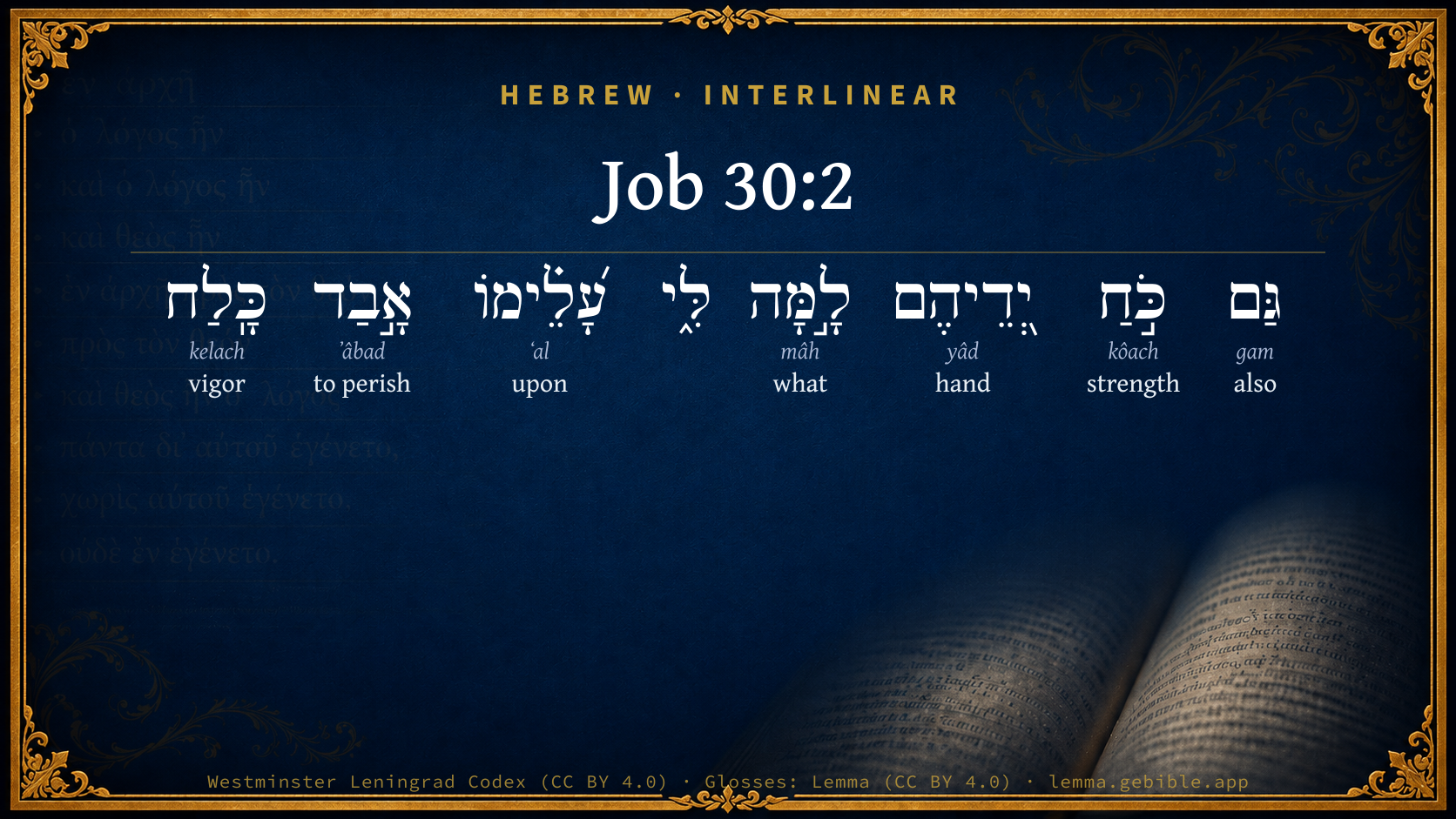
Hebrew (Westminster Leningrad Codex) Job 30:2 appears in the Hebrew Old Testament. The text above is from the Westminster Leningrad Codex. Each word links to its Strong’s number, a concise gloss, and parsing drawn from the Open Scriptures Hebrew Bible morphology. Click any word for its full Brown-Driver-Briggs (BDB) entry.
Download image
Cite this verse

Job 30:2 (World English Bible). Public Domain. Lemma interlinear Bible study tool, https://lemma.gebible.app/v/job/30/2.

Show BibTeX & RIS
BibTeX
RIS
English Translation
Of what use is the strength of their hands to me, Men in whom ripe age has perished?
World English Bible · Public Domain
Download a study sheet

One document with this verse’s original text, its word-by-word gloss line, the meaning frame, cross-references with their text, attributed commentary, and full source and license credits — printable, and it pastes into notes with its structure intact.

This verse Autodidact and up

Study sheet (.html) Plain text (.txt)

A passage Seminary Student

Up to 50 verses in one chapter. A passage sheet keeps up to 6 commentary sources and 12 cross-references per verse, in the order this page ranks them, and says so on the sheet whenever that leaves anything out. Ask for a single verse and you get the Autodidact verse sheet above.

Everything on this page stays free to read, with no account — the sheet is a download of what is already on screen, not access to it.

Want to remove ads? Support Godless Engineer
Compare translations 3

The same verse in 3 English versions, stacked beneath the original-language interlinear above. Click any original word for its lexicon entry.

Each is an independent rendering of the whole verse — the interlinear is not word-aligned to these translations.

Highlighted words mark where these versions differ — a whole-verse word diff, not a word-by-word alignment.

  • World English Bible Public Domain
    Of what use is the strength of their hands to me, Men in whom ripe age has perished?
  • King James Version Public Domain
    Yea, whereto might the strength of their hands profit me, in whom old age was perished?
  • unfoldingWord Literal Text CC BY-SA 4.0
    Indeed, the strength of their hands, for what to me? In them old age has perished.

unfoldingWord Literal Text — © unfoldingWord, licensed CC BY-SA 4.0. Word-aligned USFM3 via Door43 (git.door43.org/unfoldingWord/en_ult).

Versions to compare (up to 4)

3 of 4 selected

Show all 18 translations

Every available English version of this verse, each an independent rendering of the whole verse.

  • World English Bible Public Domain
    Of what use is the strength of their hands to me, Men in whom ripe age has perished?
  • Berean Standard Bible Public Domain
    What use to me was the strength of their hands, since their vigor had left them?
  • Majority Standard Bible Public Domain
    What use to me was the strength of their hands, since their vigor had left them?
  • King James Version Public Domain
    Yea, whereto might the strength of their hands profit me, in whom old age was perished?
  • American Standard Version (1901) Public Domain
    Yea, the strength of their hands, whereto should it profit me? Men in whom ripe age is perished.
  • Revised Version (1885) Public Domain
    Yea, the strength of their hands, whereto should it profit me? men in whom ripe age is perished.
  • Geneva Bible (1599) Public Domain
    For whereto shoulde the strength of their handes haue serued mee, seeing age perished in them?
  • Douay-Rheims (1899) Public Domain
    The strength of whose hands was to me as nothing, and they were thought unworthy of life itself.
  • Young's Literal Translation Public Domain
    Also -- the power of their hands, why `is it' to me? On them hath old age perished.
  • Literal Standard Version CC BY-SA 4.0
    Also—the power of their hands, why [is it] to me? On them old age has perished.
  • Unlocked Literal Bible CC BY-SA 4.0
    Indeed, the strength of their fathers' hands, how could it have helped me— men in whom the strength of their mature age had perished?
  • unfoldingWord Literal Text CC BY-SA 4.0
    Indeed, the strength of their hands, for what to me? In them old age has perished.
  • Darby Bible Public Domain
    Yea, whereto [should] the strength of their hands [profit] me, [men] in whom vigour hath perished?
  • World Messianic Bible Public Domain
    Of what use is the strength of their hands to me, men in whom ripe age has perished?
  • Webster's Bible Public Domain
    Yes, to what might the strength of their hands profit me, in whom old age had perished?
  • Free Bible Version CC BY-SA 4.0
    They are too weak to be any use to me; they're all worn-out.
  • Bible in Basic English Public Domain
    Of what use is the strength of their hands to me? all force is gone from them.
  • JPS Tanakh (1917) Public Domain
    Yea, the strength of their hands, whereto should it profit me? men in whom ripe age is perished.

Literal Standard Version (2020), Covenant Press — licensed CC BY-SA 4.0. Text via the HelloAO Bible API (eBible.org). Unlocked Literal Bible (unfoldingWord) — licensed CC BY-SA 4.0. Text via the HelloAO Bible API (eBible.org). unfoldingWord Literal Text — © unfoldingWord, licensed CC BY-SA 4.0. Word-aligned USFM3 via Door43 (git.door43.org/unfoldingWord/en_ult). Free Bible Version, Dr. Jonathan Gallagher — licensed CC BY-SA 4.0. Text via the HelloAO Bible API (eBible.org).

Word by word

More ways to search: Search by grammar → Find every occurrence → Compare this word →

Practice this passage: Drill this verse → Learn its vocabulary →

About this verse

These counts appear in no published source. They are computed here, from the morphology-tagged text and Lemma’s own curated glosses. What Lemma adds →

8
words
7
distinct lemmas
Wisdom
section

Notable vocabulary

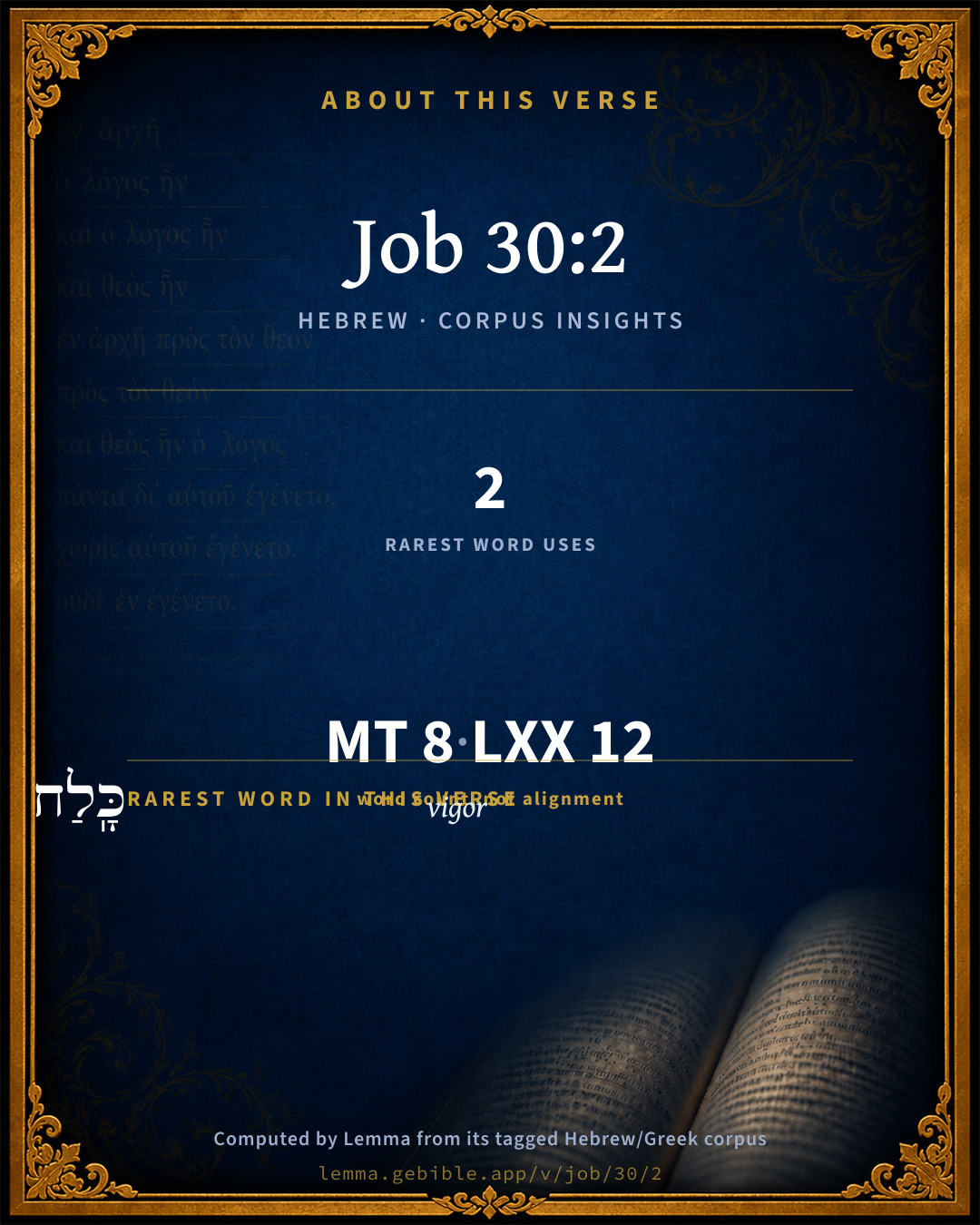
The rarest word here is כָּֽלַח vigor H3624 — appearing just 2 times in the whole Hebrew Bible.

Shared distinctive vocabulary

כָּֽלַח vigor H3624 occurs in 2 verses of the Hebrew Bible. Also found in:

Grammatical profile

  • 1 verb
  • 3 nouns
  • 2 prepositions
  • 2 particles

Verb forms

  • אָ֣בַד Qal · Perfect

Hebrew & Septuagint length

In English translation the verse runs 18 words from the Hebrew and 18 from the Septuagint (LXX English) — the same length.

A rough comparison of the two English renderings, which tokenize alike — not a word-level alignment.

Word counts can differ between the Hebrew and the Greek without any difference in meaning — e.g. the Hebrew direct-object marker אֵת has no separate Greek word, and Greek often adds the article ὁ.

In the original languages it is 8 Hebrew tokens and 12 Greek tokens — but the two are counted differently (Hebrew bundles its prefixes and suffixes into one token; the Greek is in lemma form), so that isn’t a like-for-like length.

Hebrew and Greek witnesses Masoretic Hebrew ↔ Greek Septuagint

The same verse in the two great witnesses to the Old Testament, shown verse-for-verse.

These are two independent witnesses, not word-aligned to each other, and the Septuagint is shown in lemma (dictionary) form.

Hebrew Job 30:2 Masoretic · Westminster Leningrad Codex

גַּם כֹּ֣חַ יְ֭דֵיהֶם לָ֣מָּה לִּ֑י עָ֝לֵ֗ימוֹ אָ֣בַד כָּֽלַח

Of what use is the strength of their hands to me, Men in whom ripe age has perished?

World English Bible · Public Domain

Greek LXX Job 30:2 Septuagint · lemma form

καί γέ ἰσχύς χείρ αὐτός ἵνα τίς ἐγώ ἐπί αὐτός ἀποὀλλύω συντέλεια

Yes, why had I the strength of their hands? for them the full term of life was lost.

LXX2012 (modern English Septuagint) · Public Domain

On this verse, Albert Barnes' Notes on the Bible discusses the Septuagint’s reading. Read the note in Commentary ↓

Hebrew: Westminster Leningrad Codex (CC BY 4.0). Greek: Septuagint (public domain); English from LXX2012 (modern English Septuagint) (Public Domain). How the Septuagint differs from the Hebrew →

Commentary

Notes on Job 30:2 from classic Christian and Jewish commentators (each source and its license shown beneath its notes). The classic Christian expositions comment on the surrounding passage and are grouped to its opening verse, so a note may address several verses; the Jewish commentaries on the Tanakh (Rashi and others) are per-verse, so they appear only where the commentator wrote on this verse.

Lemma curates 59 commentaries, every one of them public domain or Creative Commons licensed, each selected and text-cleaned for this edition rather than reprinted as found. About our sources →

Trapp's Complete Commentary

John Trapp

Job 30:2 Yea, whereto [might] the strength of their hands [profit] me, in whom old age was perished?

Ver. 2. Yea, whereto might the strength of their hands profit me] For, to say the truth (thus Beza here paraphraseth), the strength of those young striplings could not have stood me in any stead at all; and as for the old age of their fathers, it were such, that, having spent the greatest and best part of their life partly in idleness, and partly in divers wicked and lewd pranks, they might worthily seem to have lived in vain all that while. Thus he. The Greeks say, Eργα νεων, and the Latins, Iuniores ad labores, young men are fit for hard labour, because strong and lusty. But these Sanuiones in the text were, through idleness, mere nullities in the world, superfluities in the earth, Jeremiah’s rotten girdle, good for nothing but to devour victuals; vermin, apes, monkeys, their whole life was to eat and drink (when they could come by it), and sleep, and sport, and fleer, jeer at God’s afflicted, with words as full of scorn as profane wit or rancoured malice can make them. These are excrements in human society; pests, the Scripture styleth them, Psa 1:1 (λοιμοι. Septuag.).

In whom old age was perished?] Their fathers also were old dottrels, in ipsa senectute, senectute carentes, old, but not wise (Moriae Encore.); like the Brabanti, who are said to be the older the foolisher. Some men live long, but are good for little. Non ille diu vixit, sed diu fuit, saith Seneca of somebody, He hath not lived long, but only been long; as a ship in a storm, he hath been tossed much, but sailed nothing. Those old men who have not gotten wisdom by long experience are not worthy of their years; their old age is perished, and their honour forfeited. The Vulgate rendereth it, They were reckoned unworthy of life itself: Depontani.

John Trapp, A Commentary or Exposition upon All the Books of the Old and New Testament (1647–1656) — public domain. Text from a community e-Sword module.

Albert Barnes' Notes on the Bible

Yea, whereto might the strength of their hands profit me - There has been much difference of opinion respecting the meaning of this passage. The general sense is clear. Job means to describe those who were reduced by poverty and want, and who were without respectability or home, and who had no power in any way to affect him. He states that they were so abject and worthless as not to be worth his attention; but even this fact is intended to show how low he was himself reduced, since even the most degraded ranks in life did not show any respect to one who had been honored by princes. The Vulgate renders this, “The strength - virtus - of whose hands is to me as nothing, and they are regarded as unworthy of life.” The Septuagint, “And the strength of their hands what is it to me? Upon whom perfection - συντέλεια sunteleia - has perished.” Coverdale, “The power and strength of their hands might do me no good, and as for their age, it is spent and passed away without any profit.” The literal translation is, “Even the strength of their hands, what is it to me?” The meaning is, that their power was not worth regarding. They were abject, feeble, and reduced by hunger - poor emaciated creatures, who could do him neither good nor evil. Yet this fact did not make him feel less the indignity of being treated by such vagrants with scorn.

In whom old age was perished - Or, rather, in whom vigor, or the power of accomplishing, anything, has ceased. The word כלח kelach, means “completion,” or the act or power of finishing or completing anything. Then it denotes old age - age as “finished” or “completed;” Job 5:26. Here it means the maturity or vigor which would enable a man to complete or accomplish anything, and the idea is, that in these persons this had utterly perished. Reduced by hunger and want, they had no power of effecting anything, and were unworthy of regard. The word used here occurs only in this book in Hebrew Job 5:26; Job 30:2, but is common in Arabic; where it refers to the “wrinkles,” the “wanness,” and the “austere aspect” of the countenance, especially in age. See “Castell’s Lex.”

Albert Barnes' Notes on the Bible (1834–1885) — public domain. Text from a community e-Sword/MySword module.

Joseph Benson's Commentary

Job 30:2. Yea, whereto might their hands profit me? — Nor was it strange that I did, or might refuse to take them into any of my meanest services, being utterly impotent and unfit for any business; in whom old age was perished — Who were grown no wiser for being old. Or, rather, who had so wasted their strength and spirits by their evil courses, that when they came to old age they were debilitated, feeble, and useless for any labour. Accordingly, Houbigant interprets the clause, When all their health or strength was worn out; and others render it, In whom vigorous age was perished; that is, who were grown useless for service. For the word כלח, chelach, here rendered old age, is used only here and Job 5:26, where also it may be so rendered, Thou shalt come to thy grave in a vigorous, or mature age, having the vigour of youth even in thy old age, and until thy death, as Moses had. And if this word do signify old age, yet it signifies not every, but only a flourishing and healthful old age; as the Hebrews note, and the word may seem to imply; whence the LXX. also render it perfection, namely, of age, and of the endowments belonging to age.

Joseph Benson's Commentary on the Old and New Testaments (1811–1818) — public domain. Text from a community e-Sword module.

Tyndale Open Study Notes

Tyndale Open Resources

30:2-3 In the past, the most honorable members of society spoke well of Job (29:11); now, the least honorable mocked him (30:1) and spit in his face (30:10). Cp. Pss 35:15; 69:12; Mark 14:65; 15:17-20.

Tyndale Open Study Notes — © Tyndale Open Resources, licensed CC BY-SA 4.0. Text via the HelloAO Bible API.

Geneva Bible (1599)

Geneva Bible translators

That is, their fathers died for famine before they came to age.

Geneva Bible (1599) marginal notes — public domain. Text via Bolls.life.

Jamieson, Fausset & Brown

Robert Jamieson, A. R. Fausset & David Brown

If their fathers could be of no profit to me, much less the sons, who are feebler than their sires; and in whose case the hope of attaining old age is utterly gone, so puny are they (Job 5:26) [MAURER]. Even if they had "strength of hands," that could be now of no use to me, as all I want in my present affliction is sympathy.

Jamieson, Fausset & Brown — Commentary Critical and Explanatory on the Whole Bible (1871) — public domain (CC PDM 1.0). Text via the HelloAO Bible API.

Adam Clarke's Commentary

Verse 2. The strength of their hands profit me] He is speaking here of the fathers of these young men. What was the strength of their hands to me? Their old age also has perished. The sense of which I believe to be this: I have never esteemed their strength even in their most vigorous youth, nor their conduct, nor their counsel even in old age. They were never good for any thing, either young or old. As their youth was without profit, so their old age was without honour. See Calmet.

Mr. Good contends that the words are Arabic, and should be translated according to the meaning in that language, and the first clause of the third verse joined to the latter clause of the second, without which no good meaning can be elicited so as to keep properly close to the letter. I shall give the Hebrew text, Mr. Good's Arabic, and its translation: -

The Hebrew text is this: -

עלימו אבד כלח

aleymo abad calach

בחסר ובכפן גלמוד

becheser ubechaphan galmud

The Arabic version this: -

[Arabic]

[Arabic]

Which he translates thus: -

"With whom crabbed looks are perpetual,

From hunger and flinty famine."

This translation is very little distant from the import of the present Hebrew text, if it may be called Hebrew, when the principal words are pure Arabic, and the others constructively so.

Adam Clarke's Commentary on the Bible (1810–1826) — public domain. Text from a community e-Sword/MySword module.

Ellicott's Commentary for English Readers

(2) Whereto might the strength of their hands profit me, is the description of the fathers; Job_30:3 seqq. describes their children. The people here spoken of seem to have been somewhat similar to those known to the ancients as Troglodytes (Herod. iv. 183, &c.), the inhabitants of caves, who lived an outcast life and had manners and customs of their own. They are desolate with want and famine. They flee into the wilderness on the eve of wasteness and desolation, or when all is dark (yester night), waste, and desolate. It is evident that Job must have been familiar with a people of this kind, an alien and proscribed race living in the way he mentions.

A Bible Commentary for English Readers, edited by Charles John Ellicott (1878–1897) — public domain. Text from a community e-Sword module.

The Cambridge Bible for Schools and Colleges

gen. ed. J. J. S. Perowne

2. The verse refers to the fathers (Job_30:1), and gives the reason why Job did not employ them, or consider them worthy of a treatment equal to that of his dogs—they were enfeebled and fallen into premature decay. Yet the children of these miserable people now have him in derision. In the East the “dogs of the flock” have only one use, viz. to guard the flock and the encampment from attacks by night.

The Cambridge Bible for Schools and Colleges (gen. ed. J. J. S. Perowne; Cambridge University Press, 1878–1918) — public domain. Text from a community e-Sword module.

John Gill's Exposition

Yea, whereto might the strength of their hands profit me,.... For though they were strong, lusty, hale men, able to do business, yet their strength was to sit still and fold their hands in their bosoms, so that their strength was of no profit or avail to themselves or others; they were so slothful and lazy, that Job could not employ them in any business of his to any advantage to himself; and this may be one reason, among others, why he disdained to set them with the dogs of his flock to keep it; for the fathers seem to be intended all along to Job 30:8; though it matters not much to which of them the words are applied, since they were like father like son:

in whom old age was perished? who did not arrive to old age, but were soon consumed by their lusts, or cut off for their sins; and so the strength and labour of their hands, had they been employed, would have been of little worth; because the time of their continuance in service would have been short, especially being idle and slothful: some understand it of a lively and vigorous old age, such as was in Moses; but this being not in them, they were unfit for business, see Job 5:26; or they had not the endowments of old age, the experience, wisdom, and prudence of ancient persons, to contrive, conduct, and manage affairs, or direct in the management of them, which would make up for lack of strength and labour. Ben Gersom, Bar Tzemach, and others, interpret the word of time, or the time of life, that was perished or lost in them; their whole course of life, being spent in sloth and idleness, was all lost time.

John Gill's Exposition of the Whole Bible (1746–1763) — public domain (CC PDM 1.0). Text via the HelloAO Bible API.

Haydock's Catholic Bible Commentary

And they. Hebrew, "Their old age is perished." They were good for nothing all their lives. (Calmet)

George Leo Haydock (1774–1849), Haydock's Catholic Family Bible and Commentary, 1859 edition — public domain. Excludes Psalms (Douay-Rheims chapter numbering differs from Protestant) and Deuterocanonical books (Catholic canon only).

Matthew Poole's English Annotations

Nor was it strange that I did, or would. or might refuse to take them into any of my meanest services, because they were utterly impotent, and therefore unserviceable.

In whom old age was perished; or, lost; either,

1. Because they never attain to it, but are consumed by their lusts or cut off for their wickedness by the just hand of God, or men, in the midst of their days. Or,

2. Because they had so wasted their strength and spirits by their evil courses, that when they came to old age, they were feeble and decrepit, and useless for any labour. Or,

3. Because they had not that prudence and experience which is proper and usual in that age, by which they might have been useful, if not for work, yet to oversee and direct others in their work. But the words may be thus rendered, in whom vigorous age was perished, i.e. who were grown impotent for service. For the word here rendered old age, is used only here and Job 5:26, where also it may be so rendered, Thou shalt come to thy grave in a vigorous or mature age, having the rigour of youth even in thine old age, and until thy death, as Moses had. And if this word do signify old age, yet it signifies not every, but only a flourishing and vigorous, old age; as the Hebrews note, and the word may seem to imply; whence the LXX. interpreters also render it perfection, to wit, of age, and of thee endowments belonging to age.

Matthew Poole's English Annotations on the Holy Bible (1683–1685) — public domain. Text from a community e-Sword/MySword module.

Whedon's Commentary on the Bible

Daniel D. Whedon

2. Old age — Equivalent to manly vigour, the maturity of strength. These wretches are so eaten out by vice, or worn away by want and wretchedness, that all hope of old age has perished.

Daniel D. Whedon (gen. ed.), Commentary on the Old and New Testaments (1874–1909) — public domain. Text from a community e-Sword module.

The Pulpit Commentary

Yes, whereto might the strength of their hands profit me? Men, who had no such strength in their hands as to yield an employer any profit poor, weak creatures, in whom old age (rather, manly vigour) was perished. An effete race seems to be pointed at, without strength or stamina, nerveless, spiritless, "destined to early decay and premature death;" but how they had sunk into such a condition is not apparent. Too often such remnants are merely tribes physically weak, whom more powerful ones have starved and stunted, driving them into the least productive regions, and in every way making life hard for them.

The Pulpit Commentary (1880–1919), ed. H.D.M. Spence-Jones & Joseph S. Exell — public domain. Text from a community e-Sword module.

Rashi

Rabbi Shlomo Yitzchaki (Rashi)

Moreover, why did I need the strength of their hands in those days they were wicked, and they were useless, for trouble came because of them.

old age Heb. כָּלַח, old age.

Rashi on the Tanakh — English translations: “The Judaica Press complete Tanach with Rashi, translated by A. J. Rosenberg” (CC BY 4.0); “Pentateuch with Rashi's commentary by M. Rosenbaum and A.M. Silbermann, 1929-1934” (public domain); “The Metsudah Tanach series, Lakewood, N.J” (CC BY 4.0); and “The Book of Joshua, Metsudah Publications, 1997” (CC BY 4.0). Text via Sefaria.

Lesson kit

Teaching starters — assembled from the data on this page, not authored interpretation. Every prompt links to the verse data it draws on. Edit before teaching.

Job, in the Wisdom, opens this verse with 8 words (7 distinct Hebrew lemmas). Its most distinctive word is kelach (“vigor”). A historical commentator’s framing appears above. Read the whole chapter for the surrounding context.

Discussion questions

  1. The word kelach carries the sense “vigor.” How does it shape the verse?
  2. Job 5:26 shares the word «vigor» with this verse. How do the two illuminate each other?
  3. These translations render this verse differently; the difference is in the English rendering, not the original. What questions does that raise?
  4. The verb «אָ֣בַד» is Qal Perfect. How does its form color the action?
  5. Reading how Trapp's Complete Commentary and Albert Barnes' Notes on the Bible read this verse, where do the two commentators agree and where do they part?

Things to notice

Reading settings

Reading text

Shown beneath each verse's original-language words.

Old Testament
Old Testament edition

Read the OT as the Masoretic Hebrew (MT) or the Greek Septuagint (LXX).

English shown for the Greek Septuagint (in the Hebrew ↔ Greek comparison).

Comparing translations? Open the Compare panel on any verse page to stack up to four side by side.