Leviticus 26:20

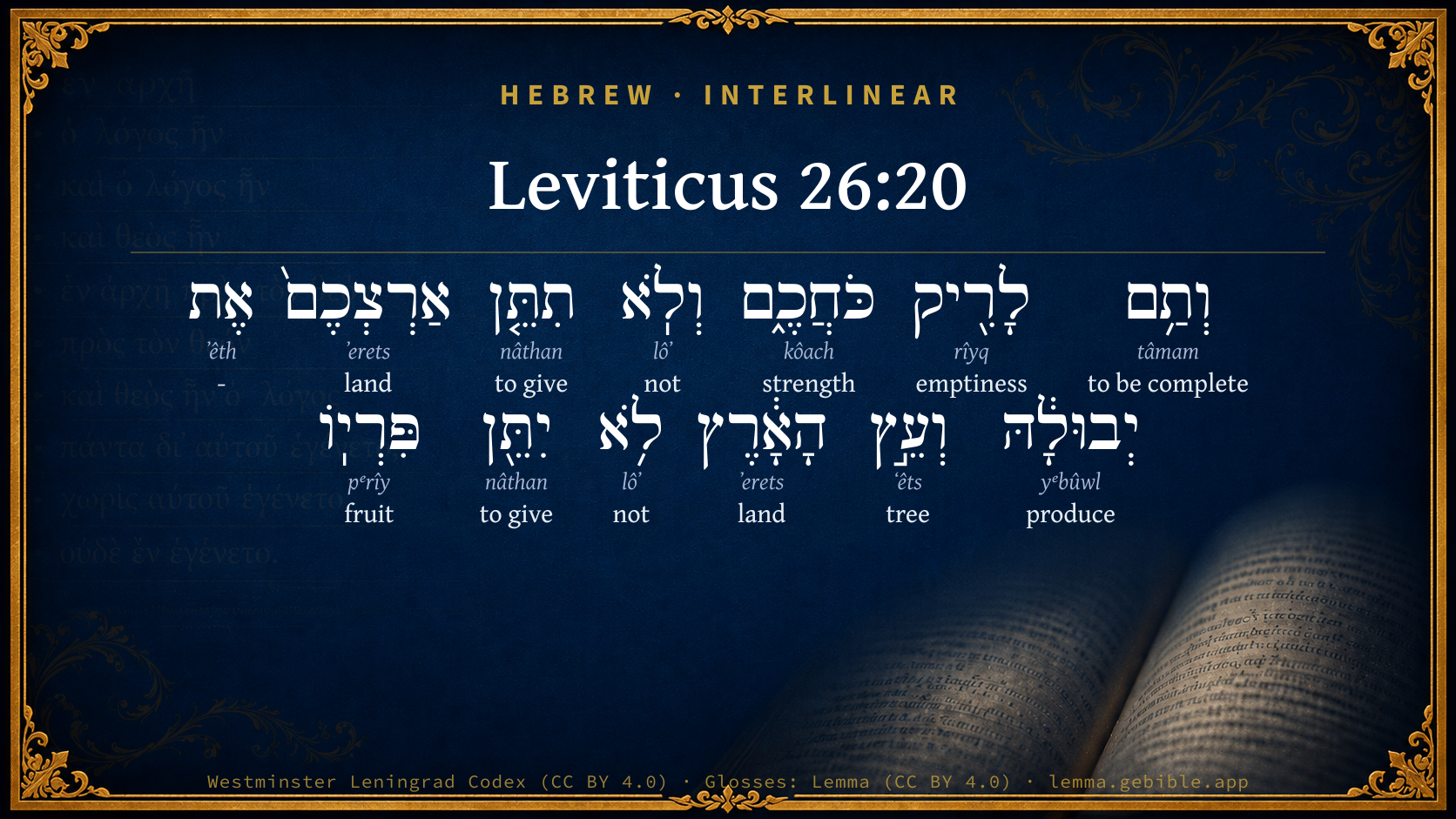
Hebrew (Westminster Leningrad Codex) Leviticus 26:20 appears in the Hebrew Old Testament. The text above is from the Westminster Leningrad Codex. Each word links to its Strong’s number, a concise gloss, and parsing drawn from the Open Scriptures Hebrew Bible morphology. Click any word for its full Brown-Driver-Briggs (BDB) entry.
Download image
Cite this verse

Leviticus 26:20 (World English Bible). Public Domain. Lemma interlinear Bible study tool, https://lemma.gebible.app/v/leviticus/26/20.

Show BibTeX & RIS
BibTeX
RIS
English Translation
and your strength will be spent in vain; for your land won't yield its increase, neither will the trees of the land yield their fruit.
World English Bible · Public Domain
Download a study sheet

One document with this verse’s original text, its word-by-word gloss line, the meaning frame, cross-references with their text, attributed commentary, and full source and license credits — printable, and it pastes into notes with its structure intact.

This verse Autodidact and up

Study sheet (.html) Plain text (.txt)

A passage Seminary Student

Up to 50 verses in one chapter. A passage sheet keeps up to 6 commentary sources and 12 cross-references per verse, in the order this page ranks them, and says so on the sheet whenever that leaves anything out. Ask for a single verse and you get the Autodidact verse sheet above.

Everything on this page stays free to read, with no account — the sheet is a download of what is already on screen, not access to it.

Want to remove ads? Support Godless Engineer
Compare translations 3

The same verse in 3 English versions, stacked beneath the original-language interlinear above. Click any original word for its lexicon entry.

Each is an independent rendering of the whole verse — the interlinear is not word-aligned to these translations.

Highlighted words mark where these versions differ — a whole-verse word diff, not a word-by-word alignment.

  • World English Bible Public Domain
    and your strength will be spent in vain; for your land won't yield its increase, neither will the trees of the land yield their fruit.
  • King James Version Public Domain
    And your strength shall be spent in vain: for your land shall not yield her increase, neither shall the trees of the land yield their fruits.
  • unfoldingWord Literal Text CC BY-SA 4.0
    And your strength shall be exhausted vain, and your land shall not give its produce, and the tree of the land shall not give its fruit.

unfoldingWord Literal Text — © unfoldingWord, licensed CC BY-SA 4.0. Word-aligned USFM3 via Door43 (git.door43.org/unfoldingWord/en_ult).

Versions to compare (up to 4)

3 of 4 selected

Show all 18 translations

Every available English version of this verse, each an independent rendering of the whole verse.

  • World English Bible Public Domain
    and your strength will be spent in vain; for your land won't yield its increase, neither will the trees of the land yield their fruit.
  • Berean Standard Bible Public Domain
    and your strength will be spent in vain. For your land will not yield its produce, and the trees of the land will not bear their fruit.
  • Majority Standard Bible Public Domain
    and your strength will be spent in vain. For your land will not yield its produce, and the trees of the land will not bear their fruit.
  • King James Version Public Domain
    And your strength shall be spent in vain: for your land shall not yield her increase, neither shall the trees of the land yield their fruits.
  • American Standard Version (1901) Public Domain
    and your strength shall be spent in vain; for your land shall not yield its increase, neither shall the trees of the land yield their fruit.
  • Revised Version (1885) Public Domain
    and your strength shall be spent in vain: for your land shall not yield her increase, neither shall the trees of the land yield their fruit.
  • Geneva Bible (1599) Public Domain
    And your strength shalbe spent in vaine: neither shall your lande giue her increase, neither shall the trees of the land giue their fruite.
  • Douay-Rheims (1899) Public Domain
    Your labour shall be spent in vain, the ground shall not bring forth her increase, nor the trees yield their fruit.
  • Young's Literal Translation Public Domain
    and consumed hath been your strength in vain, and your land doth not give her produce, and the tree of the land doth not give its fruit.
  • Literal Standard Version CC BY-SA 4.0
    and your strength has been consumed in vain, and your land does not give her produce, and the tree of the land does not give its fruit.
  • Unlocked Literal Bible CC BY-SA 4.0
    Your strength will be used up for nothing, because your land will not produce its harvest, and your trees in the land will not produce their fruit.
  • unfoldingWord Literal Text CC BY-SA 4.0
    And your strength shall be exhausted vain, and your land shall not give its produce, and the tree of the land shall not give its fruit.
  • Darby Bible Public Domain
    and your strength shall be spent in vain, and your land shall not yield its produce; and the trees of the land shall not yield their fruit.
  • World Messianic Bible Public Domain
    Your strength will be spent in vain; for your land won’t yield its increase, neither will the trees of the land yield their fruit.
  • Webster's Bible Public Domain
    And your strength shall be spent in vain: for your land shall not yield her increase, neither shall the trees of the land yield their fruits.
  • Free Bible Version CC BY-SA 4.0
    Your strength will be completely wasted because your land won't produce crops, and your trees won't produce fruit.
  • Bible in Basic English Public Domain
    And your strength will be used up without profit; for your land will not give her increase and the trees of the field will not give their fruit.
  • JPS Tanakh (1917) Public Domain
    And your strength shall be spent in vain; for your land shall not yield her produce, neither shall the trees of the land yield their fruit.

Literal Standard Version (2020), Covenant Press — licensed CC BY-SA 4.0. Text via the HelloAO Bible API (eBible.org). Unlocked Literal Bible (unfoldingWord) — licensed CC BY-SA 4.0. Text via the HelloAO Bible API (eBible.org). unfoldingWord Literal Text — © unfoldingWord, licensed CC BY-SA 4.0. Word-aligned USFM3 via Door43 (git.door43.org/unfoldingWord/en_ult). Free Bible Version, Dr. Jonathan Gallagher — licensed CC BY-SA 4.0. Text via the HelloAO Bible API (eBible.org).

Word by word

More ways to search: Search by grammar → Find every occurrence → Compare this word →

Practice this passage: Drill this verse → Learn its vocabulary →

לָרִ֖יק
rîyq
H7385
“to/for the · emptiness”
Preposition, Determined + Noun, Common, Masculine, Singular, Absolute
Part of Speech
Preposition + Noun
Type
Common
Gender
Masculine
Number
Singular
State
Absolute
Full BDB Definition

Origin: from H7324

TWOT: 2161b

emptiness, vanity, empty, idle, vain
  1. וְתַ֥ם tâmam H8552 “and · to be complete” Conjunction + Verb, Qal, Sequential Perfect, 3rd Person, Masculine, Singular
  2. כֹּחֲכֶ֑ם kôach H3581 “strength · your” Noun, Common, Masculine, Singular, Construct + Suffix, Personal, 2nd Person, Masculine, Plural
  3. וְלֹֽא lôʼ H3808 “and · not” Conjunction + Particle, Negative
  4. תִתֵּ֤ן nâthan H5414 “to give” Verb, Qal, Imperfect, 3rd Person, Feminine, Singular
  5. אַרְצְכֶם֙ ʼerets H776 “land · your” Noun, Common, Both, Singular, Construct + Suffix, Personal, 2nd Person, Masculine, Plural
  6. אֶת ʼêth H853 “-” Particle, Direct Object
  7. יְבוּלָ֔הּ yᵉbûwl H2981 “produce · her” Noun, Common, Masculine, Singular, Construct + Suffix, Personal, 3rd Person, Feminine, Singular
  8. וְעֵ֣ץ ʻêts H6086 “and · tree of” Conjunction + Noun, Common, Masculine, Singular, Construct
  9. הָאָ֔רֶץ ʼerets H776 “the · land” Particle, Definite Article + Noun, Common, Both, Singular, Absolute
  10. לֹ֥א lôʼ H3808 “not” Particle, Negative
  11. יִתֵּ֖ן nâthan H5414 “to give” Verb, Qal, Imperfect, 3rd Person, Masculine, Singular
  12. פִּרְיֽוֹ pᵉrîy H6529 “fruit · his” Noun, Common, Masculine, Singular, Construct + Suffix, Personal, 3rd Person, Masculine, Singular

About this verse

These counts appear in no published source. They are computed here, from the morphology-tagged text and Lemma’s own curated glosses. What Lemma adds →

13
words
10
distinct lemmas
Pentateuch
section

Notable vocabulary

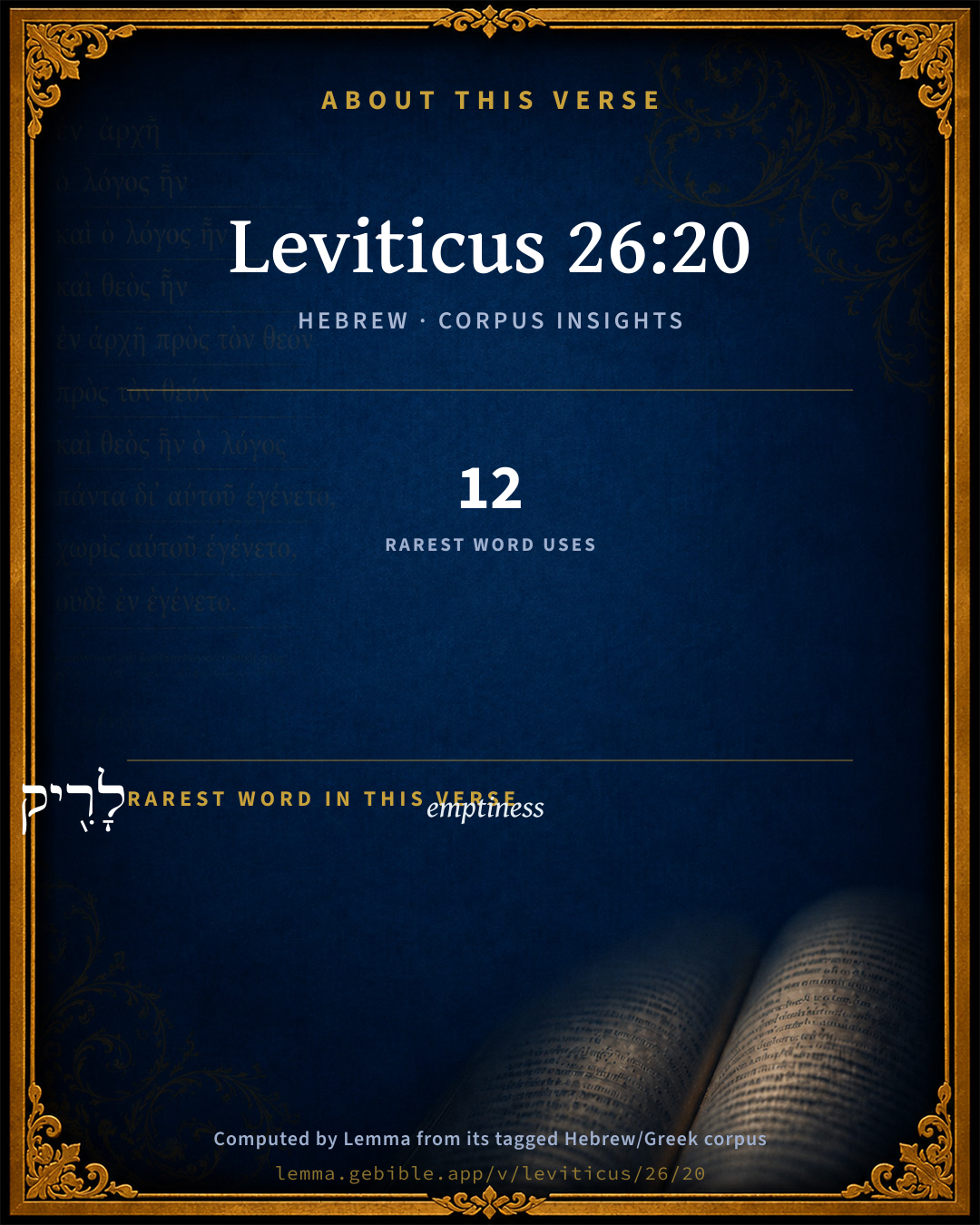
The rarest word here is לָרִ֖יק emptiness H7385 — appearing just 12 times in the whole Hebrew Bible.

Shared distinctive vocabulary

לָרִ֖יק emptiness H7385 occurs in 12 verses of the Hebrew Bible. Also found in:

Grammatical profile

  • 3 verbs
  • 7 nouns
  • 3 particles

Verb forms

  • וְתַ֥ם Qal · Sequential Perfect
  • תִתֵּ֤ן Qal · Imperfect
  • יִתֵּ֖ן Qal · Imperfect

Repetition

Words recur within this verse — often emphatic in Hebrew:

  • תִתֵּ֤ן to give H5414 ×2
  • אַרְצְכֶם֙ land H776 ×2
  • וְלֹֽא not H3808 ×2

Hebrew & Septuagint length

In English translation the verse runs 25 words from the Hebrew and 26 from the Septuagint (LXX English) — closely comparable.

A rough comparison of the two English renderings, which tokenize alike — not a word-level alignment.

Word counts can differ between the Hebrew and the Greek without any difference in meaning — e.g. the Hebrew direct-object marker אֵת has no separate Greek word, and Greek often adds the article ὁ.

Cross-references

15

Topical passages linked to Leviticus 26:20 in the Treasury of Scripture Knowledge — connected by theme and wording, ordered by reader-vote popularity; previews shown in the World English Bible.

  • Deuteronomy 11:17 and the anger of Yahweh be kindled against you, and he shut up the sky, so that there shall be no rain, and the land shall not yield its fruit; and you perish quickly from off the good land which Yahweh gives you.
  • Psalms 127:1 Unless Yahweh builds the house, They labor in vain who build it. Unless Yahweh watches over the city, The watchman guards it in vain.
  • Isaiah 49:4 But I said, I have labored in vain, I have spent my strength for nothing and vanity; yet surely the justice [due] to me is with Yahweh, and my recompense with my God.
  • Leviticus 26:4 then I will give you your rains in their season, and the land shall yield its increase, and the trees of the field shall yield their fruit.
  • Habakkuk 2:13 Behold, isn't it of Yahweh of Hosts that the peoples labor for the fire, and the nations weary themselves for vanity?
  • Deuteronomy 28:18 Cursed shall be the fruit of your body, and the fruit of your ground, the increase of your cattle, and the young of your flock.
  • Deuteronomy 28:38–40 You shall carry much seed out into the field, and shall gather little in; for the locust shall consume it.
  • Deuteronomy 28:42 All your trees and the fruit of your ground shall the locust possess.
  • Job 31:40 Let briars grow instead of wheat, And stinkweed instead of barley." The words of Job are ended.
  • Psalms 107:34 And a fruitful land into a salt waste, For the wickedness of those who dwell in it.
  • Isaiah 17:11 In the day of your planting you hedge it in, and in the morning you make your seed to blossom; but the harvest flees away in the day of grief and of desperate sorrow.
  • Haggai 1:9–11 "You looked for much, and, behold, it came to little; and when you brought it home, I blew it away. Why?" says Yahweh of Hosts, "Because of my house that lies waste, while each of you is busy with his own house.
  • Haggai 2:16 Through all that time, when one came to a heap of twenty measures, there were only ten. When one came to the wine vat to draw out fifty, there were only twenty.
  • 1 Corinthians 3:6 I planted. Apollos watered. But God gave the increase.
  • Galatians 4:11 I am afraid for you, that I might have wasted my labor for you.

Cross-references courtesy of OpenBible.info (CC BY 4.0).

Hebrew and Greek witnesses Masoretic Hebrew ↔ Greek Septuagint

The same verse in the two great witnesses to the Old Testament, shown verse-for-verse.

These are two independent witnesses, not word-aligned to each other, and the Septuagint is shown in lemma (dictionary) form.

Hebrew Leviticus 26:20 Masoretic · Westminster Leningrad Codex

וְתַ֥ם לָרִ֖יק כֹּחֲכֶ֑ם וְלֹֽא תִתֵּ֤ן אַרְצְכֶם֙ אֶת יְבוּלָ֔הּ וְעֵ֣ץ הָאָ֔רֶץ לֹ֥א יִתֵּ֖ן פִּרְיֽוֹ

and your strength will be spent in vain; for your land won't yield its increase, neither will the trees of the land yield their fruit.

World English Bible · Public Domain

Greek LXX Leviticus 26:20 Septuagint · lemma form

καί εἰμί εἰς κενός ὁ ἰσχύς σύ καί οὐ δίδωμι ὁ γῆ σύ ὁ σπόρος αὐτός καί ὁ ξύλον ὁ ἀγρός σύ οὐ δίδωμι ὁ καρπός αὐτός

And your strength shall be in vain; and your land shall not yield its seed, and the tree of your field shall not yield its fruit.

LXX2012 (modern English Septuagint) · Public Domain

Hebrew: Westminster Leningrad Codex (CC BY 4.0). Greek: Septuagint (public domain); English from LXX2012 (modern English Septuagint) (Public Domain). How the Septuagint differs from the Hebrew →

Targum (Aramaic paraphrase)

2

The Targum is the ancient Jewish Aramaic paraphrase of the Hebrew Scriptures — an interpretive translation, not the Hebrew text itself. Onkelos (literal) and Pseudo-Jonathan (expansive) render the Torah, and Jonathan the Prophets. Coverage is partial: where no permissively-licensed English translation exists for a verse, only the Aramaic is shown. This is verse-level text, not a word-by-word alignment to the Hebrew.

  1. Targum Onkelos Torah (Genesis–Deuteronomy)
    וִיסוּפוּן לְרֵיקָנוּ חֵילֵיכוֹן וְלָא תִתֵּן אַרְעֲכוֹן יָת עֲלַלְתָּהּ וְאִילַן אַרְעָא לָא יִתֵּן אִבֵּהּ

    (no public-domain English translation for this verse)

    Targum Onkelos — Aramaic: “Onkelos Genesis” (public domain); “Onkelos Exodus” (public domain); “Onkelos Leviticus” (public domain); “Onkelos Numbers” (public domain); “Onkelos Deuteronomy” (public domain). English: “Sefaria Community Translation” (CC0 1.0 (public-domain dedication)); “J.W. Etheridge. The Targums of Onkelos and Jonathan Ben Uzziel on the Pentateuch. London: Longmans, Green, 1862” (public domain). Text via Sefaria.

  2. Targum Pseudo-Jonathan Torah (Genesis–Deuteronomy)
    וִיסוּף לְרֵיקָנוּ חֵילֵיכוֹן וְלָא תִתֵּן אַרְעֲכוֹן יַת מַה דְאַתּוּן מַעֲלִין לְגַוָוהּ וְאִילַן דְאַנְפֵּי בָרָא יְקַלַח פֵּירוֹי

    And your strength shall be consumed in vain, for your land shall not yield what you bestow upon it, and the tree upon the face of the field shall drop its fruit.

    Targum Pseudo-Jonathan — Aramaic: “Targum Jonathan on Genesis” (public domain); “Targum Jonathan on Exodus” (public domain); “Targum Jonathan on Leviticus” (public domain); “Targum Jonathan on Numbers” (public domain); “Targum Jonathan on Deuteronomy” (public domain). English: “The Targum of Jonathan ben Uzziel, trans. J. W. Etheridge, London, 1862” (public domain). Text via Sefaria.

Commentary

Notes on Leviticus 26:20 from classic Christian and Jewish commentators (each source and its license shown beneath its notes). The classic Christian expositions comment on the surrounding passage and are grouped to its opening verse, so a note may address several verses; the Jewish commentaries on the Tanakh (Rashi and others) are per-verse, so they appear only where the commentator wrote on this verse.

Lemma curates 59 commentaries, every one of them public domain or Creative Commons licensed, each selected and text-cleaned for this edition rather than reprinted as found. About our sources →

Trapp's Complete Commentary

John Trapp

Lev 26:20 And your strength shall be spent in vain: for your land shall not yield her increase, neither shall the trees of the land yield their fruits.

Ver. 20. Your land shall not yield.] See this fulfilled. {Jer 14:1-2, &c., and Joe 1:12 Jer 8:13} And yet their country was called Sumen totius orbis. Cornelius Tacitus yields it to be a fruitful country. So did Rabshakeh long before. {2Ki 18:32}

John Trapp, A Commentary or Exposition upon All the Books of the Old and New Testament (1647–1656) — public domain. Text from a community e-Sword module.

Geneva Bible (1599)

Geneva Bible translators

Or, labor.

Geneva Bible (1599) marginal notes — public domain. Text via Bolls.life.

Ellicott's Commentary for English Readers

(20) And your strength shall be spent in vain.—That is, with the heaven over them as metal, their labour expended in ploughing, digging, and sowing will be perfectly useless.

Your land shall not yield her increase, as no amount of human labour will make up for the want of rain. In Deu_11:17, where the same punishment is threatened, and the same phrase is used, the Authorised Version unnecessarily obliterates the identity of the words in the original by rendering them “the land yield not her fruit.”

A Bible Commentary for English Readers, edited by Charles John Ellicott (1878–1897) — public domain. Text from a community e-Sword module.

John Gill's Exposition

And if ye walk contrary unto me,.... To his mind and will, to his laws, commands, and ordinances, showing no regard unto them by a walk and conversation agreeably to them, but neglecting and breaking them continually; or by chance, as the Targum of Jonathan, not with any intention and design to obey the Lord, and to honour and glorify him, but in a careless and indifferent manner, having no regard to the law of God, only now and then, as it happens, act according to it, but having no concern for the honour and glory of God:

and will not hearken unto me; to his voice in his laws and his precepts, or by his prophets, exhorting them to obedience to them:

I will bring seven times more plagues upon you, according to your sins; greater and sorer punishments still, and these more frequently repeated, and in proportion to their transgressions of his righteous laws.

John Gill's Exposition of the Whole Bible (1746–1763) — public domain (CC PDM 1.0). Text via the HelloAO Bible API.

Matthew Poole's English Annotations

Your strength shall be spent in vain; ploughing, and sowing, and tilling the ground.

Matthew Poole's English Annotations on the Holy Bible (1683–1685) — public domain. Text from a community e-Sword/MySword module.

John Wesley's Explanatory Notes

In vain - in plowing, and sowing, and tilling the ground.

John Wesley, Explanatory Notes Upon the Whole Bible (1754–1765) — public domain. Text via the GEBible commentary corpus.

Rashi

Rabbi Shlomo Yitzchaki (Rashi)

ותם לריק כחכם AND YOUR STRENGTH SHALL BE SPENT IN VAIN — Behold, if a man does not toil in his field — neither tills, nor sows, nor weeds it, nor clears away the thorns, nor hoes it, and then at harvest time blight comes and strikes it (the field, i. e. destroys that which sprung up of itself), surely it does not matter much (he does not take it to heart). But if a man has toiled — he has ploughed, sown, weeded, cleared away the thorns and hoed it, and then blight comes and strikes it, surely then the teeth of that man become blunt! (a figurative expression for becoming speechless, terror-stricken) (Sifra, Bechukotai, Chapter 5 4).

ולא תתן ארצכם את יבולה — This means, the earth shall not yield even as much as you brought to it at sowing-time (יבולה as passive participle with suffix of יבל “to bring”, may denote: that which is brought to it) (Sifra, Bechukotai, Chapter 5 4).

ועץ הארץ AND THE TREE OF THE GROUND [SHALL NOT YIELD] — This implies that even from the very earth a curse will rest upon it — that it will not bring its fruits to development at the time when they should develop (Sifra, Bechukotai, Chapter 5 4).

לא יתן serves as the verb with what precedes and with what follows — with “tree” and with “fruit”. Thus we obtain a second sense —

לא יתן פריו IT WILL NOT GIVE ITS FRUIT — when it does produce fruit, it will cast its fruits (Sifra, Bechukotai, Chapter 5 4). This gives two curses, and so you have here seven punishments in all.

Rashi on the Tanakh — English translations: “The Judaica Press complete Tanach with Rashi, translated by A. J. Rosenberg” (CC BY 4.0); “Pentateuch with Rashi's commentary by M. Rosenbaum and A.M. Silbermann, 1929-1934” (public domain); “The Metsudah Tanach series, Lakewood, N.J” (CC BY 4.0); and “The Book of Joshua, Metsudah Publications, 1997” (CC BY 4.0). Text via Sefaria.

Lesson kit

Teaching starters — assembled from the data on this page, not authored interpretation. Every prompt links to the verse data it draws on. Edit before teaching.

Leviticus, in the Pentateuch, opens this verse with 13 words (10 distinct Hebrew lemmas). Its most distinctive word is rîyq (“emptiness”). A historical commentator’s framing appears above. Read the whole chapter for the surrounding context.

Discussion questions

  1. What does “emptiness” (rîyq) contribute to the verse as a whole?
  2. Leviticus 26:16 shares the word «emptiness» with this verse. How do the two illuminate each other?
  3. “to give” occurs 2× in this one verse. What is the effect of the repetition?
  4. These translations render this verse differently; the difference is in the English rendering, not the original. What questions does that raise?
  5. The verb «וְתַ֥ם» is Qal Sequential Perfect. How does its form color the action?
  6. Reading how Trapp's Complete Commentary and Geneva Bible (1599) read this verse, where do the two commentators agree and where do they part?

Things to notice

Reading settings

Reading text

Shown beneath each verse's original-language words.

Old Testament
Old Testament edition

Read the OT as the Masoretic Hebrew (MT) or the Greek Septuagint (LXX).

English shown for the Greek Septuagint (in the Hebrew ↔ Greek comparison).

Comparing translations? Open the Compare panel on any verse page to stack up to four side by side.