Judges 16:6

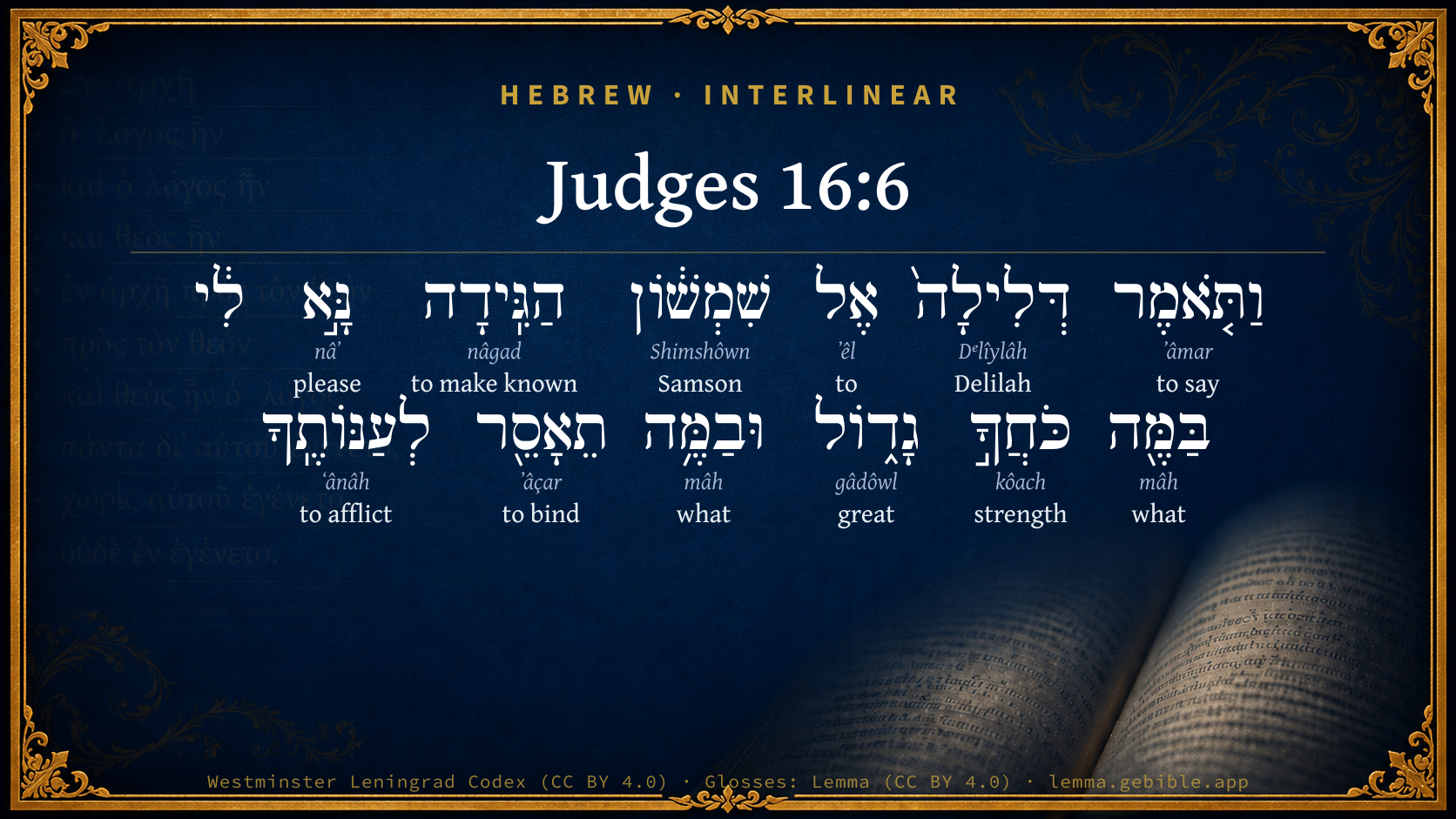
Hebrew (Westminster Leningrad Codex) Judges 16:6 appears in the Hebrew Old Testament. The text above is from the Westminster Leningrad Codex. Each word links to its Strong’s number, a concise gloss, and parsing drawn from the Open Scriptures Hebrew Bible morphology. Click any word for its full Brown-Driver-Briggs (BDB) entry.
Download image
Cite this verse

Judges 16:6 (World English Bible). Public Domain. Lemma interlinear Bible study tool, https://lemma.gebible.app/v/judges/16/6.

Show BibTeX & RIS
BibTeX
RIS
English Translation
Delilah said to Samson, Tell me, Please, in which your great strength lies, and with which you might be bound to afflict you.
World English Bible · Public Domain
Download a study sheet

One document with this verse’s original text, its word-by-word gloss line, the meaning frame, cross-references with their text, attributed commentary, and full source and license credits — printable, and it pastes into notes with its structure intact.

This verse Autodidact and up

Study sheet (.html) Plain text (.txt)

A passage Seminary Student

Up to 50 verses in one chapter. A passage sheet keeps up to 6 commentary sources and 12 cross-references per verse, in the order this page ranks them, and says so on the sheet whenever that leaves anything out. Ask for a single verse and you get the Autodidact verse sheet above.

Everything on this page stays free to read, with no account — the sheet is a download of what is already on screen, not access to it.

Want to remove ads? Support Godless Engineer
Compare translations 3

The same verse in 3 English versions, stacked beneath the original-language interlinear above. Click any original word for its lexicon entry.

Each is an independent rendering of the whole verse — the interlinear is not word-aligned to these translations.

Highlighted words mark where these versions differ — a whole-verse word diff, not a word-by-word alignment.

  • World English Bible Public Domain
    Delilah said to Samson, Tell me, Please, in which your great strength lies, and with which you might be bound to afflict you.
  • King James Version Public Domain
    And Delilah said to Samson, Tell me, I pray thee, wherein thy great strength lieth, and wherewith thou mightest be bound to afflict thee.
  • unfoldingWord Literal Text CC BY-SA 4.0
    So Delilah said to Samson, “Please declare to me in what your great strength and in what you may be bound to humble you.”

unfoldingWord Literal Text — © unfoldingWord, licensed CC BY-SA 4.0. Word-aligned USFM3 via Door43 (git.door43.org/unfoldingWord/en_ult).

Versions to compare (up to 4)

3 of 4 selected

Show all 18 translations

Every available English version of this verse, each an independent rendering of the whole verse.

  • World English Bible Public Domain
    Delilah said to Samson, Tell me, Please, in which your great strength lies, and with which you might be bound to afflict you.
  • Berean Standard Bible Public Domain
    So Delilah said to Samson, “Please tell me the source of your great strength and how you can be tied up and subdued.”
  • Majority Standard Bible Public Domain
    So Delilah said to Samson, “Please tell me the source of your great strength and how you can be tied up and subdued.”
  • King James Version Public Domain
    And Delilah said to Samson, Tell me, I pray thee, wherein thy great strength lieth, and wherewith thou mightest be bound to afflict thee.
  • American Standard Version (1901) Public Domain
    And Delilah said to Samson, Tell me, I pray thee, wherein thy great strength lieth, and wherewith thou mightest be bound to afflict thee.
  • Revised Version (1885) Public Domain
    And Delilah said to Samson, Tell me, I pray thee, wherein thy great strength lieth, and wherewith thou mightest be bound to afflict thee.
  • Geneva Bible (1599) Public Domain
    And Delilah saide to Samson, Tell mee, I pray thee, wherein thy great strength lieth, and wherewith thou mightest bee bound, to doe thee hurt.
  • Douay-Rheims (1899) Public Domain
    And Dalila said to Samson: Tell me, I beseech thee, wherein thy greatest strength lieth, and what it is wherewith if thou wert bound thou couldst not break loose.
  • Young's Literal Translation Public Domain
    And Delilah saith unto Samson, `Declare, I pray thee, to me, wherein thy great power `is', and wherewith thou art bound, to afflict thee.'
  • Literal Standard Version CC BY-SA 4.0
    And Delilah says to Samson, “Please declare to me wherein your great power [is], and with what you are bound, to afflict you.”
  • Unlocked Literal Bible CC BY-SA 4.0
    Then Delilah said to Samson, “Please, tell me how is it that you are so strong, and how could anyone bind you, so you might be controlled?”
  • unfoldingWord Literal Text CC BY-SA 4.0
    So Delilah said to Samson, “Please declare to me in what your great strength and in what you may be bound to humble you.”
  • Darby Bible Public Domain
    And Deli'lah said to Samson, "Please tell me wherein your great strength lies, and how you might be bound, that one could subdue you."
  • World Messianic Bible Public Domain
    Delilah said to Samson, “Please tell me where your great strength lies, and what you might be bound to afflict you.”
  • Webster's Bible Public Domain
    And Delilah said to Samson, Tell me, I pray thee, in what thy great strength lieth, and with what thou mayest be bound to afflict thee.
  • Free Bible Version CC BY-SA 4.0
    Delilah went and pleaded with Samson, “Please tell me where your incredible strength comes from, and what can be used to tie you up so you can't do anything.”
  • Bible in Basic English Public Domain
    So Delilah said to Samson, Make clear to me now what is the secret of your great strength, and how you may be put in bands and made feeble.
  • JPS Tanakh (1917) Public Domain
    And Delilah said to Samson: 'Tell me, I pray thee, wherein thy great strength lieth, and wherewith thou mightest be bound to afflict thee.'

Literal Standard Version (2020), Covenant Press — licensed CC BY-SA 4.0. Text via the HelloAO Bible API (eBible.org). Unlocked Literal Bible (unfoldingWord) — licensed CC BY-SA 4.0. Text via the HelloAO Bible API (eBible.org). unfoldingWord Literal Text — © unfoldingWord, licensed CC BY-SA 4.0. Word-aligned USFM3 via Door43 (git.door43.org/unfoldingWord/en_ult). Free Bible Version, Dr. Jonathan Gallagher — licensed CC BY-SA 4.0. Text via the HelloAO Bible API (eBible.org).

Word by word

More ways to search: Search by grammar → Find every occurrence → Compare this word →

Practice this passage: Drill this verse → Learn its vocabulary →

דְּלִילָה֙
Dᵉlîylâh
H1807
“Delilah”
Noun, Proper
Part of Speech
Noun
Type
Proper
Full BDB Definition

Origin: from H1809

TWOT: None

Delilah = "feeble" - the Philistine mistress of Samson who betrayed the secret of his great strength, and by cutting his hair, enfeebled him and delivered him to the Philistines
  1. וַתֹּ֤אמֶר ʼâmar H559 “and · to say” Conjunction + Verb, Qal, Sequential Imperfect, 3rd Person, Feminine, Singular
  2. אֶל ʼêl H413 “to” Preposition
  3. שִׁמְשׁ֔וֹן Shimshôwn H8123 “Samson” Noun, Proper
  4. הַגִּֽידָה nâgad H5046 “make known” Verb, Hiphil, Imperative, 2nd Person, Masculine, Singular + Suffix, h
  5. נָּ֣א nâʼ H4994 “please” Particle, Interjection
  6. בַּמֶּ֖ה mâh H4100 “in/at · what” Preposition + Particle, Interrogative
  7. כֹּחֲךָ֣ kôach H3581 “strength · your” Noun, Common, Masculine, Singular, Construct + Suffix, Personal, 2nd Person, Masculine, Singular
  8. גָד֑וֹל gâdôwl H1419 “great” Adjective, Adjective, Masculine, Singular, Absolute
  9. וּבַמֶּ֥ה mâh H4100 “and · in/at · what” Conjunction + Preposition + Particle, Interrogative
  10. תֵאָסֵ֖ר ʼâçar H631 “to bind” Verb, Niphal, Imperfect, 2nd Person, Masculine, Singular
  11. לְעַנּוֹתֶֽךָ ʻânâh H6031 “to afflict · you” Preposition + Verb, Piel, Infinitive Construct + Suffix, Personal, 2nd Person, Masculine, Singular

About this verse

These counts appear in no published source. They are computed here, from the morphology-tagged text and Lemma’s own curated glosses. What Lemma adds →

13
words
11
distinct lemmas
Historical
section

Notable vocabulary

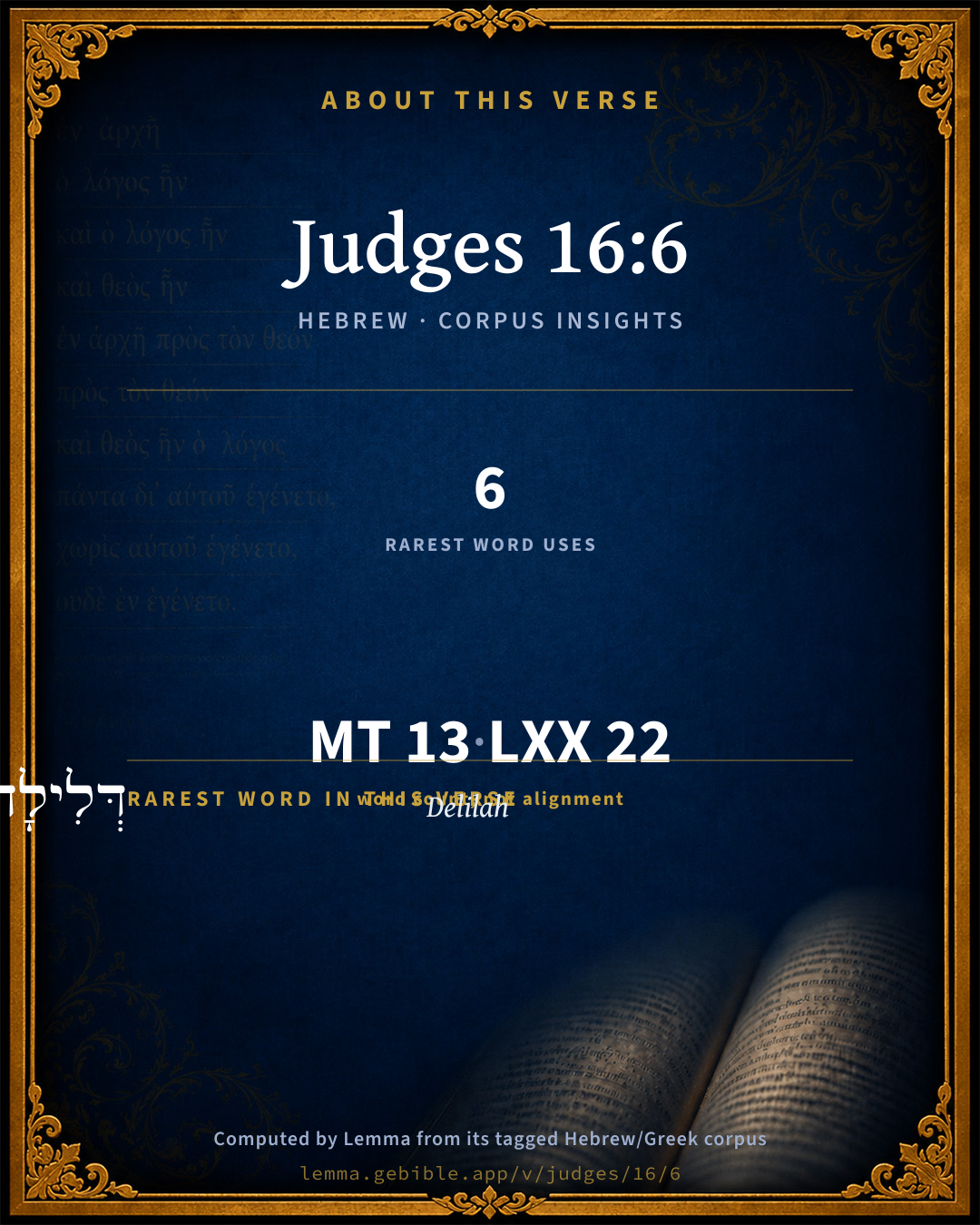
The rarest word here is דְּלִילָה֙ Delilah H1807 — appearing just 6 times in the whole Hebrew Bible.

Shared distinctive vocabulary

דְּלִילָה֙ Delilah H1807 occurs in 6 verses of the Hebrew Bible. Also found in:

Grammatical profile

  • 4 verbs
  • 3 nouns
  • 1 adjective
  • 2 prepositions
  • 3 particles

Verb forms

  • וַתֹּ֤אמֶר Qal · Sequential Imperfect
  • הַגִּֽידָה Hiphil · Imperative
  • תֵאָסֵ֖ר Niphal · Imperfect
  • לְעַנּוֹתֶֽךָ Piel · Infinitive Construct

Repetition

A word recurs within this verse — often emphatic in Hebrew:

  • בַּמֶּ֖ה what H4100 ×2

Hebrew & Septuagint length

In English translation the verse runs 23 words from the Hebrew and 26 from the Septuagint (LXX English) — closely comparable.

A rough comparison of the two English renderings, which tokenize alike — not a word-level alignment.

Word counts can differ between the Hebrew and the Greek without any difference in meaning — e.g. the Hebrew direct-object marker אֵת has no separate Greek word, and Greek often adds the article ὁ.

In the original languages it is 13 Hebrew tokens and 22 Greek tokens — but the two are counted differently (Hebrew bundles its prefixes and suffixes into one token; the Greek is in lemma form), so that isn’t a like-for-like length.

Cross-references

8

Topical passages linked to Judges 16:6 in the Treasury of Scripture Knowledge — connected by theme and wording, ordered by reader-vote popularity; previews shown in the World English Bible.

  • Psalms 12:2 Everyone lies to his neighbor. They speak with flattering lips, and with a double heart.
  • Micah 7:2 The godly man has perished out of the earth, And there is no one upright among men. They all lie in wait for blood; Every man hunts his brother with a net.
  • Proverbs 6:26 For a prostitute reduces you to a piece of bread. The adulteress hunts for your precious life.
  • Proverbs 7:21 With persuasive words, she led him astray. With the flattering of her lips, she seduced him.
  • Proverbs 22:14 The mouth of an adulteress is a deep pit: He who is under Yahweh's wrath will fall into it.
  • Proverbs 26:28 A lying tongue hates those it hurts; And a flattering mouth works ruin.
  • Jeremiah 9:2–5 Oh that I had in the wilderness a lodging-place of wayfaring men; that I might leave my people, and go from them! for they are all adulterers, an assembly of treacherous men.
  • Micah 7:5 Don't trust in a neighbor. Don't put confidence in a friend. With the woman lying in your embrace, Be careful of the words of your mouth!

Cross-references courtesy of OpenBible.info (CC BY 4.0).

Hebrew and Greek witnesses Masoretic Hebrew ↔ Greek Septuagint

The same verse in the two great witnesses to the Old Testament, shown verse-for-verse.

These are two independent witnesses, not word-aligned to each other, and the Septuagint is shown in lemma (dictionary) form.

Hebrew Judges 16:6 Masoretic · Westminster Leningrad Codex

וַתֹּ֤אמֶר דְּלִילָה֙ אֶל שִׁמְשׁ֔וֹן הַגִּֽידָה נָּ֣א לִ֔י בַּמֶּ֖ה כֹּחֲךָ֣ גָד֑וֹל וּבַמֶּ֥ה תֵאָסֵ֖ר לְעַנּוֹתֶֽךָ

Delilah said to Samson, Tell me, Please, in which your great strength lies, and with which you might be bound to afflict you.

World English Bible · Public Domain

Greek LXX Judges 16:6 Septuagint · lemma form

καί εἶπον δαλιδα πρός σαμψων ἀποἀγγέλλω δή ἐγώ ἐν τίς ὁ ἰσχύς σύ ὁ μέγας καί ἐν τίς δέω ὁ ταπεινόω σύ

And Dalida said to Sampson, Tell me, I pray you, wherein is your great strength, and wherewith you shall be bound that you may be humbled.

LXX2012 (modern English Septuagint) · Public Domain

Hebrew: Westminster Leningrad Codex (CC BY 4.0). Greek: Septuagint (public domain); English from LXX2012 (modern English Septuagint) (Public Domain). How the Septuagint differs from the Hebrew →

Targum (Aramaic paraphrase)

1

The Targum is the ancient Jewish Aramaic paraphrase of the Hebrew Scriptures — an interpretive translation, not the Hebrew text itself. Onkelos (literal) and Pseudo-Jonathan (expansive) render the Torah, and Jonathan the Prophets. Coverage is partial: where no permissively-licensed English translation exists for a verse, only the Aramaic is shown. This is verse-level text, not a word-by-word alignment to the Hebrew.

  1. Targum Jonathan Prophets (Joshua–Malachi)
    וַאֲמַרַת דְלִילָה לְשִׁמְשׁוֹן חֲוֵי כְעַן לִי בְּמֶה חֵילָךְ סַגִי וּבְמָה תִתְאַסַר לְעַנְיוּתָךְ:

    (no public-domain English translation for this verse)

    Targum Jonathan — Aramaic: “Mikraot Gedolot” (public domain). English: “Sefaria Community Translation” (CC0 1.0 (public-domain dedication)); “London "Chaldee Paraphrase," 1871” (public domain). Text via Sefaria.

Commentary

Notes on Judges 16:6 from classic Christian and Jewish commentators (each source and its license shown beneath its notes). The classic Christian expositions comment on the surrounding passage and are grouped to its opening verse, so a note may address several verses; the Jewish commentaries on the Tanakh (Rashi and others) are per-verse, so they appear only where the commentator wrote on this verse.

Lemma curates 59 commentaries, every one of them public domain or Creative Commons licensed, each selected and text-cleaned for this edition rather than reprinted as found. About our sources →

Trapp's Complete Commentary

John Trapp

Jdg 16:6 And Delilah said to Samson, Tell me, I pray thee, wherein thy great strength [lieth], and wherewith thou mightest be bound to afflict thee.

Ver. 6. Tell me, I pray thee, wherein thy great strength.] It is likely that Samson at some time or other had given out that his great strength lay in something whereof he might be deprived, though he never yet told wherein; and was now most hardly drawn to it.

John Trapp, A Commentary or Exposition upon All the Books of the Old and New Testament (1647–1656) — public domain. Text from a community e-Sword module.

Joseph Benson's Commentary

Jdg 16:6-8. Wherewith thou mightest be bound to afflict thee — This seems rather to express the sum of what Delilah aimed at than her very words. For it is scarcely credible that she put this question so openly to Samson, which would have discovered that she had some design against him. But, rather, she wormed it out of him by degrees, and in such an artful manner as gave him no cause of suspicion. Samson said, &c. — Samson was guilty both of the sin of lying, and of great folly, in encouraging her inquiries, which he should at first have checked: but as he had forsaken God, so God had now forsaken him, otherwise the frequent repetition and vehement urging of this question might easily have raised suspicion in him. With seven green withs — Probably osiers. The lords of the Philistines brought — Or rather sent; for it is not to be supposed they came themselves with these things.

Joseph Benson's Commentary on the Old and New Testaments (1811–1818) — public domain. Text from a community e-Sword module.

Ellicott's Commentary for English Readers

(6) And wherewith thou mightest be bound.—The narrative, if taken as a full account of all that took place, would leave in the mind an impression of almost incredible fatuity on the part of Samson. The general lesson is that of 1Es_4:26 : “Many have gone out of their wits for women, and have become slaves on account of them; many have perished and erred and sinned by reason of women.” (Comp. Pro_7:26.) Eastern legends constantly show how women have deceived even prophets. But there was no reason why the sacred historian should linger over the details of scenes so unworthy. If Delilah spoke thus plainly at once, we can only imagine that she was professing to treat the whole matter as a jest. Josephus says: “When Samson was drinking, or at other moments, expressing admiration of his deeds, she kept scheming how to ascertain in what way he was so pre-eminent in valour.” An illustration may be found in 1Es_4:29 : “I saw Apame taking the crown from the king’s head and setting it on her own head; she also struck the king with her left hand, and yet for all that the king gaped and gazed upon her with open mouth. If she laughed upon him, he laughed; if she took displeasure at him, he flattered her, that she may be reconciled to him.” The genius of a great poet has depicted such wiles in the idyll of Merlin and Vivi-enne, and it is only by supposing that such wiles were put forth in this instance that we can retain credit for even the most ordinary sense on the part of the Danite hero. But his fault was not stupidity—it was sensual infatuation; and in the ruin and shame which this sensual weakness brought upon him, and the way in which, step by step, it led him to forfeit the great gift of God, lies the chief moral of the story. We find the same lesson in the legend of Hercules and Omphale; and even if this legend was not influenced by the story of Samson’s life, yet there is a general analogy between the character of the Greek and the Jewish hero. Samson was no Solomon, and yet the heart of even Solomon—

“. . . . though large,

Beguiled by fair idolatresses, fell.”

A Bible Commentary for English Readers, edited by Charles John Ellicott (1878–1897) — public domain. Text from a community e-Sword module.

John Gill's Exposition

And Delilah said to Samson,.... At a proper opportunity, when in his hands and caresses, as Josephus relates (e), and introduced it in an artful manner, admiring his strange exploits, and wondering how he could perform them:

tell me, I pray thee, wherein thy great strength lieth; which she proposed seemingly out of mere curiosity, and as it would be a proof of his affection to her, to impart the secret to her:

and wherewith thou mightest be bound to afflict thee; not that she suggested to him that she was desirous to have him afflicted, or to try the experiment herself in order to afflict him, but to know by what means, if he was bound, it would be afflicting to him so that he could not relieve himself; she knew he might be bound, if he would admit of it, as he had been, but she wanted to know how he might be bound, so as to be held, and could not loose himself.

(e) Ut supra. (Antiqu. l. 5. c. 8. sect. 9.)

John Gill's Exposition of the Whole Bible (1746–1763) — public domain (CC PDM 1.0). Text via the HelloAO Bible API.

Matthew Poole's English Annotations

Wherein thy great strength lieth; what is the cause of this prodigious strength, or wherein doth it consist? She seems to ask merely out of curiosity, to understand the state of a person whom she so highly values.

Matthew Poole's English Annotations on the Holy Bible (1683–1685) — public domain. Text from a community e-Sword/MySword module.

Whedon's Commentary on the Bible

Daniel D. Whedon

6. Tell me, I pray thee, wherein thy great strength lieth — We shall better understand both the words and conduct of Delilah and Samson if we regard her questions and persuasion touching the secret of his strength as the price she laid on Samson for the privilege of intercourse with her. Instructed by the Philistine lords, she demands of Samson that he shall, before he gratifies his love with her, tell her this great secret of his life.

Daniel D. Whedon (gen. ed.), Commentary on the Old and New Testaments (1874–1909) — public domain. Text from a community e-Sword module.

unfoldingWord translationNotes

Door43 World Missions Community

bind you, so you might be controlled

This can be stated in active form. AT: "bind you to control you" or "bind you to restrain you" (See: Active or Passive)

fresh bowstrings

Bowstrings were often made from parts of an animal, often from the tendons. The words "fresh bowstrings" refer to those that come from a freshly slaughtered animal that have not yet dried.

that have not been dried

This can be stated in active form. AT: "that have not yet dried" or "that are not dry yet" (See: Active or Passive)

translationWords

Delilah

Samson

bind

bow and arrow

unfoldingWord translationNotes — © Distant Shores Media and the Door43 World Missions Community, licensed CC BY-SA 4.0. Source: git.door43.org/Door43/en_tn.

Lesson kit

Teaching starters — assembled from the data on this page, not authored interpretation. Every prompt links to the verse data it draws on. Edit before teaching.

Judges, in the Historical, opens this verse with 13 words (11 distinct Hebrew lemmas). Its most distinctive word is Dᵉlîylâh (“Delilah”). A historical commentator’s framing appears above. Read the whole chapter for the surrounding context.

Discussion questions

  1. The word Dᵉlîylâh carries the sense “Delilah.” How does it shape the verse?
  2. How does Judges 16:4, which shares the word «Delilah», read alongside this verse?
  3. What does the repetition of “what” (2× in this one verse) do in this verse?
  4. These translations render this verse differently. What is at stake in choosing one wording over another?
  5. «וַתֹּ֤אמֶר» is a Qal Sequential Imperfect verb. How does that grammatical form shape the action described?
  6. Compare how Trapp's Complete Commentary and Joseph Benson's Commentary read this verse. Where do they agree or differ?

Things to notice

Reading settings

Reading text

Shown beneath each verse's original-language words.

Old Testament
Old Testament edition

Read the OT as the Masoretic Hebrew (MT) or the Greek Septuagint (LXX).

English shown for the Greek Septuagint (in the Hebrew ↔ Greek comparison).

Comparing translations? Open the Compare panel on any verse page to stack up to four side by side.