Genesis 49:3

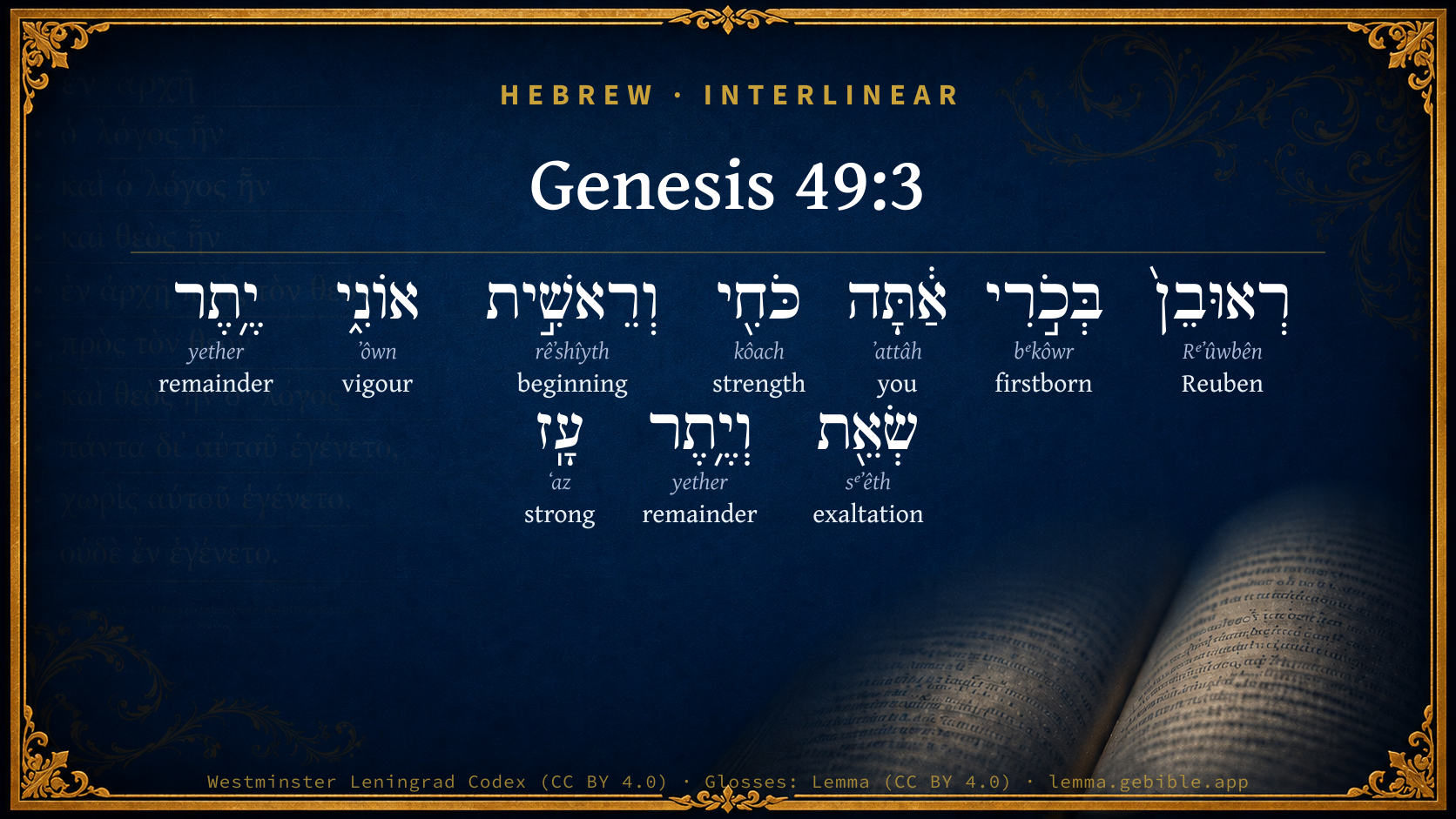
Hebrew (Westminster Leningrad Codex) Genesis 49:3 appears in the Hebrew Old Testament. The text above is from the Westminster Leningrad Codex. Each word links to its Strong’s number, a concise gloss, and parsing drawn from the Open Scriptures Hebrew Bible morphology. Click any word for its full Brown-Driver-Briggs (BDB) entry.
Download image
Cite this verse

Genesis 49:3 (World English Bible). Public Domain. Lemma interlinear Bible study tool, https://lemma.gebible.app/v/genesis/49/3.

Show BibTeX & RIS
BibTeX
RIS
English Translation
"Reuben, you are my firstborn, my might, and the beginning of my strength; The pre-eminence of dignity, and the pre-eminence of power.
World English Bible · Public Domain
Highlights
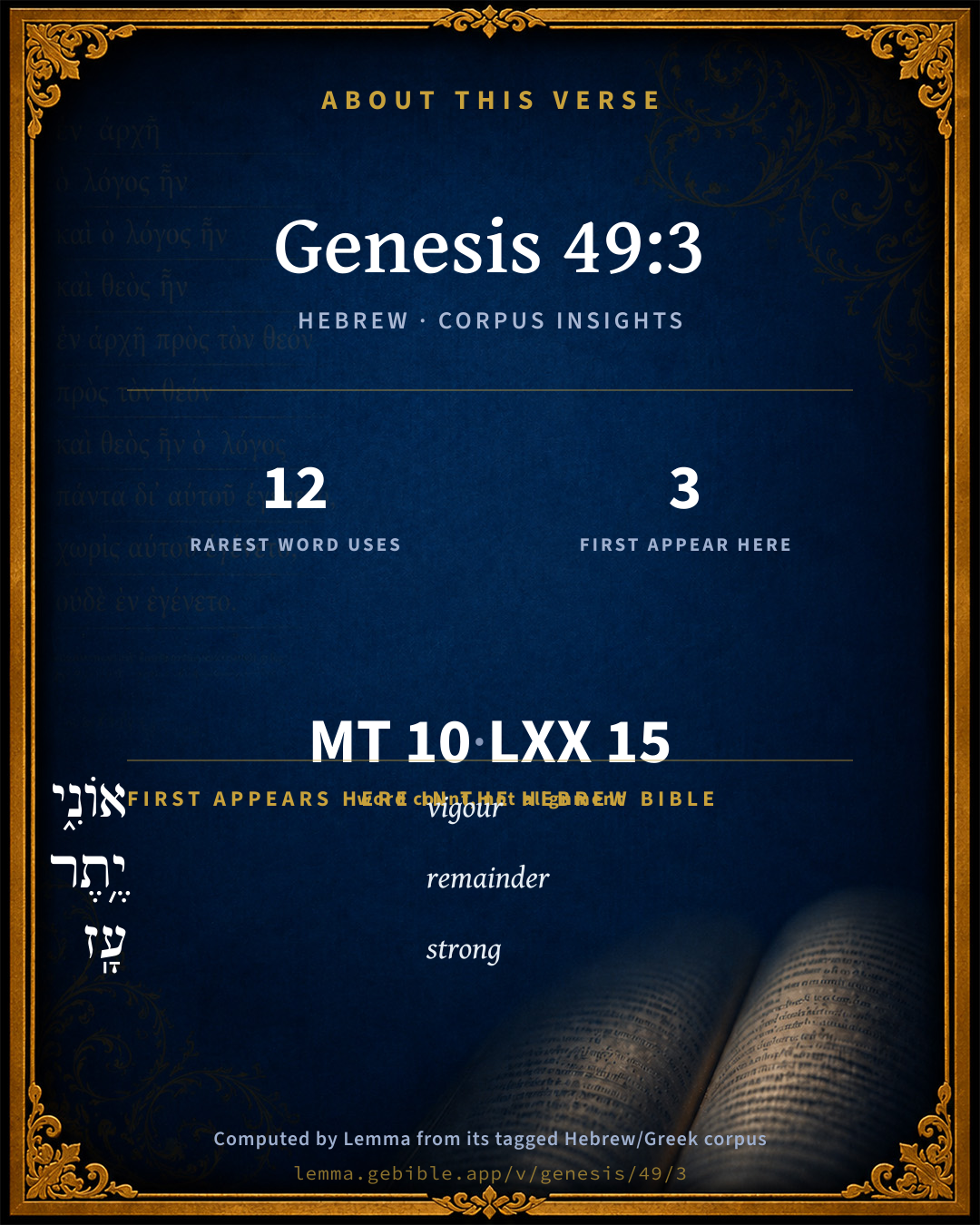
  • 3 first appearances in the Hebrew Bible
Full analysis ↓
Download a study sheet

One document with this verse’s original text, its word-by-word gloss line, the meaning frame, cross-references with their text, attributed commentary, and full source and license credits — printable, and it pastes into notes with its structure intact.

This verse Autodidact and up

Study sheet (.html) Plain text (.txt)

A passage Seminary Student

Up to 50 verses in one chapter. A passage sheet keeps up to 6 commentary sources and 12 cross-references per verse, in the order this page ranks them, and says so on the sheet whenever that leaves anything out. Ask for a single verse and you get the Autodidact verse sheet above.

Everything on this page stays free to read, with no account — the sheet is a download of what is already on screen, not access to it.

Want to remove ads? Support Godless Engineer
Compare translations 3

The same verse in 3 English versions, stacked beneath the original-language interlinear above. Click any original word for its lexicon entry.

Each is an independent rendering of the whole verse — the interlinear is not word-aligned to these translations.

Highlighted words mark where these versions differ — a whole-verse word diff, not a word-by-word alignment.

  • World English Bible Public Domain
    "Reuben, you are my firstborn, my might, and the beginning of my strength; The pre-eminence of dignity, and the pre-eminence of power.
  • King James Version Public Domain
    Reuben, thou art my firstborn, my might, and the beginning of my strength, the excellency of dignity, and the excellency of power:
  • unfoldingWord Literal Text CC BY-SA 4.0
    Reuben, you my firstborn, my might and the first of my strength, excelling rank and excelling power.

unfoldingWord Literal Text — © unfoldingWord, licensed CC BY-SA 4.0. Word-aligned USFM3 via Door43 (git.door43.org/unfoldingWord/en_ult).

Versions to compare (up to 4)

3 of 4 selected

Show all 18 translations

Every available English version of this verse, each an independent rendering of the whole verse.

  • World English Bible Public Domain
    "Reuben, you are my firstborn, my might, and the beginning of my strength; The pre-eminence of dignity, and the pre-eminence of power.
  • Berean Standard Bible Public Domain
    Reuben, you are my firstborn, my might, and the beginning of my strength, excelling in honor, excelling in power.
  • Majority Standard Bible Public Domain
    Reuben, you are my firstborn, my might, and the beginning of my strength, excelling in honor, excelling in power.
  • King James Version Public Domain
    Reuben, thou art my firstborn, my might, and the beginning of my strength, the excellency of dignity, and the excellency of power:
  • American Standard Version (1901) Public Domain
    Reuben, thou art my first-born, my might, and the beginning of my strength; The pre-eminence of dignity, and the pre-eminence of power.
  • Revised Version (1885) Public Domain
    Reuben, thou art my firstborn, my might, and the beginning of my strength; The excellency of dignity, and the excellency of power.
  • Geneva Bible (1599) Public Domain
    Reuben mine eldest sonne, thou art my might, and the beginning of my strength, the excellencie of dignitie, and the excellencie of power:
  • Douay-Rheims (1899) Public Domain
    Ruben, my firstborn, thou art my strength, and the beginning of my sorrow: excelling in gifts, greater in command.
  • Young's Literal Translation Public Domain
    Reuben! my first-born thou, My power, and beginning of my strength, The abundance of exaltation, And the abundance of strength;
  • Literal Standard Version CC BY-SA 4.0
    Reuben! You [are] my firstborn, || My power, and beginning of my strength, || The abundance of exaltation, || And the abundance of strength;
  • Unlocked Literal Bible CC BY-SA 4.0
    Reuben, you are my firstborn, my might, and the beginning of my strength, outstanding in dignity, and outstanding in power.
  • unfoldingWord Literal Text CC BY-SA 4.0
    Reuben, you my firstborn, my might and the first of my strength, excelling rank and excelling power.
  • Darby Bible Public Domain
    Reuben, thou art my firstborn, My might, and the firstfruits of my vigour: Excellency of dignity, and excellency of strength.
  • World Messianic Bible Public Domain
    “Reuben, you are my firstborn, my might, and the beginning of my strength, excelling in dignity, and excelling in power.
  • Webster's Bible Public Domain
    Reuben, thou art my first-born, my might, and the beginning of my strength, the excellence of dignity, and the excellence of power:
  • Free Bible Version CC BY-SA 4.0
    Reuben, you are my firstborn, conceived when I was strong, born when I was vigorous! You were above all others in position, above all others in power.
  • Bible in Basic English Public Domain
    Reuben, you are my oldest son, the first-fruit of my strength, first in pride and first in power:
  • JPS Tanakh (1917) Public Domain
    Reuben, thou art my first-born, my might, and the first-fruits of my strength; the excellency of dignity, and the excellency of power.

Literal Standard Version (2020), Covenant Press — licensed CC BY-SA 4.0. Text via the HelloAO Bible API (eBible.org). Unlocked Literal Bible (unfoldingWord) — licensed CC BY-SA 4.0. Text via the HelloAO Bible API (eBible.org). unfoldingWord Literal Text — © unfoldingWord, licensed CC BY-SA 4.0. Word-aligned USFM3 via Door43 (git.door43.org/unfoldingWord/en_ult). Free Bible Version, Dr. Jonathan Gallagher — licensed CC BY-SA 4.0. Text via the HelloAO Bible API (eBible.org).

Word by word

More ways to search: Search by grammar → Find every occurrence → Compare this word →

Practice this passage: Drill this verse → Learn its vocabulary →

אוֹנִ֑י
ʼôwn
H202
“vigour · my”
Noun, Common, Masculine, Singular, Construct + Suffix, Personal, 1st Person, Common, Singular
Part of Speech
Noun
Type
Common
Gender
Masculine
Number
Singular
State
Construct
Full BDB Definition

Origin: probably from the same as H205 (in the sense of effort, but successful)

TWOT: 49a

vigour, generative power - wealth - physical strength (of men and behemoth)
  1. רְאוּבֵן֙ Rᵉʼûwbên H7205 “Reuben” Noun, Proper
  2. בְּכֹ֣רִי bᵉkôwr H1060 “firstborn · my” Noun, Common, Masculine, Singular, Construct + Suffix, Personal, 1st Person, Common, Singular
  3. אַ֔תָּה ʼattâh H859 “you” Pronoun, Personal, 2nd Person, Masculine, Singular
  4. כֹּחִ֖י kôach H3581 “strength · my” Noun, Common, Masculine, Singular, Construct + Suffix, Personal, 1st Person, Common, Singular
  5. וְרֵאשִׁ֣ית rêʼshîyth H7225 “and · beginning of” Conjunction + Noun, Common, Feminine, Singular, Construct
  6. יֶ֥תֶר yether H3499 “remainder of” Noun, Common, Masculine, Singular, Construct
  7. שְׂאֵ֖ת sᵉʼêth H7613 “exaltation” Noun, Common, Feminine, Singular, Absolute
  8. וְיֶ֥תֶר yether H3499 “and · remainder of” Conjunction + Noun, Common, Masculine, Singular, Construct
  9. עָֽז ʻaz H5794 “strong” Noun, Common, Masculine, Singular, Absolute

About this verse

These counts appear in no published source. They are computed here, from the morphology-tagged text and Lemma’s own curated glosses. What Lemma adds →

10
words
9
distinct lemmas
Pentateuch
section

Notable vocabulary

The rarest word here is אוֹנִ֑י vigour H202 — appearing just 12 times in the whole Hebrew Bible.

First appearance in Scripture

These words make their first canonical appearance in the Hebrew Bible here:

  • אוֹנִ֑י vigour H202
  • יֶ֥תֶר remainder H3499
  • עָֽז strong H5794

Shared distinctive vocabulary

אוֹנִ֑י vigour H202 occurs in 12 verses of the Hebrew Bible. Also found in:

Grammatical profile

  • 9 nouns
  • 1 pronoun

Repetition

A word recurs within this verse — often emphatic in Hebrew:

  • יֶ֥תֶר remainder H3499 ×2

Hebrew & Septuagint length

In English translation the verse runs 22 words from the Hebrew and 21 from the Septuagint (LXX English) — closely comparable.

A rough comparison of the two English renderings, which tokenize alike — not a word-level alignment.

Word counts can differ between the Hebrew and the Greek without any difference in meaning — e.g. the Hebrew direct-object marker אֵת has no separate Greek word, and Greek often adds the article ὁ.

In the original languages it is 10 Hebrew tokens and 15 Greek tokens — but the two are counted differently (Hebrew bundles its prefixes and suffixes into one token; the Greek is in lemma form), so that isn’t a like-for-like length.

Cross-references

11

Topical passages linked to Genesis 49:3 in the Treasury of Scripture Knowledge — connected by theme and wording, ordered by reader-vote popularity; previews shown in the World English Bible.

  • Deuteronomy 21:17 but he shall acknowledge the firstborn, the son of the hated, by giving him a double portion of all that he has; for he is the beginning of his strength; the right of the firstborn is his.
  • Psalms 78:51 And struck all the firstborn in Egypt, The chief of their strength in the tents of Ham.
  • Genesis 29:32 Leah conceived, and bore a son, and she named him Reuben. For she said, "Because Yahweh has looked at my affliction. For now my husband will love me."
  • Psalms 105:36 He struck also all the firstborn in their land, The first fruits of all their manhood.
  • Genesis 48:18 Joseph said to his father, "Not so, my father; for this is the firstborn; put your right hand on his head."
  • Numbers 1:20 The children of Reuben, Israel's firstborn, their generations, by their families, by their fathers' houses, according to the number of the names, one by one, every male from twenty years old and upward, all who were able to go out to war;
  • 1 Chronicles 2:1 These are the sons of Israel: Reuben, Simeon, Levi, and Judah, Issachar, and Zebulun,
  • 1 Chronicles 5:1 The sons of Reuben the firstborn of Israel (for he was the firstborn; but, because he defiled his father's couch, his birthright was given to the sons of Joseph the son of Israel; and the genealogy is not to be reckoned after the birthright.
  • 1 Chronicles 5:3 the sons of Reuben the firstborn of Israel: Hanoch, and Pallu, Hezron, and Carmi.
  • Genesis 46:8 These are the names of the children of Israel, who came into Egypt, Jacob and his sons: Reuben, Jacob's firstborn.
  • Numbers 26:5 Reuben, the firstborn of Israel; the sons of Reuben: [of] Hanoch, the family of the Hanochites; of Pallu, the family of the Palluites;

Cross-references courtesy of OpenBible.info (CC BY 4.0).

Hebrew and Greek witnesses Masoretic Hebrew ↔ Greek Septuagint

The same verse in the two great witnesses to the Old Testament, shown verse-for-verse.

These are two independent witnesses, not word-aligned to each other, and the Septuagint is shown in lemma (dictionary) form.

Hebrew Genesis 49:3 Masoretic · Westminster Leningrad Codex

רְאוּבֵן֙ בְּכֹ֣רִי אַ֔תָּה כֹּחִ֖י וְרֵאשִׁ֣ית אוֹנִ֑י יֶ֥תֶר שְׂאֵ֖ת וְיֶ֥תֶר עָֽז

"Reuben, you are my firstborn, my might, and the beginning of my strength; The pre-eminence of dignity, and the pre-eminence of power.

World English Bible · Public Domain

Greek LXX Genesis 49:3 Septuagint · lemma form

ρουβην πρωτότοκος ἐγώ σύ ἰσχύς ἐγώ καί ἀρχή τέκνον ἐγώ σκληρός φέρω καί σκληρός αὐθάδης

Ruben, you are my firstborn, you my strength, and the first of my children, hard to be endured, hard and self-willed.

LXX2012 (modern English Septuagint) · Public Domain

On this verse, The Cambridge Bible for Schools and Colleges discusses the Septuagint’s reading. Read the note in Commentary ↓

Hebrew: Westminster Leningrad Codex (CC BY 4.0). Greek: Septuagint (public domain); English from LXX2012 (modern English Septuagint) (Public Domain). How the Septuagint differs from the Hebrew →

Targum (Aramaic paraphrase)

2

The Targum is the ancient Jewish Aramaic paraphrase of the Hebrew Scriptures — an interpretive translation, not the Hebrew text itself. Onkelos (literal) and Pseudo-Jonathan (expansive) render the Torah, and Jonathan the Prophets. Coverage is partial: where no permissively-licensed English translation exists for a verse, only the Aramaic is shown. This is verse-level text, not a word-by-word alignment to the Hebrew.

  1. Targum Onkelos Torah (Genesis–Deuteronomy)
    רְאוּבֵן בּוּכְרִי אַתְּ חֵילִי וְרֵישׁ תָּקְפִּי לָךְ הֲוָה חָזֵי לְמִסַּב תְּלָתָא חוּלָקִין בְּכֵירוּתָא כְּהֻנְתָּא וּמַלְכוּתָא

    (no public-domain English translation for this verse)

    Targum Onkelos — Aramaic: “Onkelos Genesis” (public domain); “Onkelos Exodus” (public domain); “Onkelos Leviticus” (public domain); “Onkelos Numbers” (public domain); “Onkelos Deuteronomy” (public domain). English: “Sefaria Community Translation” (CC0 1.0 (public-domain dedication)); “J.W. Etheridge. The Targums of Onkelos and Jonathan Ben Uzziel on the Pentateuch. London: Longmans, Green, 1862” (public domain). Text via Sefaria.

  2. Targum Pseudo-Jonathan Torah (Genesis–Deuteronomy)
    רְאוּבֵן בּוּכְרִי אַנְתְּ רֵישׁ חֵיל שִׁימוּשִׁי וְשֵׁירוּי קִרְיוּת הִרְהוּרִי חָמֵי הֲוֵי לָךְ בְּכוֹרוֹתָא וּרְבוּת כְּהוּנְתָּא וּמַלְכוּתָא וְעַל דִי חַטְיַית בְּרִי אִתְיְהִיבַת בְּכֵירוּתָא לְיוֹסֵף וּמַלְכוּתָא לִיהוּדָה וּכְהוּנְתָּא לְלֵוִי

    Reuben thou art my firstborn, the beginning of the strength of my generation, and the chief event of my thoughts To thee belonged the birthright, and the high priesthood, and the kingdom: but because thou hast sinned, my son, the birthright is given to Joseph, and the, kingdom to Jehuda, and the priesthood to Levi.

    Targum Pseudo-Jonathan — Aramaic: “Targum Jonathan on Genesis” (public domain); “Targum Jonathan on Exodus” (public domain); “Targum Jonathan on Leviticus” (public domain); “Targum Jonathan on Numbers” (public domain); “Targum Jonathan on Deuteronomy” (public domain). English: “The Targum of Jonathan ben Uzziel, trans. J. W. Etheridge, London, 1862” (public domain). Text via Sefaria.

Commentary

Notes on Genesis 49:3 from classic Christian and Jewish commentators (each source and its license shown beneath its notes). The classic Christian expositions comment on the surrounding passage and are grouped to its opening verse, so a note may address several verses; the Jewish commentaries on the Tanakh (Rashi and others) are per-verse, so they appear only where the commentator wrote on this verse.

Lemma curates 59 commentaries, every one of them public domain or Creative Commons licensed, each selected and text-cleaned for this edition rather than reprinted as found. About our sources →

Trapp's Complete Commentary

John Trapp

Gen 49:3 Reuben, thou [art] my firstborn, my might, and the beginning of my strength, the excellency of dignity, and the excellency of power:

Ver. 3. My might, and beginning of my strength.] Nate meae vires … The word here used signifieth the straining of the body forcibly to effect a thing much desired: such as was that of St Paul, {επεκτεινομενος, Php 3:14} and that of Elijah, {1Ki 18:42} when he prayed and prayed, as St James hath it, that is, with utmost intention of affection (προσευχη προσνυξατο, Jas 5:17).

The excellency of dignity, and the excellency of power.] That is, saith the Chaldee Paraphrast, Excellens principatu et sacerdotio. Both these he forfeited and fell from; so cannot Christians. {Rev 1:6}

John Trapp, A Commentary or Exposition upon All the Books of the Old and New Testament (1647–1656) — public domain. Text from a community e-Sword module.

Joseph Benson's Commentary

Gen 49:3-4. Reuben, thou art my firstborn, my might — Begotten in the prime and vigour of my days; the excellency of dignity, and the excellency of power — Such were the prerogatives of the birthright, which he would have enjoyed had he not forfeited and fallen from them by his sin; dignity above his brethren, and considerable power over them. Unstable as water, thou shalt not excel — As water is prone to flow, and still tends downward to an inferior situation, so Reuben should fall from the pre-eminence he had by birth. In the Chaldee paraphrase it is, “Thou wast to have had three parts, the birthright, the priesthood, and the kingdom; but thou hast followed thy own will; as water spilled, thou shalt not prosper.” Two shares of the inheritance, which are supposed to have belonged to the birthright, were given to Joseph, the priesthood to Levi, and the kingdom to Judah. And nothing great or excellent is recorded of the tribe of Reuben throughout the Scriptures. From it arose no judge, prophet, prince, nor any person of renown, only Dathan and Abiram, who were noted for their impious rebellion. This tribe, not aiming to excel, chose a settlement on the other side Jordan. Jacob here charges him with the sin for which he was disgraced. It was forty years ago that he had been guilty of this sin; yet now it is remembered against him. It left an indelible mark of infamy upon his family; a wound not to be healed without a scar.

Joseph Benson's Commentary on the Old and New Testaments (1811–1818) — public domain. Text from a community e-Sword module.

The Preacher's Complete Homiletical Commentary

Joseph S. Exell (gen. ed.)

MAIN HOMILETICS OF THE PARAGRAPH.—Gen_49:3-4

THE BLESSING OF REUBEN

We seem to have in this, as in other instances, words of cursing rather than of blessing. But in Gen_49:28, Jacob’s speeches concerning his sons are called “blessings.” He utters words of blame, he rebukes sharply, but does not curse the persons though he denounces the sin. He does not cast off his sons: they still continue among the tribes of Israel. As to Reuben, consider:—

I. His privileges. He was the first-born, the first-fruits of his father’s manly strength, “The excellency of dignity, and the excellency of power.” This entitled him,

1. To the first rank among his brethren.

2. To the leadership of the tribes.

3. To a double share of the inheritance. (Gen_27:29; Deu_21:17). Such were his high privileges.

II. His forfeiture of his privileges. Jacob reminds him of his privileges, only to contrast them with his present state. He will cause him to see what he might have been. Great expectations had been formed of him and he had not answered them. For it is not privileges that make us good or great, but the use to which we put them. Reuben forfeited his privileges,—

1. By a foul sin. Jacob dwells upon it with all those aggravations that made it to be the most heinous and abhorred. He turns away from Reuben (and addressing his other sons as if by way of pathetic appeal), says, “He went up to my couch.”

2. By his instability of character. He was “unstable as water,” which is sometimes fierce and tempestuous, and always yielding and treacherous. He was that double-minded man described by St. James, whose true image in nature is the restless sea which is the sport of the inconstant winds. (Jas_1:6; Jas_1:8.)

3. By a life of sensuality. This resulted in that inveterate fault of his character, instability. His passions were heated and furious, like water boiling over. (See Critical Notes.) They were ungovernable. He could not rule himself, and therefore could have no influence over others. He was unfitted for power and place. The single sin which made him infamous grew out of his character, confirming and establishing it in evil more and more. And thus the thoughts, feelings, and deeds of a man—the whole of his character in the present—are made and determined by his past. Sin is not merely done and done with. The injury done to our soul remains in its effects.

SUGGESTIVE COMMENTS ON THE VERSES

Gen_49:3-4. The term is well adapted both to express the unbridled lawlessness of Reuben’s conduct in the indulgence of his passions, and the effect of it in suddenly and irretrievably casting him down from his birthright. The force of a great current of water, when the barriers that restrained it are removed, is irresistible. Such is the force of corruption in men destitute of religious principle; yet nothing is weaker than water in small quantities—it has no principle of coherence or stability. Such is the weakness of men who walk after their own lusts.—(Bush.)

The Preacher's Complete Homiletical Commentary (gen. ed. Joseph S. Exell; Funk & Wagnalls, c. 1892) — public domain (pre-1929). A full-Bible homiletical/sermon-outline anthology covering 65 of 66 books (2 John is absent from the source module). Text from a community e-Sword module.

Tyndale Open Study Notes

Tyndale Open Resources

49:3-4 As firstborn, Reuben was entitled to be head of the family, but because he had the ungoverned impulses of boiling or turbulent waters (35:22), Jacob prophesied that Reuben would fail in leadership (see 37:21-22, 29; 42:22, 37-38; cp. Judg 5:15-16; 1 Chr 5:1-2).

Tyndale Open Study Notes — © Tyndale Open Resources, licensed CC BY-SA 4.0. Text via the HelloAO Bible API.

Geneva Bible (1599)

Geneva Bible translators

If thou hadst not lost thy birthright by thine offense.

Begotten in my youth.

Geneva Bible (1599) marginal notes — public domain. Text via Bolls.life.

Adam Clarke's Commentary

3. Reuben, my first-born art thou!

My might, and the prime of my strength,

Excelling in eminence, and excelling in power:

4. Pouring out like the waters:-thou shalt not excel,

For thou wentest up to the bed of thy father, -

Then thou didst defile: to my couch he went up!

Verse 3. Reuben as the first-born had a right to a double portion of all that the father had; see De 21:17.

The eminence or dignity mentioned here may refer to the priesthood; the power, to the regal government or kingdom. In this sense it has been understood by all the ancient Targumists. The Targum of Onkelos paraphrases it thus: "Thou shouldst have received three portions, the birthright, the priesthood, and the kingdom:" and to this the Targums of Jonathan ben Uzziel and Jerusalem add: "But because thou hast sinned, the birthright is given to Joseph, the kingdom to Judah, and the priesthood to Levi." That the birthright was given to the sons of Joseph we have the fullest proof from 1Ch 5:1.

Adam Clarke's Commentary on the Bible (1810–1826) — public domain. Text from a community e-Sword/MySword module.

John Calvin's Commentaries

3. Reuben, thou art my first-born He begins with the first-born, not for the sake of honor, to confirm him in his rank; but that he may the more completely cover him with shame, and humble him by just reproaches. For Reuben is here cast down from his primogeniture; because he had polluted his father’s bed by incestuous intercourse with his mother-in-law. The meaning of his words is this: Thou, indeed, by nature the first-born, oughtest to have excelled, seeing thou art my strength, and the beginning of my manly vigor; but since thou best flowed away like water, there is no more any ground for arrogating anything to thyself. For, from the day of thy incest, that dignity which thou receivedst on thy birth-day, from thy mother’s womb, is gone and vanished away. The noun (און,) some translate seed, others grief; and turn the passage thus: “Thou my strength, and the beginning of my grief or seed.” They who prefer the word grief, assign as a reason, that children bring care and anxiety to their parents. But if this were the true meaning, there would rather have been an antithesis between strength and sorrow. Since, however, Jacob is reciting, in continuity, the declaration of the dignity which belongs to the first-born, I doubt not that he here mentions the beginning of his manhood. For as men, in a certain sense, live again in their children, the first-born is properly called the “beginning of strength.” To the same point belongs what immediately follows, that he had been the excellency of dignity and of strength, until he had deservedly deprived himself of both. For Jacob places before the eyes of his son Reuben his former honor, because it was for his profit to be made thoroughly conscious whence he had fallen. So Paul says, that he set before the Corinthians the sins by which they were defiled, in order to make them ashamed. (1 Corinthians 6:5.) For whereas we are disposed to flatter ourselves in our vices, scarcely any one of us is brought back to a sane mind, after he has fallen, unless he is touched with a sense of his vileness. Moreover, nothing is better adapted to wound us, than when a comparison is made between those favors which God bestows upon us, and the punishments we bring upon ourselves by our own fault. After Adam had been stripped of all good things, God reproaches him sharply, and not without ridicule, “Behold Adam is as one of us.” What end is this designed to answer, except that Adam, reflecting with himself how far he is changed from that man, who had lately been created according to the image of God, and had been endowed with so many excellent gifts, might be confounded and fall prostrate, deploring his present misery? We see, then, that reproofs are necessary for us, in order that we may be touched to the quick by the anger of the Lord. For so it happens, not only that we become displeased with the sins of which we are now bearing the punishment, but also, that we take greater care diligently to guard those gifts of God which dwell within us, lest they perish through our negligence. They who refer the “excellency of dignity” to the priesthood, and the “excellency of power” to the kingly office, are, in my judgment, too subtle interpreters. I take the more simple meaning of the passage to be; that if Reuben had stood firmly in his own rank, the chief place of all excellency would have belonged to him.

John Calvin's Commentaries (1540-1563) — public domain. Text from the Calvin Translation Society English edition (1840s-50s) via the Christian Classics Ethereal Library (ccel.org). Calvin's coverage is partial (roughly two-thirds of the Bible); uncommented books and verses are honest gaps, never fabricated. The 19th-century editor's footnotes and remarks are omitted so the notes are faithfully Calvin's own voice.

Ellicott's Commentary for English Readers

(3) The beginning of my strength.—In Gen_35:18, the word oni means “my sorrow,” and it is so translated here by the Vulg., Aquila, and Symmachus. But in this verse Jacob magnifies the prerogatives of the firstborn, and our version is undoubtedly right in deriving oni from a different and not uncommon word signifying strength. It occurs in Deu_21:17; Job_40:16; Psa_78:51; Psa_105:36, &c.

The excellency . . . —We must here supply, “And therefore to thee as the firstborn belonged,” first, the excellency of dignity, that is, the priesthood; and secondly, the excellency of power, that is, the kingly office. As a matter of history no king, judge, or prophet is recorded as having sprung from the tribe of Reuben.

A Bible Commentary for English Readers, edited by Charles John Ellicott (1878–1897) — public domain. Text from a community e-Sword module.

The Cambridge Bible for Schools and Colleges

gen. ed. J. J. S. Perowne

3. Reuben] Reuben’s early pre-eminence is forfeited. The tribe’s loss of power is here ascribed to the curse of Jacob for an act of incest (see Gen_35:22; 1Ch_5:1). The territory of the tribe of Reuben lay on the east side of the Dead Sea. In Biblical history, the Reubenites are practically unknown, except for one successful campaign against the Hagarenes (1Ch_5:8-10). In the Song of Deborah (Jdg_5:16), Reuben is denounced for apathy.

beginning] Better, as R.V. marg., firstfruits. The firstborn was expected to inherit the full strength of the parent. Cf. Deu_21:17; Psa_78:51; Psa_105:36. The versions follow a different text. LXX ἀρχὴ τέκνων μου; Lat. principium doloris mei; Aquila κεφάλαιον λύπης μου; Symmachus ἀρχὴ ὀδύνης.

The excellency] This word in Early English had the meaning of “superiority,” owing to its derivation from “excel.” But this has now been lost sight of.

Vulg. major in donis, major in imperio; Targ. Onk. paraphrases “for thee it was provided to receive three portions, the right of firstborn, the priesthood, and the kingdom.”

LXX must here follow a different text, σκληρὸς φέρεσθαι καὶ σκληρὸς αὐθάδης.

The Cambridge Bible for Schools and Colleges (gen. ed. J. J. S. Perowne; Cambridge University Press, 1878–1918) — public domain. Text from a community e-Sword module.

John Gill's Exposition

Reuben, thou art my firstborn,.... Jacob addressed himself to Reuben first, in the presence of his brethren, owned him as his firstborn, as he was, Gen 29:31 did not cashier him from his family, nor disinherit him, though he had greatly disobliged him, for which the birthright, and the privileges of it, were taken from him, Ch1 5:1.

my might, and the beginning of my strength; begotten by him when in his full strength (z), as well as the first of his family, in which his strength and glory lay; so the Septuagint, "the beginning of my children"; and because he was so, of right the double portion belonged to him, had he not forfeited it, Deu 21:17. Some versions render the words, "the beginning of my grief", or "sorrow" (a), the word "Oni" sometimes so signifying, as Rachel called her youngest son "Benoni", the son of my sorrow; but this is not true of Reuben, he was not the beginning of Jacob's sorrow, for the ravishing of Dinah, and the slaughter and spoil of the Shechemites, by his sons, which gave him great sorrow and grief, were before the affair of Reuben's lying with Bilhah:

the excellency of dignity, and the excellency of power; that is, to him of right belonged excellent dignity, power, and authority in the family, a preeminence over his brethren, a double portion of goods, succession in government, and, as is commonly understood, the exercise of the priesthood; and so the Targums interpret it, that he should, had he not sinned, took three parts or portions above his brethren, the birthright, priesthood, and kingdom. Jacob observes this to him, that he might know what he had lost by sinning, and from what excellency and dignity, grandeur and power, he was fallen.

(z) "Nate. meae vires. --------" Virgil. (a) , Aquila; , Symmachus apud Drusium; "principium doloris mei", V. L. Tigurine version.

John Gill's Exposition of the Whole Bible (1746–1763) — public domain (CC PDM 1.0). Text via the HelloAO Bible API.

Haydock's Catholic Bible Commentary

My strength, &c. He calls him his strength, as being born whilst his father was in his full strength and vigour; he calls him the beginning of his sorrow, because cares and sorrows usually come on with the birth of children. --- Excelling in gifts, &c., because the first-born had a title to a double portion, and to have the command over his brethren, which Ruben forfeited by his sin; being poured out as water; that is, spilt and lost. (Challoner) --- In command. He ought to have succeeded to his father in authority. But Joseph entered in upon his rejection, 1 Paralipomenon v. 1. The priesthood was given to Levi’s descendants; and the regal power, partly to those of Joseph, who reigned over the ten tribes, for a long time; and partly to the posterity of Juda, who exercised dominion over all the people of Israel. (Chaldee) (Worthington)

George Leo Haydock (1774–1849), Haydock's Catholic Family Bible and Commentary, 1859 edition — public domain. Excludes Psalms (Douay-Rheims chapter numbering differs from Protestant) and Deuterocanonical books (Catholic canon only).

Matthew Poole's English Annotations

The beginning of my strength; the first instance or evidence of my might or strength, or of that masculine rigour whereby God enabled me to beget a child. Compare Deu 21:17; Psa 105:36. Or the first of my children, which are the strength, the stays, and supports of a father, and of his family; thence called his arrows, as Psa 127:4, and by other authors, the pillars of the house.

The excellency of dignity, and the excellency of power. As first-born thou hadst the right of precedency before all thy brethren in point of dignity and power or privilege; the double portion, the priesthood, the dominion over thy brethren were thine.

Matthew Poole's English Annotations on the Holy Bible (1683–1685) — public domain. Text from a community e-Sword/MySword module.

Whedon's Commentary on the Bible

Daniel D. Whedon

3. My firstborn, thou — By this form of expression poetic emphasis is given to the direct address.

Beginning of my strength — Allusion to the supposed superior vigour of the firstborn, as inheriting the full virile power of the father. Comp. Deu_21:17; Psa_78:51; Psa_105:36.

Excellence of dignity… power — His excellence is his natural pre-eminence as firstborn; his dignity, (Hebrews, שׂאת, from נשׂא, to lift up,) is his elevation, or the rank to which he was thus entitled. The distinction between might, strength, and power in this verse, each representing a different Hebrew word, is this: Might and strength here denote physical energy and manly vigour, while power (עז) is used in the sense of authority, a right and prerogative of the firstborn. The powers and prerogatives naturally adhering to the firstborn, were, because of Reuben’s sins, transferred to Judah and Joseph.

Daniel D. Whedon (gen. ed.), Commentary on the Old and New Testaments (1874–1909) — public domain. Text from a community e-Sword module.

John Wesley's Explanatory Notes

Reuben thou art my first-born - Jacob here puts upon him the ornaments of the birth-right, that he and all his brethren might see what he had forfeited and in that might see the evil of his sin. As the first-born he was his father's joy, being the beginning of his strength. To him belonged the excellency of dignity above his brethren, and some power over them.

John Wesley, Explanatory Notes Upon the Whole Bible (1754–1765) — public domain. Text via the GEBible commentary corpus.

Keil & Delitzsch

C. F. Keil & F. Delitzsch

Reuben, my first-born thou, my might and first-fruit of my strength; pre-eminence in dignity and pre-eminence in power. - As the first-born, the first sprout of the full virile power of Jacob, Reuben, according to natural right, was entitled to the first rank among his brethren, the leadership of the tribes, and a double share of the inheritance (Gen 27:29; Deu 21:17). (שׂאת: elevation, the dignity of the chieftainship; עז, the earlier mode of pronouncing עז, the authority of the first-born.) But Reuben had forfeited this prerogative. "Effervescence like water - thou shalt have no preference; for thou didst ascend thy father's marriage-bed: then hast thou desecrated; my couch has he ascended." פּחז: lit., the boiling over of water, figuratively, the excitement of lust; hence the verb is used in Jdg 9:4; Zep 3:4, for frivolity and insolent pride. With this predicate Jacob describes the moral character of Reuben; and the noun is stronger than the verb פחזת of the Samaritan, and אתרעת or ארתעת efferbuisti, aestuasti of the Sam. Vers., ἐξύβρισας of the lxx, and ὑπερζέσας of Symm. תּותר is to be explained by יתר: have no pre-eminence. His crime was, lying with Bilhah, his father's concubine (Gen 35:22). חלּלתּ is used absolutely: desecrated hast thou, sc., what should have been sacred to thee (cf. Lev 18:8). From this wickedness the injured father turns away with indignation, and passes to the third person as he repeats the words, "my couch he has ascended." By the withdrawal of the rank belonging to the first-born, Reuben lost the leadership in Israel; so that his tribe attained to no position of influence in the nation (compare the blessing of Moses in Deu 33:6). The leadership was transferred to Judah, the double portion to Joseph (Ch1 5:1-2), by which, so far as the inheritance was concerned, the first-born of the beloved Rachel took the place of the first-born of the slighted Leah; not, however, according to the subjective will of the father, which is condemned in Deu 21:15., but according to the leading of God, by which Joseph had been raised above his brethren, but without the chieftainship being accorded to him.

Keil & Delitzsch — Biblical Commentary on the Old Testament (1861–1891) — public domain (CC PDM 1.0). Text via the HelloAO Bible API. (Old Testament only.)

unfoldingWord translationNotes

Door43 World Missions Community

my firstborn, my might, and the beginning of my strength

The phrases "my firstborn, my might" and "the beginning of my strength" mean the same thing. The words "might" and "strength" stand for Jacob's ability to produce children. The words "firstborn" and "beginning" mean that Reuben is his first child. AT: "my first child after I became a man" (See: Parallelism)

outstanding in dignity, and outstanding in power

This can be stated as a new sentence. AT: "You are first in honor and power" or "You surpass everyone else in honor and power"

Uncontrollable as rushing water

Jacob compares Reuben to water in a strong current to emphasize that he cannot control his anger and he is not stable. (See: Simile)

you will not have the preeminence

"you shall not be first among your brothers"

because you went up to your father's bed. Then you defiled it; you went up to my couch

Here "bed" and "couch" stand for Jacob's concubine, Bilhah. Jacob is referring to when Reuben slept with Bilhah (See: Genesis 35:22). AT: "because you went to my bed and slept with Bilhah my concubine. You have shamed me" (See: Metonymy)

you went up to your father's bed ... you went up to my couch

Both statements mean the same thing. (See: Parallelism)

translationWords

Reuben

firstborn

power

defile

unfoldingWord translationNotes — © Distant Shores Media and the Door43 World Missions Community, licensed CC BY-SA 4.0. Source: git.door43.org/Door43/en_tn.

Rashi

Rabbi Shlomo Yitzchaki (Rashi)

אוני means MY VIGOUR, as (Hosea 12:9) “I have gained me (און) strength”; (Isaiah 40:26) “by the greatness of His (אונים) might”; (Isaiah 5:29) “and to him that hath no (אונים) might Ho increaseth strength”.

יתר שאת SUPERIORITY IN DIGNITY — Since you were the first-born it was proper that you should be superior to your brothers by being endowed with the priesthood. This term שאת “lifting up” alludes to the נשיאות כפים the raising of the hands when the priests pronounce the benediction (Genesis Rabbah 98:4; cf. Onkelos).

ויתר עז SUPERIORITY IN POWER — meaning in royal rank, as is meant by עז in (1 Samuel 2:10) “And he will give strength (עז) unto His king”. And what caused you to lose all these?

Rashi on the Tanakh — English translations: “The Judaica Press complete Tanach with Rashi, translated by A. J. Rosenberg” (CC BY 4.0); “Pentateuch with Rashi's commentary by M. Rosenbaum and A.M. Silbermann, 1929-1934” (public domain); “The Metsudah Tanach series, Lakewood, N.J” (CC BY 4.0); and “The Book of Joshua, Metsudah Publications, 1997” (CC BY 4.0). Text via Sefaria.

Ramban (Nachmanides)

Rabbi Moshe ben Nachman (Ramban / Nachmanides)

REUBEN MY FIRSTBORN THOU ART.. Ramban will transpose the order of the words for the purpose of deriving the meaning of the verse. The sequence of this verse is, “Reuben, thou art my firstborn, my might, and the first-fruits of my strength, the excellence of majesty, and the excellence of power,” and its purport is as follows: “You are the first-born of my might and the first-fruits of my strength when I was the excellence of majesty (se’eith) and position” — the expression being similar to that found in the verses: Shall not his excellency (‘se’eitho’) make you afraid? When he raiseth himself up (‘mise’eitho’) the mighty are afraid, 41:17. ‘mise’eitho’ meaning ascendancy and power — “and when I was at the height of strength (oz) for war” — the expression being similar to that found in the verses: And He will give strength (‘oz’) unto His king; And the strength (‘ve’izuz’) of battle.

Ramban (Nachmanides) on the Tanakh — English translation: “Commentary on the Torah by Ramban (Nachmanides). Translated and annotated by Charles B. Chavel. New York, Shilo Pub. House, 1971-1976” (CC BY 4.0). Text via Sefaria.

Radak

Rabbi David Kimhi (Radak)

ראובן בכורי אתה; Yaakov repeated this theme a second and a third time when he continued: כחי, וראשית אוני. The reason was that theoretically, Reuven was entitled to three advantages. 1) birthright; 2) priesthood, as every firstborn in each family was automatically what the כהן would be after the sin of the golden calf when that privilege was transferred to the tribe of Levite who had not participated in that sin. 3) the position of political head of the nation, known as מלכות in the language of our sages.

יתר שאת, this expression encompasses both the birthright and the priesthood, both of which are primarily a description of an aristocratic social standing. ויתר עז, a reference to the political power, Royalty. Kings need to excel in this fortitude, toughness described by the word עוז. We find the expression used in that sense in Samuel I 2,10 ויתן עוז למלכו, “He will give power to His king.” Yaakov is reminding Reuven: “you would have enjoyed all these advantages over your brothers if you had not become guilty of a great sin.” This is why he continued with פחז כמים, you were precipitous as water in not restraining your biological urges which led you to mount the couch of your father. You did not stop to consider what a sin with far ranging effects you would make yourself guilty of by your lack of self control.

אל תותר, you will no longer enjoy any advantage over your brothers.

Radak on the Tanakh — English translations: “Sefaria Community Translation” (CC0 1.0 (public-domain dedication)); “Eliyahu Munk, HaChut Hameshulash” (CC BY 4.0); “Rabbi Mike Feuer, Jerusalem Anthology” (CC BY 4.0); and “R. David Kimhi on the first book of Psalms, Translated by R.G. Finch, London, 1919” (public domain). Text via Sefaria.

Lesson kit

Teaching starters — assembled from the data on this page, not authored interpretation. Every prompt links to the verse data it draws on. Edit before teaching.

Genesis, in the Pentateuch, opens this verse with 10 words (9 distinct Hebrew lemmas). Its most distinctive word is ʼôwn (“vigour”). A historical commentator’s framing appears above. Read the whole chapter for the surrounding context.

Discussion questions

  1. How does “vigour” (ʼôwn) shape what this verse is saying?
  2. 3 words here appear for the first time in Scripture. What is being introduced at this debut?
  3. Deuteronomy 21:17 shares the word «vigour» with this verse. How do the two illuminate each other?
  4. “remainder” occurs 2× in this one verse. What is the effect of the repetition?
  5. The translations on this page render this verse differently — a whole-verse word diff, not a word-by-word alignment. What might account for the different wordings?
  6. Reading how Trapp's Complete Commentary and Joseph Benson's Commentary read this verse, where do the two commentators agree and where do they part?

Things to notice

Reading settings

Reading text

Shown beneath each verse's original-language words.

Old Testament
Old Testament edition

Read the OT as the Masoretic Hebrew (MT) or the Greek Septuagint (LXX).

English shown for the Greek Septuagint (in the Hebrew ↔ Greek comparison).

Comparing translations? Open the Compare panel on any verse page to stack up to four side by side.