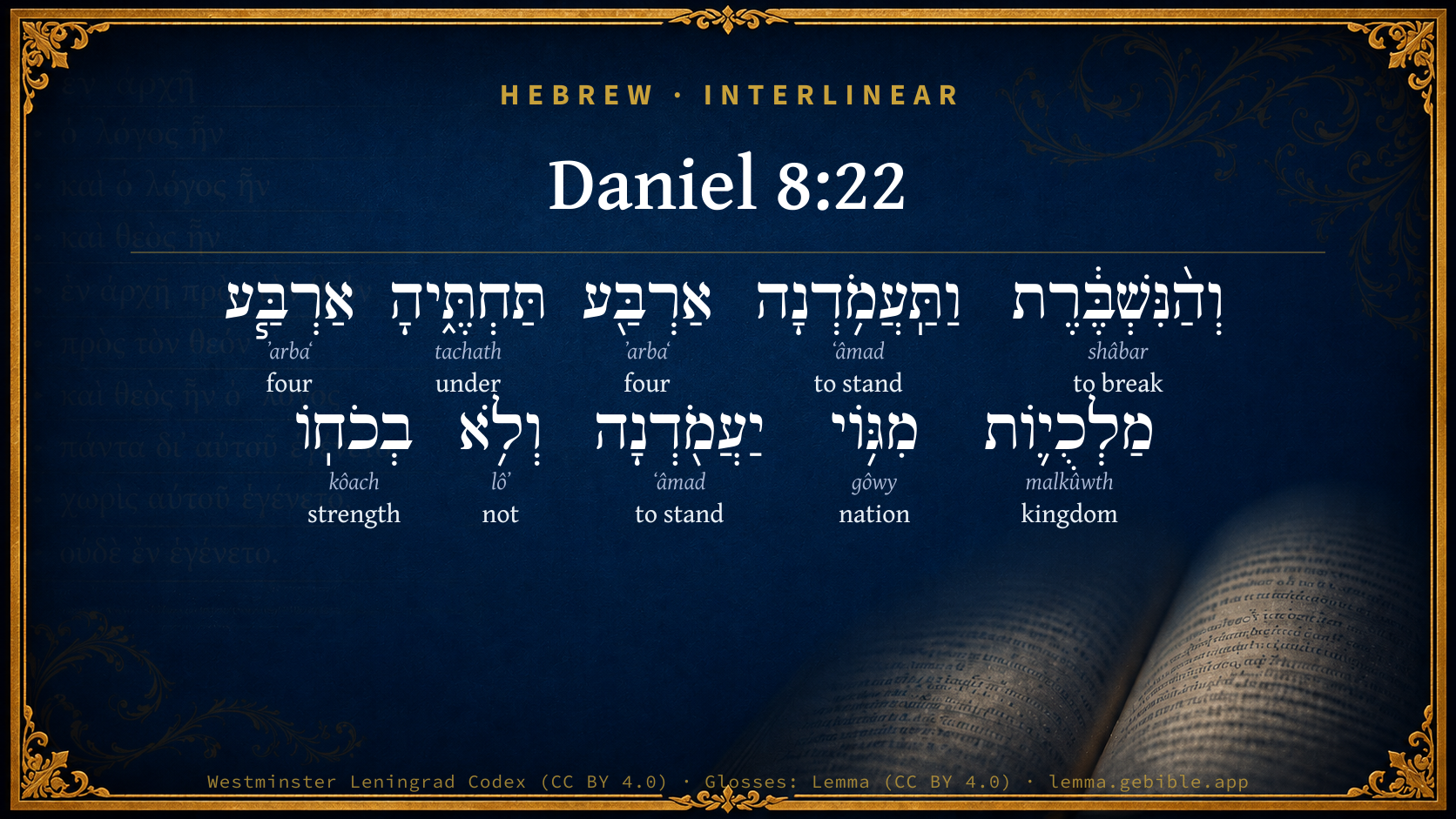
Daniel 8:22

Hebrew (Westminster Leningrad Codex) Daniel 8:22 appears in the Hebrew Old Testament. The text above is from the Westminster Leningrad Codex. Each word links to its Strong’s number, a concise gloss, and parsing drawn from the Open Scriptures Hebrew Bible morphology. Click any word for its full Brown-Driver-Briggs (BDB) entry.
Download image
Cite this verse

Daniel 8:22 (World English Bible). Public Domain. Lemma interlinear Bible study tool, https://lemma.gebible.app/v/daniel/8/22.

Show BibTeX & RIS
BibTeX
RIS
English Translation
As for that which was broken, in the place where four stood up, four kingdoms shall stand up out of the nation, but not with his power.
World English Bible · Public Domain
Download a study sheet

One document with this verse’s original text, its word-by-word gloss line, the meaning frame, cross-references with their text, attributed commentary, and full source and license credits — printable, and it pastes into notes with its structure intact.

This verse Autodidact and up

Study sheet (.html) Plain text (.txt)

A passage Seminary Student

Up to 50 verses in one chapter. A passage sheet keeps up to 6 commentary sources and 12 cross-references per verse, in the order this page ranks them, and says so on the sheet whenever that leaves anything out. Ask for a single verse and you get the Autodidact verse sheet above.

Everything on this page stays free to read, with no account — the sheet is a download of what is already on screen, not access to it.

Want to remove ads? Support Godless Engineer
Compare translations 3

The same verse in 3 English versions, stacked beneath the original-language interlinear above. Click any original word for its lexicon entry.

Each is an independent rendering of the whole verse — the interlinear is not word-aligned to these translations.

Highlighted words mark where these versions differ — a whole-verse word diff, not a word-by-word alignment.

  • World English Bible Public Domain
    As for that which was broken, in the place where four stood up, four kingdoms shall stand up out of the nation, but not with his power.
  • King James Version Public Domain
    Now that being broken, whereas four stood up for it, four kingdoms shall stand up out of the nation, but not in his power.
  • unfoldingWord Literal Text CC BY-SA 4.0
    The horn that was broken and the four that arose in its place represent four kingdoms which will arise from his nation, but not with his power.

unfoldingWord Literal Text — © unfoldingWord, licensed CC BY-SA 4.0. Word-aligned USFM3 via Door43 (git.door43.org/unfoldingWord/en_ult).

Versions to compare (up to 4)

3 of 4 selected

Show all 18 translations

Every available English version of this verse, each an independent rendering of the whole verse.

  • World English Bible Public Domain
    As for that which was broken, in the place where four stood up, four kingdoms shall stand up out of the nation, but not with his power.
  • Berean Standard Bible Public Domain
    The four horns that replaced the broken one represent four kingdoms that will rise from that nation, but will not have the same power.
  • Majority Standard Bible Public Domain
    The four horns that replaced the broken one represent four kingdoms that will rise from that nation but will not have the same power.
  • King James Version Public Domain
    Now that being broken, whereas four stood up for it, four kingdoms shall stand up out of the nation, but not in his power.
  • American Standard Version (1901) Public Domain
    And as for that which was broken, in the place whereof four stood up, four kingdoms shall stand up out of the nation, but not with his power.
  • Revised Version (1885) Public Domain
    And as for that which was broken, in the place whereof four stood up, four kingdoms shall stand up out of the nation, but not with his power.
  • Geneva Bible (1599) Public Domain
    And that that is broken, and foure stoode vp for it, are foure kingdomes, which shall stand vp of that nation, but not in his strength.
  • Douay-Rheims (1899) Public Domain
    But whereas when that was broken, there arose up four for it: four kings shall rise up of his nation, but not with his strength.
  • Young's Literal Translation Public Domain
    and that being broken, stand up do four in its place, four kingdoms from the nation do stand up, and not in its power.
  • Literal Standard Version CC BY-SA 4.0
    and that being broken, four stand up in its place, four kingdoms stand up from the nation, and not in its power.
  • Unlocked Literal Bible CC BY-SA 4.0
    As for the horn that was broken, in the place of which four others arose—four kingdoms will arise from his nation, but not with his great power.
  • unfoldingWord Literal Text CC BY-SA 4.0
    The horn that was broken and the four that arose in its place represent four kingdoms which will arise from his nation, but not with his power.
  • Darby Bible Public Domain
    Now that being broken, whereas four stood up in its stead, four kingdoms shall stand up out of the nation, but not with his power.
  • World Messianic Bible Public Domain
    As for that which was broken, in the place where four stood up, four kingdoms will stand up out of the nation, but not with his power.
  • Webster's Bible Public Domain
    Now that being broken, whereas four stood up in its place, four kingdoms shall stand up out of the nation, but not in his power.
  • Free Bible Version CC BY-SA 4.0
    The four horns that came up in place of the large horn that was broken represent the four kingdoms that arose from that nation, but not as powerful as the first.
  • Bible in Basic English Public Domain
    And as for that which was broken, in place of which four came up, four kingdoms will come up from his nation, but not with his power.
  • JPS Tanakh (1917) Public Domain
    And as for that which was broken, in the place whereof four stood up, four kingdoms shall stand up out of the nation, but not with his power.

Literal Standard Version (2020), Covenant Press — licensed CC BY-SA 4.0. Text via the HelloAO Bible API (eBible.org). Unlocked Literal Bible (unfoldingWord) — licensed CC BY-SA 4.0. Text via the HelloAO Bible API (eBible.org). unfoldingWord Literal Text — © unfoldingWord, licensed CC BY-SA 4.0. Word-aligned USFM3 via Door43 (git.door43.org/unfoldingWord/en_ult). Free Bible Version, Dr. Jonathan Gallagher — licensed CC BY-SA 4.0. Text via the HelloAO Bible API (eBible.org).

Word by word

More ways to search: Search by grammar → Find every occurrence → Compare this word →

Practice this passage: Drill this verse → Learn its vocabulary →

מַלְכֻי֛וֹת
malkûwth
H4438
“kingdoms”
Noun, Common, Feminine, Plural, Absolute
Part of Speech
Noun
Type
Common
Gender
Feminine
Number
Plural
State
Absolute
Full BDB Definition

Origin: from H4427

TWOT: 1199e

royalty, royal power, reign, kingdom, sovereign power - royal power, dominion - reign - kingdom, realm
  1. וְהַ֨נִּשְׁבֶּ֔רֶת shâbar H7665 “and · the · broken” Conjunction + Particle, Definite Article + Verb, Niphal, Participle Passive, Feminine, Singular, Absolute
  2. וַתַּֽעֲמֹ֥דְנָה ʻâmad H5975 “and · to stand” Conjunction + Verb, Qal, Sequential Imperfect, 3rd Person, Feminine, Plural
  3. אַרְבַּ֖ע ʼarbaʻ H702 “four” Adjective, Cardinal number, Feminine, Singular, Absolute
  4. תַּחְתֶּ֑יהָ tachath H8478 “under · her” Preposition + Suffix, Personal, 3rd Person, Feminine, Singular
  5. אַרְבַּ֧ע ʼarbaʻ H702 “four” Adjective, Cardinal number, Feminine, Singular, Absolute
  6. מִגּ֥וֹי gôwy H1471 “from · nation” Preposition + Noun, Common, Masculine, Singular, Absolute
  7. יַעֲמֹ֖דְנָה ʻâmad H5975 “to stand” Verb, Qal, Imperfect, 3rd Person, Feminine, Plural
  8. וְלֹ֥א lôʼ H3808 “and · not” Conjunction + Particle, Negative
  9. בְכֹחֽוֹ kôach H3581 “in/at · strength · his” Preposition + Noun, Common, Masculine, Singular, Construct + Suffix, Personal, 3rd Person, Masculine, Singular

About this verse

These counts appear in no published source. They are computed here, from the morphology-tagged text and Lemma’s own curated glosses. What Lemma adds →

10
words
8
distinct lemmas
Prophets
section

Grammatical profile

  • 3 verbs
  • 3 nouns
  • 2 adjectives
  • 1 preposition
  • 1 particle

Verb forms

  • וְהַ֨נִּשְׁבֶּ֔רֶת Niphal · Participle Passive
  • וַתַּֽעֲמֹ֥דְנָה Qal · Sequential Imperfect
  • יַעֲמֹ֖דְנָה Qal · Imperfect

Repetition

Words recur within this verse — often emphatic in Hebrew:

  • וַתַּֽעֲמֹ֥דְנָה to stand H5975 ×2
  • אַרְבַּ֖ע four H702 ×2

Hebrew & Septuagint length

In English translation the verse runs 27 words from the Hebrew and 30 from the Septuagint (LXX English) — closely comparable.

A rough comparison of the two English renderings, which tokenize alike — not a word-level alignment.

Word counts can differ between the Hebrew and the Greek without any difference in meaning — e.g. the Hebrew direct-object marker אֵת has no separate Greek word, and Greek often adds the article ὁ.

Cross-references

3

Topical passages linked to Daniel 8:22 in the Treasury of Scripture Knowledge — connected by theme and wording, ordered by reader-vote popularity; previews shown in the World English Bible.

  • Daniel 8:3 Then I lifted up my eyes, and saw, and, behold, there stood before the river a ram which had two horns: and the two horns were high; but one was higher than the other, and the higher came up last.
  • Daniel 8:8 The male goat magnified himself exceedingly: and when he was strong, the great horn was broken; and instead of it there came up four notable [horns] toward the four winds of the sky.
  • Daniel 11:4 When he shall stand up, his kingdom shall be broken, and shall be divided toward the four winds of the sky, but not to his posterity, nor according to his dominion with which he ruled; for his kingdom shall be plucked up, even for others besides these.

Cross-references courtesy of OpenBible.info (CC BY 4.0).

Hebrew and Greek witnesses Masoretic Hebrew ↔ Greek Septuagint

The same verse in the two great witnesses to the Old Testament, shown verse-for-verse.

These are two independent witnesses, not word-aligned to each other, and the Septuagint is shown in lemma (dictionary) form.

Hebrew Daniel 8:22 Masoretic · Westminster Leningrad Codex

וְהַ֨נִּשְׁבֶּ֔רֶת וַתַּֽעֲמֹ֥דְנָה אַרְבַּ֖ע תַּחְתֶּ֑יהָ אַרְבַּ֧ע מַלְכֻי֛וֹת מִגּ֥וֹי יַעֲמֹ֖דְנָה וְלֹ֥א בְכֹחֽוֹ

As for that which was broken, in the place where four stood up, four kingdoms shall stand up out of the nation, but not with his power.

World English Bible · Public Domain

Greek LXX Daniel 8:22 Septuagint · lemma form

καί ὁ συντρίβω καί ἀναβαίνω ὀπίσω αὐτός τέσσαρες κέρας τέσσαρες βασιλεύς ὁ ἔθνος αὐτός ἀναἵστημι οὐ κατά ὁ ἰσχύς αὐτός

And as for the one that was broken, in whose place there stood up four horns, four kings shall arise out of his nation, but not in their own strength.

LXX2012 (modern English Septuagint) · Public Domain

On this verse, The Cambridge Bible for Schools and Colleges discusses the Septuagint’s reading. Read the note in Commentary ↓

Hebrew: Westminster Leningrad Codex (CC BY 4.0). Greek: Septuagint (public domain); English from LXX2012 (modern English Septuagint) (Public Domain). How the Septuagint differs from the Hebrew →

Commentary

Notes on Daniel 8:22 from classic Christian and Jewish commentators (each source and its license shown beneath its notes). The classic Christian expositions comment on the surrounding passage and are grouped to its opening verse, so a note may address several verses; the Jewish commentaries on the Tanakh (Rashi and others) are per-verse, so they appear only where the commentator wrote on this verse.

Lemma curates 59 commentaries, every one of them public domain or Creative Commons licensed, each selected and text-cleaned for this edition rather than reprinted as found. About our sources →

Trapp's Complete Commentary

John Trapp

Dan 8:22 Now that being broken, whereas four stood up for it, four kingdoms shall stand up out of the nation, but not in his power.

Ver. 22. Now that being broken.] See Dan 8:8.

John Trapp, A Commentary or Exposition upon All the Books of the Old and New Testament (1647–1656) — public domain. Text from a community e-Sword module.

Tyndale Open Study Notes

Tyndale Open Resources

8:22 After Alexander’s death in 323 BC, his kingdom was divided into four major kingdoms, ruled by his generals (see “The Greeks” Profile).

Tyndale Open Study Notes — © Tyndale Open Resources, licensed CC BY-SA 4.0. Text via the HelloAO Bible API.

Geneva Bible (1599)

Geneva Bible translators

They shall not have like power as had Alexander.

That is, out of Greece.

Geneva Bible (1599) marginal notes — public domain. Text via Bolls.life.

Jamieson, Fausset & Brown

Robert Jamieson, A. R. Fausset & David Brown

not in his power--not with the power which Alexander possessed [MAURER]. An empire united, as under Alexander, is more powerful than one divided, as under the four Diadochi.

Jamieson, Fausset & Brown — Commentary Critical and Explanatory on the Whole Bible (1871) — public domain (CC PDM 1.0). Text via the HelloAO Bible API.

Adam Clarke's Commentary

Verse 22. But not in his power.] The four kingdoms which shall arise out of the Macedonian empire shall not be of Alexander's power or family, nor have his strength and dignity.

Adam Clarke's Commentary on the Bible (1810–1826) — public domain. Text from a community e-Sword/MySword module.

John Calvin's Commentaries

The great horn, says he, which was between his eyes was the first king, and when it was broken, four others sprang up. Alexander, as we have mentioned, perished in the flower of his age, and was scarcely’ thirty years old when he died, through the influence of either poison or disease. Which of the two is uncertain, although great suspicion of fraud attaches to the manner of his death; and whichever way it happened, that horn was broken. In his place there arose four horns, which sprang up, say’s he, from that nation. Here we must notice this, since I very much wonder what has come into some persons’ minds, to cause them to translate it “from the nations” and yet these are persons skilled in the Hebrew language. First, they show great ignorance by changing the number, and next, they do not comprehend the intention of the angel. For he confirms what he formerly said concerning the unity of the kingdom and its division into four parts, and he assigns the reason here. They shall spring, says he, from a nation, meaning the Greeks, and all from a single origin. For by what right did Polemy obtain the empire? solely by being one of Alexander’s generals. At the beginning, he dared not use the royal name, nor wear the diadem, but only after a lapse of time. The same is true of Selcucus, and Antigonus, and Cassander. We see, then, how correctly the kingdom of the Greeks is represented to us under the figure of a single beast, although it was immediately dispersed and torn into four parts. The kingdoms, then, which sprang from the nation meaning; Greece, shall stand, but not in full strength The copula is here taken in the sense of “but;” the four kingdom shall stand, but not by his strength, for Alexander had touched upon the Indian sea, and enjoyed the tranquil possession of his empire throughout the whole east, having filled all men with the fear of his industry, valor, and speed. Hence, the;angel states the four horns to be so small, that not one of them should be equal to the first king.

John Calvin's Commentaries (1540-1563) — public domain. Text from the Calvin Translation Society English edition (1840s-50s) via the Christian Classics Ethereal Library (ccel.org). Calvin's coverage is partial (roughly two-thirds of the Bible); uncommented books and verses are honest gaps, never fabricated. The 19th-century editor's footnotes and remarks are omitted so the notes are faithfully Calvin's own voice.

Ellicott's Commentary for English Readers

(22) Not in his power—i.e., not like the first king.

A Bible Commentary for English Readers, edited by Charles John Ellicott (1878–1897) — public domain. Text from a community e-Sword module.

The Cambridge Bible for Schools and Colleges

gen. ed. J. J. S. Perowne

22. And as for that which was broken, in the place whereof four stood up (R.V.), four kingdoms shall stand up, &c.] see on Dan_8:8.

stand up] i.e. arise. Late Hebrew uses ‘âmad, ‘to stand,’ or ‘stand up,’ where early Hebrew would say ḳûm, ‘to arise’ (e.g. Exo_1:8): similarly Dan_8:23, and several times in ch. 11.

out of the nation] There is no art. in Heb.; and the passage, as it stands, reads baldly. Read probably, with LXX, Theod., Vulg., ‘his nation’ (gôyô for gôy), i.e. Alexander’s.

but not with his power] None of the four kingdoms which ultimately (see on Dan_8:8) took the place of the Macedonian empire possessed the power which Alexander enjoyed. Cf. Dan_11:4 b.

The Cambridge Bible for Schools and Colleges (gen. ed. J. J. S. Perowne; Cambridge University Press, 1878–1918) — public domain. Text from a community e-Sword module.

John Gill's Exposition

Now that being broken,.... That is, the great horn Alexander, the first king of the Grecian monarchy; whose death, either by drunkenness, or by poison, is here expressed by being "broken". The sense is, he being dead, or upon his death,

whereas four stood up for it; four horns rose up in the room and stead of the great one broken; see Dan 8:8 these signified that

four kingdoms shall stand up out of the nation; which were the kingdoms of Egypt, Asia, Macedonia, and Syria, into which the Grecian monarchy was divided after the death of Alexander; and the first kings of them were all of the Grecian or Macedonian nation, and not Egyptians, Armenians, Syrians, &c.:

but not in his power; they did not rise and stand up in the power and strength, in the grandeur and magnificence, of Alexander; they were not equal, but greatly inferior to him, though they were notable horns, or famous kingdoms, as in Dan 8:8. Saadiah interprets it, not of his seed or offspring; these were not his sons that were the heads of these kingdoms; but his captains or generals.

John Gill's Exposition of the Whole Bible (1746–1763) — public domain (CC PDM 1.0). Text via the HelloAO Bible API.

Albert Barnes' Notes on the Bible

Now that being broken - By the death of Alexander.

Whereas four stood up for it - Stood up in its place.

Four kingdoms shall stand up - Ultimately. It is not necessary to suppose that this would be immediately. If four such should in fact spring out of this one kingdom, all that implied in the prophecy would be fulfilled. On the fulfillment of this, see the notes at Dan 8:8.

But not in his power - No one of these four dynasties had at any time the power which was wielded by Alexander the Great.

Albert Barnes' Notes on the Bible (1834–1885) — public domain. Text from a community e-Sword/MySword module.

Haydock's Catholic Bible Commentary

Nation, yet not his children. (ver. 8.)

George Leo Haydock (1774–1849), Haydock's Catholic Family Bible and Commentary, 1859 edition — public domain. Excludes Psalms (Douay-Rheims chapter numbering differs from Protestant) and Deuterocanonical books (Catholic canon only).

Matthew Poole's English Annotations

Being broken, i.e. by death, which breaks the horn of all pride and earthly glory.

Four stood up for it, i.e. four kingdoms of the nations of the Greeks.

Not in his power; that is, not in his majesty and magnificence, but inferior to him.

Matthew Poole's English Annotations on the Holy Bible (1683–1685) — public domain. Text from a community e-Sword/MySword module.

The Pulpit Commentary

Now that being broken, whereas four stood up for it, four kingdoms shall stand up out of the nation, but not in his power. The LXX, if we take the reading of the Roman edition, agrees with the Massoretie, save in the last clause, where it reads, "their power" instead of "his power." In this variation we find also Theodotion and the Peshitta agreeing. Jerome has ejus. " It is difficult to decide what is the true reading here. In the reading of the older versions the meaning is that these kings which should succeed Alexander should not be mighty. The reading of the Massoretic and Jerome implies a direct and natural comparison with Alexander the Great. As for the Greek versions, ou is easily mistaken for w in uncial manuscripts. As for the Syriac, is apt to be added to of the third person, and produce the difference we find. While the Greek versions and Jerome render, "his nation" instead of "the nation," as in the Massoretic, the Peshitta follows the Massoretic, which is wrong here. The point of the contrast is that the kings that succeeded Alexander were not of his family. Certainly none of the successors of Alexander had an empire nearly so extensive as his. The only one that really even comes into comparison with the empire of Alexander is that of Seleucus Nicator. But not only had he neither European nor African dominions, he did not possess, save for a little while. Asia Minor, nor Palestine, nor India beyond the Indus at all. The Parthian Empire seen sprang up, and wrested from the Solenoid a large portion of their possessions east of the Euphrates. It can well be said, even of the empire of Seleucus, that it had not the power of that of Alexander the Great.

The Pulpit Commentary (1880–1919), ed. H.D.M. Spence-Jones & Joseph S. Exell — public domain. Text from a community e-Sword module.

Scofield Reference Notes

C. I. Scofield

four kingdoms

The four empires into which Alexander’s empire was divided about B.C. 300; Greece, Asia Minor, including Syria, Egypt, the East.

The Scofield Reference Bible (1917 edition), notes by C. I. Scofield — public domain. Text from a community e-Sword module.

unfoldingWord translationNotes

Door43 World Missions Community

General Information:

In these verses, the angel explains to Daniel the symbolic meaning of the things he saw in his vision. The animals and horns actually represented human rulers or kingdoms. (See: Symbolic Language)

As for the horn that was broken ... four others arose

"Where the large horn was broken off, four others arose"

four kingdoms will arise from his nation

The four horns represent the four new kingdoms. This can be made explicit. AT: "they represent the four kingdoms into which the kingdom of the first king will be divided" (See: Assumed Knowledge and Implicit Information)

but not with his great power

"but they will not have as much power as the king represented by the large horn"

At the latter time of those kingdoms

"As those kingdoms approach their end"

shall have reached their limit

"have reached their full" or "have run their course"

grim-faced

This means someone who looks defiant, or like he will refuse to obey.

translationWords

kingdom

nation

power

transgress

king

unfoldingWord translationNotes — © Distant Shores Media and the Door43 World Missions Community, licensed CC BY-SA 4.0. Source: git.door43.org/Door43/en_tn.

Rashi

Rabbi Shlomo Yitzchaki (Rashi)

And the broken one that you saw being broken.

in whose stead stood four as is written in the narration of the dream above (verse 8), [there] are four kingdoms which will arise from that nation, for Alexander of Macedon divided his kingdom upon his death [into parts for] four youths, and Joseph called them four heads of a leopard in his book, and they were not the sons of the king.

but not with its strength The last ones will not be as strong as the first king, but they will be weaker than him.

Rashi on the Tanakh — English translations: “The Judaica Press complete Tanach with Rashi, translated by A. J. Rosenberg” (CC BY 4.0); “Pentateuch with Rashi's commentary by M. Rosenbaum and A.M. Silbermann, 1929-1934” (public domain); “The Metsudah Tanach series, Lakewood, N.J” (CC BY 4.0); and “The Book of Joshua, Metsudah Publications, 1997” (CC BY 4.0). Text via Sefaria.

Lesson kit

Teaching starters — assembled from the data on this page, not authored interpretation. Every prompt links to the verse data it draws on. Edit before teaching.

Daniel, in the Prophets, opens this verse with 10 words (8 distinct Hebrew lemmas). Its most distinctive word is malkûwth (“kingdom”). A historical commentator’s framing appears above. Read the whole chapter for the surrounding context.

Discussion questions

  1. How does “kingdom” (malkûwth) shape what this verse is saying?
  2. How does Daniel 8:3, which shares this passage’s theme, read alongside this verse?
  3. What does the repetition of “to stand” (2× in this one verse) do in this verse?
  4. The translations on this page render this verse differently — a whole-verse word diff, not a word-by-word alignment. What might account for the different wordings?
  5. «וְהַ֨נִּשְׁבֶּ֔רֶת» is a Niphal Participle Passive verb. How does that grammatical form shape the action described?
  6. Compare how Trapp's Complete Commentary and Tyndale Open Study Notes read this verse. Where do they agree or differ?

Things to notice

  • These translations choose different wording for 16 words in this verse.
  • “to stand” occurs 2× in this single verse.
  • 8 distinct Hebrew lemmas span 10 words in this verse.

Reading settings

Reading text

Shown beneath each verse's original-language words.

Old Testament
Old Testament edition

Read the OT as the Masoretic Hebrew (MT) or the Greek Septuagint (LXX).

English shown for the Greek Septuagint (in the Hebrew ↔ Greek comparison).

Comparing translations? Open the Compare panel on any verse page to stack up to four side by side.