
Proverbs 24:10

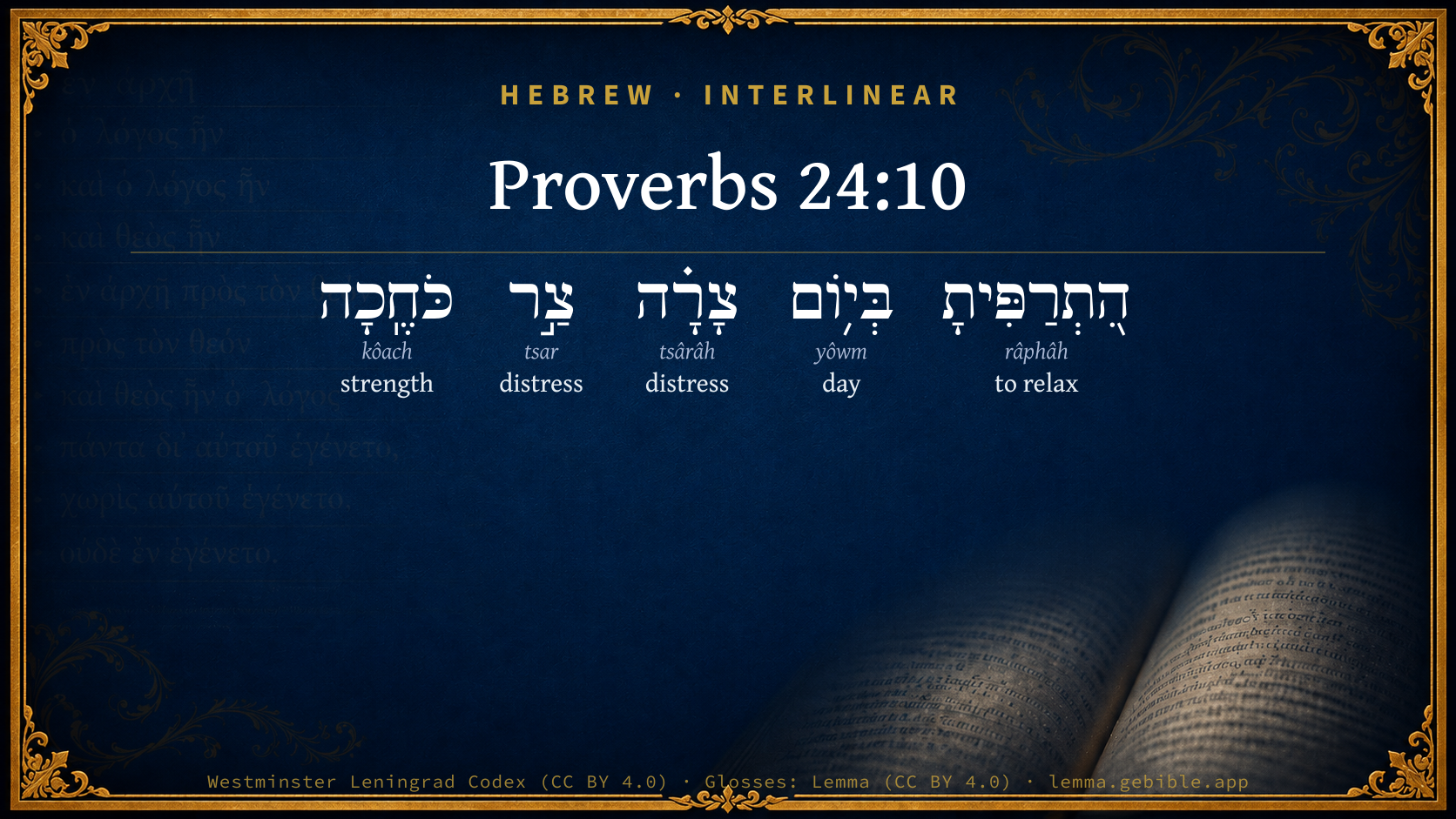
Hebrew (Westminster Leningrad Codex) Proverbs 24:10 appears in the Hebrew Old Testament. The text above is from the Westminster Leningrad Codex. Each word links to its Strong’s number, a concise gloss, and parsing drawn from the Open Scriptures Hebrew Bible morphology. Click any word for its full Brown-Driver-Briggs (BDB) entry.
Download image
Cite this verse

Proverbs 24:10 (World English Bible). Public Domain. Lemma interlinear Bible study tool, https://lemma.gebible.app/v/proverbs/24/10.

Show BibTeX & RIS
BibTeX
RIS
English Translation
If you falter in the time of trouble, Your strength is small.
World English Bible · Public Domain
Download a study sheet

One document with this verse’s original text, its word-by-word gloss line, the meaning frame, cross-references with their text, attributed commentary, and full source and license credits — printable, and it pastes into notes with its structure intact.

This verse Autodidact and up

Study sheet (.html) Plain text (.txt)

A passage Seminary Student

Up to 50 verses in one chapter. A passage sheet keeps up to 6 commentary sources and 12 cross-references per verse, in the order this page ranks them, and says so on the sheet whenever that leaves anything out. Ask for a single verse and you get the Autodidact verse sheet above.

Everything on this page stays free to read, with no account — the sheet is a download of what is already on screen, not access to it.

Want to remove ads? Support Godless Engineer
Compare translations 3

The same verse in 3 English versions, stacked beneath the original-language interlinear above. Click any original word for its lexicon entry.

Each is an independent rendering of the whole verse — the interlinear is not word-aligned to these translations.

Highlighted words mark where these versions differ — a whole-verse word diff, not a word-by-word alignment.

  • World English Bible Public Domain
    If you falter in the time of trouble, Your strength is small.
  • King James Version Public Domain
    If thou faint in the day of adversity, thy strength is small.
  • unfoldingWord Literal Text CC BY-SA 4.0
    you make yourself slack in the day of distress, your strength narrow.

unfoldingWord Literal Text — © unfoldingWord, licensed CC BY-SA 4.0. Word-aligned USFM3 via Door43 (git.door43.org/unfoldingWord/en_ult).

Versions to compare (up to 4)

3 of 4 selected

Show all 18 translations

Every available English version of this verse, each an independent rendering of the whole verse.

  • World English Bible Public Domain
    If you falter in the time of trouble, Your strength is small.
  • Berean Standard Bible Public Domain
    If you faint in the day of distress, how small is your strength!
  • Majority Standard Bible Public Domain
    If you faint in the day of distress, how small is your strength!
  • King James Version Public Domain
    If thou faint in the day of adversity, thy strength is small.
  • American Standard Version (1901) Public Domain
    If thou faint in the day of adversity, Thy strength is small.
  • Revised Version (1885) Public Domain
    If thou faint in the day of adversity, thy strength is small.
  • Geneva Bible (1599) Public Domain
    If thou bee faint in the day of aduersitie, thy strength is small.
  • Douay-Rheims (1899) Public Domain
    If thou lose hope being weary in the day of distress, thy strength shall be diminished.
  • Young's Literal Translation Public Domain
    Thou hast shewed thyself weak in a day of adversity, Straitened is thy power,
  • Literal Standard Version CC BY-SA 4.0
    You have showed yourself weak in a day of adversity, || Your power is restricted,
  • Unlocked Literal Bible CC BY-SA 4.0
    If you become weak with fear in the day of trouble, then your strength is small.
  • unfoldingWord Literal Text CC BY-SA 4.0
    you make yourself slack in the day of distress, your strength narrow.
  • Darby Bible Public Domain
    [If] thou losest courage in the day of trouble, thy strength is small.
  • World Messianic Bible Public Domain
    If you falter in the time of trouble, your strength is small.
  • Webster's Bible Public Domain
    If thou faintest in the day of adversity, thy strength is small.
  • Free Bible Version CC BY-SA 4.0
    If you give up in times of trouble, it shows how weak you are.
  • Bible in Basic English Public Domain
    If you give way in the day of trouble, your strength is small.
  • JPS Tanakh (1917) Public Domain
    If thou faint in the day of adversity, thy strength is small indeed.

Literal Standard Version (2020), Covenant Press — licensed CC BY-SA 4.0. Text via the HelloAO Bible API (eBible.org). Unlocked Literal Bible (unfoldingWord) — licensed CC BY-SA 4.0. Text via the HelloAO Bible API (eBible.org). unfoldingWord Literal Text — © unfoldingWord, licensed CC BY-SA 4.0. Word-aligned USFM3 via Door43 (git.door43.org/unfoldingWord/en_ult). Free Bible Version, Dr. Jonathan Gallagher — licensed CC BY-SA 4.0. Text via the HelloAO Bible API (eBible.org).

Word by word

More ways to search: Search by grammar → Find every occurrence → Compare this word →

Practice this passage: Drill this verse → Learn its vocabulary →

הִ֭תְרַפִּיתָ
râphâh
H7503
“to relax”
Verb, Hithpael, Perfect, 2nd Person, Masculine, Singular
Part of Speech
Verb
Stem
Hithpael
Form
Perfect
Person
2nd Person
Gender
Masculine
Number
Singular
Full BDB Definition

Origin: a primitive root

TWOT: 2198

to sink, relax, sink down, let drop, be disheartened - (Qal) - to sink down - to sink, drop - to sink, relax, abate - to relax, withdraw - (Niphal) idle (participle) - (Piel) to let drop - (Hiphil) - to let drop, abandon, relax, refrain, forsake - to let go - to refrain, let alone - to be quiet - (Hithpael) to show oneself slack
  1. בְּי֥וֹם yôwm H3117 “in/at · day of” Preposition + Noun, Common, Masculine, Singular, Construct
  2. צָרָ֗ה tsârâh H6869 “distress” Noun, Common, Feminine, Singular, Absolute
  3. צַ֣ר tsar H6862 “distress” Adjective, Adjective, Masculine, Singular, Absolute
  4. כֹּחֶֽכָה kôach H3581 “strength · your” Noun, Common, Masculine, Singular, Construct + Suffix, Personal, 2nd Person, Masculine, Singular

About this verse

These counts appear in no published source. They are computed here, from the morphology-tagged text and Lemma’s own curated glosses. What Lemma adds →

5
words
5
distinct lemmas
Wisdom
section

Shared distinctive vocabulary

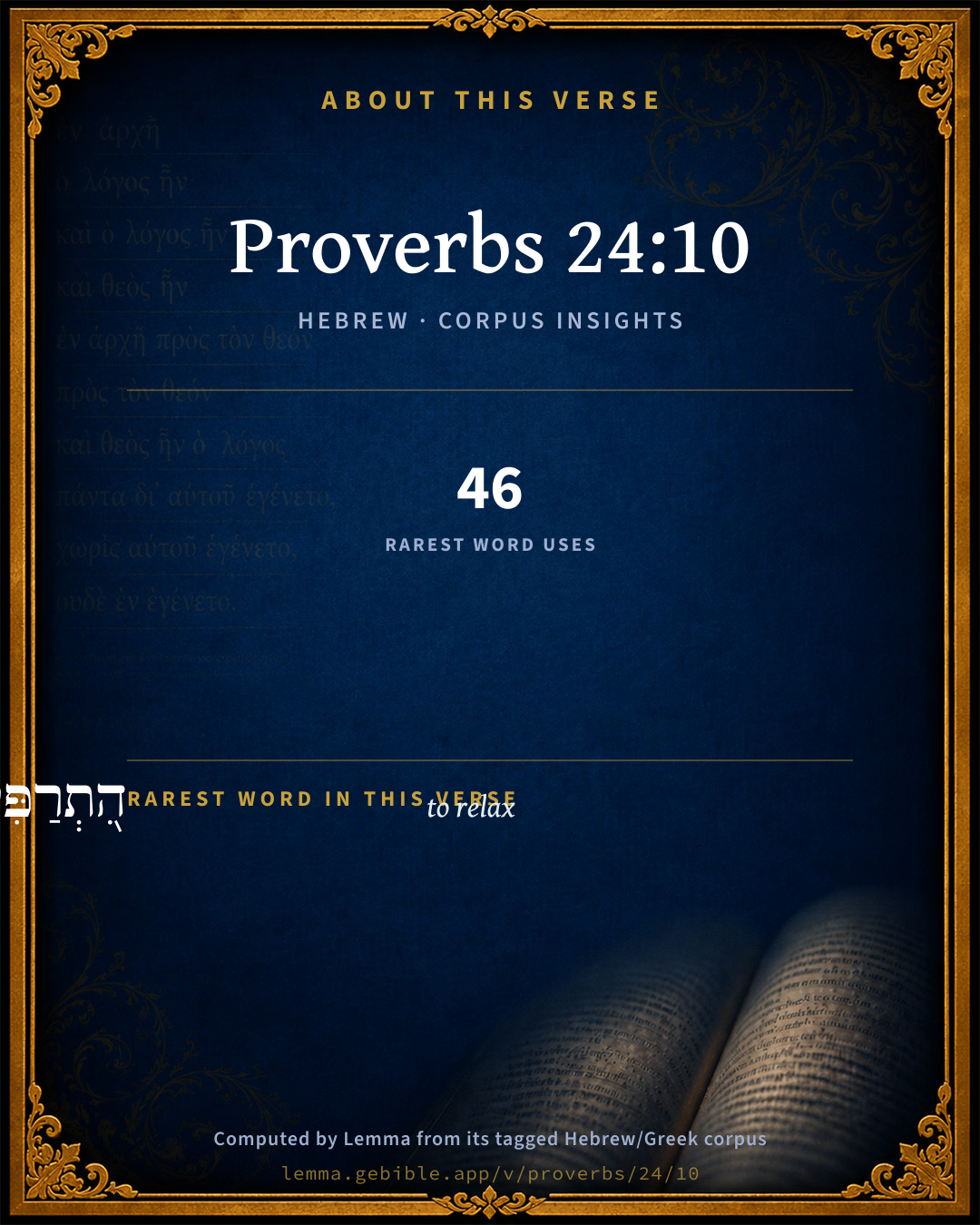
הִ֭תְרַפִּיתָ to relax H7503 occurs in 45 verses of the Hebrew Bible. Also found in:

Grammatical profile

  • 1 verb
  • 3 nouns
  • 1 adjective

Verb forms

  • הִ֭תְרַפִּיתָ Hithpael · Perfect

Hebrew & Septuagint length

In English translation the verse runs 12 words from the Hebrew and 19 from the Septuagint (LXX English) — the Septuagint runs noticeably longer here. See the side-by-side →

A rough comparison of the two English renderings, which tokenize alike — not a word-level alignment.

Word counts can differ between the Hebrew and the Greek without any difference in meaning — e.g. the Hebrew direct-object marker אֵת has no separate Greek word, and Greek often adds the article ὁ.

Cross-references

9

Topical passages linked to Proverbs 24:10 in the Treasury of Scripture Knowledge — connected by theme and wording, ordered by reader-vote popularity; previews shown in the World English Bible.

  • Isaiah 40:28–31 Have you not known? have you not heard? The everlasting God, Yahweh, the Creator of the ends of the earth, doesn't faint, neither is weary; there is no searching of his understanding.
  • Ephesians 3:13 Therefore I ask that you may not lose heart at my troubles for you, which are your glory.
  • Jeremiah 51:46 Don't let your heart faint, neither fear for the news that shall be heard in the land; for news shall come one year, and after that in another year [shall come] news, and violence in the land, ruler against ruler.
  • 1 Samuel 27:1 David said in his heart, I shall now perish one day by the hand of Saul: there is nothing better for me than that I should escape into the land of the Philistines; and Saul will despair of me, to seek me any more in all the borders of Israel: so shall I escape out of his hand.
  • Job 4:5 But now it is come to you, and you faint; It touches you, and you are troubled.
  • Hebrews 12:3–5 For consider him who has endured such contradiction of sinners against himself, that you don't grow weary, fainting in your souls.
  • 2 Corinthians 4:1 Therefore seeing we have this ministry, even as we obtained mercy, we don't faint.
  • Revelation 2:3 You have perseverance and have endured for my name's sake, and have not grown weary.
  • Revelation 2:13 "I know your works and where you dwell, where Satan's throne is. You hold firmly to my name, and didn't deny my faith in the days of Antipas my witness, my faithful one, who was killed among you, where Satan dwells.

Cross-references courtesy of OpenBible.info (CC BY 4.0).

Hebrew and Greek witnesses Masoretic Hebrew ↔ Greek Septuagint

The same verse in the two great witnesses to the Old Testament, shown verse-for-verse.

Here the Septuagint runs noticeably longer than the Hebrew — LXX2012 (modern English Septuagint) 19 words vs World English Bible 12. A rough length comparison of the two English translations, not a word-level alignment — read both below.

These are two independent witnesses, not word-aligned to each other, and the Septuagint is shown in lemma (dictionary) form.

Hebrew Proverbs 24:10 Masoretic · Westminster Leningrad Codex

הִ֭תְרַפִּיתָ בְּי֥וֹם צָרָ֗ה צַ֣ר כֹּחֶֽכָה

If you falter in the time of trouble, Your strength is small.

World English Bible · Public Domain

Greek LXX Proverbs 24:10 Septuagint · lemma form

ἐν ἡμέρα κακός καί ἐν ἡμέρα θλῖψις ἕως ἄν ἐκλείπω

He shall be defiled in the evil day, and in the day of affliction, until he be utterly consumed.

LXX2012 (modern English Septuagint) · Public Domain

On this verse, The Pulpit Commentary discusses the Septuagint’s reading. Read the note in Commentary ↓

Hebrew: Westminster Leningrad Codex (CC BY 4.0). Greek: Septuagint (public domain); English from LXX2012 (modern English Septuagint) (Public Domain). How the Septuagint differs from the Hebrew →

Commentary

Notes on Proverbs 24:10 from classic Christian and Jewish commentators (each source and its license shown beneath its notes). The classic Christian expositions comment on the surrounding passage and are grouped to its opening verse, so a note may address several verses; the Jewish commentaries on the Tanakh (Rashi and others) are per-verse, so they appear only where the commentator wrote on this verse.

Lemma curates 59 commentaries, every one of them public domain or Creative Commons licensed, each selected and text-cleaned for this edition rather than reprinted as found. About our sources →

Trapp's Complete Commentary

John Trapp

Pro 24:10 [If] thou faint in the day of adversity, thy strength [is] small.

Ver. 10. If thou faint in the day of adversity.] Afflictions try what sap we have, as hard weather tries what health. Withered leaves fall off in a wind: rotten boughs break when weight is laid on them; so do earthen vessels when set empty to the fire. "As is the man, so is his strength," said they to Gideon. Joseph’s "bow abode in strength, though the archers sorely grieved him, and shot at him, and hated him; and the arms of his hand were made strong by the hands of the mighty God of Jacob." {Gen 49:23-24}

John Trapp, A Commentary or Exposition upon All the Books of the Old and New Testament (1647–1656) — public domain. Text from a community e-Sword module.

The Biblical Illustrator

Joseph S. Exell

Pro_24:10

If thou faint in the day of adversity, thy strength is small

The Christian failing in business

There are such failures.

Christianity does not secure its disciples against misfortune and calamity. It has need of trouble. While it could not help it always without a constant miracle, it does not always help it when it can. There is a tendency in religion to promote worldly prosperity. Most of the conditions of secular success are improved by the principles and habits of spirituality. It quickens the intellect, gives calmness and self-possession to the feelings, fosters industry and diligence, creates character and credit. Many a man may be found who has been made, in this sense, by godliness. Some Christians never get on. They try many schemes, with one sorrowful result.

I. Christianity should preserve from despondency in failure. There is a tendency in trouble to dispirit. It may be checked by the force of natural energy of heart. The greater number of men are apt to sink under disappointment. Many cannot row against the tide. The evil of this depression is great. In relation to the worldly business. The man is as one possessed with a spirit of defeat. There is no ingenuity to plan; no vigorous employment of offered opportunities. This despondency affects other things. Begun in business, it extends to all departments of feeling and activity. Christianity tends to check this, because it limits the sphere of failure. It also changes its character. It teaches us that if we fail it may be the means of our greater success. The prostration, the sorrow, the want, may be the discipline of life everlasting. Sometimes the failure may be traced to the Christians own fault. Then these considerations are inapplicable. But then the evil may be overruled for good.

II. Christianity should preserve from irritation in failure. If the timid are most in danger of despondency, the proud are most in danger of exasperation. And who is so free from pride as not to be in danger of this? Failure may easily excite the evil passions of the soul, sour the temper, and arouse to anger and to wrath. If a man were only irritated against himself, there might not be much amiss. But the danger is nearly all the other way. The failing man is often found cherishing a wrong temper towards his fellows. To check this evil Christianity begets humility, and produces a spirit of benevolence.

III. Christianity should preserve from dishonesty in failure. Want is a temptation to dishonesty. It is not an excuse for it. Many who never had a thought that was not honourable have fallen into sin when they fell into trouble. And even when the trouble has been much less than entire failure. There is temptation to do wrong in order to evade, or conceal, or repair misfortune. Making us to love truth and equity, Christianity connects our self-respect with these principles. And, as Christians, we should be supremely concerned for the moral honour of Christianity. (A. J. Morris.)

Small strength

I. The occasion referred to. The day of adversity.

1. Reverse of fortune--poverty and want.

2. Bereavement.

3. Sickness.

4. Persecution.

5. Temptation.

II. The action reproved. If thou faint. Not the suffering of pain or the feeling of sorrow, but the excess of an allowable feeling.

1. When we yield to impatience, entertain hard thoughts of God, and distrust His goodness.

2. When we are so absorbed by adversity as to forget past prosperity.

3. When we yield to sorrow so far as to preclude necessary exertion.

4. When it causes us to yield to unholy methods in order to extricate ourselves from the difficulty. The Jews appealed to Egypt.

III. The fault explained. Thy strength is small.

1. Bodily.

2. Morally.

3. Spiritually.

(1) Smallness of faith.

(2) Weakness of hope.

(3) Deficiency of love.

(4) Lack of courage.

(5) Want of humility.

IV. The remedy.

1. Call into exercise the strength you have. To him that hath, etc.

2. Cherish higher thoughts of God.

3. Wait at the throne of grace. (J. Bunting.)

Susceptible character

The wych-elm manifests the approach of winter earlier than any other tree. It becomes ruined and denuded by a touch of the frosty air, and contributes no splendour, no beauty to our autumnal scenery, as its leaves curl up, become brown, and flutter from their sprays, as early, when growing in exposed situations, as the middle of September. This character of itself marks a difference from the common elm, which preserves its verdure, except from accidental causes, long after this period, and with a fine mellow yellow hue, contributing a full share with other trees to the character and splendour of autumn. The wych-elm is an emblem of the susceptible, tender human character. The soul of such a man is highly sensitive to all external impressions. The first frosty touch of a great sorrow shakes his life to its centre. Men of a more robust type are chastened by sad events; and, mellowed by chequered experiences, live on to the tranquil maturity of their existence. But he, unfortunately, cannot face the rough blasts of adversity, and perishes at once under their cruel, chilling influence. Even the cold breath of slander sometimes bears for him a sentence of death. (Scientific Illustrations.)

Flourishing upon the unpromising

Humming-birds, colibris, and their brothers of every hue, live with impunity in the fearful forests where tropical nature, under forms oftentimes of great beauty, wages her keenest strife in those gleaming solitudes where danger lurks on every side--among the most venomous insects, and upon those most mournful plants whose every shade kills. One of them (crested, green, and blue), in the Antilles, suspends his nest to the most terrible and fatal of trees, to the spectre whose fatal glance seems to freeze your blood for ever, to the deadly manchineal. It is this parroquet, which boldly crops the fruits of the fearful tree, feeds upon them, assumes their livery, and appears, from its sinister green, to draw the metallic lustre of its triumphant wings. Nature endows the birds, as she also endows men, with a marvellous capacity for accommodation to circumstances. Beautiful birds are not made out of what we should consider wholesome food, and beautiful characters are not made out of the choice events of history. Nature supplies us with an appropriative power whereby we transmute everything to the purposes which she intends to serve. We know to what splendid purposes genius has been able to turn poverty, jails, cruelty, persecution. Some of the finest characters in history have been formed by and flourished upon these unpromising elements. The bird does not take the poison and submit to death; it transmutes it into life and beauty. The hero does not let circumstances subdue him; he makes circumstances subserve the growth of his character. (Scientific Illustrations.)

The culture that gives strength

If you were to hear some mens experience, you would think that they grow as the white pine grows, with straight grain, and easily split; for I notice that all that grow easy, split easy. But there are some that grow as the mahogany grows, with veneering knots, and all quirls and contortions of grain. That is the best timber of the forest which has the most knots. Everybody seeks it, because, being hard to grow, it is hard to wear out. And when knots have been sawn and polished, how beautiful they are. There are many who are content to grow straight, like weeds on a dunghill; but there are many others who want to be stalwart and strong like the monarchs of the forest, and yet, when God sends winds of adversity to sing a lullaby in their branches, they do not like to grow in that way. They dread the culture that is really giving toughness to their soul and strength to its fibre. (H. W. Beecher.)

The Biblical Illustrator, edited by Joseph S. Exell (c. 1880s–1900s) — public domain. Text from a community e-Sword module.

Joseph Benson's Commentary

Pro 24:10. If thou faint in the day of adversity — If thou art impatient and unable to bear sufferings; if thy resolution flag, and thou give way to despondency or dejection of mind; thy strength is small — Hebrew, is narrow, it lies in a little compass; it is strait, as thy condition is; for there is an elegant allusion in the word rendered small, or narrow, in this clause, to that rendered adversity in the former. The sense is, This is a sign that thou hast but little Christian strength or courage, for that is best known by adversity.

Joseph Benson's Commentary on the Old and New Testaments (1811–1818) — public domain. Text from a community e-Sword module.

The Preacher's Complete Homiletical Commentary

Joseph S. Exell (gen. ed.)

CRITICAL NOTES.—

Pro_24:10. If thou faint, etc., rather “If thou hast been straitened in the day of straitness, strait is thy strength.” “The principle,” says Dr. Aitken, “is familiar enough, that courage and hopefulness is half a man’s strength.”

MAIN HOMILETICS OF Pro_24:10

THE DAY OF ADVERSITY

I. The inevitable in human experience. The day of adversity is an ordination of God, as a necessary element in man’s moral training. The human rulers of a well-ordered State make certain provisions for the education of the young, and these provisions necessarily include many things that are distasteful, and even painful, to the pupils. But if they were left to map out their own course, and to arrange for themselves the plan of their education, we well know that the result in the end would be unsatisfactory to everybody, and most of all to themselves when they were old enough to judge. Even so is it with mankind and the Ruler of the world. God has purposed that men shall be subject to such a course of instruction and discipline as shall at least give them an opportunity of becoming wiser and better, and the day of adversity is an indispensable element in such a training. It therefore does not come to us by chance, nor is it always to be regarded in the light of a penalty for special sin, but is a token of Divine interest in our real welfare—an expression of Divine desire for our moral growth. It is wise, then, for all to recognise the fact that adversity in some form or other, at some period or other, is an inevitable event in their human life.

II. The test of human character. No man knows his moral strength until he comes face to face with trial. The chain that holds the vessel to the quay is only as strong as the weakest link, and if that one gives way the vessel is loosed from her moorings as surely as if every link was broken. So human character is only as strong as its weakest point, and if a severe strain is brought to bear upon a man, he will break down there. In the day of adversity every virtue and excellence that we possess will be subjected to a severe test, and if only one of them is found unequal to the trial, the whole character suffers, and we are in danger of losing our hold upon God, and so drifting from the right course. A man may have a high opinion of his own physical strength, and fancy that he is well able to grapple with any foe who might attack him. But it is not till he is in the grip of his antagonist that he knows how much or how little he is able to do and to bear. If he finds himself on the ground, stunned and bleeding, he rises from the struggle with a lower estimate of his own muscular strength than he had before. And so it is with the inner man when the day of adversity overtakes it—we think that our faith and moral courage are equal to any emergency, but we are sometimes stricken down to the dust and “faint” from the weight of a blow which we thought beforehand we could withstand, and for the rest of our lives have less confidence in our spiritual strength.

III. A strengthener of human character. Although men often “faint” in the day of adversity, or find their resources insufficient to meet their needs in the hour of trial, it is not necessarily the case, nor is it always so. Indeed, the intention of trial is not to take away our strength, but to increase it. If the day of adversity proves too much for our strength, the encounter may leave us morally weaker than we were before; but if we bear it courageously, and do not allow it to drive us to despair, or even to doubt, we come out of the ordeal stronger than when we entered into it. If a tree has too firm a hold upon the soil to be uprooted by the tempest, the shaking will but make it firmer still, and if our confidence and hope in God are not lessened by the blasts of adversity, they are rendered stronger and brighter, and more fitted to encounter the next storm. But fainting at the first blow of adversity leaves very little strength to meet the next trial, and this thought seems also to be in the proverb as it stands in the Hebrew.

OUTLINES AND SUGGESTIVE COMMENTS

If you were to hear some men’s experience you would think they grew as the white pine grows, with straight grain and easily split, for I notice that all that grow easy split easy. But there are some that grow as the mahogany grows, with veneering knots, and all quirls and contortions of grain; that is the best timber of the forest which has most knots.… There are many who are content to grow straight, like weeds on a dunghill; but there are many others who want to be stalwart and strong like the monarchs of the forest, and yet when God sends the winds of adversity to sing a lullaby in their branches, they do not like to grow in that way. They dread the culture that is really giving toughness to their soul and strength to its fibre. Beecher.

The time of man’s distress, though it be a night of sorrow and trouble, which it bringeth to the soul, yet is it a day also, because it showeth truly to the soul what a man is.—Jermin.

The Preacher's Complete Homiletical Commentary (gen. ed. Joseph S. Exell; Funk & Wagnalls, c. 1892) — public domain (pre-1929). A full-Bible homiletical/sermon-outline anthology covering 65 of 66 books (2 John is absent from the source module). Text from a community e-Sword module.

Tyndale Open Study Notes

Tyndale Open Resources

24:10 Saying 24: A wise person has self-control and strength under pressure (e.g., Dan 1:8-16; 3:1-18).

Tyndale Open Study Notes — © Tyndale Open Resources, licensed CC BY-SA 4.0. Text via the HelloAO Bible API.

Geneva Bible (1599)

Geneva Bible translators

Man hath no trial of his strength till he be in troubles.

Geneva Bible (1599) marginal notes — public domain. Text via Bolls.life.

Matthew Henry's Commentary

Note, 1. In the day of adversity we are apt to faint, to droop and be discouraged, to desist from our work, and to despair of relief. Our spirits sink, and then our hands hang down and our knees grow feeble, and we become unfit for anything. And often those that are most cheerful when they are well droop most, and are most dejected, when any thing ails them. 2. This is an evidence that our strength is small, and is a means of weakening it more. "It is a sign that thou art not a man of any resolution, any firmness of thought, any consideration, any faith (for that is the strength of a soul), if thou canst not bear up under an afflictive change of thy condition." Some are so feeble that they can bear nothing; if a trouble does but touch them (Job 4:5), nay, if it does but threaten them, they faint immediately and are ready to give up all for gone; and by this means they render themselves unfit to grapple with their trouble and unable to help themselves. Be of good courage therefore, and God shall strengthen thy heart.

Matthew Henry's Commentary on the Whole Bible (1708–1710) — public domain (CC PDM 1.0). Text via the HelloAO Bible API.

Jamieson, Fausset & Brown

Robert Jamieson, A. R. Fausset & David Brown

Literally, "If thou fail in the day of straits (adversity), strait (or, small) is thy strength," which is then truly tested.

Jamieson, Fausset & Brown — Commentary Critical and Explanatory on the Whole Bible (1871) — public domain (CC PDM 1.0). Text via the HelloAO Bible API.

Adam Clarke's Commentary

Verse 10. If thou faint] If thou give way to discouragement and despair in the day of adversity - time of trial or temptation.

Thy strength is small.] צר כחכה tsar cochachah, thy strength is contracted. So the old MS. Bible excellently: Gif sliden thou dispeire, in the dai of anguyfs, schal be made litil thy strengthe. In times of trial we should endeavour to be doubly courageous; when a man loses his courage, his strength avails him nothing.

Adam Clarke's Commentary on the Bible (1810–1826) — public domain. Text from a community e-Sword/MySword module.

Ellicott's Commentary for English Readers

(10) If thou faint in the day of adversity.—And prove unable to help thyself or others; an exhortation to courage (comp. Heb_12:12). A “more excellent way” is shown in the following verse.

A Bible Commentary for English Readers, edited by Charles John Ellicott (1878–1897) — public domain. Text from a community e-Sword module.

The Cambridge Bible for Schools and Colleges

gen. ed. J. J. S. Perowne

10. faint] Or, art slack. The Heb. word is the same as in Pro_18:9.

is small] as is proved to be the case by thy “fainting” under pressure. But the proverb may mean, because of thy fainting thy strength will be small; want of courage will cause want of strength to meet the emergency. So Vulg., imminuetur fortitudo tua; and Maurer, impar eris ferendis malis. Comp. “Let us not be weary (ἐγκακῶμεν, turn cowards, lose heart, Bp Lightfoot) in well-doing, for in due season we shall reap if we faint not,” Gal_6:9; where see note in this Series.

The Cambridge Bible for Schools and Colleges (gen. ed. J. J. S. Perowne; Cambridge University Press, 1878–1918) — public domain. Text from a community e-Sword module.

John Gill's Exposition

If thou forbear to deliver them that are drawn unto death,.... Or "taken for or unto death" (h), in a violent way; who are taken by thieves and robbers, and used in a barbarous manner, as the man in the parable, whom the priest and Levite took no notice of, and was helped by the good Samaritan; or who are unjustly sentenced and appointed to death by the civil magistrate; if any know their innocency, it becomes them to do all they can to save their lives, by bearing a testimony for them; for "a true witness delivereth souls", Pro 14:25; or by interceding for them, and giving counsel and advice concerning them, or by any lawful way they can; as Reuben delivered Joseph, Jonathan interceded for David, and Ahikam and Ebedmelech for Jeremiah. Life is valuable, and all means should be taken to save it, and to prevent the shedding of innocent blood; and a man should not forbear or spare any cost, or pains, or time, to such service: likewise such as are drawn into snares and temptations, into immorality or heresy, which tend to the ruin of the souls of men, and bring them to eternal death; all proper, methods should be taken to restore such persons, to recover them out of the snare of the devil, which is saving souls from death, and covering a multitude of sins; see Ti2 2:25, Jam 5:19;

and those that are ready to be slain; or (i) "bending to slaughter"; are within a little of being executed, or put to death, upon a false accusation; for about others that suffer righteously there need not be that concern here pressed, or whose works and ways incline to destruction and lead to it, of which they seem not very far off.

(h) "captos ad mortem", Montanus. Piscator, Schultens. (i) "inclinantes ad necem", Mercerus; "nutantes ad occasionem", Montanus, Coeccius; "nutantes ad lanienam", Schultens.

John Gill's Exposition of the Whole Bible (1746–1763) — public domain (CC PDM 1.0). Text via the HelloAO Bible API.

Haydock's Catholic Bible Commentary

Diminished. This is the sad consequences of too much dejection, Ephesians iv. 19. Despairing, they abandon themselves to impurities. (Haydock)

George Leo Haydock (1774–1849), Haydock's Catholic Family Bible and Commentary, 1859 edition — public domain. Excludes Psalms (Douay-Rheims chapter numbering differs from Protestant) and Deuterocanonical books (Catholic canon only).

Matthew Poole's English Annotations

If thou faint; if thou art impatient, and unable to bear sufferings; if thy resolution flag, and thou givest way to despondency or dejection of mind. Is small, Heb. is narrow; it lives in a little compass; it is as strait as thy condition is; for there is an elegant allusion in the Hebrew words. The sense is, This is a sign that thou hast but little Christian strength or courage, for that is best known by adversity.

Matthew Poole's English Annotations on the Holy Bible (1683–1685) — public domain. Text from a community e-Sword/MySword module.

Whedon's Commentary on the Bible

Daniel D. Whedon

10. If thou faint — Adversity tests the moral strength of men. To faint under trial is a sign of moral weakness. The interpreters differ as to the exact sense.

Daniel D. Whedon (gen. ed.), Commentary on the Old and New Testaments (1874–1909) — public domain. Text from a community e-Sword module.

The Pulpit Commentary

If thou faint in the day of adversity, thy strength is small. The gnome seems to be unconnected with the preceding. There is a paronomasia between hrx (tsarah), "adversity," and rx" (tsar), "small," narrow, which is retained by Fleischer: "Si segnis fueris die angustiae, angustae sunt vires tuae." So we may say in English, "If thou faint in time of straitness, straitened is thy strength." If you fail, and succumb to anxiety or danger, instead of rising to meet the emergency, then you are but a weakling or a coward, and the strength which you seemed to possess and of which you boasted, perhaps, is nothing worth. Such a man hearkens not to the Sibyl"s counsel (Virgil, "AEneid," 6:95)"Tu ne cede malis, sed contra audentior ito, Quam tua te fortuna sinet. The LXX again varies from the received text, "He shall be polluted in an evil day, and in a day of affliction, until he fail," or "die" (ekliph ).

Fainting in the day of adversity.

I STRENGTH IS TESTED BY THE DAY OF ADVERSITY.

1. The day of adversity will come. All have not an equally painful lot. It is only the pessimist who refuses to admit that God sends a happy life to some; and if the lines have fallen in pleasant places, nothing but ingratitude or sentimentality will deny the fact. Nevertheless, the dark day of adversity will rise on every soul of man. It cannot be eluded, though in youth and health the spirit refuses to anticipate it. It is well to be prepared to meet it.

2. Strength is wanted for the day of adversity. This will be a time of assault, strain, pressure. The soul will then be besieged, buffeted, and in danger of being crushed. Therefore there is need of sufficient strength, not only for prosperous times, but for this harder occasion. The lighthouse must not only be strong enough to stand in calm weather; it should be able to resist the battering rams of the tempest. The ship must be built for the storm. The army that can look smart in a review is useless if it goes to pieces on the field of battle. The model navy is an extravagant ornament if it will not serve us in action. The lamp is useless if it goes out in the hour of darkness. Religion is for the time of trial and temptation. The spiritual life needs to be strong enough to hold on through terror, temptation, and trouble; or it is a delusion.

3. Faulty strength will fail in the day of adversity. Trouble is trial. The season of affliction will assuredly be severe enough to prove our strength. It is vain for any one to live on empty beasts and idle pretences. The hollowness of such folly will be exposed at the fatal moment. The soft-metal sword will certainly double up in the battle and bring disaster on its unhappy owner.

II FAITH AND COURAGE WILL GIVE STRENGTH IN THE DAY OF ADVERSITY.

1. To faint in the day of adversity is to make ones strength small. Such a collapse will undermine one"s energy. The coward is always weak. To fear is to fail. But courage inspires strength, and he who is able to keep up a brave heart in the day of adversity is most likely to conquer. Few men have been called upon to endure such hardships and to face such perils as Livingstone, alone in the heart of Africa. Now, Livingstone was characterized by a wonderful buoyancy of temperament, by high spirits and unfailing cheerfulness. Nelson is said not to have known fear. Gordon was as ready to face death as to go to his daily duty. No doubt such heroic courage is largely due to the natural greatness of the men who possessed it But it is not independent of moral qualities. For:

2. The secret of the highest courage is faith. He who trusts God is armed with the might of God. This is higher than natural strength, because "even the youths shall faint and be weary, and the young men shall utterly fall: but they that wait upon the Lord shall renew their strength; they shall mount up with wings as eagles; they shall run, and not be weary; and they shall walk, and not faint". (Isa_40:30, Isa_40:31) Thus there is a strength that is perfected in weakness. (2Co_12:9)

3. Therefore we have no excuse to faint in the day of adversity. With such stores of strength for the weakest, failure is culpable, Note: We are not to blame for meeting with adversity we cannot escape it; nor for suffering under it this is natural; but only for fainting, i.e. for collapse and despair. Yet even this may not mean utter failure. We may still have some strength, though it be sickly and fast ebbing away. Like Gideon"s heroes, we may be "faint, yet pursuing". (Jud_1:8:4)

Vers. 10, 15. The test of adversity.

We have all of us to expect

I THE TESTING TIME THAT COMES TO ALL MEN. It is true that prosperity has its own perils, and makes its own demands on the human spirit. But when the sky is clear above us, when loving friends stand round us with protecting care, when privileges abound on every side, it is comparatively easy to maintain an equable and obedient mind. We can all row with the stream and sail with the favouring wind. But the hour must come to us that comes to all in time, when we have to face difficulty, or to bear obloquy, or to sustain heavy loss, or to go on our way with a lonely heart, or to suffer some keen and all but crusading disappointment. When we are moved to say with Jacob, "All these things are against me;" with Elijah, "Lord, take away my life;" we faint and fall in the day of adversity.

II THE RESOURCES THAT SHOULD BE AT OUR COMMAND. When that hour comes to us, as it certainly will, we should be prepared to bear ourselves bravely and well; for there are many sources of strength with which we should be supplied. There is:

1. Ordinary human fortitude. Such manliness and strength of will as have enabled many thousands of souls even without any aid from religion to confront danger or death, or to show an undisturbed equanimity of mind. in the midst of severe sorrows. But beyond this there is for us:

2. Christian resignation. The willingness to leave the whole disposal of our lives to the wisdom and the love of God; readiness to endure the holy will of a Divine Father, of our best Friend.

3. Christian faith. The assurance that God is dealing with us in perfect wisdom and parental love at those times when we can least understand his way.

4. Christian hope. The confidence that "unto the upright there will arise light in the darkness;" that God will grant a happy issue out of all our afflictions; that though the just man fall seven times, he will rise again (see ver. 15); that though weeping may endure even for a long and stormy night, joy will come in the morning. (Psa_30:5)

5. Communion with God. To the distressed human spirit there remains that most precious refuge, the leaning of the heart on God, the appeal of the soul to him in earnest, believing prayer.

III THE INFERENCE WE ARE OBLIGED TO DRAW. If, with all these resources at our command, we "faint;

(1) if we indulge a rebellious spirit, repining at our lot and thinking ourselves hardly used; or

(2) if we yield ourselves to misery and melancholy, showing ourselves unequal to the duties that devolve upon us, resigning the useful activities in which we have been engaged; then we must conclude that "our strength is small;" we have failed to enrich our souls with that spiritual power of which we might and should have become possessed. Bat that we may not have to deplore our weakness in the day of adversity, and that we may not give a sorry illustration of Christian life as it ought not to be seen, let us learn what is

IV OUR WISDOM AT THE PRESENT TIME. And that is to be gaining strength, to be continually becoming "strong in the Lord, and in the power of his might." This is an imperative duty. (Eph_6:10 2Ti_2:1 2Pe_3:18) And we are not without the necessary means. If, in the days of sunshine and prosperity, we are daily nourishing our faith, our love, our hope, our prayerfulness, by constant exercise in devotion and in sacred duty, by using the privileges so amply supplied to us, by cultivating and cherishing our onion with Jesus Christ our Lord, we shall be strong, and we shall not faint. C.

The Pulpit Commentary (1880–1919), ed. H.D.M. Spence-Jones & Joseph S. Exell — public domain. Text from a community e-Sword module.

Keil & Delitzsch

C. F. Keil & F. Delitzsch

The last of these four distichs stands without visible connection:

Hast thou shown thyself slack in the day of adversity,

Then is thy strength small.

The perf. 10a is the hypothetic, vid., at Pro 22:29. If a man shows himself remiss (Pro 18:9), i.e., changeable, timorous, incapable of resisting in times of difficulty, then shall he draw therefrom the conclusion which is expressed in 10b. Rightly Luther, with intentional generalization, "he is not strong who is not firm in need." But the address makes the proverb an earnest admonition, which speaks to him who shows himself weak the judgment which he has to pronounce on himself. And the paronomasia צרה and צר may be rendered, where possible, "if thy strength becomes, as it were, pressed together and bowed down by the difficulty just when it ought to show itself (viz., להרחיב לך), then it is limited, thou art a weakling." Thus Fleischer accordingly, translating: si segnis fueris die angustiae, angustae sunt vires tuae. Hitzig, on the contrary, corrects after Job 7:11, רוּחך "Klemm (klamm) ist dein Mut" [= strait is thy courage]. And why? Of כסה [strength], he remarks, one can say כשׁל [it is weak] (Psa 31:11), but scarcely צר [strait, straitened]; for force is exact, and only the region of its energy may be wide or narrow. To this we answer, that certainly of strength in itself we cannot use the word כסה drow eht esu t in the sense here required; the confinement (limitation) may rather be, as with a stream, Isa 59:19, the increasing (heightening) of its intensity. But if the strength is in itself anything definite, then on the other hand its expression is something linear, and the force in view of its expression is that which is here called צר, i.e., not extending widely, not expanding, not inaccessible. צר is all to which narrow limits are applied. A little strength is limited, because it is little also in its expression.

Keil & Delitzsch — Biblical Commentary on the Old Testament (1861–1891) — public domain (CC PDM 1.0). Text via the HelloAO Bible API. (Old Testament only.)

Bridges on Proverbs

Charles Bridges

Let this be a word of strengthening encouragement. The marvel is, that those who know not where to look for refuge, when the storm is breaking over their heads, do not always faint. But natural courage and buoyancy, or a deeper plunge into the world, as a diversion from sorrow, raises them above their troubles for a while, estranging them yet further from God.

But why should the child of God, contrary to his Father’s injunction,†1 faint? Look at thy privilege — "The eternal God is thy refuge; and underneath are the everlasting arms;"†2 thy duty — "Call upon me in the time of trouble: I will deliver thee, and thou shalt glorify me;"†3 — thy security — "I will never leave thee, nor forsake thee. For a small moment have I forsaken thee; but with great mercies will I gather thee."†4

Yet we "speak not parables." Every Christian’s heart responds to the confession, that he is apt to faint. ’The strongest and holiest saint on earth is subject to some qualms of fear;’†5 not from the greatness of the danger, but from the weakness of his faith. (Mat 14:30 .) Even those who had "endured a great fight of afflictions, who had taken joyfully the spoiling of their goods," still needed stirring exhortations and encouragements to Christian steadfastness.†6 If they had borne the brunt of one battle, there are heavier conflicts before them.†7 Let each of us be awake to the besetting danger. Remember — when we seek strength from our own resources;†8 when faith gives way to distrust;†9 praise to murmuring,†10 hope to despondency;†11 when relinquished pleasures vividly come to mind,†12 and protracted toils press heavily†13 — then we faint in the day of adversity.

For this day we must prepare. "Man is born to trouble,"†14 as his portion inherited from his first father. He may be called to drink a deep draught of the bitter cup, requiring much strength, that "patience may have its perfect work." (Jas 1:4 .) The day is needful for the trial of our principles. What seemed more promising, than the confidence of the stony-ground hearers, or than the longer endurance of the apostle’s companions? But the day of adversity exposed their hollow profession.†15 Often also, even when "the root of the matter is found," a painful exhibition of faintness,†16 unable to weather out a bad day, proves the smallness, not the vigour, of strength.

But why — again we ask — should the child of God faint? If "affliction came from the dust, and sprung out of the ground" (Job 5:6 ), he might be discouraged by his ill-fortune. But where every minute circumstance has been the fruit of eternal counsel, where "the hairs of his head are all numbered" (Mat 10:30 ), well may he "stay himself upon his God." If his soul, like Israel of old, "be much discouraged because of the way" (Num 21:4-5 ), it leadeth to his Father’s house. If he be wearied with his burden, soon will he rest eternally in his Savior’s bosom. Never will he be called to a martyr’s trial, without a martyr’s faith.†17 The chastening rod is the seal of everlasting love.†18 The temporal cross comes from the same hand as his everlasting crown. ’Never believe’ — Christian — ’that thy tender-hearted Savior, who knows the weakness of thy constitution, will mix the cup of affliction with one drachm weight of poison.’†19 If thy strength be small, go to the strong for strength. "He giveth power to the faint, and to them that have no might he increaseth strength." (Isa 40:29 .) Commit thyself daily to him, for his supply of "grace is sufficient for thee." So go onward, weak and strong at once; weak in order to be strong; strong in thy weakness, "his strength being made perfect in it;" and thou at length "glorying even in thy" depressing "infirmity, that the power of Christ may rest upon thee" (2Co 12:9 ); not only sustained, but "strengthened unto joyfulness." (Col 1:11 .)

Oh! — hasten the time, when the dark and cloudy day shall be changed for unclouded sunshine; the crown of thorns for the crown of glory; "the spirit of heaviness" for the garment of "everlasting praise." (Isa 61:3 .)

Footnotes:

†1 Pro 3:11.

†2 Deu 33:27.

†3 Psa 50:15; Psa 91:15 .

†4 Heb 13:5. Isa 54:7 .

†5 Bishop Hall’s Contemplations, B. xviii. Cont. 8.

†6 Heb 10:32-36; Heb 11:1-40 .; Heb 12:1-3 .

†7 Heb 12:4.

†8 Isa 40:30.

†9 Psa 78:19-20.

†10 Exo 15:1, Exo 15:24 ; Exo 17:3 .

†11 Num 14:3.

†12 Exo 16:3. Num 11:4-6 .

†13 Job 7:1-4.

†14 Job 5:7.

†15 Mat 13:20-21. 2Ti 4:16 ; 2Ti 1:15 .

†16 Abraham, Gen 12:10-13 ; Gen 20:2 . Moses, Exo 4:10-13 ; Num 11:11 ; Joshua, Jos 7:6-10 ; David, 1Sa 27:1 ; Psa 31:1, Psa 31:22 ; Psa 116:11 ; Elijah, 1Ki 19:3-4 . Jeremiah, Jer 20:7-18 ; Jonah, Jon 4:8-9 ; Peter, Mat 26:35, Mat 26:69-74 ; the disciples, ib. verse Mat 26:35, Mat 26:56 .

†17 ’Be of good heart,’ said Ridley to his brother Latimer, with a wondrous cheerful look running to him, and embracing and kissing him — ’for God will either assuage the fury of the flame, or else strengthen us to abide it.’ — Foxe, vii. 548.

†18 Pro 3:12. Isa 48:10 .

†19 Rutherford’s Letters.

Charles Bridges, An Exposition of the Book of Proverbs (1846) — public domain. Text from a community e-Sword module.

Kretzmann's Popular Commentary

Paul E. Kretzmann

v. 10. If thou faint in the day of adversity, in times when anxiety and distress seem to obstruct progress, thy strength is small, for it is necessary to keep up courage, to develop moral courage and capacity of resistance, in order to perform anything worthwhile in life.

Paul E. Kretzmann, Popular Commentary of the Bible (1921–1924) — public domain. Text from a community e-Sword module.

unfoldingWord translationNotes

Door43 World Missions Community

General Information:

These verses continue the "thirty sayings" (Proverbs 22:20).

your strength is small

This is an idiom. AT: "you have very little strength" or "you are certainly weak" (See: Idiom)

translationWords

trouble

unfoldingWord translationNotes — © Distant Shores Media and the Door43 World Missions Community, licensed CC BY-SA 4.0. Source: git.door43.org/Door43/en_tn.

Rashi

Rabbi Shlomo Yitzchaki (Rashi)

If you have become lax in the Torah.

on a day of trouble your strength will be weak indeed The ministering angels will not maintain your strength. This is the midrash of the Sages (Midrash Mishle ad loc., Berachoth 63a). But according to its simple meaning, you have become lax on the day of your friend’s trouble, and stand from afar.

your strength will be weak indeed on the day of your punishment, as it is written (Esther 4:14): “For if you remain silent, etc.”

Rashi on the Tanakh — English translations: “The Judaica Press complete Tanach with Rashi, translated by A. J. Rosenberg” (CC BY 4.0); “Pentateuch with Rashi's commentary by M. Rosenbaum and A.M. Silbermann, 1929-1934” (public domain); “The Metsudah Tanach series, Lakewood, N.J” (CC BY 4.0); and “The Book of Joshua, Metsudah Publications, 1997” (CC BY 4.0). Text via Sefaria.

Lesson kit

Teaching starters — assembled from the data on this page, not authored interpretation. Every prompt links to the verse data it draws on. Edit before teaching.

Proverbs, in the Wisdom, opens this verse with 5 words (5 distinct Hebrew lemmas). Its most distinctive word is râphâh (“to relax”). The Greek Septuagint runs longer here. A historical commentator’s framing appears above. Read the whole chapter for the surrounding context.

Discussion questions

  1. How does “to relax” (râphâh) shape what this verse is saying?
  2. Exodus 4:26 shares the word «to relax» with this verse. How do the two illuminate each other?
  3. Compared with the Hebrew, the Septuagint runs longer here. What questions does that raise?
  4. The translations on this page render this verse differently — a whole-verse word diff, not a word-by-word alignment. What might account for the different wordings?
  5. The verb «הִ֭תְרַפִּיתָ» is Hithpael Perfect. How does its form color the action?
  6. Reading how Trapp's Complete Commentary and The Biblical Illustrator read this verse, where do the two commentators agree and where do they part?

Things to notice

Reading settings

Reading text

Shown beneath each verse's original-language words.

Old Testament
Old Testament edition

Read the OT as the Masoretic Hebrew (MT) or the Greek Septuagint (LXX).

English shown for the Greek Septuagint (in the Hebrew ↔ Greek comparison).

Comparing translations? Open the Compare panel on any verse page to stack up to four side by side.