
Psalms 147:5

Hebrew (Westminster Leningrad Codex) Psalms 147:5 appears in the Hebrew Old Testament. The text above is from the Westminster Leningrad Codex. Each word links to its Strong’s number, a concise gloss, and parsing drawn from the Open Scriptures Hebrew Bible morphology. Click any word for its full Brown-Driver-Briggs (BDB) entry.
Download image
Cite this verse

Psalms 147:5 (World English Bible). Public Domain. Lemma interlinear Bible study tool, https://lemma.gebible.app/v/psalms/147/5.

Show BibTeX & RIS
BibTeX
RIS
English Translation
Great is our Lord, and mighty in power. His understanding is infinite.
World English Bible · Public Domain
Download a study sheet

One document with this verse’s original text, its word-by-word gloss line, the meaning frame, cross-references with their text, attributed commentary, and full source and license credits — printable, and it pastes into notes with its structure intact.

This verse Autodidact and up

Study sheet (.html) Plain text (.txt)

A passage Seminary Student

Up to 50 verses in one chapter. A passage sheet keeps up to 6 commentary sources and 12 cross-references per verse, in the order this page ranks them, and says so on the sheet whenever that leaves anything out. Ask for a single verse and you get the Autodidact verse sheet above.

Everything on this page stays free to read, with no account — the sheet is a download of what is already on screen, not access to it.

Want to remove ads? Support Godless Engineer
Compare translations 3

The same verse in 3 English versions, stacked beneath the original-language interlinear above. Click any original word for its lexicon entry.

Each is an independent rendering of the whole verse — the interlinear is not word-aligned to these translations.

Highlighted words mark where these versions differ — a whole-verse word diff, not a word-by-word alignment.

  • World English Bible Public Domain
    Great is our Lord, and mighty in power. His understanding is infinite.
  • King James Version Public Domain
    Great is our Lord, and of great power: his understanding is infinite.
  • unfoldingWord Literal Text CC BY-SA 4.0
    Great is our Lord, and abundant of power, his understanding without number.

unfoldingWord Literal Text — © unfoldingWord, licensed CC BY-SA 4.0. Word-aligned USFM3 via Door43 (git.door43.org/unfoldingWord/en_ult).

Versions to compare (up to 4)

3 of 4 selected

Show all 18 translations

Every available English version of this verse, each an independent rendering of the whole verse.

  • World English Bible Public Domain
    Great is our Lord, and mighty in power. His understanding is infinite.
  • Berean Standard Bible Public Domain
    Great is our Lord, and mighty in power; His understanding has no limit.
  • Majority Standard Bible Public Domain
    Great is our Lord, and mighty in power; His understanding has no limit.
  • King James Version Public Domain
    Great is our Lord, and of great power: his understanding is infinite.
  • American Standard Version (1901) Public Domain
    Great is our Lord, and mighty in power; His understanding is infinite.
  • Revised Version (1885) Public Domain
    Great is our Lord, and mighty in power; his understanding is infinite.
  • Geneva Bible (1599) Public Domain
    Great is our Lord, and great is his power: his wisdome is infinite.
  • Douay-Rheims (1899) Public Domain
    Blessed is he who hath the God of Jacob for his helper, whose hope is in the Lord his God:
  • Young's Literal Translation Public Domain
    Great `is' our Lord, and abundant in power, Of His understanding there is no narration.
  • Literal Standard Version CC BY-SA 4.0
    Our Lord [is] great, and abundant in power, || There is no narration of His understanding.
  • Unlocked Literal Bible CC BY-SA 4.0
    Great is our Lord and awesome in power, his understanding cannot be measured.
  • unfoldingWord Literal Text CC BY-SA 4.0
    Great is our Lord, and abundant of power, his understanding without number.
  • Darby Bible Public Domain
    Great is our Lord, and of great power: his understanding is infinite.
  • World Messianic Bible Public Domain
    Great is our Lord, and mighty in power. His understanding is infinite.
  • Webster's Bible Public Domain
    Great is our Lord, and of great power: his understanding is infinite.
  • Free Bible Version CC BY-SA 4.0
    Our Lord is great! His power is immense! There's no limit to what he understands!
  • Bible in Basic English Public Domain
    Great is our Lord, and great his power; there is no limit to his wisdom.
  • JPS Tanakh (1917) Public Domain
    Great is our Lord, and mighty in power; His understanding is infinite.

Literal Standard Version (2020), Covenant Press — licensed CC BY-SA 4.0. Text via the HelloAO Bible API (eBible.org). Unlocked Literal Bible (unfoldingWord) — licensed CC BY-SA 4.0. Text via the HelloAO Bible API (eBible.org). unfoldingWord Literal Text — © unfoldingWord, licensed CC BY-SA 4.0. Word-aligned USFM3 via Door43 (git.door43.org/unfoldingWord/en_ult). Free Bible Version, Dr. Jonathan Gallagher — licensed CC BY-SA 4.0. Text via the HelloAO Bible API (eBible.org).

Word by word

More ways to search: Search by grammar → Find every occurrence → Compare this word →

Practice this passage: Drill this verse → Learn its vocabulary →

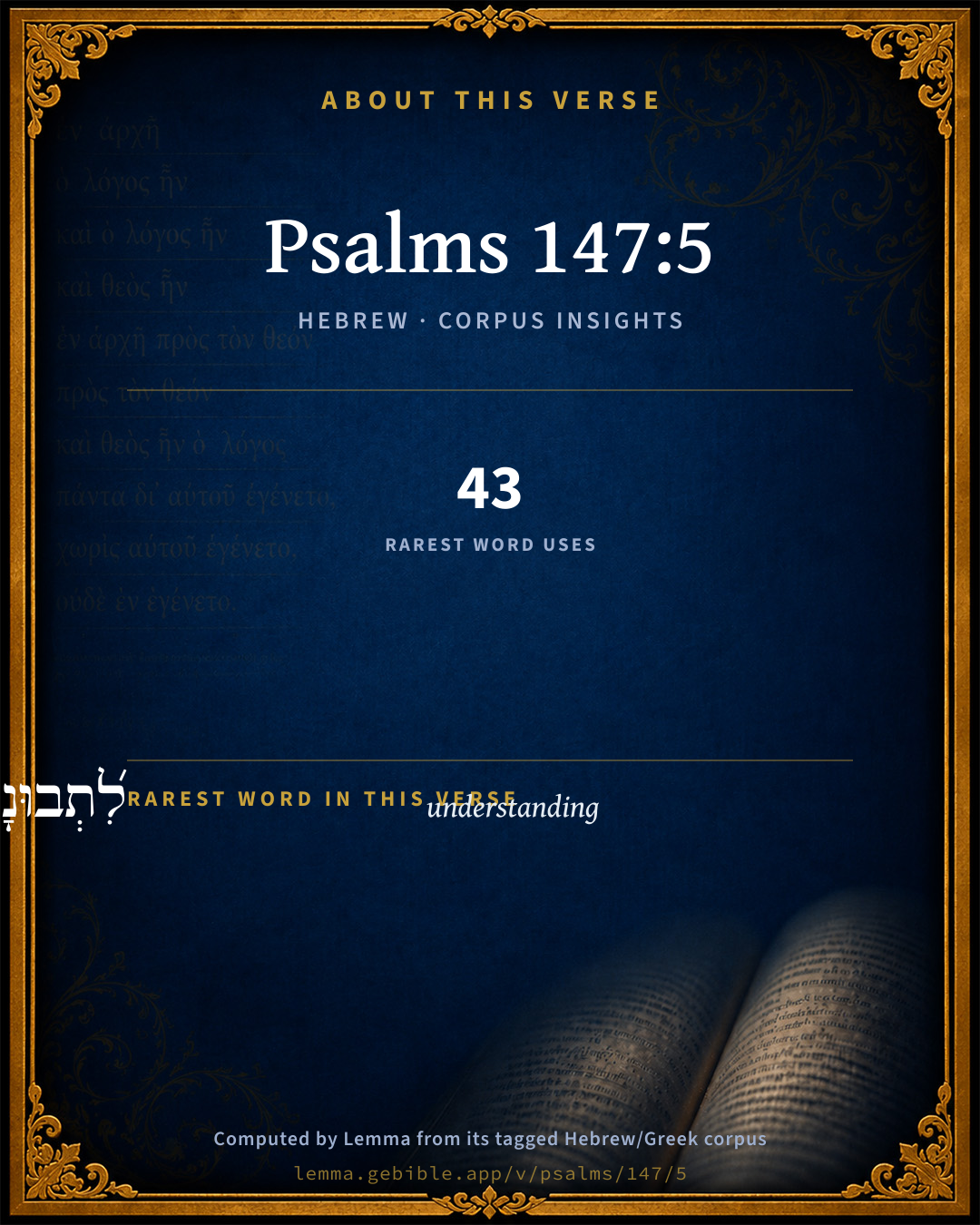
לִ֝תְבוּנָת֗וֹ
tâbûwn
H8394
“to/for · understanding · his”
Preposition + Noun, Common, Feminine, Singular, Construct + Suffix, Personal, 3rd Person, Masculine, Singular
Part of Speech
Preposition + Noun
Type
Common
Gender
Feminine
Number
Singular
State
Construct
Full BDB Definition

Origin: from H995

TWOT: 239c

understanding, intelligence - the act of understanding - skill - the faculty of understanding - intelligence, understanding, insight - the object of knowledge - teacher (personification)
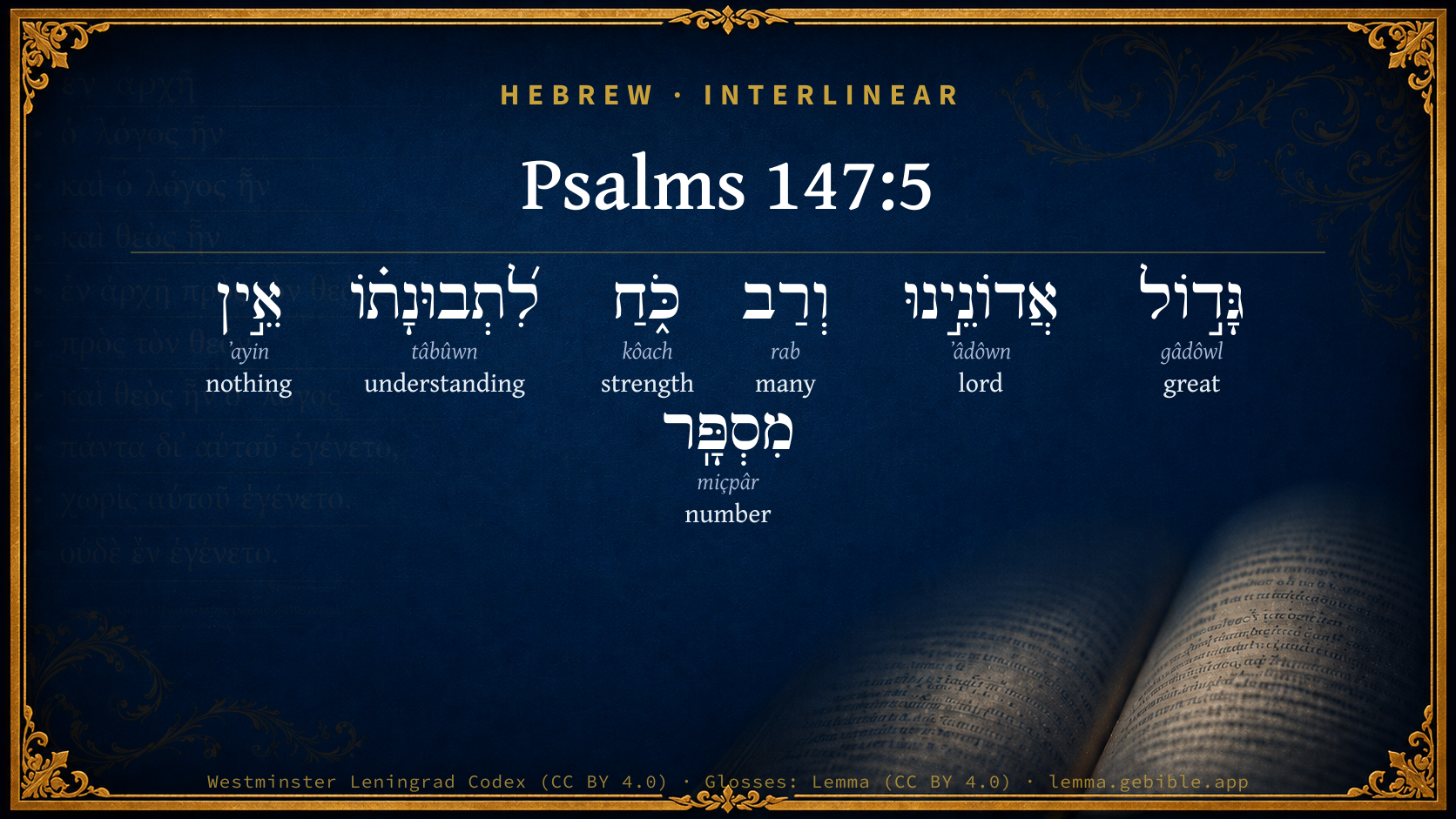
  1. גָּד֣וֹל gâdôwl H1419 “great” Adjective, Adjective, Masculine, Singular, Absolute
  2. אֲדוֹנֵ֣ינוּ ʼâdôwn H113 “lords · our” Noun, Common, Masculine, Plural, Construct + Suffix, Personal, 1st Person, Common, Plural
  3. וְרַב rab H7227 “and · many of” Conjunction + Adjective, Adjective, Masculine, Singular, Construct
  4. כֹּ֑חַ kôach H3581 “strength” Noun, Common, Masculine, Singular, Absolute
  5. אֵ֣ין ʼayin H369 “nothing” Particle, Negative
  6. מִסְפָּֽר miçpâr H4557 “number” Noun, Common, Masculine, Singular, Absolute

About this verse

These counts appear in no published source. They are computed here, from the morphology-tagged text and Lemma’s own curated glosses. What Lemma adds →

7
words
7
distinct lemmas
Wisdom
section

Shared distinctive vocabulary

לִ֝תְבוּנָת֗וֹ understanding H8394 occurs in 42 verses of the Hebrew Bible. Also found in:

Grammatical profile

  • 4 nouns
  • 2 adjectives
  • 1 particle

Hebrew & Septuagint length

In English translation the verse runs 12 words from the Hebrew and 14 from the Septuagint (LXX English) — closely comparable.

A rough comparison of the two English renderings, which tokenize alike — not a word-level alignment.

Word counts can differ between the Hebrew and the Greek without any difference in meaning — e.g. the Hebrew direct-object marker אֵת has no separate Greek word, and Greek often adds the article ὁ.

Cross-references

14

Topical passages linked to Psalms 147:5 in the Treasury of Scripture Knowledge — connected by theme and wording, ordered by reader-vote popularity; previews shown in the World English Bible.

  • Isaiah 40:28 Have you not known? have you not heard? The everlasting God, Yahweh, the Creator of the ends of the earth, doesn't faint, neither is weary; there is no searching of his understanding.
  • Psalms 139:17–18 How precious to me are your thoughts, God! How vast is the sum of them!
  • Psalms 96:4 For great is Yahweh, and greatly to be praised! He is to be feared above all gods.
  • Romans 11:33 Oh the depth of the riches both of the wisdom and the knowledge of God! How unsearchable are his judgments, and his ways past tracing out!
  • Psalms 40:5 Many, Yahweh, my God, are the wonderful works which you have done, And your thoughts which are toward us. They can't be set in order to you; If I would declare and speak of them, they are more than can be numbered.
  • Psalms 48:1 Great is Yahweh, and greatly to be praised, In the city of our God, in his holy mountain.
  • Nahum 1:3 Yahweh is slow to anger, and great in power, and will by no means leave the guilty unpunished. Yahweh has his way in the whirlwind and in the storm, and the clouds are the dust of his feet.
  • Jeremiah 10:6 There is none like you, Yahweh; you are great, and your name is great in might.
  • Jeremiah 32:17–19 Ah Lord Yahweh! behold, you have made the heavens and the earth by your great power and by your outstretched arm; there is nothing too hard for you,
  • 1 Chronicles 16:25 For great is Yahweh, and greatly to be praised: He also is to be feared above all gods.
  • Psalms 99:2 Yahweh is great in Zion. He is high above all the peoples.
  • Psalms 145:3 Great is Yahweh, and greatly to be praised! His greatness is unsearchable.
  • Revelation 15:3 They sang the song of Moses, the servant of God, and the song of the Lamb, saying, "Great and marvelous are your works, Lord God, the Almighty; Righteous and true are your ways, you King of the nations.
  • Psalms 135:5 For I know that Yahweh is great, That our Lord is above all gods.

Cross-references courtesy of OpenBible.info (CC BY 4.0).

Hebrew and Greek witnesses Masoretic Hebrew ↔ Greek Septuagint

The same verse in the two great witnesses to the Old Testament, shown verse-for-verse.

You’re reading Greek Psalm 146 (Hebrew Psalm 147). The Septuagint counts the superscription, so verse numbers can differ from the Hebrew — chapter-level alignment, not verse-by-verse. Numbering follows Rahlfs.

These are two independent witnesses, not word-aligned to each other, and the Septuagint is shown in lemma (dictionary) form.

Hebrew Psalms 147:5 Masoretic · Westminster Leningrad Codex

גָּד֣וֹל אֲדוֹנֵ֣ינוּ וְרַב כֹּ֑חַ לִ֝תְבוּנָת֗וֹ אֵ֣ין מִסְפָּֽר

Great is our Lord, and mighty in power. His understanding is infinite.

World English Bible · Public Domain

Greek LXX Greek Psalm 146:5 Septuagint · lemma form

μέγας ὁ κύριος ἐγώ καί μέγας ὁ ἰσχύς αὐτός καί ὁ σύνεσις αὐτός οὐ εἰμί ἀριθμός

Great is our Lord, and great is his strength; and his understanding is infinite.

LXX2012 (modern English Septuagint) · Public Domain

Hebrew: Westminster Leningrad Codex (CC BY 4.0). Greek: Septuagint (public domain); English from LXX2012 (modern English Septuagint) (Public Domain). How the Septuagint differs from the Hebrew →

Commentary

Notes on Psalms 147:5 from classic Christian and Jewish commentators (each source and its license shown beneath its notes). The classic Christian expositions comment on the surrounding passage and are grouped to its opening verse, so a note may address several verses; the Jewish commentaries on the Tanakh (Rashi and others) are per-verse, so they appear only where the commentator wrote on this verse.

Lemma curates 59 commentaries, every one of them public domain or Creative Commons licensed, each selected and text-cleaned for this edition rather than reprinted as found. About our sources →

The Cambridge Bible for Schools and Colleges

gen. ed. J. J. S. Perowne

5. Great is our Lord, and abundant in power] The language is borrowed from Isa_40:26.

his understanding is infinite] Lit. to his understanding there is no number, it is incalculable. Number is substituted for searching of Isa_40:28, perhaps to suggest a contrast to Psa_147:5. He numbers the stars: His wisdom cannot be numbered. The Heb. of Sir_39:20 “Is there any number [i.e. limit] to his salvation” [or according to Schechter’s conjecture, understanding] may be borrowed from this passage.

The Cambridge Bible for Schools and Colleges (gen. ed. J. J. S. Perowne; Cambridge University Press, 1878–1918) — public domain. Text from a community e-Sword module.

Trapp's Complete Commentary

John Trapp

Psa 147:5 Great [is] our Lord, and of great power: his understanding [is] infinite.

Ver. 5. His understanding is infinite] Heb. of his understanding there is no number; for he knows not only the kinds and sorts of things, but even the particulars, though they exceed all number. Sic spectat universos quasi singulos; sic singulos, quasi solos. That philosopher did not say nothing, who, being in danger of shipwreck in a light starry night, said, Surely I shall not perish, there are so many eyes of providence over me.

John Trapp, A Commentary or Exposition upon All the Books of the Old and New Testament (1647–1656) — public domain. Text from a community e-Sword module.

Joseph Benson's Commentary

Psa 147:5-6. Great is our Lord, and of great power — “This is a proper conclusion, drawn from the former part of the Psalm, and especially from the preceding verse. The greatness of God’s power, which overcometh all difficulties, to effect the salvation of his people, is not to be grasped by the human mind; and that wisdom which numbers the stars of heaven, and the sand of the sea, and the generations of the sons of Adam, can itself be subject to the rules of no arithmetic.” The Lord lifteth up the meek, &c. — “To exalt and reward the humble, penitent, believing, and obedient; and to depress and punish the proud, impenitent, unbelieving, and disobedient; these are the measures and ends of all the divine dispensations. And as a man ranks himself in one or other of these two divisions, he may expect from heaven storm or sunshine, mercy or judgment.” — Horne.

Joseph Benson's Commentary on the Old and New Testaments (1811–1818) — public domain. Text from a community e-Sword module.

J. A. Alexander on Psalms

Joseph Addison Alexander

5. (Psa 147:5) Great is our Lord and of much power; to his understanding there is no number, i.e. it is incalculable and immense. Compare Isa 40:26; Isa 40:28. Of much power, or abundant in strength.

Joseph Addison Alexander, The Psalms Translated and Explained (1850) — public domain. Text from a community e-Sword module.

Adam Clarke's Commentary

Verse 5. His understanding is infinite.] To his intelligence there is no number: though he numbers the stars, his understanding is without number. It is infinite; therefore, he can know, as he can do, all things.

Adam Clarke's Commentary on the Bible (1810–1826) — public domain. Text from a community e-Sword/MySword module.

Ellicott's Commentary for English Readers

(5) Of great power.—Literally, abounding in power.

Infinite.—Literally, without number. (See Note, Psa_145:3, and Isa_40:28; that prophetic passage being still in the poet’s mind, though the expression is changed.)

A Bible Commentary for English Readers, edited by Charles John Ellicott (1878–1897) — public domain. Text from a community e-Sword module.

John Gill's Exposition

Great is our Lord, and of great power,.... "Our Lord" is our Lord Jesus Christ, the Lord of the whole earth; the Lord of his own people by creation, by redemption, by marriage, and by the conquest of his grace, and their voluntary submission to him; he is "great" in his person, offices, and grace, and therefore greatly to be praised; see Psa 145:3; and particularly his "power" is very "great", as appears in the creation of all things out of nothing by him; in the sustaining and support of the world and all things in it: in the redemption of his people from the hand of their powerful enemies; in beginning, carrying on, and perfecting a work of grace on their hearts by his Spirit and power; and in the preservation of them unto eternal life, through a thousand dangers and difficulties: at his resurrection all power in heaven and earth were given him as Mediator; and in the latter day he will take to himself his great power and reign; and in the last day will raise the dead out of their graves;

his understanding is infinite; it reaches to all things, not to the stars of heaven only, as in Psa 147:4, but to the fowls of the air, to the beasts of the field, and cattle upon a thousand hills; to all on the surface of the earth, or in the bowels of it; and to the fishes of the sea: it reaches to all men, and to all the thoughts of their hearts, the words of their mouths, and the actions of their lives; it reaches to all things past, that have been, to everything present, and to whatsoever is to come; it includes not only the knowledge of all things that are, or certainly will be, but of all things possible, or which he could bring into being if he would; it is concerned not only with the quality and nature of things it perfectly understands, but with the quantity of them; even all things in creation and providence, which are without number and past finding out by men; and so his understanding is without number, and cannot be declared, as the word signifies.

John Gill's Exposition of the Whole Bible (1746–1763) — public domain (CC PDM 1.0). Text via the HelloAO Bible API.

Albert Barnes' Notes on the Bible

Great is our Lord - See the notes at Psa 48:1.

And of great power - This seems to be added, as in Isa 40:28, in view of the power required in making the heavens, and in guiding and numbering the stars: “Hast thou not known? Hast thou not heard, that the everlasting God, the Lord, the Creator of the ends of the earth, fainteth not, neither is weary?”

His understanding is infinite - Margin, Of his understanding there is no number. That is, This corresponds with his power to number the stars. There is no limit to it. It is not bounded; there is no point reached where it can be said that there is no more; that it is exhausted. See the notes at Isa 40:28 : “There is no searching of his understanding.”

Albert Barnes' Notes on the Bible (1834–1885) — public domain. Text from a community e-Sword/MySword module.

The Treasury of David

Charles H. Spurgeon

Ver. 5. Great is our Lord. Our Lord and King is great magnanimous, infinite, inconceivably glorious. None can describe his majesty, or reckon up the number of his excellencies. And of great power. Doing as he wills, and willing to do mighty deeds. His acts reveal something of his might, but the mass of his power is hidden, for all things are possible with God, even the things impossible with men. His understanding is infinite. There is no fathoming his wisdom, or measuring his knowledge. He is infinite in existence, in power, and in knowledge; as these three phrases plainly teach us. The gods of the heathen are nothing, but our God filleth all things. And yet how condescending! For this is he who so tenderly nurses sick souls, and waist to be gracious to sinful men. He brings his boundless power and infinite understanding to bear upon human distress for its assuagement and sanctification. For all these reasons let his praise be great: even could it be infinite, it would not exceed his due. In the building of his church and the salvation of souls, his greatness, power, and wisdom are all displayed: let him be extolled because of each of these attributes.

Ver. 5. His understanding is infinite. Hebrew: "Of his understanding there is no number." God is incomprehensible. In place; in time; in understanding; in love. First, in place; because no place, no space, can be imagined so great, but God exceeds it, and may be found beyond it. Secondly, in time; because he exceeds all time: for be was before all time that can be conceived, and shall be after all lime. Time is a created thing, to attend upon the creation and continuance of all things created and continued by God. Thirdly, in understanding; because no created understanding can comprehend him so that nothing of God may be hid from it. Fourthly, in love because God doth exceed all love: no creature can love God according to his worth. All these ways of incomprehensibleness follow upon his infiniteness. Thomas Larkham, in "The Attributes of God Unfolded, and Applied", 1656.

Ver. 5. His understanding is infinite. The Divine wisdom is said to be "without number"; that is, the objects of which this wisdom of God can take cognisance are innumerable. Simon de Muis.

Ver. 5. In this verse we have three of God's attributes, his greatness, his power, and his knowledge; and though only the last of these be expressly said to be infinite, yet is the same implied also of the two former; for all the perfections of God being essential to him, must need be infinite as he himself is; and therefore what is affirmed of one must, by a parity of reason, be extended to the rest. John Conant, 1608-1693.

Ver. 5. A contemplation of God's greatness.

1. Great in his essential nature.

2. Great in Power.

3. Great in wisdom. Let us draw inferences concerning the insignificance of man, & c.

Psalms 147:6*

Charles H. Spurgeon's The Treasury of David (1869–1885) — public domain. Psalms only. Text from a community e-Sword/MySword module.

The Pulpit Commentary

Great is our Lord, and of great power; or, "mighty in strength". (comp. Nah_1:3) His understanding is infinite. He is at once omnipotent and omniscient.

The Pulpit Commentary (1880–1919), ed. H.D.M. Spence-Jones & Joseph S. Exell — public domain. Text from a community e-Sword module.

Lesson kit

Teaching starters — assembled from the data on this page, not authored interpretation. Every prompt links to the verse data it draws on. Edit before teaching.

Psalms, in the Wisdom, opens this verse with 7 words (7 distinct Hebrew lemmas). Its most distinctive word is tâbûwn (“understanding”). A historical commentator’s framing appears above. Read the whole chapter for the surrounding context.

Discussion questions

  1. The word tâbûwn carries the sense “understanding.” How does it shape the verse?
  2. How does Exodus 31:3, which shares the word «understanding», read alongside this verse?
  3. These translations render this verse differently. What is at stake in choosing one wording over another?
  4. Compare how The Cambridge Bible for Schools and Colleges and Trapp's Complete Commentary read this verse. Where do they agree or differ?

Things to notice

Reading settings

Reading text

Shown beneath each verse's original-language words.

Old Testament
Old Testament edition

Read the OT as the Masoretic Hebrew (MT) or the Greek Septuagint (LXX).

English shown for the Greek Septuagint (in the Hebrew ↔ Greek comparison).

Comparing translations? Open the Compare panel on any verse page to stack up to four side by side.