
Isaiah 37:3

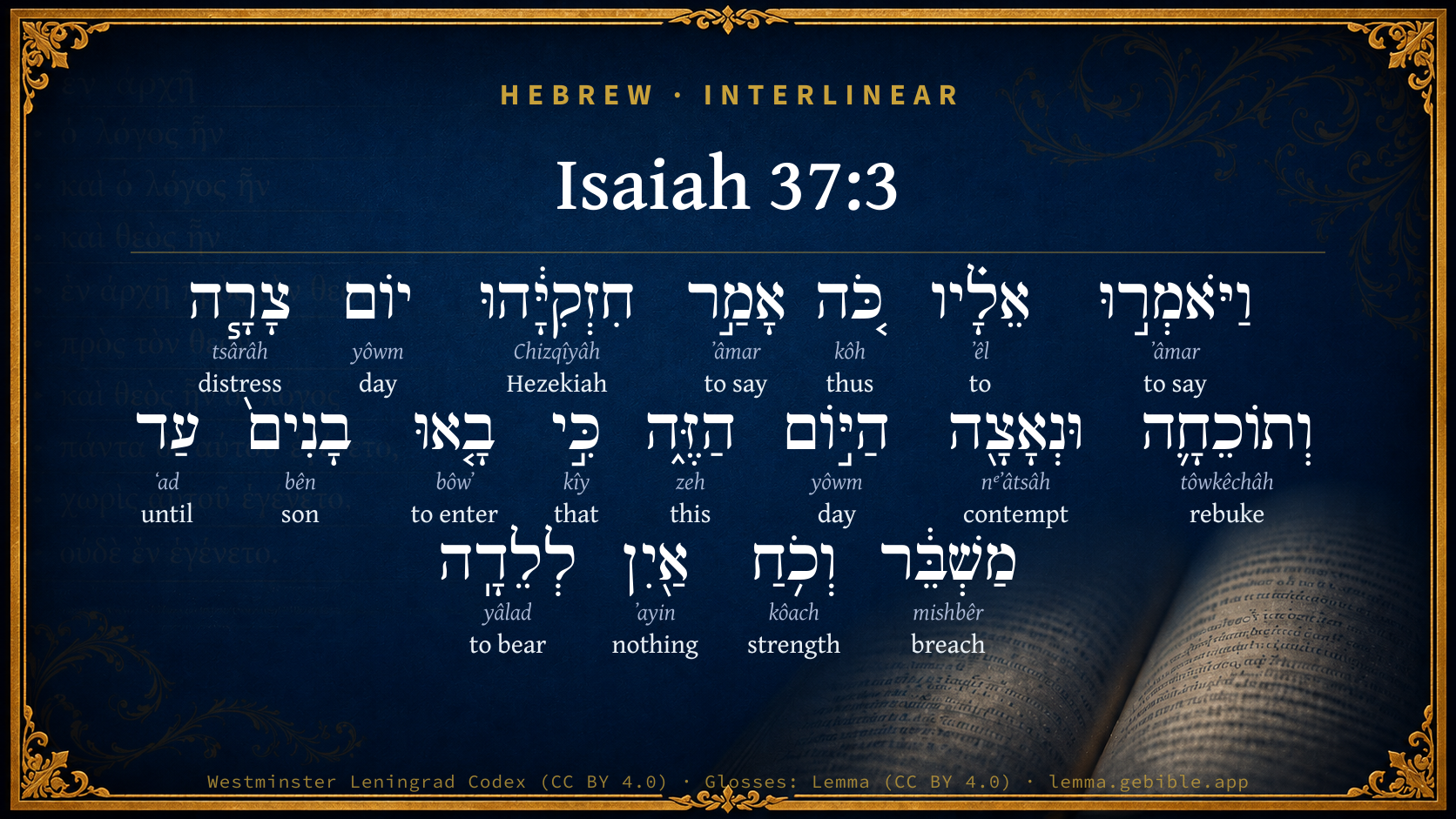
Hebrew (Westminster Leningrad Codex) Isaiah 37:3 appears in the Hebrew Old Testament. The text above is from the Westminster Leningrad Codex. Each word links to its Strong’s number, a concise gloss, and parsing drawn from the Open Scriptures Hebrew Bible morphology. Click any word for its full Brown-Driver-Briggs (BDB) entry.
Download image
Cite this verse

Isaiah 37:3 (World English Bible). Public Domain. Lemma interlinear Bible study tool, https://lemma.gebible.app/v/isaiah/37/3.

Show BibTeX & RIS
BibTeX
RIS
English Translation
They said to him, Thus says Hezekiah, This day is a day of trouble, and of rebuke, and of rejection; for the children have come to the birth, and there is no strength to bring forth.
World English Bible · Public Domain
Download a study sheet

One document with this verse’s original text, its word-by-word gloss line, the meaning frame, cross-references with their text, attributed commentary, and full source and license credits — printable, and it pastes into notes with its structure intact.

This verse Autodidact and up

Study sheet (.html) Plain text (.txt)

A passage Seminary Student

Up to 50 verses in one chapter. A passage sheet keeps up to 6 commentary sources and 12 cross-references per verse, in the order this page ranks them, and says so on the sheet whenever that leaves anything out. Ask for a single verse and you get the Autodidact verse sheet above.

Everything on this page stays free to read, with no account — the sheet is a download of what is already on screen, not access to it.

Want to remove ads? Support Godless Engineer
Compare translations 3

The same verse in 3 English versions, stacked beneath the original-language interlinear above. Click any original word for its lexicon entry.

Each is an independent rendering of the whole verse — the interlinear is not word-aligned to these translations.

Highlighted words mark where these versions differ — a whole-verse word diff, not a word-by-word alignment.

  • World English Bible Public Domain
    They said to him, Thus says Hezekiah, This day is a day of trouble, and of rebuke, and of rejection; for the children have come to the birth, and there is no strength to bring forth.
  • King James Version Public Domain
    And they said unto him, Thus saith Hezekiah, This day is a day of trouble, and of rebuke, and of blasphemy: for the children are come to the birth, and there is not strength to bring forth.
  • unfoldingWord Literal Text CC BY-SA 4.0
    And they said to him, “Thus says Hezekiah, ‘This day a day of trouble and chastisement and reproach, for sons have come to the birth canal, but no strength to give birth.

unfoldingWord Literal Text — © unfoldingWord, licensed CC BY-SA 4.0. Word-aligned USFM3 via Door43 (git.door43.org/unfoldingWord/en_ult).

Versions to compare (up to 4)

3 of 4 selected

Show all 18 translations

Every available English version of this verse, each an independent rendering of the whole verse.

  • World English Bible Public Domain
    They said to him, Thus says Hezekiah, This day is a day of trouble, and of rebuke, and of rejection; for the children have come to the birth, and there is no strength to bring forth.
  • Berean Standard Bible Public Domain
    to tell him, “This is what Hezekiah says: Today is a day of distress, rebuke, and disgrace; for children have come to the point of birth, but there is no strength to deliver them.
  • Majority Standard Bible Public Domain
    to tell him, “This is what Hezekiah says: Today is a day of distress, rebuke, and disgrace; for children have come to the point of birth, but there is no strength to deliver them.
  • King James Version Public Domain
    And they said unto him, Thus saith Hezekiah, This day is a day of trouble, and of rebuke, and of blasphemy: for the children are come to the birth, and there is not strength to bring forth.
  • American Standard Version (1901) Public Domain
    And they said unto him, Thus saith Hezekiah, This day is a day of trouble, and of rebuke, and of contumely; for the children are come to the birth, and there is not strength to bring forth.
  • Revised Version (1885) Public Domain
    And they said unto him, Thus saith Hezekiah, This day is a day of trouble, and of rebuke, and of contumely: for the children are come to the birth, and there is not strength to bring forth.
  • Geneva Bible (1599) Public Domain
    And they sayd vnto him, Thus saith Hezekiah, This day is a day of tribulation and of rebuke and blasphemie: for the children are come to the birth, and there is no strength to bring foorth.
  • Douay-Rheims (1899) Public Domain
    And they said to him: Thus saith Ezechias: This day is a day of tribulation, and of rebuke, and of blasphemy: for the children are come to the birth, and there is not strength to bring forth.
  • Young's Literal Translation Public Domain
    and they say unto him, `Thus said Hezekiah, A day of distress, and rebuke, and despising, `is' this day; for come have sons unto the birth, and power there is not to bear.
  • Literal Standard Version CC BY-SA 4.0
    and they say to him, “Thus said Hezekiah: A day of distress, and rebuke, and despising, [is] this day; for sons have come to the birth, and there is not power to bear.
  • Unlocked Literal Bible CC BY-SA 4.0
    They said to him, “Hezekiah says, 'This day is a day of distress, rebuke, and disgrace, like when a child is ready to be born, but the mother has no strength to give birth to her child.
  • unfoldingWord Literal Text CC BY-SA 4.0
    And they said to him, “Thus says Hezekiah, ‘This day a day of trouble and chastisement and reproach, for sons have come to the birth canal, but no strength to give birth.
  • Darby Bible Public Domain
    And they said to him, Thus says Hezekiah: This day is a day of trouble, and of rebuke, and of reviling; for the children are come to the birth, and there is not strength to bring forth.
  • World Messianic Bible Public Domain
    They said to him, “Hezekiah says, ‘Today is a day of trouble, and of rebuke, and of rejection; for the children have come to the birth, and there is no strength to give birth.
  • Webster's Bible Public Domain
    And they said to him, Thus saith Hezekiah, This day is a day of trouble, and of rebuke, and of blasphemy: for the children are come to the birth, and there is not strength to bring forth.
  • Free Bible Version CC BY-SA 4.0
    They told him, “This is what Hezekiah says: Today is a day of trouble and of punishment. It's like when babies arrive at the entrance to the birth canal but there's no strength to deliver them.
  • Bible in Basic English Public Domain
    And they said to him, Hezekiah says, This day is a day of trouble and punishment and shame: for the children are ready to come to birth, but there is no strength to give birth to them.
  • JPS Tanakh (1917) Public Domain
    And they said unto him: 'Thus saith Hezekiah: This day is a day of trouble, and of rebuke, and of contumely; for the children are come to the birth, and there is not strength to bring forth.

Literal Standard Version (2020), Covenant Press — licensed CC BY-SA 4.0. Text via the HelloAO Bible API (eBible.org). Unlocked Literal Bible (unfoldingWord) — licensed CC BY-SA 4.0. Text via the HelloAO Bible API (eBible.org). unfoldingWord Literal Text — © unfoldingWord, licensed CC BY-SA 4.0. Word-aligned USFM3 via Door43 (git.door43.org/unfoldingWord/en_ult). Free Bible Version, Dr. Jonathan Gallagher — licensed CC BY-SA 4.0. Text via the HelloAO Bible API (eBible.org).

Word by word

More ways to search: Search by grammar → Find every occurrence → Compare this word →

Practice this passage: Drill this verse → Learn its vocabulary →

מַשְׁבֵּ֔ר
mishbêr
H4866
“breach”
Noun, Common, Masculine, Singular, Absolute
Part of Speech
Noun
Type
Common
Gender
Masculine
Number
Singular
State
Absolute
Full BDB Definition

Origin: from H7665

TWOT: 2321c

place of breaking forth, place of breach, opening - of womb
  1. וַיֹּאמְר֣וּ ʼâmar H559 “and · to say” Conjunction + Verb, Qal, Sequential Imperfect, 3rd Person, Masculine, Plural
  2. אֵלָ֗יו ʼêl H413 “to · him” Preposition + Suffix, Personal, 3rd Person, Masculine, Singular
  3. כֹּ֚ה kôh H3541 “thus” Adverb
  4. אָמַ֣ר ʼâmar H559 “to say” Verb, Qal, Perfect, 3rd Person, Masculine, Singular
  5. חִזְקִיָּ֔הוּ Chizqîyâh H2396 “Hezekiah” Noun, Proper
  6. יוֹם yôwm H3117 “day of” Noun, Common, Masculine, Singular, Construct
  7. צָרָ֧ה tsârâh H6869 “distress” Noun, Common, Feminine, Singular, Absolute
  8. וְתוֹכֵחָ֛ה tôwkêchâh H8433 “and · rebuke” Conjunction + Noun, Common, Feminine, Singular, Absolute
  9. וּנְאָצָ֖ה nᵉʼâtsâh H5007 “and · contempt” Conjunction + Noun, Common, Feminine, Singular, Absolute
  10. הַיּ֣וֹם yôwm H3117 “the · day” Particle, Definite Article + Noun, Common, Masculine, Singular, Absolute
  11. הַזֶּ֑ה zeh H2088 “the · this” Particle, Definite Article + Pronoun, Demonstrative, Masculine, Singular
  12. כִּ֣י kîy H3588 “that” Conjunction
  13. בָ֤אוּ bôwʼ H935 “to enter” Verb, Qal, Perfect, 3rd Person, Common, Plural
  14. בָנִים֙ bên H1121 “sons” Noun, Common, Masculine, Plural, Absolute
  15. עַד ʻad H5704 “until” Preposition
  16. וְכֹ֥חַ kôach H3581 “and · strength” Conjunction + Noun, Common, Masculine, Singular, Absolute
  17. אַ֖יִן ʼayin H369 “nothing” Particle, Negative
  18. לְלֵדָֽה yâlad H3205 “to/for · childbirth” Preposition + Noun, Common, Feminine, Singular, Absolute

About this verse

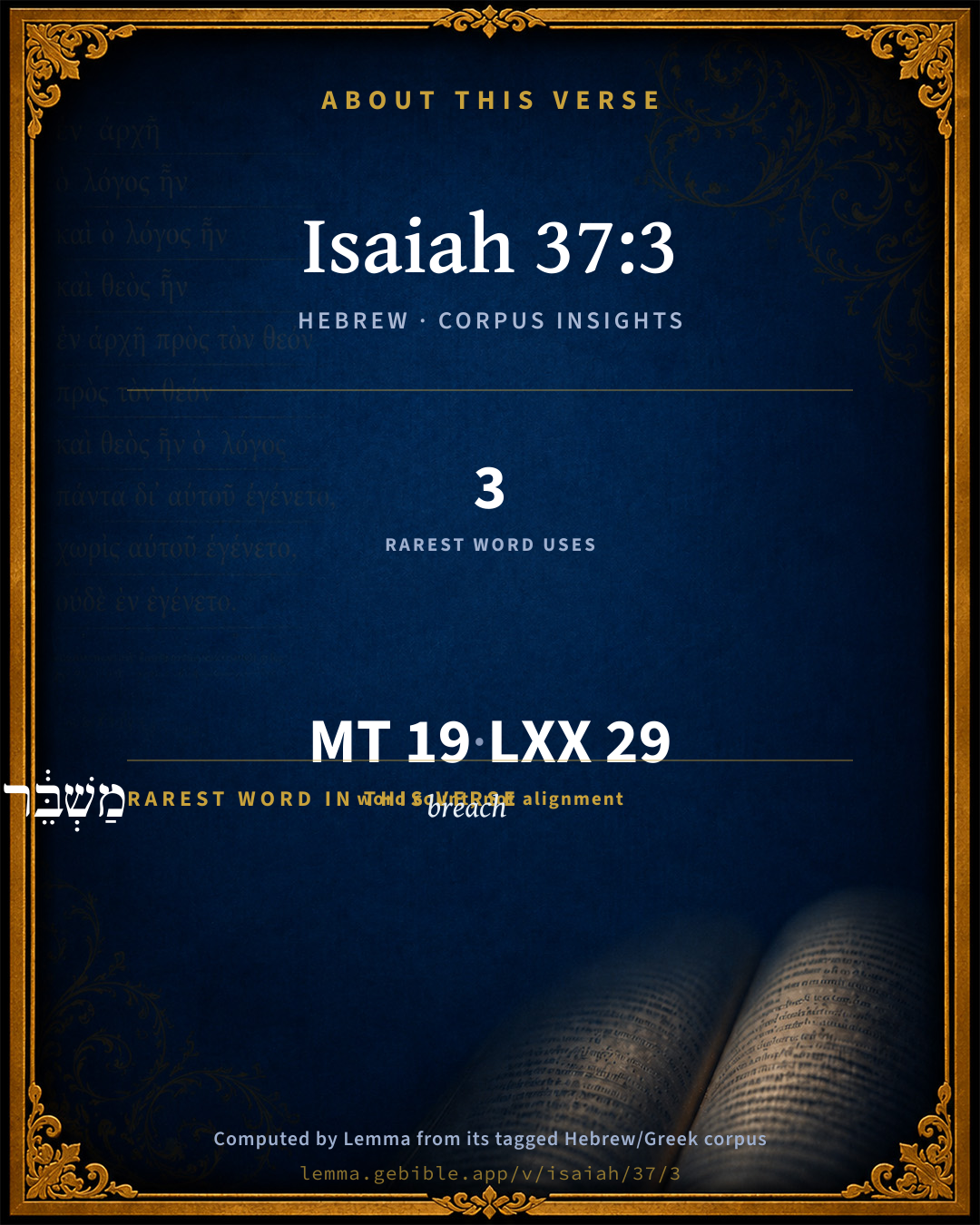
These counts appear in no published source. They are computed here, from the morphology-tagged text and Lemma’s own curated glosses. What Lemma adds →

19
words
17
distinct lemmas
Prophets
section

Notable vocabulary

The rarest word here is מַשְׁבֵּ֔ר breach H4866 — appearing just 3 times in the whole Hebrew Bible.

Shared distinctive vocabulary

מַשְׁבֵּ֔ר breach H4866 occurs in 3 verses of the Hebrew Bible. Also found in:

Grammatical profile

  • 3 verbs
  • 10 nouns
  • 1 pronoun
  • 2 prepositions
  • 1 conjunction
  • 1 adverb
  • 1 particle

Verb forms

  • וַיֹּאמְר֣וּ Qal · Sequential Imperfect
  • אָמַ֣ר Qal · Perfect
  • בָ֤אוּ Qal · Perfect

Repetition

Words recur within this verse — often emphatic in Hebrew:

  • וַיֹּאמְר֣וּ to say H559 ×2
  • יוֹם day H3117 ×2

Hebrew & Septuagint length

In English translation the verse runs 36 words from the Hebrew and 29 from the Septuagint (LXX English) — closely comparable.

A rough comparison of the two English renderings, which tokenize alike — not a word-level alignment.

Word counts can differ between the Hebrew and the Greek without any difference in meaning — e.g. the Hebrew direct-object marker אֵת has no separate Greek word, and Greek often adds the article ὁ.

In the original languages it is 19 Hebrew tokens and 29 Greek tokens — but the two are counted differently (Hebrew bundles its prefixes and suffixes into one token; the Greek is in lemma form), so that isn’t a like-for-like length.

Cross-references

14

Topical passages linked to Isaiah 37:3 in the Treasury of Scripture Knowledge — connected by theme and wording, ordered by reader-vote popularity; previews shown in the World English Bible.

  • Isaiah 66:9 Shall I bring to the birth, and not cause to bring forth? says Yahweh: shall I who cause to bring forth shut [the womb]? says your God.
  • Hosea 13:13 The sorrows of a travailing woman will come on him. He is an unwise son; For when it is time, he doesn't come to the opening of the womb.
  • Isaiah 26:17–18 Like as a woman with child, who draws near the time of her delivery, is in pain and cries out in her pangs; so we have been before you, Yahweh.
  • 2 Kings 19:3 They said to him, Thus says Hezekiah, This day is a day of trouble, and of rebuke, and of rejection; for the children are come to the birth, and there is not strength to bring forth.
  • Psalms 50:15 Call on me in the day of trouble. I will deliver you, and you will honor me."
  • Isaiah 33:2 Yahweh, be gracious to us; we have waited for you: be our arm every morning, our salvation also in the time of trouble.
  • 2 Chronicles 15:4 But when in their distress they turned to Yahweh, the God of Israel, and sought him, he was found of them.
  • Psalms 91:15 He will call on me, and I will answer him. I will be with him in trouble. I will deliver him, and honor him.
  • Psalms 95:8 Don't harden your heart, as at Meribah, As in the day of Massah in the wilderness,
  • Revelation 3:19 As many as I love, I reprove and chasten. Be zealous therefore, and repent.
  • Isaiah 22:5 For it is a day of confusion, and of treading down, and of perplexity, from the Lord, Yahweh of Hosts, in the valley of vision; a breaking down of the walls, and a crying to the mountains.
  • Hosea 5:15–6:1 I will go and return to my place, until they acknowledge their offense, And seek my face. In their affliction they will seek me earnestly."
  • Psalms 116:3–4 The cords of death surrounded me, The pains of Sheol got a hold of me. I found trouble and sorrow.
  • Jeremiah 30:7 Alas! for that day is great, so that none is like it: it is even the time of Jacob's trouble; but he shall be saved out of it.

Cross-references courtesy of OpenBible.info (CC BY 4.0).

Hebrew and Greek witnesses Masoretic Hebrew ↔ Greek Septuagint

The same verse in the two great witnesses to the Old Testament, shown verse-for-verse.

These are two independent witnesses, not word-aligned to each other, and the Septuagint is shown in lemma (dictionary) form.

Hebrew Isaiah 37:3 Masoretic · Westminster Leningrad Codex

וַיֹּאמְר֣וּ אֵלָ֗יו כֹּ֚ה אָמַ֣ר חִזְקִיָּ֔הוּ יוֹם צָרָ֧ה וְתוֹכֵחָ֛ה וּנְאָצָ֖ה הַיּ֣וֹם הַזֶּ֑ה כִּ֣י בָ֤אוּ בָנִים֙ עַד מַשְׁבֵּ֔ר וְכֹ֥חַ אַ֖יִן לְלֵדָֽה

They said to him, Thus says Hezekiah, This day is a day of trouble, and of rebuke, and of rejection; for the children have come to the birth, and there is no strength to bring forth.

World English Bible · Public Domain

Greek LXX Isaiah 37:3 Septuagint · lemma form

καί εἶπον αὐτός ὅδε λέγω εζεκιας ἡμέρα θλῖψις καί ὀνειδισμός καί ἐλεγμός καί ὀργή ὁ σήμερον ἡμέρα ὅτι ἥκω ὁ ὠδίν ὁ τίκτω ἰσχύς δέ οὐ ἔχω ὁ τίκτω

To-day is a day of affliction, and reproach, and rebuke, and anger: for the pangs are come upon the travailing woman, but she has not strength to bring forth.

LXX2012 (modern English Septuagint) · Public Domain

On this verse, John Gill's Exposition discusses the Septuagint’s reading. Read the note in Commentary ↓

Hebrew: Westminster Leningrad Codex (CC BY 4.0). Greek: Septuagint (public domain); English from LXX2012 (modern English Septuagint) (Public Domain). How the Septuagint differs from the Hebrew →

Targum (Aramaic paraphrase)

1

The Targum is the ancient Jewish Aramaic paraphrase of the Hebrew Scriptures — an interpretive translation, not the Hebrew text itself. Onkelos (literal) and Pseudo-Jonathan (expansive) render the Torah, and Jonathan the Prophets. Coverage is partial: where no permissively-licensed English translation exists for a verse, only the Aramaic is shown. This is verse-level text, not a word-by-word alignment to the Hebrew.

  1. Targum Jonathan Prophets (Joshua–Malachi)
    וְאָמְרוּ לֵיהּ כִּדְנַן אֲמַר חִזְקִיָה יוֹם עָקָא וְחִיסוּדִין וְנִיאוּצָא יוֹמָא הָדֵין אֲרֵי אֲקֵיפְתָּנָא עָקָא כְּאִתָּא דְיָתְבָא עַל מַתְבְּרָא וְחֵיל לֵית לָהּ לְמֵילַד:

    And they said unto him, Thus saith Hezekiah: This day is a day of distress, of reproach, and of contumely: for distress hath laid hold on us, as a woman that sitteth upon the stool of a woman in labour, and hath no strength to bring forth.

    Targum Jonathan — Aramaic: “Mikraot Gedolot” (public domain). English: “Sefaria Community Translation” (CC0 1.0 (public-domain dedication)); “London "Chaldee Paraphrase," 1871” (public domain). Text via Sefaria.

Commentary

Notes on Isaiah 37:3 from classic Christian and Jewish commentators (each source and its license shown beneath its notes). The classic Christian expositions comment on the surrounding passage and are grouped to its opening verse, so a note may address several verses; the Jewish commentaries on the Tanakh (Rashi and others) are per-verse, so they appear only where the commentator wrote on this verse.

Lemma curates 59 commentaries, every one of them public domain or Creative Commons licensed, each selected and text-cleaned for this edition rather than reprinted as found. About our sources →

The Biblical Illustrator

Joseph S. Exell

Isa_37:3

This day is a day of trouble

Hezekiahs day of trouble

Ahaz the father and immediate predecessor of Hezekiah on the throne of Judah, engaged himself, and virtually his successors, to pay tribute to the kings of Assyria.

Such a state of vassalage Hezekiah no doubt rightly though hazardously declined to continue, and this is what is meant when it is said of him that he rebelled gains the king of Assyria and served him not (2Ki_18:7). Any such refusal on the part of Hezekiah to acknowledge the despotic king of Assyria as his lordparamount we may be sure would not be allowed to pass unchallenged, and hence Sennacheribs invasion of the kingdom of Judah in order to compel submission to what the king of Judah objected to and declined to do. This is what constituted Hezekiahs day of trouble. (W. Alnwick.)

Days of trouble

1. Hezekiah but represents what has been the general experience of man, for there has probably never lived a man on the face of the earth whose lot it has not been to have some days of trouble and annoyance.

2. If we cannot entertain a reasonable hope of any such thing as immunity from trouble, we can, however, endeavour to live and act so that our troubles may not be more than they need to be. It cannot be doubted that many bring much trouble on themselves, and subject themselves to many heart-aches and heart burns, which they ought never to have known, and probably would not have experienced had a different course of conduct been pursued, a course, perhaps, pointed out to them by those gifted with greater wisdom, prudence, and foresight than they themselves were possessed of, but which by their obstinacy of will and unjustifiable determination to take their own way, they were led to reject.

3. We are not, of course, to think that because many and great troubles fall to the-lot of a man, he has necessarily acted foolishly, acted in opposition to any law of God, either natural, religious, or spiritual. This was just the grievous mistake Jobs friends fell into.

4. It is only in heaven that trouble will be a thing unknown, and where all tears will for ever be wiped away.

5. We cannot but see the importance of being well prepared for days of trouble before we are made sensible of their presence with us. If we are wise enough to prepare ourselves for them their approach will be no surprise to us, and we shall be the better able to battle with them, and to turn that which is an evil in itself into a blessing, and so much help to us in our journey heavenward.

6. There can be no doubt that troubles are often sent by a wise and gracious providence for this very purpose.

7. It now only remains for me to make a few further remarks on how to deal with days of trouble when from being matters of prospect or future contingents, they have become translated into actual and stern facts. In dealing with such days we shall find much instruction and guidance afforded us by the example of Hezekiah in dealing with his day of trouble. As soon as Hezekiah became acquainted with the invasion of Sennacherib, he went into the house of the Lord, the sure resort of Gods people in the time of distress, there in prayer to lay both his trouble and its cause before God, and at the same time he sent Eliakim and Shebna unto the prophet Isaiah to desire that man of God to lift up his prayer in behalf of the remnant that was left. We are informed what was the blessed result of this union of prayer on the part of the king and the prophet. The day of trouble was removed, and the sun, which one day was shrouded in darkness, the next, shone forth bright and clear, every cloud being swept from the sky. The course taken by the king of Judah in his day of trouble and distress must commend itself to all who are found in similar circumstances by its marvellous success. It is a fact, in spite of the sneering scepticism of some people, that prayer is a really great power, and that as a means for the attainment of ends consistent with and approved by infinite wisdom and goodness, it will succeed when other means, such as men in their ignorance sometimes elect to employ as the best and fittest, utterly fail to reach the end aimed at. (W. Alnwick.)

Hours when prophets have influence

In the midst of his distress Hezekiah sent unto Isaiah the prophet the son of Amoz. So far Hezekiah was right. He might have gone himself directly by an act of faith to the living God, but he had regard to the constitution of Israel, and he availed himself of the ordinances and institutes appointed of Heaven. Hezekiah made through Eliakim a pathetic speech to Isaiah--This day is a day of trouble, and of rebuke, and of blasphemy. There are hours when prophets come to the enjoyment of their fullest influence. Isaiah had been despised and derided, but now his hour has come, and he stands up as the one hope of Judah. The question was, What can you, Isaiah, do to extract Israel from all the peril which now presses upon the people of God? In the sixth verse we see how nobly the attitude of Isaiah contrasts with the attitude of Hezekiah. Instead of the word of inspiration proceeding from the, king it issued from the prophet. (J. Parker, D. D.)

A dangerous crisis

The children are come to the birth, &c. Obviously a proverbial expression for a crisis which becomes dangerous through lack of strength to meet it (Isa_66:9; Hos_13:13). (Prof. J. Skinner, D. D.)

The Biblical Illustrator, edited by Joseph S. Exell (c. 1880s–1900s) — public domain. Text from a community e-Sword module.

Geneva Bible (1599)

Geneva Bible translators

We are in as great sorrow as a woman that travaileth of child, and cannot be delivered.

Geneva Bible (1599) marginal notes — public domain. Text via Bolls.life.

Jamieson, Fausset & Brown

Robert Jamieson, A. R. Fausset & David Brown

rebuke--that is, the Lord's rebuke for His people's sins (Psa 149:7; Hos 5:9).

blasphemy--blasphemous railing of Rab-shakeh.

the children, &c.--a proverbial expression for, We are in the most extreme danger and have no power to avert it (compare Hos 13:13).

Jamieson, Fausset & Brown — Commentary Critical and Explanatory on the Whole Bible (1871) — public domain (CC PDM 1.0). Text via the HelloAO Bible API.

Ellicott's Commentary for English Readers

(3) The children are come to the birth.—The bold language of the text stands where we should use an adjective of which we half forget the meaning. Things had come to such a pass that all plans and counsels were literally abortive. (Comp. Isa_26:17-18, and Hos_13:13 for a like simile.)

A Bible Commentary for English Readers, edited by Charles John Ellicott (1878–1897) — public domain. Text from a community e-Sword module.

The Cambridge Bible for Schools and Colleges

gen. ed. J. J. S. Perowne

3. a day of trouble, and of rebuke, and of blasphemy] Rather, of distress and chastisement and rejection. The word for “blasphemy” (Neh_9:18; Neh_9:26; Eze_35:12) is differently pointed from that here used, which occurs only here and in 2Ki_19:3. The sense “rejection” suits the context better; the king speaks of the “distress” as a Divine dispensation.

the children are come to the birth …] Obviously a proverbial expression for a crisis which becomes dangerous through lack of strength to meet it (cf. ch. Isa_66:9; Hos_13:13).

The Cambridge Bible for Schools and Colleges (gen. ed. J. J. S. Perowne; Cambridge University Press, 1878–1918) — public domain. Text from a community e-Sword module.

John Gill's Exposition

And they said unto him,.... The messengers to the prophet:

thus saith Hezekiah; this is the message he has sent us with; this is what he would have us lay before thee, and has given us in charge to say unto thee:

this day is a day of trouble, and of rebuke, and of blasphemy; it was a "day of trouble" to Hezekiah and his people, because it was a "day of rebuke", in which God rebuked them for their sins; or of "reproach and reviling", as the Targum and Septuagint, in which the Assyrians reviled and reproached both God and them; and especially because it was a "day of blasphemy" against God:

for the children are come to the birth, and there is not strength to bring forth; which is to be understood not of the reformation within themselves, happily begun and carried on, but now hindered from being brought to perfection, by the Assyrian army being so near them; nor of their attempt to cast off the Assyrian yoke, which was thought to be just upon finishing, but now despaired of, unless divine assistance be given; nor of their inability to punish the blasphemy that so much affected them; but of the deplorable condition they were now in. Hezekiah compares himself and his people to a woman in travail, that has been some time in it, and the child is fallen down to the place of the breaking forth of children, as the word (p) used signifies, but unable to make its way, and she having neither strength to bear it, nor to bring it forth, nature being quite exhausted, and strength gone, through the many pains and throes endured: and just so it was even with him and his people, they were in the utmost pain and distress; they could not help themselves, nor could he help them; and therefore must perish, unless they had immediate assistance and relief. Jarchi interprets the children of the children of Israel, the children of God.

(p) a "fregit, confregit----matrix, vel os matricis, quod partu frangi videtur vel a frangentibus partus doloribus sic dictum", Gusset. Ebr. Comment. p. 324. "usque ad angustias uteri", Vatablus. So Ben Melech interprets it of "the womb".

John Gill's Exposition of the Whole Bible (1746–1763) — public domain (CC PDM 1.0). Text via the HelloAO Bible API.

Albert Barnes' Notes on the Bible

This is a day of rebuke - This may refer either to the reproaches of Rabsbakeh, or more probably to the fact that Hezekiah regarded the Lord as rebuking his people for their sins. The word which is used here (תוכחח tôkēchâh), means more properly chastisement or punishment Psa 149:7; Hos 5:9.

And of blasphemy - Margin, ‘Provocation.’ The word used here (נאצה ne'âtsâh), means properly reproach or contumely; and the sense is, that God and his cause had been vilified by Rabshakeh, and it was proper to appeal to him to vindicate the honor of his own name Isa 37:4.

For the children are come ... - The meaning of this figure is plain. There was the highest danger, and need of aid. It was as in childbirth in which the pains had been protracted, the strength exhausted, and where there was most imminent danger in regard to the mother and the child. So Hezekiah said there was the most imminent danger in the city of Jerusalem. They had made all possible preparations for defense. And now, in the most critical time, they felt their energies exhausted, their strength insufficient for their defense, and they needed the interposition of God.

Albert Barnes' Notes on the Bible (1834–1885) — public domain. Text from a community e-Sword/MySword module.

The Pulpit Commentary

A day... of rebuke; rather, of reproof, or punishment. (comp. Psa_149:7 and Hos_5:9) That God should have allowed such an insulting embassy to come and go in safety was a mode of reproving his people, and to some extent punishing them for their sins. Even Hezekiah himself deserved reproof for having so long placed his reliance upon Egypt, (Isa_20:5, 6 30:1-4 36:6, 9) though now apparently he had turned to Jehovah, and relied on him only. (Isa_36:7, Isa_36:15) Blasphemy. So Delitzsch. Mr. Cheyne suggests "contumely," and Dr. Kay "contempt.

But the meaning "blasphemy," which Mr. Cheyne confesses to "suit the context," is required in all the other passages where (substantially) the same word occurs. (Neh_9:18, 26 Eze_35:12) Hezekiah calls the day one "of blasphemy," on account of Rabshakeh"s impious utterances. (Isa_36:15, Isa_36:18, Isa_36:20) The children are come to the birth, etc. This was a proverbial phrase for a time of extreme difficulty, (see Hos_13:13) and is not to be pressed as embodying at all a close analogy. Judah was in sore trouble, and was expecting deliverance. It seemed now as if she would not have strength to go through the crisis, but would perish through weakness.

The Pulpit Commentary (1880–1919), ed. H.D.M. Spence-Jones & Joseph S. Exell — public domain. Text from a community e-Sword module.

J. A. Alexander on Isaiah

Joseph Addison Alexander

“And they said unto him, Thus saith Hezekiah, A day of anguish and rebuke and contempt (is) this day, for the children are come to the birth (or to the place of birth), and there is not strength to bring forth.” As the execution of a command is often left to be inferred from the command itself (Isa 7:3; Isa 8:1, etc.) so here the details of the command are to be gathered from the record of its execution. The common version ‘trouble’, seems too weak for the occasion and for the figure in the other clause. It denotes, not external danger merely, but the complicated distress, both of a temporal and spiritual nature, in which Hezekiah was involved by the threats and blasphemies of the Assyrian. Rebuke signifies the divine rebuke or chastisement, as in Psa 73:14; Psa 149:7. It is characteristic of the Scriptures and the ancient saints to represent even the malignity of human enemies as a rebuke from God. The very same phrase (day of rebuke) is used in the same sense by Hosea (Hos 5:9). The metaphor in the last clause expresses, in the most affecting manner, the ideas of extreme pain, imminent danger, critical emergency, utter weakness, and entire dependence on the aid of others. (Compare the similar expressions of Isa 26:18).

Joseph Addison Alexander, The Prophecies of Isaiah (1846–1847; New York: Scribner, 1870–1878) — public domain. Text from a community e-Sword module.

unfoldingWord translationNotes

Door43 World Missions Community

They said to him

"The men sent by Hezekiah said to Isaiah"

like when a child is ready to be born, but the mother has no strength to give birth to her child

This comparison is made to emphasizes that they are in a time of extreme difficulty. AT: "It is as terrible as the day when a child is ready to be born, but the mother has no strength to give birth to her child" (See: Simile)

It may be Yahweh your God will hear the words

Hezekiah is indirectly suggesting that if the people pray Yahweh may listen and act upon what the chief commander had said. The full meaning of this statement can be made clear. AT: "Maybe if you pray to Yahweh your God will hear the message" (See: Assumed Knowledge and Implicit Information)

the chief commander

See how you translated this phrase in Isaiah 36:2.

his master

This phrase means that the king is the chief commander's master.

will rebuke the words which Yahweh your God has heard

Here the phrase "the words which Yahweh your God has heard" refers to what the king of Assyria had said. The full meaning of this statement can be made clear. AT: "Yahweh your God will rebuke the king of Assyria for what he has said" (See: Assumed Knowledge and Implicit Information)

lift up your prayer

Praying to Yahweh is described this way to emphasize that Yahweh is in heaven. A prayer is spoken of as if they were objects that could be lifted high into the sky. AT: "pray" (See: Metaphor)

for the remnant that is still here

This refers to the people who are left in Jerusalem. AT: "for the few of us that are still here" (See: Metonymy)

translationWords

Hezekiah

rebuke

Yahweh

God

word

king

Assyria

pray

remnant

unfoldingWord translationNotes — © Distant Shores Media and the Door43 World Missions Community, licensed CC BY-SA 4.0. Source: git.door43.org/Door43/en_tn.

Rashi

Rabbi Shlomo Yitzchaki (Rashi)

proof (Aprobement in O.F.) The enemies show evidence to praise themselves with their success, saying, “Our hand has overpowered (lit., has become high), and there is no God (like our God).”

for the children have come The children of Israel, children of the Holy One, blessed be He.

as far as the birthstool and there is no strength to give birth It is a time of distress analogous to a woman sitting on the birthstool, and the fetus has no strength to come out.

Rashi on the Tanakh — English translations: “The Judaica Press complete Tanach with Rashi, translated by A. J. Rosenberg” (CC BY 4.0); “Pentateuch with Rashi's commentary by M. Rosenbaum and A.M. Silbermann, 1929-1934” (public domain); “The Metsudah Tanach series, Lakewood, N.J” (CC BY 4.0); and “The Book of Joshua, Metsudah Publications, 1997” (CC BY 4.0). Text via Sefaria.

Lesson kit

Teaching starters — assembled from the data on this page, not authored interpretation. Every prompt links to the verse data it draws on. Edit before teaching.

Isaiah, in the Prophets, opens this verse with 19 words (17 distinct Hebrew lemmas). Its most distinctive word is mishbêr (“breach”). A historical commentator’s framing appears above. Read the whole chapter for the surrounding context.

Discussion questions

  1. The word mishbêr carries the sense “breach.” How does it shape the verse?
  2. 2 Kings 19:3 shares the word «breach» with this verse. How do the two illuminate each other?
  3. “to say” occurs 2× in this one verse. What is the effect of the repetition?
  4. These translations render this verse differently. What is at stake in choosing one wording over another?
  5. The verb «וַיֹּאמְר֣וּ» is Qal Sequential Imperfect. How does its form color the action?
  6. Reading how The Biblical Illustrator and Geneva Bible (1599) read this verse, where do the two commentators agree and where do they part?

Things to notice

Reading settings

Reading text

Shown beneath each verse's original-language words.

Old Testament
Old Testament edition

Read the OT as the Masoretic Hebrew (MT) or the Greek Septuagint (LXX).

English shown for the Greek Septuagint (in the Hebrew ↔ Greek comparison).

Comparing translations? Open the Compare panel on any verse page to stack up to four side by side.