
Job 6:12

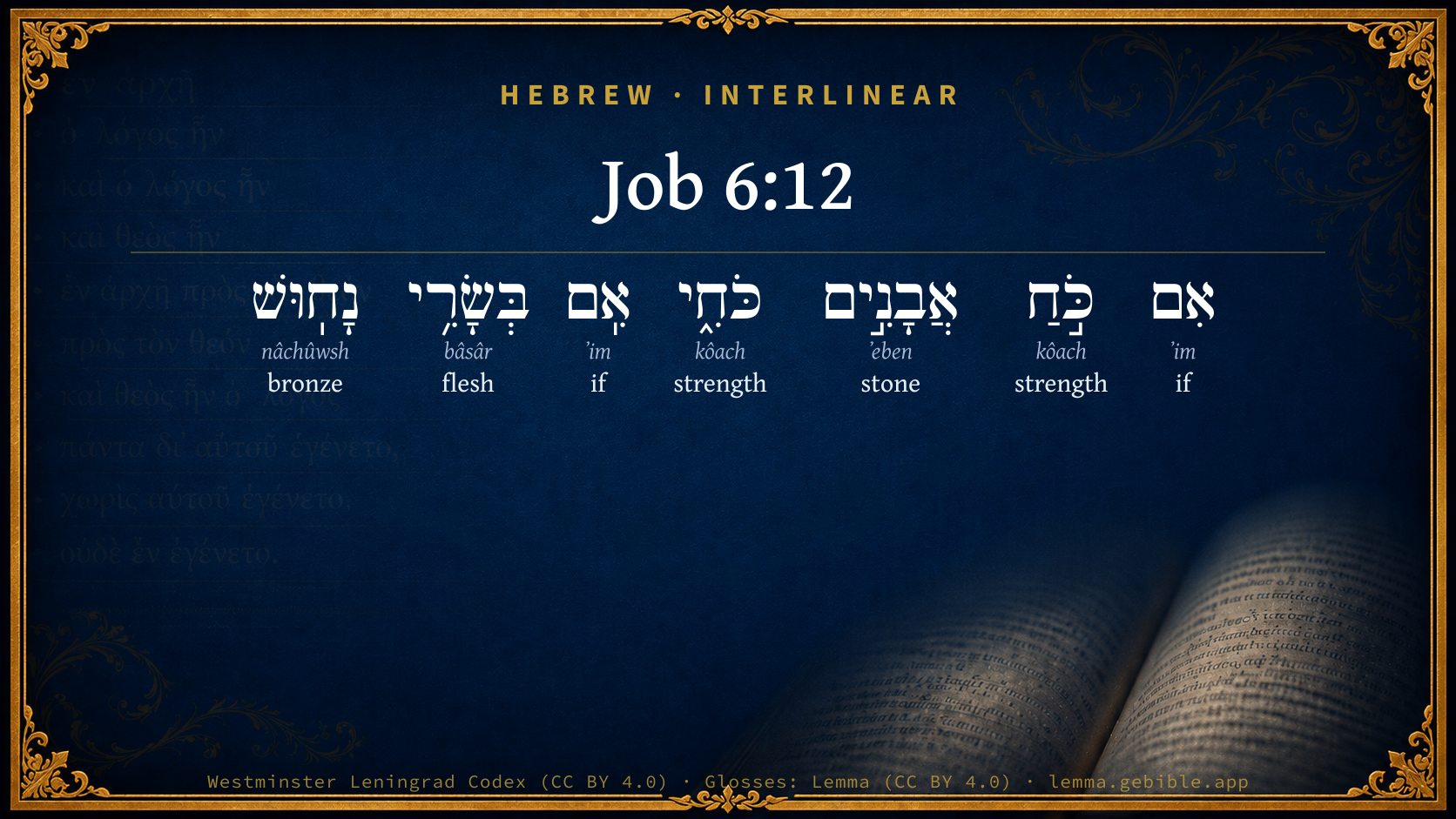
Hebrew (Westminster Leningrad Codex) Job 6:12 appears in the Hebrew Old Testament. The text above is from the Westminster Leningrad Codex. Each word links to its Strong’s number, a concise gloss, and parsing drawn from the Open Scriptures Hebrew Bible morphology. Click any word for its full Brown-Driver-Briggs (BDB) entry.
Download image
Cite this verse

Job 6:12 (World English Bible). Public Domain. Lemma interlinear Bible study tool, https://lemma.gebible.app/v/job/6/12.

Show BibTeX & RIS
BibTeX
RIS
English Translation
Is my strength the strength of stones? Or is my flesh of brass?
World English Bible · Public Domain
Highlights
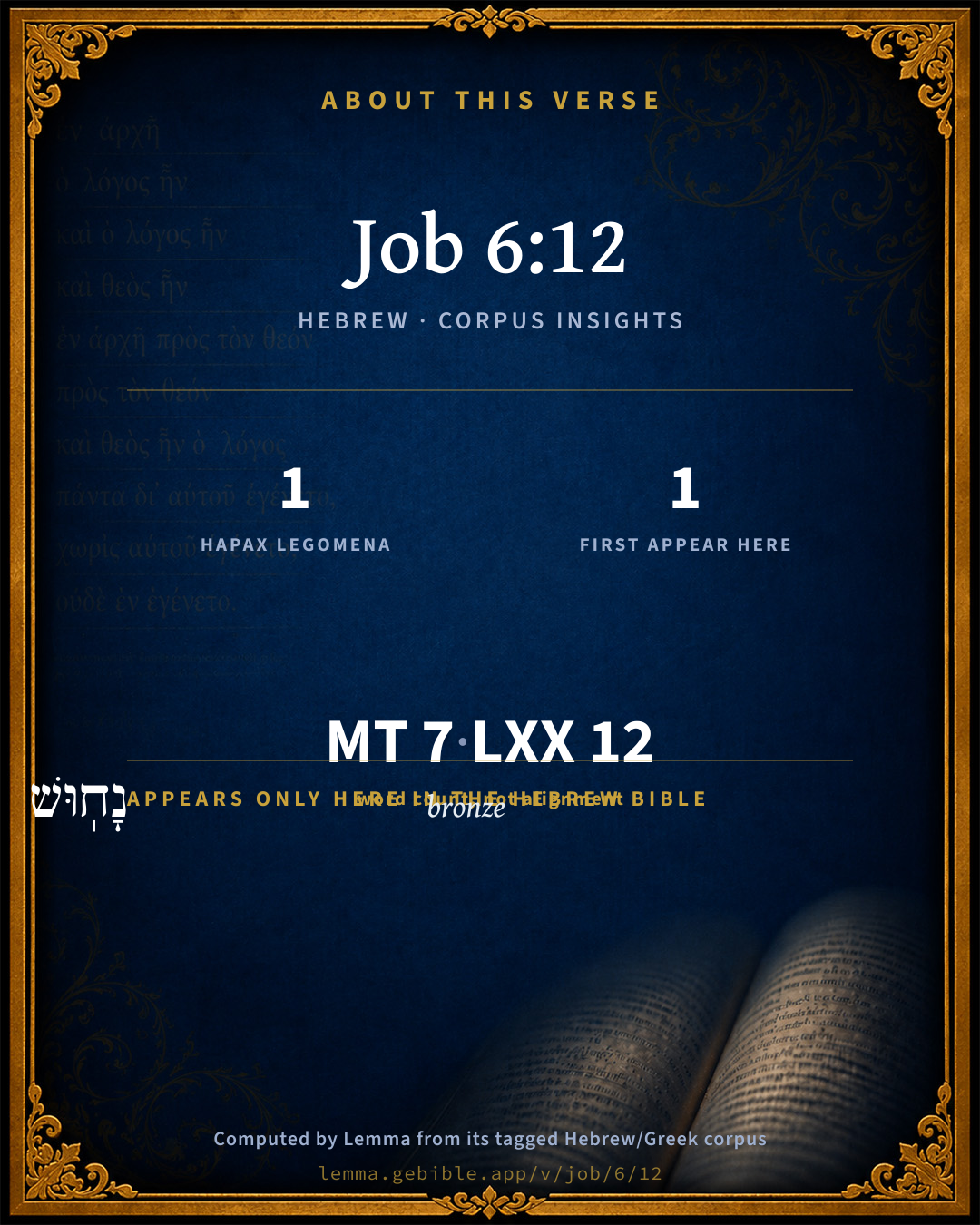
  • 1 hapax legomenon — only here in the Hebrew Bible
  • 1 first appearance in the Hebrew Bible
Full analysis ↓
Download a study sheet

One document with this verse’s original text, its word-by-word gloss line, the meaning frame, cross-references with their text, attributed commentary, and full source and license credits — printable, and it pastes into notes with its structure intact.

This verse Autodidact and up

Study sheet (.html) Plain text (.txt)

A passage Seminary Student

Up to 50 verses in one chapter. A passage sheet keeps up to 6 commentary sources and 12 cross-references per verse, in the order this page ranks them, and says so on the sheet whenever that leaves anything out. Ask for a single verse and you get the Autodidact verse sheet above.

Everything on this page stays free to read, with no account — the sheet is a download of what is already on screen, not access to it.

Want to remove ads? Support Godless Engineer
Compare translations 3

The same verse in 3 English versions, stacked beneath the original-language interlinear above. Click any original word for its lexicon entry.

Each is an independent rendering of the whole verse — the interlinear is not word-aligned to these translations.

Highlighted words mark where these versions differ — a whole-verse word diff, not a word-by-word alignment.

  • World English Bible Public Domain
    Is my strength the strength of stones? Or is my flesh of brass?
  • King James Version Public Domain
    Is my strength the strength of stones? or is my flesh of brass?
  • unfoldingWord Literal Text CC BY-SA 4.0
    If my strength the strength of stones? If my flesh bronze?

unfoldingWord Literal Text — © unfoldingWord, licensed CC BY-SA 4.0. Word-aligned USFM3 via Door43 (git.door43.org/unfoldingWord/en_ult).

Versions to compare (up to 4)

3 of 4 selected

Show all 18 translations

Every available English version of this verse, each an independent rendering of the whole verse.

  • World English Bible Public Domain
    Is my strength the strength of stones? Or is my flesh of brass?
  • Berean Standard Bible Public Domain
    Is my strength like that of stone, or my flesh made of bronze?
  • Majority Standard Bible Public Domain
    Is my strength like that of stone, or my flesh made of bronze?
  • King James Version Public Domain
    Is my strength the strength of stones? or is my flesh of brass?
  • American Standard Version (1901) Public Domain
    Is my strength the strength of stones? Or is my flesh of brass?
  • Revised Version (1885) Public Domain
    Is my strength the strength of stones? or is my flesh of brass?
  • Geneva Bible (1599) Public Domain
    Is my strength the strength of stones? or is my flesh of brasse?
  • Douay-Rheims (1899) Public Domain
    My strength is not the strength of stones, nor is my flesh of brass.
  • Young's Literal Translation Public Domain
    Is my strength the strength of stones? Is my flesh brazen?
  • Literal Standard Version CC BY-SA 4.0
    Is my strength the strength of stones? Is my flesh bronze?
  • Unlocked Literal Bible CC BY-SA 4.0
    Is my strength the strength of stones? Or is my flesh made of bronze?
  • unfoldingWord Literal Text CC BY-SA 4.0
    If my strength the strength of stones? If my flesh bronze?
  • Darby Bible Public Domain
    Is my strength the strength of stones? is my flesh of brass?
  • World Messianic Bible Public Domain
    Is my strength the strength of stones? Or is my flesh of bronze?
  • Webster's Bible Public Domain
    Is my strength the strength of stones? or is my flesh of brass?
  • Free Bible Version CC BY-SA 4.0
    Am I as strong as rock? Am I made out of bronze?
  • Bible in Basic English Public Domain
    Is my strength the strength of stones, or is my flesh brass?
  • JPS Tanakh (1917) Public Domain
    Is my strength the strength of stones? or is my flesh of brass?

Literal Standard Version (2020), Covenant Press — licensed CC BY-SA 4.0. Text via the HelloAO Bible API (eBible.org). Unlocked Literal Bible (unfoldingWord) — licensed CC BY-SA 4.0. Text via the HelloAO Bible API (eBible.org). unfoldingWord Literal Text — © unfoldingWord, licensed CC BY-SA 4.0. Word-aligned USFM3 via Door43 (git.door43.org/unfoldingWord/en_ult). Free Bible Version, Dr. Jonathan Gallagher — licensed CC BY-SA 4.0. Text via the HelloAO Bible API (eBible.org).

Word by word

More ways to search: Search by grammar → Find every occurrence → Compare this word →

Practice this passage: Drill this verse → Learn its vocabulary →

About this verse

These counts appear in no published source. They are computed here, from the morphology-tagged text and Lemma’s own curated glosses. What Lemma adds →

7
words
5
distinct lemmas
Wisdom
section

Notable vocabulary

1 hapax legomenon — a word that appears only here in the entire Hebrew Bible:

  • נָחֽוּשׁ bronze H5153

First appearance in Scripture

This word makes its first canonical appearance in the Hebrew Bible here:

  • נָחֽוּשׁ bronze H5153

Grammatical profile

  • 4 nouns
  • 1 adjective
  • 2 conjunctions

Repetition

Words recur within this verse — often emphatic in Hebrew:

  • כֹּ֣חַ strength H3581 ×2
  • אִם if H518 ×2

Hebrew & Septuagint length

In English translation the verse runs 13 words from the Hebrew and 13 from the Septuagint (LXX English) — the same length.

A rough comparison of the two English renderings, which tokenize alike — not a word-level alignment.

Word counts can differ between the Hebrew and the Greek without any difference in meaning — e.g. the Hebrew direct-object marker אֵת has no separate Greek word, and Greek often adds the article ὁ.

In the original languages it is 7 Hebrew tokens and 12 Greek tokens — but the two are counted differently (Hebrew bundles its prefixes and suffixes into one token; the Greek is in lemma form), so that isn’t a like-for-like length.

Cross-references

2

Topical passages linked to Job 6:12 in the Treasury of Scripture Knowledge — connected by theme and wording, ordered by reader-vote popularity; previews shown in the World English Bible.

  • Job 40:18 His bones are like tubes of brass. His limbs are like bars of iron.
  • Job 41:24 His heart is as firm as a stone, Yes, firm as the lower millstone.

Cross-references courtesy of OpenBible.info (CC BY 4.0).

Hebrew and Greek witnesses Masoretic Hebrew ↔ Greek Septuagint

The same verse in the two great witnesses to the Old Testament, shown verse-for-verse.

These are two independent witnesses, not word-aligned to each other, and the Septuagint is shown in lemma (dictionary) form.

Hebrew Job 6:12 Masoretic · Westminster Leningrad Codex

אִם כֹּ֣חַ אֲבָנִ֣ים כֹּחִ֑י אִֽם בְּשָׂרִ֥י נָחֽוּשׁ

Is my strength the strength of stones? Or is my flesh of brass?

World English Bible · Public Domain

Greek LXX Job 6:12 Septuagint · lemma form

μή ἰσχύς λίθος ὁ ἰσχύς ἐγώ ἤ ὁ σάρξ ἐγώ εἰμί χάλκειος

Is my strength the strength of stones? or is my flesh of brass?

LXX2012 (modern English Septuagint) · Public Domain

Hebrew: Westminster Leningrad Codex (CC BY 4.0). Greek: Septuagint (public domain); English from LXX2012 (modern English Septuagint) (Public Domain). How the Septuagint differs from the Hebrew →

Commentary

Notes on Job 6:12 from classic Christian and Jewish commentators (each source and its license shown beneath its notes). The classic Christian expositions comment on the surrounding passage and are grouped to its opening verse, so a note may address several verses; the Jewish commentaries on the Tanakh (Rashi and others) are per-verse, so they appear only where the commentator wrote on this verse.

Lemma curates 59 commentaries, every one of them public domain or Creative Commons licensed, each selected and text-cleaned for this edition rather than reprinted as found. About our sources →

Trapp's Complete Commentary

John Trapp

Job 6:12 [Is] my strength the strength of stones? or [is] my flesh of brass?

Ver. 12. Is my strength the strength of stones? or is my flesh of brass?] Is it made of marble, or of the hardest metal? as it is said of one in Homer, that he was χαλκεντερος, of brazen bowels, and of Julius Scaliger, that he had a golden soul in an iron body; he was a very iron sides: but so was not Job; he had neither a body of brass, nor sinews of iron, to stand out against so many storms, and bear so many batteries; he felt what he endured, and could not long endure what he felt. As for the damned in hell, they are by the power of God upheld for ever, that they may suffer his fierce wrath for ever; which else they could never do. And as for those desperate assassins, Baltasar Gerardus, the Burgundian, who slew the Prince of Orange, A. D. 1584, and Ravilliac ( Ferale illud prodigium, as one calleth him, that hideous hell hound), who slew Henry IV of France in the midst of his preparations, and endured thereupon most exquisite torments; this they did out of stupidity of sense, not solidity of faith; and from a reckless desperation, not a confident resolution.

John Trapp, A Commentary or Exposition upon All the Books of the Old and New Testament (1647–1656) — public domain. Text from a community e-Sword module.

Joseph Benson's Commentary

Job 6:12. Is my strength the strength of stones? — I am not made of stone or brass, but of flesh and blood, as others are; therefore I am not able to endure these miseries longer, and can neither desire nor hope for the continuance of my life. Bishop Patrick’s paraphrase on this verse is, “God hath not made me insensible; and therefore do not wonder that I desire to be released from these very sharp pains.”

Joseph Benson's Commentary on the Old and New Testaments (1811–1818) — public domain. Text from a community e-Sword module.

Jamieson, Fausset & Brown

Robert Jamieson, A. R. Fausset & David Brown

Disease had so attacked him that his strength would need to be hard as a stone, and his flesh like brass, not to sink under it. But he has only flesh, like other men. It must, therefore, give way; so that the hope of restoration suggested by Eliphaz is vain (see on Job 5:11).

Jamieson, Fausset & Brown — Commentary Critical and Explanatory on the Whole Bible (1871) — public domain (CC PDM 1.0). Text via the HelloAO Bible API.

Adam Clarke's Commentary

Verse 12. Is my strength the strength of stones?] I am neither a rock, nor is my flesh brass, that I can endure all these calamities. This is a proverbial saying, and exists in all countries. Cicero says, Non enim est e saxo sculptus, aut e ROBORE dolatus HOMO; habet corpus, habet animum; movetur mente, movetur sensibus. "For man is not chiselled out of the rock, nor hewn out of the oak; he has a body, and he has a soul; the one is actuated by intellect, the other by the senses." Quaest. Acad. iv. 31. So Homer, where he represents Apollo urging the Trojans to attack the Greeks: -

Νεμεσησε δ' Απολλων,

Περγαμου εκκατιδων· Τρωεσσι δε κεκλετ' αυσας·

Ορνυσθ', ἱπποδαμοι Τρωες, μηδ' εικετε χαρμης

Αργειοις· επει ου σφιλιθος χρως, ουδε σιδηρος,

Χαλκον ανασχεσθαι ταμεσιχροα βαλλομενοισιν.

ILLIAD, lib. iv., ver. 507.

But Phoebus now from Ilion's towering height

Shines forth reveal'd, and animates the fight.

Trojans, be bold, and force to force oppose;

Your foaming steeds urge headlong on the foes!

Nor are their bodies ROCKS, nor ribb'd with STEEL;

Your weapons enter, and your strokes they feel.

POPE.

These are almost the same expressions as those in Job.

Adam Clarke's Commentary on the Bible (1810–1826) — public domain. Text from a community e-Sword/MySword module.

The Cambridge Bible for Schools and Colleges

gen. ed. J. J. S. Perowne

12. Unless his strength were that of stones or his flesh brass he could not hold out against the exhausting afflictions which he has to bear, or recover from them.

The Cambridge Bible for Schools and Colleges (gen. ed. J. J. S. Perowne; Cambridge University Press, 1878–1918) — public domain. Text from a community e-Sword module.

John Gill's Exposition

Is my help in me?.... Or "my defence" (y), as some; is it not in my power to defend myself against the calumnies and reproaches cast upon me? it is; and, though one have no help in myself to bear my burdens, or extricate myself out of my difficulties, yet I have the testimony of a good conscience within me, that supports me; and I have the strength and force of reason and argument on my side, to defend me against all objectors:

and is wisdom driven from me? either sound doctrine, the law (z), or, rather, the Gospel, the wisdom of God in a mystery, revealed in the words of the Holy One before mentioned; or wisdom in the hidden part, the fear of God, which is wisdom, true grace in the heart, which, when once implanted, can never be driven out; or natural reason and understanding, of which he was not bereaved; for, though his body was thus sorely afflicted, he retained his reasoning and intellectual faculties. The words, in connection with the former, may be read, "what, if help is not with me, is wisdom also driven quite from me?" (a) does it follow, because I am not able to help myself out of this afflicted and distressed condition in which I am, that I am deprived of my reason? or be it that I am such a weak impotent creature, and even distracted, as you take me to be, should I not then rather be pitied than insulted? so some (b) connect the words following.

(y) "defensio mea penes me", Junius et Tremellius, Piscator. (z) "lex", Mercerus; so Peritsol. (a) So Cocceius and Schultens. (b) So De Dieu.

John Gill's Exposition of the Whole Bible (1746–1763) — public domain (CC PDM 1.0). Text via the HelloAO Bible API.

Albert Barnes' Notes on the Bible

Is my strength the strength of stones? - That is, like a rampart or fortification made of stones, or like a craggy rock that can endure assaults made upon it. A rock will bear the beatings of the tempest, and resist the floods, but how can frail man do it? The idea of Job is, that he had no strength to bear up against these accumulated trials; that he was afraid that he should be left to sink under them, and to complain of God; and that his friends were not to wonder if his strength gave way, and he uttered the language of complaint.

Or is my flesh of brass? - Margin, “brazen.” The comparison used here is not uncommon. So Cicero, Aca. Qu. iv. 31, says, Non enim est e saxo sculptus, ant e robore dolatus homo; habet corpus, habet animum; movetur mente, movetur sensibus: - “for man is not chiselled out of the rock, nor cut from a tree; he has a body, he has a soul; he is actuated by mind, he is swayed by senses.” So Theocritus, in his description of Amycus, Idyll. xxii. 47:

Στήθεα δ ̓ ἐσφαίρωτο πελώρια και πλατὺ νῶτον,

Σαρκὶ σιδαρείῃ σφυρήλακος οἷα κολασσός.

Stēthea d' esfairōto pelōria kai platu nōton,

Sarki sidareiē sfurēlakos hoia kolossos.

Round as to his vast breast and broad back, and with iron flesh, he is as if a colossus formed with a hammer - So in Homer the expression frequently occurs - σιδήρειον ἦτορ sidēreion ētor - an iron heart - to denote courage. And so, according to Schultens, it has come to be a proverb, οὐκ ἀπὸ δρυὸς, οὐκ ἀπο πέτρης ouk apo druos, ouk apo petrēs - not from a tree, not from a rock. The meaning of Job is plain. He had flesh like others. His muscles, and nerves, and sinews, could not bear a constant force applied to them, as if they were made of brass or iron. They must give way; and he apprehended that he would sink under these sorrows, and be left to use language that might dishonor God. At all events, he felt that these great sorrows justified the strong expressions which he had already employed.

Albert Barnes' Notes on the Bible (1834–1885) — public domain. Text from a community e-Sword/MySword module.

Haydock's Catholic Bible Commentary

Brass. This is proverbial. Homer (Iliad A) says, "Attack the Greeks; their skin is neither of stone, (Calmet) iron, or brass." Those who are aware of their own frailty, ought not to expose themselves to dangerous company, particularly to those of the other sex.

George Leo Haydock (1774–1849), Haydock's Catholic Family Bible and Commentary, 1859 edition — public domain. Excludes Psalms (Douay-Rheims chapter numbering differs from Protestant) and Deuterocanonical books (Catholic canon only).

Matthew Poole's English Annotations

I am not made of stone or brass, but of flesh and blood, as others are; and therefore I am utterly unable to endure these miseries longer, and can neither hope for nor desire any continuance of my life, or restoration of my former happiness, but only wish for that death which is the common refuge of all miserable persons, as I said, Job 3:17,18.

Matthew Poole's English Annotations on the Holy Bible (1683–1685) — public domain. Text from a community e-Sword/MySword module.

Whedon's Commentary on the Bible

Daniel D. Whedon

12. Is my flesh of brass — That is, invulnerable? Brass is used sometimes as the symbol of incorrigible pride and wanton immorality, and sometimes as an emblem of durability and strength. — (Eadie.) The ancients possessed some secret for hardening brass (more properly copper) so as to make it firm like iron. “For man,” says Cicero, “is not sculptured out of the rock, nor hewn out of the oak-tree: he has body, he has mind; he is moved by mind, he is actuated by senses.” — Acad. Quest., 4:31.

Daniel D. Whedon (gen. ed.), Commentary on the Old and New Testaments (1874–1909) — public domain. Text from a community e-Sword module.

The Pulpit Commentary

Is my strength the strength of stones? or is my flesh of brass? It would require a man to have a body of brass, and strength like that of rocks, for him to be able to endure the ravages of such a disease, and yet to recover from it. Job cannot pretend to either.

The Pulpit Commentary (1880–1919), ed. H.D.M. Spence-Jones & Joseph S. Exell — public domain. Text from a community e-Sword module.

John Wesley's Explanatory Notes

Is, &c. - I am not made of stone or brass, but of flesh and blood, as others are, therefore I am unable to endure these miseries longer, and can neither hope for. nor desire the continuance of my life.

John Wesley, Explanatory Notes Upon the Whole Bible (1754–1765) — public domain. Text via the GEBible commentary corpus.

unfoldingWord translationNotes

Door43 World Missions Community

General Information:

The writer uses parallel rhetorical questions in each of these verses to emphasize Job's lack of strength to endure suffering. (See: Parallelism)

Is my strength the strength of stones? Or is my flesh made of bronze?

Job describes the weakness of his body by saying that he is not as strong as rocks and bronze to emphasize his lack of strength. These rhetorical questions may be written as statements. AT: "I am not as strong as the rocks. My flesh is not as strong as metal." (See: Rhetorical Question)

Is it not true that I have no help in myself ... me?

Job uses this rhetorical question to emphasize his lack of wisdom and his weakness. This question can be written as a statement. Also, the phrase "no help in myself" is an idiom. AT: "It is true that I have no strength left ... me." (See: Rhetorical Question and Idiom)

wisdom has been driven out of me

"my success has been taken from me." This can be stated in active form. AT: "my wisdom is gone" (See: Active or Passive)

translationWords

stone

flesh

bronze

wise

unfoldingWord translationNotes — © Distant Shores Media and the Door43 World Missions Community, licensed CC BY-SA 4.0. Source: git.door43.org/Door43/en_tn.

Lesson kit

Teaching starters — assembled from the data on this page, not authored interpretation. Every prompt links to the verse data it draws on. Edit before teaching.

Job, in the Wisdom, opens this verse with 7 words (5 distinct Hebrew lemmas). Its most distinctive word is nâchûwsh (“bronze”). A historical commentator’s framing appears above. Read the whole chapter for the surrounding context.

Discussion questions

  1. How does “bronze” (nâchûwsh) shape what this verse is saying?
  2. This verse holds 1 word here found nowhere else in the Hebrew Bible. What might the rare word draw attention to?
  3. The word “bronze” first appears here in Scripture. What is being introduced at this debut?
  4. Job 40:18 shares this passage’s theme. How do the two illuminate each other?
  5. “strength” occurs 2× in this one verse. What is the effect of the repetition?
  6. The translations on this page render this verse differently — a whole-verse word diff, not a word-by-word alignment. What might account for the different wordings?
  7. Reading how Trapp's Complete Commentary and Joseph Benson's Commentary read this verse, where do the two commentators agree and where do they part?

Things to notice

  • 1 word in this verse appears nowhere else in the Hebrew Bible.
  • 1 word makes its first canonical appearance in Scripture here.
  • This verse counts 7 Hebrew ↔ 12 Greek words.
  • These translations choose different wording for 2 words in this verse.
  • “strength” occurs 2× in this single verse.

Reading settings

Reading text

Shown beneath each verse's original-language words.

Old Testament
Old Testament edition

Read the OT as the Masoretic Hebrew (MT) or the Greek Septuagint (LXX).

English shown for the Greek Septuagint (in the Hebrew ↔ Greek comparison).

Comparing translations? Open the Compare panel on any verse page to stack up to four side by side.