
Psalms 102:23

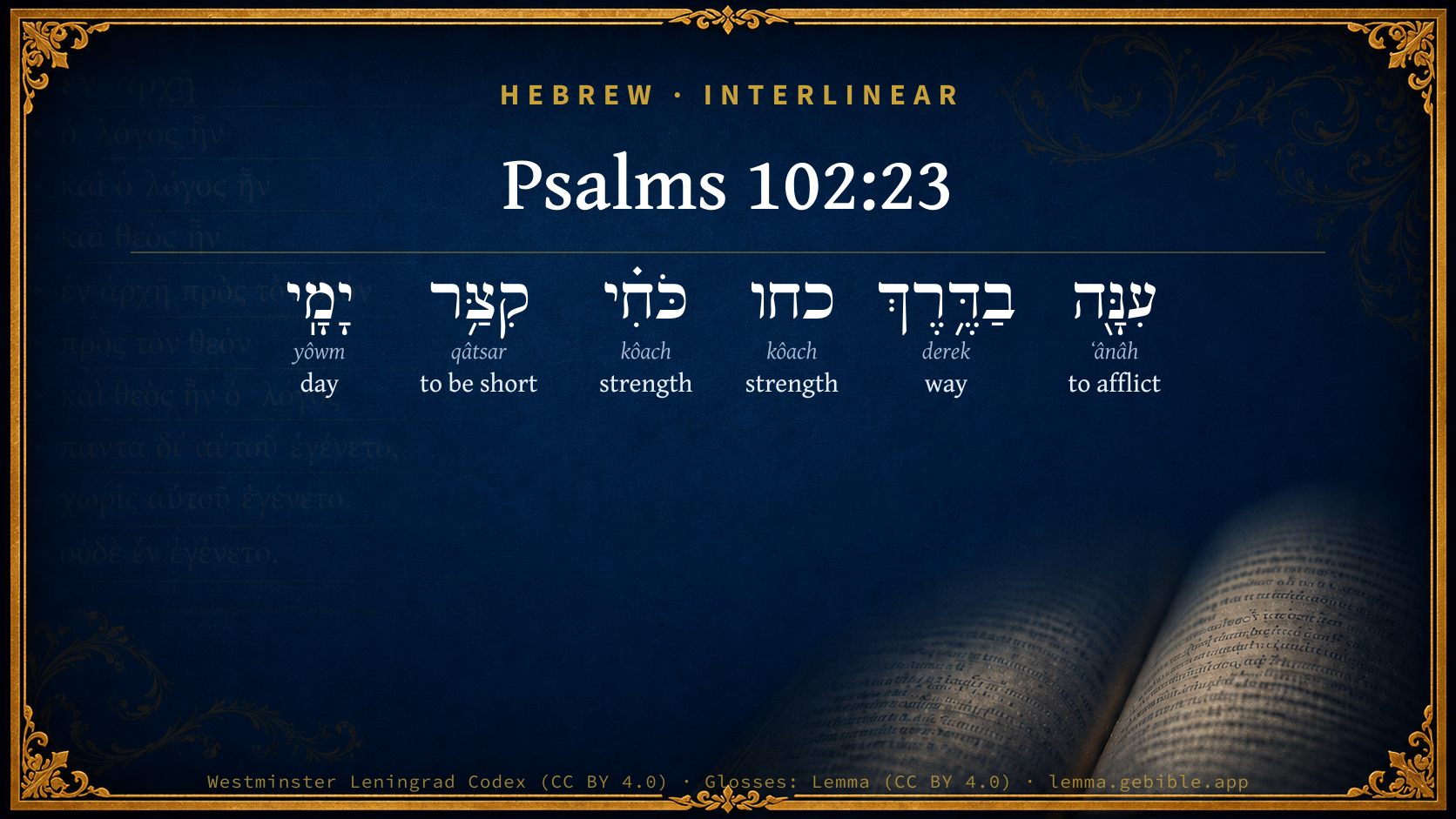
Hebrew (Westminster Leningrad Codex) Psalms 102:23 appears in the Hebrew Old Testament. The text above is from the Westminster Leningrad Codex. Each word links to its Strong’s number, a concise gloss, and parsing drawn from the Open Scriptures Hebrew Bible morphology. Click any word for its full Brown-Driver-Briggs (BDB) entry.
Download image
Cite this verse

Psalms 102:23 (World English Bible). Public Domain. Lemma interlinear Bible study tool, https://lemma.gebible.app/v/psalms/102/23.

Show BibTeX & RIS
BibTeX
RIS
English Translation
He weakened my strength along the course. He shortened my days.
World English Bible · Public Domain
Download a study sheet

One document with this verse’s original text, its word-by-word gloss line, the meaning frame, cross-references with their text, attributed commentary, and full source and license credits — printable, and it pastes into notes with its structure intact.

This verse Autodidact and up

Study sheet (.html) Plain text (.txt)

A passage Seminary Student

Up to 50 verses in one chapter. A passage sheet keeps up to 6 commentary sources and 12 cross-references per verse, in the order this page ranks them, and says so on the sheet whenever that leaves anything out. Ask for a single verse and you get the Autodidact verse sheet above.

Everything on this page stays free to read, with no account — the sheet is a download of what is already on screen, not access to it.

Want to remove ads? Support Godless Engineer
Compare translations 3

The same verse in 3 English versions, stacked beneath the original-language interlinear above. Click any original word for its lexicon entry.

Each is an independent rendering of the whole verse — the interlinear is not word-aligned to these translations.

Highlighted words mark where these versions differ — a whole-verse word diff, not a word-by-word alignment.

  • World English Bible Public Domain
    He weakened my strength along the course. He shortened my days.
  • King James Version Public Domain
    He weakened my strength in the way; he shortened my days.
  • unfoldingWord Literal Text CC BY-SA 4.0
    He has broken my strength on the road. He has shortened my days.

unfoldingWord Literal Text — © unfoldingWord, licensed CC BY-SA 4.0. Word-aligned USFM3 via Door43 (git.door43.org/unfoldingWord/en_ult).

Versions to compare (up to 4)

3 of 4 selected

Show all 18 translations

Every available English version of this verse, each an independent rendering of the whole verse.

  • World English Bible Public Domain
    He weakened my strength along the course. He shortened my days.
  • Berean Standard Bible Public Domain
    He has broken my strength on the way; He has cut short my days.
  • Majority Standard Bible Public Domain
    He has broken my strength on the way; He has cut short my days.
  • King James Version Public Domain
    He weakened my strength in the way; he shortened my days.
  • American Standard Version (1901) Public Domain
    He weakened my strength in the way; He shortened my days.
  • Revised Version (1885) Public Domain
    He weakened my strength in the way; he shortened my days.
  • Geneva Bible (1599) Public Domain
    He abated my strength in the way, and shortened my dayes.
  • Douay-Rheims (1899) Public Domain
    When the people assemble together, and kings, to serve the Lord.
  • Young's Literal Translation Public Domain
    He hath humbled in the way my power, He hath shortened my days.
  • Literal Standard Version CC BY-SA 4.0
    He has humbled my power in the way, || He has shortened my days.
  • Unlocked Literal Bible CC BY-SA 4.0
    He has taken away my strength in the middle of life. He has shortened my days.
  • unfoldingWord Literal Text CC BY-SA 4.0
    He has broken my strength on the road. He has shortened my days.
  • Darby Bible Public Domain
    He weakened my strength in the way, he shortened my days.
  • World Messianic Bible Public Domain
    He weakened my strength along the course. He shortened my days.
  • Webster's Bible Public Domain
    \\102:22\\When the people are assembled, and the kingdoms, to serve the LORD.
  • Free Bible Version CC BY-SA 4.0
    But as for me, he broke my health while I was still young, cutting my life short.
  • Bible in Basic English Public Domain
    He has taken my strength from me in the way; he has made short my days.
  • JPS Tanakh (1917) Public Domain
    (102-24) He weakened my strength in the way; He shortened my days.

Literal Standard Version (2020), Covenant Press — licensed CC BY-SA 4.0. Text via the HelloAO Bible API (eBible.org). Unlocked Literal Bible (unfoldingWord) — licensed CC BY-SA 4.0. Text via the HelloAO Bible API (eBible.org). unfoldingWord Literal Text — © unfoldingWord, licensed CC BY-SA 4.0. Word-aligned USFM3 via Door43 (git.door43.org/unfoldingWord/en_ult). Free Bible Version, Dr. Jonathan Gallagher — licensed CC BY-SA 4.0. Text via the HelloAO Bible API (eBible.org).

Word by word

More ways to search: Search by grammar → Find every occurrence → Compare this word →

Practice this passage: Drill this verse → Learn its vocabulary →

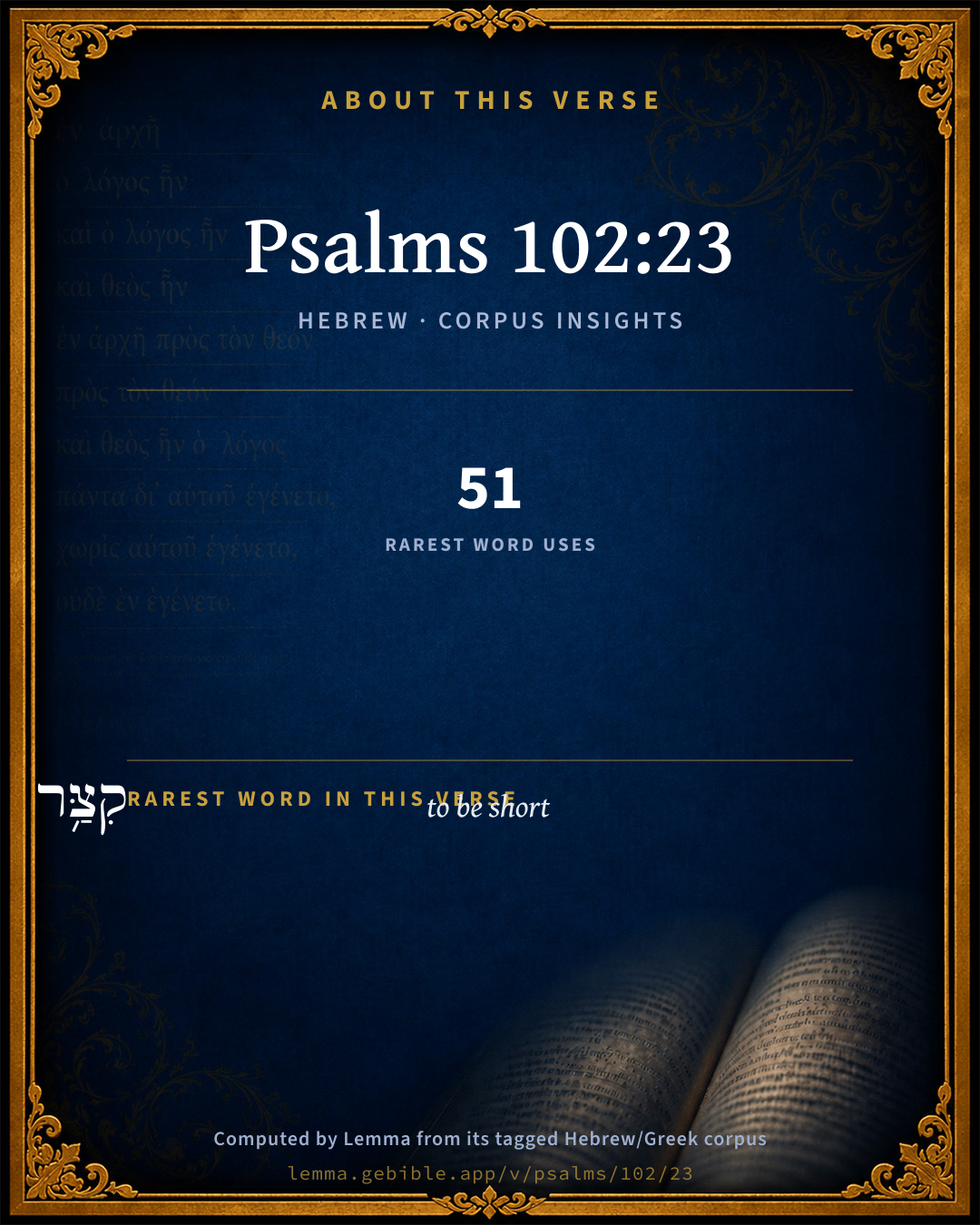
About this verse

These counts appear in no published source. They are computed here, from the morphology-tagged text and Lemma’s own curated glosses. What Lemma adds →

6
words
5
distinct lemmas
Wisdom
section

Shared distinctive vocabulary

קִצַּ֥ר to be short H7114 occurs in 46 verses of the Hebrew Bible. Also found in:

Grammatical profile

  • 2 verbs
  • 4 nouns

Verb forms

  • עִנָּ֖ה Piel · Perfect
  • קִצַּ֥ר Piel · Perfect

Repetition

A word recurs within this verse — often emphatic in Hebrew:

  • כחו strength H3581 ×2

Hebrew & Septuagint length

In English translation the verse runs 11 words from the Hebrew and 16 from the Septuagint (LXX English) — closely comparable.

A rough comparison of the two English renderings, which tokenize alike — not a word-level alignment.

Word counts can differ between the Hebrew and the Greek without any difference in meaning — e.g. the Hebrew direct-object marker אֵת has no separate Greek word, and Greek often adds the article ὁ.

Cross-references

6

Topical passages linked to Psalms 102:23 in the Treasury of Scripture Knowledge — connected by theme and wording, ordered by reader-vote popularity; previews shown in the World English Bible.

  • Job 21:21 For what does he care for his house after him, When the number of his months is cut off?
  • Psalms 89:38–47 But you have rejected and spurned. You have been angry with your anointed.
  • 2 Thessalonians 2:3–12 Let no one deceive you in any way. For it will not be, unless the departure comes first, and the man of sin is revealed, the son of destruction,
  • 1 Timothy 4:1–3 But the Spirit says expressly that in later times some will fall away from the faith, paying attention to seducing spirits and doctrines of demons,
  • 2 Timothy 3:1–17 But know this, that in the last days, grievous times will come.
  • Revelation 11:2–19 Leave out the court which is outside of the temple, and don't measure it, for it has been given to the gentiles. They will tread the holy city under foot for forty-two months.

Cross-references courtesy of OpenBible.info (CC BY 4.0).

Hebrew and Greek witnesses Masoretic Hebrew ↔ Greek Septuagint

The same verse in the two great witnesses to the Old Testament, shown verse-for-verse.

You’re reading Greek Psalm 101 (Hebrew Psalm 102). The Septuagint counts the superscription, so verse numbers can differ from the Hebrew — chapter-level alignment, not verse-by-verse. Numbering follows Rahlfs.

These are two independent witnesses, not word-aligned to each other, and the Septuagint is shown in lemma (dictionary) form.

Hebrew Psalms 102:23 Masoretic · Westminster Leningrad Codex

עִנָּ֖ה בַדֶּ֥רֶךְ כחו כֹּחִ֗י קִצַּ֥ר יָמָֽי

He weakened my strength along the course. He shortened my days.

World English Bible · Public Domain

Greek LXX Greek Psalm 101:23 Septuagint · lemma form

ἐν ὁ συνἄγω λαός ἐπί ὁ αὐτός καί βασιλεία ὁ δουλεύω ὁ κύριος

He answered him in the way of his strength: tell me the fewness of my days.

LXX2012 (modern English Septuagint) · Public Domain

On this verse, Keil & Delitzsch discusses the Septuagint’s reading. Read the note in Commentary ↓

Hebrew: Westminster Leningrad Codex (CC BY 4.0). Greek: Septuagint (public domain); English from LXX2012 (modern English Septuagint) (Public Domain). How the Septuagint differs from the Hebrew →

Commentary

Notes on Psalms 102:23 from classic Christian and Jewish commentators (each source and its license shown beneath its notes). The classic Christian expositions comment on the surrounding passage and are grouped to its opening verse, so a note may address several verses; the Jewish commentaries on the Tanakh (Rashi and others) are per-verse, so they appear only where the commentator wrote on this verse.

Lemma curates 59 commentaries, every one of them public domain or Creative Commons licensed, each selected and text-cleaned for this edition rather than reprinted as found. About our sources →

Matthew Henry's Commentary

We may here observe,

I. The imminent danger that the Jewish church was in of being quite extirpated and cut off by the captivity in Babylon (Psa 102:23): He weakened my strength in the way. They were for many ages in the way to the performance of the great promise made to their fathers concerning the Messiah, longing as much for it as ever a traveller did to be at his journey's end. The legal institutions led them in the way; but when the ten tribes were lost in Assyria, and the two almost lost in Babylon, the strength of that nation was weakened, and, in all appearance, its day shortened; for they said, Our hope is lost; we are cut off for our parts, Eze 37:11. And then what becomes of the promise that Shiloh should arise out of Judah, the star out of Jacob, and the Messiah out of the family of David? If these fail, the promise fails. This the psalmist speaks of as in his own person, and it is very applicable to two of the common afflictions of this time: - 1. To be sickly. Bodily distempers soon weaken our strength in the way, make the keepers of the house to tremble and the strong men to bow themselves. 2. To be short-lived. Where the former is felt, this is feared; when in the midst of our days, according to a course of nature, our strength is weakened, what can we expect but that the number of our months should be cut off in the midst? and what should we do but provide accordingly? We must own God's hand in it (for in his hand our strength and time are), and must reconcile it to his love, for it has often been the lot of those that have used their strength well to have it weakened, and of those that could very ill be spared to have their days shortened.

II. A prayer for the continuance of it (Psa 102:24): "O my God! take me not away in the midst of my days; let not this poor church be cut off in the midst of the days assigned it by the promise; let it not be cut off till the Messiah shall come. Destroy it not, for that blessing is in it," Isa 65:8. She is a criminal, but, for the sake of that blessing which is in her, she pleads for a reprieve. This is a prayer for the afflicted, and which, with submission to the will of God, we may in faith put up, that God would not take us away in the midst of our days, but that, if it be his will, he would spare us to do him further service and to be made riper for heaven.

III. A plea to enforce this prayer taken from the eternity of the Messiah promised, Psa 102:25-27. The apostle quotes these verses (Heb 1:10-12) and tells us, He saith this to the Son, and in that exposition we must acquiesce. It is very comfortable, in reference to all the changes that pass over the church, and all the dangers it is in, that Jesus Christ is the same yesterday, today, and for ever. Thy years are throughout all generations, and cannot be shortened. It is likewise comfortable in reference to the decay and death of our own bodies, and the removal of our friends from us, that God is an everliving God, and that therefore, if he be ours, in him we may have everlasting consolation. In this plea observe how, to illustrate the eternity of the Creator, he compares it with the mutability of the creature; for it is God's sole prerogative to be unchangeable. 1. God made the world, and therefore had a being before it from eternity. The Son of God, the eternal Word, made the world. It is expressly said, All things were made by him, and without him was not any thing made that was made; and therefore the same was in the beginning from eternity with God, and was God, Joh 1:1-3; Col 1:16; Eph 3:9; Heb 1:2. Earth and heaven, and the hosts of both, include the universe and its fulness, and these derive their being from God by his Son (Psa 102:25): "Of old hast thou laid the foundation of the earth, which is founded on the seas and on the floods and yet it abides; much more shall the church, which is built upon a rock. The heavens are the work of thy hands, and by thee are all their motions and influences directed;" God is therefore the fountain, not only of all being, but of all power and dominion. See how fit the great Redeemer is to be entrusted with all power, both in heaven and in earth, since he himself, as Creator of both, perfectly knows both and is entitled to both. 2. God will unmake the world again, and therefore shall have a being to eternity (Psa 102:26, Psa 102:27): They shall perish, for thou shalt change them by the same almighty power that made them, and therefore, no doubt, thou shalt endure; thou art the same. God and the world, Christ and the creature, are rivals for the innermost and uppermost place in the soul of man, the immortal soul; now what is here said, one would think, were enough to decide the controversy immediately and to determine us for God and Christ. For, (1.) A portion in the creature is fading and dying: They shall perish; they will not last so long as we shall last. The day is coming when the earth and all the works that are therein shall be burnt up; and then what will become of those that have laid up their treasure in it? Heaven and earth shall wax old as a garment, not by a gradual decay, but, when the set time comes, they shall be laid aside like an old garment that we have no more occasion for: As a vesture shalt thou change them, and they shall be changed, not annihilated, but altered, it may be so that they shall not be at all the same, but new heavens and a new earth. See God's sovereign dominion over heaven and earth. He can change them as he pleases and when he pleases; and the constant changes they are subject to, in the revolutions of day and night, summer and winter, are earnests of their last and final change, when the heavens and time (which is measured by them) shall be no more. (2.) A portion in God is perpetual and everlasting: Thou art the same, subject to no change; and thy years have no end, Psa 102:27. Christ will be the same in the performance that he was in the promise, the same to his church in captivity that he was to his church at liberty. Let not the church fear the weakening of her strength, or the shortening of her days, while Christ himself is both her strength and her life; he is the same, and has said, Because I live you shall live also. Christ came in the fulness of time, and set up his kingdom in spite of the power of the Old Testament Babylon, and he will keep it up in spite of the power of the New Testament Babylon.

IV. A comfortable assurance of an answer to this prayer (Psa 102:28): The children of thy servants shall continue; since Christ is the same, the church shall continue from one generation to another; from the eternity of the head we may infer the perpetuity of the body, though often weak and distempered, and even at death's door. Those that hope to wear out the saints of the Most High will be mistaken. Christ's servants shall have children; those children shall have a seed, a succession, of professing people; the church, as well as the world, is under the influence of that blessing, Be fruitful and multiply. These children shall continue, not in their own persons, by reason of death, but in their seed, which shall be established before God (that is, in his service, and by his grace); the entail of religion shall not be cut off while the world stands, but, as one generation of good people passes away, another shall come, and thus the throne of Christ shall endure.

Matthew Henry's Commentary on the Whole Bible (1708–1710) — public domain (CC PDM 1.0). Text via the HelloAO Bible API.

Trapp's Complete Commentary

John Trapp

Psa 102:23 He weakened my strength in the way; he shortened my days.

Ver. 23. He weakened my strength in the way] This is the complaint of the poor captives yet undelivered, In via, hoc est in vita, quia hic sumus viatores, in coelo comprehensores, here we are but on our way to heaven, and we meet with many discouragements.

He shortened my days] viz. According to my account; for otherwise in respect of God our days are numbered.

Stat sua cuique dies.

John Trapp, A Commentary or Exposition upon All the Books of the Old and New Testament (1647–1656) — public domain. Text from a community e-Sword module.

Joseph Benson's Commentary

Psa 102:23. He — Namely, God, whom he considered as bringing these calamities upon them for their sins, and to whom therefore he applies for relief; weakened my strength in the way — That is, soon impaired the prosperity and flourishing condition of our church and commonwealth, in the course of our affairs. “They were for many ages,” says Henry, “in the way to the performance of the great promise made to their fathers, concerning the Messiah, longing as much for it as ever a traveller did to be at his journey’s end; the legal institutions led them in the way; but when the ten tribes were lost in Assyria, and the two almost lost in Babylon, the strength of that nation was weakened, and, in all appearances, its days shortened, for they said, Our hope is lost, we are cut off for our parts, Eze 37:11.” “The prophet,” says Dr. Horne, “in the person of captive Zion, having, from Psa 102:13-22, expressed his faith and hope in the promised redemption, now returns to his mournful complaints as at Psa 102:11. Israel doubts not of God’s veracity, but fears lest his heavy hand should crush the generation then in being, before they should behold the expiration of their troubles. They were in the way, but their strength was so weakened, and their days shortened, that they almost despaired of holding out to their journey’s end.” Bishop Patrick, however, supposes that the psalmist spake of himself personally, and interprets the passage thus: “I had hopes to have lived to see this blessed time, (namely, of the redemption from Babylon, and the accession of the Gentile nations to the church of God, spoken of in the preceding verses,) “and thought I had been in the way to it, Ezr 3:8. But he hath stopped our vigorous beginnings, Ezr 4:4, and thereby so sorely afflicted me, that I feel I am like to fall short of my expectations.” Dr. Dodd understands the words nearly in the same sense, observing, “The connection is this: ‘Notwithstanding these glorious hopes of being speedily restored to my native country, I find that through continual affliction God hath weakened my strength, even while I thought I was in the way to that happiness; and that, on account of the short remainder of my life, I shall not be able to attain it.’” This interpretation of the words connects well with the following verse.

Joseph Benson's Commentary on the Old and New Testaments (1811–1818) — public domain. Text from a community e-Sword module.

Whedon's Commentary on the Bible

Daniel D. Whedon

23. He weakened my strength in the way—The psalmist returns to a brief reminiscence of his affliction and the agony of his prayer, but in a more hopeful strain than in his complaint, Psa_102:1-11. “In the way,” here, may be understood by means of “the way,” as “in fetters” means, by means of “fetters,” (Psa_105:18,) and in “the way” means, because of “the way,” (Num_21:4,) or, it may signify that the visitations of God “along the way,” had bowed down his “strength.” But the former is the more probable sense. The allusion is to the journeyings of Israel in the desert. See Exo_18:8; Num_17:12-13; Deu_8:2; especially, Num_21:4, “And the soul of the people was much discouraged because of the way.” The abrupt transition of Psa_102:23-24, is exceedingly impassioned and plaintive.

Daniel D. Whedon (gen. ed.), Commentary on the Old and New Testaments (1874–1909) — public domain. Text from a community e-Sword module.

J. A. Alexander on Psalms

Joseph Addison Alexander

24. (Psa 102:23) He has humbled in the way his strength; he has, shortened my days. The Psalmist here resumes the tone of complaint, but only for a moment, and as an introduction to what follows. Humbled, weakened, or afflicted. In or by the way of his providential guidance, as distinguished from the glorious end to which it led. His strength and my days seem clearly to refer to the same person. To avoid this harsh enallage, the masoretic critics changed a single letter, and for his strength read my strength, which, though adopted in most versions, is an obvious evasion of a supposed difficulty. With the last clause compare Psa 89:45. See also Psa 55:23.

Joseph Addison Alexander, The Psalms Translated and Explained (1850) — public domain. Text from a community e-Sword module.

Tyndale Open Study Notes

Tyndale Open Resources

102:23-28 Although the psalmist suffers in the present, he bases his hope for the future on the Lord’s past faithfulness.

Tyndale Open Study Notes — © Tyndale Open Resources, licensed CC BY-SA 4.0. Text via the HelloAO Bible API.

Geneva Bible (1599)

Geneva Bible translators

The Church laments that they see not the time of Christ, which was promised, but have but few years and short days.

Geneva Bible (1599) marginal notes — public domain. Text via Bolls.life.

Adam Clarke's Commentary

Verse 23. He weakened my strength in the way] We are brought so low in our captivity by oppression, by every species of hard usage, and by death, that there is now no hope of our restoration by any efforts of our own.

Adam Clarke's Commentary on the Bible (1810–1826) — public domain. Text from a community e-Sword/MySword module.

John Calvin's Commentaries

23. He hath afflicted my strength in the way Some improperly restrict this complaint to the time when the Jews were subjected to much annoyance after the liberty granted them to return to their own land. We are rather to understand the word journey or way in a metaphorical sense. As the manifestation of Christ was the goal of the race which God’s ancient people were running, they justly complain that they are afflicted and weakened in the midst of their course. Thus they set before God his promise, telling him, that although they had not run at random, but had confided in his protection, they were nevertheless broken and crushed by his hand in the midst of their journey. They do not indeed find fault with him, as if he had disappointed their hope; but fully persuaded, that he does not deal deceitfully with those who serve him, by this complaint they strengthen themselves in the hope of a favorable issue. In the same sense they add, that their days were shortened, because they directed their view to the fullness of time, which did not arrive till Christ was revealed. It accordingly follows, — (verse 24,) Cut me not off in the midst of my days. They compare the intervening period until Christ should appear to the middle of life; for, as has been already observed, the Church only attained to her perfect age at his coming. This calamity, no doubt, had been foretold, but the nature of the covenant which God had entered into with his ancient people required that he should take them under his protection, and defend them. The captivity, therefore, was as it were a violent rupture, on which account the godly prayed with the greater confidence, that they might not be prematurely taken away in the midst of their journey. By speaking in this manner, they did not fix for themselves a certain term of life; but as God, in freely adopting them, had given them the commencement of life, with the assurance that he would maintain them even to the advent of Christ, they might warrantably bring forward and plead this promise. Lord, as if they had said, thou hast promised us life, not for a few days, or for a month or for a few years, but until thou shouldst renew the whole world, and gather together all nations under the dominion of thine Anointed One.

John Calvin's Commentaries (1540-1563) — public domain. Text from the Calvin Translation Society English edition (1840s-50s) via the Christian Classics Ethereal Library (ccel.org). Calvin's coverage is partial (roughly two-thirds of the Bible); uncommented books and verses are honest gaps, never fabricated. The 19th-century editor's footnotes and remarks are omitted so the notes are faithfully Calvin's own voice.

Ellicott's Commentary for English Readers

(23) In the way—i.e., in the course of life. Others render, “by reason of the way,” but the meaning is the same. The clause is exactly parallel to “shortened my days.”

A Bible Commentary for English Readers, edited by Charles John Ellicott (1878–1897) — public domain. Text from a community e-Sword module.

The Cambridge Bible for Schools and Colleges

gen. ed. J. J. S. Perowne

23, 24. He hath brought down my strength in the way;

He hath shortened my days.

I will say, O my God &c.

Life has been a toilsome journey for him; he is prematurely old; but he deprecates an untimely death. He would fain survive to see with his own eyes the glory which he knows is to be revealed. Cp. Psa_89:47, note. The contrast of God’s eternal years adds pathos to the thought of the brevity of his own life, yet at the same time that eternity is the guarantee for His faithfulness to His people.

My strength is the traditional reading (Q’rç), which is supported by most of the Versions. The written text (K’thîbh) has his strength, which must be rendered, He hath afflicted me with his strength; or, His strength hath brought me down. But the Q’rç gives a better sense.

23–28. From the contemplation of the glorious future the Psalmist returns to the present, and takes up the thought of Psa_102:11.

The Cambridge Bible for Schools and Colleges (gen. ed. J. J. S. Perowne; Cambridge University Press, 1878–1918) — public domain. Text from a community e-Sword module.

John Gill's Exposition

I said, O my God, take me not away in the midst of my days;.... Which was always reckoned as a judgment, as a token of God's sore displeasure, and as what only befell wicked men, Psa 55:23, in the Hebrew it is, "cause me not to ascend" (f); either as smoke, which ascends, and vanishes away; or rather it designs the separation of the soul from the body at death, when it ascends upwards to God that gave it; so Aben Ezra compares it with Ecc 12:7, the Targum is,

"do not take me out of the world in the midst of my days, bring me to the world to come:''

some, who think that Daniel was the penman of this psalm, or some other, about the time of the Babylonish captivity, curiously observe, that that period was much about the middle between the building of Solomon's temple and the coming of Christ, the antitype of it; which was about a thousand years, of which four hundred and ninety were to come, according to Daniel's weeks; so, representing the church, prays they might not be destroyed, as such; but be continued till the Messiah came:

thy years are throughout all generations; which are not as men's years, of the same measure or number; but are boundless and infinite: the phrase is expressive of the eternity of God, or Christ; which the psalmist opposes to his own frailty, and which he illustrates in the following verses, by setting it in contrast with the discontinuance and changeableness of the heavens and the earth; see Job 10:5.

(f) "ne ascendere facias me", Montanus, Gejerus.

John Gill's Exposition of the Whole Bible (1746–1763) — public domain (CC PDM 1.0). Text via the HelloAO Bible API.

Albert Barnes' Notes on the Bible

He weakened my strength in the way - Margin, as in Hebrew, “afflicted.” The idea is, that God had taken his strength away; he had weakened him - humbled him - brought him low by sorrow. The word “way” refers to the course which he was pursuing. In his journey of life God had thus afflicted - humbled - prostrated him. The psalmist here turns from the exulting view which he had of the future Psa 102:21-22, and resumes his complaint - the remembrance of his troubles and sorrows Psa 102:3-11. He speaks, doubtless, in the name of his people, and describes troubles which were common to them all. Perhaps the allusion to his troubles here may be designed, as such a recollection should do, to heighten his sense of the goodness and mercy of God in the anticipated blessings of the future.

He shortened my days - Compare Job 21:21; Psa 89:45. That is, He seemed to be about to cut me off from life, and to bring me to the grave. The psalmist felt so confident that he would die - that he could not endure these troubles, but must sink under them, that he spoke as if it were already done. Compare Psa 6:4-5.

Albert Barnes' Notes on the Bible (1834–1885) — public domain. Text from a community e-Sword/MySword module.

Matthew Poole's English Annotations

He, to wit, God, to whom he ascribes these calamities, Psa 102:10; to whom therefore he addresseth himself for relief.

In the way; either,

1. In the midst of our expectations. Whilst we are expecting the accomplishment of thy promise, either of bringing us out of Babylon, or of sending the Messias, we faint, and one of us perish after another, and our hope is like the giving up of the ghost. Or rather,

2. In the midst of the course of our lives; which sense is confirmed,

1. From the following clause; which, after the manner, explains the former,

he shortened my days; as also from the next verse, where he begs relief from God against this misery in these words, take me not away in the midst of my days.

2. From the use of this word way, which is used for the course of a man’s life, Psa 2:12, and (which comes to the same thing) for the course of a journey, as it is opposed to the end of the journey, Gen 24:27; Exo 23:20, and elsewhere; the life of man being oft compared to a journeying or travelling, and death to his journey’s end. And the psalmist here speaks (as other sacred writers do elsewhere, and as all sorts of writers frequently do) of the whole commonwealth as of one man, and of its continuance as of the life of one man. And so this seems to be the matter of his complaint and humble expostulation with God: O Lord, thou didst choose us out of all the world to be thy peculiar people, and didst plant us in Canaan, and cause a glorious temple to be built to thy name, to be the only place of thy public and solemn worship in the world, and didst make great and glorious promises, that thine eyes and heart should be upon it perpetually, 1Ki 9:3, and that thy people should be planted in thy land, so as not to be moved any more or afflicted, as they had been in the days of the judges, 2Sa 7:10,11; from whence we promised to ourselves a long and settled prosperity. But, alas, how soon were our hopes blasted! not long after the beginning of our settlement, in Rehoboam’s time, and so successively in the course of our affairs under the following kings, till at last thou didst give us up to ruin and desolation, as at this day. And this he doth not allege to accuse God, or excuse himself or his people, but only that he might move the Divine Majesty to show them some pity, considering the shortness of their days, and his own eternity, as he pursues the argument in the following verses. My days; the days of my life, or of my prosperous state, as above, Psa 102:1; for adversity is a kind of death, and is frequently so called.

Matthew Poole's English Annotations on the Holy Bible (1683–1685) — public domain. Text from a community e-Sword/MySword module.

The Treasury of David

Charles H. Spurgeon

Ver. 23. He weakened my strength in the way. Here the Psalmist comes down again to the mournful string, and pours forth his personal complaint. His sorrow had cast down his spirit, and even caused weakness in his bodily frame, so that he was like a pilgrim who limped along the road, and was ready to lie down and die.

He shortened my days. Though he had bright hopes for Jerusalem, he feared that he should have departed this life long before those visions had become realities; he felt that he was pining away and would be a shortlived man. Perhaps this may be our lot, and it will materially help us to be content with it, if we are persuaded that the grandest of all interests is safe, and the good old cause secure in the hands of the Lord.

Ver. 23. For the sick.

1. SubmissionThe Lord sent the trial"He weakeneth, "etc.

2. Serviceexonerated from some work, he now requires of me patience, earnestness, etc.

3. Preparationfor going home.

4. Prayerfor others to occupy my place.

5. ExpectationI shall soon be in heaven, now that my days are shortened.

Psalms 102:24*

Charles H. Spurgeon's The Treasury of David (1869–1885) — public domain. Psalms only. Text from a community e-Sword/MySword module.

The Pulpit Commentary

Vers. 23-28. The third strophe begins with an acknowledgment of weakness a sort of "renewed complaint" (Hengstenberg). But from this there is an ascent to a higher confidence than any displayed previously a confidence that God, who is everlasting (vers. 24-27), will perpetually protect his people, and, whatever becomes of the existing generation, will establish their seed before him forever (ver. 28).

He weakened my strength in the way. The reading "my strength" (yjk) is greatly to be preferred to that of "his strength" (wjk), which cannot be made to yield a tolerable meaning. It is judiciously adopted by Professor Cheyne, who translates, "He has brought down my strength in the way," and explains "the way" as "the journey of life." So also Rosenmuller and Hengstenberg. He shortened my days; i.e. "made me grow old prematurely" (comp. ver. 1).

Vers. 23-28. The mortality of man and the eternity of God.

The psalmist returns to his own personal condition; he considers himself as one who has but a narrow span of life, and even that small span is likely to be shortened; his heart is troubled at the thought of

I THE BREVITY AND UNCERTAINTY OF OUR MORTAL LIFE.

1. The length of our life is regarded by us very differently, according to the portion of it which we have spent. In youth it seems long, and we are eager to get on further, we anticipate the coming years; but in age it seems short indeed, and we wish we were younger than we are. Many, immersed in cares or pleasures, have no time to measure the life they are fast expending; but to the thoughtful (as well as to the merely imaginative) human life seems a painfully short time in which to sustain its pure and holy relationships, in which to gather its fruits of learning and wisdom, in which to do its work and achieve some solid and enduring task. All too soon does that shadow decline, all too quickly do the flowers wither (see ver. 11).

2. And this pensiveness is deepened by the thought of the uncertainty of life. Sudden sickness comes, and the strong man in his prime is laid on the bed of death. The fatal accident occurs, and men and women are removed in an hour from the scenes of their activity, the homes of their affection. The land mourns its prince, its statesman, its scholar; the Church deplores its ruler, its minister, its counsellor; the home laments its head, its mistress, its ornament, that one that should long have stayed and been its strength and joy. But in sharp and striking contrast with this is

II THE ETERNITY OF GOD.

1. He is from everlasting. Our finite mind cannot possibly comprehend the idea of the infinite. We cannot take into our imagination the absolutely boundless past. But we can think of that which was indefinitely and immeasurably remote, and consider that God was long before that. We think of the ages behind us, when the first foundations of the earth were laid, and we reflect that all that vast and unknown period counts not even one degree of the time that God has been.

2. He is to everlasting. Similarly, we look on to that distant hour, inconceivably far away, when our planet itself will be consumed or be congealed, or even to the time when the whole sidereal system will be dissolved, and we think that that immense tract of time will not count one unit of "the years of the right hand of the Most High.

3. He is the Unchangeable One. Not that the idea of boundless temporal duration includes that of moral and spiritual constancy; but it suggests it, and it may be said to imply it; for surely it is only the Unchangeable that could be and would be the Eternal. So that while we are placing our mortality in contrast with the immortality of God, we may also place our fickleness and unreliableness in contrast with his immutability, and give the fullest meaning to the words, "thou art the same". (see Jam_1:17 Heb_13:8)

III THE REDEEMING THOUGHT. The psalmist seems to feel that God, out of the exceeding riches of his eternity, might well bestow upon him a few more years of life (ver. 24). But he closes with the relieving thought that the children of God"s servants will dwell in the land, that they will find a home there from which they will not be driven, and that their children will still be found in happy occupation, through coming generations (ver. 28). We have, in this Christian dispensation, a far more precious consolation. That is twofold. It consists of:

1. The fact that the briefest human life, spent in the service of God and of man, holds a worth which no arithmetic can compute, no wealth can weigh.

2. The truth that a holy life on earth conducts to a blessed and glorious immortality beyond. "They shall perish, but thou shalt endure." So also shall we, and our years shall have no end; for "he that doeth the will of God abideth forever.

Vers. 23, 24. Prayer for renewal of imperilled life.

All love life, and desire to have it prolonged. But the psalmist does not ask for its renewal on merely personal grounds. He pleads that he is so sure God"s restoring mercies are just at hand; and, if he could see them realized, he could die in peace. Compare Simeon"s song as he held the Babe-Saviour. Death coming when a man is in the very midst of life"s work is the most trying of human experiences. We always feel intensely sorry for Moses, though he was so aged, because he must leave his life work incomplete. See the intense distress of Hezekiah, because his "purposes were broken off." This was the special bitterness of his grief: "I said, I shall not see the Lord, even the Lord, in the land of the living." So with this psalmist of the Exile. He shrank from dying just at the time when he was expecting that manifestation of the Divine power for which he had been so long hoping and waiting. To die on this side of our promised land is always hard work. Death is dreaded in the midst of

(1) manhood;

(2) prosperity;

(3) responsibility;

(4) spiritual growth;

(5) Christian work, etc.

I THE MISSION OF DEATH IN THE MIDST OF LIFE TO HIM WHO DIES. Show how supreme a moral test it may be. It tries a man"s submission. It reveals incompleteness of culture. It shows what an undue hold the world may have gained on a man. It puts him on proving the power of prayer. It humbles him by showing that he is not so essential to the well being of humanity as he had thought. Sickness, imperilling life, coming to a man in the midst of his days, often proves to be a most humbling and sanctifying experience.

II THE MISSION OF DEATH IN THE MIDST OF LIFE TO THOSE WHO HAVE TO LIVE ON. Nothing so effectively convinces of the uncertainty of life. Nothing better pleads for the faithful doing of the duty of every hour. Nothing more effectively convinces that no man is necessary to God"s work in the world. It teaches us that as our life-work may be "rounded off" at any moment, it should always be ready for "rounding off." The imperilled may pray for renewed life and lengthened days, but not in any unconditional way, since length of life is no supreme and necessary good. Such prayer must wait on the holy will. R.T.

The Pulpit Commentary (1880–1919), ed. H.D.M. Spence-Jones & Joseph S. Exell — public domain. Text from a community e-Sword module.

John Wesley's Explanatory Notes

He - God. The way - In the midst of the course of our lives. Some think the psalmist here speaks of the whole commonwealth as of one man, and of its continuance, as of the life of one man.

John Wesley, Explanatory Notes Upon the Whole Bible (1754–1765) — public domain. Text via the GEBible commentary corpus.

Keil & Delitzsch

C. F. Keil & F. Delitzsch

On the way (ב as in Psa 110:7) - not "by means of the way" (ב as in Psa 105:18), in connection with which one would expect of find some attributive minuter definition of the way - God hath bowed down his strength (cf. Deu 8:2); it was therefore a troublous, toilsome way which he has been led, together with his people. He has shortened his days, so that he only drags on wearily, and has only a short distance still before him before he is entirely overcome. The Chethb כחו (lxx ἰσχύος αὐτοῦ) may be understood of God's irresistible might, as in Job 23:6; Job 30:18, but in connection with it the designation of the object is felt to be wanting. The introductory אמר (cf. Job 10:2), which announces a definite moulding of the utterance, serves to give prominence to the petition that follows. In the expression אל־תּעלני life is conceived of as a line the length of which accords with nature; to die before one's time is a being taken up out of this course, so that the second half of the line is not lived through (Ps 55:24, Isa 38:10). The prayer not to sweep him away before his time, the poet supports not by the eternity of God in itself, but by the work of the rejuvenation of the world and of the restoration of Israel that is to be looked for, which He can and will bring to an accomplishment, because He is the ever-living One. The longing to see this new time is the final ground of the poet's prayer for the prolonging of his life. The confession of God the Creator in Psa 102:26 reminds one in its form of Isa 48:13, cf. Psa 44:24. המּה in Psa 102:27 refers to the two great divisions of the universe. The fact that God will create heaven and earth anew is a revelation that is indicated even in Isa 34:4, but is first of all expressed more fully and in many ways in the second part of the Book of Isaiah, viz., Isa 51:6, Isa 51:16; Isa 65:17; Isa 66:22. It is clear from the agreement in the figure of the garment (Isa 51:6, cf. Psa 50:9) and in the expression (עמד, perstare, as in Isa 66:22) that the poet has gained this knowledge from the prophet. The expressive אתּה הוּא, Thou art He, i.e., unalterably the same One, is also taken from the mouth of the prophet, Isa 41:4; Isa 43:10; Isa 46:4; Isa 48:12; הוּא is a predicate, and denotes the identity (sameness) of Jahve (Hofmann, Schriftbeweis, i. 63). In v. 29 also, in which the prayer for a lengthening of life tapers off to a point, we hear Isa 65:2; Isa 66:22 re-echoed. And from the fact that in the mind of the poet as of the prophet the post-exilic Jerusalem and the final new Jerusalem upon the new earth under a new heaven blend together, it is evident that not merely in the time of Hezekiah or of Manasseh (assuming that Isa 40:1 are by the old Isaiah), but also even in the second half of the Exile, such a perspectively foreshortened view was possible. When, moreover, the writer of the Epistle to the Hebrews at once refers Psa 102:26-28 to Christ, this is justified by the fact that the God whom the poet confesses as the unchangeable One is Jahve who is to come.

Keil & Delitzsch — Biblical Commentary on the Old Testament (1861–1891) — public domain (CC PDM 1.0). Text via the HelloAO Bible API. (Old Testament only.)

unfoldingWord translationNotes

Door43 World Missions Community

taken away my strength

David describes God causing him to become weak as if his strength were a physical item that could be taken away from him. AT: "has caused me to become weak" (See: Metaphor)

my days

The word "days" here refers to his life. AT: "my life" (See: Metaphor)

do not take me away

David is asking God to not let him die. AT: "do not take me away from the earth" or "do not let me die" (See: Metaphor)

you are here throughout all generations

"you are present throughout all generations"

translationWords

life

God

generation

unfoldingWord translationNotes — © Distant Shores Media and the Door43 World Missions Community, licensed CC BY-SA 4.0. Source: git.door43.org/Door43/en_tn.

Lesson kit

Teaching starters — assembled from the data on this page, not authored interpretation. Every prompt links to the verse data it draws on. Edit before teaching.

Psalms, in the Wisdom, opens this verse with 6 words (5 distinct Hebrew lemmas). Its most distinctive word is qâtsar (“to be short”). A historical commentator’s framing appears above. Read the whole chapter for the surrounding context.

Discussion questions

  1. What does “to be short” (qâtsar) contribute to the verse as a whole?
  2. Leviticus 19:9 shares the word «to be short» with this verse. How do the two illuminate each other?
  3. “strength” occurs 2× in this one verse. What is the effect of the repetition?
  4. The translations on this page render this verse differently — a whole-verse word diff, not a word-by-word alignment. What might account for the different wordings?
  5. The verb «עִנָּ֖ה» is Piel Perfect. How does its form color the action?
  6. Reading how Matthew Henry's Commentary and Trapp's Complete Commentary read this verse, where do the two commentators agree and where do they part?

Things to notice

  • These translations choose different wording for 7 words in this verse.
  • “strength” occurs 2× in this single verse.
  • 5 distinct Hebrew lemmas span 6 words in this verse.

Reading settings

Reading text

Shown beneath each verse's original-language words.

Old Testament
Old Testament edition

Read the OT as the Masoretic Hebrew (MT) or the Greek Septuagint (LXX).

English shown for the Greek Septuagint (in the Hebrew ↔ Greek comparison).

Comparing translations? Open the Compare panel on any verse page to stack up to four side by side.