
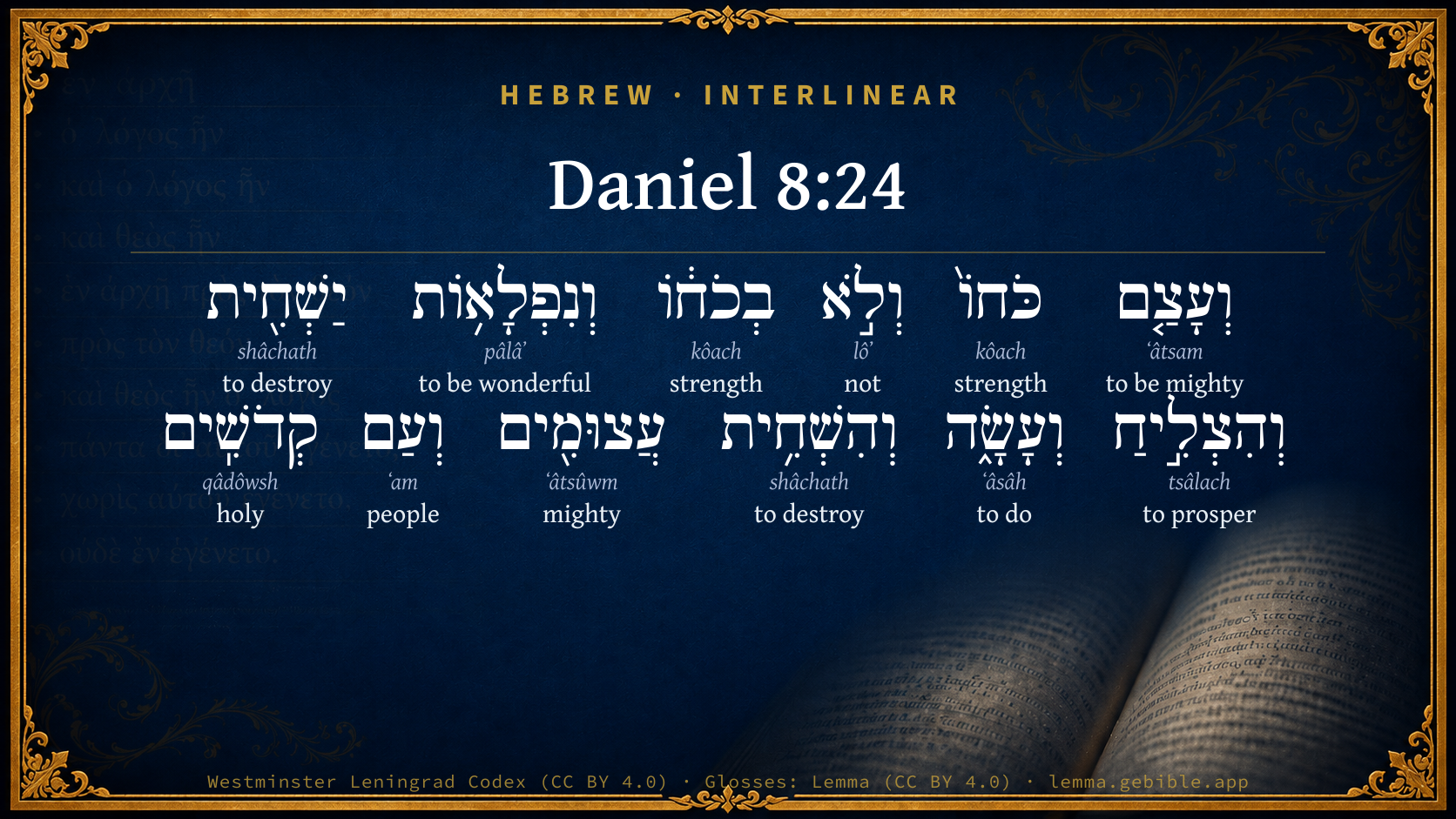
Daniel 8:24

Hebrew (Westminster Leningrad Codex) Daniel 8:24 appears in the Hebrew Old Testament. The text above is from the Westminster Leningrad Codex. Each word links to its Strong’s number, a concise gloss, and parsing drawn from the Open Scriptures Hebrew Bible morphology. Click any word for its full Brown-Driver-Briggs (BDB) entry.
Download image
Cite this verse

Daniel 8:24 (World English Bible). Public Domain. Lemma interlinear Bible study tool, https://lemma.gebible.app/v/daniel/8/24.

Show BibTeX & RIS
BibTeX
RIS
English Translation
His power shall be mighty, but not by his own power; and he shall destroy wonderfully, and shall prosper and do [his pleasure]; and he shall destroy the mighty ones and the holy people.
World English Bible · Public Domain
Download a study sheet

One document with this verse’s original text, its word-by-word gloss line, the meaning frame, cross-references with their text, attributed commentary, and full source and license credits — printable, and it pastes into notes with its structure intact.

This verse Autodidact and up

Study sheet (.html) Plain text (.txt)

A passage Seminary Student

Up to 50 verses in one chapter. A passage sheet keeps up to 6 commentary sources and 12 cross-references per verse, in the order this page ranks them, and says so on the sheet whenever that leaves anything out. Ask for a single verse and you get the Autodidact verse sheet above.

Everything on this page stays free to read, with no account — the sheet is a download of what is already on screen, not access to it.

Want to remove ads? Support Godless Engineer
Compare translations 3

The same verse in 3 English versions, stacked beneath the original-language interlinear above. Click any original word for its lexicon entry.

Each is an independent rendering of the whole verse — the interlinear is not word-aligned to these translations.

Highlighted words mark where these versions differ — a whole-verse word diff, not a word-by-word alignment.

  • World English Bible Public Domain
    His power shall be mighty, but not by his own power; and he shall destroy wonderfully, and shall prosper and do [his pleasure]; and he shall destroy the mighty ones and the holy people.
  • King James Version Public Domain
    And his power shall be mighty, but not by his own power: and he shall destroy wonderfully, and shall prosper, and practise, and shall destroy the mighty and the holy people.
  • unfoldingWord Literal Text CC BY-SA 4.0
    His power will be great—but not by his own power. He will destroy to an extraordinary degree; he will succeed in what he does. He will destroy mighty men and the holy people.

unfoldingWord Literal Text — © unfoldingWord, licensed CC BY-SA 4.0. Word-aligned USFM3 via Door43 (git.door43.org/unfoldingWord/en_ult).

Versions to compare (up to 4)

3 of 4 selected

Show all 18 translations

Every available English version of this verse, each an independent rendering of the whole verse.

  • World English Bible Public Domain
    His power shall be mighty, but not by his own power; and he shall destroy wonderfully, and shall prosper and do [his pleasure]; and he shall destroy the mighty ones and the holy people.
  • Berean Standard Bible Public Domain
    His power will be great, but it will not be his own. He will cause terrible destruction and succeed in whatever he does. He will destroy the mighty men along with the holy people.
  • Majority Standard Bible Public Domain
    His power will be great, but it will not be his own. He will cause terrible destruction and succeed in whatever he does. He will destroy the mighty men along with the holy people.
  • King James Version Public Domain
    And his power shall be mighty, but not by his own power: and he shall destroy wonderfully, and shall prosper, and practise, and shall destroy the mighty and the holy people.
  • American Standard Version (1901) Public Domain
    And his power shall be mighty, but not by his own power; and he shall destroy wonderfully, and shall prosper and do `his pleasure'; and he shall destroy the mighty ones and the holy people.
  • Revised Version (1885) Public Domain
    And his power shall be mighty, but not by his own power; and he shall destroy wonderfully, and shall prosper and do his pleasure: and he shall destroy the mighty ones and the holy people.
  • Geneva Bible (1599) Public Domain
    And his power shalbe mightie, but not in his strength: and hee shall destroy wonderfully, and shall prosper, and practise, and shall destroy the mightie, and the holy people.
  • Douay-Rheims (1899) Public Domain
    And his power shall be strengthened, but not by his own force: and he shall lay all things waste, and shall prosper, and do more than can be believed. And he shall destroy the mighty, and the people of the saints,
  • Young's Literal Translation Public Domain
    and his power hath been mighty, and not by his own power; and wonderful things he destroyeth, and he hath prospered, and wrought, and destroyed mighty ones, and the people of the Holy Ones.
  • Literal Standard Version CC BY-SA 4.0
    and his power has been mighty, and not by his own power; and he destroys wonderful things, and he has prospered, and worked, and destroyed mighty ones, and the people of the Holy Ones.
  • Unlocked Literal Bible CC BY-SA 4.0
    His power will be great—but not by his own power. He will be amazing in what he destroys; he will act and succeed. He will destroy powerful people, people among the holy ones.
  • unfoldingWord Literal Text CC BY-SA 4.0
    His power will be great—but not by his own power. He will destroy to an extraordinary degree; he will succeed in what he does. He will destroy mighty men and the holy people.
  • Darby Bible Public Domain
    And his power shall be mighty, but not by his own power; and he shall destroy marvellously, and shall prosper, and shall practise, and shall destroy the mighty ones, and the people of the saints.
  • World Messianic Bible Public Domain
    His power will be mighty, but not by his own power. He will destroy awesomely, and will prosper in what he does. He will destroy the mighty ones and the holy people.
  • Webster's Bible Public Domain
    And his power shall be mighty, but not by his own power: and he shall destroy wonderfully, and shall prosper, and practice, and shall destroy the mighty and the holy people.
  • Free Bible Version CC BY-SA 4.0
    It will become very powerful but not by its own power. It will be terribly destructive, and will succeed in everything it does. It will destroy great leaders and God's dedicated people.
  • Bible in Basic English Public Domain
    And his power will be great, and he will be purposing strange things. And all will go well for him and he will do his pleasure; and he will send destruction on the strong ones.
  • JPS Tanakh (1917) Public Domain
    And his power shall be mighty, but not by his own power; and he shall destroy wonderfully, and shall prosper and do; and he shall destroy them that are mighty and the people of the saints.

Literal Standard Version (2020), Covenant Press — licensed CC BY-SA 4.0. Text via the HelloAO Bible API (eBible.org). Unlocked Literal Bible (unfoldingWord) — licensed CC BY-SA 4.0. Text via the HelloAO Bible API (eBible.org). unfoldingWord Literal Text — © unfoldingWord, licensed CC BY-SA 4.0. Word-aligned USFM3 via Door43 (git.door43.org/unfoldingWord/en_ult). Free Bible Version, Dr. Jonathan Gallagher — licensed CC BY-SA 4.0. Text via the HelloAO Bible API (eBible.org).

Word by word

More ways to search: Search by grammar → Find every occurrence → Compare this word →

Practice this passage: Drill this verse → Learn its vocabulary →

וְעָצַ֤ם
ʻâtsam
H6105
“and · to be mighty”
Conjunction + Verb, Qal, Sequential Perfect, 3rd Person, Masculine, Singular
Part of Speech
Conjunction + Verb
Stem
Qal
Form
Sequential Perfect
Person
3rd Person
Gender
Masculine
Number
Singular
Full BDB Definition

Origin: a primitive root

TWOT: 1673 , 1674

to be vast, be numerous, be mighty - (Qal) - to be mighty - to be numerous - (Hiphil) to make strong, make mighty - to shut (the eyes), close (the eyes) - (Qal) to shut (the eyes) - (Piel) to shut tightly (the eyes)
  1. כֹּחוֹ֙ kôach H3581 “strength · his” Noun, Common, Masculine, Singular, Construct + Suffix, Personal, 3rd Person, Masculine, Singular
  2. וְלֹ֣א lôʼ H3808 “and · not” Conjunction + Particle, Negative
  3. בְכֹח֔וֹ kôach H3581 “in/at · strength · his” Preposition + Noun, Common, Masculine, Singular, Construct + Suffix, Personal, 3rd Person, Masculine, Singular
  4. וְנִפְלָא֥וֹת pâlâʼ H6381 “and · being wonderful” Conjunction + Verb, Niphal, Participle Active, Feminine, Plural, Absolute
  5. יַשְׁחִ֖ית shâchath H7843 “to destroy” Verb, Hiphil, Imperfect, 3rd Person, Masculine, Singular
  6. וְהִצְלִ֣יחַ tsâlach H6743 “and · to prosper” Conjunction + Verb, Hiphil, Sequential Perfect, 3rd Person, Masculine, Singular
  7. וְעָשָׂ֑ה ʻâsâh H6213 “and · to do” Conjunction + Verb, Qal, Sequential Perfect, 3rd Person, Masculine, Singular
  8. וְהִשְׁחִ֥ית shâchath H7843 “and · to destroy” Conjunction + Verb, Hiphil, Sequential Perfect, 3rd Person, Masculine, Singular
  9. עֲצוּמִ֖ים ʻâtsûwm H6099 “mighty” Adjective, Adjective, Masculine, Plural, Absolute
  10. וְעַם ʻam H5971 “and · people of” Conjunction + Noun, Common, Masculine, Singular, Construct
  11. קְדֹשִֽׁים qâdôwsh H6918 “holy” Adjective, Adjective, Masculine, Plural, Absolute

About this verse

These counts appear in no published source. They are computed here, from the morphology-tagged text and Lemma’s own curated glosses. What Lemma adds →

12
words
10
distinct lemmas
Prophets
section

Notable vocabulary

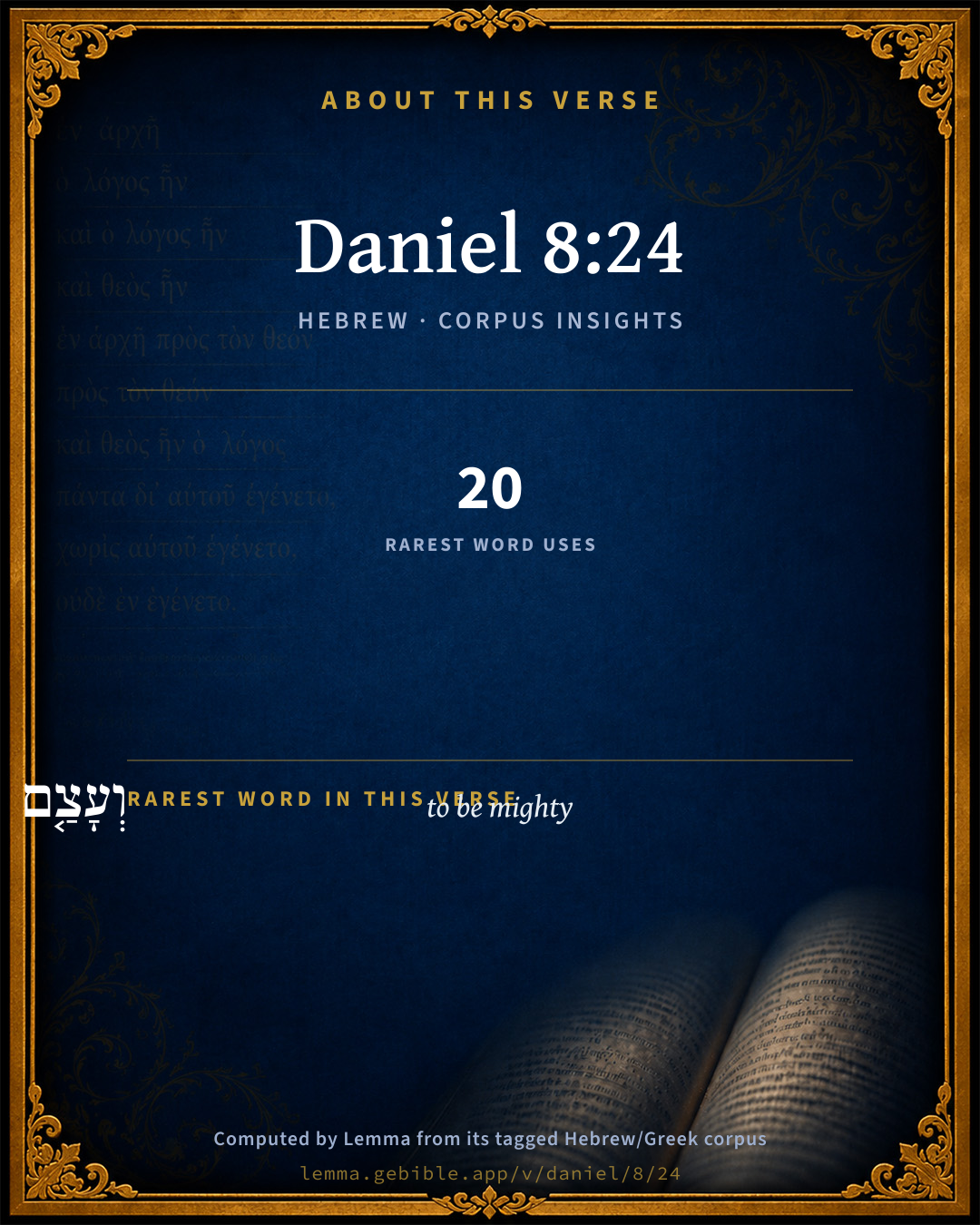
The rarest word here is וְעָצַ֤ם to be mighty H6105 — appearing just 20 times in the whole Hebrew Bible.

Shared distinctive vocabulary

וְעָצַ֤ם to be mighty H6105 occurs in 20 verses of the Hebrew Bible. Also found in:

Grammatical profile

  • 6 verbs
  • 3 nouns
  • 2 adjectives
  • 1 particle

Verb forms

  • וְעָצַ֤ם Qal · Sequential Perfect
  • וְנִפְלָא֥וֹת Niphal · Participle Active
  • יַשְׁחִ֖ית Hiphil · Imperfect
  • וְהִצְלִ֣יחַ Hiphil · Sequential Perfect
  • וְעָשָׂ֑ה Qal · Sequential Perfect
  • וְהִשְׁחִ֥ית Hiphil · Sequential Perfect

Repetition

Words recur within this verse — often emphatic in Hebrew:

  • כֹּחוֹ֙ strength H3581 ×2
  • יַשְׁחִ֖ית to destroy H7843 ×2

Hebrew & Septuagint length

In English translation the verse runs 34 words from the Hebrew and 24 from the Septuagint (LXX English) — the Septuagint runs noticeably shorter here. See the side-by-side →

A rough comparison of the two English renderings, which tokenize alike — not a word-level alignment.

Word counts can differ between the Hebrew and the Greek without any difference in meaning — e.g. the Hebrew direct-object marker אֵת has no separate Greek word, and Greek often adds the article ὁ.

Cross-references

11

Topical passages linked to Daniel 8:24 in the Treasury of Scripture Knowledge — connected by theme and wording, ordered by reader-vote popularity; previews shown in the World English Bible.

  • Daniel 8:12 The host was given over [to it] together with the continual [burnt offering] through disobedience; and it cast down truth to the ground, and it did [its pleasure] and prospered.
  • Daniel 7:25 He shall speak words against the Most High, and shall wear out the saints of the Most High; and he shall think to change the times and the law; and they shall be given into his hand until a time and times and half a time.
  • Daniel 11:31–36 Forces shall stand on his part, and they shall profane the sanctuary, even the fortress, and shall take away the continual [burnt offering], and they shall set up the abomination that makes desolate.
  • Daniel 12:7 I heard the man clothed in linen, who was above the waters of the river, when he held up his right hand and his left hand to heaven, and swore by him who lives forever that it shall be for a time, times, and a half; and when they have made an end of breaking in pieces the power of the holy people, all these things shall be finished.
  • Revelation 13:3–10 One of his heads looked like it had been wounded fatally. His fatal wound was healed, and the whole earth marveled at the beast.
  • Revelation 17:17 For God has put in their hearts to do what he has in mind, and to be of one mind, and to give their kingdom to the beast, until the words of God should be accomplished.
  • Daniel 8:10 It grew great, even to the host of the sky; and some of the host and of the stars it cast down to the ground, and trampled on them.
  • Revelation 17:6 I saw the woman drunken with the blood of the saints, and with the blood of the martyrs of Jesus. When I saw her, I wondered with great amazement.
  • Revelation 17:12–13 The ten horns that you saw are ten kings who have received no kingdom as yet, but they receive authority as kings, with the beast, for one hour.
  • Revelation 19:2 for true and righteous are his judgments. For he has judged the great prostitute, who corrupted the earth with her sexual immorality, and he has avenged the blood of his servants at her hand."
  • Revelation 16:6 For they poured out the blood of the saints and the prophets, and you have given them blood to drink. They deserve this."

Cross-references courtesy of OpenBible.info (CC BY 4.0).

Hebrew and Greek witnesses Masoretic Hebrew ↔ Greek Septuagint

The same verse in the two great witnesses to the Old Testament, shown verse-for-verse.

Here the Septuagint runs noticeably shorter than the Hebrew — LXX2012 (modern English Septuagint) 24 words vs World English Bible 34. A rough length comparison of the two English translations, not a word-level alignment — read both below.

These are two independent witnesses, not word-aligned to each other, and the Septuagint is shown in lemma (dictionary) form.

Hebrew Daniel 8:24 Masoretic · Westminster Leningrad Codex

וְעָצַ֤ם כֹּחוֹ֙ וְלֹ֣א בְכֹח֔וֹ וְנִפְלָא֥וֹת יַשְׁחִ֖ית וְהִצְלִ֣יחַ וְעָשָׂ֑ה וְהִשְׁחִ֥ית עֲצוּמִ֖ים וְעַם קְדֹשִֽׁים

His power shall be mighty, but not by his own power; and he shall destroy wonderfully, and shall prosper and do [his pleasure]; and he shall destroy the mighty ones and the holy people.

World English Bible · Public Domain

Greek LXX Daniel 8:24 Septuagint · lemma form

καί στερεόω ὁ ἰσχύς αὐτός καί οὐ ἐν ὁ ἰσχύς αὐτός καί θαυμαστῶς φθείρω καί εὐοδόω καί ποιέω καί φθείρω δυνάστης καί δῆμος ἅγιος

And his power shall be great, and he shall destroy wonderfully, and prosper, and practise, and shall destroy mighty men, and the holy people.

LXX2012 (modern English Septuagint) · Public Domain

On this verse, The Pulpit Commentary discusses the Septuagint’s reading. Read the note in Commentary ↓

Hebrew: Westminster Leningrad Codex (CC BY 4.0). Greek: Septuagint (public domain); English from LXX2012 (modern English Septuagint) (Public Domain). How the Septuagint differs from the Hebrew →

Commentary

Notes on Daniel 8:24 from classic Christian and Jewish commentators (each source and its license shown beneath its notes). The classic Christian expositions comment on the surrounding passage and are grouped to its opening verse, so a note may address several verses; the Jewish commentaries on the Tanakh (Rashi and others) are per-verse, so they appear only where the commentator wrote on this verse.

Lemma curates 59 commentaries, every one of them public domain or Creative Commons licensed, each selected and text-cleaned for this edition rather than reprinted as found. About our sources →

Trapp's Complete Commentary

John Trapp

Dan 8:24 And his power shall be mighty, but not by his own power: and he shall destroy wonderfully, and shall prosper, and practise, and shall destroy the mighty and the holy people.

Ver. 24. Not by his own power.] But by his policy rather, and by the perfidy of others. {Dan 11:23}

And he shall destroy wonderfully.] Mirificentissime. In three days he slew fourscore thousand in Jerusalem; forty thousand were put in bands, and as many sold.

And shall prosper, and practice.] Shall do whatsoever he wishes; as if he were some petty god within himself.

And shall destroy the mighty.] So the Jews are called, because stout and undaunted, and while they kept close to God, insuperable; as when otherwise, weak as water. See Hos 13:1. {See Trapp on "Hos 13:1"}

And the holy people.] Federally holy at least.

John Trapp, A Commentary or Exposition upon All the Books of the Old and New Testament (1647–1656) — public domain. Text from a community e-Sword module.

Joseph Benson's Commentary

Dan 8:24. And his power shall be mighty — His power shall increase more and more, namely, in Judea; but not by his own power — This shall not be owing so much to himself, as to the wickedness and factions among the Jews. “Antiochus,” says Mr. Wintle, “was certainly much favoured in his designs by a factious party of the Jews themselves, by the treachery of the Jewish people, according to Josephus, and, according to Appion, the perfidy of others. Eumenes, king of Pergamus, and his brother Attalus, being jealous of the Romans, desired to make the king of Syria their friend, and supported Antiochus in his kingdom. The divine displeasure also against the Jews operated to the furtherance of his designs, who was herein an agent of the vindictive justice of God.” And he shall destroy wonderfully — He shall cause a very great and scarcely credible desolation in Judea. Wintle renders it, He shall make astonishing havoc, and shall be successful: which prediction was accomplished when Jerusalem was taken by Antiochus, 40,000 Jews were slain, and as many were sold into slavery. And shall destroy the mighty and the holy people — Or, the people of the holy God, as עם קדשׂיםmay be rendered, the noun plural being sometimes applied to the Deity. Or the expressions may mean, that he should destroy many of the principal and chief men, and many of the common sort, termed the holy people, as being good men, and sincere worshippers of God. With regard to the former, Grotius observes, from Josephus, that men of the greatest reputation, and of the most generous spirit, among the Jews, paid no regard to Antiochus, and therefore were harassed daily, and died under the most bitter torments. Antiochus, in his first invasion of Judea, slew and led captive 80,000 Jews; and two years afterward sent Apollonius, with an army of 22,000 men, to destroy those that assembled in their synagogues on the sabbath, 2Ma 5:14; 2Ma 5:24; and 1Ma 1:29.

Joseph Benson's Commentary on the Old and New Testaments (1811–1818) — public domain. Text from a community e-Sword module.

Tyndale Open Study Notes

Tyndale Open Resources

8:24 not by his own power: God remained in sovereign control of the seemingly fortuitous events of history that brought Antiochus IV to power. • a shocking amount of destruction: See 1 Maccabees 1:10-63, which describes many of the evils that Antiochus IV instigated.

Tyndale Open Study Notes — © Tyndale Open Resources, licensed CC BY-SA 4.0. Text via the HelloAO Bible API.

Geneva Bible (1599)

Geneva Bible translators

That is, not like Alexander’s strength.

Both the Gentiles that dwelt about him, and also the Jews.

Geneva Bible (1599) marginal notes — public domain. Text via Bolls.life.

Jamieson, Fausset & Brown

Robert Jamieson, A. R. Fausset & David Brown

not by his own power--which in the beginning was "little" (Dan 8:9; Dan 7:8); but by gaining over others through craft, the once little horn became "mighty" (compare Dan 8:25; Dan 11:23). To be fully realized by Antichrist. He shall act by the power of Satan, who shall then be permitted to work through him in unrestricted license, such as he has not now (Rev 13:2); hence the ten kingdoms shall give the beast their power (Th2 2:9-12; Rev 17:13).

prosper and practise--prosper in all that he attempts (Dan 8:12).

holy people--His persecutions are especially directed against the Jews.

Jamieson, Fausset & Brown — Commentary Critical and Explanatory on the Whole Bible (1871) — public domain (CC PDM 1.0). Text via the HelloAO Bible API.

Adam Clarke's Commentary

Verse 24. But not by his own power] The strength of the other kingdoms consisted in themselves; but the Roman empire, as a horn or kingdom of the goat, was not mighty by its own power - was not strong by virtue of the goat, but drew its nourishment and strength from Rome and Italy. There grew the trunk and body of the tree; though the branches extended over Greece, Asia, Syria, and Egypt. - Bp. Newton.

Shall destroy wonderfully] In the taking of Jerusalem by the Romans ninety-seven thousand Jews were made captives, and eleven hundred thousand were slain. So they destroyed this once mighty and holy people!

Adam Clarke's Commentary on the Bible (1810–1826) — public domain. Text from a community e-Sword/MySword module.

John Calvin's Commentaries

After the angel had explained the Grecian monarchy, he records the future origin of a king who should be hard of face Without the slightest doubt, he implies the iniquity of Antiochus by this phrase. He was notoriously destitute of any nobleness of mind, and remarkable for low cunning, and to this disposition was added an impudence which faltered at nothing. This is the sense in which I take the words hard of face The following phrase asserts his cunning, when it says, he shall be skilled in enigmas This is equivalent to saying, he should excel in cunning, and should not be easily deceived. By these two epithets he does not compliment, but rather defames Antiochus Epiphanes, by representing him as hardened as the wicked usually are, without the slightest particle of either reason, or equity, or shame. He next blames his craftiness and deceit, by stating he should be skilled in enigmas He afterwards adds, his power shall be strengthened, and yet not by his own might Some are of opinion that Antiochus Epiphanes is here compared to Alexander, as the angel had previously stated the inferiority of the four kings to the first; for they were prefigured by four small horns. For the most powerful of them all did not reign over a fifth part of the dominions which Alexander had acquired for himself by violence and war. Others, again, explain this passage as if the power of Antiochus would be great, but still very unlike that of Alexander, and far inferior to it, according to the sense, not in his, i.e., Alexander’s, strength,. Many, however, refer this to Antiochus, although they do not agree among themselves. Some, again, want a kind of correction, as if the angel implied that the power of Antiochus should be great, but not quite openly so. Hence his valor shall be strengthened, not meaning by “valor” that heroic spirit with which kings are usually endowed, nor any increase in magnanimity; nor yet that Antiochus should imitate such monarchs as these, but his strength should lie concealed. He should creep on by clandestine acts, and not contend in open battle according to the practice of those who excel in courage; he should secretly try many schemes, and thus stealthily extend his empire. This makes a tolerable sense. Others, again, think this ought to be referred to God, since the strength of Antiochus was not the result of his own industry or valor, but of the judgment of God, who armed him with it, because he wished to use him as a scourge to execute his punishments on the Jews. His fortitude, therefore, shall be strengthened, yet not by his own valor, as this entirely depended on the just designs and vengeance of God. Although this last sense is more profitable, and contains much useful instruction, yet I fear it is distorted. And thus the last clause is either a correction of the preceding words, meaning” because he should not increase with ingenuous earnestness,” or else, the angel is still comparing his strength with the power of Alexander. His power, therefore, shall be strengthened, and yet not bear comparison with Alexander’s; or, his power shall be strengthened, but not by habits of war nor by open magnanimity, but he shall grow great by fraudulent and clandestine arts; because he was on the one hand most impious, and on the other, of a servile disposition, as we have formerly said.

It follows, He shall make wonderful havoc, and shall prosper, and shall proceed, that is, shall execute, and shall destroy the strong, and the people of the saints. By עצומים, gnetzumim, I understand not only the Jews, but also other neighboring nations; as if the angel had said, Antiochus shall be conqueror wherever he shall extend his arms, until at length he shall subdue Judea, and miserably afflict the people of God. Wherefore, he shall strike or destroy the brave, and the people of the saints, that is, the holy people, as we saw before. And according to his understanding shall his craftiness prosper in his hand The conjunction “and may be here superfluous; in this sense the passage is usually received, thus reading it on in one context; according to his understanding he shall prosper, although there is the conjunction “and” in the way, but this is frequently superfluous in Hebrew. It means, deceit shall prosper in his hand Here the angel confirms the former assertion respecting the servile cunning of Antiochus, as he did not act with ingenuous manliness, but with his audacity and hardihood he united malicious arts and craftiness unworthy of a king. Craft, therefore, shall prosper in his hand, and that too, as far as he understands it. Some suppose the sharpness of Antiochus to be noticed here, as if the angel had said, Craftiness shall prosper in his hand, in consequence of his possessing superior ability and penetration. But the passage may be suitably explained in this way, — Antiochus shall act prosperously according to his mental perception, and shall be so assisted by’ his craftiness, as to obtain whatever he shall grasp at.

John Calvin's Commentaries (1540-1563) — public domain. Text from the Calvin Translation Society English edition (1840s-50s) via the Christian Classics Ethereal Library (ccel.org). Calvin's coverage is partial (roughly two-thirds of the Bible); uncommented books and verses are honest gaps, never fabricated. The 19th-century editor's footnotes and remarks are omitted so the notes are faithfully Calvin's own voice.

Ellicott's Commentary for English Readers

(24) Not by his own power.—Not might, but cunning, will cause his success. (Comp. 1Ma_1:10, &c.) Thus his destructive powers become astonishing.

The mighty.—No special individuals are pointed out, but rulers in general.

A Bible Commentary for English Readers, edited by Charles John Ellicott (1878–1897) — public domain. Text from a community e-Sword module.

The Cambridge Bible for Schools and Colleges

gen. ed. J. J. S. Perowne

24. his power shall be mighty, but not by his own power] but rather, so it is implied in this rendering, by the permission of God (Häv., Hitz.). The rendering not by his power (but rather by intrigues) is, however, preferable: the first two clauses of the verse will thus contain an oxymoron. R.V. marg. ‘Or, with his power. See Dan_8:22’ seems to refer the pron. (with Ewald) to Alexander; but such a reference is here far-fetched.

destroy wonderfully] work destruction in an extraordinary degree;—the idea of ‘wonder,’ ‘wonderful’ in Heb. is properly that of something distinctive, exceptional, extraordinary. Cf. Dan_11:36, Dan_12:6.

prosper, and do] cf. Dan_8:12.

the mighty] them that are mighty (indef.), alluding to Antiochus’ political foes.

and the people of the holy ones (or saints)] i.e. Israel: cf. Dan_7:25 (‘and shall wear away the holy ones (or saints) of the Most High’).

The Cambridge Bible for Schools and Colleges (gen. ed. J. J. S. Perowne; Cambridge University Press, 1878–1918) — public domain. Text from a community e-Sword module.

John Gill's Exposition

And his power shall be mighty, but not by his own power,.... He should possess a large kingdom, and that should be increased by conquests:

but not in his power (s), the power of Alexander; he should not arrive to that greatness he did, as in Dan 8:22 so Jacchiades: or, "in his own power" (t); for it was not so much by his own courage and valour, by any heroic actions of Antiochus, he became so great, as by craft and deceit: through sedition he procured the death of his father and eider brother; and by fraud got the kingdom from his nephew; and through the perfidy of Menelaus and Jason, the high priests of the Jews, and other apostates, he obtained what dominion he had over the Jews; and it was by the assistance of Eumenes king of Pergamos, and his brother Attalus, that he kept the kingdom he had usurped, who stood by him, in order to check the growing power of the Romans; and more especially it was by a power given him from above, or by the permission and providence of God, who suffered him to be so great, and to prevail particularly over the Jews; because of their sins, as Aben Ezra and Saadiah observe, to chastise them for them: so his antitype, antichrist, became great and powerful, through craft and policy, and by the help of the ten kings that gave their kingdoms to him:

and he shall destroy wonderfully; or beyond all credit, countries, cities, towns, and their inhabitants; he slew fourscore thousand Jews in three days' time, bound forty thousand, and sold as many,

"And there were destroyed within the space of three whole days fourscore thousand, whereof forty thousand were slain in the conflict; and no fewer sold than slain.'' (2 Maccabees 5:14)

or, "he shall destroy wonderful things" (u); the temple, and the wonderful things of worth and value in it, so Saadiah and Jacchiades; he took away the vessels of the temple, the golden lamps, the ark, and table of gold, &c.:

and shall prosper and practise; for a while do what he pleased, none being able to oppose and hinder him; see Dan 8:12.

and shall destroy the mighty and the holy people; by the "mighty" may be meant the Egyptians, Parthians, and other nations he made war with; and by the "holy people" the Jews, who were sanctified and separated from other people by the Lord, to be a peculiar people; among whom were his holy temple, his holy priests, his holy word, ordinances, and worship; multitudes of these he destroyed, as before observed. Jacchiades interprets this of the sons of Aaron, the holy priests of the Lord, whom he slew.

(s) "robore ipsius", Junius & Tremellius, Piscator. (t) "In fortitudine sua", Pagninus, Montanus; "per virtutem suam", Munster. (u) "mirabilia", Montanus, Polanus.

John Gill's Exposition of the Whole Bible (1746–1763) — public domain (CC PDM 1.0). Text via the HelloAO Bible API.

Albert Barnes' Notes on the Bible

And his power shall be mighty - He shall be a powerful monarch. Though not as mighty as Alexander, yet his conquests of Egypt and other places show that he deserved to be numbered among the mighty kings of the earth.

But not by his own power - That is, it shall not be by any strength of his own, but by the power which God gives him. This is true of all kings and princes (compare Joh 19:11; Isa 10:5, following), but it seems to be referred to here particularly to show that the calamities which he was about to bring upon the Hebrew people were by Divine direction and appointment. This great power was given him in order that he might be an instrument in the Divine hand of inflicting deserved punishment on them for their sins.

And he shall destroy wonderfully - In a wonderful or extraordinary manner shall he spread desolation. This refers particularly to the manner in which he would lay waste the holy city, and the land of Judea. The history in the books of Maccabees shows that this was literally fulfilled.

And shall prosper - Antiochus was among the most successful kings in his various expeditions. Particularly was he successful in his enterprises against the holy land.

And practice - Hebrew, “do.” That is, he shall be distinguished not only for “forming” plans, but for “executing” them; not merely for “purposing,” but for “doing.”

And shall destroy the mighty and the holy people - The people of God - the Jewish nation. See the notes at Dan 8:9-12.

Albert Barnes' Notes on the Bible (1834–1885) — public domain. Text from a community e-Sword/MySword module.

Haydock's Catholic Bible Commentary

By. Hebrew: "not to his (Alexander’s) strength." (ver. 22.) Epiphanes conquered Egypt and the Jews: but the former had an infant king, and the latter were unprovided. He shewed more cunning than prowess.

George Leo Haydock (1774–1849), Haydock's Catholic Family Bible and Commentary, 1859 edition — public domain. Excludes Psalms (Douay-Rheims chapter numbering differs from Protestant) and Deuterocanonical books (Catholic canon only).

Matthew Poole's English Annotations

Not by his own power; not by any heroic deeds, or truly regal qualities, but by making use of the Jewish factions, and also through the Divine permission, and commission given him to punish a backsliding, degenerate nation; lastly, by the help of Eumenes and Attalus, by whose means and help he got up to this height; who being kings, suspected the Roman power, and raised him to be a kind of cheek to them.

The holy people; he shall by force, craft, and cruelty destroy many of God’s people, from the highest to the meanest ranks of them.

Matthew Poole's English Annotations on the Holy Bible (1683–1685) — public domain. Text from a community e-Sword/MySword module.

Whedon's Commentary on the Bible

Daniel D. Whedon

24. See Dan_8:12. Not by his own power he shall prosper, and practice (literally, do), and destroy wonderfully (or, by a slight change, utter monstrous things, as Dan_11:36), and afflict “the mighty ones and the people of the saints.” This was permitted not because he was more powerful than Jehovah, but rather because, like Pharaoh, he was being unconsciously controlled by the One who can make even the sin and wrath of man to praise him. As a double meaning is always to be looked for in an apocalyptic description there may also be a reference here to the fact that it was through outside help that he reached the throne and was confirmed upon it. Still other exegetes make prominent the fact that it was not by power but by poison that this crafty king worked his way up to the throne.

Daniel D. Whedon (gen. ed.), Commentary on the Old and New Testaments (1874–1909) — public domain. Text from a community e-Sword module.

The Pulpit Commentary

And his power shall be mighty, but not by his own power: and he shall destroy wonderfully, and shall prosper, and practise, and shall destroy the mighty and the holy people. This verse involves many difficulties, grammatical and exegetical. These difficulties may be said to be present in all the versions of this passage. The LXX renders, "And his power shall be confirmed, and not in his strength, and he shall destroy marvellously, and prosper and do, and shall destroy the rulers and people of the saints." Theodotion is so far slavishly close to the Massoretic text; but he seems to have read qodesh, an adjective agreeing with people," instead of qedosheem, saints;" and he omits the negative clause. The Peshitta is very close to the Massoretic. It emphasizes the negative clause by adding denaphsho, and translates wonders" instead of "wonderfully." Jerome, more intent on expressing what is his own interpretation of the passage than on representing- the original, translates the first heel ("power") by fortitude, and the second by viribus suis. That the power of Epiphanes was great greater than that of his brother and immediate predecessor is undoubted. It is also the ease that lie was confirmed in Iris place by the Romans, though, if we are to receive the account of Appian, the direct means of his elevation to the throne was the intervention of Eumenes of Pergamus on his behalf. Thus the reference of the phrase, "not by his own power," may be to this. Little as he might brook the thought, he was but a subject-ally of the great republic. The other interpretations are

(1) that of Theodoret. Keil, Fuller, Havernick. Kranichfeld. and Moses Stuart, that the reference here is to Divine power as setting up Epiphanes to be a scourge to his people;

(2) that of von Lengerke, Kliefoth, Bevan, Behrmann, etc., not by might, but by his cunning;

(3) that of Hitzig, which combines the two his cunning is divinely given;

(4) that of Calvin and Ewald, that the contrast is with the might of Alexander the Great. All of these have something to favour them, but also something against them. There is against the first that there is no reference in the context to the fact, true though it was, that Antiochus was raised up by God for his own purposes. Against the second is the pronominal suffix, which would be needless if the contrast were between force and fraud. Of course, Hitzig"s combination falls with this. Against the view advocated by Calvin and Ewald is the fact that it seems a long time to hold the reference to Alexander in abeyance. Still, it may be urged that the vision was before the prophet; on the other hand, the relative strength of Epiphanes and Alexander does not seem to be of importance. We still think that the real reference is to the fact that he did not attain the throne either by inheritance or by his own prowess, but by the help and authority of others, namely, Eumencs and Rome. And he shall destroy wonderfully. Gratz thinks yasheeth, "destroy," suspicious, and Professor Bevan suggests jyciy, (yaseeh), and would render, "He shall utter monstrous things;" but, unfortunately for his view, there is no hint in the versions of any difficulty as to the reading, and, further, jWc (sooh) does not mean utter," but "meditate." We must take the words as they stand, (comp. Jud_1:13:19) and translate, "He shall destroy portentously." Certainly Epiphanes was to the Jews a portent of destruction; there had not been his like not Nebuchadnezzar, who burned the temple, was to be compared to him who endeavoured to blot out the worship of Jehovah altogether: not any other of the Greek monarchs. He was unique in his enmity against God and his worship. He shall destroy the mighty and the holy people. The rendering of the Revised Version better conveys the sense of the original, "He shall destroy the mighty ones." There has been discussion as to the distinction involved here. Ewald regards the mighty as the three other horns of the ten (Dan_7:8) an interpretation which proceeds in the false identification of the fourth beast with the Greek Empire. Rashi imagines the star-worshippers; this seems the height of caprice. Jephet-ibn-Ali, who identifies the little horn with Mahommed, holds the "mighty" to be the Romans. Keil and Fuller hold it to be the heathen rulers generally. Von Lengerke, Kliefoth, and others maintain it refers to the rich of the holy people, while ("am) are the poor. Hitzig refers it to the three claimants for the crown, whom Antiochus is alleged, on somewhat insufficient evidence, to have overthrown; Behrmann and Zockler, to the political and warlike enemies of Epiphanes, in contrast to the holy people, who were unwarlike. Kranichfeld refers it to the rulers of Israel, as distinct from the people; Calvin to "neighbouring nations." Moses Stuart would render, "great numbers, even the people of the saints;" while Professor Bevan thinks there is an interpolation here, and adopts a reading of Gratz from the LXX for the beginning of the following verse. On the whole, this seemsthe best solution of the difficulty. After Epiphanes had destroyed the "mighty," that is to say, the political enemies he had, the Egyptians, etc., he directed his mind the "people of the saints."

The Pulpit Commentary (1880–1919), ed. H.D.M. Spence-Jones & Joseph S. Exell — public domain. Text from a community e-Sword module.

John Wesley's Explanatory Notes

Not by his own power - Not by any heroick deeds, but by making use of the Jewish factions, through the divine commission to punish a backsliding nation; and by means of Eumenes and Attalus, by whose help he got up to this height. Shall destroy - He shall by force, craft, and cruelty, destroy many of God's people.

John Wesley, Explanatory Notes Upon the Whole Bible (1754–1765) — public domain. Text via the GEBible commentary corpus.

unfoldingWord translationNotes

Door43 World Missions Community

General Information:

In these verses, the angel explains to Daniel the symbolic meaning of the things he saw in his vision. The animals and horns actually represented human rulers or kingdoms. (See: Symbolic Language)

but not by his own power

"but someone else will give him his power"

he will make deceit prosper

Here "deceit" is spoken of as if it is a person who will prosper. AT: "the amount of deception will increase" (See: Personification)

under his hand

Here "hand" refers to his rule. AT: "under his rule" (See: Metonymy)

King of kings

This refers to God.

he will be broken

Here "he" refers to his power. AT: "his rule will end" (See: Metonymy)

not by any human hand

Here "hand" refers to power. This can be also stated in positive form. AT: "not by any human power" or "by divine power" (See: Metonymy)

translationWords

power

devastate

holy

deceive

hand

king

unfoldingWord translationNotes — © Distant Shores Media and the Door43 World Missions Community, licensed CC BY-SA 4.0. Source: git.door43.org/Door43/en_tn.

Rashi

Rabbi Shlomo Yitzchaki (Rashi)

And his power will become strong and not with might but with smooth talk, as is explained at the end of the Book (11:21).

and he will destroy wondrously and with wonder upon wonder, he will destroy.

and he will prosper and accomplish his desire.

and he will destroy the mighty many nations.

and the people of the holy ones Israel, who believe in the Torah.

Rashi on the Tanakh — English translations: “The Judaica Press complete Tanach with Rashi, translated by A. J. Rosenberg” (CC BY 4.0); “Pentateuch with Rashi's commentary by M. Rosenbaum and A.M. Silbermann, 1929-1934” (public domain); “The Metsudah Tanach series, Lakewood, N.J” (CC BY 4.0); and “The Book of Joshua, Metsudah Publications, 1997” (CC BY 4.0). Text via Sefaria.

Lesson kit

Teaching starters — assembled from the data on this page, not authored interpretation. Every prompt links to the verse data it draws on. Edit before teaching.

Daniel, in the Prophets, opens this verse with 12 words (10 distinct Hebrew lemmas). Its most distinctive word is ʻâtsam (“to be mighty”). The Greek Septuagint runs shorter here. A historical commentator’s framing appears above. Read the whole chapter for the surrounding context.

Discussion questions

  1. The word ʻâtsam carries the sense “to be mighty.” How does it shape the verse?
  2. How does Genesis 26:16, which shares the word «to be mighty», read alongside this verse?
  3. What does the repetition of “strength” (2× in this one verse) do in this verse?
  4. The Septuagint runs shorter here than the Hebrew. What might account for the difference?
  5. These translations render this verse differently. What is at stake in choosing one wording over another?
  6. «וְעָצַ֤ם» is a Qal Sequential Perfect verb. How does that grammatical form shape the action described?
  7. Compare how Trapp's Complete Commentary and Joseph Benson's Commentary read this verse. Where do they agree or differ?

Things to notice

Reading settings

Reading text

Shown beneath each verse's original-language words.

Old Testament
Old Testament edition

Read the OT as the Masoretic Hebrew (MT) or the Greek Septuagint (LXX).

English shown for the Greek Septuagint (in the Hebrew ↔ Greek comparison).

Comparing translations? Open the Compare panel on any verse page to stack up to four side by side.