
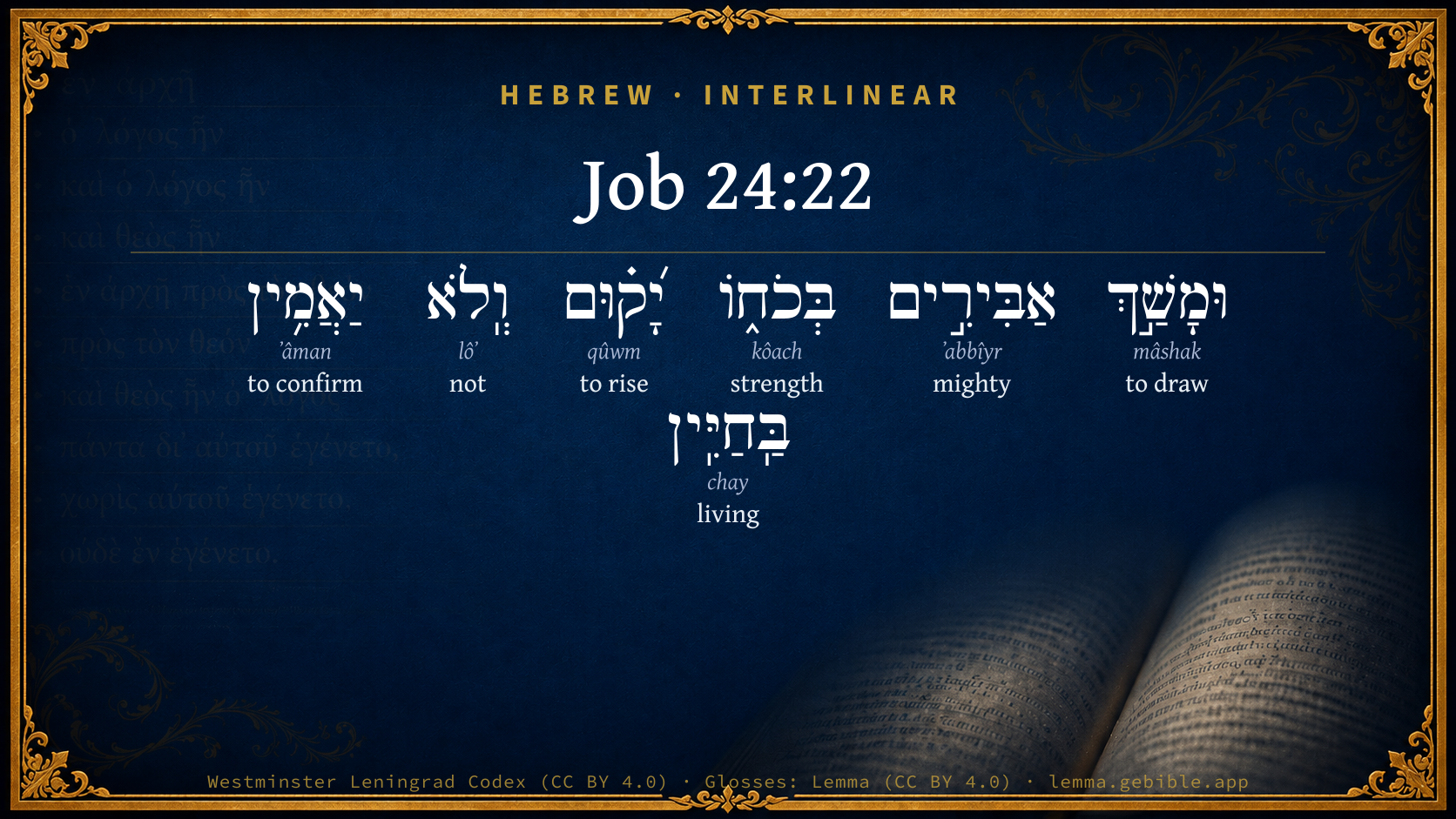
Job 24:22

Hebrew (Westminster Leningrad Codex) Job 24:22 appears in the Hebrew Old Testament. The text above is from the Westminster Leningrad Codex. Each word links to its Strong’s number, a concise gloss, and parsing drawn from the Open Scriptures Hebrew Bible morphology. Click any word for its full Brown-Driver-Briggs (BDB) entry.
Download image
Cite this verse

Job 24:22 (World English Bible). Public Domain. Lemma interlinear Bible study tool, https://lemma.gebible.app/v/job/24/22.

Show BibTeX & RIS
BibTeX
RIS
English Translation
Yet God preserves the mighty by his power. He rises up who has no assurance of life.
World English Bible · Public Domain
Download a study sheet

One document with this verse’s original text, its word-by-word gloss line, the meaning frame, cross-references with their text, attributed commentary, and full source and license credits — printable, and it pastes into notes with its structure intact.

This verse Autodidact and up

Study sheet (.html) Plain text (.txt)

A passage Seminary Student

Up to 50 verses in one chapter. A passage sheet keeps up to 6 commentary sources and 12 cross-references per verse, in the order this page ranks them, and says so on the sheet whenever that leaves anything out. Ask for a single verse and you get the Autodidact verse sheet above.

Everything on this page stays free to read, with no account — the sheet is a download of what is already on screen, not access to it.

Want to remove ads? Support Godless Engineer
Compare translations 3

The same verse in 3 English versions, stacked beneath the original-language interlinear above. Click any original word for its lexicon entry.

Each is an independent rendering of the whole verse — the interlinear is not word-aligned to these translations.

Highlighted words mark where these versions differ — a whole-verse word diff, not a word-by-word alignment.

  • World English Bible Public Domain
    Yet God preserves the mighty by his power. He rises up who has no assurance of life.
  • King James Version Public Domain
    He draweth also the mighty with his power: he riseth up, and no man is sure of life.
  • unfoldingWord Literal Text CC BY-SA 4.0
    But he drags away the mighty by his power; he arises and he does not believe in life.

unfoldingWord Literal Text — © unfoldingWord, licensed CC BY-SA 4.0. Word-aligned USFM3 via Door43 (git.door43.org/unfoldingWord/en_ult).

Versions to compare (up to 4)

3 of 4 selected

Show all 18 translations

Every available English version of this verse, each an independent rendering of the whole verse.

  • World English Bible Public Domain
    Yet God preserves the mighty by his power. He rises up who has no assurance of life.
  • Berean Standard Bible Public Domain
    Yet by His power, God drags away the mighty; though rising up, they have no assurance of life.
  • Majority Standard Bible Public Domain
    Yet by His power, God drags away the mighty; though rising up, they have no assurance of life.
  • King James Version Public Domain
    He draweth also the mighty with his power: he riseth up, and no man is sure of life.
  • American Standard Version (1901) Public Domain
    Yet `God' preserveth the mighty by his power: He riseth up that hath no assurance of life.
  • Revised Version (1885) Public Domain
    He draweth away the mighty also by his power: he riseth up, and no man is sure of life.
  • Geneva Bible (1599) Public Domain
    He draweth also the mighty by his power, and when he riseth vp, none is sure of life.
  • Douay-Rheims (1899) Public Domain
    He hath pulled down the strong by his might: and when he standeth up, he shall not trust to his life.
  • Young's Literal Translation Public Domain
    And hath drawn the mighty by his power, He riseth, and none believeth in life.
  • Literal Standard Version CC BY-SA 4.0
    And [God] has drawn the mighty by His power, || He rises, and none believes in life.
  • Unlocked Literal Bible CC BY-SA 4.0
    Yet God drags away the mighty people by his power; he rises up and does not strengthen them in life.
  • unfoldingWord Literal Text CC BY-SA 4.0
    But he drags away the mighty by his power; he arises and he does not believe in life.
  • Darby Bible Public Domain
    He draweth also the mighty with his power; he riseth up, and no [man] is sure of life.
  • World Messianic Bible Public Domain
    Yet God preserves the mighty by his power. He rises up who has no assurance of life.
  • Webster's Bible Public Domain
    He draweth also the mighty with his power: he riseth up, and no man is sure of life.
  • Free Bible Version CC BY-SA 4.0
    God prolongs the life of the wicked by his power; but when they arise, they have no assurance of life.
  • Bible in Basic English Public Domain
    But God by his power gives long life to the strong; he gets up again, though he has no hope of life.
  • JPS Tanakh (1917) Public Domain
    He draweth away the mighty also by his power; he riseth up, and he trusteth not his own life.

Literal Standard Version (2020), Covenant Press — licensed CC BY-SA 4.0. Text via the HelloAO Bible API (eBible.org). Unlocked Literal Bible (unfoldingWord) — licensed CC BY-SA 4.0. Text via the HelloAO Bible API (eBible.org). unfoldingWord Literal Text — © unfoldingWord, licensed CC BY-SA 4.0. Word-aligned USFM3 via Door43 (git.door43.org/unfoldingWord/en_ult). Free Bible Version, Dr. Jonathan Gallagher — licensed CC BY-SA 4.0. Text via the HelloAO Bible API (eBible.org).

Word by word

More ways to search: Search by grammar → Find every occurrence → Compare this word →

Practice this passage: Drill this verse → Learn its vocabulary →

About this verse

These counts appear in no published source. They are computed here, from the morphology-tagged text and Lemma’s own curated glosses. What Lemma adds →

7
words
7
distinct lemmas
Wisdom
section

Notable vocabulary

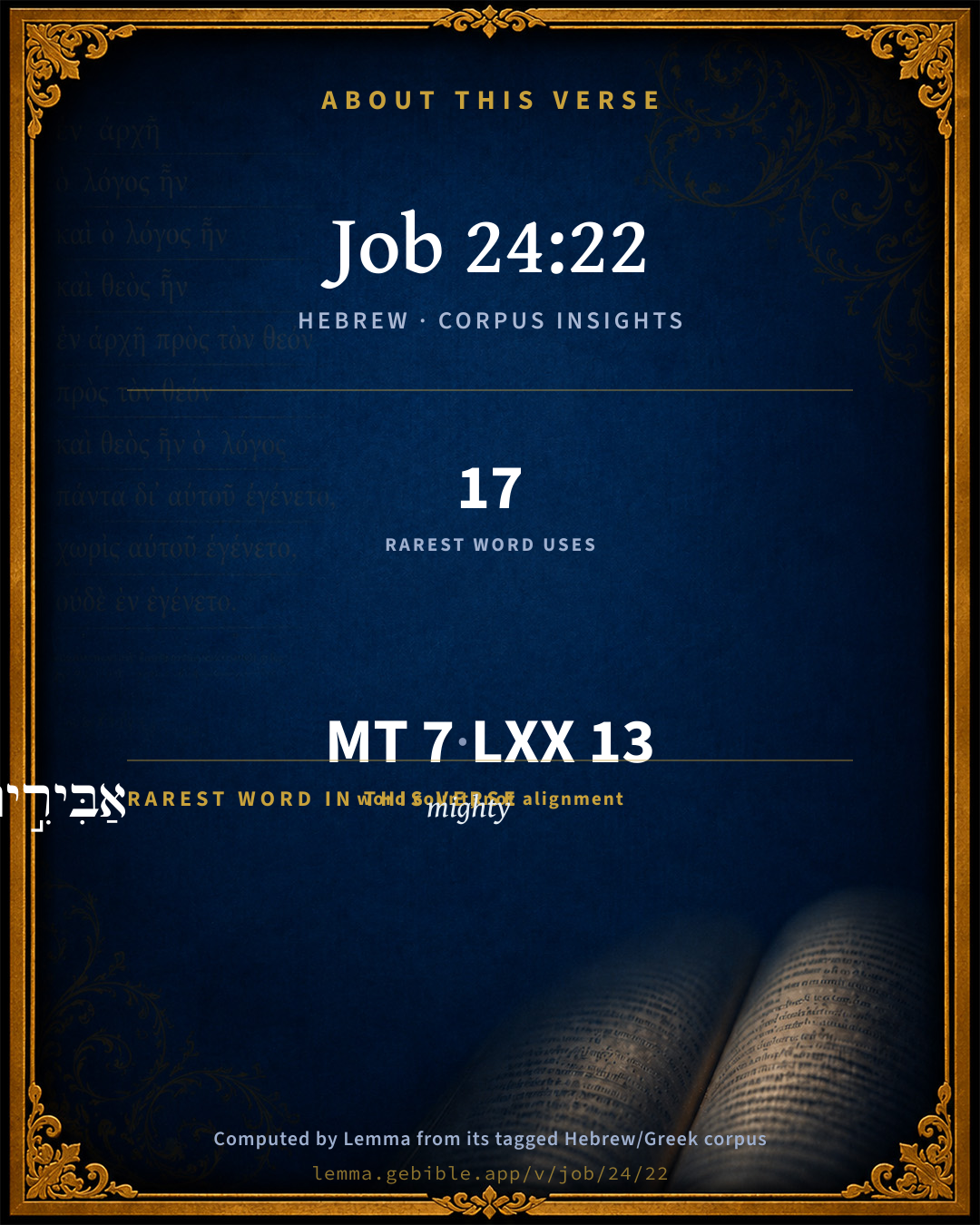
The rarest word here is אַבִּירִ֣ים mighty H47 — appearing just 17 times in the whole Hebrew Bible.

Shared distinctive vocabulary

אַבִּירִ֣ים mighty H47 occurs in 17 verses of the Hebrew Bible. Also found in:

Grammatical profile

  • 3 verbs
  • 2 nouns
  • 1 adjective
  • 1 particle

Verb forms

  • וּמָשַׁ֣ךְ Qal · Sequential Perfect
  • יָ֝ק֗וּם Qal · Imperfect
  • יַאֲמִ֥ין Hiphil · Imperfect

Hebrew & Septuagint length

In English translation the verse runs 17 words from the Hebrew and 23 from the Septuagint (LXX English) — closely comparable.

A rough comparison of the two English renderings, which tokenize alike — not a word-level alignment.

Word counts can differ between the Hebrew and the Greek without any difference in meaning — e.g. the Hebrew direct-object marker אֵת has no separate Greek word, and Greek often adds the article ὁ.

In the original languages it is 7 Hebrew tokens and 13 Greek tokens — but the two are counted differently (Hebrew bundles its prefixes and suffixes into one token; the Greek is in lemma form), so that isn’t a like-for-like length.

Cross-references

5

Topical passages linked to Job 24:22 in the Treasury of Scripture Knowledge — connected by theme and wording, ordered by reader-vote popularity; previews shown in the World English Bible.

  • Daniel 6:4–9 Then the presidents and the satraps sought to find occasion against Daniel as touching the kingdom; but they could find no occasion nor fault, because he was faithful, neither was there any error or fault found in him.
  • Esther 3:8–10 Haman said to king Ahasuerus, There is a certain people scattered abroad and dispersed among the peoples in all the provinces of your kingdom; and their laws are diverse from [those of] every people; neither keep they the king's laws: therefore it is not for the king's profit to allow them.
  • John 19:12–16 At this, Pilate was seeking to release him, but the Jews cried out, saying, "If you release this man, you aren't Caesar's friend! Everyone who makes himself a king speaks against Caesar!"
  • Revelation 16:13–14 I saw coming out of the mouth of the dragon, and out of the mouth of the beast, and out of the mouth of the false prophet, three unclean spirits, something like frogs;
  • Revelation 17:2 with whom the kings of the earth committed sexual immorality, and those who dwell in the earth were made drunken with the wine of her sexual immorality."

Cross-references courtesy of OpenBible.info (CC BY 4.0).

Hebrew and Greek witnesses Masoretic Hebrew ↔ Greek Septuagint

The same verse in the two great witnesses to the Old Testament, shown verse-for-verse.

These are two independent witnesses, not word-aligned to each other, and the Septuagint is shown in lemma (dictionary) form.

Hebrew Job 24:22 Masoretic · Westminster Leningrad Codex

וּמָשַׁ֣ךְ אַבִּירִ֣ים בְּכֹח֑וֹ יָ֝ק֗וּם וְֽלֹא יַאֲמִ֥ין בַּֽחַיִּֽין

Yet God preserves the mighty by his power. He rises up who has no assurance of life.

World English Bible · Public Domain

Greek LXX Job 24:22 Septuagint · lemma form

θυμός δέ καταστρέφω ἀδύνατος ἀναἵστημι τοιγαροῦν οὐ μή πιστεύω κατά ὁ ἑαυτοῦ ζωή

And in wrath he has overthrown the helpless: therefore when he has arisen, a man will not feel secure of his own life.

LXX2012 (modern English Septuagint) · Public Domain

Hebrew: Westminster Leningrad Codex (CC BY 4.0). Greek: Septuagint (public domain); English from LXX2012 (modern English Septuagint) (Public Domain). How the Septuagint differs from the Hebrew →

Commentary

Notes on Job 24:22 from classic Christian and Jewish commentators (each source and its license shown beneath its notes). The classic Christian expositions comment on the surrounding passage and are grouped to its opening verse, so a note may address several verses; the Jewish commentaries on the Tanakh (Rashi and others) are per-verse, so they appear only where the commentator wrote on this verse.

Lemma curates 59 commentaries, every one of them public domain or Creative Commons licensed, each selected and text-cleaned for this edition rather than reprinted as found. About our sources →

The Cambridge Bible for Schools and Colleges

gen. ed. J. J. S. Perowne

22. he draweth also the mighty] Rather as above, he continueth the mighty, i. e. He (God) prolongeth their life and continueth them in their place. The “mighty” are the oppressive lords of the soil, Job_24:2 seq. And it is God that upholds them by His power; comp. ch. Job_9:24.

he riseth up, and no man is sure of life] Rather as above. Even when they fall under calamity or sickness and “believe not that they shall live,” i. e. despair of recovery or of regaining their former prosperity, they are raised up again, their life and power being prolonged.

22–24. The other picture drawn by Job’s own hand to exhibit the actual truth. Such (Job_24:18-21), according to the popular imagination, is the fate and history of the wicked; the following (Job_24:22-24) is their history according to facts:

22. Nay, he continueth the mighty by his power,

They rise up, though they believed not that they should live.

23. He giveth them to be in safety, and they are upheld,

And his eyes are upon their ways.

24. They are exalted: in a moment they are not;

They are brought low, and gathered in as all others,

And are cut off as the tops of the ears of corn.

The Cambridge Bible for Schools and Colleges (gen. ed. J. J. S. Perowne; Cambridge University Press, 1878–1918) — public domain. Text from a community e-Sword module.

Trapp's Complete Commentary

John Trapp

Job 24:22 He draweth also the mighty with his power: he riseth up, and no [man] is sure of life.

Ver. 22. He draweth also the mighty with his power] i.e. He hath brought them by force under his girdle, and compelled them to do him homage and service.

He riseth up] In the fuluess of his might, as "a king, against whom there is no rising up," Pro 30:31.

And no man is sure of life] Which the tyrant taketh away at his pleasure. Or thus, the tyrant himself, after he hath made all cock sure, as he may think, is not yet sure of his own life, dare not confide in his best friends. Dionysius, for instance, and our Richard III. The Hebrew is, And he is not sure of life.

John Trapp, A Commentary or Exposition upon All the Books of the Old and New Testament (1647–1656) — public domain. Text from a community e-Sword module.

Joseph Benson's Commentary

Job 24:22. He draweth also the mighty with his power — He draweth into his net, as Psa 10:9, or to his party, to assist and serve him in his enterprises, those who are mighty in place, or wealth, or power; he practiseth upon these as well as upon the poor: he riseth up — Namely, against any man, as the same word קום, kum, is rendered, Psa 18:39; Psa 44:5. When he sets himself against a man and resolves to destroy him, no man is sure of life — None of them, whom he so opposes, can be secure of holding his life, but all such give themselves up as lost men, as knowing they cannot resist his greater power.

Joseph Benson's Commentary on the Old and New Testaments (1811–1818) — public domain. Text from a community e-Sword module.

Whedon's Commentary on the Bible

Daniel D. Whedon

Third strophe — Tyrants, too, God upholds in life, delivering them from dangerous sickness; until at last, ripe in years, they sink into the grave, bearing no marks of divine displeasure, Job_24:22-25.

22. He draweth — Literally, He (God) preserveth the mighty by his power. For a similar use of משׁךְ in the sense of “preserve,” “prolong,” see Psa_36:10; Psa_85:5; Isa_13:22. As frequently before, Job now shrinks from mentioning the name of Deity in such painful connexion.

No man is sure of life — Hebrew, He (the wicked) riseth up and (though) he trusted not in life — that is, despaired of life. Canon Cook calls attention to hhayin, life, with its plural termination in, instead of im, which has been held to denote a late age for the book, and cites the Moabitic stone to show that the termination an is very ancient.

Daniel D. Whedon (gen. ed.), Commentary on the Old and New Testaments (1874–1909) — public domain. Text from a community e-Sword module.

Geneva Bible (1599)

Geneva Bible translators

He declareth that after that the wicked have destroyed the weakest, they will do like to the stranger, and therefore are justly punished by God’s judgments.

Geneva Bible (1599) marginal notes — public domain. Text via Bolls.life.

Jamieson, Fausset & Brown

Robert Jamieson, A. R. Fausset & David Brown

Reply of Job to the opinion of the friends. Experience proves the contrary. Translate: "But He (God) prolongeth the life of (literally, draweth out at length; Psa 36:10, Margin) the mighty with His (God's) power. He (the wicked) riseth up (from his sick bed) although he had given up hope of (literally, when he no longer believed in) life" (Deu 28:66).

Jamieson, Fausset & Brown — Commentary Critical and Explanatory on the Whole Bible (1871) — public domain (CC PDM 1.0). Text via the HelloAO Bible API.

Adam Clarke's Commentary

Verse 22. He draweth also the mighty] Calmet gives the following version of the original: "He draws with him guards for his defense; he raises himself up, and does not feel assured of his life." In the midst even of his guards he is afraid; and dares not put confidence in any person. This is an admirable delineation of the inquietudes and terrors of a tyrant.

Adam Clarke's Commentary on the Bible (1810–1826) — public domain. Text from a community e-Sword/MySword module.

Ellicott's Commentary for English Readers

(22) He draweth also the mighty.—He now appears to revert to his former line, and describes another case—that, namely, of a great tyrant who draws others by his influence and example to the same courses.

He riseth up, and no man is sure of his life.—Being so completely under his sway.

A Bible Commentary for English Readers, edited by Charles John Ellicott (1878–1897) — public domain. Text from a community e-Sword module.

John Gill's Exposition

He draweth also the mighty with his power,.... Such a wicked man not only maltreats the weak, the helpless, and the defenceless, but even attacks the mighty and powerful; such as are in great power and authority, and abound in wealth and riches, only somewhat inferior in both to himself: wherefore, by his superior force, he draws them to be of his party, to join with him in acts of rapine and violence, oppression and cruelty; or he draws them by power or policy, or by both, as the wicked man does the poor with his net, Psa 10:9; and so makes a prey of him and his substance. Some understand this of the punishment of wicked men, and interpret it, as Jarchi does, of God's drawing him to punishment; God sometimes does indeed draw and hurl the mighty from their seats; though they are set in high, yet in slippery places, and are brought down to destruction in a moment; and he will draw them all to his judgment seat hereafter, whether they will or not, and send them into everlasting punishment; but the former sense is best:

he riseth up, and no man is sure of life; he rises up in the morning:, either from his bed, or from his lurking place, where he was all night with a murdering intention, and no man he meets with is safe, but in the utmost danger of his life, Job 24:14; or, he rises in the world to great power and dignity, and increases in wealth and riches, which he abuses to the hurt of others; so that they flee from him and hide themselves, not caring to trust their life with him, Pro 28:28; or he riseth up against a man in an hostile way, and against whomsoever he does, they are in the utmost jeopardy, and cannot be secure of their lives; though this also is by some interpreted as the punishment of a wicked man, who, when he rises in the morning, "trusteth not his own life" (f), as the words may be rendered, and as they are in the margin of our Bibles; but his life is in suspense, being surrounded with a thousand dangers, and has no assurance of it, and is in continual fear, and often fears where no fear is; see Deu 28:66; or, if a man rises up against him, the wicked tyrant and cruel oppressor, he the tyrant is not sure of his life but may be slain by him that rises up against him; but the former sense is best.

(f) "non fidit suae vitae", Tigurine version, Piscator; so V. L.

John Gill's Exposition of the Whole Bible (1746–1763) — public domain (CC PDM 1.0). Text via the HelloAO Bible API.

Albert Barnes' Notes on the Bible

He draweth also the mighty with his power - The word here rendered draweth (משׁך mâshak), means to draw; and then, to lay hold of, to take, to take away, and, hence, to remove, to destroy; Psa 28:3; Eze 22:20. The idea here seems to be, that his acts of oppression and cruelty were not confined to the poor and the defenseless. Even the great and the mighty were also exposed, and he spared none. No one was safe, and no rights could be regarded as secure. The character here described is one that pertains to a tyrant, or a conqueror, and Job probably meant to describe some such mighty man, who was regardless alike of the rights of the high and the low.

He riseth up - When he rises up; that is, when he enters on an enterprise, or goes forth to accomplish his wicked purposes.

And no man is sure of life - From the dread of him even the great and mighty have no security. This language will well describe the character of an Oriental despot. Having absolute power, no man, not even the highest in rank, can feel that his life is safe if the monarch becomes in any way offended. Yet, Job says that even such a despot was permitted to live in prosperity, and to die without any remarkable proof of the divine displeasure.

Albert Barnes' Notes on the Bible (1834–1885) — public domain. Text from a community e-Sword/MySword module.

Haydock's Catholic Bible Commentary

Down. Hebrew, "taketh along with him his guards for his defence. He riseth and is not sure of his life," fearing lest his enemies may still overpower him. This is a description of the tyrant’s continual anxiety. (Calmet) --- Protestants, "And no man is sure of life," may intimate that the wicked put all men in danger. (Haydock) --- He who puts others in fear, must also be alarmed. (Menochius)

George Leo Haydock (1774–1849), Haydock's Catholic Family Bible and Commentary, 1859 edition — public domain. Excludes Psalms (Douay-Rheims chapter numbering differs from Protestant) and Deuterocanonical books (Catholic canon only).

Matthew Poole's English Annotations

He draweth, either into his net, as Psa 10:9, or to his party, to assist and serve him in his enterprises.

The mighty; who are mighty in place, or wealth, or power; he practiseth upon these as well as upon the poor.

With his power; which being greater than theirs, he soon forceth them to comply with his desires and demands.

He riseth up, to wit, against any man, as this phrase is used, Psa 18:38; 44:5; when he sets himself against a man, and resolves to destroy him.

No man is sure of life, i.e. none of them whom he so opposeth can be secure or confident of holding his life, but all such give up themselves for lost men, as knowing they cannot resist his greater might: compare Deu 28:26.

Matthew Poole's English Annotations on the Holy Bible (1683–1685) — public domain. Text from a community e-Sword/MySword module.

The Pulpit Commentary

He draweth also the mighty with his power; i.e. he draws to his side, and makes his helpers, those who are mighty, attracting them or compelling them to join him by the power which he already has. He riseth up, and no man is sure of life. This is also the translation of the Revised Version. Some commentators, however, prefer to render, "He riseth up, when he has despaired of life; i.e. the wicked man, when he has been brought into trouble, either sickness or danger of death at the hands of Justice, to men"s surprise, "riseth up is delivered from the danger, and recovers his prosperity.

The Pulpit Commentary (1880–1919), ed. H.D.M. Spence-Jones & Joseph S. Exell — public domain. Text from a community e-Sword module.

John Wesley's Explanatory Notes

Draweth - Into his net.

John Wesley, Explanatory Notes Upon the Whole Bible (1754–1765) — public domain. Text via the GEBible commentary corpus.

Keil & Delitzsch

C. F. Keil & F. Delitzsch

22 And He preserveth the mighty by His strength;

Such an one riseth again, though he despaired of life.

23 He giveth him rest, and he is sustained,

And His eyes are over their ways.

24 They are exalted - a little while, - then they are no more,

And they are sunken away, snatched away like all others,

And as the top of the stalk they are cut off. -

25 And if it is not so, who will charge me with lying,

And make my assertion worthless?

Though it becomes manifest after their death how little the ungodly, who were only feared by men, were beloved, the form of their death itself is by no means such as to reveal the retributive justice of God. And does it become at all manifest during their life? The Waw, with which the strophe begins, is, according to our rendering, not adversative, but progressive. God is the subject. משׁך, to extend in length, used elsewhere of love, Psa 36:11; Psa 109:12, and anger, Psa 85:6, is here transferred to persons: to prolong, preserve long in life. אבּירים are the strong, who bid defiance not only to every danger (Psa 76:6), but also to all divine influences and noble impulses (Isa 46:12). These, whose trust in their own strength God might smite down by His almighty power, He preserves alive even in critical positions by that very power: he (the אבּיר) stands up (again), whilst he does not trust to life, i.e., whilst he believes that he must succumb to death (האמין as Psa 27:13, comp. Genesis, S. 368; חיּין, Aramaic form, like מלּין, Job 4:2; Job 12:11; the whole is a contracted circumstantial clause for והוא לא וגו). He (God) grants him לבטח, in security, viz., to live, or even directly: a secure peaceful existence, since לבטח is virtually an object, and the ל is that of condition (comp. לרב, Job 26:3). Thus Hahn, who, however, here is only to be followed in this one particular, takes it correctly: and that he can support himself, which would only be possible if an inf. with ל had preceded. Therefore: and he is supported or he can support himself, i.e., be comforted, though this absolute use of נשׁען cannot be supported; in this instance we miss על־טוּבו, or some such expression (Job 8:15). God sustains him and raises him up again: His eyes (עיניחוּ = עיניו) are (rest) on the ways of these men, they stand as it were beneath His special protection, or, as it is expressed in Job 10:3 : He causes light to shine from above upon the doings of the wicked. "They are risen up, and are conscious of the height (of prosperity) - a little while, and they are no more." Thus Job 24:24 is to be explained. The accentuation רומו with Mahpach, מעט with Asla legarmeh (according to which it would have to be translated: they stand on high a short time), is erroneous. The verb רוּם signifies not merely to be high, but also to rise up, raise one's self, e.g., Pro 11:11, and to show one's self exalted, here extulerunt se in altum or exaltati sunt; according to the form of writing רומּוּ, רוּם is treated as an Ayin Waw verb med. O, and the Dagesh is a so-called Dag. affecuosum (Olsh. 83, b), while רמּוּ (like רבּוּ, Gen 49:23) appears to assume the form of a double Ayin verb med. O, consequently רמם (Ges. 67, rem. 1).

מעט, followed by Waw of the conclusion, forms a clause of itself, as more frequently עוד מעט ו (yet a little while, then ... ), as, e.g., in an exactly similar connection in Psa 37:10; here, however, not expressive of the sudden judgment of the ungodly, but of their easy death without a struggle (εὐθανασία): a little, then he is not (again a transition from the plur. to the distributive or individualizing sing.). They are, viz., as Job 24:24 further describes, bowed down all at once (an idea which is expressed by the perf.), are snatched off like all other men. המּכוּ is an Aramaizing Hophal-form, approaching the Hoph. of strong verbs, for הוּמכּוּ (Ges. 67, rem. 8), from מכך, to bow one's self (Psa 106:43), to be brought low (Ecc 10:18); comp. Arab. mkk, to cause to vanish, to annul. יקּפצוּן (for which it is unnecessary with Olsh. to read יקּבצוּן, after Eze 29:5) signifies, according to the primary signification of קפץ, comprehendere, constringere, contrahere (cogn. קבץ, קמץ, קמט, comp. supra, p. 481): they are hurried together, or snatched off, i.e., deprived of life, like the Arabic qbḍh allâh (קפצו אלהים) and passive qubiḍa, equivalent to, he has died. There is no reference in the phrase to the componere artus, Gen 49:33; it is rather the figure of housing (gathering into the barn) that underlies it; the word, however, only implies seizing and drawing in. Thus the figure which follows is also naturally (comp. קמץ, Arab. qabḍat, manipulus) connected with what precedes, and, like the head of an ear of corn, i.e., the corn-bearing head of the wheat-stalk, they are cut off (by which one must bear in mind that the ears are reaped higher up than with us, and the standing stalk is usually burnt to make dressing for the field; vid., Ges. Thes. s.v. קשׁ).

(Note: Another figure is also presented here. It is a common thing for the Arabs (Beduins) in harvest-time to come down upon the fields of standing corn - especially barley, because during summer and autumn this grain is indispensable to them as food for their horses - of a district, chiefly at night, and not unfrequently hundreds of camels are laden at one time. As they have no sickles, they cut off the upper part of the stalk with the ‛aqfe (a knife very similar to the Roman sica) and with sabres, whence this theft is called qard קרץ, sabring off; and that which is cut off, as well as the uneven stubble that is left standing, is called qarid. - Wetzst.)).

On ימּלוּ (fut. Niph. = ימּלּוּ), vid., on Job 14:2; Job 18:16; the signification praedicuntur, as observed above, is more suitable here than marcescunt (in connection with which signification Job 5:26 ought to be compared, and the form regarded as fut. Kal). Assured of the truth, in conformity with experience, of that which has been said, he appeals finally to the friends: if it be not so (on אפו = אפוא in conditional clauses, vid., Job 9:24), who (by proving the opposite) is able to charge me with lying and bring to nought (לאל = לאין, Ew. 321, b, perhaps by אל being conceived of as originally infin. from אלל (comp. אליל), in the sense of non-existence, Arab. 'l-‛adam) my assertion?

The bold accusations in the speech of Eliphaz, in which the uncharitableness of the friends attains its height, must penetrate most deeply into Job's spirit. But Job does not answer like by like. Even in this speech in opposition to the friends, he maintains the passionless repose which has once been gained. Although the misjudgment of his character has attained its height in the speech of Eliphaz, his answer does not contain a single bitter personal word. In general, he does not address them, not as though he did not wish to show respect to them, but because he has nothing to say concerning their unjust and wrong conduct that he would not already have said, and because he has lost all hope of his reproof taking effect, all hope of sympathy with his entreaty that they would spare him, all hope of understanding and information on their part.

In the first part of the speech (Job 23) he occupies himself with the mystery of his own suffering lot, and in the second part (Job 24) with the reverse of this mystery, the evil-doers' prosperity and immunity from punishment. How is he to vindicate himself against Eliphaz, since his lament over his sufferings as unmerited as accounted by the friends more and more as defiant obstinacy (מרי), and consequently tends to bring him still deeper into that suspicion which he is trying to remove? His testimony concerning himself is of no avail; for it appears to the friends more self-delusive, hypocritical, and sinful, the more decidedly he maintains it; consequently the judgment of God can alone decide between him and his accusers. But while the friends accuse him by word of mouth, God himself is pronouncing sentence against him by His acts, - his affliction is a de facto accusation of God against him. Therefore, before the judgment of God can become a vindication of his affliction against the friends, he must first of all himself have defended and proved his innocence in opposition to the Author of his affliction. Hence the accusation of the friends, which in the speech of Eliphaz is become more direct and cutting than heretofore, must urge on anew with all its power the desire in Job of being able to bring his cause before God.

At the outset he is confident of victory, for his consciousness does not deceive him; and God, although He is both one party in the cause and judge, is influenced by the irresistible force of the truth. Herein the want of harmony in Job's conception of God, the elevation of which into a higher unity is the goal of the development of the drama, again shows itself. He is not able to think of the God who pursues him, the innocent one, at the present time with suffering, as the just God; on the other hand, the justice of the God who will permit him to approach His judgment throne, is to him indisputably sure: He will attend to him, and for ever acquit him. Now Job yields to the arbitrary power of God, but then he will rise by virtue of the justice and truth of God. His longing is, therefore, that the God who now afflicts him may condescend to hear him: this seems to him the only way of convincing God, and indirectly the friends, of his innocence, and himself of God's justice. The basis of this longing is the desire of being free from the painful conception of God which he is obliged to give way to. For it is not the darkness of affliction that enshrouds him which causes Job the intensest suffering, but the darkness in which it has enshrouded God to him, - the angry countenance of God which is turned to him. But if this is sin, that he is engaged in a conflict concerning the justice of the Author of his affliction, it is still greater that he indulges evil thoughts respecting the Judge towards whose throne of judgment he presses forward. He thinks that God designedly avoids him, because He is well aware of his innocence; now, however, he will admit no other thought but that of suffering him to endure to the end the affliction decreed. Job's suspicion against God is as dreadful as it is childish. This is a profoundly tragic stroke. It is not to be understood as the sarcasm of defiance; on the contrary, as one of the childish thoughts into which melancholy bordering on madness falls. From the bright height of faith to which Job soars in Job 19:25. he is here again drawn down into the most terrible depth of conflict, in which, like a blind man, he gropes after God, and because he cannot find Him thinks that He flees before him lest He should be overcome by him. The God of the present, Job accounts his enemy; and the God of the future, to whom his faith clings, who will and must vindicate him so soon as He only allows himself to be found and seen - this God is not to be found! He cannot get free either from his suffering or from his ignominy. The future for him is again veiled in a twofold darkness.

Thus Job does not so much answer Eliphaz as himself, concerning the cutting rebukes he has brought against him. He is not able to put them aside, for his consciousness does not help him; and God, whose judgment he desires to have, leaves him still in difficulty. But the mystery of his lot of affliction, which thereby becomes constantly more torturing, becomes still more mysterious from a consideration of the reverse side, which he is urged by Eliphaz more closely to consider, terrible as it may be to him. He, the innocent one, is being tortured to death by an angry God, while for the ungodly there come no times of punishment, no days of vengeance: greedy conquerors, merciless rulers, oppress the poor to the last drop of blood, who are obliged to yield to them, and must serve them without wrong being helped by the right; murderers, who shun the light, thieves, and adulterers, carry on their evil courses unpunished; and swiftly and easily, without punishment overtaking them, or being able to overtake them, Shel snatches them away, as heat does the melted snow; even God himself preserves the oppressors long in the midst of extreme danger, and after a long life, free from care and laden with honour, permits them to die a natural death, as a ripe ear of corn is cut off. Bold in the certainty of the truth of his assertion, Job meets the friends: if it is not so, who will convict me as a liar?! What answer will they give? They cannot long disown the mystery, for experience outstrips them. Will they therefore solve it? They might, had they but the key of the future state to do it with! But neither they nor Job were in possession of that, and we shall therefore see how the mystery, without a knowledge of the future state, struggled through towards solution; or even if this were impossible, how the doubts which it excites are changed to faith, and so are conquered.

Keil & Delitzsch — Biblical Commentary on the Old Testament (1861–1891) — public domain (CC PDM 1.0). Text via the HelloAO Bible API. (Old Testament only.)

unfoldingWord translationNotes

Door43 World Missions Community

Connecting Statement:

Job continues speaking.

by his power

"by using his power" or "because he is powerful"

he rises up and does not strengthen them in life

Here "does not strengthen them in life" means God does not keep them alive. AT: "God rises up and does not give wicked people the strength to live" or "God rises up and causes them to die" (See: Idiom)

but his eyes are on their ways

Here "eyes" refers to God. AT: "but he is always watching what they do" (See: Synecdoche)

translationWords

God

might

power

raise

life

unfoldingWord translationNotes — © Distant Shores Media and the Door43 World Missions Community, licensed CC BY-SA 4.0. Source: git.door43.org/Door43/en_tn.

Rashi

Rabbi Shlomo Yitzchaki (Rashi)

And He draws The Holy One, blessed be He, [draws] those mighty men with His strength to retribution and to sustenance by the reprieve that He granted them.

he rises one day.

and does not believe in his life Heb. בחיין, like בחיים; (Gen. 7:11): “on that day all the fountains of the deep were torn apart etc.”

Rashi on the Tanakh — English translations: “The Judaica Press complete Tanach with Rashi, translated by A. J. Rosenberg” (CC BY 4.0); “Pentateuch with Rashi's commentary by M. Rosenbaum and A.M. Silbermann, 1929-1934” (public domain); “The Metsudah Tanach series, Lakewood, N.J” (CC BY 4.0); and “The Book of Joshua, Metsudah Publications, 1997” (CC BY 4.0). Text via Sefaria.

Lesson kit

Teaching starters — assembled from the data on this page, not authored interpretation. Every prompt links to the verse data it draws on. Edit before teaching.

Job, in the Wisdom, opens this verse with 7 words (7 distinct Hebrew lemmas). Its most distinctive word is ʼabbîyr (“mighty”). A historical commentator’s framing appears above. Read the whole chapter for the surrounding context.

Discussion questions

  1. What does “mighty” (ʼabbîyr) contribute to the verse as a whole?
  2. How does Judges 5:22, which shares the word «mighty», read alongside this verse?
  3. The translations on this page render this verse differently — a whole-verse word diff, not a word-by-word alignment. What might account for the different wordings?
  4. «וּמָשַׁ֣ךְ» is a Qal Sequential Perfect verb. How does that grammatical form shape the action described?
  5. Compare how The Cambridge Bible for Schools and Colleges and Trapp's Complete Commentary read this verse. Where do they agree or differ?

Things to notice

Reading settings

Reading text

Shown beneath each verse's original-language words.

Old Testament
Old Testament edition

Read the OT as the Masoretic Hebrew (MT) or the Greek Septuagint (LXX).

English shown for the Greek Septuagint (in the Hebrew ↔ Greek comparison).

Comparing translations? Open the Compare panel on any verse page to stack up to four side by side.