
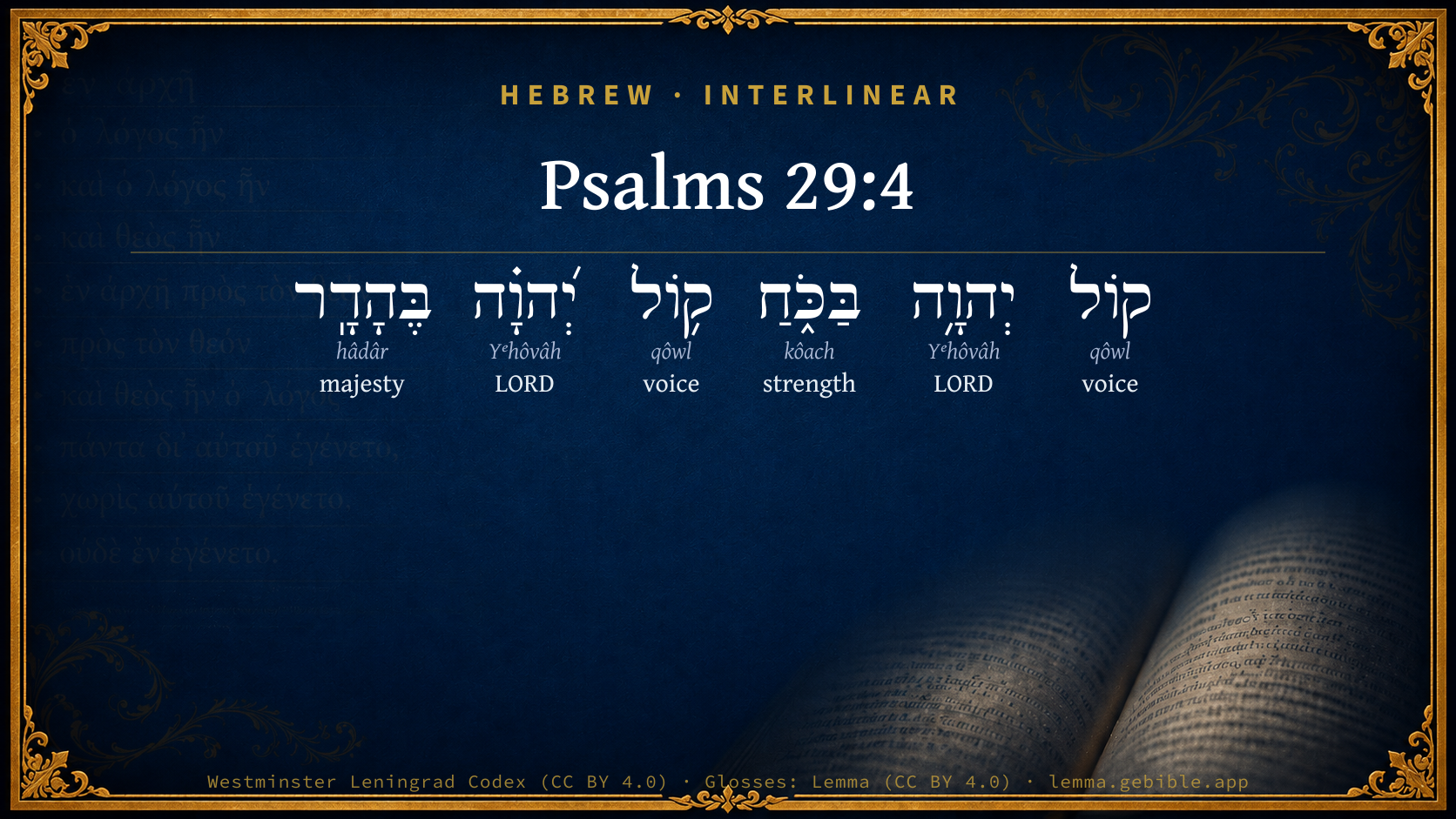
Psalms 29:4

Hebrew (Westminster Leningrad Codex) Psalms 29:4 appears in the Hebrew Old Testament. The text above is from the Westminster Leningrad Codex. Each word links to its Strong’s number, a concise gloss, and parsing drawn from the Open Scriptures Hebrew Bible morphology. Click any word for its full Brown-Driver-Briggs (BDB) entry.
Download image
Cite this verse

Psalms 29:4 (World English Bible). Public Domain. Lemma interlinear Bible study tool, https://lemma.gebible.app/v/psalms/29/4.

Show BibTeX & RIS
BibTeX
RIS
English Translation
Yahweh's voice is powerful. Yahweh's voice is full of majesty.
World English Bible · Public Domain
Download a study sheet

One document with this verse’s original text, its word-by-word gloss line, the meaning frame, cross-references with their text, attributed commentary, and full source and license credits — printable, and it pastes into notes with its structure intact.

This verse Autodidact and up

Study sheet (.html) Plain text (.txt)

A passage Seminary Student

Up to 50 verses in one chapter. A passage sheet keeps up to 6 commentary sources and 12 cross-references per verse, in the order this page ranks them, and says so on the sheet whenever that leaves anything out. Ask for a single verse and you get the Autodidact verse sheet above.

Everything on this page stays free to read, with no account — the sheet is a download of what is already on screen, not access to it.

Want to remove ads? Support Godless Engineer
Compare translations 3

The same verse in 3 English versions, stacked beneath the original-language interlinear above. Click any original word for its lexicon entry.

Each is an independent rendering of the whole verse — the interlinear is not word-aligned to these translations.

Highlighted words mark where these versions differ — a whole-verse word diff, not a word-by-word alignment.

  • World English Bible Public Domain
    Yahweh's voice is powerful. Yahweh's voice is full of majesty.
  • King James Version Public Domain
    The voice of the LORD is powerful; the voice of the LORD is full of majesty.
  • unfoldingWord Literal Text CC BY-SA 4.0
    The voice of Yahweh is with power; the voice of Yahweh is with majesty.

unfoldingWord Literal Text — © unfoldingWord, licensed CC BY-SA 4.0. Word-aligned USFM3 via Door43 (git.door43.org/unfoldingWord/en_ult).

Versions to compare (up to 4)

3 of 4 selected

Show all 18 translations

Every available English version of this verse, each an independent rendering of the whole verse.

  • World English Bible Public Domain
    Yahweh's voice is powerful. Yahweh's voice is full of majesty.
  • Berean Standard Bible Public Domain
    The voice of the LORD is powerful; the voice of the LORD is majestic.
  • Majority Standard Bible Public Domain
    The voice of the LORD is powerful; the voice of the LORD is majestic.
  • King James Version Public Domain
    The voice of the LORD is powerful; the voice of the LORD is full of majesty.
  • American Standard Version (1901) Public Domain
    The voice of Jehovah is powerful; The voice of Jehovah is full of majesty.
  • Revised Version (1885) Public Domain
    The voice of the LORD is powerful; the voice of the LORD is full of majesty.
  • Geneva Bible (1599) Public Domain
    The voyce of the Lord is mightie: the voyce of the Lord is glorious.
  • Douay-Rheims (1899) Public Domain
    The voice of the Lord is in power; the voice of the Lord in magnificence.
  • Young's Literal Translation Public Domain
    The voice of Jehovah `is' with power, The voice of Jehovah `is' with majesty,
  • Literal Standard Version CC BY-SA 4.0
    The voice of YHWH [is] with power, || The voice of YHWH [is] with majesty,
  • Unlocked Literal Bible CC BY-SA 4.0
    The voice of Yahweh is powerful; the voice of Yahweh is majestic.
  • unfoldingWord Literal Text CC BY-SA 4.0
    The voice of Yahweh is with power; the voice of Yahweh is with majesty.
  • Darby Bible Public Domain
    The voice of Jehovah is powerful; the voice of Jehovah is full of majesty.
  • World Messianic Bible Public Domain
    The LORD’s voice is powerful. The LORD’s voice is full of majesty.
  • Webster's Bible Public Domain
    The voice of the LORD is powerful; the voice of the LORD is full of majesty.
  • Free Bible Version CC BY-SA 4.0
    The Lord's voice is powerful; the Lord's voice is majestic;
  • Bible in Basic English Public Domain
    The voice of the Lord is full of power; the voice of the Lord has a noble sound.
  • JPS Tanakh (1917) Public Domain
    The voice of the LORD is powerful; the voice of the LORD is full of majesty.

Literal Standard Version (2020), Covenant Press — licensed CC BY-SA 4.0. Text via the HelloAO Bible API (eBible.org). Unlocked Literal Bible (unfoldingWord) — licensed CC BY-SA 4.0. Text via the HelloAO Bible API (eBible.org). unfoldingWord Literal Text — © unfoldingWord, licensed CC BY-SA 4.0. Word-aligned USFM3 via Door43 (git.door43.org/unfoldingWord/en_ult). Free Bible Version, Dr. Jonathan Gallagher — licensed CC BY-SA 4.0. Text via the HelloAO Bible API (eBible.org).

Word by word

More ways to search: Search by grammar → Find every occurrence → Compare this word →

Practice this passage: Drill this verse → Learn its vocabulary →

About this verse

These counts appear in no published source. They are computed here, from the morphology-tagged text and Lemma’s own curated glosses. What Lemma adds →

6
words
4
distinct lemmas
Wisdom
section

Shared distinctive vocabulary

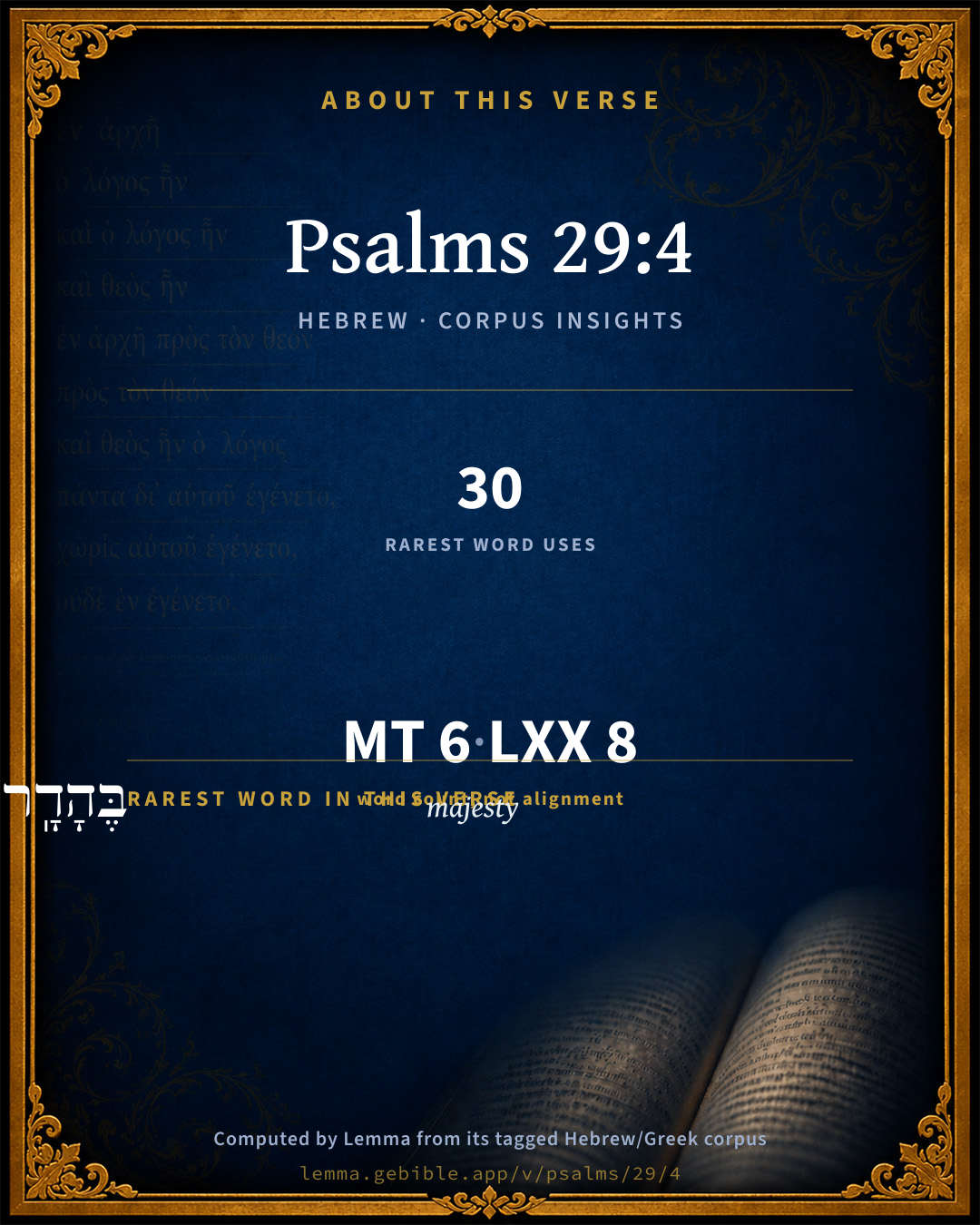
בֶּהָדָֽר majesty H1926 occurs in 29 verses of the Hebrew Bible. Also found in:

Grammatical profile

  • 6 nouns

Repetition

Words recur within this verse — often emphatic in Hebrew:

  • קוֹל voice H6963 ×2
  • יְהוָ֥ה LORD H3068 ×2

Hebrew & Septuagint length

In English translation the verse runs 10 words from the Hebrew and 16 from the Septuagint (LXX English) — closely comparable.

A rough comparison of the two English renderings, which tokenize alike — not a word-level alignment.

Word counts can differ between the Hebrew and the Greek without any difference in meaning — e.g. the Hebrew direct-object marker אֵת has no separate Greek word, and Greek often adds the article ὁ.

In the original languages it is 6 Hebrew tokens and 8 Greek tokens — but the two are counted differently (Hebrew bundles its prefixes and suffixes into one token; the Greek is in lemma form), so that isn’t a like-for-like length.

Cross-references

8

Topical passages linked to Psalms 29:4 in the Treasury of Scripture Knowledge — connected by theme and wording, ordered by reader-vote popularity; previews shown in the World English Bible.

  • Ezekiel 10:5 The sound of the wings of the cherubim was heard even to the outer court, as the voice of God Almighty when he speaks.
  • Psalms 33:9 For he spoke, and it was done. He commanded, and it stood firm.
  • Psalms 68:33 To him who rides on the heaven of heavens, which are of old; Behold, he utters his voice, a mighty voice.
  • Jeremiah 51:15–16 He has made the earth by his power, he has established the world by his wisdom, and by his understanding has he stretched out the heavens:
  • Luke 4:36 Amazement came on all, and they spoke together, one with another, saying, "What is this word? For with authority and power he commands the unclean spirits, and they come out!"
  • Isaiah 66:6 A voice of tumult from the city, a voice from the temple, a voice of Yahweh that renders recompense to his enemies.
  • Luke 8:25 He said to them, "Where is your faith?" Being afraid they marveled, saying one to another, "Who is this, then, that he commands even the winds and the water, and they obey him?"
  • Job 40:9–12 Or have you an arm like God? Can you thunder with a voice like him?

Cross-references courtesy of OpenBible.info (CC BY 4.0).

Hebrew and Greek witnesses Masoretic Hebrew ↔ Greek Septuagint

The same verse in the two great witnesses to the Old Testament, shown verse-for-verse.

You’re reading Greek Psalm 28 (Hebrew Psalm 29). The Septuagint counts the superscription, so verse numbers can differ from the Hebrew — chapter-level alignment, not verse-by-verse. Numbering follows Rahlfs.

These are two independent witnesses, not word-aligned to each other, and the Septuagint is shown in lemma (dictionary) form.

Hebrew Psalms 29:4 Masoretic · Westminster Leningrad Codex

קוֹל יְהוָ֥ה בַּכֹּ֑חַ ק֥וֹל יְ֝הוָ֗ה בֶּהָדָֽר

Yahweh's voice is powerful. Yahweh's voice is full of majesty.

World English Bible · Public Domain

Greek LXX Greek Psalm 28:4 Septuagint · lemma form

φωνή κύριος ἐν ἰσχύς φωνή κύριος ἐν μεγαλοπρέπεια

The voice of the Lord is mighty; the voice of the Lord is full of majesty.

LXX2012 (modern English Septuagint) · Public Domain

On this verse, Ellicott's Commentary for English Readers discusses the Septuagint’s reading. Read the note in Commentary ↓

Hebrew: Westminster Leningrad Codex (CC BY 4.0). Greek: Septuagint (public domain); English from LXX2012 (modern English Septuagint) (Public Domain). How the Septuagint differs from the Hebrew →

Commentary

Notes on Psalms 29:4 from classic Christian and Jewish commentators (each source and its license shown beneath its notes). The classic Christian expositions comment on the surrounding passage and are grouped to its opening verse, so a note may address several verses; the Jewish commentaries on the Tanakh (Rashi and others) are per-verse, so they appear only where the commentator wrote on this verse.

Lemma curates 59 commentaries, every one of them public domain or Creative Commons licensed, each selected and text-cleaned for this edition rather than reprinted as found. About our sources →

Trapp's Complete Commentary

John Trapp

Psa 29:4 The voice of the LORD [is] powerful; the voice of the LORD [is] full of majesty.

Ver. 4. The voice of the Lord is powerful] So that it shaketh heaven and earth, Heb 12:26. Cogitent ergo principes quantum infra Deum subsidant, &c. (Validum est et vehemens tonitru. Vat. Beza). Let those that think themselves some great business consider God’s infinite power, putting forth itself in thunders and tempests, and they will soon be crest fallen.

The voice of the Lord is full of majesty] Heb. in majesty; it is magnificent and immutable, though some fools have attempted to imitate it (as a certain king of Egypt, and Caligula, the emperor), by certain engines and devices.

John Trapp, A Commentary or Exposition upon All the Books of the Old and New Testament (1647–1656) — public domain. Text from a community e-Sword module.

Joseph Benson's Commentary

Psa 29:4-6. The voice of the Lord is full of majesty — Is a very awful and evident proof of God’s glorious majesty. Breaketh the cedars — By lightning, vulgarly called thunderbolts; which have torn asunder and destroyed trees and towers. The cedars of Lebanon — A place famous for strong and lofty cedars. He maketh them also — The cedars last mentioned; to skip like a calf — For, being broken by the lightning, the fragments of them are suddenly and violently hurled about hither and thither; Lebanon also, and Sirion — A high mountain beyond Jordan, joining to Lebanon: and these mountains may here be understood, either, 1st, Properly, and so they are said to skip and leap, both here and Psa 114:4, by a poetical hyberbole, very usual both in Scripture and other authors; or, 2d, Metonymically, being put for the trees or people of them, as the wilderness is to be understood, Psa 29:8; and as the earth, by the same figure, is frequently put for the inhabitants of it; like a young unicorn — Hebrew reem: see Num 23:22; Psa 22:21.

Joseph Benson's Commentary on the Old and New Testaments (1811–1818) — public domain. Text from a community e-Sword module.

J. A. Alexander on Psalms

Joseph Addison Alexander

4. (Psa 29:4) The voice of Jehovah in power! The voice of Jehovah in majesty! The exclamations, as in Psa 29:3, may be converted into propositions by supplying either the past or present tense of the verb to be. "The voice of Jehovah is (or was) in power." In power, in majesty, i.e. invested with these attributes, a stronger expression than the corresponding adjectives strong and majestic, would be, and certainly more natural and consonant to usage than the construction which makes in a mere sign of that in which something else consists. It is, indeed, little short of nonsense to affirm that the voice of God consists in power, consists in majesty, whereas there is truth as well as beauty in describing it as clothed or invested with those qualities.

Joseph Addison Alexander, The Psalms Translated and Explained (1850) — public domain. Text from a community e-Sword module.

Jamieson, Fausset & Brown

Robert Jamieson, A. R. Fausset & David Brown

powerful . . . majesty--literally, "in power, in majesty."

Jamieson, Fausset & Brown — Commentary Critical and Explanatory on the Whole Bible (1871) — public domain (CC PDM 1.0). Text via the HelloAO Bible API.

Adam Clarke's Commentary

Verse 4. Is powerful] There is no agent in universal nature so powerful as the electric fluid. It destroys life, tears castles and towers to pieces, rends the strongest oaks, and cleaves the most solid rocks: universal animate nature is awed and terrified by it. To several of these effects the psalmist here refers; and for the illustration of the whole I must refer to the above notes on Job.

Full of majesty.] No sound in nature is so tremendous and majestic as that of thunder; it is the most fit to represent the voice of God.

Adam Clarke's Commentary on the Bible (1810–1826) — public domain. Text from a community e-Sword/MySword module.

Ellicott's Commentary for English Readers

(4) Powerful; full of majesty.—Better literally, as in LXX. and Vulg., in might, in majesty.

A Bible Commentary for English Readers, edited by Charles John Ellicott (1878–1897) — public domain. Text from a community e-Sword module.

The Cambridge Bible for Schools and Colleges

gen. ed. J. J. S. Perowne

4. is powerful … is full of majesty] Lit. is with power … is with majesty.

The Cambridge Bible for Schools and Colleges (gen. ed. J. J. S. Perowne; Cambridge University Press, 1878–1918) — public domain. Text from a community e-Sword module.

John Gill's Exposition

The voice of the Lord is powerful,.... Or "with power" (a); as thunder, in the effect of it, shows; and so is the Gospel, when it comes, not in word only, but is attended with the power of God to the conversion and salvation of souls; it is then quick and powerful, Heb 4:12; and the word of Christ personal, when here on earth, was with power, Luk 4:32;

the voice of the Lord is full of majesty; Christ, in his state of humiliation, spake and taught as one having authority; and now, in the ministration of his Gospel by his servants, he goes forth with glory and majesty, Psa 45:3.

(a) "in potentia", Pagninus, Montanus; "cum potentia", Cocceius, Michaelis; "with able power", Ainsworth.

John Gill's Exposition of the Whole Bible (1746–1763) — public domain (CC PDM 1.0). Text via the HelloAO Bible API.

Albert Barnes' Notes on the Bible

The voice of the Lord is powerful - Margin, as in Hebrew: “in power.” That is, is mighty; or, has strength. Allusion may be made to what seems to be the effect of thunder in prostrating trees, or tearing off their limbs, or it may be merely to the loud sound of the thunder.

Is full of majesty - Margin, as in Hebrew, “in majesty.” That is, it is grand, sublime, overpowering.

Albert Barnes' Notes on the Bible (1834–1885) — public domain. Text from a community e-Sword/MySword module.

Matthew Poole's English Annotations

Is an evident proof of God’s glorious majesty.

Matthew Poole's English Annotations on the Holy Bible (1683–1685) — public domain. Text from a community e-Sword/MySword module.

The Treasury of David

Charles H. Spurgeon

Ver. 4. The voice of the Lord is powerful. An irresistible power attends the lightning of which the thunder is the report. In an instant, when the Lord wills it, the force of electricity produces amazing results. A writer upon this subject, speaks of these results as including a light of the intensity of the sun in his strength, a heat capable of fusing the most compact metals, a force in a moment paralysing the muscles of the most powerful animals; a power suspending the all pervading gravity of the earth, and an energy capable of decomposing and recomposing the closest affinities of the most intimate combinations. Well does Thompson speak of "the unconquerable lightning, "for it is the chief of the ways of God in physical forces, and none can measure its power.

As the voice of God in nature is so powerful, so is it in grace; the reader will do well to draw a parallel, and he will find much in the gospel which may be illustrated by the thunder of the Lord in the tempest. His voice, whether in nature or revelation, shakes both earth and heaven; see that ye refuse not him that speaketh. If his voice be thus mighty, what must his hand be! beware lest ye provoke a blow. The voice of the Lord is powerful; the voice of the Lord is full of majesty. The King of kings speaks like a king. As when a lion roareth, all the beasts of the forest are still, so is the earth hushed and mute while Jehovah thundereth marvellously.

"It is listening fear and dumb amazement all."

As for the written word of God, its majesty is apparent both in its style, its matter, and its power over the human mind; blessed be God, it is the majesty of mercy wielding a silver sceptre; of such majesty the word of our salvation is full to overflowing.

Ver. 4. The voice of the Lord. These vehement repetitions resemble a series of thunderclaps; one seems to hear the dread artillery of heaven firing volley after volley, while peal on peal the echo follows the sound. C. H. S.

Ver. 4. The voice of the Lord is powerful. I would render unto God the glory due unto his name, for the admirable change which he has wrought in my heart. There was nothing to be found in me but an impious hardness and inveterate disorder. From this helpless state he changed me into a new man and made resplendent the glory of his name and the power of his grace. He alone can work such prodigies. Unbelievers who refuse to acknowledge the hand of God in creation must surely in this case admit that "this is the finger of God." Yes, great God, chaos knows not how to resist thee, it hears thy voice obediently, but the obdurate heart repels thee, and thy mighty voice too often calls to it in vain. Thou art not so great and wonderful in creating worlds out of nothing as thou art when thou dost command a rebel heart to arise from its abyss of sin, and to run in the ways of thy commandments. To disperse a chaos of crime and ignorance by the majesty of thy word, to shed light on the direst darkness, and by the Holy Ghost to establish harmonious order where all was confusion, manifests in far greater measure thine omnipotence than the calling forth of heavenly laws and celestial suns from the first chaos. J. B. Massillon.

Ver. 4. O may the evangelical "Boanerges" so cause the glorious sound of the gospel to be heard under the whole heaven, that the world may again be made sensible thereof; before that voice of the Son of Man, which hath so often called sinners to repentance, shall call them to judgment. George Horne.

Ver. 4. Where the word of a king is, there is power, but what imperial voice shall be likened unto the majestic thunder of the Lord? C. H. S.

Ver. 4. Power and majesty of the gospel. Illustrate by succeeding verses.

Ver. 4. (last clause). "The majestic voice." See Spurgeon's Sermons, No. 87.

Psalms 29:5*

Charles H. Spurgeon's The Treasury of David (1869–1885) — public domain. Psalms only. Text from a community e-Sword/MySword module.

The Pulpit Commentary

The voice of the Lord is powerful; literally, in power, or with power (LXX, en iscui ). The voice of the Lord is full of majesty; literally, in majesty, or with majesty. Two somewhat distant crashes, each louder than the preceding one, are thought to be represented the storm sweeping on, and gradually drawing nearer and more near.

The Pulpit Commentary (1880–1919), ed. H.D.M. Spence-Jones & Joseph S. Exell — public domain. Text from a community e-Sword module.

Rashi

Rabbi Shlomo Yitzchaki (Rashi)

The voice of the Lord is in strength At the time of the giving of the Torah, He moderated His voice according to the strength of Israel, as it is said (Exod. 19:19): “and God would answer him with a voice,” with Moses’ voice.

Rashi on the Tanakh — English translations: “The Judaica Press complete Tanach with Rashi, translated by A. J. Rosenberg” (CC BY 4.0); “Pentateuch with Rashi's commentary by M. Rosenbaum and A.M. Silbermann, 1929-1934” (public domain); “The Metsudah Tanach series, Lakewood, N.J” (CC BY 4.0); and “The Book of Joshua, Metsudah Publications, 1997” (CC BY 4.0). Text via Sefaria.

Lesson kit

Teaching starters — assembled from the data on this page, not authored interpretation. Every prompt links to the verse data it draws on. Edit before teaching.

Psalms, in the Wisdom, opens this verse with 6 words (4 distinct Hebrew lemmas). Its most distinctive word is hâdâr (“majesty”). A historical commentator’s framing appears above. Read the whole chapter for the surrounding context.

Discussion questions

  1. What does “majesty” (hâdâr) contribute to the verse as a whole?
  2. How does Leviticus 23:40, which shares the word «majesty», read alongside this verse?
  3. What does the repetition of “voice” (2× in this one verse) do in this verse?
  4. These translations render this verse differently. What is at stake in choosing one wording over another?
  5. Compare how Trapp's Complete Commentary and Joseph Benson's Commentary read this verse. Where do they agree or differ?

Things to notice

Reading settings

Reading text

Shown beneath each verse's original-language words.

Old Testament
Old Testament edition

Read the OT as the Masoretic Hebrew (MT) or the Greek Septuagint (LXX).

English shown for the Greek Septuagint (in the Hebrew ↔ Greek comparison).

Comparing translations? Open the Compare panel on any verse page to stack up to four side by side.