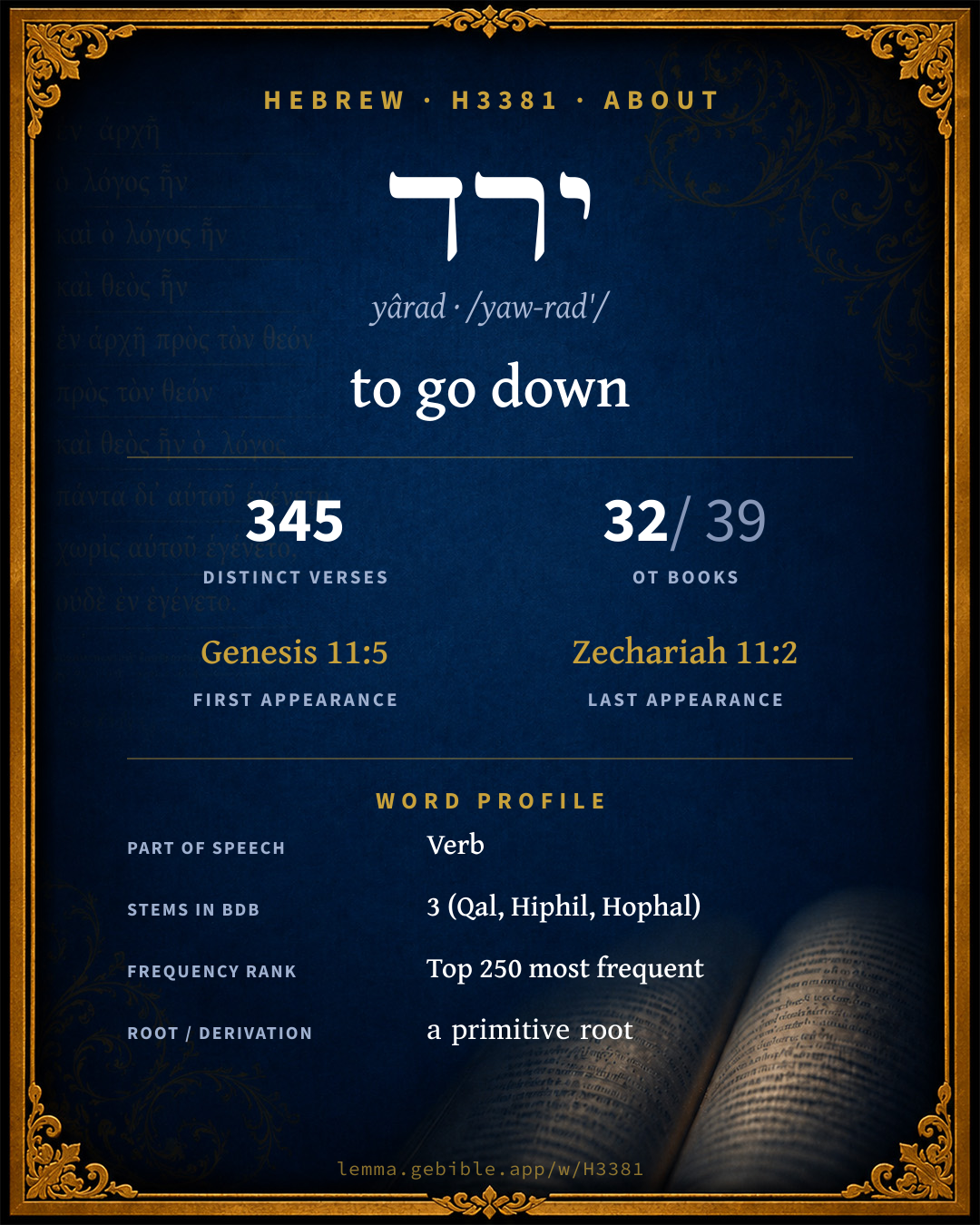
יָרַד
to go down
also: descend, decline, march down, sink down fuller range ↓
Full lexicon entry — Brown-Driver-Briggs (BDB)
From Brown-Driver-Briggs (BDB)
Where this word appears
See every Qal verb in the Hebrew Bible →
Grammar key — what these labels mean
Part of speech
- Verb
- An action or state-of-being word.
Stem
- Qal
- The basic, simple active stem — the plain form of the verb (“he wrote”). Here: ‘go down’
- Hiphil
- The causative active stem (“he caused / brought about”). Here: ‘bring down’
- Hophal
- The passive counterpart of the Hiphil (“he was caused to…”). Here: ‘be brought down’
Form
- Sequential Imperfect
- An imperfect with prefixed waw — the standard past-narrative form (waw-consecutive imperfect).
- Perfect
- A completed action or state — Hebrew marks aspect (completeness) more than strict tense (“he wrote”).
- Participle Active
- A verbal adjective expressing ongoing or characteristic action (“writing / one who writes”).
- Infinitive Construct
- A bound verbal noun, frequently with prepositions (“to write / in writing”).
- Sequential Perfect
- A perfect with prefixed waw continuing a preceding imperfect or command (waw-consecutive perfect).
- Imperfect
- An incomplete, ongoing, or future action (“he will / would write”).
- Imperative
- A direct command (“write!”).
- Cohortative
- A first-person volitional form expressing wish or resolve (“let me / let us write”).
- Jussive
- A third- or second-person volitional form expressing wish or command (“let him write”).
- Infinitive Absolute
- An unbound verbal noun, often intensifying or standing in for a finite verb.
State
- Construct
- A noun bound to a following noun in a possessive / “of” relationship (the construct chain).
- Absolute
- The independent form of a noun, not bound to a following word.
Person
- 3rd Person
- The one spoken about (“he / she / it / they”).
- 2nd Person
- The one addressed (“you”).
- 1st Person
- The speaker (“I / we”).
Gender
- Masculine
- Grammatically masculine.
- Common
- Either gender — not distinguished for this form.
- Feminine
- Grammatically feminine.
Number
- Singular
- One.
- Plural
- More than one (in Hebrew, generally three or more).
29 verses where H3381 appears in the Qal stem in the Book of 1 Samuel. Filtered view — show all forms. Click any verse to open its interlinear word-by-word view. Verse text shown in the World English Bible for context — . Each verse’s Hebrew form is shown with its reference; the English is not keyword-highlighted, since the data carries no word-level English alignment. Use “Compare translations” on any verse to read it across multiple English versions. This concordance covers the Hebrew Bible; Septuagint (Greek Old Testament) occurrences are not indexed here.
1 Samuel
- 1 Samuel 6:21 רְד֕וּ Qal impv 2mp They sent messengers to the inhabitants of Kiriath Jearim, saying, The Philistines have brought back the ark of Yahweh; come you down, and bring it up to you.
- 1 Samuel 9:25 וַ/יֵּרְד֥וּ conj + Qal wimpf 3mp When they were come down from the high place into the city, he talked with Saul on the housetop.
- 1 Samuel 9:27 יֽוֹרְדִים֙ Qal ptcp.act mp As they were going down at the end of the city, Samuel said to Saul, Bid the servant pass on before us (and he passed on), but stand you still first, that I may cause you to hear the word of God.
- 1 Samuel 10:5 יֹרְדִ֣ים Qal ptcp.act mp After that you shall come to the hill of God, where is the garrison of the Philistines: and it shall happen, when you are come there to the city, that you shall meet a band of prophets coming down from the high place with a psaltery, and a tambourine, and a pipe, and a harp, before them; and they will be prophesying:
- 1 Samuel 10:8 וְ/יָרַדְתָּ֣ יֹרֵ֣ד conj + Qal wpf 2ms Qal ptcp.act ms You shall go down before me to Gilgal; and, behold, I will come down to you, to offer burnt offerings, and to sacrifice sacrifices of peace-offerings: seven days shall you wait, until I come to you, and show you what you shall do.
- 1 Samuel 13:12 יֵרְד֨וּ Qal impf 3mp therefore said I, Now will the Philistines come down on me to Gilgal, and I haven't entreated the favor of Yahweh: I forced myself therefore, and offered the burnt offering.
- 1 Samuel 13:20 וַ/יֵּרְד֥וּ conj + Qal wimpf 3mp but all the Israelites went down to the Philistines, to sharpen every man his plowshare, mattock, axe, and sickle;
- 1 Samuel 14:36 נֵרְדָ֣ה Qal coh 1cp Saul said, Let us go down after the Philistines by night, and take spoil among them until the morning light, and let us not leave a man of them. They said, Do whatever seems good to you. Then said the priest, Let us draw near here to God.
- 1 Samuel 14:37 הַֽ/אֵרֵד֙ ptcl inter + Qal impf 1cs Saul asked counsel of God, Shall I go down after the Philistines? will you deliver them into the hand of Israel? But he didn't answer him that day.
- 1 Samuel 15:6 רְד֜וּ Qal impv 2mp Saul said to the Kenites, Go, depart, get you down from among the Amalekites, lest I destroy you with them; for you shown kindness to all the children of Israel, when they came up out of Egypt. So the Kenites departed from among the Amalekites.
- 1 Samuel 15:12 וַ/יֵּ֖רֶד conj + Qal wimpf 3ms Samuel rose early to meet Saul in the morning; and it was told Samuel, saying, Saul came to Carmel, and, behold, he set him up a monument, and turned, and passed on, and went down to Gilgal.
- 1 Samuel 17:8 וְ/יֵרֵ֥ד conj + Qal juss 3ms He stood and cried to the armies of Israel, and said to them, Why are you come out to set your battle in array? am I not a Philistine, and you servants to Saul? choose you a man for you, and let him come down to me.
- 1 Samuel 17:28 יָרַ֗דְתָּ יָרָֽדְתָּ Qal pf 2ms Qal pf 2ms Eliab his eldest brother heard when he spoke to the men; and Eliab's anger was kindled against David, and he said, Why are you come down? and with whom have you left those few sheep in the wilderness? I know your pride, and the naughtiness of your heart; for you have come down that you might see the battle.
- 1 Samuel 20:19 תֵּרֵ֣ד Qal juss 2ms When you have stayed three days, you shall go down quickly, and come to the place where you did hide yourself when the business was in hand, and shall remain by the stone Ezel.
- 1 Samuel 22:1 וַ/יֵּרְד֥וּ conj + Qal wimpf 3mp David therefore departed there, and escaped to the cave of Adullam: and when his brothers and all his father's house heard it, they went down there to him.
- 1 Samuel 23:4 רֵ֣ד Qal impv 2ms Then David inquired of Yahweh yet again. Yahweh answered him, and said, Arise, go down to Keilah; for I will deliver the Philistines into your hand.
- 1 Samuel 23:6 יָרַ֥ד Qal pf 3ms It happened, when Abiathar the son of Ahimelech fled to David to Keilah, that he came down with an ephod in his hand.
- 1 Samuel 23:8 לָ/רֶ֣דֶת prep + Qal inf.cs Saul summoned all the people to war, to go down to Keilah, to besiege David and his men.
- 1 Samuel 23:11 הֲ/יֵרֵ֣ד יֵרֵֽד ptcl inter + Qal impf 3ms Qal impf 3ms Will the men of Keilah deliver me up into his hand? will Saul come down, as your servant has heard? Yahweh, the God of Israel, I beg you, tell your servant. Yahweh said, He will come down.
- 1 Samuel 23:20 לָ/רֶ֖דֶת רֵ֑ד prep + Qal inf.cs Qal impv 2ms Now therefore, O king, come down, according to all the desire of your soul to come down; and our part shall be to deliver him up into the king's hand.
- 1 Samuel 23:25 וַ/יֵּ֣רֶד conj + Qal wimpf 3ms Saul and his men went to seek him. They told David: why he came down to the rock, and abode in the wilderness of Maon. When Saul heard [that], he pursued after David in the wilderness of Maon.
- 1 Samuel 25:1 וַ/יֵּ֖רֶד conj + Qal wimpf 3ms Samuel died; and all Israel gathered themselves together, and lamented him, and buried him in his house at Ramah. David arose, and went down to the wilderness of Paran.
- 1 Samuel 25:20 וְ/יֹרֶ֨דֶת֙ יֹרְדִ֖ים conj + Qal ptcp.act fs Qal ptcp.act mp It was so, as she rode on her donkey, and came down by the covert of the mountain, that behold, David and his men came down toward her; and she met them.
- 1 Samuel 25:23 וַ/תֵּ֖רֶד conj + Qal wimpf 3fs When Abigail saw David, she hurried, and alighted from her donkey, and fell before David on her face, and bowed herself to the ground.
- 1 Samuel 26:2 וַ/יֵּ֨רֶד֙ conj + Qal wimpf 3ms Then Saul arose, and went down to the wilderness of Ziph, having three thousand chosen men of Israel with him, to seek David in the wilderness of Ziph.
- 1 Samuel 26:6 יֵרֵ֥ד אֵרֵ֥ד Qal impf 3ms Qal impf 1cs Then answered David and said to Ahimelech the Hittite, and to Abishai the son of Zeruiah, brother to Joab, saying, Who will go down with me to Saul to the camp? Abishai said, I will go down with you.
- 1 Samuel 26:10 יֵרֵ֖ד Qal impf 3ms David said, As Yahweh lives, Yahweh will strike him; or his day shall come to die; or he shall go down into battle and perish.
- 1 Samuel 29:4 יֵרֵ֤ד Qal impf 3ms But the princes of the Philistines were angry with him; and the princes of the Philistines said to him, Make the man return, that he may go back to his place where you have appointed him, and let him not go down with us to battle, lest in the battle he become an adversary to us: for with what should this [fellow] reconcile himself to his lord? should it not be with the heads of these men?
- 1 Samuel 30:24 הַ/יֹּרֵ֣ד ptcl def.art + Qal ptcp.act ms Who will listen to you in this matter? for as his share is who goes down to the battle, so shall his share be who tarries by the baggage: they shall share alike.
About this entry
At a glance — auto-summarized from this page’s data, not written by a person. Every figure links to its source below. This summary describes the numbers; it doesn’t interpret them.
“to go down” is the headline sense of the Hebrew verb ירד (yârad). Its earliest occurrence is Genesis 11:5. It turns up in 345 verses across 32 books, a common footprint. The verb spans 3 stems, from Qal to Hiphil. It clusters with מורד, ירד and ירדן under a shared root. See the sense tree, 345-verse concordance, and the renderings breakdown below.
Gloss history
Strong's 1890 vs modern scholarship
About this word
Strong's H3381 catalogs a Hebrew word from the Hebrew Old Testament.
These counts are not copied from any lexicon or concordance. They are computed here, from the morphology-tagged Hebrew Old Testament. What Lemma adds →
- 345
- distinct verses
- The word appears in 345 distinct verses.
- 32 / 39
- OT books
- The word appears in 32 of 39 Old Testament books.
- #130
- by frequency
- Top 250 most frequent Hebrew words (rank 130 of 8,640 Hebrew words by occurrence).
View all 345 occurrences in the concordance →
By section of the Old Testament
By traditional corpus
Conventional, traditional groupings — biblical authorship is debated, so this is a traditional corpus grouping, not an authorship claim. Each share is this word’s portion of its verses in that division of the Hebrew canon. Each figure is a share of the word’s 345 distinct verses.
- Prophets (Nevi'im) 208 verses · 60%
- Torah (Pentateuch) 81 verses · 23%
- Writings (Ketuvim) 56 verses · 16%
How translations render this word
Counts come from each version’s own published word-to-Strong’s tagging or interlinear alignment — an approximate guide to how each version renders this word, not a word-level alignment the data otherwise carries. Because each total is that version’s own tagged count, the per-version totals vary from one another and need not match the appearance or distinct-verse counts above. These counts may also differ from a printed concordance because Lemma counts each distinctly tagged rendering and does not collapse phrase taggings into a single head-word total. This is a fixed set of word-tagged versions (KJV, ASV, BSB, ULT) and does not change with the reading translation you choose elsewhere. Each version’s license is shown beside its name below (and on Sources).
- King James Version: Go down 34×, Went down 33×, Came down 32×
- American Standard Version: Went down 36×, Go down 33×, Came down 24×
- Berean Standard Bible: Went down 37×, Go down 28×, Came down 23×
- unfoldingWord Literal Text: Went down 50×, Go down 40×, And 39×
King James Version Public Domain
Renders H3381 across 386 tagged occurrences — most commonly:
Plus other, less common renderings. Plus 131 renderings that appear only once — usually multi-word phrases or single function words the recovered tagging swept in, not distinct renderings. Not rendered by a distinct English word in 2 further occurrences.
American Standard Version Public Domain
Renders H3381 across 385 tagged occurrences — most commonly:
Plus other, less common renderings. Plus 136 renderings that appear only once — usually multi-word phrases or single function words the recovered tagging swept in, not distinct renderings.
Berean Standard Bible Public Domain
Renders H3381 across 372 tagged occurrences — most commonly:
Plus other, less common renderings. Plus 134 renderings that appear only once — usually multi-word phrases or single function words the recovered tagging swept in, not distinct renderings. Not rendered by a distinct English word in 7 further occurrences.
unfoldingWord Literal Text CC BY-SA 4.0
Renders H3381 across 480 tagged occurrences — most commonly:
Plus other, less common renderings. Plus 105 renderings that appear only once — usually multi-word phrases or single function words the recovered tagging swept in, not distinct renderings.
34 senses and sub-senses in the full BDB
Hebrew verbs can shift meaning by stem (binyan): Qal is the basic action, Niphal is often passive or reflexive, Piel often intensifies or makes it factitive, and Hiphil is typically causative. The senses below are grouped under the stem BDB assigns to each. This entry also uses Hophal (the passive of Hiphil).
What do BDB’s symbols mean?
BDB uses these scholarly abbreviations:
| Symbol | Meaning |
|---|---|
| 𝔊 | the Septuagint (the ancient Greek translation, LXX) |
| 𝔙 | the Vulgate (the Latin translation) |
| 𝔖 | the Syriac version (the Peshitta) |
| 𝔗 | the Targum (the Aramaic translation) |
| ψ | the Psalms |
| √ | root (the underlying root or stem) |
| ‖ | parallel passage (a synonymous or contrasted parallel) |
| † | the dagger: every passage where the word occurs is cited |
The 34 senses and sub-senses the full Brown-Driver-Briggs lexicon distinguishes for this word, in lexicon order (not ranked by frequency), with BDB’s own verbatim wording and sub-sense lettering. Shown in Hebrew script with BDB’s own scholarly abbreviations. The condensed entry is in the Lexicon Entry tab. See also the Forms in the corpus table below.
Qal
- Pf. יָרַד Ex 19:18 +; יְרַד Ju 5:13(×2) (but read יָרַד or יֵרֵד); רַד 19:11 (read יָרַד), etc.; Impf. יֵרֵד Gn 42:38 +; וַיֵּ֫רֶד Gn 11:5 +; וַיֵּרַ֑ד 2 S 22:10 + 2 times; 3 fs. (אֵשׁ) תֵּ֫רֶד 2 K 1:10, 12; תּרַד Je 13:17 La 3:48; תֵּרֵ֔ד Is 34:5; 63:14; תֵּרֵ֑ד Ez 26:11 (יוֹרִיד Vrss Co); וַתֵּ֫רֶד Gn 24:16 + 7 times; 2 ms. תֵּרֵד Gn 26:2 + 5 times + 1 S 20:19, where read תִּפָּקֵד We Dr, cf. 𝔊 𝔖 𝔗 1 s. אֵרֵד Gn 37:35 + 3 times; וָאֵרֵד Ex 3:8 + 3 times; cohort. אֵרְדָה־נָא Gn 18:21; יֵרְדוּ 1 S 13:12 + 4 times; וַיֵּרְדוּ Gn 42:3 + 19 times; 3 f. pl. תֵּרַדְנָה Je 14:17 + 2 times; 1 pl. נֵרֵד Gn 43:5; cohort. נֵרְדָה Gn 11:7 + 2 times; וַנֵּ֫רֶד 2 K 10:13; Imv. רֵד Ex 19:21 +; רְדָה Gn 45:9 Ez 32:19; רֵ֑דָה 2 K 1:9, 11; fs. רְדִי Je 48:18 Is 47:1; mpl. רְדוּ Gn 42:2 + 5 times; Inf. abs. יָרֹד Gn 43:20; cstr. רֶ֫דֶת Gn 44:26 +; (מֵ)רְדָה Gn 46:3 (v. Köi. 402); sf. רִדְתִּי ψ 30:10, etc. (in ψ 30:4 read Kt מִיּוֹרְדֵי, so 𝔊 𝔖 Che Bae, v. Ol§§ 160 b, 245 d); Pt. יוֹרֵד Ju 9:36 +; fs. יֹרְדָה La 1:16; (הַ)יֹּרֶ֫דֶת Ec 3:21 1 S 25:30, etc.;— e.g. Exodus 19:18
- 1.
- a. come or go down: from (מִן) a mountain Ex 19:14; 32:1, 15 (all E), 34:29(×2) (JE), Dt 9:15; 10:5 Nu 20:28 (P) +; abs. Ex 19:21, 24 (J), v 25 (J; c. אֶל pers.); from the air, of birds, sq. עַל Gn 15:11 (JE). e.g. Exodus 19:14
- b. go down (usually from mountain or hill-country into plain), to battle, abs. Ju 5:14; sq. לָעֵמֶק Ju 1:34; sq. לַשְּׁעָרִים Ju 5:11; sq. אֶל v 10, 11, cf. 1 S 17:8 (sq. אֶל pers.); sq. לִקְרַאת Ju 7:24; sq. אַחֲרֵי pers. 1 S 14:36; sq. ב loc. Ju 7:9; בַּמִּלְחָמָה יֵרֵד וְנִסְפָּה 1 S 26:10, cf. 29:4; 30:24; of single combat, וַיֵּרֶד אֵלָיו בַּשָּׁ֑בֶט 2 S 23:21 = 1 Ch 11:23. e.g. Judges 5:14
- c. go down to (acc.) threshing-floor, Ru 3:3, 5; (from David’s palace) to Uriah’s house (אֶל) 2 S 11:9, 10(×2), 13; from temple to (acc.) king’s house Je 36:12 (+ עַל־לִשְׁכַּת הַסֹּפֵר); רֵד בֵּית־מֶלֶךְ יְהוּדָח 22:1, etc. e.g. Ruth 3:3
- d. go down (abs.) from Palestine to Egypt Gn 42:3 (E), v 38 (J) + 6 times JE; †sq. אֵלַי Gn 45:9 (E); sq. מִצְרַ֫יְמָה Gn 46:3, 4 (E), 12:10; 26:2 (both J), Nu 20:15 (JE); sq. מִצְרַיִם Jos 24:4 (E), Gn 43:15 (J), Is 30:2; 31:1; 52:4; sq. שָׁ֫מָּה Gn 42:2 (E)†; so to Philistine cities Ju 14:19; 16:31 1 S 13:20 Am 6:2. e.g. Genesis 42:3
- e. from Jerusalem, abs. Ju 1:9 1 K 1:25 Ne 6:3 2 Ch 20:16 (to battle); to Jezreel 2 K 8:21 = 9:26 = 2 Ch 22:6; to Samaria 1 K 22:2 = 2 Ch 18:2; (to Gihon) 1 Ki 1:38, etc. e.g. Judges 1:9
- f. from altar ירד מֵעֲשׂוֹת הַחַטָּאת Lv 9:22 (P); from chariot, c. מֵעַל Ju 4:15; from ass, c. מֵעַל 1 S 25:23; from throne, c. מֵעַל Ez 26:16, abs. Is 47:1, cf. רְדִי מִכָּבוֹד Je 48:18; from ships, c. מִן Ez 27:29; from bed, c. מִן 2 K 1:4, 6, 16 (all opp. עלה). e.g. Leviticus 9:22
- g. go down הָעַ֫יְנָה Gn 24:16, 45 (J); sq. לִרְחֹץ עַל הַיְאֹר Ex 2:5 (E), cf. (abs.) 2 K 5:14; sq. acc. הַסֶּלַע 1 S 23:25; יוֹרְדֵי הַיָּם Is 42:10; יוֹרְדֵי הַיָּם בָּאֳנִיּוֹת ψ 107:23; abs. (into pit or well) 2 S 23:30 = 1 Ch 11:22, sq. שָׁם (i.e. בְּאֵר) 2 S 17:18.—וְיָרַדְתִּי Ju 11:37, read וְרַדְתִּי (√ רוד, wander about), RS in Bla. e.g. Genesis 24:16
- h. = sink, in water יָֽרְדוּ בִמְצוֹלוֹת כְּמוֹ־אָ֑בֶן Ex 15:5 (song in E); לְקִצְבֵי הָרִים יָרַדְתִּי Jon 2:7; more gen., opp. rising, יַעֲלוּ הָרִים יֵֽרְדוּ בְקָעוֹת ψ 104:8 mountains rise, valleys sink; יַעֲלוּ שָׁמַיִם יֵרְדוּ תְהוֹמוֹת 107:26. e.g. Exodus 15:5
- i. go down to Sheʾôl: †sq. שְׁא֫וֹלָה Gn 37:35 (J; + אֶל־בְּנִי), Nu 16:30, 33 (JE), Ez 31:15, 17; sq. שְׁאוֹל Ez 32:27 ψ 55:16 Jb 7:6 (opp. עלה); בַּדֵּי שְׁאֹל תֵּרַדְנָה Jb 17:16; abs. Is 5:14 Ez 32:19 (‖ הָשְׁכְּבָה), v 21, 30, ψ 49:15 (sq. אַחֲרָיו); יָֽרְדוּ עֲרֵלִים Ez 32:24; sq. שַׁחַת Jb 33:24, אֶל־שַׁחַת ψ 30:10; sq. בּוֹר ψ 30:4 Qr (Kt יורדי); יוֹרְדֵי אֶל־אַבְנֵי־בוֹר Is 14:19†; יוֹרְדֵי בוֹר ψ 28:1 Ez 26:20(×2) (‖ אֶרֶץ תַּחְתִּיּוֹת) + 11 times (v. בּוֹר); †יוֹרְדֵי עָפָר ψ 22:30; יוֹרְדֵי דוּמָה 115:17 (‖ הַמֵּתִים); רַגְלֶיהָ יֹרְדֹת מָ֑וֶת Pr 5:5, cf. 7:27 (‖ דַּרְכֵי שְׁאוֹל); note also מִי יוֹדֵעַ … רוּחַ הַבְּהֵמָה הַיֹּרֶדֶת הִיא לְמַטָּה לָאָרֶץ Ec 3:21 (opp. הָעֹלָה הִיא לְמָ֑עְלָה; read חֲיֹרדת, הַעֹלָה, with Vrss, see VB). e.g. Genesis 37:35
- j. fig. יֹרֵד בַּבֶּ֑כִי Is 15:3 going down (dissolving) in tears (‖ יְיֵלֵיל; cf. 3 c). e.g. Isaiah 15:3
- k. = be prostrated, abs., of horses and riders Hg 2:22, cf. Is 34:7, perhaps also Je 48:15; 50:27 (+ לַטָּ֑בַח); forest Is 32:19 Zc 11:2; city Dt 20:20 La 1:9; wall Dt 28:52; nation תֵּרֵד מַ֫טָּה מָ֑טָּה Dt 28:43 (opp. עלה); מַצֵּבוֹה Ez 26:11 + לָאָרֶץ (where Co ויחרדו). e.g. Haggai 2:22
- 2. of divine manifestations: descend, of י׳ in theoph. [= על ההר]יָרַד עָלָיו י׳ בָּאֵשׁ Ex 19:11, 18 (E), v 20 (J; אֶל־רֹאשׁ הָהָר), cf. Ne 9:13; יֵרֵד י׳ צְבָאוֹת לִצְבֹּא עַל־הַר־צִיּוֹן Is 31:4; abs. Gn 11:5, 7; 18:21 Ex 3:8 (all J), Nu 11:17 (JE), 2 S 22:10 = ψ 18:10 (cf. 144:5), Mi 1:3 Is 63:19; 64:2; וַיֵּרֶד י׳ בֶּעָנָן Ex 34:5 Nu 11:25, cf. 12:5 (all JE); of pillar of cloud Ex 33:9 (JE); מִ׳ עָלָה־שָׁמַיִם וַיֵּרַ֡ד Pr 30:4; of angels on סֻלָּם; עֹלִים וְיֹרְדִים בּוֹ Gn 28:12 (E). e.g. Exodus 19:11
- 3. of inanimate things:
- a. hail c. עַל pers. Ex 9:19 (J); dew c. עַל loc. Nu 11:9 (JE), ψ 133:3; rain (as אָבָק and עָפָר), sq. מִן הַשָּׁמַיִם + על pers. Dt 28:24, so in sim. of future king יֵרֵד כְּמָטָר עַל־גֵּז ψ 72:6; of גֶּשֶׁם and שֶׁלֶג, c. מִן הַשָּׁמַיִם Is 55:10; manna (c. עַל loc.) Nu 11:9 (JE); fire from (מִן) heaven 2 K 1:10(×2), 12(×2), 14 2 Ch 7:1, abs. 2 Ch 7:3. e.g. Exodus 9:19
- b. waters, flowing down הַנַּחַל הַיֹּרֵד מִן־הָהָר Dt 9:21, cf. Jos 3:13 (sq. מִלְמָ֑עְלָה), v 16; sq. עַל־יַם הָעֲרָבָה v 16; עַל־הָעֲרָבָה Ez 47:8; sq. מִן 47:1. e.g. Deuteronomy 9:21
- c. tears, פַּלְגֵי־מַיִם יָֽרְדוּ עֵינָ֑י ψ 119:36, and so La 3:48; also עֵינִי יֹרְדָה מַיִם La 1:16, and so Je 9:17; 13:17; 14:17 (cf. also Is 15:3, 1 j). e.g. Psalms 119:36
- d. of oil descending upon (על) beard, etc. ψ 133:2(×2). e.g. Psalms 133:2
- e. of shadow on dial 2 K 20:11 = Is 38:8(×2). e.g. 2 Kings 20:11
- f. of boundary going down (from or to a place) Jos 16:3 (JE), elsewhere P, Nu 34:11(×2), 12 Jos 15:10; 16:7; 17:9; 18:13, 16. e.g. Joshua 16:3
- g. come down, abs. of headdresses, in sign of humiliation Je 13:18. e.g. Jeremiah 13:18
- h. pride of power Ez 30:6. e.g. Ezekiel 30:6
- i. of calamity מֵאֵת י׳ Mi 1:12; עַל־קָדְקְדוֹ הֲמָסוֹ יֵרֵד ψ 7:17; of sword descending on (על) Edom Is 34:5. e.g. Micah 1:12
- j. fig. of words of talebearer; יָֽרְדוּ חַדְרֵי־בָּ֑טֶן Pr 18:8 = 26:22.—Vid. also supr. 1 k. e.g. Proverbs 18:8
Hiphil
- Pf. 3 ms. הוֹרִד 2 K 16:17; וְהוֹרִיד consec. Am 3:11 (We וְהוּרַד); 2 ms. וְהוֹרַדְתָּ֫ 1 K 2:9; 2 fs. sf. הוֹרַדְתֵּנִי Jos 2:18 (v. Baern. and Köi 412); הוֹרִידוּ 1 S 6:15 La 2:10 etc.; Impf. 3 ms. וַיּוֹרֶד Ju 7:5 + 5 times (+ 1 K 6:32 Klo, who reads וַיֹּרֶד for וַיָּרֶד, v. רדד); sf. יוֹרִידֵנִי Ob 3; יוֹרִדֵהוּ 1 S 30:16 1 K 17:23; וַיֹּרִדֵם 1 K 18:40; 2 ms. וְלֹא תּוֹרֵד 1 K 2:6; sf. (הֲ)תוֹרִדֵנִי 1 S 30:15, תּוֹרִדֵם ψ 55:24 etc.; Imv. ms. הוֹרֵד Ex 33:5 + 2 times; sf. הוֹרִדֵהוּ Ez 32:18; הוֹרִידֵמוֹ ψ 59:12; fs. הוֹרִידִי La 2:18; mpl. הוֹרִידוּ Gn 43:7, 11; sf. הוֹרִדֻהוּ Gn 44:21; Inf. cstr. לְהוֹרִיד Gn 37:25; sf. הוֹרִדִי Ez 31:16; Pt. מוֹרִיד 1 S 2:6; מֹרִיד 2 S 22:48;—cause to come or go down: e.g. 2 Kings 16:17
- 1.
- a. bring down (to Egypt), c. acc. pers. + שָׁ֫מָּה Gn 39:1 (J); + הֵ֫נָּה 45:13 (E); + אֵלַי 44:21; abs. 43:7; c. acc. rei 43:11; + מִצְרַ֫יְמָה 37:25; abs. 43:22 (all J); from Canaan to desert Dt 1:25 (sq. אֵלֵינוּ); to (אֶל) Amalekites 1 S 30:15(×2); abs. v 16; bring down (obj. pers. vel rei) אֶל־הַמַּיִם Ju 7:4, 5; אֶל־נַ֫חַל Dt 21:4 1 K 18:40; יָ֫מָּה 1 K 5:23; to Gaza (עַזָּ֫תָה) Ju 16:21; from Jerusalem to Gihon, c. עַל (Qr אֶל) 1 K 1:33; to valley of Jehosh. (אֶל) Jo 4:2; from (מִן) temple (to king’s house) 2 K 11:19 = 2 Ch 23:20; from (מֵעַל) altar 1 K 1:53; from (מִן) upper chamber, sq. הַבַּ֫יְתָה 1 K 17:23; from (מִן) the heavens Am 9:2; Edom, from (מִן) nest in rocks Je 49:16 Ob 4; cf. of Isr. כְּעוֹף הַשָּׁמַיִם Ho 7:12; c. acc. of limit (אֶרֶץ) Ob 3; bring down (from Babylon) into (בְּ) ships Is 43:14 (v. VB). e.g. Genesis 39:1
- b. send down rain (הַגֶּשֶׁם) Ez 34:26, cf. Jo 2:23; = cause to flow down, obj. spittle, וַיּוֹרֶד רִירוֹ אֶל־זְקָנוֹ 1 S 21:14; tears הוֹרִידִי כַנַּחל דִּמְעָה La 2:18; water-streams וַיּוֹרֶד כַּנְּהָרוֹת מָ֑יִם ψ 78:16. e.g. Ezekiel 34:26
- c. = lay prostrate, prostrate הוֹרִיד מִמֵּךְ עֻזֵּךְ Am 3:11 (where however We reads וְהוּרַד) cf. Pr 21:22; וְאוֹרִיד כַּאבִּיר יוֹשְׁבִים Is 10:13; of God’s casting down peoples ψ 56:8 Is 63:6 (sq. לָאָרֶץ); מוֹרִיד עַמִּים תַּחְתֵּנוּ 2 S 22:48 (וַיַּדְבֵּר in ‖ ψ 18:48); so perhaps Babylonians, like lambs, לִטְבֿוֹחַ Je 51:40; so ψ 59:12 (si vera l.; 𝔖 וַהֲנִידֵמוֹ make them vagabonds, v. LagProph. Chald. (1872), xlviii. VB Hup Now Che Bae Dr2 S 15:20). e.g. Amos 3:11
- d. bring down to Sheʾôl י׳ מֵמִית וּמְחַיֶּ֑ה מוֹרִיד שְׁאוֹל וַיָּ֑עַל׃ 1 S 2:6; sq. שְׁא(וֹ)ל also 1 K 2:6, 9; sq. שְׁא֫וֹלָה (obj. grey hair) Gn 42:38; 44:29, 31 (all J); cf. Ez 26:20; 31:16; 32:18; sq. לִבְאֵר שַׁחַת ψ 55:24; לַשַּׁחַת Ez 28:8. e.g. 1 Samuel 2:6
- 2. take down (from cart) 1 S 6:15; the sea from upon (מֵעַל) the brazen oxen 2 K 16:17; corpse from (מִן) tree Jos 8:29, and (מֵעַל) 10:27 (both JE); the מִשְׁכָּן Nu 1:51 (P); the פָּרֹכֶת Nu 4:5 (P); take off ornaments מֵעָלֶיךָ Ex 33:5 (JE). e.g. 1 Samuel 6:15
- 3. let down וַתֹּ֫רֶד כַּדָּהּ עַל־יָדָהּ Gn 24:18, so, with מֵעָלֶיהָ v 46, to give one a drink; וַיּוֹרִדוּ אִישׁ אֶת־אַמְתַּחְתּוֹ אָ֑רְצָה Gn 44:11 (all J); obj. pers. Jos 2:18, בַּחֶבֶל בְּעַד הַחַלּוֹן v 15 (both JE); בְּעַד הַחַלּוֹן 1 S 19:12; cf. also הוֹרִידוּ לָאָרֶץ רֹאשָׁן בְּתוּלֹת יְרוּשָׁלַםִ La 2:10 the virgins of Jerusalem have bowed down their heads to the ground. e.g. Genesis 24:18
Hophal
- Pf. הוּרַד Gn 39:1 + 2 times + 1 S 30:24 Kt (Qr Qal Pt.); וְהוּרַד consec. Zc 10:11; 2 ms. וְהוּרַדְתָּ֫ Ez 31:18; Impf. 2 ms. תּוּרַד Is 14:15;— e.g. Genesis 39:1
- 1. be brought down מִצְרַ֫יְמָה Gn 39:1 (J); בַּמִּלְחָמָה 1 S 30:24 Kt (v. supr.); to She’ôl הוּרַד שְׁאוֹל גְּאוֹנֶךָ Is 14:11 (of king of Babylon); אֶל־שְׁאוֹל תּוּרַד אֶל־יַרְכְּתֵי־בוֹר v 15; וְהוּרַדְתָּ֫ אֶל־אֶרֶץ תַּחְתִּית Ez 31:18; וְהוּרַד גְּאוֹן אַשּׁוּר Zc 10:11.—In Am 3:11 We reads וְהוּרַד ממך (v. Hiph. supr.) e.g. Genesis 39:1
- 2. be taken down, of the מִשְׁכָּן Nu 10:7 (P). e.g. Numbers 10:7
Senses from the full Brown-Driver-Briggs lexicon (Brown, Driver, Briggs; Oxford 1906 — public domain), digitized via Sefaria, supplemented by the OpenScriptures HebrewLexicon (CC BY 4.0). Full attribution on Sources.
Word origin
vb. come or go down, descend (NH id.; MI32 וארד and רד; Assyrian arâdu, DlHWB 240; Arabic وَرَدَ come to, arrive at, also descend; Ethiopic ወረደ descend; Sab. ורד and הורד id., DHM in MV)—
— Brown-Driver-Briggs (Oxford 1906, public domain), digitized via Sefaria, supplemented by the OpenScriptures HebrewLexicon (CC BY 4.0). See Sources.
Origin: a primitive root
Jastrow Dictionary
A second Hebrew/Aramaic lexicon for comparison, covering Aramaic and post-biblical (Talmudic, Targumic, Midrashic) usage that the biblical-Hebrew BDB does not. Matched by lemma rather than by Strong’s number, so a lemma may carry more than one Jastrow headword (shown separately below), and the entries cover usage well beyond the Bible.
יָרַד
- (b. h.) to move about, run; esp. to go down; י׳ ל־ to enter; י׳ מ־ to leave. Tanḥ. B’ḥuck. 5 (ref. to וירדתי, Jud. XI, 37) וכי … יוֹרֵד על ההרים … עולים להרים does one go down on the mountains, do not men go up to &c.?; ib. הניחני ואֵרֵד אצל ב"ד (ed. Bub. 7 ואלך) give me leave that I may go down to the court-house; Yalk. Jud. 67. Men. 109ᵇ מה זה שלא י׳ לה כך when this one (Shimei) who was not permitted to enter into it (the office) became so jealous, היוֹרֵד לה וכ׳ how much more so is he who once has entered it (and is to be ousted). Ib. כל האומר לי לֵירֵד ממנה וכ׳ whoever would ask me to resign it (the office), I would throw at him &c.—Taan. 8ᵇ יָרְדוּ גשמים it rains. Ib. 8ᵃ אין גשמים יוֹרְדִים וכ׳ the rain falls only for the sake of the men of faith. Cant. R. to I, 2ᵇ מה מים יורדין וכ׳ as the water (rain) comes down in drops.—י׳ לנכסי to take possession of, seize, administer property. B. Mets. 38ᵇ היוֹרֵד לנ׳ שבוים he who takes possession of the property of captives. Tosef. Keth. VIII, 2, sq.; a. fr.—י׳ מנכסיו to be compelled to leave an estate, to become poor (cmp. B. Mets. 38ᵇ היוֹרֵד לנ׳ שבוים he who takes possession of the property of captives. Tosef. Keth. VIII, 2, sq.; a. fr.—י׳ מנכסיו to be compelled to leave an estate, to become poor (cmp. דִּלְדִּל). Gen. R. s. 71; Lam. R. to III, 4; Ned. 64ᵇ; a. fr.—(קרבן) עוֹלֶה ויוֹרֵד a sacrifice of higher or lesser value according to pecuniary conditions (Lev. V, 6—11). Shebu. 21ᵃ. Hor. II, 7 (9ᵃ); a. fr.—[For other idiomatic uses, v. עָלָה.]—Part. pass. יָרוּד q. v. e.g. Judges 11:37
- to let down, bring down; to lower. Taan. 8ᵃ בשעה שהשמים … מִלְּהוֹרִיד וכ׳ ed. (Ms. M., v. Rabb. D. S. a. l.) when the heavens are locked up so as not to let down rain. Lev. R. s. 1 ירד שה׳ את התורה Moses is surnamed Yered (I Chr. IV, 18) because he brought down the Law; שה׳ את חשכינה וכ׳ he caused the Divine Presence to come down &c. Y. Ber. IV, 7ᵈ top לא הוֹרִידוּ אותו מגדולתו they did not remove him from his position. Sot. 13ᵇ (ref. to Gen. XXXIX, 1) א"ת הוּרַד אלא הוֹרִיד שה׳ וכ׳ read not ‘he was brought down’, but ‘he did bring down’, for he (Joseph) was the cause of the removal of the astronomers of Pharaoh from their positions.—Y. B. Kam. IV, 4ᵇ top הוֹרִידָן מנכסיהן he drove them out of their estates (cmp. Bab. B. Kam. 38ᵃ); a. v. fr.—ה׳ לנכסי (v. supra) to appoint as administrator. B. Mets. 38ᵇ מוֹרִידִין קרוב לנ׳ שבוי we may appoint a relative (presumptive heir) an administrator of the estate of a captive; a. fr.—לא מעלה ולא מוריד neither raises nor lowers, i.e. has no effect or influence. Ḥull. 45ᵇ. Gitt. 52ᵃ, a. e. דברי חלומות לא מעלין ולא מוֹרִידִין dreams must not be regarded. Men. V, 6, a. e. מעלה ומוריד moves upward and downward.—[Tosef. Par. IX (VIII), 6 שהוא מוריד, v. מוֹרִיר.]—מעלין … ולא מורידין, v. עָלָה. e.g. 1 Chronicles 4:18
A Dictionary of the Targumim, the Talmud Babli and Yerushalmi, and the Midrashic Literature (Marcus Jastrow; London, Luzac, 1903) — Public Domain. Digitized via Sefaria. Digitized via Sefaria. Full attribution on Sources.
Forms in the corpus
The 263 distinct written forms H3381 takes in the Hebrew Bible, most frequent first — each parse links to that stem’s occurrences in the concordance. Hebrew forms include their vowel points and cantillation, so a single lemma takes many written forms.
The 60 most common forms are shown; 203 rarer forms follow in the full concordance.
Same root — word family
Other BDB entries built from the same root as H3381, grouped by Strong’s listed origin. These share a root / origin per the lexicon — not necessarily a shared meaning. Each links to that word’s own entry.
Derived from this word
Proper names from this root
People and places named from this root — a name, not an additional meaning of the word.
Compare all same-root words → 2 of the same-root words are proper names (people or places). They share a root, not necessarily a meaning.
Septuagint verse parallels
This word appears in 330 verses that also exist in the Greek Old Testament (Septuagint), out of the 345 Hebrew verses it occurs in. You can read those verses in Greek by switching the Old Testament edition to the Septuagint.
Read these verses in the Septuagint
- Genesis 11:5
- Exodus 2:5
- Leviticus 9:22
- Numbers 1:51
- Deuteronomy 1:25
- Joshua 2:15
- Judges 1:9
- Ruth 3:3
- 1 Samuel 2:6
- 2 Samuel 5:17
- 1 Kings 1:25
- 2 Kings 1:4
This is a verse-level parallel only — the same verses exist in both the Hebrew and Greek Old Testaments. No word-level Hebrew↔Greek correspondence is claimed: the data carries no such alignment, so no Greek word is shown as this Hebrew word’s translation. Coverage is not total — the Septuagint omits the deuterocanon and renumbers the Psalms, so some Hebrew verses have no direct Greek parallel.