
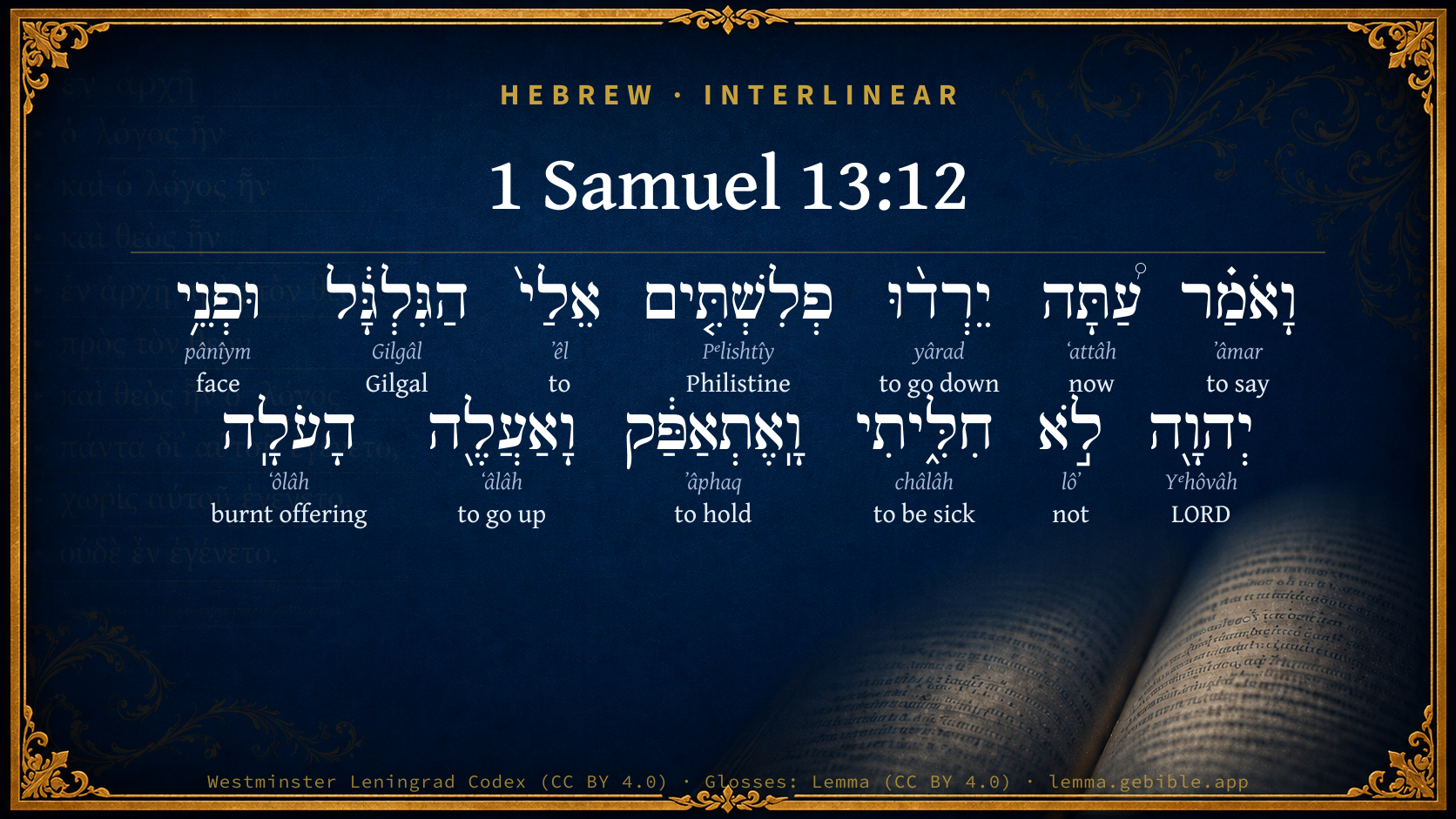
1 Samuel 13:12

Hebrew (Westminster Leningrad Codex) 1 Samuel 13:12 appears in the Hebrew Old Testament. The text above is from the Westminster Leningrad Codex. Each word links to its Strong’s number, a concise gloss, and parsing drawn from the Open Scriptures Hebrew Bible morphology. Click any word for its full Brown-Driver-Briggs (BDB) entry.
Download image
Cite this verse

1 Samuel 13:12 (World English Bible). Public Domain. Lemma interlinear Bible study tool, https://lemma.gebible.app/v/1-samuel/13/12.

Show BibTeX & RIS
BibTeX
RIS
English Translation
therefore said I, Now will the Philistines come down on me to Gilgal, and I haven't entreated the favor of Yahweh: I forced myself therefore, and offered the burnt offering.
World English Bible · Public Domain
Download a study sheet

One document with this verse’s original text, its word-by-word gloss line, the meaning frame, cross-references with their text, attributed commentary, and full source and license credits — printable, and it pastes into notes with its structure intact.

This verse Autodidact and up

Study sheet (.html) Plain text (.txt)

A passage Seminary Student

Up to 50 verses in one chapter. A passage sheet keeps up to 6 commentary sources and 12 cross-references per verse, in the order this page ranks them, and says so on the sheet whenever that leaves anything out. Ask for a single verse and you get the Autodidact verse sheet above.

Everything on this page stays free to read, with no account — the sheet is a download of what is already on screen, not access to it.

Want to remove ads? Support Godless Engineer
Compare translations 3

The same verse in 3 English versions, stacked beneath the original-language interlinear above. Click any original word for its lexicon entry.

Each is an independent rendering of the whole verse — the interlinear is not word-aligned to these translations.

Highlighted words mark where these versions differ — a whole-verse word diff, not a word-by-word alignment.

  • World English Bible Public Domain
    therefore said I, Now will the Philistines come down on me to Gilgal, and I haven't entreated the favor of Yahweh: I forced myself therefore, and offered the burnt offering.
  • King James Version Public Domain
    Therefore said I, The Philistines will come down now upon me to Gilgal, and I have not made supplication unto the LORD: I forced myself therefore, and offered a burnt offering.
  • unfoldingWord Literal Text CC BY-SA 4.0
    then I said, ‘Now the Philistines will come down against me Gilgal, but I have not entreated the face of Yahweh.’ So I forced myself, and I offered the burnt offering.”

unfoldingWord Literal Text — © unfoldingWord, licensed CC BY-SA 4.0. Word-aligned USFM3 via Door43 (git.door43.org/unfoldingWord/en_ult).

Versions to compare (up to 4)

3 of 4 selected

Show all 18 translations

Every available English version of this verse, each an independent rendering of the whole verse.

  • World English Bible Public Domain
    therefore said I, Now will the Philistines come down on me to Gilgal, and I haven't entreated the favor of Yahweh: I forced myself therefore, and offered the burnt offering.
  • Berean Standard Bible Public Domain
    I thought, ‘Now the Philistines will descend upon me at Gilgal, and I have not sought the favor of the LORD.’ So I felt compelled to offer the burnt offering.”
  • Majority Standard Bible Public Domain
    I thought, ‘Now the Philistines will descend upon me at Gilgal, and I have not sought the favor of the LORD.’ So I felt compelled to offer the burnt offering.”
  • King James Version Public Domain
    Therefore said I, The Philistines will come down now upon me to Gilgal, and I have not made supplication unto the LORD: I forced myself therefore, and offered a burnt offering.
  • American Standard Version (1901) Public Domain
    therefore said I, Now will the Philistines come down upon me to Gilgal, and I have not entreated the favor of Jehovah: I forced myself therefore, and offered the burnt-offering.
  • Revised Version (1885) Public Domain
    therefore said I, Now will the Philistines come down upon me to Gilgal, and I have not entreated the favour of the LORD: I forced myself therefore, and offered the burnt offering.
  • Geneva Bible (1599) Public Domain
    Therefore said I, The Philistims will come downe nowe vpon me to Gilgal, and I haue not made supplication vnto the Lord. I was bolde therefore and offred a burnt offring.
  • Douay-Rheims (1899) Public Domain
    I said: Now will the Philistines come down upon me to Galgal, and I have not appeased the face of the Lord. Forced by necessity, I offered the holocaust.
  • Young's Literal Translation Public Domain
    and I say, Now do the Philistines come down unto me to Gilgal, and the face of Jehovah I have not appeased; and I force myself, and cause the burnt-offering to ascend.'
  • Literal Standard Version CC BY-SA 4.0
    and I say, Now the Philistines come down to me to Gilgal, and I have not appeased the face of YHWH; and I force myself, and cause the burnt-offering to ascend.”
  • Unlocked Literal Bible CC BY-SA 4.0
    I said, 'Now the Philistines will come down against me at Gilgal, and I have not sought the favor of Yahweh.' So I forced myself to offer the burnt offering.”
  • unfoldingWord Literal Text CC BY-SA 4.0
    then I said, ‘Now the Philistines will come down against me Gilgal, but I have not entreated the face of Yahweh.’ So I forced myself, and I offered the burnt offering.”
  • Darby Bible Public Domain
    I said, The Philistines will come down now upon me to Gilgal, and I have not made supplication to Jehovah; and I forced myself, and offered up the burnt-offering.
  • World Messianic Bible Public Domain
    therefore I said, ‘Now the Philistines will come down on me to Gilgal, and I haven’t entreated the favor of the LORD.’ I forced myself therefore, and offered the burnt offering.”
  • Webster's Bible Public Domain
    Therefore said I, the Philistines will now come down upon me to Gilgal, and I have not made supplication to the LORD; I forced myself therefore, and offered a burnt-offering.
  • Free Bible Version CC BY-SA 4.0
    I said to myself, ‘The Philistines are about to attack me at Gilgal, and I haven't asked the Lord for his help.’ So I felt I had to present the burnt offering myself.”
  • Bible in Basic English Public Domain
    I said, Now the Philistines will come down on me at Gilgal, and I have made no prayer for help to the Lord: and so, forcing myself to do it, I made a burned offering.
  • JPS Tanakh (1917) Public Domain
    therefore said I: Now will the Philistines come down upon me to Gilgal, and I have not entreated the favour of the LORD; I forced myself therefore, and offered the burnt-offering.'

Literal Standard Version (2020), Covenant Press — licensed CC BY-SA 4.0. Text via the HelloAO Bible API (eBible.org). Unlocked Literal Bible (unfoldingWord) — licensed CC BY-SA 4.0. Text via the HelloAO Bible API (eBible.org). unfoldingWord Literal Text — © unfoldingWord, licensed CC BY-SA 4.0. Word-aligned USFM3 via Door43 (git.door43.org/unfoldingWord/en_ult). Free Bible Version, Dr. Jonathan Gallagher — licensed CC BY-SA 4.0. Text via the HelloAO Bible API (eBible.org).

Word by word

More ways to search: Search by grammar → Find every occurrence → Compare this word →

Practice this passage: Drill this verse → Learn its vocabulary →

וָֽאֶתְאַפַּ֔ק
ʼâphaq
H662
“and · to hold”
Conjunction + Verb, Hithpael, Sequential Imperfect, 1st Person, Common, Singular
Part of Speech
Conjunction + Verb
Stem
Hithpael
Form
Sequential Imperfect
Person
1st Person
Gender
Common
Number
Singular
Full BDB Definition

Origin: a primitive root

TWOT: 149

to hold, be strong, restrain, hold back - (Hithpael) - to restrain oneself, refrain - to force, compel oneself
  1. וָאֹמַ֗ר ʼâmar H559 “and · to say” Conjunction + Verb, Qal, Sequential Imperfect, 1st Person, Common, Singular
  2. עַ֠תָּה ʻattâh H6258 “now” Adverb
  3. יֵרְד֨וּ yârad H3381 “to go down” Verb, Qal, Imperfect, 3rd Person, Masculine, Plural
  4. פְלִשְׁתִּ֤ים Pᵉlishtîy H6430 “Philistines” Noun, Gentilic, Masculine, Plural, Absolute
  5. אֵלַי֙ ʼêl H413 “to · me” Preposition + Suffix, Personal, 1st Person, Common, Singular
  6. הַגִּלְגָּ֔ל Gilgâl H1537 “the · Gilgal” Particle, Definite Article + Noun, Proper
  7. וּפְנֵ֥י pânîym H6440 “and · face(s) of” Conjunction + Noun, Common, Both, Plural, Construct
  8. יְהוָ֖ה Yᵉhôvâh H3068 “LORD” Noun, Proper
  9. לֹ֣א lôʼ H3808 “not” Particle, Negative
  10. חִלִּ֑יתִי châlâh H2470 “to be sick” Verb, Piel, Perfect, 1st Person, Common, Singular
  11. וָאַעֲלֶ֖ה ʻâlâh H5927 “and · to go up” Conjunction + Verb, Hiphil, Sequential Imperfect, 1st Person, Common, Singular
  12. הָעֹלָֽה ʻôlâh H5930 “the · burnt offering” Particle, Definite Article + Noun, Common, Feminine, Singular, Absolute

About this verse

These counts appear in no published source. They are computed here, from the morphology-tagged text and Lemma’s own curated glosses. What Lemma adds →

13
words
13
distinct lemmas
Historical
section

Notable vocabulary

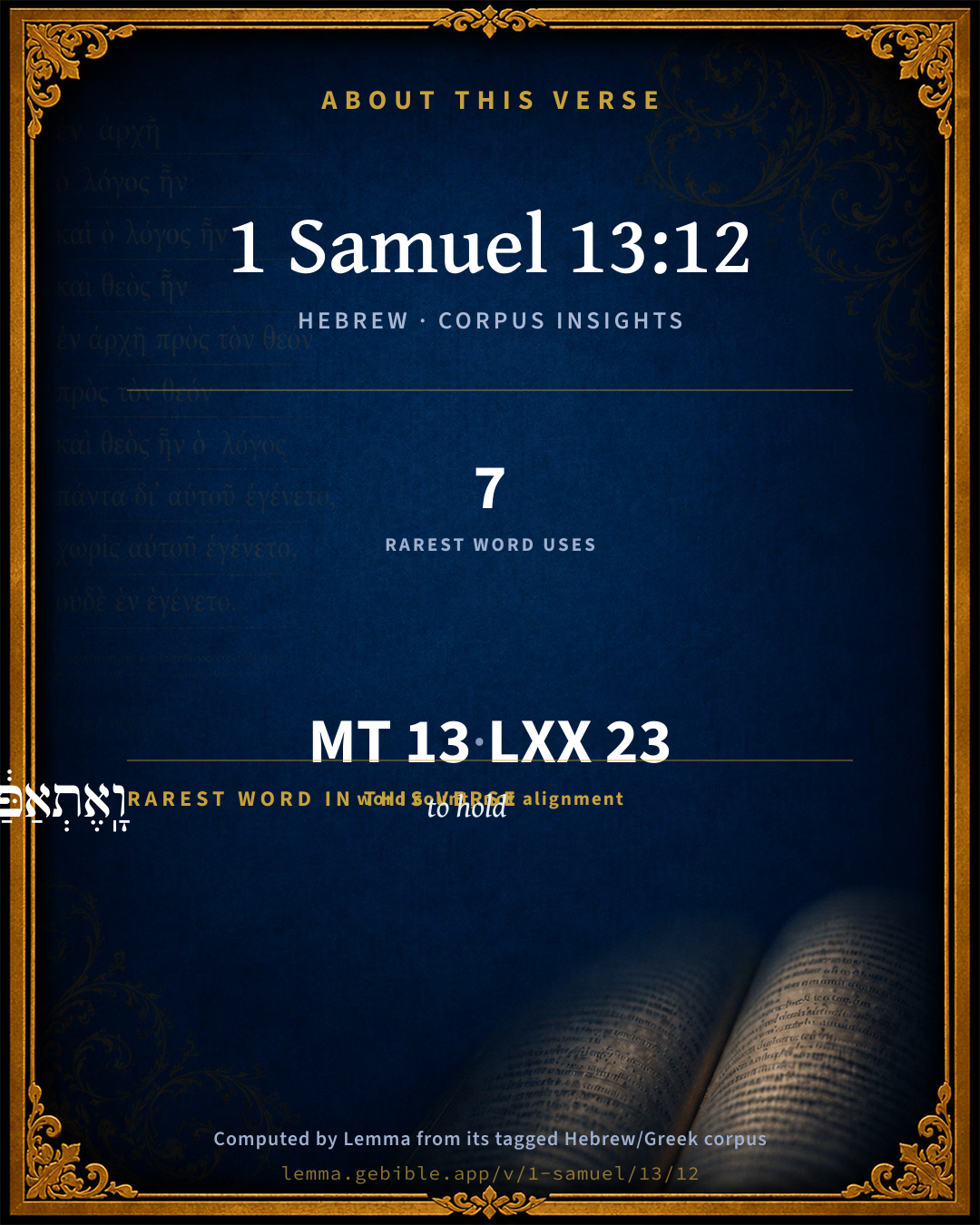
The rarest word here is וָֽאֶתְאַפַּ֔ק to hold H662 — appearing just 7 times in the whole Hebrew Bible.

Shared distinctive vocabulary

וָֽאֶתְאַפַּ֔ק to hold H662 occurs in 7 verses of the Hebrew Bible. Also found in:

Grammatical profile

  • 5 verbs
  • 5 nouns
  • 1 preposition
  • 1 adverb
  • 1 particle

Verb forms

  • וָאֹמַ֗ר Qal · Sequential Imperfect
  • יֵרְד֨וּ Qal · Imperfect
  • חִלִּ֑יתִי Piel · Perfect
  • וָֽאֶתְאַפַּ֔ק Hithpael · Sequential Imperfect
  • וָאַעֲלֶ֖ה Hiphil · Sequential Imperfect

Hebrew & Septuagint length

In English translation the verse runs 30 words from the Hebrew and 33 from the Septuagint (LXX English) — closely comparable.

A rough comparison of the two English renderings, which tokenize alike — not a word-level alignment.

Word counts can differ between the Hebrew and the Greek without any difference in meaning — e.g. the Hebrew direct-object marker אֵת has no separate Greek word, and Greek often adds the article ὁ.

In the original languages it is 13 Hebrew tokens and 23 Greek tokens — but the two are counted differently (Hebrew bundles its prefixes and suffixes into one token; the Greek is in lemma form), so that isn’t a like-for-like length.

Cross-references

5

Topical passages linked to 1 Samuel 13:12 in the Treasury of Scripture Knowledge — connected by theme and wording, ordered by reader-vote popularity; previews shown in the World English Bible.

  • 1 Kings 12:26–27 Jeroboam said in his heart, Now will the kingdom return to the house of David:
  • Psalms 66:3 Tell God, "How awesome are your deeds! Through the greatness of your power, your enemies submit themselves to you.
  • Amos 8:5 Saying, 'When will the new moon be gone, that we may sell grain? And the Sabbath, that we may market wheat, Making the ephah small, and the shekel large, And dealing falsely with balances of deceit;
  • 2 Corinthians 9:7 Let each man give according as he has determined in his heart; not grudgingly, or under compulsion; for God loves a cheerful giver.
  • 1 Samuel 21:7 Now a certain man of the servants of Saul was there that day, detained before Yahweh; and his name was Doeg the Edomite, the best of the herdsmen who belonged to Saul.

Cross-references courtesy of OpenBible.info (CC BY 4.0).

Hebrew and Greek witnesses Masoretic Hebrew ↔ Greek Septuagint

The same verse in the two great witnesses to the Old Testament, shown verse-for-verse.

These are two independent witnesses, not word-aligned to each other, and the Septuagint is shown in lemma (dictionary) form.

Hebrew 1 Samuel 13:12 Masoretic · Westminster Leningrad Codex

וָאֹמַ֗ר עַ֠תָּה יֵרְד֨וּ פְלִשְׁתִּ֤ים אֵלַי֙ הַגִּלְגָּ֔ל וּפְנֵ֥י יְהוָ֖ה לֹ֣א חִלִּ֑יתִי וָֽאֶתְאַפַּ֔ק וָאַעֲלֶ֖ה הָעֹלָֽה

therefore said I, Now will the Philistines come down on me to Gilgal, and I haven't entreated the favor of Yahweh: I forced myself therefore, and offered the burnt offering.

World English Bible · Public Domain

Greek LXX 1 Samuel 13:12 Septuagint · lemma form

καί εἶπον νῦν καταβαίνω ὁ ἀλλόφυλος πρός ἐγώ εἰς γάλγαλα καί ὁ πρόσωπον ὁ κύριος οὐ δέω καί ἐνκρατεύζω καί ἀναφέρω ὁ ὁλοκαύτωσις

Then I said, Now will the Philistines come down to me to Galgala, and I have not sought the face of the Lord: so I forced myself and offered the whole burnt offering.

LXX2012 (modern English Septuagint) · Public Domain

Hebrew: Westminster Leningrad Codex (CC BY 4.0). Greek: Septuagint (public domain); English from LXX2012 (modern English Septuagint) (Public Domain). How the Septuagint differs from the Hebrew →

Targum (Aramaic paraphrase)

1

The Targum is the ancient Jewish Aramaic paraphrase of the Hebrew Scriptures — an interpretive translation, not the Hebrew text itself. Onkelos (literal) and Pseudo-Jonathan (expansive) render the Torah, and Jonathan the Prophets. Coverage is partial: where no permissively-licensed English translation exists for a verse, only the Aramaic is shown. This is verse-level text, not a word-by-word alignment to the Hebrew.

  1. Targum Jonathan Prophets (Joshua–Malachi)
    וַאֲמָרִית כְּעַן יֶחֱתוּן פְלִשְׁתָּאֵי לְוָתִי לְגִלְגָלָא וּקְדָם יְיָ לָא צַלֵיתִי וְאִתְחַסְנֵית וְאַסְקֵית עֲלָתָא:

    (no public-domain English translation for this verse)

    Targum Jonathan — Aramaic: “Mikraot Gedolot” (public domain). English: “Sefaria Community Translation” (CC0 1.0 (public-domain dedication)); “London "Chaldee Paraphrase," 1871” (public domain). Text via Sefaria.

Commentary

Notes on 1 Samuel 13:12 from classic Christian and Jewish commentators (each source and its license shown beneath its notes). The classic Christian expositions comment on the surrounding passage and are grouped to its opening verse, so a note may address several verses; the Jewish commentaries on the Tanakh (Rashi and others) are per-verse, so they appear only where the commentator wrote on this verse.

Lemma curates 59 commentaries, every one of them public domain or Creative Commons licensed, each selected and text-cleaned for this edition rather than reprinted as found. About our sources →

Trapp's Complete Commentary

John Trapp

1Sa 13:12 Therefore said I, The Philistines will come down now upon me to Gilgal, and I have not made supplication unto the LORD: I forced myself therefore, and offered a burnt offering.

Ver. 12. And I have not made supplication unto the Lord.] Saul dared not enter the battle without this armour: but the sacrifice of the wicked is abomination to the Lord, {Pro 15:8} how much more when it is brought with an evil heart! {Pro 21:27} But the devil had taught the Athenians also when they began the battle to cry out Io Paean, which is the same in force as Jehovahpeneh, that is, Lord look upon us. And it is storied of Pausanias, king of Sparta, that when he fought against the Persians at Platea, he would not suffer a blow to be given till he had sacrificed, and had an auspicious answer. {a}

I forced myself therefore.] Or, I restrained or contained myself: sc., till I could no longer forbear. Here was a plausible pretence: hypocrisy needeth not to be taught to tell her own tale: but God is not mocked. Deus est sapiens nummularius, saith a father. {b}

{a} Macrob.

{b} Nummum fictum non recipiet. - Bern.

John Trapp, A Commentary or Exposition upon All the Books of the Old and New Testament (1647–1656) — public domain. Text from a community e-Sword module.

The Biblical Illustrator

Joseph S. Exell

1Sa_13:12

I forced myself therefore, and offered a burnt offering.

The right and the wrong of Sauls conduct

I forced myself therefore; could not help it; my poverty but not my will consents. This not tenable in Christian morality. (Rom_12:1-21 fin.; 1Co_10:13.) The prophet was mouthpiece of Divine law: the king its administrator and executor. Prophet superior to king in respect of religious observances. Sauls difficulty continually recurs, plain commands of God not to be slighted or disobeyed for less plain ones. In this incident we find something right in Saul, and something wrong.

I. Where Saul was right. He was in great distress, and felt need of Divine aid. (Psa_60:11.) He was for seeking it in ordinances appointed. Christs sacrifice on cross our great peace offering, to be presented in faithful, intelligent prayer. (St. Joh_14:6 fin.) Do not stay at a mere dull, diffused sense of wanting pardon. So, if need enlightenment, seek it in Holy Scripture (St. Joh_5:39); if spiritual refreshment, at Holy Communion. Ordinances have their proper value, rightly used. Thus Saul was right.

II. Where Saul was wrong. Elements of his fault: Want of faith; contrast Gideon (Isa_28:16); superstition as to sacrifice. Nowadays, many value ordinance of religion quite independently of state of heart in the person using it. Saul relied on the form only. Sacrifice must be offered! No! It is not the objective but the subjective that is of highest importance; the formal is useless without the spiritual. Heart first. (Isa_1:10-20; Jam_4:3; St. Joh_4:24; Psa_51:9-10.) Saul misapprehended the object and effect of religious ordinances. It is not the thing done, but the obedient spirit of the doer which obtains. (Psa_50:18.) No mechanical influence upon God by prayer, etc. Ordinances are not charms, but channels of grace when rightly used. Therefore Saul disobeyed. Sin never necessary. Contrary notion arises from cowardice, or from superstition, or from some other want of intelligence Since Sauls fault was superstitious distrustfulness, seek from Holy Spirit an intelligent reliance on the general promises of God, and an intelligent obedience to the plain commands. (Cornelius Witherby, M. A.)

The Biblical Illustrator, edited by Joseph S. Exell (c. 1880s–1900s) — public domain. Text from a community e-Sword module.

Tyndale Open Study Notes

Tyndale Open Resources

13:12 asked for the Lord’s help: The purpose of the burnt offering was to entreat God to grant victory in battle. Samuel himself had offered a similar sacrifice, which did lead to victory in battle (see 7:7-11). But Samuel, unlike Saul, served in a priestly role.

Tyndale Open Study Notes — © Tyndale Open Resources, licensed CC BY-SA 4.0. Text via the HelloAO Bible API.

Adam Clarke's Commentary

Verse 12. I forced myself] It was with great reluctance that I did what I did. In all this Saul was sincere, but ha was rash, and regardless of the precept of the Lord, which precept or command he most evidently had received, 1Sa 13:13. And one part of this precept was, that the Lord should tell him what he should do. Without this information, in an affair under the immediate cognizance of God, he should have taken no step.

Adam Clarke's Commentary on the Bible (1810–1826) — public domain. Text from a community e-Sword/MySword module.

John Gill's Exposition

Therefore said I..... That is, within himself:

the Philistines will come down now upon me to Gilgal; on a sudden, unprepared for them, especially in a religious way:

and I have not made supplication to the Lord; for his direction and assistance, and for success in the war; which it seems went along with sacrifices, or was implied in them:

I forced myself therefore, and offered a burnt offering; it was reluctant to him, it was against his will as well as the command of Samuel, to offer before he came, he suggests; but such were the circumstances he was in, that he was obliged to it; these are the reasons or excuses he made, and some of them have a specious appearance in them.

John Gill's Exposition of the Whole Bible (1746–1763) — public domain (CC PDM 1.0). Text via the HelloAO Bible API.

Haydock's Catholic Bible Commentary

Lord, by sacrifices. --- Holocaust. Hebrew, "I forced myself therefore," &c. It is asked whether Saul offered sacrifice, or caused it to be offered by the priests. The text seems to assert that he did it himself. Samuel and David did the like; and we read that Solomon ascended to the brazen altar, at Gabaon, for the same purpose, 2 Paralipomenon i. 5. If it was lawful to erect altars out of the tabernacle, notwithstanding the divine prohibition, why might not individuals also offer sacrifice on certain solemn occasions? The Hebrew kings seem to have exercised some of the sacerdotal functions, particularly before the building of the temple; for afterwards we find one of their kings severely punished for presuming to offer incense, 4 Kings xv. 5. (Calmet) --- Yet the proofs that they ever lawfully offered sacrifice, are not very satisfactory, as, in the Scripture language, a person is often said to do what he enjoins another to perform on his account; and if some prophets have acted in the character of priests, by divine dispensation, we need not extend the privilege to all who have dared to assume the like prerogative. The law is clear. It is the duty of all who do not regulate their conduct by it, to know that they have God’s approbation. Their expressing no scruple on the occasion, proves nothing, no more than the sacred writer’s omitting to stigmatize their proceedings. But here, if Saul really offered the holocaust, the words of Samuel, Thou hast done foolishly, convey a sufficient reproach: but if he did not, we must suppose that he blames the neglect of waiting the full term of days. (Haydock)

George Leo Haydock (1774–1849), Haydock's Catholic Family Bible and Commentary, 1859 edition — public domain. Excludes Psalms (Douay-Rheims chapter numbering differs from Protestant) and Deuterocanonical books (Catholic canon only).

Matthew Poole's English Annotations

I have not made supplication to the Lord; hence it appears that sacrifices were accompanied with solemn prayers.

I forced myself; I did it against my own mind and inclination. My conscience told me I should forbear it, and punctually obey God’s command delivered to me by Samuel, but my necessity urged me to make haste.

Matthew Poole's English Annotations on the Holy Bible (1683–1685) — public domain. Text from a community e-Sword/MySword module.

Whedon's Commentary on the Bible

Daniel D. Whedon

12. I forced myself — I did violence to my conscience, and with great reluctance did this act. But all his apology is very feeble in the face of a broken commandment, and of the most plain and solemn counsels of his great spiritual father.

Daniel D. Whedon (gen. ed.), Commentary on the Old and New Testaments (1874–1909) — public domain. Text from a community e-Sword module.

The Pulpit Commentary

I have not made supplication unto Jehovah. Literally, "I have not stroked the face of Jehovah," but used of making him propitious by prayer. (Exo_32:11; Jer_26:19) I forced myself. Saul pleads in his justification the imminence of the danger, and perhaps there are few who have faith enough to "stand still and see the salvation of Jehovah". (Exo_14:13)

The Pulpit Commentary (1880–1919), ed. H.D.M. Spence-Jones & Joseph S. Exell — public domain. Text from a community e-Sword module.

John Wesley's Explanatory Notes

Supplication - Thence it appears, that sacrifices were accompanied with solemn prayers. Forced myself - I did it against my own mind and inclination.

John Wesley, Explanatory Notes Upon the Whole Bible (1754–1765) — public domain. Text via the GEBible commentary corpus.

Rashi

Rabbi Shlomo Yitzchaki (Rashi)

So I forced myself. I overcame my will, for my heart told me to wait for you, and against my will I suppressed my heart, and offered the burnt-offering.

Rashi on the Tanakh — English translations: “The Judaica Press complete Tanach with Rashi, translated by A. J. Rosenberg” (CC BY 4.0); “Pentateuch with Rashi's commentary by M. Rosenbaum and A.M. Silbermann, 1929-1934” (public domain); “The Metsudah Tanach series, Lakewood, N.J” (CC BY 4.0); and “The Book of Joshua, Metsudah Publications, 1997” (CC BY 4.0). Text via Sefaria.

Lesson kit

Teaching starters — assembled from the data on this page, not authored interpretation. Every prompt links to the verse data it draws on. Edit before teaching.

1 Samuel, in the Historical, opens this verse with 13 words (13 distinct Hebrew lemmas). Its most distinctive word is ʼâphaq (“to hold”). A historical commentator’s framing appears above. Read the whole chapter for the surrounding context.

Discussion questions

  1. What does “to hold” (ʼâphaq) contribute to the verse as a whole?
  2. How does Genesis 43:31, which shares the word «to hold», read alongside this verse?
  3. These translations render this verse differently; the difference is in the English rendering, not the original. What questions does that raise?
  4. «וָאֹמַ֗ר» is a Qal Sequential Imperfect verb. How does that grammatical form shape the action described?
  5. Compare how Trapp's Complete Commentary and The Biblical Illustrator read this verse. Where do they agree or differ?

Things to notice

Reading settings

Reading text

Shown beneath each verse's original-language words.

Old Testament
Old Testament edition

Read the OT as the Masoretic Hebrew (MT) or the Greek Septuagint (LXX).

English shown for the Greek Septuagint (in the Hebrew ↔ Greek comparison).

Comparing translations? Open the Compare panel on any verse page to stack up to four side by side.